TBSE Class 12 Syllabus 2024 Physics
Finished viewing? Save it for later —
Download TBSE Class 12 Syllabus 2024 Physics (PDF · 8 pages)About TBSE Class 12 Syllabus 2024 Physics
TBSE Class 12 Syllabus 2024 Physics is available here for free download. Published by Tripura Board for Class 12, this syllabus can be viewed online or downloaded as a PDF (8 pages). Candidates preparing for Class 12 can use TBSE Class 12 Syllabus 2024 Physics to understand the exam pattern, the type of questions asked, and the overall difficulty level.
Frequently Asked Questions
How can I download TBSE Class 12 Syllabus 2024 Physics?
Open this page and click the Download button to save TBSE Class 12 Syllabus 2024 Physics as a PDF. It is completely free on AglaSem Docs.
Is TBSE Class 12 Syllabus 2024 Physics free to download?
Yes. TBSE Class 12 Syllabus 2024 Physics can be viewed online and downloaded as a PDF free of cost on AglaSem Docs.
How many pages does TBSE Class 12 Syllabus 2024 Physics have?
TBSE Class 12 Syllabus 2024 Physics contains 8 pages, which you can read online or download together as a single PDF.
Where can I find more Class 12 study material?
You can find more Class 12 question papers, sample papers, syllabus, and answer keys on AglaSem Docs.
TBSE Class 12 Syllabus 2024 Physics – Text
Read the full text of this syllabus below — useful to quickly search, copy and reference the content online without downloading the PDF.
📄 View text version (8 pages)
Page 1
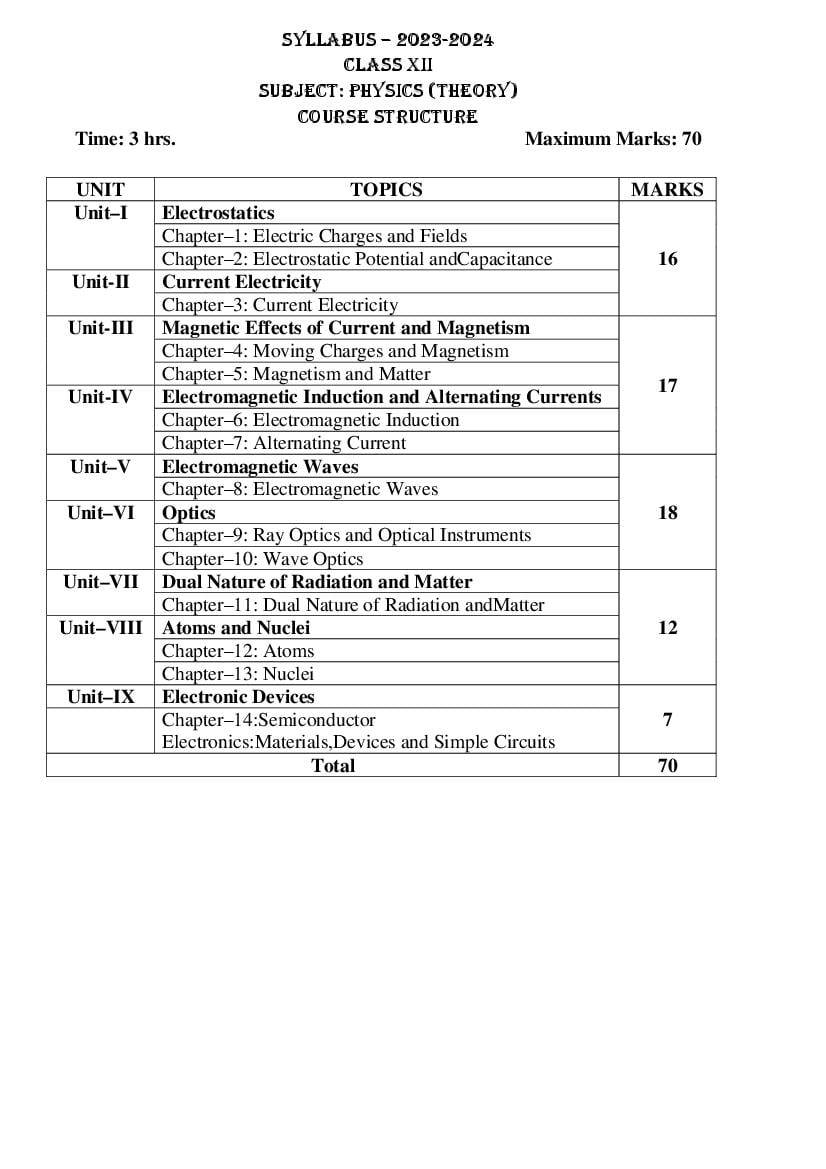
CLASS XII
SUBJECT: PHYSICS (THEORY)
COURSE STRUCTURE
Time: 3 hrs. Maximum Marks: 70
UNIT TOPICS MARKS
Unit–I Electrostatics
Chapter–1: Electric Charges and Fields
Chapter–2: Electrostatic Potential andCapacitance 16
Unit-II Current Electricity
Chapter–3: Current Electricity
Unit-III Magnetic Effects of Current and Magnetism
Chapter–4: Moving Charges and Magnetism
Chapter–5: Magnetism and Matter
17
Unit-IV Electromagnetic Induction and Alternating Currents
Chapter–6: Electromagnetic Induction
Chapter–7: Alternating Current
Unit–V Electromagnetic Waves
Chapter–8: Electromagnetic Waves
Unit–VI Optics 18
Chapter–9: Ray Optics and Optical Instruments
Chapter–10: Wave Optics
Unit–VII Dual Nature of Radiation and Matter
Chapter–11: Dual Nature of Radiation andMatter
Unit–VIII Atoms and Nuclei 12
Chapter–12: Atoms
Chapter–13: Nuclei
Unit–IX Electronic Devices
Chapter–14:Semiconductor 7
Electronics:Materials,Devices and Simple Circuits
Total 70
Page 2
Chapter–1: Electric Charges and Fields
Electric Charges, Conservation of charge, Coulomb's law-force between
twopoint-charges, forces between multiple charges; superposition principle
andcontinuous charge distribution.
Electric field, electric field due to a point charge, electric field lines,
electricdipole,electric field due to a dipole, torque on a dipole in uniform electric field.
Electric flux, statement of Gauss's theorem and its applications to find fielddue
to infinitely long straight wire, uniformly charged infinite plane sheet anduniformly
charged thin spherical shell (field inside and outside).
Chapter–2: Electrostatic Potential and Capacitance
Electric potential, potential difference, electric potential due to a point charge,a
dipole and system of charges; equipotential surfaces, electrical potentialenergy of a
system of two-point charges and of electric dipole in anelectrostatic field.
Conductors and insulators, free charges and bound charges inside aconductor.
Dielectrics and electric polarisation, capacitors and capacitance,combination of
capacitors in series and in parallel, capacitance of a parallelplate capacitor with and
without dielectric medium between the plates, energystored in a capacitor (no
derivation, formulae only).
Unit II: Current Electricity
Chapter–3: Current Electricity
Electric current, flow of electric charges in a metallic conductor, drift
velocity,mobility and their relation with electric current; Ohm's law,
electricalresistance, V-I characteristics (linear and non-linear), electrical energy
andpower, electrical resistivity and conductivity, temperaturedependence of resistance.
Internal resistance of a cell, potential difference and emf of a cell,
combinationof cells in series and in parallel, Kirchhoff's rules,Wheatstone bridge.
Unit III: Magnetic Effects of Current and Magnetism
Chapter–4: Moving Charges and Magnetism
Concept of magnetic field, Oersted's experiment.
Biot - Savart law and its application to current carrying circular loop.
Ampere's law and its applications to infinitely long straight wire. Straight
solenoids, force on a moving charge inuniform magnetic and electric fields.
Force on a current-carrying conductor in a uniform magnetic field,
forcebetween two parallel current-carrying conductors-definition of ampere,
torqueexperienced by a current loop in uniform magnetic field; Current loop as a
magnetic dipole and its magnetic dipole moment, moving coilgalvanometer-its current
sensitivity and conversion to ammeter and voltmeter.
Chapter–5: Magnetism and Matter
Bar magnet, bar magnet as an equivalent solenoid (qualitative treatment only)
magnetic field intensity due to amagnetic dipole (bar magnet) along its axis and
perpendicular to its axis (qualitative treatment only),torque on a magnetic dipole (bar
magnet) in a uniform magnetic field (qualitative treatment only), magnetic field lines.
Page 3
examples,Magnetisation of materials, effect of temperature on magnetic properties.
Unit IV: Electromagnetic Induction and Alternating Currents
Chapter–6: Electromagnetic Induction
Electromagnetic induction; Faraday's laws, induced EMF and current;
Lenz'sLaw, Self and mutual induction.
Chapter–7: Alternating Current
Alternating currents, peak and RMS value of alternating
current/voltage;reactance and impedance; LCRseries circuit (phasors only), resonance,
power in AC circuits, power factor, wattless current.
AC generator and transformer.
Unit V: Electromagnetic waves
Chapter–8: Electromagnetic Waves
Basic idea of displacement current, Electromagnetic waves, theircharacteristics,
their transverse nature (qualitative ideas only).
Electromagnetic spectrum (radio waves, microwaves, infrared,
visible,ultraviolet, X-rays, gamma rays) including elementary facts about their uses.
Unit VI: Optics
Chapter–9: Ray Optics and Optical Instruments
Ray Optics: Reflection of light, spherical mirrors, mirror formula, refraction
oflight, total internal reflection and optical fibers, refraction atspherical surfaces,
lenses, thin lens formula, lensmaker's formula,magnification, power of a lens,
combination of thin lenses in contact,refraction of light through a prism.
Optical instruments: Microscopes and astronomical telescopes (reflecting
andrefracting) and their magnifying powers.
Chapter–10: Wave Optics
Wave optics: Wave front and Huygens’s principle, reflection and refraction
ofplane wave at a plane surface using wave fronts. Proof of laws of reflectionand
refraction using Huygens’s principle. Interference, Young's double slitexperiment and
expression for fringe width (No derivation, final expression only), coherent sources
and sustainedinterference of light, diffraction due to a single slit, width of central
maximum (qualitative treatment only). Polarisation, Plane polarized light, Brewster’s
law.
Unit VII: Dual Nature of Radiation and Matter
Chapter–11: Dual Nature of Radiation and Matter
Dual nature of radiation, Photoelectric effect, Hertz and Lenard's
observations;Einstein's photoelectric equation-particle nature of light.
Experimental study of photoelectric effect.
Matter waves-wave nature of particles, de-Broglie relation.
Unit VIII: Atoms and Nuclei
Chapter–12: Atoms
Page 4
of hydrogen atom, Expression for radius of nth possible orbit, velocity and energy of
electron in this orbit, hydrogen line spectra (qualitative treatment only).
Chapter–13: Nuclei
Composition and size of nucleus, nuclear force.
Mass-energy relation, mass defect; binding energy per nucleon and itsvariation
with mass number; nuclear fission, nuclear fusion.
Unit IX: Electronic Devices
Chapter–14: Semiconductor Electronics: Materials, Devices and Simple
Circuits
Energy bands in conductors, semiconductors and insulators (qualitative
ideasonly).
Intrinsic and extrinsic semiconductors- p- and n-type, p-n junction.
Semiconductor diode - I-V characteristics in forward and reverse bias,
application of junction diode as a rectifier.
SYLLABUS FOR HALF-YEARLY EXAM
PHYSICS (THEORY)
Time: 3 hrs. Maximum Marks: 70
UNIT TOPICS MARKS
Unit–I Electrostatics
Chapter–1: Electric Charges and Fields
Chapter–2: Electrostatic Potential andCapacitance 32
Unit-II Current Electricity
Chapter–3: Current Electricity
Unit-III Magnetic Effects of Current and Magnetism
Chapter–4: Moving Charges and Magnetism
Chapter–5: Magnetism and Matter
32
Unit-IV Electromagnetic Induction and Alternating Currents
Chapter–6: Electromagnetic Induction
Chapter–7: Alternating Current
Unit–V Electromagnetic Waves
06
Chapter–8: Electromagnetic Waves
Total 70
Page 5
Subject: Physics
Course Structure
Blue print of Marks Distribution
Name of Name of VSA SA LA-01 LA-02 Total
Units Chapters Marks
1 Marks 2 Marks 3 Marks 5 Marks
Chapter-1
Electric
Charges and
1 Fields
1X4=4 2X3=6 3X2=6 - 16
Electrostatics Chapter-2
Electrostatics
Potential and
Capacitance
2 Chapter-3
Current Current 1X4=4 2X2=4 3X1=3 5X1=5 16
Electricity Electricity
Chapter-4
3 Moving
Magnetic Charges and
Effect of Magnetism 1X3=3 2X1=2 3X2=6 5X1=5 16
Current And Chapter-5
Magnetism Magnetism
And Matter
4 Chapter-6
Electro- Electro-
Magnetics Magnetic
Induction Induction 1X5=5 - 3X2=6 5X1=5 16
and Chapter-7
Alternating Alternating
Current Current
5 Chapter-8
Electro Electro
1X4=4 2X1=2 - - 6
Magnetic Magnetic
Waves Waves
Total Marks 1X20=20 2X7=14 3X7=21 5X3=15 70
Page 6
Subject: Physics
Pre-Board and Board Final 2023-2024
BLUE-PRINT OF QUESTION PAPER
Unit Chapter VSA SA LA-I LA-II Total
(1 Mark) (2 Marks) (3 Marks) (5 Marks)
MCQ Objective
type
Electrostatics
Ch-1: Electric Charges
Unit-I and Fields 1(1x1=1)
1(5x1=5)
Ch-2: Electrostatic - 1(2x1=2) -
Potential and 1(1x1=1) 16
Capacitance
Current Electricity
Unit-II
Ch-3: Current Electricity 1(1x1=1)
1(1x1=1) 1(2x1=2) 1(3x1=3)
_
Magnetic Effects of
Current And
Magnetism
Unit-III Ch-4: Moving Charges
and Magnetism - 1(1x1=1) -
Ch-5: Magnetism and
Matter 1(1x1=1) 1(2x1=2) 1(3x1=3)
17
Electromagnetic
1(5x1=5)
Induction and
Alternating Currents
Unit-IV Ch-6: Electromagnetic
induction - 1(1x1=1) -
Ch-7: Alternating
Currents 1(1x1=1) - - 1(3x1=3)
Electromagnetic
Waves
Unit-V
Electromagnetic Waves - - - 1(3x1=3) -
Optics 18
Ch-9: Ray Optics and 1(5x1=5)
Unit-VI Optical Instruments 1(1x1=1) 2(1x2=2) 1(2x1=2) -
Ch-10: Wave Optics 1(1x1=1) 1(1x1=1) 1(3x1=3)
Page 7
Radiationand Matter
Unit-
VII Ch-11: Dual nature of 12
Radiation and Matter 1(1x1=1) 1(1x1=1) - -
1(2x1=2)
Atoms and Nuclei
Unit- Ch-12: Atoms 1(1x1=1)
1(1x1=1) -
VIII 1(3x1=3)
Ch-13: Nuclei - 1(1x1=1) 1(2x1=2) -
Electronic Devices
Ch-14: Semiconductor 7
Unit-IX Electronics: Materials,
Devices and Simple 1(1x1=1) 1(1x1=1) 1(2x1=2) 1(3x1=3) -
Circuits.
Note:- The above template is only a sample. Suitable internal variation may be made for generating
similar templates keeping the overall weightage to different form of questions and typology of
question same.
PRACTICALS
The record, to be submitted by the students, at the time of their annual
examination, has to include:
• Record of at least 6 Experiments [with 3 from each section], to be performed
by the students.
EVALUATION SCHEME
Time 3 hours Maximum Marks: 30
Topic Marks
Two experiments one from each section 10+10
Practical record (experiment and activities) 3
Attendance 5
Viva on experiments 2
TOTAL 30
SECTION–A
Experiments
1. To determine resistivity of a given wire by plotting a graph for potential
difference versus current.
2. To find resistance of a given wire / standard resistor using Meter Bridge.
3. To verify the laws of combination (series) of resistances using a Meter Bridge.
OR
To verify the laws of combination (parallel) of resistances using a Meter Bridge.
4. To determine resistance of a galvanometer by half-deflection method and to find
its figure of merit.
5. To convert the given galvanometer (of known resistance and figure of merit)
into a voltmeter of desired range and to verify the same.
OR
Page 8
into an ammeter of desired range and to verify the same.
6. To find the frequency of AC mains with a sonometer.
SECTION-B
Experiments
1. To find the value of v for different values of u in case of a concave mirror and to
find the focal length.
2. To find the focal length of a convex mirror, using a convex lens.
3. To find the focal length of a convex lens by plotting graphs between u and v or
between and .
4. To determine angle of minimum deviation for a given prism by plotting a graph
between angle of incidence and angle of deviation.
5. To determine refractive index of a glass slab using a travelling microscope.
6. To find the refractive index of a liquid using convex lens and plane mirror.
7. To draw the I-V characteristic curve for a p-n junction diode in forward and
reverse bias.
[[
Prescribed Books:
1. Physics, Class XI, Part -I and II, Published by NCERT/SCERT.
2. Physics, Class XII, Part -I and II, Published by NCERT/SCERT.
3. Laboratory Manual of Physics for class XII Published by NCERT.
4. The list of other related books and manuals brought out by NCERT (consider
multimedia also).
Note: The content indicated in NCERT textbooks as excluded for the year
2023-2024 is not to be tested by schools and will not be assessed in the Board
examinations 2023-2024.