NCERT Book Class 9 Science Chapter 3 Atoms and molecules
Finished viewing? Save it for later —
Download NCERT Book Class 9 Science Chapter 3 Atoms and molecules (PDF · 15 pages)About NCERT Book Class 9 Science Chapter 3 Atoms and molecules
NCERT Book Class 9 Science Chapter 3 Atoms and molecules is available here for free download. Published by NCERT for Class 9, this books can be viewed online or downloaded as a PDF (15 pages). Candidates preparing for Class 9 can use NCERT Book Class 9 Science Chapter 3 Atoms and molecules to understand the exam pattern, the type of questions asked, and the overall difficulty level.
Frequently Asked Questions
How can I download NCERT Book Class 9 Science Chapter 3 Atoms and molecules?
Open this page and click the Download button to save NCERT Book Class 9 Science Chapter 3 Atoms and molecules as a PDF. It is completely free on AglaSem Docs.
Is NCERT Book Class 9 Science Chapter 3 Atoms and molecules free to download?
Yes. NCERT Book Class 9 Science Chapter 3 Atoms and molecules can be viewed online and downloaded as a PDF free of cost on AglaSem Docs.
How many pages does NCERT Book Class 9 Science Chapter 3 Atoms and molecules have?
NCERT Book Class 9 Science Chapter 3 Atoms and molecules contains 15 pages, which you can read online or download together as a single PDF.
Where can I find more Class 9 study material?
You can find more Class 9 question papers, sample papers, syllabus, and answer keys on AglaSem Docs.
NCERT Book Class 9 Science Chapter 3 Atoms and molecules – Text
Read the full text of this books below — useful to quickly search, copy and reference the content online without downloading the PDF.
📄 View text version (1 page)
Page 1
ATOMS AND MOLECULES
Ancient Indian and Greek philosophers have much experimentations by Lavoisier and
always wondered about the unknown and Joseph L. Proust.
unseen form of matter. The idea of divisibility
of matter was considered long back in India, 3.1.1 LAW OF CONSERVATION OF MASS
around 500 BC. An Indian philosopher
Maharishi Kanad, postulated that if we go on Is there a change in mass when a chemical
dividing matter (padarth), we shall get smaller change (chemical reaction) takes place?
and smaller particles. Ultimately, a stage will
come when we shall come across the smallest Activity ______________ 3.1
particles beyond which further division will • Take one of the following sets, X and Y
not be possible. He named these particles of chemicals—
Parmanu. Another Indian philosopher, X Y
Pakudha Katyayama, elaborated this doctrine (i) copper sulphate sodium carbonate
and said that these particles normally exist
in a combined form which gives us various (ii) barium chloride sodium sulphate
forms of matter.
Around the same era, ancient Greek (iii) lead nitrate sodium chloride
philosophers – Democritus and Leucippus
• Prepare separately a 5% solution of
suggested that if we go on dividing matter, a
any one pair of substances listed
stage will come when particles obtained
under X and Y each in 10 mL in water.
cannot be divided further. Democritus called
• Take a little amount of solution of Y in
these indivisible particles atoms (meaning a conical flask and some solution of
indivisible). All this was based on X in an ignition tube.
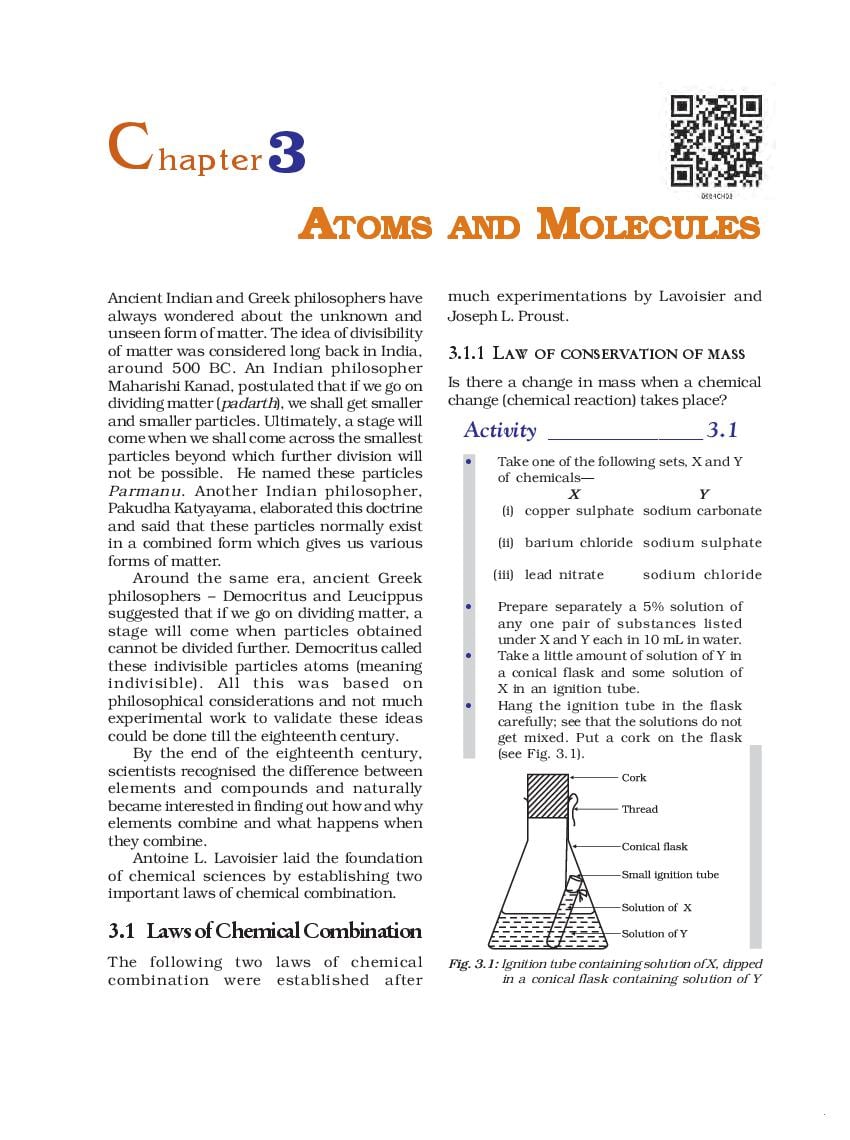
philosophical considerations and not much • Hang the ignition tube in the flask
experimental work to validate these ideas carefully; see that the solutions do not
could be done till the eighteenth century. get mixed. Put a cork on the flask
By the end of the eighteenth century, (see Fig. 3.1).
scientists recognised the difference between
elements and compounds and naturally
became interested in finding out how and why
elements combine and what happens when
they combine.
Antoine L. Lavoisier laid the foundation
of chemical sciences by establishing two
important laws of chemical combination.
3.1 Laws of Chemical Combination
The following two laws of chemical Fig. 3.1: Ignition tube containing solution of X, dipped
combination were established after in a conical flask containing solution of Y
Showing the first page only. Download the PDF above for the complete document.
Document Details
| Board / Org | NCERT |
| Exam | Class 9 |
| Type | Books |
| Pages | 15 |
| Updated | 22 Jul 2026 |