NCERT Book Class 9 Science Chapter 9 Gravitation
Finished viewing? Save it for later —
Download NCERT Book Class 9 Science Chapter 9 Gravitation (PDF · 17 pages)About NCERT Book Class 9 Science Chapter 9 Gravitation
NCERT Book Class 9 Science Chapter 9 Gravitation is available here for free download. Published by NCERT for Class 9, this books can be viewed online or downloaded as a PDF (17 pages). Candidates preparing for Class 9 can use NCERT Book Class 9 Science Chapter 9 Gravitation to understand the exam pattern, the type of questions asked, and the overall difficulty level.
Frequently Asked Questions
How can I download NCERT Book Class 9 Science Chapter 9 Gravitation?
Open this page and click the Download button to save NCERT Book Class 9 Science Chapter 9 Gravitation as a PDF. It is completely free on AglaSem Docs.
Is NCERT Book Class 9 Science Chapter 9 Gravitation free to download?
Yes. NCERT Book Class 9 Science Chapter 9 Gravitation can be viewed online and downloaded as a PDF free of cost on AglaSem Docs.
How many pages does NCERT Book Class 9 Science Chapter 9 Gravitation have?
NCERT Book Class 9 Science Chapter 9 Gravitation contains 17 pages, which you can read online or download together as a single PDF.
Where can I find more Class 9 study material?
You can find more Class 9 question papers, sample papers, syllabus, and answer keys on AglaSem Docs.
NCERT Book Class 9 Science Chapter 9 Gravitation – Text
Read the full text of this books below — useful to quickly search, copy and reference the content online without downloading the PDF.
📄 View text version (1 page)
Page 1
GRAVITATION
Let us try to understand the motion of the
We have learnt about the motion of objects and moon by recalling activity 7.11.
force as the cause of motion. We have learnt
that a force is needed to change the speed or Activity ______________ 9.1
the direction of motion of an object. We always
observe that an object dropped from a height • Take a piece of thread.
• Tie a small stone at one end. Hold the
falls towards the earth. We know that all the
other end of the thread and whirl it
planets go around the Sun. The moon goes round, as shown in Fig. 9.1.
around the earth. In all these cases, there must • Note the motion of the stone.
be some force acting on the objects, the planets • Release the thread.
and on the moon. Isaac Newton could grasp • Again, note the direction of motion of
that the same force is responsible for all these. the stone.
This force is called the gravitational force.
In this chapter we shall learn about
gravitation and the universal law of
gravitation. We shall discuss the motion of
objects under the influence of gravitational
force on the earth. We shall study how the
weight of a body varies from place to place.
We shall also discuss the conditions for
objects to float in liquids.
9.1 Gravitation
We know that the moon goes around the earth.
An object when thrown upwards, reaches a
certain height and then falls downwards. It is
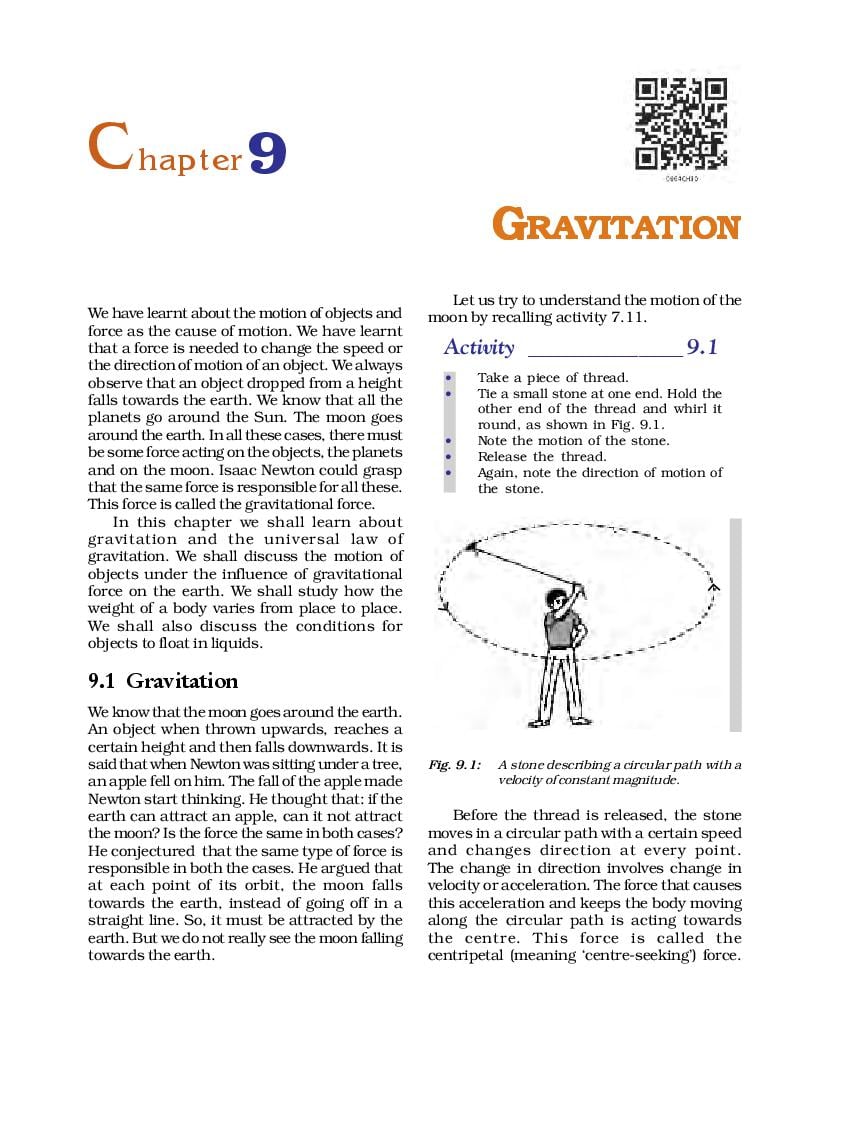
said that when Newton was sitting under a tree, Fig. 9.1: A stone describing a circular path with a
an apple fell on him. The fall of the apple made velocity of constant magnitude.
Newton start thinking. He thought that: if the
earth can attract an apple, can it not attract Before the thread is released, the stone
the moon? Is the force the same in both cases? moves in a circular path with a certain speed
He conjectured that the same type of force is and changes direction at every point.
responsible in both the cases. He argued that The change in direction involves change in
at each point of its orbit, the moon falls velocity or acceleration. The force that causes
towards the earth, instead of going off in a this acceleration and keeps the body moving
straight line. So, it must be attracted by the along the circular path is acting towards
earth. But we do not really see the moon falling the centre. This force is called the
towards the earth. centripetal (meaning ‘centre-seeking’) force.
100 SCIENCE
Showing the first page only. Download the PDF above for the complete document.
Document Details
| Board / Org | NCERT |
| Exam | Class 9 |
| Type | Books |
| Pages | 17 |
| Updated | 22 Jul 2026 |