NCERT Book Class 9 Science Chapter 5 The fundamental unit of life
Finished viewing? Save it for later —
Download NCERT Book Class 9 Science Chapter 5 The fundamental unit of life (PDF · 11 pages)About NCERT Book Class 9 Science Chapter 5 The fundamental unit of life
NCERT Book Class 9 Science Chapter 5 The fundamental unit of life is available here for free download. Published by NCERT for Class 9, this books can be viewed online or downloaded as a PDF (11 pages). Candidates preparing for Class 9 can use NCERT Book Class 9 Science Chapter 5 The fundamental unit of life to understand the exam pattern, the type of questions asked, and the overall difficulty level.
Frequently Asked Questions
How can I download NCERT Book Class 9 Science Chapter 5 The fundamental unit of life?
Open this page and click the Download button to save NCERT Book Class 9 Science Chapter 5 The fundamental unit of life as a PDF. It is completely free on AglaSem Docs.
Is NCERT Book Class 9 Science Chapter 5 The fundamental unit of life free to download?
Yes. NCERT Book Class 9 Science Chapter 5 The fundamental unit of life can be viewed online and downloaded as a PDF free of cost on AglaSem Docs.
How many pages does NCERT Book Class 9 Science Chapter 5 The fundamental unit of life have?
NCERT Book Class 9 Science Chapter 5 The fundamental unit of life contains 11 pages, which you can read online or download together as a single PDF.
Where can I find more Class 9 study material?
You can find more Class 9 question papers, sample papers, syllabus, and answer keys on AglaSem Docs.
NCERT Book Class 9 Science Chapter 5 The fundamental unit of life – Text
Read the full text of this books below — useful to quickly search, copy and reference the content online without downloading the PDF.
📄 View text version (1 page)
Page 1
THE FUNDAMENTAL UNIT OF LIFE
While examining a thin slice of cork, Robert avoid air bubbles while putting the
Hooke saw that the cork resembled the cover slip with the help of a mounting
structure of a honeycomb consisting of many needle. Ask your teacher for help. We
have prepared a temporary mount of
little compartments. Cork is a substance
onion peel. We can observe this slide
which comes from the bark of a tree. This under low power followed by high
was in the year 1665 when Hooke made this powers of a compound microscope.
chance observation through a self-designed
microscope. Robert Hooke called these boxes Eyepiece
cells. Cell is a Latin word for ‘a little room’.
This may seem to be a very small and
insignificant incident but it is very important
in the history of science. This was the very first Coarse adjustment
Body tube
time that someone had observed that living
Fine adjustment
things appear to consist of separate units. The
Arm
use of the word ‘cell’ to describe these units is
Clip Objective lens
being used till this day in biology. Microscope slide
Let us find out about cells. Stage
Swivel
Condenser
5.1 What are Living Organisms Mirror
Made Up of? Base
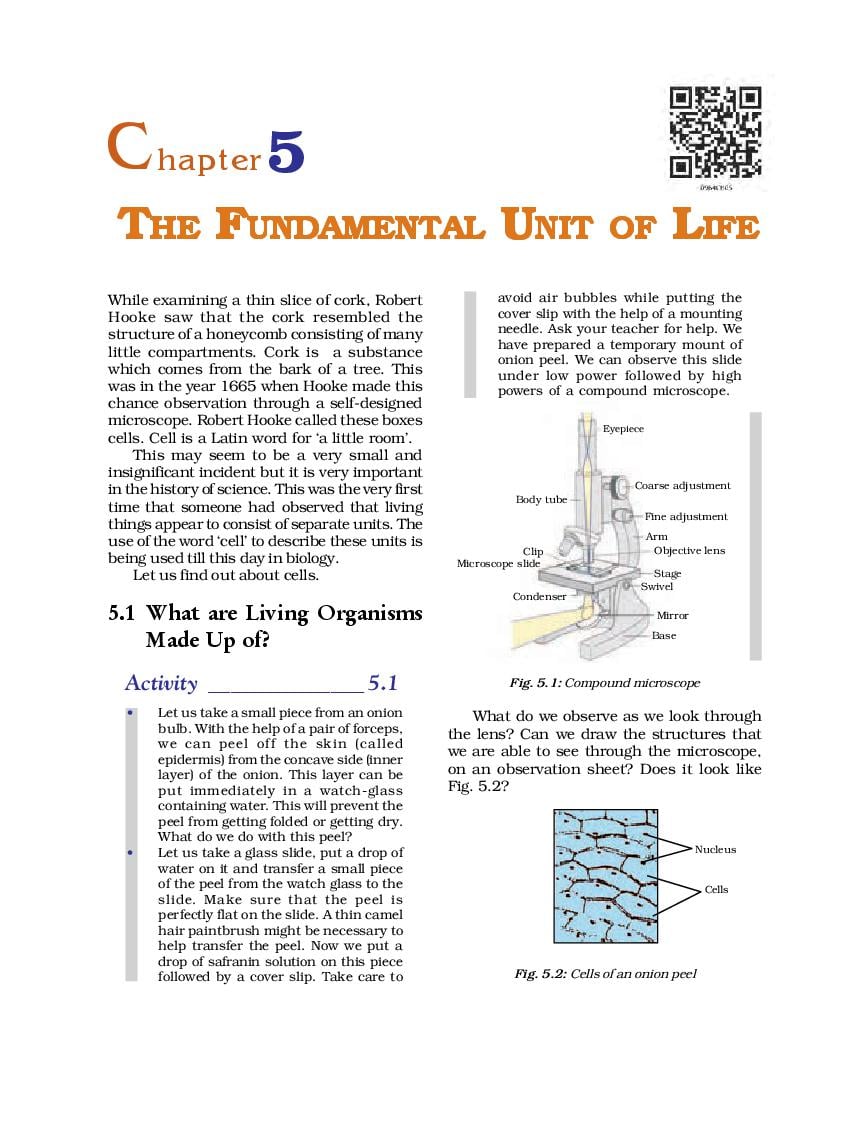
Activity ______________ 5.1 Fig. 5.1: Compound microscope
• Let us take a small piece from an onion What do we observe as we look through
bulb. With the help of a pair of forceps, the lens? Can we draw the structures that
we can peel of f the skin (called
epidermis) from the concave side (inner
we are able to see through the microscope,
layer) of the onion. This layer can be on an observation sheet? Does it look like
put immediately in a watch-glass Fig. 5.2?
containing water. This will prevent the
peel from getting folded or getting dry.
What do we do with this peel?
• Let us take a glass slide, put a drop of Nucleus
water on it and transfer a small piece
of the peel from the watch glass to the Cells
slide. Make sure that the peel is
perfectly flat on the slide. A thin camel
hair paintbrush might be necessary to
help transfer the peel. Now we put a
drop of safranin solution on this piece
followed by a cover slip. Take care to Fig. 5.2: Cells of an onion peel
Showing the first page only. Download the PDF above for the complete document.
Document Details
| Board / Org | NCERT |
| Exam | Class 9 |
| Type | Books |
| Pages | 11 |
| Updated | 22 Jul 2026 |