PUBDET 2023 Question Paper English
Finished viewing? Save it for later —
Download PUBDET 2023 Question Paper English (PDF · 12 pages)About PUBDET 2023 Question Paper English
PUBDET 2023 Question Paper English is available here for free download. Published by WBJEEB for PUBDET, this question paper can be viewed online or downloaded as a PDF (12 pages). Candidates preparing for PUBDET can use PUBDET 2023 Question Paper English to understand the exam pattern, the type of questions asked, and the overall difficulty level.
Frequently Asked Questions
How can I download PUBDET 2023 Question Paper English?
Open this page and click the Download button to save PUBDET 2023 Question Paper English as a PDF. It is completely free on AglaSem Docs.
Is PUBDET 2023 Question Paper English free to download?
Yes. PUBDET 2023 Question Paper English can be viewed online and downloaded as a PDF free of cost on AglaSem Docs.
How many pages does PUBDET 2023 Question Paper English have?
PUBDET 2023 Question Paper English contains 12 pages, which you can read online or download together as a single PDF.
Where can I find more PUBDET study material?
You can find more PUBDET question papers, sample papers, syllabus, and answer keys on AglaSem Docs.
PUBDET 2023 Question Paper English – Text
Read the full text of this question paper below — useful to quickly search, copy and reference the content online without downloading the PDF.
📄 View text version (12 pages)
Page 1
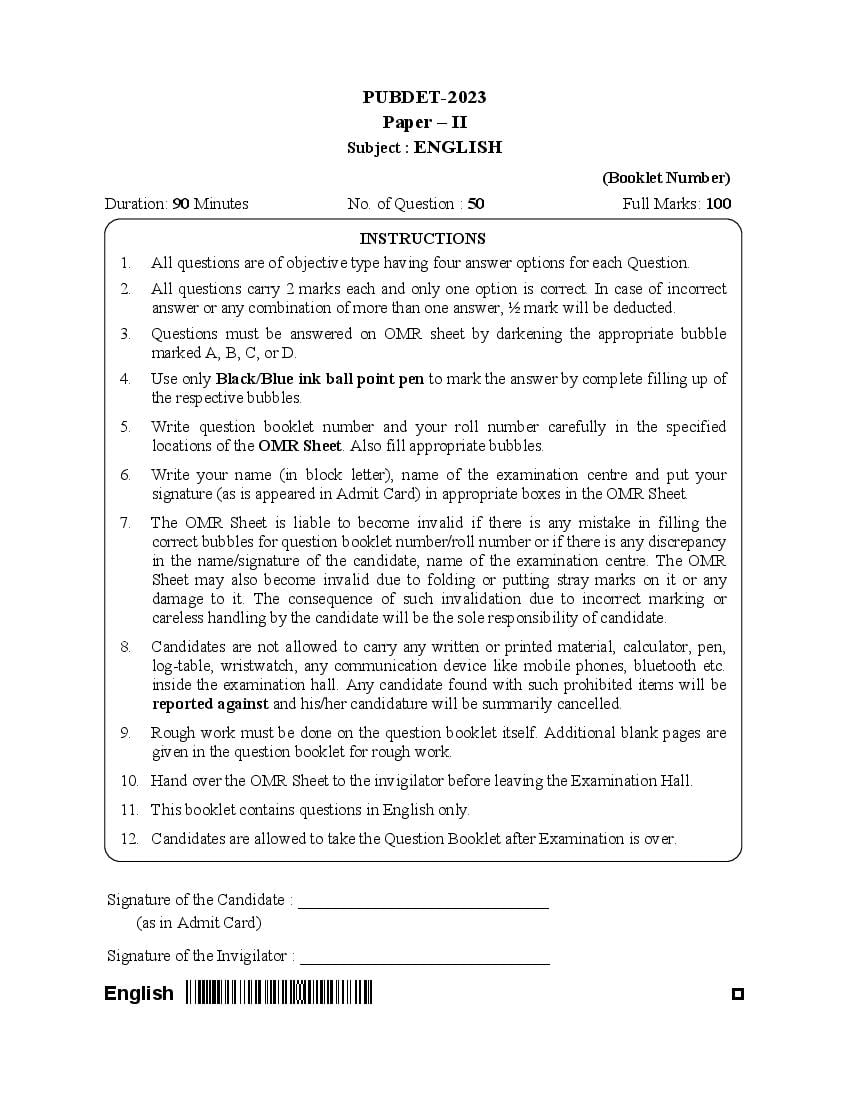
Subject : ENGLISH
(Booklet Number)
Duration: 90 Minutes No. of Question : 50 Full Marks: 100
INSTRUCTIONS
1. All questions are of objective type having four answer options for each Question.
2. All questions carry 2 marks each and only one option is correct. In case of incorrect
answer or any combination of more than one answer, ½ mark will be deducted.
3. Questions must be answered on OMR sheet by darkening the appropriate bubble
marked A, B, C, or D.
4. Use only Black/Blue ink ball point pen to mark the answer by complete filling up of
the respective bubbles.
5. Write question booklet number and your roll number carefully in the specified
locations of the OMR Sheet. Also fill appropriate bubbles.
6. Write your name (in block letter), name of the examination centre and put your
signature (as is appeared in Admit Card) in appropriate boxes in the OMR Sheet.
7. The OMR Sheet is liable to become invalid if there is any mistake in filling the
correct bubbles for question booklet number/roll number or if there is any discrepancy
in the name/signature of the candidate, name of the examination centre. The OMR
Sheet may also become invalid due to folding or putting stray marks on it or any
damage to it. The consequence of such invalidation due to incorrect marking or
careless handling by the candidate will be the sole responsibility of candidate.
8. Candidates are not allowed to carry any written or printed material, calculator, pen,
log-table, wristwatch, any communication device like mobile phones, bluetooth etc.
inside the examination hall. Any candidate found with such prohibited items will be
reported against and his/her candidature will be summarily cancelled.
9. Rough work must be done on the question booklet itself. Additional blank pages are
given in the question booklet for rough work.
10. Hand over the OMR Sheet to the invigilator before leaving the Examination Hall.
11. This booklet contains questions in English only.
12. Candidates are allowed to take the Question Booklet after Examination is over.
Signature of the Candidate : ______________________________
(as in Admit Card)
Signature of the Invigilator : ______________________________
English 1 A
Page 2
English 2
Page 3
1. Which of these poets believed in Pantheism ?
(A) Wordsworth and Coleridge (B) Wordsworth and Southey
(C) Wordsworth and Byron (D) Wordsworth and Shelley
2. Which of these authors is NOT a Metaphysical poet ?
(A) George Herbert (B) Henry Vaughan
(C) Richard Suckling (D) Abraham Cowley
3. Complete the sequence with the appropriate word – sonnet, ballad, elegy, …
(A) satire (B) epic
(C) long narrative poem (D) ode
4. Which of these dramatists is said to write comedies of menace ?
(A) Harold Pinter (B) Samuel Beckett
(C) John Osborne (D) Arnold Wesker
5. Which of these literary forms was NOT written in the eighteenth century ?
(A) Periodical essays (B) Heroic tragedy
(C) Gothic novels (D) Romantic poetry
6. Which of these plays by Shakespeare falls into the same group as Measure for Measure ?
(A) Timon of Athens (B) Two Gentlemen of Verona
(C) Pericles (D) Troilus and Cressida
7. Find the odd one out.
(A) Oliver Goldsmith (B) Horace Walpole
(C) Aphra Behn (D) Thomas Gray
English 3
Page 4
(A) Abdulrazak Gurnah (B) Wole Soyinka
(C) Ngugi wa Thiong’o (D) Nuruddin Farah
9. What is the difference between a story and a plot ?
(A) A story deals with people while a plot deals with social problems.
(B) A story moves between several locations while a plot mandatorily stays at one
place.
(C) A story is a sequence of events while a plot shows the causes behind the events.
(D) A story focuses on everyday life while a plot deals with important people.
10. What do these authors from various continents have in common – Kingsley Amis,
Patrick White, Shyam Selvadurai and J.M. Coetzee ?
(A) They are all poets (B) They are all novelists
(C) They are dramatists (D) They are all pamphleteers
11. Find the odd one out.
(A) Louis Macneice (B) Philip Larkin
(C) W.H. Auden (D) Christopher Isherwood
12. Who wrote the kind of sonnet known as the ‘curtal sonnet’ ?
(A) Edmund Spenser (B) James Thompson
(C) Elizabeth Barrett Browning (D) Gerard Manley Hopkins
13. Given below is a Statement, followed by two Assumptions. Read the sentences carefully
and select the correct option.
Statement : The Age of Pope has been called ‘the age of prose and reason’.
Assumption (i) : Pope and his contemporaries were influenced by ideas that valued
reason over imagination.
Assumption (ii) : Pope’s famous poem, ‘The Rape of the Lock’, is completely bereft of
imagination.
In the light of the above Statement, how would you rate the Assumptions ?
(A) (i) is correct but (ii) is incorrect (B) (i) is incorrect but (ii) is correct
(C) Both (i) and (ii) are correct (D) Both (i) and (ii) are incorrect
English 4
Page 5
(A) 6 lines (B) 7 lines
(C) 8 lines (D) 9 lines
15. What is an alexandrine ?
(A) A ten-syllable line in trochaic tetrameter
(B) A twelve-syllable line in iambic hexameter
(C) A fourteen-syllable line in trochaic tetrameter
(D) A sixteen-syllable line in iambic pentameter
16. What is a ‘metaphysical conceit’ ?
(A) A form of braggadocio seen in comic characters in Elizabethan drama
(B) A kind of poetic image comprising dissimilar objects and concepts
(C) A kind of stanza used in religious poetry
(D) A poem extolling the virtues of charity and piety
17. Fill in the blanks with the appropriate words.
The meeting _______ postponed on account of _______ town tomorrow as your presence
is _____.
(A) have been; you leave; voluntary
(B) have to be; you will leave; involuntary
(C) have had to be; you left; gustatory
(D) will have to be; your leaving; mandatory
18. Identify the mood of the italicized verb in the following sentence:
I wish it were Sunday tomorrow and not a working day.
(A) Indicative (B) Imperative
(C) Subjunctive (D) Oblative
English 5
Page 6
speech:
He said, ‘I went there yesterday’.
(A) He said he went there yesterday
(B) He said that he went there yesterday
(C) He said that he had gone there the previous day
(D) He said that he had been there a day before
20. Choose the word nearest in meaning to the italicized word in the following sentence:
I was extremely perturbed by his rude behaviour.
(A) Disillusioned (B) Disturbed
(C) Dismayed (D) Disgusted
21. What is the meaning of the phrase – ‘milk of human kindness; ?
(A) Good behaviour (B) Compliant nature
(C) Passivity (D) Compassion
22. Given below is a Statement, followed by an Inference. Read the sentences carefully and
select the correct option.
Statement : The current CBCS (Choice-based Credit System) syllabus is intended to
facilitate credit transfers.
Inference : The CBCS syllabus is of no use at all for students who do not wish to opt for
credit transfers.
In the light of the above Statement, the Inference is :
(A) Acceptable (B) Unacceptable
(C) Dependable (D) Indispensable
English 6
Page 7
logical sequence.
1. At the Restoration, he attached himself to the fortunes of King Charles II and to the
Church of England.
2. Of Dryden it can be said without qualification that he always attempted to be
representative of his age.
3. Nevertheless, despite further political adjustments, he ultimately lost his position as
Poet Laureate and Historiographer General.
4. In the pre-Restoration era, he wrote a laudation of Oliver Cromwell.
The correct sequence is :
(A) 1, 4, 3, 2 (B) 3, 1, 2, 4
(C) 2, 4, 1, 3 (D) 4, 2, 3, 1
24. What kind of poem is Langland’s Piers Plowman ?
(A) A pastoral elegy (B) A dream allegory
(C) A metrical romance (D) A heroic poem
25. Find the correct figures of speech in the italicized phrases in the following line –
‘What passing bells for those who die as cattle ?’
(A) Hypallage and simile (B) Metonymy and metaphor
(C) Apostrophe and chiasmus (D) Personification and pathetic fallacy
26. Which two plays by Shakespeare are NOT in the correct chronological order ?
(A) The Comedy of Errors; Romeo and Juliet
(B) A Midsummer Night’s Dream; The Merchant of Venice
(C) King Lear; The Tempest
(D) Macbeth; Hamlet
27. In which of Jane Austen’s novels do we find Catherine Morland ?
(A) Pride and Prejudice (B) Northanger Abbey
(C) Sense and Sensibility (D) Emma
English 7
Page 8
To thy high requiem become a sod.”
The word ‘sod’ is a metaphor for:
(A) mud (B) sand
(C) happiness (D) death
29. Identify the ambiguous phrase in the following sentence - Visiting relatives can be
tedious.
(A) Visiting relatives (B) relatives can
(C) relatives can be (D) can be tedious
30. Given below are lines from a poem by Wordsworth, followed by two inferences. Study
them carefully and select the correct option.
“The music in my heart I bore
Long after it was heard no more”
Inference (i) : Wordsworth is referring to a beautiful memory
Inference (ii) : Wordsworth is enjoying the music
(A) (i) is correct but (ii) is incorrect.
(B) (i) is incorrect but (ii) is correct.
(C) Both (i) and (ii) are correct.
(D) Both (i) and (ii) are incorrect.
31. A body of writing that is authorized as authentic and of great merit is known as a:
(A) cannon (B) canon
(C) collection (D) syllabus
32. Identify the figure of speech in the following line:
She sells sea shells on the sea shore
(A) tongue-twister (B) asyndeton
(C) alliteration (D) assonance
English 8
Page 9
(A) an episode (B) a canto
(C) an epigraph (D) a strophe
34. Which of these novels was NOT written by Sir Walter Scott ?
(A) The Heart of Midlothian (B) Ivanhoe
(C) Oroonoko (D) Kenilworth
35. What is the meaning of the term – polysemous ?
(A) multiple objects (B) multilingual
(C) multicoloured (D) multiple meanings
36. The perspective from which a novel is narrated is known as:
(A) the author (B) the point of view
(C) the focus (D) the frame
37. Which of these tales from Chaucer’s The Canterbury Tales is written in prose ?
(A) The Parson’s Tale (B) The Wife of Bath’s Tale
(C) The Miller’s Tale (D) The Knight’s Tale
38. The use of vers libre (free verse) as a poetic style was common in:
(A) Neo-classical poetry (B) Pre-Raphaelite poetry
(C) Romantic poetry (D) Modernist poetry
39. ‘Epic theatre’ was a form of drama developed by:
(A) Anton Chekhov (B) George Bernard Shaw
(C) Bertolt Brecht (D) Luigi Pirandello
40. Which of these playwrights wrote absurd drama ?
(A) Samuel Beckett (B) Oscar Wilde
(C) Noel Coward (D) T.S. Eliot
English 9
Page 10
England ?
(A) Wuthering Heights (B) Mary Barton
(C) Daniel Deronda (D) Vanity Fair
42. Name the essayist who had worked as a clerk in the East India Company.
(A) Charles Lamb (B) William Hazlitt
(C) Thomas De Quincey (D) Thomas Carlyle
43. When was Charles Darwin’s On the Origin of Species published ?
(A) 1839 (B) 1849
(C) 1859 (D) 1869
44. Study the sentences below and select the correct option.
(i) The Principle was not in her office.
(ii) She has very strong principals and will never compromise
(A) (i) is correct but (ii) is incorrect.
(B) (i) is incorrect but (ii) is correct.
(C) Both (i) and (ii) are correct.
(D) Both (i) and (ii) are incorrect.
45. Which novel by Dickens begins with the famous words – “It was the best of times, it was
the worst of times …”
(A) Hard Times (B) A Tale of Two Cities
(C) Barnaby Rudge (D) Martin Chuzzlewit
46. Fill in the blanks with the appropriate group of words:
The job is _____ on _____ to Delhi, _____ I _____ it.
(A) dependant; me moving; but then; lost
(B) dependent; my moving; or else; lose
(C) depending; I move; since else; having lost
(D) dependable; I am moving; though otherwise; had lost
English 10
Page 11
What are days for ?
Days are where we live.
They come, they wake us
Time and time over.
They are to be happy in:
Where can we live but days ?
Ah, solving that question
Brings the priest and the doctor
In their long coats
Running over the fields.
47. What is the setting of the poem ?
(A) fields (B) a hospital
(C) a house (D) the progress of time
48. What is the central idea of the poem ?
(A) life (B) death
(C) life and death (D) happiness
49. What is implied in the phrase ‘they wake us’ ?
(A) to solve questions (B) to give us awareness
(C) to be born (D) to hear the alarm clock
50. How do the priest and the doctor solve the problem ?
(A) by administering cures for the body and soul.
(B) by running over the fields.
(C) by making death less painful.
(D) by wearing long coats.
_____________
English 11
Page 12
English 12
Document Details
| Board / Org | WBJEEB |
| Exam | PUBDET |
| Type | Question Paper |
| Pages | 12 |
| Updated | 22 Jul 2026 |