ISC Class 12 Specimen Paper 2022 Electricity and Electronics Semester 2
Finished viewing? Save it for later —
Download ISC Class 12 Specimen Paper 2022 Electricity and Electronics Semester 2 (PDF · 4 pages)About ISC Class 12 Specimen Paper 2022 Electricity and Electronics Semester 2
ISC Class 12 Specimen Paper 2022 Electricity and Electronics Semester 2 is available here for free download. Published by CISCE for Class 12, this sample paper can be viewed online or downloaded as a PDF (4 pages). Candidates preparing for Class 12 can use ISC Class 12 Specimen Paper 2022 Electricity and Electronics Semester 2 to understand the exam pattern, the type of questions asked, and the overall difficulty level.
Frequently Asked Questions
How can I download ISC Class 12 Specimen Paper 2022 Electricity and Electronics Semester 2?
Open this page and click the Download button to save ISC Class 12 Specimen Paper 2022 Electricity and Electronics Semester 2 as a PDF. It is completely free on AglaSem Docs.
Is ISC Class 12 Specimen Paper 2022 Electricity and Electronics Semester 2 free to download?
Yes. ISC Class 12 Specimen Paper 2022 Electricity and Electronics Semester 2 can be viewed online and downloaded as a PDF free of cost on AglaSem Docs.
How many pages does ISC Class 12 Specimen Paper 2022 Electricity and Electronics Semester 2 have?
ISC Class 12 Specimen Paper 2022 Electricity and Electronics Semester 2 contains 4 pages, which you can read online or download together as a single PDF.
Where can I find more Class 12 study material?
You can find more Class 12 question papers, sample papers, syllabus, and answer keys on AglaSem Docs.
ISC Class 12 Specimen Paper 2022 Electricity and Electronics Semester 2 – Text
Read the full text of this sample paper below — useful to quickly search, copy and reference the content online without downloading the PDF.
📄 View text version (4 pages)
Page 1
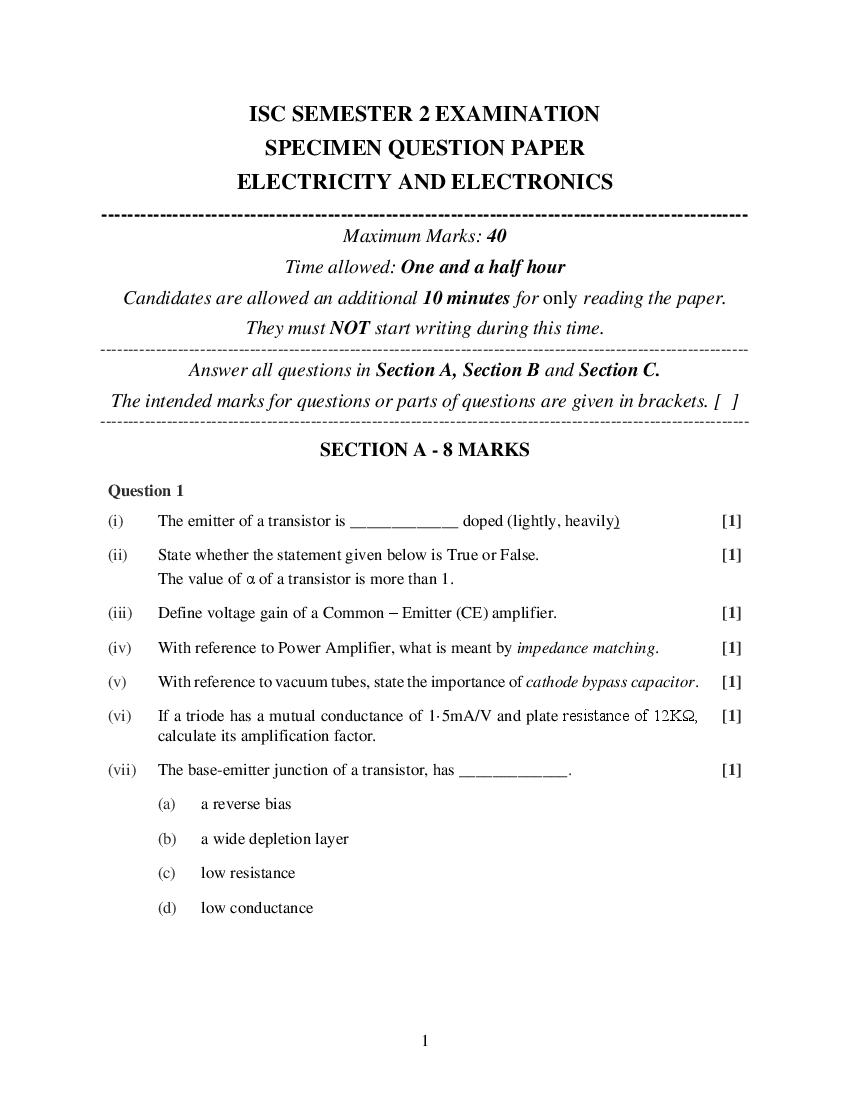
SPECIMEN QUESTION PAPER
ELECTRICITY AND ELECTRONICS
----------------------------------------------------------------------------------------------------
Maximum Marks: 40
Time allowed: One and a half hour
Candidates are allowed an additional 10 minutes for only reading the paper.
They must NOT start writing during this time.
---------------------------------------------------------------------------------------------------------------------
Answer all questions in Section A, Section B and Section C.
The intended marks for questions or parts of questions are given in brackets. [ ]
---------------------------------------------------------------------------------------------------------------------
SECTION A - 8 MARKS
Question 1
(i) The emitter of a transistor is _____________ doped (lightly, heavily) [1]
(ii) State whether the statement given below is True or False. [1]
The value of α of a transistor is more than 1.
(iii) Define voltage gain of a Common – Emitter (CE) amplifier. [1]
(iv) With reference to Power Amplifier, what is meant by impedance matching. [1]
(v) With reference to vacuum tubes, state the importance of cathode bypass capacitor. [1]
(vi) If a triode has a mutual conductance of 1·5mA/V and plate resistance of 12KΩ, [1]
calculate its amplification factor.
(vii) The base-emitter junction of a transistor, has _____________. [1]
(a) a reverse bias
(b) a wide depletion layer
(c) low resistance
(d) low conductance
1
Page 2
(a)
(b)
(c)
(d)
SECTION B - 12 MARKS
Answer the following questions briefly.
Question 2 [2]
State any two differences between half wave rectifier and full wave rectifier.
Question 3 [2]
Draw a neat circuit diagram of an RC filter.
Question 4 [2]
With reference to transistors, obtain the relationship between α and β (symbols have their
usual meaning).
Question 5 [2]
What inference can be drawn by maintaining control grid at:
(i) Positive potential
(ii) Negative potential
Question 6 [2]
State any two advantages of Power Amplifier over Voltage Amplifier.
2
Page 3
(i) For the Common – Emitter (CE) transistor given in Figure 1(a), β=45 and voltage
drop across 1KΩ resistor which is connected to the collector circuit is 1V.
Calculate the base current of the transistor.
Figure 1(a)
OR
(ii) For the Common – base (CB) transistor given in Figure 1(b), the current
amplification factor is 0·9. If the emitter current is 1mA, calculate the base current
of the transistor.
Figure 1(b)
SECTION C - 20 MARKS
Answer the following questions.
Question 8 [4]
With the help of a neat circuit diagram, explain the working of a bridge rectifier.
Question 9 [4]
With the help of a neat circuit diagram of a Common Emitter (CE) amplifier, explain how
a weak signal can be amplified. (Use either PNP or NPN type of transistor)
3
Page 4
Figure 2 given below shows a circuit diagram of a voltage stabilizer. Explain the
importance of the following:
(i) resistor ‘R’
(ii) Zener diode
Figure 2
Question 11 [4]
𝐼
(i) Prove 𝐼𝑟𝑚𝑠 = 0
√2
OR
2𝐼
(ii) Prove 𝐼𝑑𝑐 = 𝜋𝑜
Question 12 [4]
Explain the working of a crystal microphone. Also, state the energy conversion that takes
place in this microphone.
4
Document Details
| Board / Org | CISCE |
| Exam | Class 12 |
| Type | Sample Paper |
| Pages | 4 |
| Language | english |
| Updated | 30 Apr 2026 |