ISC Class 12 Project Work in Engineering Sciences
Finished viewing? Save it for later —
Download ISC Class 12 Project Work in Engineering Sciences (PDF · 3 pages)About ISC Class 12 Project Work in Engineering Sciences
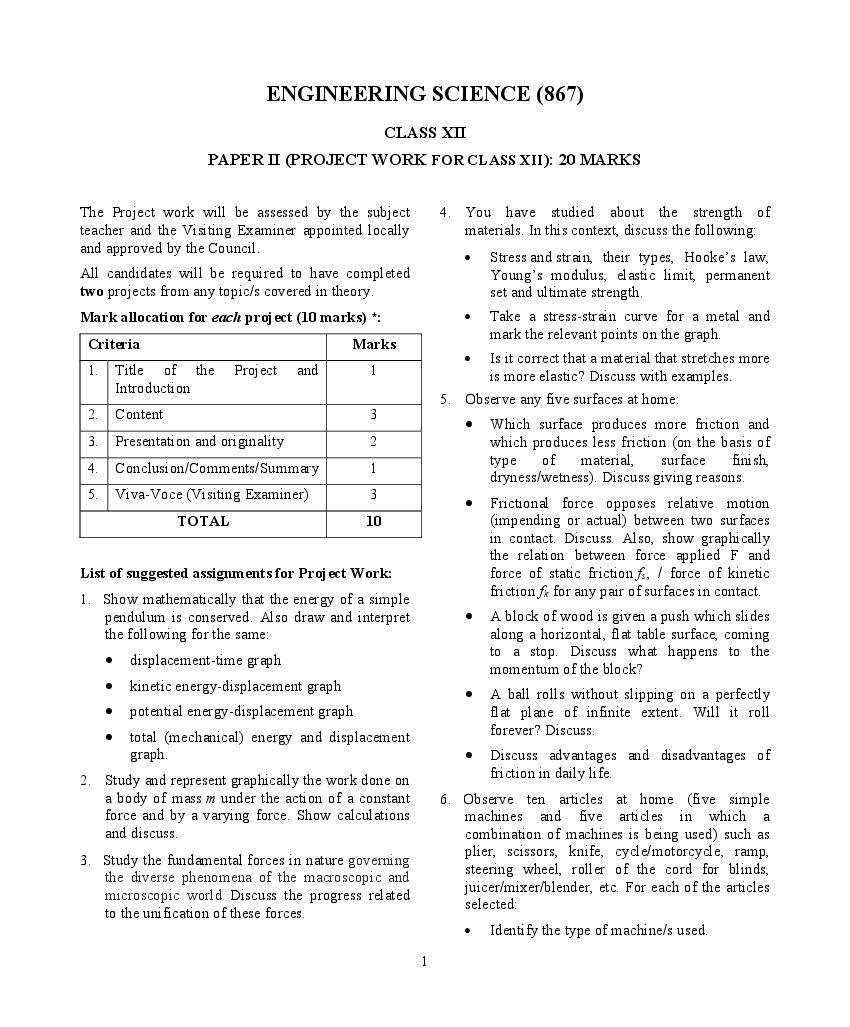
ISC Class 12 Project Work in Engineering Sciences is available here for free download. Published by CISCE for Class 12, this brochure can be viewed online or downloaded as a PDF (3 pages). Candidates preparing for Class 12 can use ISC Class 12 Project Work in Engineering Sciences to understand the exam pattern, the type of questions asked, and the overall difficulty level.
Frequently Asked Questions
How can I download ISC Class 12 Project Work in Engineering Sciences?
Open this page and click the Download button to save ISC Class 12 Project Work in Engineering Sciences as a PDF. It is completely free on AglaSem Docs.
Is ISC Class 12 Project Work in Engineering Sciences free to download?
Yes. ISC Class 12 Project Work in Engineering Sciences can be viewed online and downloaded as a PDF free of cost on AglaSem Docs.
How many pages does ISC Class 12 Project Work in Engineering Sciences have?
ISC Class 12 Project Work in Engineering Sciences contains 3 pages, which you can read online or download together as a single PDF.
Where can I find more Class 12 study material?
You can find more Class 12 question papers, sample papers, syllabus, and answer keys on AglaSem Docs.
ISC Class 12 Project Work in Engineering Sciences – Text
Read the full text of this brochure below — useful to quickly search, copy and reference the content online without downloading the PDF.
📄 View text version (3 pages)
Page 1
CLASS XII
PAPER II (PROJECT WORK FOR CLASS XII): 20 MARKS
The Project work will be assessed by the subject 4. You have studied about the strength of
teacher and the Visiting Examiner appointed locally materials. In this context, discuss the following:
and approved by the Council.
• Stress and strain, their types, Hooke’s law,
All candidates will be required to have completed Young’s modulus, elastic limit, permanent
two projects from any topic/s covered in theory. set and ultimate strength.
Mark allocation for each project (10 marks) *: • Take a stress-strain curve for a metal and
mark the relevant points on the graph.
Criteria Marks
• Is it correct that a material that stretches more
1. Title of the Project and 1 is more elastic? Discuss with examples.
Introduction
5. Observe any five surfaces at home:
2. Content 3
• Which surface produces more friction and
3. Presentation and originality 2 which produces less friction (on the basis of
type of material, surface finish,
4. Conclusion/Comments/Summary 1
dryness/wetness). Discuss giving reasons.
5. Viva-Voce (Visiting Examiner) 3
• Frictional force opposes relative motion
TOTAL 10 (impending or actual) between two surfaces
in contact. Discuss. Also, show graphically
the relation between force applied F and
List of suggested assignments for Project Work: force of static friction f s , / force of kinetic
friction f k for any pair of surfaces in contact.
1. Show mathematically that the energy of a simple
pendulum is conserved. Also draw and interpret • A block of wood is given a push which slides
the following for the same: along a horizontal, flat table surface, coming
to a stop. Discuss what happens to the
• displacement-time graph
momentum of the block?
• kinetic energy-displacement graph
• A ball rolls without slipping on a perfectly
• potential energy-displacement graph flat plane of infinite extent. Will it roll
• total (mechanical) energy and displacement forever? Discuss.
graph. • Discuss advantages and disadvantages of
2. Study and represent graphically the work done on friction in daily life.
a body of mass m under the action of a constant 6. Observe ten articles at home (five simple
force and by a varying force. Show calculations machines and five articles in which a
and discuss. combination of machines is being used) such as
plier, scissors, knife, cycle/motorcycle, ramp,
3. Study the fundamental forces in nature governing
steering wheel, roller of the cord for blinds,
the diverse phenomena of the macroscopic and
juicer/mixer/blender, etc. For each of the articles
microscopic world. Discuss the progress related
selected:
to the unification of these forces.
• Identify the type of machine/s used.
1
Page 2
and mark the load, effort and fulcrum. Write and draw its labelled diagram. Discuss the
expressions for mechanical advantage, principle on which it works and the reasons for
velocity ratio and efficiency. energy losses. Find out the transmission and
distribution mode of electrical energy from a
• Discuss briefly the utility of each type of
power plant to a consumer. Discuss its pros and
machine used.
cons.
7. Study electricity bills of your home issued by the
9. Assemble a household circuit comprising three
electricity department from January to December.
bulbs, three on/off switches, a fuse, and a power
Prepare a month wise analysis of units of
source from the given materials (Three bulbs
electricity consumed and bill paid in a tabular
(6V,1W) each, main switch of a power supply
form. Represent the same graphically. Suggest
(battery eliminator), three switches, fuse (0.6A),
some ways in which you can economise
connecting wires with red and black plastic
electricity consumption at home.
coating, fuse wire, a plier and a cutter).
Draw a circuit diagram of the actual layout and
write the theory and procedure involved.
NOTE: No question paper for Project work will
be set by the Council.
2
Page 3
S. Unique PROJECT 1 PROJECT 2 TOTAL
No. Identification MARKS
Number A B C D E F G H I J
(Unique ID) of
the candidate Teacher Visiting Average Viva- Total Teacher Visiting Average Viva-Voce Total (E + J)
Examiner Marks Voce by Marks Examiner Marks by Visiting Marks
(A + B ÷ Visiting (C + D) (F + G ÷ Examiner (H + I)
2) Examiner 2)
7 Marks 7 Marks 7 Marks 3 Marks 10 Marks 7 Marks 7 Marks 7 Marks 3 Marks 10 Marks 20 Marks
1
2
3
4
5
6
7
8
9
10
*For breakup of the 7 Marks to be awarded separately by the Teacher and the Visiting Examiner, please refer to the table giving the criteria
for mark allocation for each project.
NOTE: VIVA-VOCE (3 Marks) for each Project is to be conducted only by the Visiting Examiner and should be based on the Project only.
3
Document Details
| Board / Org | CISCE |
| Exam | Class 12 |
| Type | Brochure |
| Pages | 3 |
| Language | english |
| Updated | 30 Apr 2026 |