AP ECET 2023 Syllabus for Mathematics (For B.Sc Graduates)
Finished viewing? Save it for later —
Download AP ECET 2023 Syllabus for Mathematics (For B.Sc Graduates) (PDF · 5 pages)About AP ECET 2023 Syllabus for Mathematics (For B.Sc Graduates)
AP ECET 2023 Syllabus for Mathematics (For B.Sc Graduates) is available here for free download. Published by APSCHE for Andhra Pradesh Engineering Common Entrance Test, this syllabus can be viewed online or downloaded as a PDF (5 pages). Candidates preparing for Andhra Pradesh Engineering Common Entrance Test can use AP ECET 2023 Syllabus for Mathematics (For B.Sc Graduates) to understand the exam pattern, the type of questions asked, and the overall difficulty level.
Frequently Asked Questions
How can I download AP ECET 2023 Syllabus for Mathematics (For B.Sc Graduates)?
Open this page and click the Download button to save AP ECET 2023 Syllabus for Mathematics (For B.Sc Graduates) as a PDF. It is completely free on AglaSem Docs.
Is AP ECET 2023 Syllabus for Mathematics (For B.Sc Graduates) free to download?
Yes. AP ECET 2023 Syllabus for Mathematics (For B.Sc Graduates) can be viewed online and downloaded as a PDF free of cost on AglaSem Docs.
How many pages does AP ECET 2023 Syllabus for Mathematics (For B.Sc Graduates) have?
AP ECET 2023 Syllabus for Mathematics (For B.Sc Graduates) contains 5 pages, which you can read online or download together as a single PDF.
Where can I find more Andhra Pradesh Engineering Common Entrance Test study material?
You can find more Andhra Pradesh Engineering Common Entrance Test question papers, sample papers, syllabus, and answer keys on AglaSem Docs.
AP ECET 2023 Syllabus for Mathematics (For B.Sc Graduates) – Text
Read the full text of this syllabus below — useful to quickly search, copy and reference the content online without downloading the PDF.
📄 View text version (5 pages)
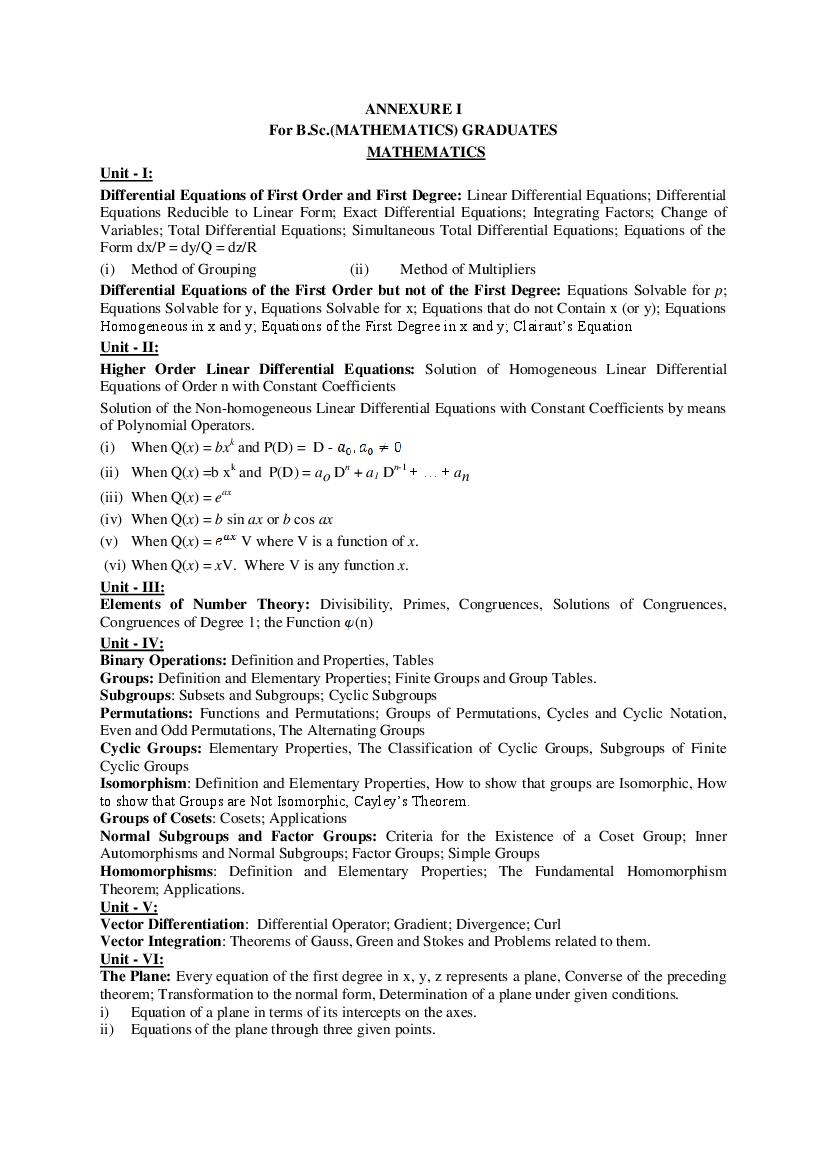
Page 1
For B.Sc.(MATHEMATICS) GRADUATES
MATHEMATICS
Unit - I:
Differential Equations of First Order and First Degree: Linear Differential Equations; Differential
Equations Reducible to Linear Form; Exact Differential Equations; Integrating Factors; Change of
Variables; Total Differential Equations; Simultaneous Total Differential Equations; Equations of the
Form dx/P = dy/Q = dz/R
(i) Method of Grouping (ii) Method of Multipliers
Differential Equations of the First Order but not of the First Degree: Equations Solvable for p;
Equations Solvable for y, Equations Solvable for x; Equations that do not Contain x (or y); Equations
Homogeneous in x and y; Equations of the First Degree in x and y; Clairaut’s Equation
Unit - II:
Higher Order Linear Differential Equations: Solution of Homogeneous Linear Differential
Equations of Order n with Constant Coefficients
Solution of the Non-homogeneous Linear Differential Equations with Constant Coefficients by means
of Polynomial Operators.
(i) When Q(x) = bxk and P(D) = D -
(ii) When Q(x) =b xk and P(D) = ao Dn + a1 Dn-1 + … + an
(iii) When Q(x) = eax
(iv) When Q(x) = b sin ax or b cos ax
(v) When Q(x) = V where V is a function of x.
(vi) When Q(x) = xV. Where V is any function x.
Unit - III:
Elements of Number Theory: Divisibility, Primes, Congruences, Solutions of Congruences,
Congruences of Degree 1; the Function (n)
Unit - IV:
Binary Operations: Definition and Properties, Tables
Groups: Definition and Elementary Properties; Finite Groups and Group Tables.
Subgroups: Subsets and Subgroups; Cyclic Subgroups
Permutations: Functions and Permutations; Groups of Permutations, Cycles and Cyclic Notation,
Even and Odd Permutations, The Alternating Groups
Cyclic Groups: Elementary Properties, The Classification of Cyclic Groups, Subgroups of Finite
Cyclic Groups
Isomorphism: Definition and Elementary Properties, How to show that groups are Isomorphic, How
to show that Groups are Not Isomorphic, Cayley’s Theorem.
Groups of Cosets: Cosets; Applications
Normal Subgroups and Factor Groups: Criteria for the Existence of a Coset Group; Inner
Automorphisms and Normal Subgroups; Factor Groups; Simple Groups
Homomorphisms: Definition and Elementary Properties; The Fundamental Homomorphism
Theorem; Applications.
Unit - V:
Vector Differentiation: Differential Operator; Gradient; Divergence; Curl
Vector Integration: Theorems of Gauss, Green and Stokes and Problems related to them.
Unit - VI:
The Plane: Every equation of the first degree in x, y, z represents a plane, Converse of the preceding
theorem; Transformation to the normal form, Determination of a plane under given conditions.
i) Equation of a plane in terms of its intercepts on the axes.
ii) Equations of the plane through three given points.
Page 2
plane; Bisectors of angles between two planes; Joint equation of two planes;
Orthogonal projection on a plane; Volume of a tetrahedron in terms of the co-ordinates of its vertices;
Equations of a line; Right Line; Angle between a line and a plane; The condition that a given line
may lie in a given plane; The condition that two given lines are coplanar, Number of arbitrary
constants in the equations of a straight line. Sets of conditions which determine a line; The shortest
distance between two lines. The length and equations of the line of shortest distance between two
straight lines; Length of the perpendicular from a given point to a given line; Intersection of three
planes; Triangular Prism.
The Sphere: Definition and equation of the sphere; Equation of the Sphere through four given
points; Plane sections of a sphere. Intersection of two spheres; Equation of a circle. Sphere through a
given circle; Intersection of a sphere and a line. Power of a point; Tangent plane. Plane of contact.
Polar plane . Angle of intersection of two spheres. Conditions of two spheres. Conditions for two
spheres to be orthogonal; Radical plane, coaxial system of spheres; Simplified form of the equation of
two spheres.
Unit - VII:
The Real Numbers: The algebraic and Order Properties of R; Absolute Value and Real Line; The
Completeness Property of R; Applications of the Supremum Property; Intervals (No question should
be set from this part).
Sequences and Series: Sequences and their Limits; Limits Theorems; Monotone Sequences;
Subsequences and the Bolzano - Weierstrass Theorem; The Cauchy Criterion; Properly Divergent
Sequences; Series.
Limits: Limits of Functions, Limits Theorems, Some Extensions of the Limit Concept.
Continuous Functions: Continuous Functions, Combinations of Continuous Functions; Continuous
Functions on Intervals, Uniform Continuity, Definition, Non-Uniform Continuity Criteria, Uniform
Continuity Theorem.
Unit - VIII:
Differentiation: The derivative, The Mean Value theorem, L’Hospital Rules, Taylor’s Theorem.
The Riemann Integral: The Riemann Integral, Riemann Integrable Functions, the Fundamental
theorem (Scope as in Introduction to Real Analysis by Robert G. Bartle and Donald R. Sherbert,
published by John. Willey and Sons, Inc.)
Unit - IX:
Rings: Definition and Basic Properties, Fields.
Integral Domains: Divisors of 0 and cancellation, Integral domains, The Characteristic of a Ring.
Some Non-Commutative Examples: Matrices over a field, The Quaternions
Homomorphisms of Rings: Definition and Elementary properties; Maximal and Prime Ideals, Prime
Fields
Rings of Polynomials: Polynomials in an Indeterminate, The Evaluation Homomorphisms.
Factorization of Polynomials over a field: The Division Algorithm in F[x]; Irreducible polynomials,
ideal structure in F[x], Uniqueness of Factorization in F[x].
Unit - X:
Vector Spaces: Vector Spaces, Subspaces, Linear Combinations and Systems of Linear Equations,
Linear Dependence and Linear Independence, Bases and Dimension
Linear Transformation and Matrices: Linear Transformations, Null spaces, and Ranges, The
Matrix Representation of a Linear Transformation, Composition of Linear Transformations and
Matrix Multiplication, Invertibility and Isomorphism’s.
Systems of linear Equations: Elementary Matrix operations and Elementary Matrices, The Rank of a
Matrix and Matrix Inverses, Systems of Linear Equations:- Theoretical Aspects, Systems of Linear
Equations - Computational Aspects.
Determinants: Determinants of Order 2; Determinants of Order n, Properties of Determinants.
Diagonalization: Eigen values and Eigen Vectors
Inner Product Spaces: Inner Products and Norms, the Gram - Schmidt Orthogonalisation Process
and Orthogonal Compliments, The Adjoint of a Linear Operator, Normal and Self - Adjoint
Operators, Unitary and Orthogonal Operators and their Matrices.
Page 3
For B.Sc.(MATHEMATICS) GRADUATES
Number of questions to be set unit wise (Total 100)
UNIT No: TOPICS Marks
I Differential Equations of First Order and First Degree 5
Differential Equations of the First Order but not of the First Degree 5
II Higher Order Linear Differential Equations 10
III Elements of Number Theory 1
IV Binary Operations 1
Groups 1
Subgroups 1
Permutations 1
Cyclic Groups 1
Isomorphism 1
Groups of Cosets 1
Normal Subgroup and Factor Group 1
Homomorphisms 1
V Vector Differentiation 10
Vector Integration 10
VI Solid geometry
The Plane 5
The Sphere 5
VII The Real Numbers 1
Sequences and Series 2
Limits 1
Continuous Functions 2
VIII Differentiations 4
The Riemann Integral 4
IX Rings 1
Integral Domains 1
Some Non-Commutative Examples 1
Homomorphisms of Rings 1
Rings of Polynomials 1
Factorization of Polynomials over a field 1
X Vector Spaces 4
Linear Transformation and Matrices 4
Systems of linear Equations 2
Determinants 3
Diagonalization 3
Inner Product Spaces 4
Page 4
MODEL QUESTIONS FOR B.Sc. (Mathematics)
1. Mathematics (100 Questions of this type)
1. Solution of xdy-ydx =xy2dx is
1. =c
2.
3.
4.
2. The complimentary function of (D2-5D+6)y = xe4x
1. =c1e-2x+c2e-3x
2. =c1e2x+c2e3x
3. =c1cos2x+c2sin2x
4. =c1cosh2x+c2sinh2x
3. The radius of the sphere x2+y2+z2+6x-8y-t=0 is 6 then the value of the t is
1. 8
2. 10
3. 11
4. 9
4. The No.of generators of a cyclic group of order 5
1. 1
2. 4
3. 2
4. 3
5. The left hand limit of is
1. 4/5
2. 3/2
3. 2/7
4. 1/6
6. If f(x) = x on [0,1] and P = {0,1/3,2/3,1} then U[P,f] is
1. 2/3
2. 1/3
3. 4/3
4. 5/3
7. If = xi+yj+zk then div
1. 2
2. 3
3. 0
4. 4
Page 5
1. (a+b+c)
2. (a+b+c)
3. (a+b+c)
4. (a+b+c)
9. Let T:V2 V3 be defined by T(x,y) = (x+y,2x-y,7y) then the matrix of T with respect
to the standard bases of V2 and V3 is
1.
2.
3.
4.
10. If α = (2,1,3), β = (1,2,3) are two vectors in an inner product space then the
inner product between α and β is
1. 13
2. 12
3. 11
4. 10
Document Details
| Board / Org | APSCHE |
| Exam | Andhra Pradesh Engineering Common Entrance Test |
| Type | Syllabus |
| Pages | 5 |
| Updated | 22 Jul 2026 |