AP ECET 2023 Syllabus for Mechanical Engineering
Finished viewing? Save it for later —
Download AP ECET 2023 Syllabus for Mechanical Engineering (PDF · 4 pages)About AP ECET 2023 Syllabus for Mechanical Engineering
AP ECET 2023 Syllabus for Mechanical Engineering is available here for free download. Published by APSCHE for Andhra Pradesh Engineering Common Entrance Test, this syllabus can be viewed online or downloaded as a PDF (4 pages). Candidates preparing for Andhra Pradesh Engineering Common Entrance Test can use AP ECET 2023 Syllabus for Mechanical Engineering to understand the exam pattern, the type of questions asked, and the overall difficulty level.
Frequently Asked Questions
How can I download AP ECET 2023 Syllabus for Mechanical Engineering?
Open this page and click the Download button to save AP ECET 2023 Syllabus for Mechanical Engineering as a PDF. It is completely free on AglaSem Docs.
Is AP ECET 2023 Syllabus for Mechanical Engineering free to download?
Yes. AP ECET 2023 Syllabus for Mechanical Engineering can be viewed online and downloaded as a PDF free of cost on AglaSem Docs.
How many pages does AP ECET 2023 Syllabus for Mechanical Engineering have?
AP ECET 2023 Syllabus for Mechanical Engineering contains 4 pages, which you can read online or download together as a single PDF.
Where can I find more Andhra Pradesh Engineering Common Entrance Test study material?
You can find more Andhra Pradesh Engineering Common Entrance Test question papers, sample papers, syllabus, and answer keys on AglaSem Docs.
AP ECET 2023 Syllabus for Mechanical Engineering – Text
Read the full text of this syllabus below — useful to quickly search, copy and reference the content online without downloading the PDF.
📄 View text version (4 pages)
Page 1
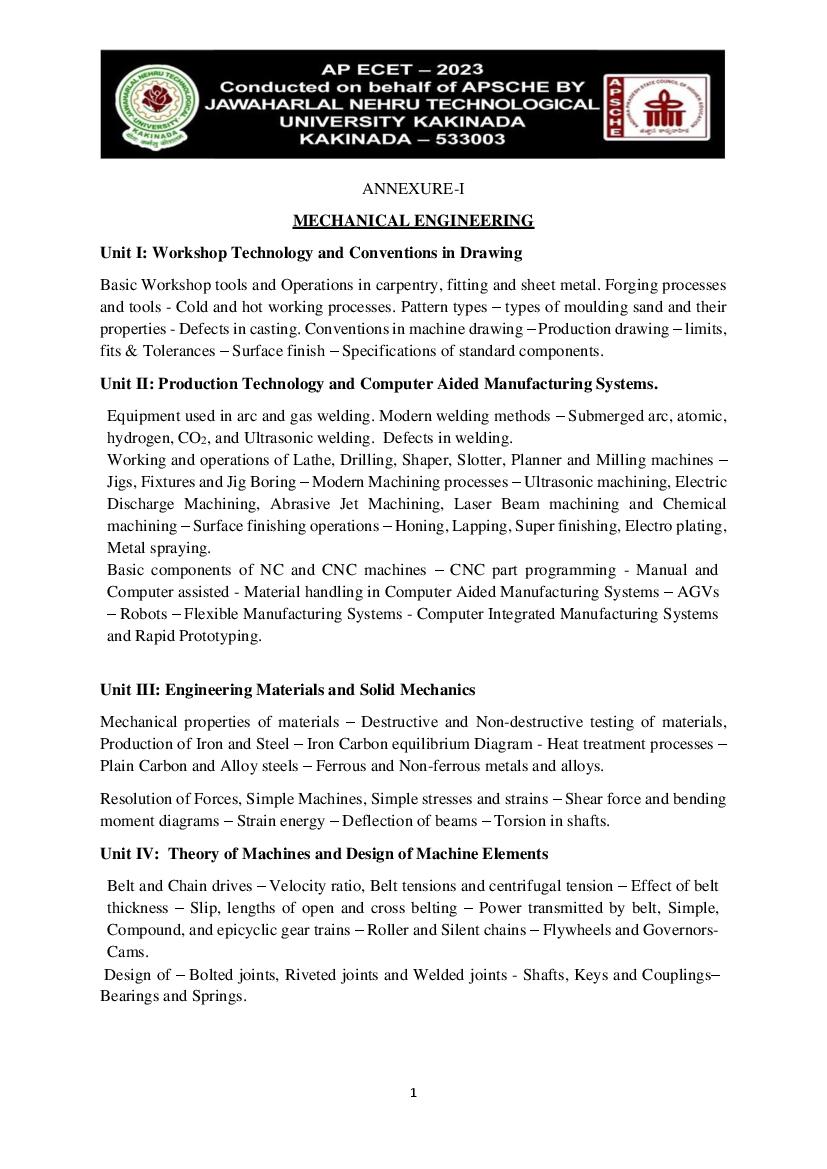
MECHANICAL ENGINEERING
Unit I: Workshop Technology and Conventions in Drawing
Basic Workshop tools and Operations in carpentry, fitting and sheet metal. Forging processes
and tools - Cold and hot working processes. Pattern types – types of moulding sand and their
properties - Defects in casting. Conventions in machine drawing – Production drawing – limits,
fits & Tolerances – Surface finish – Specifications of standard components.
Unit II: Production Technology and Computer Aided Manufacturing Systems.
Equipment used in arc and gas welding. Modern welding methods – Submerged arc, atomic,
hydrogen, CO2, and Ultrasonic welding. Defects in welding.
Working and operations of Lathe, Drilling, Shaper, Slotter, Planner and Milling machines –
Jigs, Fixtures and Jig Boring – Modern Machining processes – Ultrasonic machining, Electric
Discharge Machining, Abrasive Jet Machining, Laser Beam machining and Chemical
machining – Surface finishing operations – Honing, Lapping, Super finishing, Electro plating,
Metal spraying.
Basic components of NC and CNC machines – CNC part programming - Manual and
Computer assisted - Material handling in Computer Aided Manufacturing Systems – AGVs
– Robots – Flexible Manufacturing Systems - Computer Integrated Manufacturing Systems
and Rapid Prototyping.
Unit III: Engineering Materials and Solid Mechanics
Mechanical properties of materials – Destructive and Non-destructive testing of materials,
Production of Iron and Steel – Iron Carbon equilibrium Diagram - Heat treatment processes –
Plain Carbon and Alloy steels – Ferrous and Non-ferrous metals and alloys.
Resolution of Forces, Simple Machines, Simple stresses and strains – Shear force and bending
moment diagrams – Strain energy – Deflection of beams – Torsion in shafts.
Unit IV: Theory of Machines and Design of Machine Elements
Belt and Chain drives – Velocity ratio, Belt tensions and centrifugal tension – Effect of belt
thickness – Slip, lengths of open and cross belting – Power transmitted by belt, Simple,
Compound, and epicyclic gear trains – Roller and Silent chains – Flywheels and Governors-
Cams.
Design of – Bolted joints, Riveted joints and Welded joints - Shafts, Keys and Couplings–
Bearings and Springs.
1
Page 2
Basic thermodynamics and Laws of Perfect gases, Thermodynamic processes, Air standard
Cycles, fuels and combustion, I.C Engines - Two and Four stroke engines – Petrol and Diesel
engines, Indicated and brake powers, Indicated and Brake thermal efficiencies, Air
Compressors, Gas turbines and Jet propulsion.
Unit VI: Hydraulics and Fluid Power Systems
Basics of Fluid mechanics, Fluid Statics, Fluid Kinematics and Dynamics-Flow through
pipes, Impact of Jets, Hydraulic turbines, Working principles and operation of reciprocating
and centrifugal pumps, Hydraulic and pneumatic Circuit devices- Valves and Actuators.
Unit VII: Steam Boilers, Nozzles, Turbines and Condensers
Properties of Steam, Working, Performance of Boilers, Steam nozzles, Condition for
maximum discharge – steam turbines – classification, Velocity diagrams for single stage
impulse turbine and Reaction turbine- Steam Condensers.
Unit VIII: Refrigeration and Air Conditioning
Methods of refrigeration, Cycles and Analysis - Air, Vapor Compression and Vapor
Absorption refrigeration, Refrigeration equipment – Air Conditioning and Psychrometry –
Air Conditioning Equipment and Applications of Air Conditioning.
Unit IX: Industrial Management and Engineering
Work study, Inspection and SQC - Estimation and Costing – Basics of Industrial
management, organization structures and behaviour, Production and materials management,
Maintenance Management and Industrial Safety, Entrepreneurial development, Principles of
ISO 9000.
Unit X: Energy Sources and Power Plant Engineering
Types of Renewable energy sources – Solar energy – Wind energy – Fuel cells – MHD
generator – Bio energy – Tidal energy – Thermal power plants - layout, important elements
in layout and supporting activities- Nuclear Power Plants – Nuclear Energy chain reaction,
Nuclear fuels, Working Principle of Nuclear reactor such as PWR and BWR.
2
Page 3
Number of questions to be set (each question carries one mark)MECHANICAL
ENGINEERING
UNIT TOPIC MARKS
NO S
I Workshop Technology and Conventions in drawing 12
Production Technology and Computer Aided
II 15
Manufacturing Systems.
III Engineering Materials and Solid Mechanics 12
IV Theory of Machines and Design of Machine Elements 11
V Thermodynamics and Heat Power Engineering 12
VI Hydraulics and Fluid Power Systems 09
VII Steam Boilers, Nozzles, Turbines and Condensers 10
VIII Refrigeration and Air Conditioning 05
IX Industrial Management and Engineering 08
X Energy Sources and Power Plant Engineering 06
100
3
Page 4
MODEL QUESTIONS FOR MECHANICAL ENGINEERING
1. Speed Control Valves are
1. Flow Control Valves
2. Pressure regulating Valves
3. Non – Return Valves
4. Direction Control Valves
2. A simply supported beam has a uniformly distributed load on it. The
bendingmovement diagram is in the form of
1. Rectangle
2. Triangle
3. Parabola
4. Semicircle
3. The first law of Thermodynamics deals with conservation of
1. Velocity
2. Mass
3. Momentum
4. Energy
4
Document Details
| Board / Org | APSCHE |
| Exam | Andhra Pradesh Engineering Common Entrance Test |
| Type | Syllabus |
| Pages | 4 |
| Updated | 22 Jul 2026 |