AP ECET 2023 Syllabus for Metallurgical Engineering
Finished viewing? Save it for later —
Download AP ECET 2023 Syllabus for Metallurgical Engineering (PDF · 4 pages)About AP ECET 2023 Syllabus for Metallurgical Engineering
AP ECET 2023 Syllabus for Metallurgical Engineering is available here for free download. Published by APSCHE for Andhra Pradesh Engineering Common Entrance Test, this syllabus can be viewed online or downloaded as a PDF (4 pages). Candidates preparing for Andhra Pradesh Engineering Common Entrance Test can use AP ECET 2023 Syllabus for Metallurgical Engineering to understand the exam pattern, the type of questions asked, and the overall difficulty level.
Frequently Asked Questions
How can I download AP ECET 2023 Syllabus for Metallurgical Engineering?
Open this page and click the Download button to save AP ECET 2023 Syllabus for Metallurgical Engineering as a PDF. It is completely free on AglaSem Docs.
Is AP ECET 2023 Syllabus for Metallurgical Engineering free to download?
Yes. AP ECET 2023 Syllabus for Metallurgical Engineering can be viewed online and downloaded as a PDF free of cost on AglaSem Docs.
How many pages does AP ECET 2023 Syllabus for Metallurgical Engineering have?
AP ECET 2023 Syllabus for Metallurgical Engineering contains 4 pages, which you can read online or download together as a single PDF.
Where can I find more Andhra Pradesh Engineering Common Entrance Test study material?
You can find more Andhra Pradesh Engineering Common Entrance Test question papers, sample papers, syllabus, and answer keys on AglaSem Docs.
AP ECET 2023 Syllabus for Metallurgical Engineering – Text
Read the full text of this syllabus below — useful to quickly search, copy and reference the content online without downloading the PDF.
📄 View text version (4 pages)
Page 1
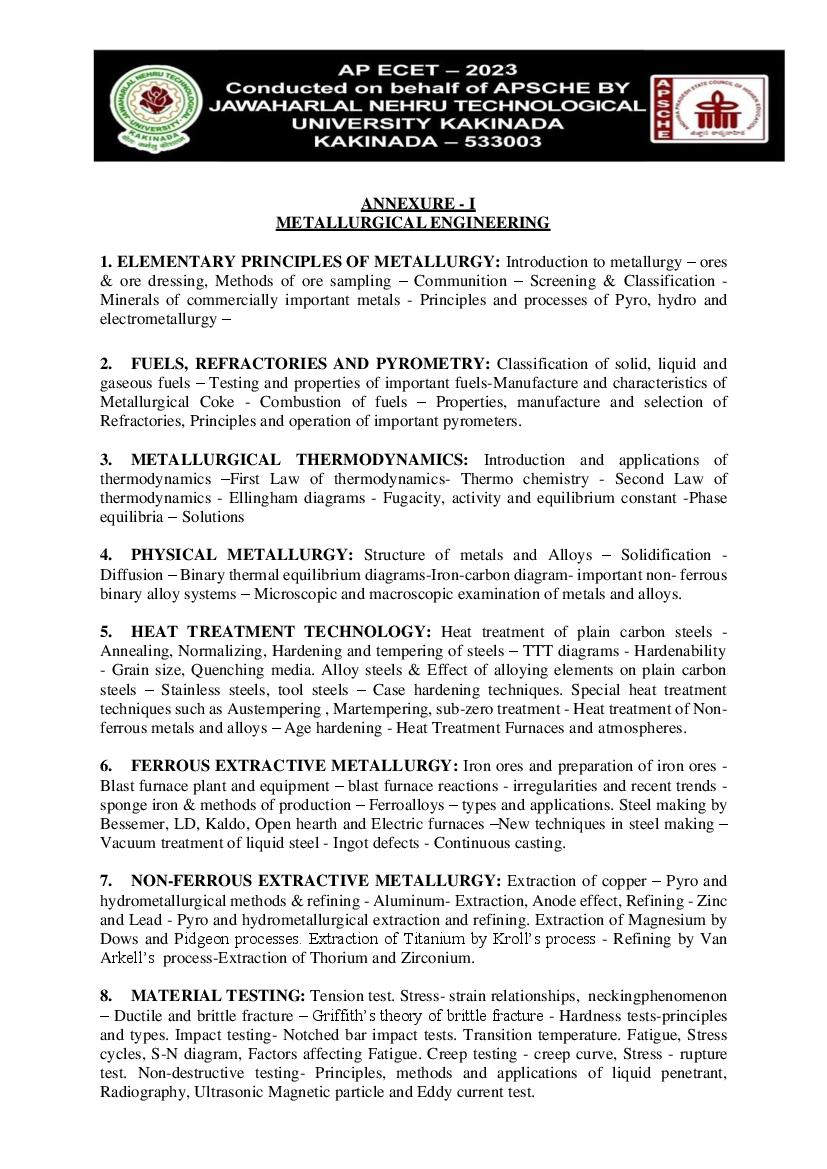
1. ELEMENTARY PRINCIPLES OF METALLURGY: Introduction to metallurgy – ores
& ore dressing, Methods of ore sampling – Communition – Screening & Classification -
Minerals of commercially important metals - Principles and processes of Pyro, hydro and
electrometallurgy –
2. FUELS, REFRACTORIES AND PYROMETRY: Classification of solid, liquid and
gaseous fuels – Testing and properties of important fuels-Manufacture and characteristics of
Metallurgical Coke - Combustion of fuels – Properties, manufacture and selection of
Refractories, Principles and operation of important pyrometers.
3. METALLURGICAL THERMODYNAMICS: Introduction and applications of
thermodynamics –First Law of thermodynamics- Thermo chemistry - Second Law of
thermodynamics - Ellingham diagrams - Fugacity, activity and equilibrium constant -Phase
equilibria – Solutions
4. PHYSICAL METALLURGY: Structure of metals and Alloys – Solidification -
Diffusion – Binary thermal equilibrium diagrams-Iron-carbon diagram- important non- ferrous
binary alloy systems – Microscopic and macroscopic examination of metals and alloys.
5. HEAT TREATMENT TECHNOLOGY: Heat treatment of plain carbon steels -
Annealing, Normalizing, Hardening and tempering of steels – TTT diagrams - Hardenability
- Grain size, Quenching media. Alloy steels & Effect of alloying elements on plain carbon
steels – Stainless steels, tool steels – Case hardening techniques. Special heat treatment
techniques such as Austempering , Martempering, sub-zero treatment - Heat treatment of Non-
ferrous metals and alloys – Age hardening - Heat Treatment Furnaces and atmospheres.
6. FERROUS EXTRACTIVE METALLURGY: Iron ores and preparation of iron ores -
Blast furnace plant and equipment – blast furnace reactions - irregularities and recent trends -
sponge iron & methods of production – Ferroalloys – types and applications. Steel making by
Bessemer, LD, Kaldo, Open hearth and Electric furnaces –New techniques in steel making –
Vacuum treatment of liquid steel - Ingot defects - Continuous casting.
7. NON-FERROUS EXTRACTIVE METALLURGY: Extraction of copper – Pyro and
hydrometallurgical methods & refining - Aluminum- Extraction, Anode effect, Refining - Zinc
and Lead - Pyro and hydrometallurgical extraction and refining. Extraction of Magnesium by
Dows and Pidgeon processes. Extraction of Titanium by Kroll’s process - Refining by Van
Arkell’s process-Extraction of Thorium and Zirconium.
8. MATERIAL TESTING: Tension test. Stress- strain relationships, neckingphenomenon
– Ductile and brittle fracture – Griffith’s theory of brittle fracture - Hardness tests-principles
and types. Impact testing- Notched bar impact tests. Transition temperature. Fatigue, Stress
cycles, S-N diagram, Factors affecting Fatigue. Creep testing - creep curve, Stress - rupture
test. Non-destructive testing- Principles, methods and applications of liquid penetrant,
Radiography, Ultrasonic Magnetic particle and Eddy current test.
Page 2
Slip and Twinning - CRSS –Strengthening mechanisms. Strain hardening - Hot and Cold
working - Recovery, recrystallisation and grain growth. Metal forming processes-Rolling,
Forging, Extrusion & Sheet metal forming processes and defects – Powder metallurgy.
Methods of powder production, Characterization, Compaction, Sintering and applications of
Powder Metallurgy.
10. FOUNDRY TECHNOLOGY: Types of foundries – Basic steps in casting - Patterns:
Types, materials and pattern allowances, Moulding Sands - properties and Testing, Moulding
Processes and equipment: Sand casting, Die casting, Shell moulding, Centrifugal casting,
Investment casting and CO2 process-Cores: Types of Cores and properties, pouring and feeding
of castings. Cast irons – types - Melting of Cast irons - Grey, S.G and Malleable iron. Aluminium,
Copper and Steel Foundry practices. Defects in Castings. Cleaning & Salvage of Castings.
11. WELDING TECHNOLOGY: Basic concepts of Welding - Principles and processes of
various welding techniques such as Oxy-acetylene, Arc welding, Inert gas welding- TIG and
MIG - Special welding processes- Plasma, resistance, electro slag, electron beam, thermit and
Laser. Soldering and brazing– Weldability, factors affecting weldability – Heat affected Zone,
Microstructure – Post weld treatments –Welding defects –Inspection andtesting.
Page 3
Number of question to be set Unit wise (Total 100)
UNIT NO TOPICS MARKS
ELEMENTARY PRINCIPLES OF
I 06
METALLURGY
FUELS, REFRACTORIES AND
II 05
PYROMETRY
III METALLURGICAL THERMODYNAMICS 08
IV PHYSICAL METALLURGY 11
V HEAT TREATMENT TECHNOLOGY 12
VI FERROUS EXTRACTIVE METALLURGY 12
NON-FERROUS EXTRACTIVE
VII 10
METALLURGY
VIII MATERIAL TESTING 08
IX MECHANICAL METALLURGY 10
X FOUNDRY TECHNOLOGY 10
XI WELDING TECHNOLOGY 08
Total 100
Page 4
MODEL QUESTIONS FOR METALLURGICAL ENGINEERING
1. Rawmaterial for production of Aluminium is -------
1) Bauxite
2) Cryolite
3) Alumina
4) Gibbsite
2. No of slip systems in FCC structure
1) 12
2) 48
3) 16
4) 03
3. ASTM grain size is measured by------ formula
1) N=2 n-1
2)n=2N-1
3) N=2n-1
4)n=2N-1
4. In proximate analysis of coal is determined.
1) Hydrogen, Nitrogen, Oxygen & Carbon
2) Moisture, ash, Volatile matter & carbon
3) Hydrogen, ash, Oxygen & Carbon
4) Sulphure, Moisture & Carbon.
5. In Iso-thermal process
1) dp=0
2) dt=0
3) dq=0
4) dv=0
6. In LD Process Oxygen is released through the lance at a pressure of .
1) 150-175 psi
2) 100-150 psi
3) 200-250 psi
4) <100 psi
Document Details
| Board / Org | APSCHE |
| Exam | Andhra Pradesh Engineering Common Entrance Test |
| Type | Syllabus |
| Pages | 4 |
| Updated | 22 Jul 2026 |