NIOS Class 12 Sample Paper 2023 Sociology
Finished viewing? Save it for later —
Download NIOS Class 12 Sample Paper 2023 Sociology (PDF · 6 pages)About NIOS Class 12 Sample Paper 2023 Sociology
NIOS Class 12 Sample Paper 2023 Sociology is available here for free download. Published by NIOS for National Institute of Open Schooling Class 12, this sample paper can be viewed online or downloaded as a PDF (6 pages). Candidates preparing for National Institute of Open Schooling Class 12 can use NIOS Class 12 Sample Paper 2023 Sociology to understand the exam pattern, the type of questions asked, and the overall difficulty level.
Frequently Asked Questions
How can I download NIOS Class 12 Sample Paper 2023 Sociology?
Open this page and click the Download button to save NIOS Class 12 Sample Paper 2023 Sociology as a PDF. It is completely free on AglaSem Docs.
Is NIOS Class 12 Sample Paper 2023 Sociology free to download?
Yes. NIOS Class 12 Sample Paper 2023 Sociology can be viewed online and downloaded as a PDF free of cost on AglaSem Docs.
How many pages does NIOS Class 12 Sample Paper 2023 Sociology have?
NIOS Class 12 Sample Paper 2023 Sociology contains 6 pages, which you can read online or download together as a single PDF.
Where can I find more National Institute of Open Schooling Class 12 study material?
You can find more National Institute of Open Schooling Class 12 question papers, sample papers, syllabus, and answer keys on AglaSem Docs.
NIOS Class 12 Sample Paper 2023 Sociology – Text
Read the full text of this sample paper below — useful to quickly search, copy and reference the content online without downloading the PDF.
📄 View text version (5 pages)
Page 1
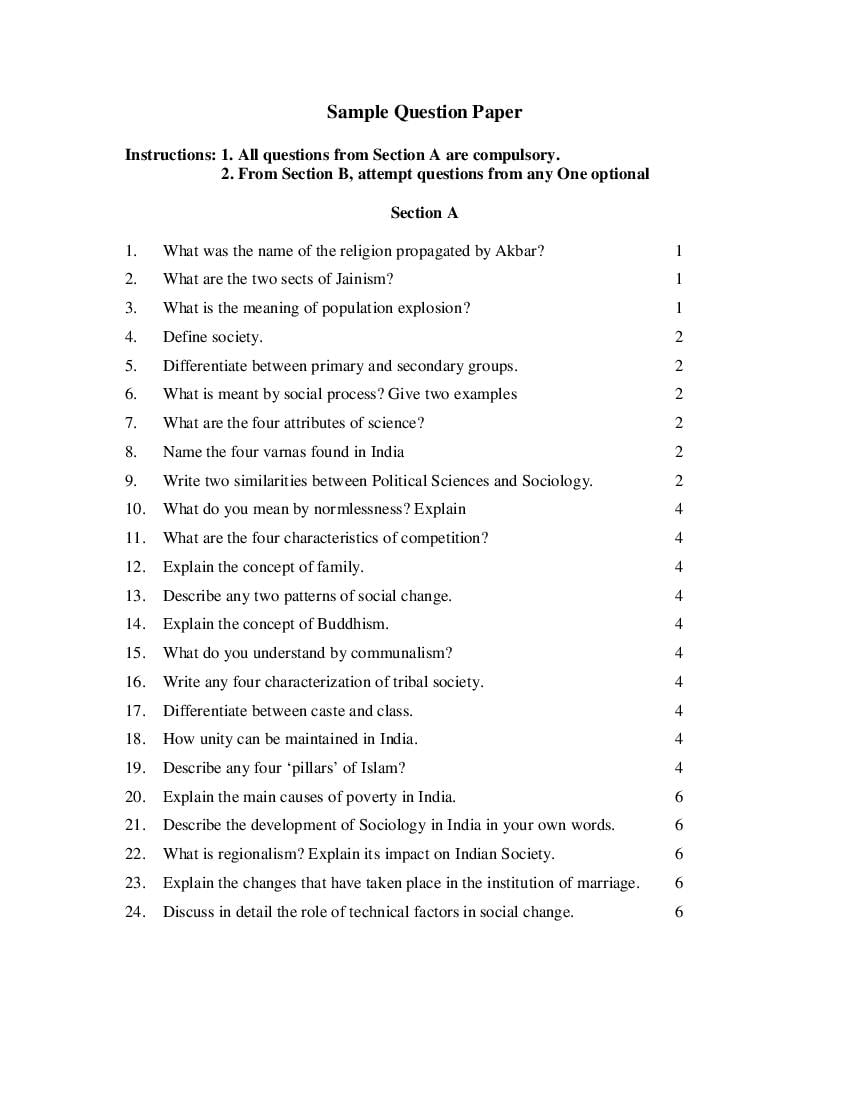
Instructions: 1. All questions from Section A are compulsory.
2. From Section B, attempt questions from any One optional
Section A
1. What was the name of the religion propagated by Akbar? 1
2. What are the two sects of Jainism? 1
3. What is the meaning of population explosion? 1
4. Define society. 2
5. Differentiate between primary and secondary groups. 2
6. What is meant by social process? Give two examples 2
7. What are the four attributes of science? 2
8. Name the four varnas found in India 2
9. Write two similarities between Political Sciences and Sociology. 2
10. What do you mean by normlessness? Explain 4
11. What are the four characteristics of competition? 4
12. Explain the concept of family. 4
13. Describe any two patterns of social change. 4
14. Explain the concept of Buddhism. 4
15. What do you understand by communalism? 4
16. Write any four characterization of tribal society. 4
17. Differentiate between caste and class. 4
18. How unity can be maintained in India. 4
19. Describe any four ‘pillars’ of Islam? 4
20. Explain the main causes of poverty in India. 6
21. Describe the development of Sociology in India in your own words. 6
22. What is regionalism? Explain its impact on Indian Society. 6
23. Explain the changes that have taken place in the institution of marriage. 6
24. Discuss in detail the role of technical factors in social change. 6
Page 2
Option – I
(Status of Women)
25. What is feminism? 1
26. Distinguish between sex and gender 2
27. What is meant by women’s movement? 2
28. Write a note on sexual harassment at the work place? 4
29. Write about the status of women in medieval period. 6
Option – II
Culture
25. Name the four Vedas. 1
26. What are the two characteristics of culture? 2
27. What is the meaning of Cultural Heritage? 2
28. Explain the concept cultural lag with examples. 4
29. Explain the positive and negative impact of television. 6
Page 3
Section A
1. Din-e-ilahi 1
2. Digambara and Svetambara ½ + ½ =1
3. Increase in population at alarming rate (because of higher birth rate and lower death
rate) 1
4. Web of social relations and ever changing. 1+1=2
5. Direct and personnel relations.
Indirect and impersonal relations.( Any other) 1+1=2
6. Modes of interaction between individuals or groups. Example – cooperation;
conflict, integration etc. 1+ ½+½=2
7. Theoretical; empirical; cumulative and non-ethical. ½x4=2
8. Brahmin
Kshatriya
Vaish
Sudhra ½x4=2
9. Similarities: (1) Both for welfare of society
(2) Scope of study in both is society and its units. 1+1=2
10. Detachment from existing social norms or rules. 1+3=4
11. 1. Impersonal struggle
2. Unconscious activity – at times conscious also
3. Universal
4. Conducive to progress (any other). 1x4=4
12. (i) Basic Units of society. (ii) Minimal form may consist of husband, wife and
children. (iii) In widest sense generations connected by blood, marriage or adoption
(Any four) 1x4=4
13. Linear change;
Cyclical change;
Fluctuating change; (Any two) 2x2=4
14. Enlightened – One who has attained knowledge of life. Particular of life that would
lead to salvation. 4
15. Placing ones own community above others,
Hatred for other religion, fanatism etc. 4
Page 4
Live in forests and hilly area;
Own culture, folklore, belief system
Economically self-sufficient (Any other) 1x4=4
18. Caste Class
Hereditary Non-hereditary
Endogamy Exogamy and endogamy 1x4=4
Based ritual criteria Secular criteria
Close system open system
(Any other)
19. 1. By sacrificing personal interests 1x4=4
2. Tolerance
3. Creating awareness
4. Plural society
(Any other)
20. 1. Muhammed is God’s Prophet 1x4=4
2. Praying 5 times a day
3. Zakat
4. Fasting during Ramadan
5. Performing Haj.
(Any four)
21. (i) Social; (ii) economic, (iii) political, (iv) religions, (v) natural, (vi) physical, (vii)
illiteracy (viii) population explosion. (Any 6) 6
22. Foundation of sociology 1½ x4 =6
From 1769-1900;
From 1901-1950;
Third phase after India’s independence.
(As a whole).
23. Strong feeling of unity among the people of a region based on language, culture
and economic interests.
Impact: Division among different people, violence, favoritism and bias etc.
2+4=6
24. (i) From polygamy to monogamy (ii) inter-caste and inter-religious marriage;
(iii) decrease role of parents in mate selection; (iv) merit of boy or girl important; (v)
higher age of marriage; (vi) easier divorces. (Any other) 1x6=6
25. (i) Modifies customs and traditions; (ii) changes in material materials things;
(iii) division of labours (iv) specialization; (v) manual labour replaced;
(vi) changed quality of production. etc. (Any other) 1x6=6
Page 5
Option – I
(Status of Women)
25. An ideology which recognizes the existence of gender inequality and protest
against the same. 1
26. Sex-biological; Gender-social construct. 1+1=2
27. Struggles launched by groups or individual for the liberation of women from
social evils and for establishing equality among men and women. 2
28. Violence which women face in their work place. e.g.
a. Physical contact or advancing in such a manner as to suggest sexual
contact;
b. Coercion or request for sexual favors
c. Use of sexist language
d. Display of Pornographic literature
e. Any physical or oral act, which includes unwanted sexual elements.
(Any four)
1x4=4
29. (i) Purdha system; (ii) seclusion; (iii) sati; (iv) child marriage;(v) ill treatment of
widows; (vi) deprived of education; (vii) low status; 6
Option II
Culture
25. Rig; Yajur; Sama and Athara ¼ x4=1
26. Universal; stable yet dynamoic; learned behaviour; (Any other/two only)
1x2=2
27. The items of culture which are inherited by posterity collectively. 2
28. Ideas, Values and norms & beliefs do not keep pase with changes in
technology of society. 3+1=4
29. Positive: Informative; educative; entertainment; knowledge and
understanding;
Negative: Exposure to sensuality; criminal items; westage of time – affects
studies of students; crime and violence shown. 3+3=6
Document Details
| Board / Org | NIOS |
| Exam | National Institute of Open Schooling Class 12 |
| Type | Sample Paper |
| Pages | 6 |
| Updated | 22 Jul 2026 |