ISC Class 12 Specimen Paper 2022 Physics Semester 2
Finished viewing? Save it for later —
Download ISC Class 12 Specimen Paper 2022 Physics Semester 2 (PDF · 5 pages)About ISC Class 12 Specimen Paper 2022 Physics Semester 2
ISC Class 12 Specimen Paper 2022 Physics Semester 2 is available here for free download. Published by CISCE for Class 12, this sample paper can be viewed online or downloaded as a PDF (5 pages). Candidates preparing for Class 12 can use ISC Class 12 Specimen Paper 2022 Physics Semester 2 to understand the exam pattern, the type of questions asked, and the overall difficulty level.
Frequently Asked Questions
How can I download ISC Class 12 Specimen Paper 2022 Physics Semester 2?
Open this page and click the Download button to save ISC Class 12 Specimen Paper 2022 Physics Semester 2 as a PDF. It is completely free on AglaSem Docs.
Is ISC Class 12 Specimen Paper 2022 Physics Semester 2 free to download?
Yes. ISC Class 12 Specimen Paper 2022 Physics Semester 2 can be viewed online and downloaded as a PDF free of cost on AglaSem Docs.
How many pages does ISC Class 12 Specimen Paper 2022 Physics Semester 2 have?
ISC Class 12 Specimen Paper 2022 Physics Semester 2 contains 5 pages, which you can read online or download together as a single PDF.
Where can I find more Class 12 study material?
You can find more Class 12 question papers, sample papers, syllabus, and answer keys on AglaSem Docs.
ISC Class 12 Specimen Paper 2022 Physics Semester 2 – Text
Read the full text of this sample paper below — useful to quickly search, copy and reference the content online without downloading the PDF.
📄 View text version (5 pages)
Page 1
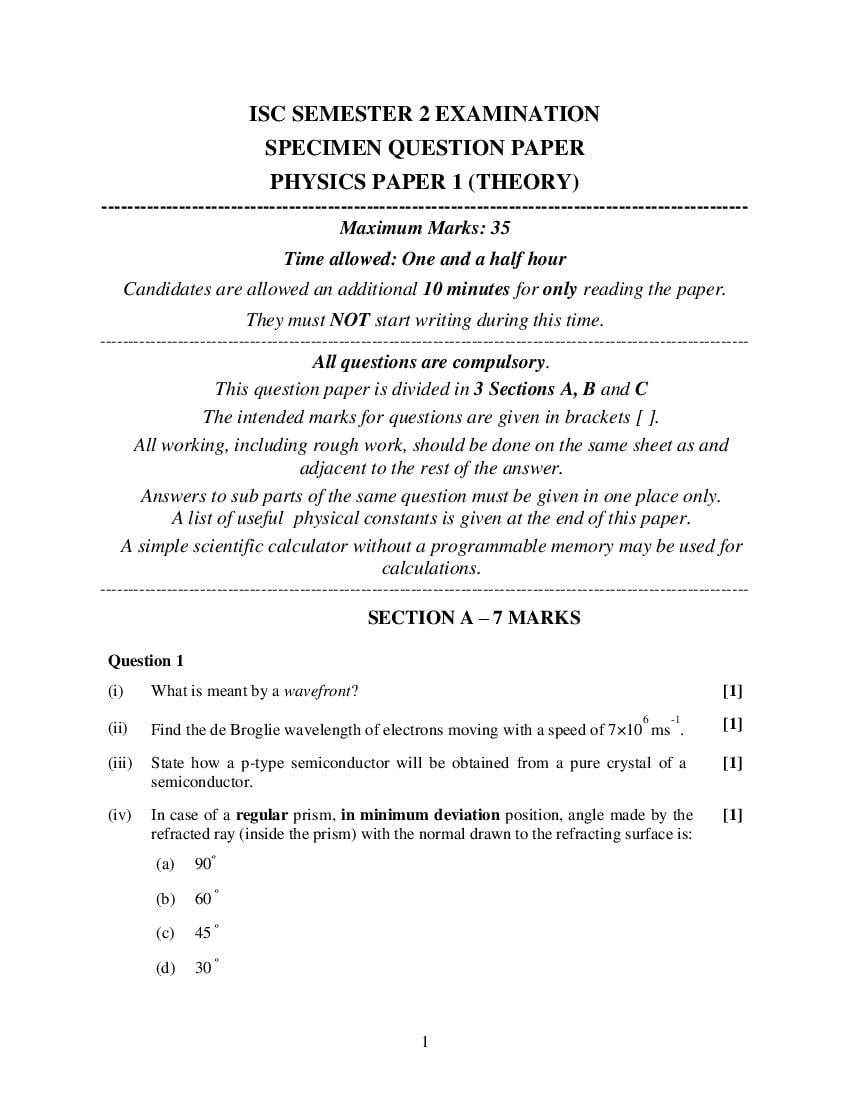
SPECIMEN QUESTION PAPER
PHYSICS PAPER 1 (THEORY)
----------------------------------------------------------------------------------------------------
Maximum Marks: 35
Time allowed: One and a half hour
Candidates are allowed an additional 10 minutes for only reading the paper.
They must NOT start writing during this time.
---------------------------------------------------------------------------------------------------------------------
All questions are compulsory.
This question paper is divided in 3 Sections A, B and C
The intended marks for questions are given in brackets [ ].
All working, including rough work, should be done on the same sheet as and
adjacent to the rest of the answer.
Answers to sub parts of the same question must be given in one place only.
A list of useful physical constants is given at the end of this paper.
A simple scientific calculator without a programmable memory may be used for
calculations.
---------------------------------------------------------------------------------------------------------------------
SECTION A – 7 MARKS
Question 1
(i) What is meant by a wavefront? [1]
6 -1
(ii) Find the de Broglie wavelength of electrons moving with a speed of 7×10 ms . [1]
(iii) State how a p-type semiconductor will be obtained from a pure crystal of a [1]
semiconductor.
(iv) In case of a regular prism, in minimum deviation position, angle made by the [1]
refracted ray (inside the prism) with the normal drawn to the refracting surface is:
(a) 90º
(b) 60 º
(c) 45 º
(d) 30 º
1
Page 2
are brought closer to each other?
(a) Fringes disappear.
(b) Fringe width increases.
(c) Fringe width decreases.
(d) Fringe width remains unaltered.
(vi) First line of Balmer series (Hα) in the spectrum of hydrogen is obtained when an [1]
electron of hydrogen atom goes from:
(a) 2nd orbit to 1st orbit
(b) 2nd orbit to 3rd orbit
(c) 3rd orbit to 2nd orbit
(d) 3rd orbit to 1st orbit
(vii) Which of the following graphs correctly represents the variation of maximum [1]
kinetic energy (Ek) of photoelectrons with the frequency (𝜈) of the incident
radiation?
(a)
(b)
(c)
(d)
2
Page 3
Question 2 [2]
(i) What is meant by Constructive interference?
(ii) In Young’s double slit experiment, what should be the phase difference between
the two overlapping waves to obtain 5th dark band/fringe on the screen?
Question 3 [2]
(i) A thin converging lens of focal length 5cm is used as a simple microscope.
Calculate its magnifying power when image formed lies at:
(a) Infinity.
(b) Least distance of distinct vision (D = 25 cm).
OR
(ii) A thin converging lens of focal length 12cm is kept in contact with a thin
diverging lens of focal length 18cm. Calculate the effective/equivalent
focal length of the combination.
Question 4 [2]
(i) Define angular dispersion.
(ii) State any one difference between a primary rainbow and a secondary rainbow.
Question 5 [2]
Explain the following terms:
(i) Intrinsic semiconductor.
(ii) Extrinsic semiconductor.
Question 6 [2]
(i) Calculate maximum kinetic energy of photoelectrons emitted by a metal
(work function = 1·5eV) when it is illuminated with light of wavelength 198 nm.
OR
(ii) Calculate the minimum amount of energy which a gamma ray photon should
have for the production of an electron and a positron pair.
3
Page 4
Question 7 [3]
(i) In a single slit diffraction experiment, how does the angular width of the central
maxima change when:
(a) screen is moved away from the plane of the slit?
(b) width of the slit is increased?
(c) light of larger wavelength is used?
OR
(ii) Using Huygen’s wave theory of light, prove Snell’s law of refraction of light.
Question 8 [3]
Draw a ray diagram of a refracting astronomical telescope when final image is formed
at infinity. Also write the expression for its angular magnification (magnifying power).
Question 9 [3]
Radius of curvature of an equi – convex lens of glass (n = 1·5) is 30 cm. Find its focal
length. An object of height 5·0 cm is placed at a distance of 60 cm from the optical
centre of the lens. Find the position and the height of the image formed.
Question 10 [3]
On the basis of Bohr’s theory, derive an expression for the radius of the nth orbit of an
electron of hydrogen atom.
Question 11 [3]
Read the passage given below and answer the questions that follow.
Mr. Ravi had been living in a small town with his family for many years. He decided to
shift to a city when he learnt that a nuclear power plant would be built in his town. His
son Prakash, who was a science teacher, did not agree with his father’s decision.
Prakash explained to his father how mass defect during nuclear fission released energy.
He assured his father that the authorities were taking all the possible safety measures to
avoid any kind of nuclear mishap. Mr. Ravi understood the scientific explanation given
by his son and decided not to shift to another place.
(i) What is the cause of energy generation of a nuclear reactor during nuclear
fission?
4
Page 5
reactor.
(iii) Give the formula for the energy generation that takes place in the nuclear reactor.
Question 12 [3]
(i) Answer the following questions.
(a) Draw the circuit diagram of a full wave rectifier.
(b) Draw labelled graphs showing the input and output voltages.
OR
(ii) With reference to Semiconductor Physics,
(a) Name the diode that emits spontaneous radiation when forward biased.
(b) Draw a labelled energy band diagram for a semiconductor.
(c) Name the process that causes depletion region in a p-n junction.
Useful Constants & Relations:
1 Mass of electron/positron m 9·1 × 10-31 kg
2 Charge of an electron e 1·6 × 10-19 C
3 Speed of light in vacuum c 3·0 × 108 ms-1
4 Planck’s constant h 6·6 × 10-34 Js
5 1nm = 1 × 10⁻⁹ m
6 1eV = 1·6 × 10-19 J
5
Document Details
| Board / Org | CISCE |
| Exam | Class 12 |
| Type | Sample Paper |
| Pages | 5 |
| Language | english |
| Updated | 30 Apr 2026 |