PSEB 11th Class Syllabus 2027 Economics
Finished viewing? Save it for later —
Download PSEB 11th Class Syllabus 2027 Economics (PDF · 5 pages)About PSEB 11th Class Syllabus 2027 Economics
PSEB 11th Class Syllabus 2027 Economics is available here for free download. Published by Punjab Board for Class 11, this syllabus can be viewed online or downloaded as a PDF (5 pages). Candidates preparing for Class 11 can use PSEB 11th Class Syllabus 2027 Economics to understand the exam pattern, the type of questions asked, and the overall difficulty level.
Frequently Asked Questions
How can I download PSEB 11th Class Syllabus 2027 Economics?
Open this page and click the Download button to save PSEB 11th Class Syllabus 2027 Economics as a PDF. It is completely free on AglaSem Docs.
Is PSEB 11th Class Syllabus 2027 Economics free to download?
Yes. PSEB 11th Class Syllabus 2027 Economics can be viewed online and downloaded as a PDF free of cost on AglaSem Docs.
How many pages does PSEB 11th Class Syllabus 2027 Economics have?
PSEB 11th Class Syllabus 2027 Economics contains 5 pages, which you can read online or download together as a single PDF.
Where can I find more Class 11 study material?
You can find more Class 11 question papers, sample papers, syllabus, and answer keys on AglaSem Docs.
PSEB 11th Class Syllabus 2027 Economics – Text
Read the full text of this syllabus below — useful to quickly search, copy and reference the content online without downloading the PDF.
📄 View text version (6 pages)
Page 1
PSEB 11th Class
Syllabus 2027
Economics
EXAM YEAR TYPE SUBJECT
Punjab Class 11 2027 Syllabus Economics
Notes · Sample Papers · Previous Year Papers · Mock Tests
Page 2
m c. o
em l a s
s ag
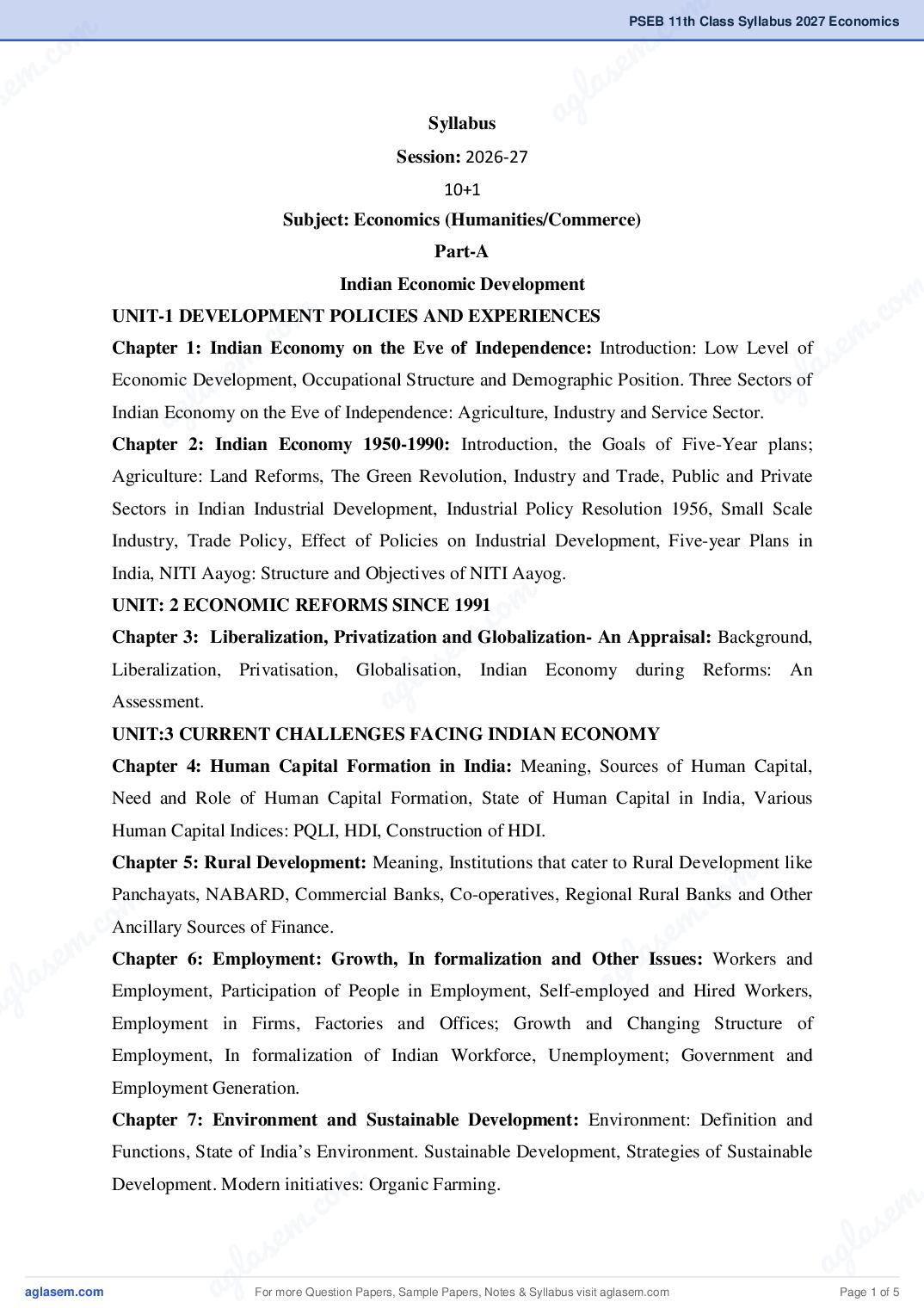
Syllabus
Session: 2026-27
10+1
Subject: Economics (Humanities/Commerce)
Part-A
m
.co
Indian Economic Development
m
UNIT-1 DEVELOPMENT POLICIES AND EXPERIENCES
em
Chapter 1: Indian Economy on the Eve of Independence: Introduction: Low Level of
l a s a g
ag
Economic Development, Occupational Structure and Demographic Position. Three Sectors of
Indian Economy on the Eve of Independence: Agriculture, Industry and Service Sector.
Chapter 2: Indian Economy 1950-1990: Introduction, the Goals of Five-Year plans;
Agriculture: Land Reforms, The Green Revolution, Industry and Trade, Public and Private
Sectors in Indian Industrial Development, Industrial Policy Resolution 1956, Small Scale
Industry, Trade Policy, Effect of Policies on Industrial Development, Five-year Plans in
m
India, NITI Aayog: Structure and Objectives of NITI Aayog.
UNIT: 2 ECONOMIC REFORMS SINCE 1991
. c o
s Indian Economy during Reforms: An
Chapter 3: Liberalization, Privatization and Globalization- An Appraisal: Background,
l a
ag
Liberalization, Privatisation, Globalisation,
Assessment.
UNIT:3 CURRENT CHALLENGES FACING INDIAN ECONOMY
Chapter 4: Human Capital Formation in India: Meaning, Sources of Human Capital,
Need and Role of Human Capital Formation, State of Human Capital in India, Various
Human Capital Indices: PQLI, HDI, Construction of HDI.
m
Chapter 5: Rural Development: Meaning, Institutions that cater to Rural Development like
m c. o
c. oAncillary Sources of Finance. m
Panchayats, NABARD, Commercial Banks, Co-operatives, Regional Rural Banks and Other
s e
s em Chapter 6: Employment: Growth, In formalization and Other g l aIssues: Workers and
gla a and Hired Workers,
a
Employment, Participation of People in Employment, Self-employed
Employment in Firms, Factories and Offices; Growth and Changing Structure of
Employment, In formalization of Indian Workforce, Unemployment; Government and
Employment Generation.
Chapter 7: Environment and Sustainable Development: Environment: Definition and
Functions, State of India’s Environment. Sustainable Development, Strategies of Sustainable
.co m
Development. Modern initiatives: Organic Farming.
m s e
se g l a
l a a
ag For more Question Papers, Sample Papers, Notes & Syllabus visit Page 1 of 5
Page 3
PUNJAB ECONOMY
UNIT 4: AN OVERVIEW OF PUNJAB ECONOMY
Chapter 1: Physical and Human Resources of Punjab: Physical Features of Punjab,
Physical Resources of Punjab: Geographical and Socio-Cultural Division of Punjab, Soils,
Water Resources, Minerals, Forest Resources, Power Resources. Human Resources of
Punjab, Size and Growth of Population, Sex Ratio, Literacy Ratio, Density of Population,
Trends in Urbanization, Occupational Distribution of Population.
Chapter 2: Agricultural and Industrial Development of Punjab: Salient Features of
Punjab’s Agriculture, Major Crops of Punjab, Agricultural Marketing in Punjab, Green
Revolution in Punjab-A Critical Assessment. Industrial Development of Punjab, Major
Industries of Punjab, Need for Industrialization in Punjab, Difficulties in the Way of
Industrialization in Punjab, Steps Taken by Government to Develop Industries in Punjab.
Chapter 3: Fiscal State of Punjab: Sources of Revenue and Expenditure of Punjab
Government, Overall Budgetary Position of Punjab Government, Public Debt of Punjab
Government.
PART-C
STATISTICS
UNIT 5: STATISTICS IN ECONOMICS
Chapter 1: Introduction: Why Economics, Statistics and Economics: What is Statistics,
What Statistics Does?
UNIT 6: COLLECTION, ORGANIZATION AND PRESENTATION OF DATA
Chapter 2: Collection of Data: Sources of Data, How Do We Collect the Data, Census and
Sample Surveys, Sampling and Non-Sampling Errors, Census of India and NSO.
Chapter 3: Organization of Data: Raw Data, Classification of Data, Variables: Continuous
and Discrete; What is Frequency Distribution, Bivariate Frequency Distribution.
Chapter 4: Presentation of Data: Textual Presentation of Data, Tabular Presentation of
Data, Tabulation of Data and Parts of a Table, Diagrammatic Presentation of Data.
UNIT 7: ANALYSIS OF DATA
Chapter 5: Measures of Central Tendency: Arithmetic Mean, Median, Quartile, Decile,
Percentile, Mode, Relative Position of Mean, Median and Mode.
For more Question Papers, Sample Papers, Notes & Syllabus visit Page 2 of 5
Page 4
m c. o
em l a s
s ag
Chapter 6: Correlation: Types of Correlation, Techniques for Measuring Correlation:
Scatter Diagram, Karl Pearson’s Coefficient of Correlation, Spearman’s Rank Correlation,
Appendix to Correlation.
Chapter 7: Index Numbers: What is an index number, Construction of an Index Number:
Simple Aggregative Method, Simple Average of Price Relative Method, Some Important
m
.co
Index Numbers: Consumer Price Index, Wholesale Price Index, Index of Industrial
m
Production, Human Development Index, Sensex, Issues in the Construction of an Index
em
Number, Index Number in Economics.
l a s a g
ag
Chapter 8: Use of Statistical Tools: Construction of Project Work in Economics: Various
Steps in the Construction of Project Work and Suggested List of Projects.
Developing Project in Economics
The students may be encouraged to develop projects, as per the suggested project guidelines.
Case studies of a few organisations/outlets may also be encouraged. Under this, the students
will do only ONE comprehensive project using concepts from Part A, B and C of their
syllabus.
m
Guidelines for Project Work in Economics
. co
The objectives of the project work are to enable learners to:
em
Probe deeper into theoretical concepts learnt in XI
a s
Analyse and evaluate real world economic scenarios using theoretical constructs and
arguments
g l
a
Demonstrate the learning of economic theory
Follow up aspects of Economics in which learners have interest
Develop the communication skills to argue Logically
The expectations of the project work are that:
Learners will complete ONE project and will work on one topic of Moral Values and
try to imbibe those values along with the Project Work in each academic session.
Project should be of 1000 words (excluding diagrams & graphs), preferably hand-
m
written
m
It will be an independent, self-directed piece of study
s
Role of the teacher
s em l a
The teacher plays a critical role in developing thinking skills of the learners. A teacher
la ag
should:
ag Help each learner select the topic based on recently published extracts from the news
media, government policies, RBI bulletin, NITI Aayog Reports, IMF/World Bank
Reports etc., after detailed discussions and deliberations of the topic.
Play the role of a facilitator and supervisor to monitor the project work of the learner
through periodic discussions
Guide the research work in terms of sources for the relevant data.
Educate learner about plagiarism and the importance of quoting the source of the
information to ensure authenticity of research work
.co s e m
e m l a
l a s a g
ag For more Question Papers, Sample Papers, Notes & Syllabus visit Page 3 of 5
Page 5
Arrange a presentation of the project file
Scope of the project
Learners may work upon the following lines as a suggested flow chart:
Choose a title/topic of the research problem
Set objectives of the research problem
Design of a questionnaire /Selection of Sources
Framing a sample & collection of data / material
Classification of data / material
Presentation of data/ material (with graphs and tables)
Analysis of data/ material (with various statistical techniques i.e. mean, median, SD, CV etc.)
Interpretation of data (draw the relevant conclusion from the collected data/material)
Suggestions to solve the problem
References / Bibliography
Expected Checklist
Introduction of topic/title
Identifying the causes, consequences and/or remedies
Various stakeholders and effect on each of them
Advantages and disadvantages of situations or issues identified
Short-term and long-term implications of economic strategies suggested in the course
of research.
Validity, reliability, appropriateness and relevance of data used for research work and
for presentation in the project file.
Presentation and writing that is succinct and coherent in project file
Citation of the materials referred to, in the file in footnotes, resources section,
bibliography etc.
Mode of presentation/submission of the Project
At the end of the stipulated term, each student will present the research work in the Project
File to the External and Internal examiner. The questions should be asked from the Research
Work/ Project File of the learner through viva-voce. The Internal Examiner should ensure
that the research report submitted by the learner is his/her own original work. In case of any
doubt, authenticity should be checked and verified.
Some of the examples of the projects are as follows (they are not mandatory but only
suggestive):
1. Goods and Services Tax and its impact on GDP
For more Question Papers, Sample Papers, Notes & Syllabus visit Page 4 of 5
Page 6
m c. o
em l a s
s ag
2. A critical analysis of the present year Government Budget
3. Determination of Minimum Support prices in India
4. Digital India- A step towards the future
5. Role of RBI in controlling Money Supply in India
6. Health Expenditure in India- Comparison of two or more states can be done
Moral Value Topics:
m
1. Sarv Shiksha Abhiyan- Cost benefit Analysis
m .co
2. Waste Management- A need of the Hour
3. Make in India- The way ahead
em
4. Rain water harvesting- A solution to water problem in India
l a s
5. Organic Farming- Back to the nature
a g
ag
m
. co
s em
g l a
a
m
m c. o
c. o s e m
s em l a
gla ag
a
.co s e m
e m l a
l a s a g
ag For more Question Papers, Sample Papers, Notes & Syllabus visit Page 5 of 5