JEMAS PG 2023 Question Paper M.Sc PH MCH
Finished viewing? Save it for later —
Download JEMAS PG 2023 Question Paper M.Sc PH MCH (PDF · 15 pages)About JEMAS PG 2023 Question Paper M.Sc PH MCH
JEMAS PG 2023 Question Paper M.Sc PH MCH is available here for free download. Published by WBJEEB for JEMAS PG, this question paper can be viewed online or downloaded as a PDF (15 pages). Candidates preparing for JEMAS PG can use JEMAS PG 2023 Question Paper M.Sc PH MCH to understand the exam pattern, the type of questions asked, and the overall difficulty level.
Frequently Asked Questions
How can I download JEMAS PG 2023 Question Paper M.Sc PH MCH?
Open this page and click the Download button to save JEMAS PG 2023 Question Paper M.Sc PH MCH as a PDF. It is completely free on AglaSem Docs.
Is JEMAS PG 2023 Question Paper M.Sc PH MCH free to download?
Yes. JEMAS PG 2023 Question Paper M.Sc PH MCH can be viewed online and downloaded as a PDF free of cost on AglaSem Docs.
How many pages does JEMAS PG 2023 Question Paper M.Sc PH MCH have?
JEMAS PG 2023 Question Paper M.Sc PH MCH contains 15 pages, which you can read online or download together as a single PDF.
Where can I find more JEMAS PG study material?
You can find more JEMAS PG question papers, sample papers, syllabus, and answer keys on AglaSem Docs.
JEMAS PG 2023 Question Paper M.Sc PH MCH – Text
Read the full text of this question paper below — useful to quickly search, copy and reference the content online without downloading the PDF.
📄 View text version (14 pages)
Page 1
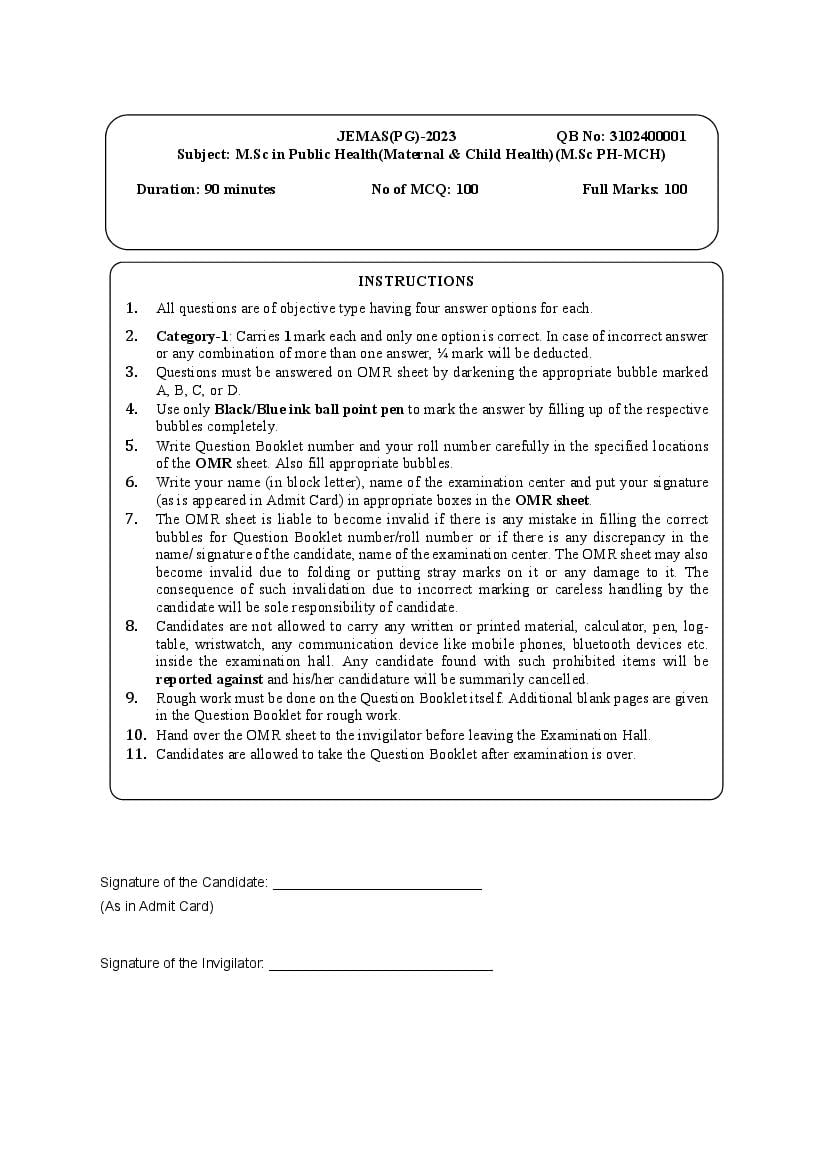
Subject: M.Sc in Public Health(Maternal & Child Health)(M.Sc PH-MCH)
Duration: 90 minutes No of MCQ: 100 Full Marks: 100
INSTRUCTIONS
1. All questions are of objective type having four answer options for each.
2. Category-1: Carries 1 mark each and only one option is correct. In case of incorrect answer
or any combination of more than one answer, ¼ mark will be deducted.
3. Questions must be answered on OMR sheet by darkening the appropriate bubble marked
A, B, C, or D.
4. Use only Black/Blue ink ball point pen to mark the answer by filling up of the respective
bubbles completely.
5. Write Question Booklet number and your roll number carefully in the specified locations
of the OMR sheet. Also fill appropriate bubbles.
6. Write your name (in block letter), name of the examination center and put your signature
(as is appeared in Admit Card) in appropriate boxes in the OMR sheet.
7. The OMR sheet is liable to become invalid if there is any mistake in filling the correct
bubbles for Question Booklet number/roll number or if there is any discrepancy in the
name/ signature of the candidate, name of the examination center. The OMR sheet may also
become invalid due to folding or putting stray marks on it or any damage to it. The
consequence of such invalidation due to incorrect marking or careless handling by the
candidate will be sole responsibility of candidate.
8. Candidates are not allowed to carry any written or printed material, calculator, pen, log-
table, wristwatch, any communication device like mobile phones, bluetooth devices etc.
inside the examination hall. Any candidate found with such prohibited items will be
reported against and his/her candidature will be summarily cancelled.
9. Rough work must be done on the Question Booklet itself. Additional blank pages are given
in the Question Booklet for rough work.
10. Hand over the OMR sheet to the invigilator before leaving the Examination Hall.
11. Candidates are allowed to take the Question Booklet after examination is over.
Signature of the Candidate: ___________________________
(As in Admit Card)
Signature of the Invigilator: _____________________________
Page 2
(A) Putting drops in the child's mouth.
(B) Injecting the child.
(C) 1st dose by drops and 2nd dose by injection.
(D) 1st dose by injection and 2nd dose by drops.
2. A booster dose is:
(A) An extra administration of a vaccine after an earlier (prime) dose.
(B) An extra administration of a vaccine before an earlier (prime) dose.
(C) An extra administration of a vaccine after missing a dose.
(D) None of the above.
3. Mission Indradhanush aims to provide vaccination against seven vaccine preventable diseases
to:
(A) All children under the age of 2 years.
(B) All pregnant women.
(C) Both the above groups.
(D) None of the above groups.
4. Every adolescent girl must receive all the following except:
(A) Dietary counselling.
(B) Weekly iron and folic acid supplementation.
(C) De-worming prophylaxis.
(D) Contraceptive counselling.
5. Stunting reflects:
(A) Chronic undernutrition during the most critical periods of growth and development in
early life.
(B) Acute undernutrition during the most critical periods of growth and development in early
life.
(C) Chronic undernutrition after critical periods of growth and development in early life.
(D) Acute undernutrition after the most critical periods of growth and development in early
life.
6. Elimination of a public health problem means to decrease the prevalence rate to less than:
(A) 1 case per 10,000 people from random population at national level.
(B) 10 cases per 10,000 people from random population at national level.
(C) 100 cases per 10,000 people from random population at national level.
(D) 1000 case per 10,000 people from random population at national level.
7. An unsafe abortion is the termination of a pregnancy:
(A) By people lacking the necessary skills.
(B) In an environment lacking minimal medical standards.
(C) Both the above.
(D) None of the above.
8. Abortion is defined as:
(A) Pregnancy termination prior to 20 weeks' gestation.
(B) Pregnancy termination prior to 24 weeks' gestation.
(C) Pregnancy termination prior to 26 weeks' gestation.
(D) Pregnancy termination prior to 28 weeks' gestation.
P a g e 1 | 13
Page 3
(A) Cervical cancer.
(B) Cervical infection.
(C) Cervical pregnancy.
(D) All of the above.
10. A set of printed or written questions with a choice of answers, devised for the purposes of a
survey is known as a:
(A) Questionnaire.
(B) Interview guide.
(C) MCQ.
(D) None of the above.
11. JE vaccine is given along with:
(A) MMR vaccine.
(B) OPV vaccine.
(C) HepB vaccine.
(D) Pentavalent vaccine.
12. Disease agents transmitted transplacentally include all the following except:
(A) Rubella.
(B) Cytomegalovirus.
(C) Hepatitis B.
(D) TB.
13. Diseases transmitted by blood include all the following except:
(A) Hepatitis B.
(B) Hepatitis A.
(C) Malaria.
(D) HIV/AIDS.
14. All the following are live attenuated viral vaccines except:
(A) Oral polio.
(B) Measles.
(C) Chicken pox.
(D) BCG.
15. All the following are inactivated/killed bacterial vaccines except:
(A) Typhoid.
(B) Cholera.
(C) Pertussis.
(D) Rabies.
16. Administration of 9 doses of Vitamin A supplements to children should be completed by:
(A) 5 yrs.
(B) 4 yrs.
(C) 6 yrs.
(D) 3 yrs.
P a g e 2 | 13
Page 4
except:
(A) Anaemia.
(B) Goitre.
(C) Obesity.
(D) Jaundice.
18. Eligible couple means:
(A) Married couple where the age of wife is between 18 – 45 years.
(B) Married couple where the age of husband is between 21 – 50 years.
(C) Married couple where the woman is in the reproductive age group.
(D) Married couple where the husband is in the reproductive age group.
19. Vaccine is available for prevention of:
(A) Cervical cancer.
(B) Breast cancer.
(C) Lung cancer.
(D) Bone cancer.
20. Low birth weight baby means:
(A) Weight at birth less than 2.5Kg.
(B) Weight at birth 2.5 kg.
(C) Weight at birth less than 2 kg.
(D) Weight at birth 2 kg.
21. Vaccine that must be stored in the freezer compartment:
(A) DT.
(B) TT.
(C) Pentavalent vaccines.
(D) Polio.
22. If in a VVM (vaccine vial monitor) the colour of the inner circle matches that of the outer
circle:
(A) Do not use vaccine.
(B) Use vaccine.
(C) Use vaccine only for outreach session.
(D) Use vaccine only for health centre immunization sessions.
23. Seasonal variations are common in all the following diseases, except:
(A) Measles.
(B) Varicella.
(C) Malaria.
(D) TB.
24. Active immunity may be acquired by all the following except:
(A) Following clinical infection.
(B) Following subclinical infection.
(C) Following immunization.
(D) From mother to child.
P a g e 3 | 13
Page 5
(A) Tuberculosis.
(B) Cholera.
(C) John Snow.
(D) Louis Pasteur.
26. Which of the following is an example of primary prevention?
(A) Cervical cytology screening.
(B) Measles immunisation.
(C) Self-examination of breast for lumps.
(D) Smoking cessation after a heart attack.
27. All are true about Accredited Social Health Activist, except:
(A) One per 1000 rural population.
(B) Provider of DOTs under RNTCP.
(C) May conduct delivery as skilled birth attendant.
(D) Acts as Depot holder for iron folic acid (IFA) tablets.
28. Perinatal mortality rate includes which of the following?
(A) Abortions + still births + early neonatal deaths.
(B) Abortions + early neonatal deaths.
(C) Still births + early neonatal deaths.
(D) Still births + deaths upto first 42 days after birth.
29. Sex Ratio is defined as:
(A) Number of males per 100 females.
(B) Number of females per 100 males.
(C) Number of males per 1000 females.
(D) Number of females per 1000 males.
30. All of the following are adverse effects of Oral Contraceptive Pills, except:
(A) Iron deficiency anaemia.
(B) Breast tenderness.
(C) Weight gain.
(D) Elevated blood pressure.
31. After vasectomy operation the acceptor male becomes sterile:
(A) Immediately after operation.
(B) Usually after one week.
(C) After at least 10 ejaculations.
(D) After at least 30 ejaculations.
32. Which of the following vaccine is administered subcutaneously?
(A) BCG.
(B) Hepatitis B.
(C) Measles.
(D) Pentavalent.
P a g e 4 | 13
Page 6
(A) 1000.
(B) 2000.
(C) 3000.
(D) 5000.
34. Adolescent age group:
(A) 15 to 24 years.
(B) 10 to 20 years.
(C) 10 to 19 years.
(D) 10 to 14 years.
35. At Primary Health Centre (PHC) level, vaccines are stored in:
(A) Cold box.
(B) Ice lined refrigerator.
(C) Deep freezer.
(D) Vaccine carrier.
36. Zero dose of OPV can be given to a newborn within:
(A) First 24 hours.
(B) First 48 hours.
(C) First 7 days.
(D) First 15 days.
37. Commonest cause of diarrhoea in under-five children is:
(A) Rota virus.
(B) Adeno virus.
(C) Norwalk virus.
(D) Giardiasis.
38. Which of the following has highest protein content?
(A) Mutton.
(B) Soyabean.
(C) Egg.
(D) Nuts.
39. Helsinki declaration was about:
(A) Issues related to women rights.
(B) Ethical principles for medical research.
(C) Issues related to human rights.
(D) Issues related to gender discrimination.
40. Kuppuswamy’s socio-economic status scale is based on all, except:
(A) Housing.
(B) Education.
(C) Occupation.
(D) Income.
P a g e 5 | 13
Page 7
body parts?
(A) Yellow.
(B) Black.
(C) Red.
(D) Blue.
42. The most common cause of blindness in India is:
(A) Cataract.
(B) Vitamin A deficiency.
(C) Trachoma.
(D) Refractive error.
43. Milk is rich source of all, except:
(A) Iron.
(B) Calcium.
(C) Vitamin A.
(D) Vitamin C.
44. Bitot’s spots are seen on:
(A) Cornea.
(B) Conjunctiva.
(C) Retina.
(D) Eye lid.
45. Mid-day meal should supply:
(A) At least 1/2 of protein requirement and 1/2 of energy requirement of child.
(B) At least 1/2 of protein and 1/3rd of energy requirement of child.
(C) At least 1/3rd of protein and 1/3rd of energy requirement of child.
(D) At least 1/3rd of protein and 1/2 of energy requirement of child.
46. Multipurpose worker scheme in India was introduced following the recommendation of:
(A) Srivastava committee.
(B) Bhore committee.
(C) Kartar Singh committee.
(D) Mudaliar committe.
47. Anti malaria month is observed in the month of:
(A) April.
(B) May.
(C) June.
(D) July.
48. Breast Feeding Week is celebrated on:
(A) 1st week of March.
(B) 1st week of July.
(C) 1st week of August.
(D) 1st week of December.
P a g e 6 | 13
Page 8
(A) Failures per 1000 women-years of exposure.
(B) Failures per 100 women-years of exposure.
(C) Failures per 10 women-years of exposure.
(D) Failures per women-years of exposure.
50. Extra calories required per day (Kcal/day) in lactating mothers in first six months:
(A) 300.
(B) 500.
(C) 600.
(D) 1000.
51. Preterm baby is baby who is born before:
(A) 28 weeks of pregnancy.
(B) 24 weeks of pregnancy.
(C) 37 weeks of pregnancy.
(D) 20 weeks of pregnancy.
52. Benefits available under JSSK scheme are:
(A) Free food and drug.
(B) Free diagnostics, blood and consumables.
(C) Free transport to & from home.
(D) All of the above.
53. RBSK scheme includes all except:
(A) Birth defect.
(B) Deficiency diseases.
(C) Developmental delays.
(D) All of the above.
54. In case of Sore nipple, a mother can be advised for all of the following except:
(A) To continue breast feeding more frequently.
(B) To express breast milk to reduce engorgement.
(C) Stop breast feeding.
(D) To give hot compress to relieve pain.
55. Beneficiaries of ICDS scheme are:
(A) Children bellow 6 years of age.
(B) Pregnant and Lactating mothers.
(C) Adolescent Girls.
(D) All of the above.
56. The diseases which are covered under Integrated Management of Neonatal and Childhood
Illnesses (IMNCI) are:
(A) ARI & Diarrhoea.
(B) Measles, Malaria.
(C) Malnutrition.
(D) All of the above.
P a g e 7 | 13
Page 9
(A) Sepsis.
(B) Haemorrhage.
(C) Abortion.
(D) Hypertensive disorders of pregnancy.
58. All of the following are common causes of Infant death in India except:
(A) ARI.
(B) Diarrhoea.
(C) Hypothermia.
(D) Jaundice.
59. All of the following are Iron absorption enhancers except:
(A) Lemon.
(B) Orange.
(C) Tea.
(D) Amla.
60. Causes of Anaemia among children are:
(A) Faulty Infant and Young Child Feeding practices.
(B) Low Iron store at birth.
(C) Parasitic infections.
(D) All of the above.
61. All cases of Diarrhoea in Infants should get all of the following except:
(A) ORS.
(B) Zinc.
(C) Inj. Gentamycin.
(D) Continued breast feeding.
62. Frequent passage of loose stool for 2 weeks is called:
(A) Acute Diarrhoea.
(B) Persistent Diarrhoea.
(C) Chronic Diarrhoea.
(D) Dysentery.
63. In Iron supplementation program (NIPI), the IFA tablet given to Children between 5- 9 years
is:
(A) Blue.
(B) Pink.
(C) Red.
(D) Black.
64. In ICDS program, supplementary food is provided to the beneficiaries for:
(A) 100 days in a year.
(B) 200 days in a year.
(C) 300 days in a year.
(D) 365 days in a year.
P a g e 8 | 13
Page 10
(A) Up to 2 hours.
(B) Up to 24 hours.
(C) Up to 8 hours.
(D) Up to 1 hour.
66. Transmission of Diseases directly by coughing, sneezing etc. is called:
(A) Vehicle transmission.
(B) Droplet transmission.
(C) Fomite borne transmission.
(D) Air borne transmission.
67. Registration of birth & death should be done:
(A) Within 15 days.
(B) Within 1 month.
(C) Within 21 days.
(D) Within 7 days.
68. All of the following are major Social causes of Maternal mortality in India except:
(A) Illiteracy.
(B) Poverty.
(C) Too early, too many and too frequent pregnancy.
(D) PPH.
69. All of the following are true about Breast feeding except:
(A) Should be initiated immediately after birth.
(B) Should be initiated at least within one hour after birth.
(C) First milk should not be discarded.
(D) Should be stopped if the mother has diarrhoea.
70. Separation of a sick/ infected person in a place till he or she becomes non- infectious is
called:
(A) Isolation.
(B) Quarantine.
(C) Observation.
(D) None of the above.
71. The pregnancy testing kit (PTK) supplied free of cost by ASHA is called:
(A) Freedays.
(B) Antara.
(C) Chhaya.
(D) Nischay.
72. Each packet of “Freedays” (Sanitary napkin supplied by the ASHA) contains:
(A) Three pieces of Napkins.
(B) Four pieces of Napkins.
(C) Six pieces of Napkins.
(D) Seven pieces of Napkins.
P a g e 9 | 13
Page 11
(A) As soon as the pregnancy is suspected, preferably before 12 weeks.
(B) Between 12 - 14 weeks.
(C) Between 14 - 16 weeks.
(D) Only when the mother starts getting some problem.
74. All of the following are Hormonal oral contraceptive pills except:
(A) Combined Oral Contraceptive pill (COC).
(B) Progestin only Pill (POP).
(C) Centchroman.
(D) Emergency Contraceptive pills (ECP).
75. Pentavalent vaccine contains:
(A) DPT + JE + Measles vaccine.
(B) DPT + Measles + Rubella vaccine.
(C) DPT + Rota + IPV.
(D) DPT + Hep-B + Hib.
76. All of the following are true for Iron and Folic Acid supplementation except:
(A) Should take Iron and Folic acid supplementation for 6 months before and 6 months after
delivery.
(B) IFA and Calcium tablets should be taken together.
(C) IFA and Calcium tablets should not be taken together.
(D) Calcium can also prevent Hypertensive disorder in pregnancy (PET).
77. All of the following are major warning signs / symptoms during Antenatal period:
(A) Any bleeding per vagina.
(B) Blurring of vision.
(C) Loss of foetal movements.
(D) Diarrhoea or constipation.
78. The Milk from which butter has been removed is called:
(A) Toned milk.
(B) Skimmed milk.
(C) Condensed milk.
(D) Milk powder.
79. The process whereby nutrients are added to food to improve its quality is called:
(A) Fortification.
(B) Adulteration.
(C) Standardisation.
(D) Preservation.
80. Dengue is transmitted by:
(A) Culex mosquitoes.
(B) Anopheles mosquitoes.
(C) Aedes mosquitoes.
(D) Sand fly.
P a g e 10 | 13
Page 12
(A) Acts as a natural contraceptive.
(B) Helps in early involution of Uterus.
(C) Reduces the risk of Postpartum Haemorrhage (PPH).
(D) Increases the risk of Breast Cancer.
82. All of the following are true for demand feeding except:
(A) Feeding is given whenever the child demands.
(B) Baby decides both the duration & frequency of each feeding.
(C) Mother decides the frequency of feeding.
(D) There is no restriction in duration of feeding.
83. All of the following are good sign of attachment except:
(A) Chin touching the breast.
(B) Mouth wide open.
(C) Lower lip turned out.
(D) Most of the areola is outside the mouth.
84. Lactational Amenorrhoea is effective only when:
(A) Mother exclusively breastfeeding her baby.
(B) Feeding the baby eight times or more during the day.
(C) Give at least one night feeding.
(D) All of the above.
85. Hard Immunity plays an important role in the outbreak of all of the following diseases
except:
(A) Measles.
(B) Tetanus.
(C) Polio Myelitis.
(D) Diphtheria.
86. Nosocomial infections means:
(A) Infection of the Nasopharynx.
(B) Infection acquired from the community.
(C) Infections acquired from hospital / health facility.
(D) None of the above.
87. All of the following are true about Injection Oxytocin except:
(A) It is an Uterotonic drug.
(B) Can be given at all health facilities.
(C) Can be stored in room temperature.
(D) It is the drug of choice after delivery.
88. Injection Oxytocin:
(A) Enhances contraction of the uterine muscles.
(B) Facilitates expulsion of the placenta and.
(C) Diminishes bleeding & helps to prevent PPH.
(D) All of the above.
P a g e 11 | 13
Page 13
(A) Should wait till the pulsation of the umbilical artery stops.
(B) Should be cut immediately after delivery.
(C) Do not apply any substance to the stump.
(D) Leave the stump uncovered and dry.
90. All of the following are true for newborn care after birth except:
(A) Weight of the baby should be taken before leaving the delivery room.
(B) Vernix should be wiped off.
(C) First bath should be delayed beyond 24 hours after birth.
(D) Baby should be covered with dry clothes to keep him warm.
91. The limitation of the freedom of movement of a person who is suspected to have been
exposed to an infectious disease for a period equal to the longest incubation period of the
disease is called:
(A) Isolation.
(B) Observation.
(C) Quarantine.
(D) None of the above.
92. Great Sanitary awakening of England was contributed by:
(A) John snow.
(B) Thomas Sydenham.
(C) Edwin Chadwick.
(D) Louis Pasteur.
93. The denominator for Infant Mortality Rate is:
(A) Population at risk.
(B) Mid-year population.
(C) Total number of live births.
(D) Total number of Infants.
94. Minimum educational qualification for ASHA worker is_________.
(A) Class 6.
(B) Class 7.
(C) Class 8.
(D) Class 10.
95. Which of the following is not a part of Epidemiological triad?
(A) Agent.
(B) Host.
(C) Environment.
(D) Carriers.
96. Used Syringes have to be disposed in which coloured bin:
(A) White.
(B) Red.
(C) Yellow.
(D) Green.
P a g e 12 | 13
Page 14
(A) Beat Diabetes.
(B) Depression: let’s talk.
(C) Health for All.
(D) Support nurses and midwifes.
98. Injectable DMPA is called:
(A) SAHELI.
(B) CHHAYA.
(C) ANTARA.
(D) MAYA.
99. Diluent of BCG vaccine is:
(A) Distilled Water.
(B) Phosphate Buffer.
(C) Ammonium Sulphate.
(D) Normal Saline.
100. Reverse cold chain is used in:
(A) Immunization.
(B) Polio surveillance.
(C) Malaria surveillance.
(D) TB surveillance.
P a g e 13 | 13
Document Details
| Board / Org | WBJEEB |
| Exam | JEMAS PG |
| Type | Question Paper |
| Pages | 15 |
| Updated | 24 Sep 2026 |