PUMDET 2018 Question Paper Applied Geology
Finished viewing? Save it for later —
Download PUMDET 2018 Question Paper Applied Geology (PDF · 8 pages)About PUMDET 2018 Question Paper Applied Geology
PUMDET 2018 Question Paper Applied Geology is available here for free download. Published by WBJEEB for PUMDET, this question paper can be viewed online or downloaded as a PDF (8 pages). Candidates preparing for PUMDET can use PUMDET 2018 Question Paper Applied Geology to understand the exam pattern, the type of questions asked, and the overall difficulty level.
Frequently Asked Questions
How can I download PUMDET 2018 Question Paper Applied Geology?
Open this page and click the Download button to save PUMDET 2018 Question Paper Applied Geology as a PDF. It is completely free on AglaSem Docs.
Is PUMDET 2018 Question Paper Applied Geology free to download?
Yes. PUMDET 2018 Question Paper Applied Geology can be viewed online and downloaded as a PDF free of cost on AglaSem Docs.
How many pages does PUMDET 2018 Question Paper Applied Geology have?
PUMDET 2018 Question Paper Applied Geology contains 8 pages, which you can read online or download together as a single PDF.
Where can I find more PUMDET study material?
You can find more PUMDET question papers, sample papers, syllabus, and answer keys on AglaSem Docs.
PUMDET 2018 Question Paper Applied Geology – Text
Read the full text of this question paper below — useful to quickly search, copy and reference the content online without downloading the PDF.
📄 View text version (8 pages)
Page 1
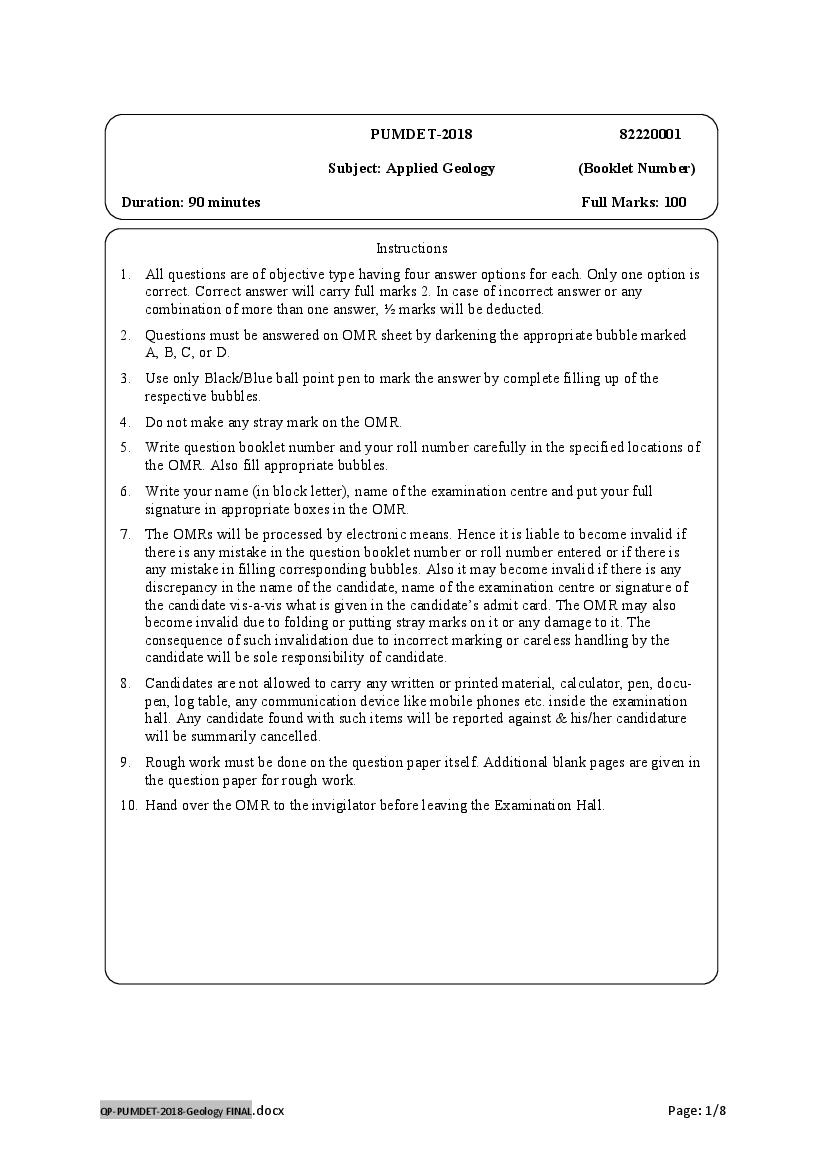
Subject: Applied Geology (Booklet Number)
Duration: 90 minutes Full Marks: 100
Instructions
1. All questions are of objective type having four answer options for each. Only one option is
correct. Correct answer will carry full marks 2. In case of incorrect answer or any
combination of more than one answer, ½ marks will be deducted.
2. Questions must be answered on OMR sheet by darkening the appropriate bubble marked
A, B, C, or D.
3. Use only Black/Blue ball point pen to mark the answer by complete filling up of the
respective bubbles.
4. Do not make any stray mark on the OMR.
5. Write question booklet number and your roll number carefully in the specified locations of
the OMR. Also fill appropriate bubbles.
6. Write your name (in block letter), name of the examination centre and put your full
signature in appropriate boxes in the OMR.
7. The OMRs will be processed by electronic means. Hence it is liable to become invalid if
there is any mistake in the question booklet number or roll number entered or if there is
any mistake in filling corresponding bubbles. Also it may become invalid if there is any
discrepancy in the name of the candidate, name of the examination centre or signature of
the candidate vis-a-vis what is given in the candidate’s admit card. The OMR may also
become invalid due to folding or putting stray marks on it or any damage to it. The
consequence of such invalidation due to incorrect marking or careless handling by the
candidate will be sole responsibility of candidate.
8. Candidates are not allowed to carry any written or printed material, calculator, pen, docu-
pen, log table, any communication device like mobile phones etc. inside the examination
hall. Any candidate found with such items will be reported against & his/her candidature
will be summarily cancelled.
9. Rough work must be done on the question paper itself. Additional blank pages are given in
the question paper for rough work.
10. Hand over the OMR to the invigilator before leaving the Examination Hall.
QP-PUMDET-2018-Geology FINAL.docx Page: 1/8
Page 2
Page 3
defraction techniques are called
(A) Amorphous (B) Microcrystalline
(C) Cryptocrystalline (D) Diffractocrystalline
2. Which of the following matched pairs correctly associates the plutonic rock with its extrusive
equivalent?
(A) Syenite - Trachyte (B) Gabbro – Dacite
(C) Granite – Andesite (D) Diorite – Aplite
3. Which one is not a copper (Cu) bearing mineral?
(A) Bornite (B) Covellite (C) Braunite (D) Azurite
4. A fault that brings ultra basic igneous rocks into direct contact with typical shales should be recorded
as
(A) a negative gravitational anomaly
(B) a positive gravitational anomaly
(C) a zero gravitational anomaly because the specific gravity of the two rock types in similar.
(D) negative or positive anomaly depending upon whether one uses the torsion balance or the
pendulum method.
5. In considering the strain ellipsoid, shear fractures are most likely to occur at angles of about
(A) 300 to the axis of greatest strain
(B) 600 to the axis of greatest stress
(C) 300 to the axis of least stress
(D) 300 to the axis of least strain
6. The phase difference between two rays emerging from a mineral examined in polarized light varies
inversely with
(A) Mineral thickness
(B) The wave length of the light source
(C) The difference in indices of refraction of the two rays emerging from the mineral
(D) The chemical composition of the mineral.
7. Of the following high specific gravity minerals, the one hardest to concentrate by gravity is
(A) Ilmenite (B) Monazite (C) Magnetite (D) Molybdenite
8. The division between the zone of aeration and the zone of saturation is called the
(A) Interstitial zone (B) Capillary Fringe
(C) Belt of Soil Moisture (D) Water Table
QP-PUMDET-2018-Geology FINAL.docx Page: 3/8
Page 4
(A) In the Intra-Pacific region
(B) As Vesuvius type eruption
(C) In the cores of folded mountains
(D) As extrusive continental lava flows.
10. An impure carbonate rock is subjected to thermal metamorphism. The net chemical effect in to
(A) Decrease silica content (B) Produce glaucophane schist
(C) Drive off Carbon dioxide (D) Produce cordierite
11. The average density of the Earth is 5.5 gms / c.c. Since the density of rocks in the crust averages
about 2.7 gms / c.c. We may infer that
(A) The outer core is molten.
(B) The density must increase to a maximum of 5.5 gms / c.c with depth
(C) The density of the core must be greater than 5.5 gms / c.c
(D) The mantle is composed of heavy silicates.
12. The particle size that requires the least lifting velocity on the part of a stream current is
(A) Clay (B) Medium sand (C) Coarse sand (D) Pebble
13. Khetri area is famous for
(A) Uranium mineralization (B) Gold mineralization
(C) Copper mineralization (D) Nickel mineralization
14. Which one of the following is not a common fault plane feature?
(A) Mylonite (B) Slickensides
(C) Pseudo tachyllite (D) Roche moutonnee
15. Which one of the following deposits was probably not formed as a direct consequence of the
metamorphism of plant matter?
(A) Peat (B) Bituminous coal (C) Graphite (D) Anthracite coal
16. A rock consisting of about fifty percent pyroxene and fifty percent olivine would be called
(A) Dunite (B) Peridotite (C) Gabbro (D) Amphibolite
17. The refractive indices of a mineral section are ω = 1.548 and ϵ =1.642. Then which of the following
statement is true?
(A) The mineral belongs to uniaxial positive
(B) The mineral belongs to uniaxial negative
(C) The mineral belongs to biaxial positive
(D) The mineral belongs to biaxial negative
QP-PUMDET-2018-Geology FINAL.docx Page: 4/8
Page 5
(A) Carbon (B) Zinc (C) Gold (D) Copper
19. The earth’s outer core is thought to be molten because,
(A) P waves are not transmitted through it.
(B) S waves are not transmitted it.
(C) Information from meteorites suggests this.
(D) L waves are not transmitted through it.
20. Which of the following minerals has two different values of hardness in different orientation?
(A) Quartz (B) Fluorite (C) Kyanite (D) Feldspar
21. Shadow zone for direct P-wave arrival takes place between
(A) 1030 to 1630 (B) 730 and 1030 (C) 1030 to 1430 (D) 1630 and 1730
22. A strike – slip fault is one in which the net slip
(A) is parallel to the strike of the adjacent strata
(B) follows regional structure
(C) contains both a large vertical and horizontal component
(D) is along the strike of the fault plane
23. Gossan or cap rock out crops give clues to the type of one body below chiefly by their
(A) Coarse cellular structure (B) Wavy out crop pattern
(C) Distinctive coloring (D) Preponderance of limonite
24. The Mohorovicic discontinuity is defined as
(A) the Crust-Mantle boundary
(B) the change from gravitic sial to the basaltic sima
(C) the depth of shallow earthquakes
(D) the depth below which isostatic adjustment takes place.
25. Which of the following is not a feature of glacial erosion?
(A) Cirques (B) U-shapped valleys
(C) Roches moutonnees (D) Valley trains
26. Which of the following pairs of minerals have the most similar atomic structure?
(A) Calcite - Anorthite (B) Muscovite – Hematite
(C) Halite – Galena (D) Graphite – Diamond
27. Which of the following precious and relatively rare minerals is associated with ultra basic igneous
rocks?
(A) Gold (B) Silver (C) Platinum (D) Uranium
QP-PUMDET-2018-Geology FINAL.docx Page: 5/8
Page 6
(A) Stretching of a competent bed parallel to the limbs of a fold
(B) intrusion of fluids parallel to the fold axis
(C) exfolliation on a small scale common in most rocks
(D) refolding of previous folds.
29. Hypidiomorphic texture is common in
(A) Aplite (B) Komatitite (C) Granite (D) Basalt
30. Which of the following minerals is member of the Molis scale of hardness?
(A) Tourmalive (B) Muscovite (C) Garnet (D) Topaz
31. Which physical property of a mineral least favour its mechanical concentration?
(A) High Specific Gravity (B) High Sphericity
(C) High degree of hardness (D) Highly platy habit
32. Which does not belong to the definition of a mineral?
(A) Definite crystal structure (B) Definite or limited chemical composition
(C) Definite cleavage (D) Inorganic compound in solid state
33. The contact between the conglomerate and granite is best described as
(A) a disconformity (B) a paraconformity
(C) an angular unconformity (D) a non - conformity
34. Which choice correctly associates crystal system and crystal form (or class) with the mineral which
characteristically crystallizes in that form or class?
(A) Isometric – Octahedral – Quartz (B) Tetragonal – Prismatic – Tourmaline
(C) Monoclinic – Rhombic – Sulphur (D) Triclinic – Pinacoidal – Anorthite
35. The crystal system containing minerals that produce uniaxial interference figures in convergent
polarized light in the
(A) Isometric (B) Tetragonal (C) Orthorhombic (D) Monoclinic
36. The highest order interference colours are obtained in a quartz wedge cut
(A) Parallel to the optic axis (B) At right angles to the optic axis
(C) diagonal to the optic axis (D) Parallel to the obtuse bisectrix
37. The ‘Ring of Fire’ refers to a belt of vulcanism and tectonic disturbances rimming
(A) eastern South America (B) the Indian Ocean
(C) the Pacific Ocean (D) the North Atlantic Ocean
38. Emerald is a gem variety of the mineral
(A) Tourmaline (B) Beryl (C) Corundum (D) Topaz
QP-PUMDET-2018-Geology FINAL.docx Page: 6/8
Page 7
the light source are said to be
(A) Triclinic (B) Monoclinic (C) Anisotropic (D) Isometric
40. Which one of the following sedimentary rocks is the least well sorted?
(A) Arkose (B) Subgray wacke (C) Tillite (D) Orthoquartzite
41. Which one of the following primary features is least useful in distinguishing the top from bottom in
sedimentary strata?
(A) Cross bedding
(B) Local unconformity such as channelling
(C) Fossil shells, whether concave up or down
(D) Casts of current ripple marks.
42. An anisotropic mineral grain is brought into its dark position between the crossed nicols of the
polarising microscope. Which statement may be taken as correct from this fact?
(A) The fast ray is parallel to the upper nicol.
(B) The slow ray is parallel to the upper nicol.
(C) The traces of the vibration planes of the mineral are parallel to the cross-wires of the
microscope.
(D) The mineral is of the Isometric system.
43. The concept of metamorphic zones was first developed by
(A) Billings (B) Turner (C) Harker (D) Barrow
44. A sediment has a diameter in phi size units of – 3. Its diameter in millimetre is
(A) 3 mm (B) 0.3 mm (C) 0.8 mm (D) 8 mm
45. The best proof of the similarity of age of widely separated strata is
(A) litho logic similarity (B) identical facies
(C) similar sequence (D) identical fauna
46. A primitive fish without paired appendages or jaws, but with a head of bony armor is the,
(A) Placodermi (B) Agnatha (C) Tunicata (D) Osteichthyes
47. Dike rocks that are made up of more than one – third dark minerals and have an abundance of
euhedral crystals in a groundmass of alkalic feldspar are called
(A) Gabbros (B) Peridotites (C) Pegmatites (D) Lamprophyres
48. Which one of the following usually decreases in a downstream direction?
(A) Velocity (B) Discharge (C) Particle size (D) Water volume
49. A mineral not of monoclinic system is
(A) Pyroxene (B) Garnet (C) Orthoclase (D) Amphibole
QP-PUMDET-2018-Geology FINAL.docx Page: 7/8
Page 8
(A) the crystal face is parallel to the a – axis but intersects the other two axes at same
distances.
(B) the crystal face is parallel to the ‘b’ and ‘c’ axes but intersects the a – axis.
(C) the crystal face is parallel to the a – axis but intersects the other two axes at their unit
relative distances.
(D) the crystal is exclusive to the isometric system.
QP-PUMDET-2018-Geology FINAL.docx Page: 8/8
Document Details
| Board / Org | WBJEEB |
| Exam | PUMDET |
| Type | Question Paper |
| Pages | 8 |
| Updated | 22 Jul 2026 |