PUMDET 2018 Question Paper Applied Economics
Finished viewing? Save it for later —
Download PUMDET 2018 Question Paper Applied Economics (PDF · 9 pages)About PUMDET 2018 Question Paper Applied Economics
PUMDET 2018 Question Paper Applied Economics is available here for free download. Published by WBJEEB for PUMDET, this question paper can be viewed online or downloaded as a PDF (9 pages). Candidates preparing for PUMDET can use PUMDET 2018 Question Paper Applied Economics to understand the exam pattern, the type of questions asked, and the overall difficulty level.
Frequently Asked Questions
How can I download PUMDET 2018 Question Paper Applied Economics?
Open this page and click the Download button to save PUMDET 2018 Question Paper Applied Economics as a PDF. It is completely free on AglaSem Docs.
Is PUMDET 2018 Question Paper Applied Economics free to download?
Yes. PUMDET 2018 Question Paper Applied Economics can be viewed online and downloaded as a PDF free of cost on AglaSem Docs.
How many pages does PUMDET 2018 Question Paper Applied Economics have?
PUMDET 2018 Question Paper Applied Economics contains 9 pages, which you can read online or download together as a single PDF.
Where can I find more PUMDET study material?
You can find more PUMDET question papers, sample papers, syllabus, and answer keys on AglaSem Docs.
PUMDET 2018 Question Paper Applied Economics – Text
Read the full text of this question paper below — useful to quickly search, copy and reference the content online without downloading the PDF.
📄 View text version (9 pages)
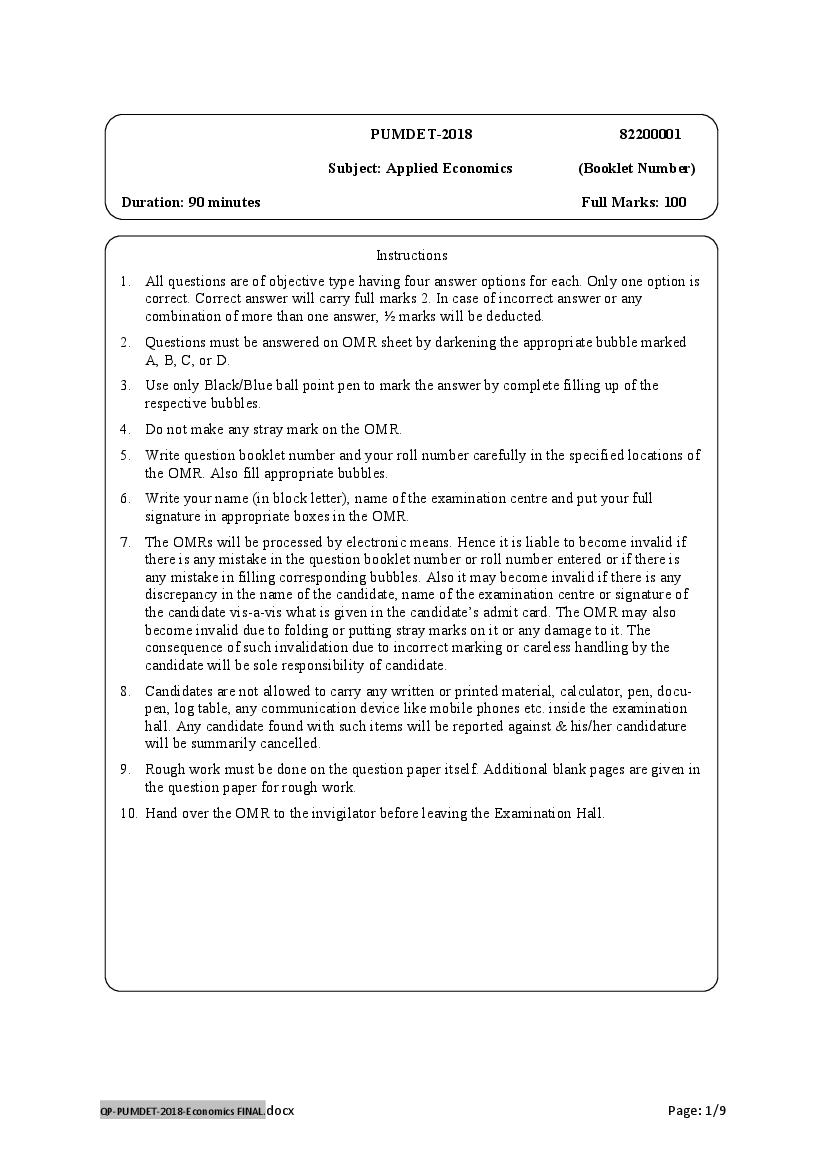
Page 1
Subject: Applied Economics (Booklet Number)
Duration: 90 minutes Full Marks: 100
Instructions
1. All questions are of objective type having four answer options for each. Only one option is
correct. Correct answer will carry full marks 2. In case of incorrect answer or any
combination of more than one answer, ½ marks will be deducted.
2. Questions must be answered on OMR sheet by darkening the appropriate bubble marked
A, B, C, or D.
3. Use only Black/Blue ball point pen to mark the answer by complete filling up of the
respective bubbles.
4. Do not make any stray mark on the OMR.
5. Write question booklet number and your roll number carefully in the specified locations of
the OMR. Also fill appropriate bubbles.
6. Write your name (in block letter), name of the examination centre and put your full
signature in appropriate boxes in the OMR.
7. The OMRs will be processed by electronic means. Hence it is liable to become invalid if
there is any mistake in the question booklet number or roll number entered or if there is
any mistake in filling corresponding bubbles. Also it may become invalid if there is any
discrepancy in the name of the candidate, name of the examination centre or signature of
the candidate vis-a-vis what is given in the candidate’s admit card. The OMR may also
become invalid due to folding or putting stray marks on it or any damage to it. The
consequence of such invalidation due to incorrect marking or careless handling by the
candidate will be sole responsibility of candidate.
8. Candidates are not allowed to carry any written or printed material, calculator, pen, docu-
pen, log table, any communication device like mobile phones etc. inside the examination
hall. Any candidate found with such items will be reported against & his/her candidature
will be summarily cancelled.
9. Rough work must be done on the question paper itself. Additional blank pages are given in
the question paper for rough work.
10. Hand over the OMR to the invigilator before leaving the Examination Hall.
QP-PUMDET-2018-Economics FINAL.docx Page: 1/9
Page 2
Page 3
TC = 40 + 82q − 6q 2 + 0.2q 3 ?
(A) 25 (B) 35 (C) 15 (D) 10
2. A monopolist faces the demand schedule p = 460 − 2q, and the cost schedule TC = 20 + 0.5q2. How
much should it sell to maximize profit?
(A) 90 (B) 91 (C) 94 (D) 93
3. Derive the MR function for the demand function q = 400 − 0.1p
(A) MR = - 0.2p (B) MR = 4000 - 0.2q
(C) MR = 4000 - 20q (D) MR = 40 - 20p
4. In a basic Keynesian macroeconomic model it is assumed that Y = C + I Where, I = 250 and C =
0.75 Y. What increase in I would be needed to cause Y to increase to1200?
(A)0.5 (B) 5 (C) 0.005 (D) 50
5. A firm uses 200000 units of a component in a year, with demand evenly spread over the year. In
addition to the purchase price, each order placed for a batch of components costs INR 80. Each unit
held in stock over a year costs INR 8. What is the optimum order size?
(A) 25000 (B) 2500 (C) 24000 (D) 2000
6. Given the utility function U = 72AB − 0.6A 2 B2 , how much of A will be consumed if it is a free
good? If necessary give answers in terms of the fixed amount of B.
(A) 60 unit
(B) Consumption of A depends inversely on B.
(C) Consumption of A depends proportionately on B.
(D) 42unit
7. If a firm spends INR 650 on fixed costs what is its total cost (TC) function if its marginal cost
function is MC = 82 − 16q + 1.8q 2 ?
( A ) TC = 16 + 3.6q ( B ) TC = 650 + 82q + 8q 2 + 0.6q3
( C ) TC = 82q − 8q 2 + 0.6q3 ( D ) TC = 650 + 82q − 8q 2 + 0.6q3
8. There is initially an equilibrium in the basic Keynesian model
Yt = C t + I t
C t = 650 + 0.5Yt −1
With It remaining at 300. Then It suddenly increases to 420 and remains there. What will be the
actual level of Y six time periods after this change?
(A) 21.125 (B) 2138.125 (C) 213.125 (D) 4266.125
9. Population in a developing country is growing continuously at an annual rate of 3%. If the
population is now 4.5 million, what will be the approximate population in 15 years’ time?
(A) 7 million (B) 6.5 million (C) 67.5 million (D) 13.5 million
QP-PUMDET-2018-Economics FINAL.docx Page: 3/9
Page 4
found a factory’s output of product Q at any moment in time to be determined by the function
Q = 40e0.03t , where t is the number of years from the base year in the empirical study and Q is the
output per year in tones. What is the annual growth rate of production?
(A) 1.2% (B) 0.12% (C) 12% (D) 3%
11. Over the last 15 years a country’s population has risen continuously at the same annual growth rate
from 8.2 million to 11.9 million. What is this rate of growth?
(A) 2.48% (B) 2.00% (C) 4.80% (D) 3.80%
12. Let the consumption function & investment function are: C = 50 + 0.80Yd and I = 80 respectively.
Again Y = Yd. Derive the equilibrium output (Y) by equating saving leakages and investment
injections.
(A) Y= 550 (B) Y= 650 (C) Y= 750 (D) Y= 850
13. Suppose, I = 70 & C = 60 + 0.80Y. Find equilibrium output when there is an increase in autonomous
investment by 10 units.
(A) Y= 700 (B) Y= 600 (C) Y= 500 (D) Y= 800
14. “The Dependency Theory of Development” related to economist(s)
(A) J. M. Keynes (B) Prebisch, Singer
(C) David Ricardo (D) Amartya Sen
15. If the saving rate in Indonesia is 23% of GDP, which of the following combinations is consistent
with the Harrod- Domar growth equation?
(A) ICOR = 15.4; GDP growth rate = 7.6 % p.a
(B) ICOR = 4.0; GDP growth rate = 5.75% p.a
(C) ICOR = 50.6, GDP growth rate = 2.2% p.a
(D) ICOR =1%, GDP growth rate = 22% p.a
16. If MPC=0, the value of multiplier is
(A) 0 (B) 1 (C) Between 0 and 1 (D) Infinity
17. If X is distributed normally, X2 follows
(A) t distribution (B) Chi-square distribution
(C) F distribution (D) Poisson Distribution
18. The level of significance is the probability of committing
(A) Type I error (B) Type II error
(C) Type III error (D) No error
QP-PUMDET-2018-Economics FINAL.docx Page: 4/9
Page 5
(A) Greater than Reverse REPO Rate
(B) Less than Reverse REPO Rate
(C) Equal to Reverse REPO Rate
(D) Greater than or equal to Reverse REPO Rate
20. A firm faces the average fixed cost function AFC = 200x −1 , where x is output, and the average
variable cost (AVC) function AVC = 0.2x 2 . What shape will its average total cost function (AC)
take?
(A) Concave to the Origin (B) Convex to the Origin
(C) Rectangular Hyperbola (D) U-Shaped
21. What type of returns to scale does the production function Q = 45K 0.4 L0.4 exhibit?
(A) IRS (B) CRS (C) DRS (D) SRS
22. For an equation: Y = 40 + 0.63C, given the standard error of the estimated coefficient of C is 0.12.
What will be the t value and level of significance?
(A) t= 333.33, significant at 1% level. (B) t =333.33, significant at 5% level.
(C) t= 5.25, significant at 1% level. (D) t= 5.35, significant at 1% level.
23. For a time series econometric model, when we can use the Johansen Co integration test?
(A) When some variables are I(0) and some are I(1).
(B) When all the variables are I(0)
(C) When all the Variables are I(1)
(D) When all the Variables are I(2)
24. If E ( x t u t ) ≠ 0, then
(A) Problem of Autocorrelation occurs.
(B) Problem of Heteroscadasticity occurs.
(C) Problem of Spurious Correlation occurs.
(D) None of the above.
25. For a Panel Data Regression Model Yit = a i + bit x it + ( u i + zit ) , where, ui => Cross section specific
error term, zit =>Cross section as well as time specific error term. Specify the null hypothesis for
“Hausman” test.
(A) ui are not correlated with xit (B) ui are correlated with xit
(C) zit are correlated with xit (D) None of the above.
26. What will be the example of Random Walk model?
( A ) X t = X t −1 + u t ( B ) X t = Yt −1 + u t
(C) Xt = a + b Xn + u t ( D ) X t = a + b Yn + u t
QP-PUMDET-2018-Economics FINAL.docx Page: 5/9
Page 6
choose the correct process of stationarity.
(A) Strict Stationary (B) Weak Stationary
(C) Non-stationary (D) None of the above
28. If the independent variable in a regression model is qualitative in nature, then what will be the model
you choose for estimation?
(A) OLS model (B) MLE model
(C) Tobit model (D) Both OSL and MLE model
29. Match the following:
List-I List-II
I) Box-Jenkins Method 1) Causality
II) Unit-root test 2) Forecasting
III) Darbin-Watson test 3) Stationarity
IV) Granger test 4) Autocorrelation
I II III IV
(A) 3 1 2 4
(B) 2 3 4 1
(C) 1 2 3 4
(D) 4 1 2 3
30. Correlation coefficient between X and Y is 0.3 and correlation coefficient between P and Q is 0.6,
then the strength of correlation between P and Q is higher than between X and Y by
(A) Two times (B) Three times (C) Four times (D) Five times
31. −1
The production function, Q = A β K − a + αL− a a
, is homogeneous of degree
(A) Zero (B) One (C) Infinity (D) a
32. Given the total cost function C= 7Q2 + 26Q + 5, MC at Q=5 is
(A) 100 (B) 200 (C) 85 (D) 96
33. For the regression model given below:
Y= β0 + β1 X + U
Y= 20+2X
SE: 0.46
To test H0: β1 = 2.1 against H1: β1 ≠ 2.1, test statistics ∣t∣ is equal to
(A) 4.609 (B) 0.217 (C) 4.34 (D) 0.33
QP-PUMDET-2018-Economics FINAL.docx Page: 6/9
Page 7
statistic ∣t∣, with n observation is
(A) n - k (B) n – k + 1 (C) n – k - 1 (D) n + k - 1
35. Assume that an entrepreneur’s short-run total cost function is C= q3 – 10q2 +17q +66. Determine the
output level at which he maximizes profit if p=5.
(A) q= 6.5 (B) q=6 (C) q= 2/3 (D) q=1
36. A monopolist uses one input, X, which she purchases at the fixed price r = 5 to produce her output Q.
Her demand and production functions are p= 85 - 3q and q = 2x1/2 respectively. Determine the value
of p, q and x at which the monopolist maximizes her profit.
(A) p = 45, q = 10, x = 25 (B) p = 55, q = 10, x = 25
(C) p = 55, q = 25, x = 10 (D) p = 25, q = 45, x = 10
37. Let the demand and cost functions of a monopolist be p = 100 − 3q + 4A1/2 , C = 4q 2 + 10q + A , where
A is the level of her advertising expenditure. Find the values of A, q and p that maximizes profit.
(A) A = 900, q = 15, p = 175 (B) A = 900, q = 25, p = 200
(C) A = 450, q = 175, p = 15 (D) None of the above
38. Let the duopolist I, producing a differentiated product, face an inverse demand function given by
p1 = 100 − 2q1 − q 2 and have the cost function C1= 2.5q12. Assume that duopolist II wishes to
maintain a market share of 1/3. Find the optimal price, output and profit for duopolist I.
(A) p1=75, q1=10, π1=500 (B) p1=55, q1=10, π1=550
(C) p1=75, q1=10, π1=750 (D) p1=7.5, q1=25, π1=50.0
39. A consumer’s consumption-utility function for a two period horizon is U=c1c20.6, his income stream
is y1=1000 and y2=648 and the market rate of interest is 0.08. Determine values for c1 and c2 that
maximizes his utility
(A) c1= 1000, c2= 648 (B) c1= 648, c2= 1000
(C) c1= 100, c2= 64.8 (D) c1= 64.8, c2= 1000
40. Consider an entrepreneur point-input-point-output wine ageing process. His initial cost is 20, the
sales value of the wine is R(T) = 100T1/2, and the rate of interest is 0.05. How long is his optimal
investment period?
(A) T=15 (B) T=11 (C) T=10 (D) T=100
41. When the price of a product is lowered from £350 to £200, quantity demand increases from 600 to
750 units. Calculate the elasticity of demand.
(A) 11/27 (B) 21/27 (C) 1/7 (D) 7/11
42. For the production function Q = 20K 0.5 L0.5 derive a two-variable function in the form K = f(L) for
the iso-quant Q = 100.
( A ) K = 25L−1 ( B ) K = 35L−1 ( C ) K = 5L−1 ( D ) K = 15L−1
QP-PUMDET-2018-Economics FINAL.docx Page: 7/9
Page 8
apply, C = £60m + 0.7Yt, Y = C + I + G, Yt= 0.6Y, where C is consumption, Y is national income, Yt
is disposable income, I is investment and G is government expenditure. If the values of I and G are
exogenously determined as £90 million and £140 million respectively, what is the equilibrium level
of national income?
(A) Y= 500 (B)Y=450 (C)Y=400 (D) Y=550
44. In a certain city 100 men in a sample of 400 were found to be smokers. In another city, the number
of smokers was 300 in a random sample of 800. In that case, which of the following statements is
true? [Given, z ≤ −1.645 at 5% level of significance and z ≤ −2.33 at 1% level of significance]
(A) Proportion of smokers is less in the second city
(B) Proportion of smokers is greater in the second city
(C) Proportion of smokers are equal in both the city
(D) None of the above is true
45. A random sample of size 20 from a normal population gives a sample mean of 42 and sample
standard deviation of 6. Test the null hypothesis that the population mean is 44. [Given, t0.005=2.86
and t0.025=2.09 with DOF= 19]
(A) Accept the null hypothesis
(B) Reject the null hypothesis
(C) Accept the alternative hypothesis at 5% level of significance
(D) None of the above
46. A random sample of size 20 from a normal population gives a sample mean of 42 and sample
standard deviation of 6. Test the hypothesis you allow for and the level of significance you adopted.
(A) H1: σ> 9, accepted at 5% level of significance
(B) H1: σ = 9, accepted at 5% level of significance
(C) H1: σ > 9, rejected at 5% level of significance
(D) H1: σ< 9, accepted at 5% level of significance
47. When current income includes negative transitory component, relating consumption with current
income will produce:
(A) An average propensity to consume that is lower than the long run average propensity to
consume.
(B) An average propensity to consume that is higher than the long run average propensity to
consume.
(C) An average propensity to consume that is equal to the long run average propensity to
consume.
(D) None of the above.
QP-PUMDET-2018-Economics FINAL.docx Page: 8/9
Page 9
(A) All potential investors expect the rate of interest to rise in future.
(B) All potential investors expect the rate of interest to fall in future.
(C) Natural rate of interest is above the critical rate of interest.
(D) Demand for money for speculative purpose is interest inelastic.
49. In Harrod’s model of economic growth, if warranted rate is below the natural rate of growth then it is
possible to maintain steady state growth at the warranted rate with
(A) continually increasing unemployment
(B) a constant rate of unemployment
(C) continually decreasing unemployment
(D) none of the above
50. All internationally traded services are covered under which of the following WTO arguments?
(A) GATS (B) TRIPS (C) TRIMS (D) PTA
QP-PUMDET-2018-Economics FINAL.docx Page: 9/9
Document Details
| Board / Org | WBJEEB |
| Exam | PUMDET |
| Type | Question Paper |
| Pages | 9 |
| Updated | 22 Jul 2026 |