TIFR GS 2027 Sample Paper Physics
Finished viewing? Save it for later —
Download TIFR GS 2027 Sample Paper Physics (PDF · 7 pages)About TIFR GS 2027 Sample Paper Physics
TIFR GS 2027 Sample Paper Physics is available here for free download. Published by TIFR for TIFR GS, this sample paper can be viewed online or downloaded as a PDF (7 pages). Candidates preparing for TIFR GS can use TIFR GS 2027 Sample Paper Physics to understand the exam pattern, the type of questions asked, and the overall difficulty level.
Frequently Asked Questions
How can I download TIFR GS 2027 Sample Paper Physics?
Open this page and click the Download button to save TIFR GS 2027 Sample Paper Physics as a PDF. It is completely free on AglaSem Docs.
Is TIFR GS 2027 Sample Paper Physics free to download?
Yes. TIFR GS 2027 Sample Paper Physics can be viewed online and downloaded as a PDF free of cost on AglaSem Docs.
How many pages does TIFR GS 2027 Sample Paper Physics have?
TIFR GS 2027 Sample Paper Physics contains 7 pages, which you can read online or download together as a single PDF.
Where can I find more TIFR GS study material?
You can find more TIFR GS question papers, sample papers, syllabus, and answer keys on AglaSem Docs.
TIFR GS 2027 Sample Paper Physics – Text
Read the full text of this sample paper below — useful to quickly search, copy and reference the content online without downloading the PDF.
📄 View text version (7 pages)
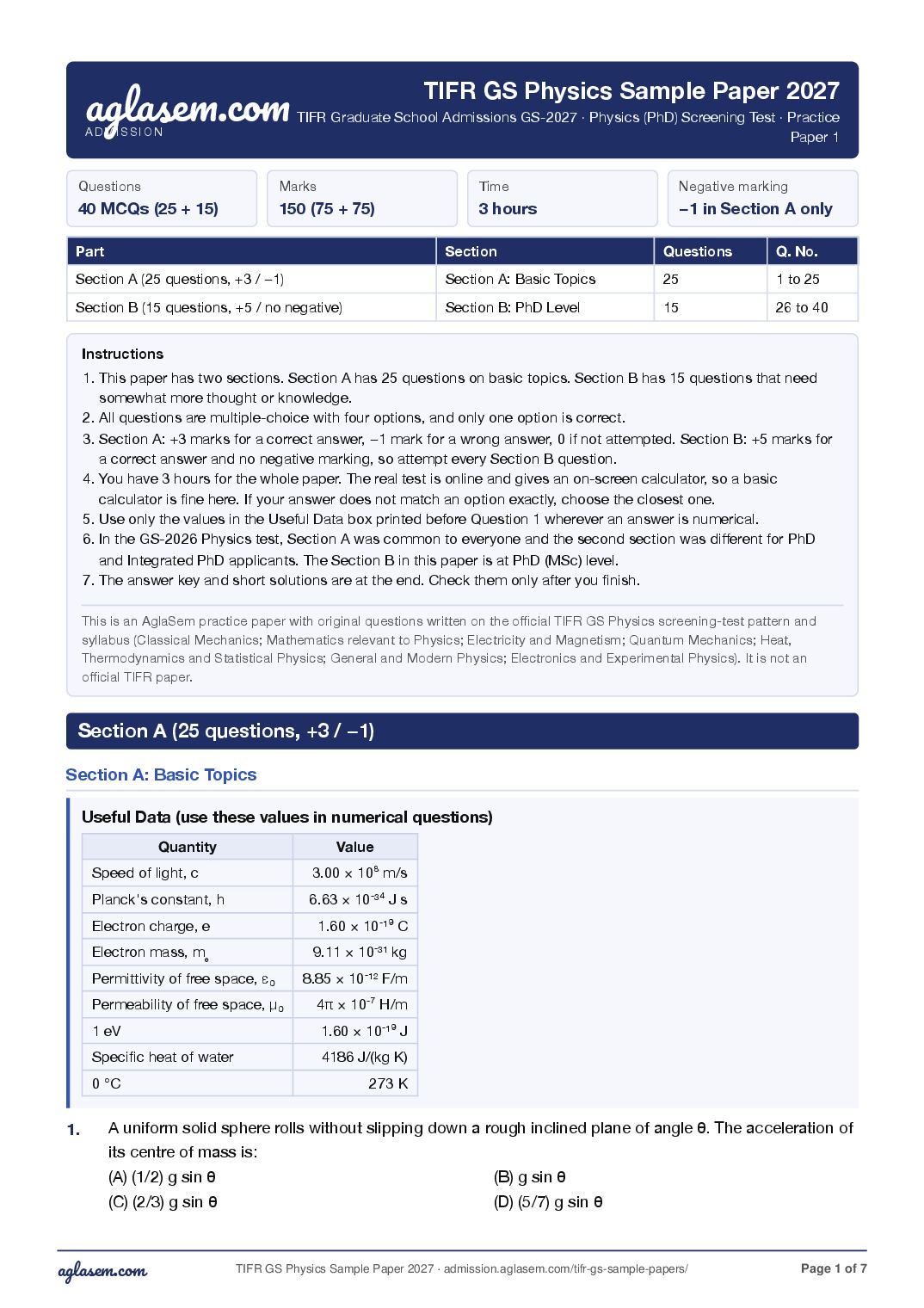
Page 1
TIFR Graduate School Admissions GS-2027 · Physics (PhD) Screening Test · Practice
ADMISSION
Paper 1
Questions Marks Time Negative marking
40 MCQs (25 + 15) 150 (75 + 75) 3 hours −1 in Section A only
Part Section Questions Q. No.
Section A (25 questions, +3 / −1) Section A: Basic Topics 25 1 to 25
Section B (15 questions, +5 / no negative) Section B: PhD Level 15 26 to 40
Instructions
1. This paper has two sections. Section A has 25 questions on basic topics. Section B has 15 questions that need
somewhat more thought or knowledge.
2. All questions are multiple-choice with four options, and only one option is correct.
3. Section A: +3 marks for a correct answer, −1 mark for a wrong answer, 0 if not attempted. Section B: +5 marks for
a correct answer and no negative marking, so attempt every Section B question.
4. You have 3 hours for the whole paper. The real test is online and gives an on-screen calculator, so a basic
calculator is fine here. If your answer does not match an option exactly, choose the closest one.
5. Use only the values in the Useful Data box printed before Question 1 wherever an answer is numerical.
6. In the GS-2026 Physics test, Section A was common to everyone and the second section was different for PhD
and Integrated PhD applicants. The Section B in this paper is at PhD (MSc) level.
7. The answer key and short solutions are at the end. Check them only after you finish.
This is an AglaSem practice paper with original questions written on the official TIFR GS Physics screening-test pattern and
syllabus (Classical Mechanics; Mathematics relevant to Physics; Electricity and Magnetism; Quantum Mechanics; Heat,
Thermodynamics and Statistical Physics; General and Modern Physics; Electronics and Experimental Physics). It is not an
official TIFR paper.
Section A (25 questions, +3 / −1)
Section A: Basic Topics
Useful Data (use these values in numerical questions)
Quantity Value
Speed of light, c 3.00 × 10⁸ m/s
Planck's constant, h 6.63 × 10⁻³⁴ J s
Electron charge, e 1.60 × 10⁻¹⁹ C
Electron mass, mₑ 9.11 × 10⁻³¹ kg
Permittivity of free space, ε₀ 8.85 × 10⁻¹² F/m
Permeability of free space, μ₀ 4π × 10⁻⁷ H/m
1 eV 1.60 × 10⁻¹⁹ J
Specific heat of water 4186 J/(kg K)
0 °C 273 K
1. A uniform solid sphere rolls without slipping down a rough inclined plane of angle θ. The acceleration of
its centre of mass is:
(A) (1/2) g sin θ (B) g sin θ
(C) (2/3) g sin θ (D) (5/7) g sin θ
TIFR GS Physics Sample Paper 2027 · admission./tifr-gs-sample-papers/ Page 1 of 7
Page 2
to the orbital speed of a satellite skimming the surface. The maximum height it reaches above the
surface is:
(A) 2R (B) R
(C) R/√2 (D) R/2
3. A particle of mass m moves in one dimension in the potential V(x) = kx⁴ (k > 0). If the amplitude of
oscillation is A, the period T depends on A as:
(A) T ∝ A (B) T ∝ A²
(C) T is independent of A (D) T ∝ 1/A
4. The eigenvalues of the matrix
| 0 1 0 |
| 1 0 1 |
| 0 1 0 |
are:
(A) 0, 2, −2 (B) 0, √2, −√2
(C) 1, √2, −√2 (D) 0, 1, −1
5. The contour integral ∮ eᶻ/(z − 1) dz, taken anticlockwise around the circle |z| = 2 in the complex plane,
equals:
(A) 0 (B) 2πi e
(C) 2πi (D) πi e
6. ₙ
Using the Fourier series of f(x) = x² on (−π, π), one can show that Σ ₌₁^∞ 1/n² = π²/6. The value of 1 −
1/2² + 1/3² − 1/4² + … is:
(A) π²/12 (B) π²/8
(C) π²/6 (D) π/4
7. X and Y are independent random variables, each uniformly distributed on [0, 1]. The probability that X +
Y < 1/2 is:
(A) 1/8 (B) 1/16
(C) 1/4 (D) 1/2
8. An isolated parallel-plate capacitor of capacitance C carries charge Q. The work needed to slowly pull
the plates apart until their separation is doubled is:
(A) Zero (B) Q²/(4C)
(C) Q²/(2C) (D) Q²/C
9. A square loop of side a carries a steady current I. The magnitude of the magnetic field at the centre of
the loop is:
(A) μ₀I/(2a) (B) 4μ₀I/(πa)
(C) 2√2 μ₀I/(πa) (D) √2 μ₀I/(πa)
10. A plane electromagnetic wave in vacuum has an electric field amplitude of 100 V/m. Its time-averaged
intensity is closest to:
(A) 6.6 W/m² (B) 13 W/m²
(C) 27 W/m² (D) 1.3 W/m²
11. An electron is confined in a one-dimensional infinite square well of width 1.0 nm. Its ground-state
energy is closest to:
(A) 1.5 eV (B) 0.38 eV
(C) 3.8 eV (D) 0.094 eV
TIFR GS Physics Sample Paper 2027 · admission./tifr-gs-sample-papers/ Page 2 of 7
Page 3
(A) iħ p̂ (B) 0
(C) 2iħ p̂ (D) −2iħ p̂
13. The Lyman-α line (n = 2 → n = 1) of atomic hydrogen has wavelength 121.6 nm. The corresponding line
of singly ionised helium, He⁺, has wavelength closest to:
(A) 30.4 nm (B) 60.8 nm
(C) 486.4 nm (D) 121.6 nm
14. An ideal monatomic gas is compressed reversibly and adiabatically to one-eighth of its initial volume. Its
absolute temperature increases by a factor of:
(A) 2 (B) 4
(C) 2√2 (D) 8
15. 1 kg of water is heated from 0 °C to 100 °C at constant pressure. The increase in its entropy is closest
to:
(A) 0.42 kJ/K (B) 4.19 kJ/K
(C) 1.31 kJ/K (D) 1.53 kJ/K
16. A two-level system has energies 0 and ε. At a temperature T such that kT = ε/ln 3, the probability of
finding the system in the upper level is:
(A) 1/3 (B) 3/4
(C) 1/4 (D) 1/2
17. According to classical statistical mechanics, the average total energy of a three-dimensional isotropic
harmonic oscillator in equilibrium at temperature T is:
(A) (3/2)kT (B) 3kT
(C) kT (D) 6kT
18. X-rays are Compton-scattered by free electrons. The increase in wavelength of the radiation scattered
at 90° is closest to:
(A) 1.2 pm (B) 2.4 pm
(C) 0.24 pm (D) 4.9 pm
19. Muons with a mean lifetime of 2.2 μs (in their rest frame) move through the laboratory at 0.99c. The
mean distance they travel in the laboratory before decaying is closest to:
(A) 4.6 km (B) 0.09 km
(C) 0.65 km (D) 46 km
20. A radioactive sample has mean life τ. The fraction of the original nuclei that decay between t = τ and t =
2τ is closest to:
(A) 0.50 (B) 0.23
(C) 0.37 (D) 0.14
21. An ideal op-amp is used as a non-inverting amplifier with feedback resistor R_f = 47 kΩ and resistor R₁
= 10 kΩ from the inverting input to ground. For an input of 0.20 V, the output is:
(A) −1.14 V (B) −0.94 V
(C) 1.14 V (D) 0.94 V
22. The Boolean expression (A + B)(A + C) simplifies to:
(A) A + B + C (B) ABC
(C) AB + C (D) A + BC
TIFR GS Physics Sample Paper 2027 · admission./tifr-gs-sample-papers/ Page 3 of 7
Page 4
measured with errors of 1%, 2% and 1% respectively. The maximum possible percentage error in ρ is:
(A) 6% (B) 4%
(C) 5% (D) 3%
24. Light of wavelength 600 nm falls normally on a single slit of width 0.10 mm. On a screen 2.0 m away,
the width of the central bright fringe is:
(A) 12 mm (B) 24 mm
(C) 6 mm (D) 48 mm
25. A string of length 1.0 m and linear mass density 0.010 kg/m is fixed at both ends and kept under a
tension of 100 N. Its fundamental frequency is:
(A) 50 Hz (B) 200 Hz
(C) 100 Hz (D) 25 Hz
Section B (15 questions, +5 / no negative)
Section B: PhD Level
26. A one-dimensional harmonic oscillator of mass m and angular frequency ω is perturbed by H′ = λx². To
first order in λ, the shift in its ground-state energy is:
(A) λħ/(4mω) (B) λħ/(mω)
(C) Zero (D) λħ/(2mω)
27. A spin-½ particle is in the eigenstate of Sz with eigenvalue +ħ/2. Its spin component is then measured
along a unit vector in the xz-plane that makes an angle of 60° with the z-axis. The probability of getting
+ħ/2 is:
(A) 3/4 (B) 1/2
(C) 1/4 (D) √3/2
28. Three non-interacting spin-½ fermions of mass m are placed in a one-dimensional infinite square well. If
E₁ = π²ħ²/(2mL²) is the single-particle ground-state energy, the ground-state energy of the three-particle
system is:
(A) 6E₁ (B) 14E₁
(C) 9E₁ (D) 3E₁
29. A particle of mass m moves in the attractive one-dimensional potential V(x) = −α δ(x), with α > 0. The
energy of its only bound state is:
(A) −2mα²/ħ² (B) −mα²/ħ²
(C) −mα²/(4ħ²) (D) −mα²/(2ħ²)
30. A particle moves in the central potential V(r) = kr² (k > 0). For an orbit that is close to circular, the ratio of
the angular frequency of small radial oscillations to the angular frequency of revolution is:
(A) 1 (B) √2
(C) √3 (D) 2
31. Two identical masses m move on a frictionless line. They are joined to each other by a spring of
constant k, and each is joined to a fixed wall on its own side by an identical spring k (wall–k–m–k–m–k–
wall). The normal-mode angular frequencies are:
(A) √(k/2m) and √(3k/2m) (B) √(2k/m) and √(3k/m)
(C) √(k/m) and √(3k/m) (D) √(k/m) and √(2k/m)
TIFR GS Physics Sample Paper 2027 · admission./tifr-gs-sample-papers/ Page 4 of 7
Page 5
sphere is:
(A) −P/(3ε₀) (B) −2P/(3ε₀)
(C) Zero (D) −P/ε₀
33. A thin spherical shell of radius R carries a total charge Q spread uniformly over its surface and spins
with angular velocity ω about a diameter. The magnitude of its magnetic dipole moment is:
(A) QR²ω/5 (B) QR²ω/2
(C) 2QR²ω/3 (D) QR²ω/3
34. For a single band in a one-dimensional tight-binding chain with lattice spacing a, the dispersion is E(k) =
E₀ − 2t cos(ka), with t > 0. The effective mass of an electron at the bottom of the band is:
(A) ħ²/(ta²) (B) ħ²/(4ta²)
(C) ħ²/(2ta²) (D) 2ħ²/(ta²)
35. A two-dimensional gas of non-interacting spin-½ fermions of mass m has N particles in area A. With n =
N/A, its Fermi energy at T = 0 is:
(A) 2πħ²n/m (B) πħ²n/(2m)
(C) πħ²n/m (D) ħ²(3π²n)^(2/3)/(2m)
36. The temperature of a cavity containing black-body radiation is doubled while its volume is kept fixed. Its
entropy increases by a factor of:
(A) 2 (B) 16
(C) 4 (D) 8
37. N independent spin-½ particles, each with magnetic moment μ, are in a weak magnetic field B at
temperature T, with μB ≪ kT. The magnetisation (total moment along B) is approximately:
(A) Nμ²B/(kT) (B) Nμ²B/(2kT)
(C) Nμ²B/(3kT) (D) 2Nμ²B/(kT)
38. The value of the integral ∫ dx/(x² + 1)², taken from x = −∞ to x = +∞, is:
(A) π/2 (B) π
(C) π/4 (D) 2π
39. The Fourier transform F(k) = ∫ e^(−a|x|) e^(−ikx) dx, taken over all x (a > 0), is:
(A) 2/(a + k)² (B) 1/(a² + k²)
(C) a/(a² + k²) (D) 2a/(a² + k²)
40. Which one of the following processes is forbidden for free particles in the Standard Model?
(A) π⁰ → γ + γ (B) π⁺ → μ⁺ + ν_μ
(C) n → p + e⁻ + ν̄ ₑ (D) μ⁻ → e⁻ + γ
TIFR GS Physics Sample Paper 2027 · admission./tifr-gs-sample-papers/ Page 5 of 7
Page 6
1 D 2 B 3 D 4 B 5 B 6 A 7 A 8 C 9 C 10 B
11 B 12 C 13 A 14 B 15 C 16 C 17 B 18 B 19 A 20 B
21 C 22 D 23 C 24 B 25 A 26 D 27 A 28 A 29 D 30 D
31 C 32 A 33 D 34 C 35 C 36 D 37 A 38 A 39 D 40 D
Solutions
Section A: Basic Topics
1. (D) a = g sin θ/(1 + I/MR²) and I/MR² = 2/5 for a solid sphere, so a = (5/7) g sin θ. The value 2/3 is for a solid cylinder
and 1/2 for a ring.
2. (B) With v² = GM/R, energy conservation gives ½GM/R − GM/R = −GM/r, so r = 2R and the height is r − R = R.
3. (D) The only time scale from m, k and A is √(m/k)/A (since k has units of energy/length⁴). Physically, a larger
amplitude means a steeper restoring force and faster motion, so T ∝ 1/A.
4. (B) det(M − λI) = −λ(λ² − 1) + λ = −λ³ + 2λ = 0, so λ = 0, ±√2.
5. (B) The only singularity inside |z| = 2 is the simple pole at z = 1 with residue e¹ = e, so the integral is 2πi e.
6. (A) The alternating sum equals (1 − 2·¼) Σ 1/n² = ½ × π²/6 = π²/12.
7. (A) The region X + Y < 1/2 in the unit square is a right triangle with legs 1/2, of area ½ × ½ × ½ = 1/8.
8. (C) Q stays fixed and the capacitance halves, so the energy Q²/2C' rises from Q²/2C to Q²/C. The work done is the
increase, Q²/(2C).
9. (C) Each side gives μ₀I(sin 45° + sin 45°)/(4π·a/2) = √2 μ₀I/(2πa). Four sides add: 2√2 μ₀I/(πa).
10. (B) I = ½ cε₀E₀² = 0.5 × 3.00 × 10⁸ × 8.85 × 10⁻¹² × 10⁴ ≈ 13.3 W/m².
11. (B) E₁ = h²/(8mL²) = (6.63 × 10⁻³⁴)²/(8 × 9.11 × 10⁻³¹ × 10⁻¹⁸) ≈ 6.03 × 10⁻²⁰ J ≈ 0.38 eV.
12. (C) [x, p²] = p[x, p] + [x, p]p = 2iħp, using [x, p] = iħ.
13. (A) Hydrogen-like energy levels scale as Z². For He⁺ (Z = 2) the photon energy is 4 times larger, so λ = 121.6/4 =
30.4 nm.
14. (B) TV^(γ−1) is constant with γ − 1 = 2/3, so T₂/T₁ = 8^(2/3) = 4.
15. (C) ΔS = mc ln(T₂/T₁) = 4186 × ln(373/273) ≈ 4186 × 0.312 ≈ 1.31 kJ/K.
16. (C) P(upper) = e^(−ε/kT)/(1 + e^(−ε/kT)) and e^(−ε/kT) = 1/3, so P = (1/3)/(4/3) = 1/4.
17. (B) There are six quadratic terms (three kinetic, three potential), each contributing ½kT, so ⟨E⟩ = 3kT.
18. (B) Δλ = (h/mₑc)(1 − cos 90°) = 6.63 × 10⁻³⁴/(9.11 × 10⁻³¹ × 3.00 × 10⁸) ≈ 2.43 × 10⁻¹² m.
19. (A) γ = 1/√(1 − 0.99²) ≈ 7.09. Distance = γvτ = 7.09 × 0.99 × 3.00 × 10⁸ × 2.2 × 10⁻⁶ ≈ 4.6 × 10³ m.
20. (B) N(τ) − N(2τ) = N₀(e⁻¹ − e⁻²) = N₀(0.368 − 0.135) ≈ 0.23 N₀.
21. (C) Gain = 1 + R_f/R₁ = 1 + 4.7 = 5.7, so V_out = 5.7 × 0.20 = 1.14 V (same sign as the input).
22. (D) (A + B)(A + C) = A + AC + AB + BC = A(1 + B + C) + BC = A + BC.
23. (C) Maximum relative error = 2(Δd/d) + ΔR/R + ΔL/L = 2 + 2 + 1 = 5%. (Adding in quadrature would give 3%, but
that is not the maximum.)
24. (B) The first minima are at y = ±λD/a = ±600 × 10⁻⁹ × 2/10⁻⁴ = ±12 mm, so the central maximum is 24 mm wide.
25. (A) Wave speed v = √(T/μ) = √(100/0.01) = 100 m/s and f₁ = v/2L = 50 Hz.
Section B: PhD Level
26. (D) ΔE = λ⟨x²⟩₀ and ⟨x²⟩₀ = ħ/(2mω). Check: the exact frequency is √(ω² + 2λ/m) ≈ ω + λ/(mω), and ½ħ times the
change is λħ/(2mω).
27. (A) The probability is cos²(θ/2) = cos²30° = 3/4.
TIFR GS Physics Sample Paper 2027 · admission./tifr-gs-sample-papers/ Page 6 of 7
Page 7
29. (D) With ψ ∝ e^(−κ|x|), the derivative jump at x = 0 gives κ = mα/ħ², so E = −ħ²κ²/2m = −mα²/(2ħ²).
30. (D) For V ∝ rⁿ, ω_r/ω_φ = √(n + 2). With n = 2 this is 2, so the orbit closes after half a revolution per radial cycle (an
ellipse centred on the origin).
31. (C) In-phase motion leaves the middle spring unstretched: ω² = k/m. Opposite-phase motion stretches the middle
spring twice as much: ω² = (k + 2k)/m = 3k/m.
32. (A) The bound surface charge σ = P cos θ produces a uniform field −P/(3ε₀) inside the sphere.
33. (D) A ring at polar angle θ carries current (Q/2) sin θ dθ · ω/2π and encloses area πR² sin²θ. Integrating gives m =
(QωR²/4)∫ sin³θ dθ = (QωR²/4)(4/3) = QR²ω/3. (QR²ω/5 is for a uniformly charged solid sphere.)
34. (C) Near k = 0, E ≈ E₀ − 2t + ta²k². Comparing with ħ²k²/2m* gives m* = ħ²/(2ta²).
35. (C) N = 2 × A πk_F²/(2π)², so k_F² = 2πn and E_F = ħ²k_F²/2m = πħ²n/m. The last option is the three-dimensional
result.
36. (D) For a photon gas S = (4/3)aVT³ (since U = aVT⁴), so doubling T multiplies S by 2³ = 8. The energy rises by 16.
37. (A) Exactly M = Nμ tanh(μB/kT), and tanh x ≈ x for small x. The factor 1/3 belongs to classical dipoles (Langevin),
not to two-state spins.
38. (A) Close the contour in the upper half-plane. The double pole at z = i has residue d/dz[(z + i)⁻²] at z = i = −2/(2i)³ =
1/(4i), so the integral is 2πi/(4i) = π/2.
39. (D) Splitting at x = 0 gives 1/(a + ik) + 1/(a − ik) = 2a/(a² + k²).
40. (D) μ⁻ → e⁻γ would change muon and electron lepton numbers separately and has never been seen. The other three
are the main observed decays of the π⁺, the free neutron and the π⁰.
TIFR GS Physics Sample Paper 2027 · admission./tifr-gs-sample-papers/ Page 7 of 7
Document Details
| Board / Org | TIFR |
| Exam | TIFR GS |
| Type | Sample Paper |
| Pages | 7 |
| Language | english |
| Updated | 27 Oct 2026 |