PUMDET 2018 Question Paper Chemistry
Finished viewing? Save it for later —
Download PUMDET 2018 Question Paper Chemistry (PDF · 12 pages)About PUMDET 2018 Question Paper Chemistry
PUMDET 2018 Question Paper Chemistry is available here for free download. Published by WBJEEB for PUMDET, this question paper can be viewed online or downloaded as a PDF (12 pages). Candidates preparing for PUMDET can use PUMDET 2018 Question Paper Chemistry to understand the exam pattern, the type of questions asked, and the overall difficulty level.
Frequently Asked Questions
How can I download PUMDET 2018 Question Paper Chemistry?
Open this page and click the Download button to save PUMDET 2018 Question Paper Chemistry as a PDF. It is completely free on AglaSem Docs.
Is PUMDET 2018 Question Paper Chemistry free to download?
Yes. PUMDET 2018 Question Paper Chemistry can be viewed online and downloaded as a PDF free of cost on AglaSem Docs.
How many pages does PUMDET 2018 Question Paper Chemistry have?
PUMDET 2018 Question Paper Chemistry contains 12 pages, which you can read online or download together as a single PDF.
Where can I find more PUMDET study material?
You can find more PUMDET question papers, sample papers, syllabus, and answer keys on AglaSem Docs.
PUMDET 2018 Question Paper Chemistry – Text
Read the full text of this question paper below — useful to quickly search, copy and reference the content online without downloading the PDF.
📄 View text version (12 pages)
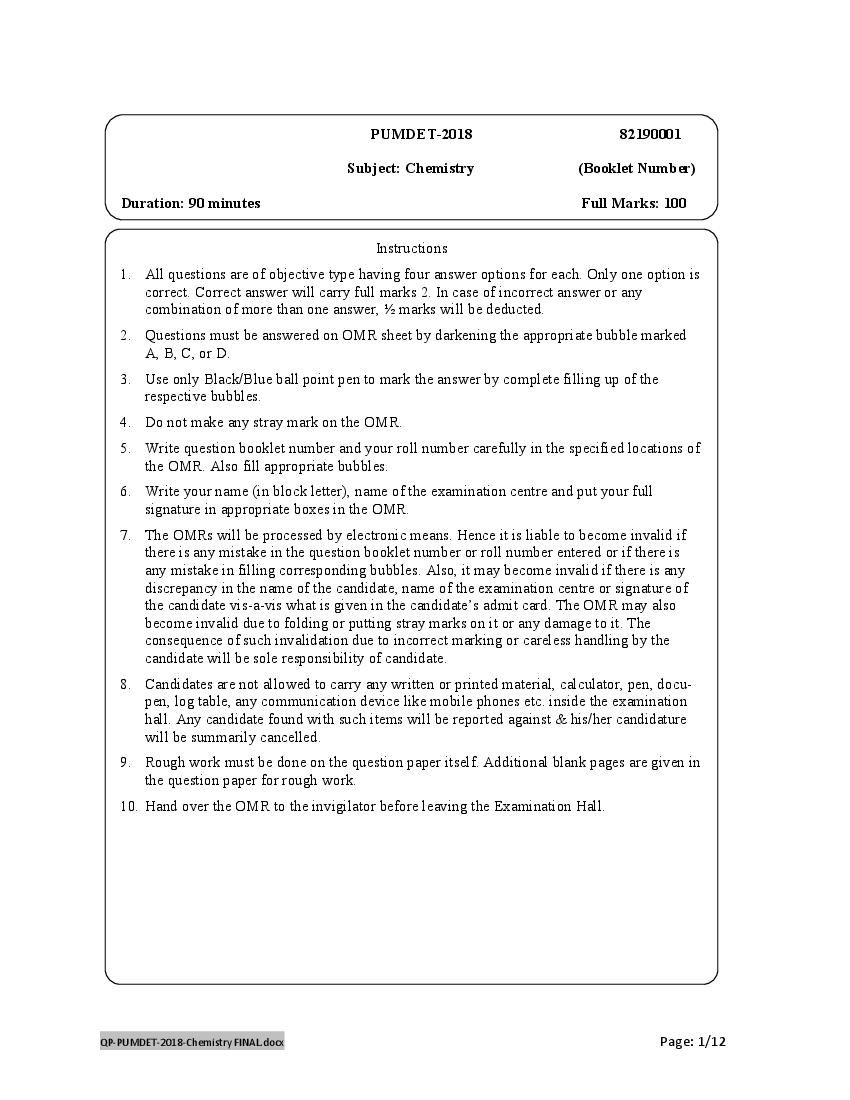
Page 1
Subject: Chemistry (Booklet Number)
Duration: 90 minutes Full Marks: 100
Instructions
1. All questions are of objective type having four answer options for each. Only one option is
correct. Correct answer will carry full marks 2. In case of incorrect answer or any
combination of more than one answer, ½ marks will be deducted.
2. Questions must be answered on OMR sheet by darkening the appropriate bubble marked
A, B, C, or D.
3. Use only Black/Blue ball point pen to mark the answer by complete filling up of the
respective bubbles.
4. Do not make any stray mark on the OMR.
5. Write question booklet number and your roll number carefully in the specified locations of
the OMR. Also fill appropriate bubbles.
6. Write your name (in block letter), name of the examination centre and put your full
signature in appropriate boxes in the OMR.
7. The OMRs will be processed by electronic means. Hence it is liable to become invalid if
there is any mistake in the question booklet number or roll number entered or if there is
any mistake in filling corresponding bubbles. Also, it may become invalid if there is any
discrepancy in the name of the candidate, name of the examination centre or signature of
the candidate vis-a-vis what is given in the candidate’s admit card. The OMR may also
become invalid due to folding or putting stray marks on it or any damage to it. The
consequence of such invalidation due to incorrect marking or careless handling by the
candidate will be sole responsibility of candidate.
8. Candidates are not allowed to carry any written or printed material, calculator, pen, docu-
pen, log table, any communication device like mobile phones etc. inside the examination
hall. Any candidate found with such items will be reported against & his/her candidature
will be summarily cancelled.
9. Rough work must be done on the question paper itself. Additional blank pages are given in
the question paper for rough work.
10. Hand over the OMR to the invigilator before leaving the Examination Hall.
QP-PUMDET-2018-Chemistry FINAL.docx Page: 1/12
Page 2
Page 3
1. Hybridization of C in solid C3O2 and gaseous CO2 are :
(A) sp in both (B) sp2 and sp (C) sp3 and sp2 (D) both sp2
2. The reaction
2 N 3 − + I2 → 3 N 2 + 2 I −
is strongly catalyzed by
(A) NO3− (B) NO2− (C) K + (D) S2−
3. The attractive forces between metal ions and delocalized electrons can be weakened or overcome by:
(A) water (B) sudden decrease in temperature
(C) increasing the temperature (D) corrosion resistant materials
4. Buffer species present in human blood contain
(A) only haemoglobin (B) haemoglobin, HCO3− and H2 PO4 −
(C) HCO3− and H2 PO4 − (D) H2 PO4 − and haemoglobin
5. Given the following data (250C) for the sparingly soluble salt MX :
M + X − → MX + e; E 0 = −0.01V
M → M+ + e ; E 0 = −0.60V
The value of log KSP for MX will be
(A) - 20 (B) - 10 (C) - 15.6 (D) - 5.6
6. Consider the following statements for
(NH 4 )2 [ Ce(NO3 ]6
(i) Coordination number of Ce in the compound is 12
(ii) compound is paramagnetic
(iii) compound is an oxidising agent.
The correct combination of statements is :
(A) (ii) and (iii) (B) (i), (ii) and (iii)
(C) (i) and (ii) (D) (i) and (iii)
QP-PUMDET-2018-Chemistry FINAL.docx Page: 3/12
Page 4
(A) 2, 3 – bisphosphoglycerate (BPG) increases the affinity of haemoglobin for oxygen.
(B) Deoxygenated haemoglobin has a higher binding affinity for protons than oxyhaemoglobin.
(C) Haemoglobin has a higher affinity for oxygen than does myoglobin.
(D) One molecule of haemoglobin binds sixteen molecules of oxygen (four per subunit).
8. The correct observation for the reaction
trans − Ir Cl ( CO )( PPh 3 )2 + Cl2 → trans − Ir Cl3 ( CO )( PPh 3 )2 is
(A) υCO (product) > υCO (reactant) (B) υCO (product) < υCO (reactant)
(C) υCO (product) = υCO (reactant) (D) υCO (product) = υCO (free CO)
9. Which of the following electronic transition will exhibit highest energy? (n = principal quantum
number).
(A) n 6 → n 5 (B) n 5 → n 4 (C) n 3 → n 2 (D) n 4 → n 3
10. The Madelung constant value for an ionic solid depends on :
(A) Geometry and charge of ions. (B) Only geometry of the solid.
(C) Only the charge of ions. (D) Geometry and radius of ions.
11. Ozone molecule is :
(A) Diamagnetic with zero dipole moment.
(B) Diamagnetic with high dipole moment.
(C) Paramagnetic with low dipole moment.
(D) Diamagnetic with low dipole moment.
12. Consider the feasibility of the following reactions
(i) CH 3 HgOH + HSO3 − → CH 3 HgSO3 − + HOH
(ii) OH− + CH 3 HgSO3− → CH 3 HgOH + SO32−
(A) keq for both (i) and (ii) are < 1.
(B) Reaction (i) has keq > 1, but (ii) has keq < 1.
(C) Both reactions have keq > 1.
(D) Reaction (i) has keq < 1, but (ii) has keq > 1.
13. If the cell potential of the cell at 298 k Ni| Ni +2 (0.01 M) Cu+2 (0.1 M)|Cu is 0.58 V, standard
+2
potential of Ni couple will be: (Given E 0 Cu +2 = 0.34 v ).
Ni Cu
(A) - 0.24 V (B) 0.0295 V (C) - 0.2105 V (D) 0.55 V
QP-PUMDET-2018-Chemistry FINAL.docx Page: 4/12
Page 5
(A) - 0.54 ∆ 0 (B) - 0.54 ∆ t (C) - 1.2 ∆ 0 (D) - 0.6 ∆ 0
15. The basic character of Ce2O3, Gd2O3 and Lu2O3 follows the order :
(A) Lu 2 O 3 > Gd 2 O 3 > Ce2 O 3 (B) Lu 2 O 3 < Gd 2 O 3 < Ce2 O3
(C) Ce2 O 3 > Lu 2 O 3 > Gd 2 O 3 (D) Gd 2 O 3 < Ce2 O 3 < Lu 2 O3
16. The compound Fe(CO)2 ( NO )2 contains two nitrosyl groups which are
(A) both bent (B) both linear
(C) one bent and one linear (D) can be both (A) and (B)
17. The approximate gravimetric factor for determination of Fe gravimetrically when it is precipitated as
Fe(OH)3 is (At. Wt. Fe = 56, O = 16)
(A) 0.52 (B) 0.96 (C) 0.70 (D) 0.35
18. When the π modecular orbitals of butadiene are constructed by combination of the π molecular
orbitals of two ethylene molecules, it is oberved that due to this process the energy levels of
(A) both HOMO and LUMO are raised.
(B) both HOMO and LUMO are lowered.
(C) HOMO is raised and LUMO is lowered.
(D) HOMO is lowered and LUMO is raised.
19. The enol content of the following dienones will follow the order
O O O
O
O
III
O II
I
(A) I > II > III (B) III > II > I (C) I > III > II (D) III > I > II
QP-PUMDET-2018-Chemistry FINAL.docx Page: 5/12
Page 6
D
H
I
Br
Br
D H
will be
I I
H H
H D
H D H D
(A) (C) (D)
(B)
H D D H
D D
D H
I I
21. Choose the correct statement regarding the bond lengths between the two C – Cl bonds of the
dichlorodioxane conformer shown below
O Cl
O
Cl
(A) Both are equal
(B) Axial C – Cl bond is longer than equatorial C – Cl bond
(C) Equatorial C – Cl bond is longer than axial C – Cl bond
(D) Axial C – Cl bond is shorter than C – Cl bond of CH3 – Cl
22. Among the following compounds identify the compound which fails to undergo coupling with
PhN2⊕ Cl .
NMe2
NMe2
(A) (B) Me Me
NMe2 OH
(C) (D) Me Me
Me
QP-PUMDET-2018-Chemistry FINAL.docx Page: 6/12
Page 7
mechanism is
(A) PhCH2CO2CH2CH3 (B) Ph CO2CH2CH2CH3
(C) Ph CH2CH2 CO2CH3 (D) CH3CO2CH-Ph
CH3
24. Identify the aldehyde which fails to undergo benzoin condensation
(A) p - nitrobenzaldelyde (B) p - chlorobenzaldehyde
CHO
(C) o - nitrobenzaldelyde (D) furfural ( O )
25. Treatment of phenylhydrazone of acetone with acid gives
(A) quinoline (B) isoquinoline
(C) 2 – methylindole (D) 3 - methylindole
26. The product of the following reaction
will be
(A) (B) (C) (D)
27. Nylon and PVC are two common polymers. Their structural features indicate that
(A) nylon is condensation polymer while PVC is addition polymer.
(B) nylon is addition polymer while PVC is condensation polymer.
(C) both nylon and PVC are addition polymers.
(D) both nylon and PVC are condensation polymers.
QP-PUMDET-2018-Chemistry FINAL.docx Page: 7/12
Page 8
Ph O Ph H N-NH , H O
2 2 2 2
Cu(II) cat.
O
(A) Ph O Ph (B) Ph O Ph
NNH2 O
(C) Ph NHNH2
(D) Ph O Ph
O
O
O
29. The following reaction yields mainly
CH 2 = CH − CHO + C2 H 5 OH + HCl →
(A) ClCH 2 CH 2 CHO (B) CH 3CHCl CHO
(C) Cl CH 2 CH 2 CH(OC2H5 )2 (D) CH 3 CHCl CH(OC2H5 )2
30. The reaction depicted below will provide mainly
F
1. Ph Li
2. CO2
+
3. H3O
Ph
CO2H (B)
(A) Ph CO2H
CO2H
(D)
(C)
QP-PUMDET-2018-Chemistry FINAL.docx Page: 8/12
Page 9
Me
(+)
NaOH, heat
N major product
Me
Me
N (B) N Me
(A)
Me
Me Me
(D) N
(C) N
Me Me
32. The best reaction condition (X & Y) for the cyclisations shown below are
O Y
X
O
O O
(A) X is Et3N & Me3SiOTf and Y is piperidine
(B) X is LDA and Y is TiCl4
(C) X is P2O5 and Y is NaOEt
(D) X is piperidine and Y is ZnCl2
33. In a 300 MHz NMR instrument the difference of chemical shifts between the most deshielded and
most shielded Hs of butanone is 390 Hz. The chemical shift of methylene Hs is recorded at δ 2.5. So
the chemical shift of the most upfield proton of butanone in δ scale is
(A) 3.6 (B) 0.9 (C) 1.2 (D) 2.1
QP-PUMDET-2018-Chemistry FINAL.docx Page: 9/12
Page 10
around 1650 – 1750 cm-1. It shows only one 1H-NMR signal at δ 2.5. The compound is
H3C CH3 CH3 O
O H3CO OCH3
H3C
CH3
H3C O O
H3C CH3
O
O
H3C CH3 CH3
(B)
(A)
CH3 O
H3C CH3
O
H3CO OCH3 (D) H3C
(C)
CH3
O O
35. Two ideal gases P and Q (mol.wt = 16 and 64 respectively) are kept at 7270C and T Kelvin
respectively. The average momentum of the molecules of P and Q will be equal when T is
(A) 300 (B) 250 (C) 25 (D) 500
36. An ideal gas at temperature T Kelvin undergoes an adiabatic free expansion (expansion against zero
opposing pressure) to 1.11 times its original volume. The final temperature, in Kelvin, will be
(A) T – 1.11 (B) T + 1.11 (C) T (D) T
1.11
37. One mole of an ideal gas undergoes a change of state, from ( P1 , V1 , T1 ) to ( sP1 ,r V1 , T2 ) where s and
r are non-zero positive numbers. The entropy change is given by the expression
(A) C p ln(r) (B) C v ln(s)
(C) Cp ln(r) − C v ln(s) (D) C p ln(r) + C v ln(s)
38. The vapour pressure of a homogeneous mixture of two liquids A and B, both obeying Raoult’s law,
under the following conditions : same temperature T, mole ratio of A : B is 1 : 2, P0A = 90 mm Hg,
P0 B = 60 mm Hg ; will be
(A) 60 mm Hg (B) 70 mm Hg (C) 80 mm Hg (D) 210 mm Hg
39. At a certain temperature of T Kelvin, the osmotic pressure of an aqueous solution, which is a mixture
of 0.01 (M) glucose and 0.01 (M) NaCl (assumed to be 100% dissociated) is P atm. At the same
temperature P atm will be the osmotic pressure of
(A) 0.02 (M) glucose (B) 0.02 (M) NaCl (100% dissociated)
(C) 0.03 (M) glucose (D) None of these
QP-PUMDET-2018-Chemistry FINAL.docx Page: 10/12
Page 11
dissociation, ∝ << 1) with K a = 1 x 10 −5 is very nearly
(A) 10−4 g-ion . L−1 (B) 10 −3 g-ion . L−1
(C) 10 −2 g-ion . L−1 (D) 10 −1 g-ion . L−1
41. A 0.1 (M) aqueous solution of a weak monobasic acid HA (with ∝ << 1) whose K a = 1 x 10 −5 is
titrated against 1.0 (M) NaOH solution. The ratio of pH at 0% and 50% neutralization will be
(A) 2 : 5 (B) 3 : 5 (C) 4 : 5 (D) 1 : 5
42. The ‘solubility’ (in grams) of KHTa ( Potassium Hydrogen Tartrate) in water, 0.1 (M) KCl (aq) and
0.1 (M) KOH (aq) are s 0 , s1 , s2 respectively. The order of ‘solubility’ is [ ‘solubility is measured by
the amount of salt (solute) required to saturate 100 ml of solution]
(A) s 0 < s1 << s2 (B) s 0 > s1 > s2 (C) s2 >> s 0 > s1 (D) s2 = s 0 > s1
43. A coloured solution of a dye (concentration c1 mol / L ) absorbs at wavelength λ and
temperature T with 7% transmittance. At a concentration c2 mol / L it absorbs 30% of the
incident light of same wavelength. Assuming ∈ ℓ = 1.0 L / mol , the value of (c2 – c1) will be
(A) 1.0 (B) 10.0 (C) 0.0 (D) - 0.1
44. For a particle in a one-dimensional box, a transition from a level with quantum number m to another
with quantum number n is allowed only if
(A) (m + n) is odd (B) (m + n) is even
(C) m is odd (D) n is even
45. For a simple harmonic oscillator (SHO) in one dimension the zero point energy is M times the
energy gap between the successive levels. The value of M is
(A) 2.0 (B) 1.0 (C) 0.5 (D) 0.5
46. Two optically active substances A and B are mixed taking 5 g each, and the mixture was dissolved in
100 ml of water. The specific rotations of A and B are ( + 500) and ( - 1100) respectively. The
mixture is placed in a 2 dm polarimeter tube and the optical rotation is noted. The value will be
(A) + 60 (B) - 60 (C) + 160 (D) 00
47. If the reaction N 2 + 3H 2 → 2 NH 3 has d [ H 2 ] / dt = −0.006 mol L−1s −1 at a certain instant what is the
value of d [ NH 3 ] / dt at that instant (in the same units) ?
(A) - 0.004 (B) - 0.002 (C) + 0.004 (D) +0.015
48. Among the molecules , H2O, NO, CO2, N2O and CH4, those having microwave spectrum are
(A) NO, H2O and CH4 (B) N2O, CO2 and H2O
(C) NO, N2O and H2O (D) H2O, CH4 and N2O
QP-PUMDET-2018-Chemistry FINAL.docx Page: 11/12
Page 12
liquid A rises a height of 2.0 cm in a capillary, what will be the height to which the liquid B will rise
in the same capillary?
(A) 1.0 cm (B) 2.0 cm (C) 4.0 cm (D) 8.0 cm
50. For a second order reaction of decomposition of a compound, the time taken to reduce initial
concentration by a factor of half is 10 min. The time required to reduce the initial concentration by a
factor of 1 will be
4
(A) 20 min (B) 30 min (C) 40 min (D) 60 min
QP-PUMDET-2018-Chemistry FINAL.docx Page: 12/12
Document Details
| Board / Org | WBJEEB |
| Exam | PUMDET |
| Type | Question Paper |
| Pages | 12 |
| Updated | 22 Jul 2026 |