CHSE Odisha 12th Syllabus Physics, Chemistry, Biology, Maths
Finished viewing? Save it for later —
Download CHSE Odisha 12th Syllabus Physics, Chemistry, Biology, Maths (PDF · 52 pages)About CHSE Odisha 12th Syllabus Physics, Chemistry, Biology, Maths
CHSE Odisha 12th Syllabus Physics, Chemistry, Biology, Maths is available here for free download. Published by Odisha Board for Class 12, this syllabus can be viewed online or downloaded as a PDF (52 pages). Candidates preparing for Class 12 can use CHSE Odisha 12th Syllabus Physics, Chemistry, Biology, Maths to understand the exam pattern, the type of questions asked, and the overall difficulty level.
Frequently Asked Questions
How can I download CHSE Odisha 12th Syllabus Physics, Chemistry, Biology, Maths?
Open this page and click the Download button to save CHSE Odisha 12th Syllabus Physics, Chemistry, Biology, Maths as a PDF. It is completely free on AglaSem Docs.
Is CHSE Odisha 12th Syllabus Physics, Chemistry, Biology, Maths free to download?
Yes. CHSE Odisha 12th Syllabus Physics, Chemistry, Biology, Maths can be viewed online and downloaded as a PDF free of cost on AglaSem Docs.
How many pages does CHSE Odisha 12th Syllabus Physics, Chemistry, Biology, Maths have?
CHSE Odisha 12th Syllabus Physics, Chemistry, Biology, Maths contains 52 pages, which you can read online or download together as a single PDF.
Where can I find more Class 12 study material?
You can find more Class 12 question papers, sample papers, syllabus, and answer keys on AglaSem Docs.
CHSE Odisha 12th Syllabus Physics, Chemistry, Biology, Maths – Text
Read the full text of this syllabus below — useful to quickly search, copy and reference the content online without downloading the PDF.
📄 View text version (52 pages)
Page 1
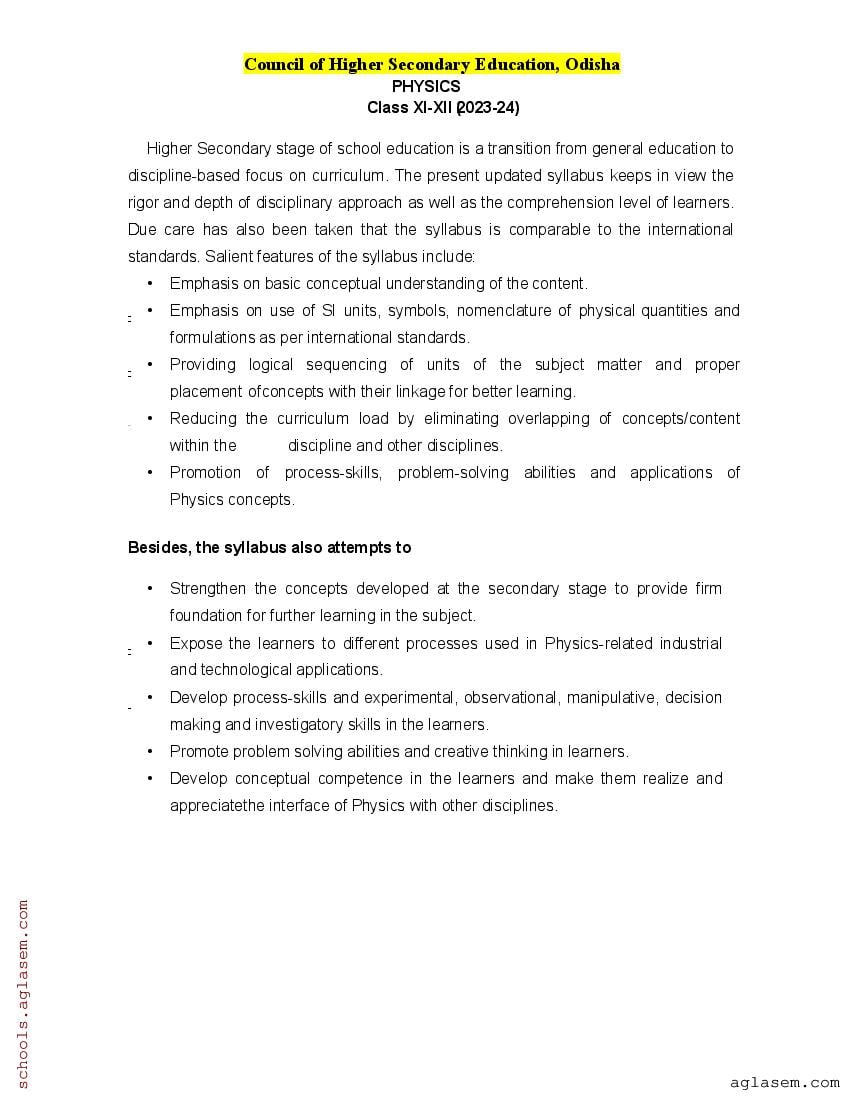
PHYSICS
Class XI-XII (2023-24)
Higher Secondary stage of school education is a transition from general education to
discipline-based focus on curriculum. The present updated syllabus keeps in view the
rigor and depth of disciplinary approach as well as the comprehension level of learners.
Due care has also been taken that the syllabus is comparable to the international
standards. Salient features of the syllabus include:
• Emphasis on basic conceptual understanding of the content.
• Emphasis on use of SI units, symbols, nomenclature of physical quantities and
formulations as per international standards.
• Providing logical sequencing of units of the subject matter and proper
placement of concepts with their linkage for better learning.
• Reducing the curriculum load by eliminating overlapping of concepts/content
within the discipline and other disciplines.
• Promotion of process-skills,
process problem-solving abilities and applications of
Physics concepts.
Besides, the syllabus also attempts to
• Strengthen the concepts developed at the secondary stage to provide firm
foundation for further learning in the subject.
• Expose the learners to different processes used in Physics-related
related industrial
and technological applications.
• Develop process-skills and experimental, observational, manipulative, decision
making and investigatory skills in the learners.
• Promote problem solving abilities and creative thinking in learners.
• Develop conceptual competence in the learners and make them
hem realize and
appreciatethe interface of Physics with other disciplines.
Page 2
COURSE STRUCTURE
Class XI – 2023-24 (Theory)
Time: 3 hrs. Max Marks: 70
No. of
Unit Topics Mark
periods
Unit–I Physical World and Measurement
Chapter–2: Units and Measurements 08
Unit-II Kinematics
Chapter–3: Motion in a Straight Line 24
Chapter–4: Motion in a Plane 23
Unit–III Laws of Motion
Chapter–5: Laws of Motion 14
Unit–IV Work, Energy and Power
Chapter–6: Work, Energy and Power 14
Unit–V Motion of System of Particles and Rigid
Body 18 17
Chapter–7: System of Particles and
Rotational Motion
Unit-VI Gravitation
Chapter–8: Gravitation 12
Unit–VII Properties of Bulk Matter
Chapter–9: Mechanical Properties of Solids
Chapter–10: Mechanical Properties of Fluids 24
Chapter–11: Thermal Properties of Matter
20
Unit–VIII Thermodynamics
Chapter–12: Thermodynamics 12
Unit–IX Behaviour of Perfect Gases and Kinetic
Theory of Gases 08
Chapter–13: Kinetic Theory
Unit–X Oscillations and Waves
Chapter–14: Oscillations 26 10
Chapter–15: Waves
Total 160 70
2
Page 3
Chapter–2: Units and Measurements
Need for measurement: Units of measurement; systems of units; SI units,
fundamental and derived units. significant figures. Dimensions of physical
quantities, dimensional analysis and its applications.
Unit II: Kinematics 24 Periods
Chapter–3: Motion in a Straight Line
Frame of reference, Motion in a straight line, Elementary concepts of
differentiation and integration for describing motion, uniform and non-
uniform motion, and instantaneous velocity, uniformly accelerated motion,
velocity~time and position~time graphs. Relation between associated
physical quantities for uniformly accelerated motion (graphical treatment).
Chapter–4: Motion in a Plane
Scalar and vector quantities; position and displacement vectors, general
vectors and their notations; equality of vectors, multiplication of vectors by a
real number; addition and subtraction of vectors, unit vector; resolution of a
vector in a plane, rectangular components, Scalar and Vector product of
vectors.
Motion in a plane:- Cases of uniform velocity and uniform acceleration,
projectile motion, uniform circular motion.
Unit III: Laws of Motion 14 Periods
Chapter–5: Laws of Motion
Intuitive concept of force, Inertia, Newton's first law of motion; momentum
and Newton's second law of motion; impulse; Newton's third law of motion.
Law of conservation of linear momentum and its applications.
Equilibrium of concurrent forces, static and kinetic friction, laws of friction,
rollingfriction, lubrication.
Dynamics of uniform circular motion: Centripetal force, examples of circular
motion (vehicle on a level circular road, vehicle on a banked road).
Unit IV: Work, Energy and Power 14 Periods
Chapter–6: Work, Energy and Power
Work done by a constant force and a variable force; kinetic energy, work-
energy theorem, power.
Notion of potential energy, potential energy of a spring, conservative forces:
non-conservative forces, motion in a vertical circle; elastic and inelastic
collisions in one and two dimensions.
3
Page 4
Chapter–7: System of Particles and Rotational Motion
Centre of mass of a two-particle system, momentum conservation and
Centre of mass motion. Centre of mass of a rigid body; centre of mass of a
uniform rod.
Moment of a force, torque, angular momentum, law of conservation of
angular momentum and its applications.
Equilibrium of rigid bodies, rigid body rotation and equations of rotational
motion, comparison of linear and rotational motions.
Moment of inertia, radius of gyration, values of moments of inertia for simple
geometrical objects (no derivation).
Unit VI: Gravitation 12 Periods
Chapter–8: Gravitation
Kepler's laws of planetary motion, universal law of gravitation. Acceleration
due to gravity and its variation with altitude and depth. Gravitational potential
energy and gravitational potential, escape speed, orbital velocity of a
satellite.
Unit VII: Properties of Bulk Matter 24 Periods
Chapter–9: Mechanical Properties of Solids
Elasticity: Stress-strain diagram, Hooke's law, Young’s modulus, bulk
modulus, shear modulus of rigidity (qualitative idea only), Poisson's ratio;
elastic potential energy.
Chapter–10: Mechanical Properties of Fluids
Pressure due to a fluid column; Pascal's law and its applications (hydraulic
lift and hydraulic brakes), effect of gravity on fluid pressure.
Viscosity, Stokes' law, terminal velocity, streamline and turbulent flow, critical
velocity, Bernoulli's theorem and its simple applications.
Surface energy and surface tension, angle of contact, excess pressure
across a curved liquid surface, application of surface tension: ideas of liquid
drops, bubbles and capillary rise.
Chapter–11: Thermal Properties of Matter
Heat, Temperature, Thermal expansion: thermal expansion of solids, liquids
and gases, anomalous expansion of water; specific heat capacity; CP, CV,
calorimetry; change of state: idea & definition of latent heat.
Heat transfer: Conduction, Convection and Radiation, thermal conductivity,
qualitative ideas of blackbody radiation, Wein's displacement law, Stefan's
law .
4
Page 5
Chapter–12: Thermodynamics
Thermal equilibrium and definition of temperature, zeroth law of
thermodynamics, heat, work and internal energy. First law of
thermodynamics,
Second law of thermodynamics: gaseous state of matter, change of condition
of gaseous state: isothermal, adiabatic, reversible, irreversible, and cyclic
processes.
Unit IX: Behavior of Perfect Gases and Kinetic Theory of Gases 08 Periods
Chapter–13: Kinetic Theory
Equation of state of a perfect gas, work done in compressing a gas.
Kinetic theory of gases: assumptions, concept of pressure. kinetic
interpretation of temperature; rms speed of gas molecules; degrees of
freedom, law of equi-partition of energy (statement only) and application to
specific heat capacities of gases; concept of mean free path, Avogadro's
Number.
Unit X: Oscillations and Waves 26 Periods
Chapter–14: Oscillations
Periodic motion: time period, frequency, displacement as a function of time,
periodic functions and their applications.
Simple Harmonic Motion (SHM) and its equations of motion; phase;
oscillations of a loaded spring- restoring force and force constant; energy in
SHM, Kinetic and potential energies; simple pendulum, derivation of
expression for its time period.
Chapter–15: Waves
Wave motion: Transverse and longitudinal waves, speed of travelling wave,
displacement relation for a progressive wave, principle of superposition of
waves, reflection of waves, standing waves in strings and organ pipes,
fundamental mode and harmonics, Beats.
5
Page 6
Total Periods: 60
The fair practical records are to be submitted by the students at the time of their annual
examination. At least 08 experiments are required to be performed by each student.
EVALUATION SCHEME
Time: 3 hours Max. Marks: 30
Topic Marks
One experiment from the list of experiments outlined below 15
Theory (2 marks) , Observation/Graph/Circuit diagram/Ray diagram (10 (02+10+03)
marks) , Calculation & Conclusion (3 marks)
Practical record 04
Experiment based conceptual question 05
Viva on experiments 06
Total 30 marks
Experiments
1. To measure the diameter of a small spherical / cylindrical body and to measure
internal diameter and depth of a given beaker / calorimeter using Vernier Callipers
and hence to find their volumes.
2. To measure the diameter of a given wire and thickness of a given sheet using
Screw gauge.
3. To determine the volume of an irregular lamina by using a screw gauge.
4. To determine the radius of curvature of a given spherical surface by a spherometer.
5. To determine the mass of two different objects by using a beam balance.
6. To find the weight of a given body by using parallelogram law of addition of vectors.
7. Using a simple pendulum, plot L~T2 graph and use it to find the effective length
of second's pendulum.
8. To study the variation of time period of a simple pendulum of a given length by
taking bobs of same size but different masses and interpret the result.
9. To study the relationship between force of limiting friction and normal reaction and
to find the co- efficient of friction between a block and a horizontal surface.
10. To find the downward force, along an inclined plane, acting on a roller due to
gravitational pull of the earth and study its relationship with the angle of inclination
θ by plotting graph between force and sinθ.
11. To determine Young's modulus of elasticity of the material of a given wire.
6
Page 7
extension.
13. To determine the surface tension of water by capillary rise method.
14. To study the relationship between the temperature of a hot body and time by
plotting a cooling curve.
15. To determine specific heat capacity of a given solid by method of mixtures.
16. To study the relation between frequency and length of a given wire under constant
tension by using a sonometer.
17. To study the relation between the length of a given wire and tension for constant
frequency by using a sonometer.
18. To find the speed of sound in air at room temperature by using a resonance tube
at two resonance positions.
Practical Examination for Visually Impaired students
Class XI
Note: Same Evaluation scheme and general guidelines for visually impaired students as
given for Class XII may be followed.
A. Items for Identification/Familiarity of the apparatus for assessment in
practical’s (all experiments)
Spherical ball, Cylindrical objects, vernier calipers, beaker, calorimeter, Screw
gauge, wire, Beam balance, spring balance, weight box, gram and milligram
weights, forceps, Parallelogram law of vectors apparatus, pulleys and pans used in
the same ‘weights’ used, Bob and string used in a simple pendulum, meter scale,
split cork, suspension arrangement, stop clock/stop watch, Helical spring,
suspension arrangement used, weights, arrangement used for measuring
extension, Sonometer, Wedges, pan and pulley used in it, ‘weights’ Tuning Fork,
Meter scale, Beam balance, Weight box, gram and milligram weights, forceps,
Resonance Tube, Tuning Fork, Meter scale, Flask/Beaker used for adding water.
B. List of Practicals
1. To measure diameter of a small spherical/cylindrical body using a vernier calipers.
2. To measure the internal diameter and depth of a given beaker/calorimeter
using a vernier calipers and hence find its volume.
3. To measure diameter of given wire using a screw gauge.
4. To measure thickness of a given sheet using a screw gauge.
5. To determine the mass of a given object using a beam balance.
6. Using a simple pendulum plot L~T2 graph; hence find the effective length of
second’s pendulum using appropriate length values.
7
Page 8
vectors.
8. To find the force constant of given helical spring by plotting a graph
between load and extension.
9 (i) To study the relation between frequency and length of a given wire
under constant tension using a sonometer.
(ii) To study the relation between the length of a given wire and tension, for
constant frequency by using a sonometer.
10. To find the speed of sound in air, at room temperature, using a resonance
tube, by observing two resonance positions.
Note: Above practicals may be performed in an experiential manner rather than
recording the observations.
Prescribed Books:
1. Physics Part-I, Textbook for Class XI, Published by NCERT
2. Physics Part-II, Textbook for Class XI, Published by NCERT
3. Laboratory Manual of Physics, Class XI Published by NCERT
4. The list of other related books and manuals brought out by
NCERT (consider multimedia also).
5. Bureau’s Higher Secondary (+2) Physics , Published by Odisha State Bureau
of Text Book Preparation and Production, Bhubaneswar
8
Page 9
PHYSICS (THEORY)
Time: 3 hrs. Max Marks: 70
No. of
Unit Topics Mark
periods
Unit–I Electrostatics
Chapter–1: Electric Charges and Fields
Chapter–2: Electrostatic Potential and 26 16
Capacitance
Unit-II Current Electricity
Chapter–3: Current Electricity 18
Unit-III Magnetic Effects of Current and Magnetism
Chapter–4: Moving Charges and Magnetism 25
Chapter–5: Magnetism and Matter 17
Unit-IV Electromagnetic Induction and Alternating
Currents 24
Chapter–6: Electromagnetic Induction
Chapter–7: Alternating Current
Unit–V Electromagnetic Waves
Chapter–8: Electromagnetic Waves 04
Unit–VI Optics 18
Chapter–9: Ray Optics and Optical 30
Instruments
Chapter–10: Wave Optics
Unit–VII Dual Nature of Radiation and Matter
Chapter–11: Dual Nature of Radiation and 8
Matter 12
Unit–VIII Atoms and Nuclei
Chapter–12: Atoms 15
Chapter–13: Nuclei
Unit–IX Electronic Devices
Chapter–14: Semiconductor 10
Electronics: Materials, Devices and 7
Simple Circuits
Total 160 70
9
Page 10
Chapter–1: Electric Charges and Fields
Electric charges, Conservation of charge, Coulomb's law: electrostatic
force between two point charges, forces between multiple charges;
superposition principleand continuous charge distribution.
Electric field: electric field intensity, electric field (intensity) due to a point
charge, electric field lines, electric dipole, electric field due to a dipole,
torque on a dipole placed in a uniform electric field.
Electric flux, statement of Gauss's theorem and its application to find out
electric field due to an infinitely long & uniformly charged straight
wire, uniformly charged infinite plane sheet and uniformly charged thin
spherical shell (field inside and outside).
Chapter–2: Electrostatic Potential and Capacitance
Electric potential, potential difference, electric potential due to a point
charge, a dipole and a system of point charges; equi-potential surfaces,
electric potential energy of a system of two-point charges and of
electric dipole in an electric field.
Conductors and insulators, free charges and bound charges inside a
conductor. Dielectrics and electric polarization, capacitors and
capacitance, combination of capacitors in series and in parallel,
capacitance of a parallel plate capacitor with and without dielectric
medium between the plates, energy stored in a capacitor (no derivation,
formulae only).
Unit II: Current Electricity 18 Periods
Chapter–3: Current Electricity
Electric current, flow of electric charges in a metallic conductor, drift
velocity, mobility and their relation with electric current; Ohm's law, V-I
characteristics (linear and non-linear), electrical energy and power,
electrical resistivity and conductivity, temperature dependence of
resistance, internal resistance of a cell, potential difference and emf of a
cell, combination of cells in series and in parallel, Kirchhoff's rules,
Wheatstone bridge.
Unit III: Magnetic Effects of Current and Magnetism 25 Periods
Chapter–4: Moving Charges and Magnetism
Concept of magnetic field, Oersted's experiment. Biot - Savart law and its
application to find the magnetic field near a current carrying circular loop.
Ampere's law and its applications to to find the magnetic field near an
infinitely long straight wire carrying current. Straight solenoid (only
10
Page 11
Force on a moving charge in uniform magnetic and electric fields. Force
on a current-carrying conductor in a uniform magnetic field, force
between two parallel current-carrying conductors: definition of ampere.
Torque experienced by a current loop in uniform magnetic field; Current
loopas a magnetic dipole and its magnetic dipole moment.
Moving coil galvanometer: its current sensitivity and conversion to
ammeter and voltmeter.
Chapter–5: Magnetism and Matter
Bar magnet: bar magnet as an equivalent solenoid (qualitative treatment
only), magnetic field intensity due to a magnetic dipole (bar magnet)
along its axis and perpendicular to its axis (qualitative treatment only),
torque on a magnetic dipole (bar magnet) in a uniform magnetic field
(qualitative treatment only), magnetic field lines.
Magnetic properties of materials- dia- para- and ferro - magnetic materials
with examples, Magnetization of materials, effect of temperature on
magnetic properties.
Unit IV: Electromagnetic Induction and Alternating Currents 24 Periods
Chapter–6: Electromagnetic Induction
Electromagnetic induction: Faraday's laws; induced emf and current;
Lenz's Law, self and mutual induction.
Chapter–7: Alternating Current
Alternating currents, peak and rms value of alternating current / voltage;
reactance and impedance; series LCR circuit (phasors only), resonance,
power in AC circuits, power factor, watt-less current.
AC generator, Transformer.
Unit V: Electromagnetic waves 04 Periods
Chapter–8: Electromagnetic Waves
Basic idea of displacement current, Electromagnetic waves, their
characteristics, transverse nature of e m waves (qualitative idea only).
Electromagnetic spectrum (radio waves, microwaves, infrared, visible,
ultraviolet, X-rays, gamma rays) including elementary facts about their
uses.
Unit VI: Optics 30 Periods
Chapter–9: Ray Optics and Optical Instruments
Ray Optics: Reflection of light, spherical mirrors, mirror formula,
refraction of light, total internal reflection and optical fibers, refraction at
11
Page 12
magnification, power of a lens, combination of thin lenses in contact,
refraction of light through a prism.
Optical instruments: Microscopes and astronomical telescopes (reflecting
and refracting) and their magnifying powers.
Chapter–10: Wave Optics
Wave optics: Wave front and Huygen’s principle, reflection and
refraction of plane wave at a plane surface using wave fronts. Proof of
laws of reflection and refraction using Huygen’s principle.
Interference: Young's double slit experiment and expression for fringe
width (No derivation; final expression only), coherent sources and
sustained interference of light, diffraction due to a single slit, width of
central maxima (qualitative treatmentonly).
Unit VII: Dual Nature of Radiation and Matter 08 Periods
Chapter–11: Dual Nature of Radiation and Matter
Dual nature of radiation, Photoelectric effect, Hertz and Lenard's
observations; Einstein's photoelectric equation; particle nature of light.
Experimental study of photoelectric effect
Matter waves-wave nature of particles, de-Broglie relation.
Unit VIII: Atoms and Nuclei 15 Periods
Chapter–12: Atoms
Alpha-particle scattering experiment; Rutherford's model of atom; Bohr
model of hydrogen atom, Expression for radius of nth stationary orbit,
velocity and energy of electron in nth orbit, hydrogen line spectra
(qualitative treatment only).
Chapter–13: Nuclei
Composition and size of nucleus, nuclear force, Mass-energy relation, mass
defect; binding energy per nucleon and its variation with mass number;
nuclear fission, nuclear fusion.
Unit IX: Electronic Devices 10 Periods
Chapter–14: Semiconductor Electronics: Materials, Devices and
Simple Circuits
Energy bands in conductors, semiconductors and insulators (qualitative
ideas only) Intrinsic and extrinsic semiconductors: p- and n- type, p-n
junction
Semiconductor diode: I~V characteristics in forward and reverse bias,
application of junction diode: diode as a rectifier.
12
Page 13
Total Periods 60
The fair practical records are to be submitted by the students at the time of their
annual examination. At least 08 experiments are required to be performed by each
student.
Evaluation Scheme
Time: 3 hours Max. Mark: 30
Topic Marks
One experiment from the list of experiments 15
Theory (2 marks) , Observation/Graph/Circuit diagram/Ray diagram (10
marks) , Calculation& Conclusion( 3 marks)
(02+10+03)
Practical record 04
Experiment based conceptual question 05
Viva on experiments 06
Total 30 marks
Experiments
1. To determine resistance per unit length of (two / three) given wires by plotting a
graph for potentialdifference versus current.
2. To find resistance of a given wire / standard resistor by metre bridge method
3. To verify the laws of combination (series/ parallel) of resistances using a metre bridge.
4. To determine resistance of a galvanometer by half-deflection method and to find its
figure of merit.
5. To convert the given galvanometer (of known resistance and figure of merit) into a
voltmeter of desired range and to verify the same.
OR
To convert the given galvanometer (of known resistance and figure of merit) into an
ammeter of desired range and to verify the same.
6. To find the frequency of AC mains by using a sonometer.
7. To find the value of v for different values of u in case of a concave mirror and to find its
focal length.
8. To find the focal length of a convex mirror, by using a convex lens.
13
Page 14
or between 1/u and 1/v.
10. To find the focal length of a concave lens, using a convex lens.
11. To determine angle of minimum deviation for a given prism by plotting a graph between
angle of incidence and angle of deviation.
12. To determine refractive index of a glass slab by using a travelling microscope.
13. To draw the reverse characteristic curve for a Zener diode and to determine its
breakdown voltage
14. To draw an I~V characteristic curve of a p-n junction diode in forward and
reverse biased conditions.
Practical Examination for Visually Impaired students
Class XII
Evaluation Scheme
Time 2 hours Max. Marks: 30
Identification/Familiarity with the apparatus 05 marks
Written test (based on given/prescribed practicals) 10 marks
Practical Record 05 marks
Viva 10 marks
Total 30 marks
General Guidelines
I. The practical examination will be of two-hour duration.
II. A separate list of 8 experiments should be included here.
III. The written examination in practical for these students will be conducted at
the timeof practical examination of all other students.
IV. The written test will be of 30 minutes duration.
V. The question paper given to the students should be legibly typed. It should
contain a total of 15 practical skill based very short answer type
questions. A student would be required to answer any 10 questions.
VI. A writer may be allowed to such students as per CHSE examination rules.
VII. All questions included in the question papers should be related to the listed
practicals.Every question should require about two minutes to be answered.
VIII. These students are also required to maintain a practical file. A student is
expected to record at least five of the listed experiments as per the specific
instructions for each subject. These practical should be duly checked and
signed by the internal examiner.
IX. The format of writing any experiment in the practical file should include aim,
apparatus required, simple theory, procedure, related practical skills,
14
Page 15
X. Questions may be generated jointly by the external/internal examiners and
used for assessment.
XI. The viva questions may include questions based on basic
theory/principle/concept, apparatus/ materials/chemicals required
procedure, precautions, sources of error etc.
Class XII
A. Items for Identification/ familiarity with the apparatus for assessment in
practical (All experiments)
Meter scale, general shape of the voltmeter/ammeter, battery/power supply,
connecting wires, standard resistances, connecting wires, voltmeter/ammeter,
meter bridge, screw gauge, jockey Galvanometer, Resistance Box, standard
Resistance, connecting wires, Potentiometer, jockey, Galvanometer, Lechlanche
cell, Daniel cell [simple distinction between the two vis-à-vis their outer (glass and
copper) containers], rheostat connecting wires, Galvanometer, resistance box,
Plug-in and tapping keys, connecting wires battery/power supply, Diode, Resistor
(Wire-wound or carbon ones with two wires connected to two ends), capacitors
(one or two types), Inductors, Simple electric/electronic bell, battery/power supply,
Plug- in and tapping keys, Convex lens, concave lens, convex mirror, concave
mirror, Core/hollow wooden cylinder, insulated wire, ferromagnetic rod,
Transformer core, insulated wire.
B. List of Practicals
1. To determine the resistance per cm of a given wire by plotting a graph
betweenvoltage and current.
2. To verify the laws of combination (series/parallel combination) of resistances
by Ohm’s law.
3. To find the resistance of a given wire / standard resistor using a meter bridge.
4. To determine the resistance of a galvanometer by half deflection method.
5. To identify a resistor, capacitor, inductor and diode from a mixed collection
of such items.
6. To observe the difference between
(i) a convex lens and a concave lens
(ii) a convex mirror and a concave mirror and to estimate the likely
difference between the power of two given convex /concave
lenses.
7. To design an inductor coil and to know the effect of
(i) change in the number of turns
(ii) Introduction of ferromagnetic material as its core material on
theinductance of the coil.
8. To design a (i) step up (ii) step down transformer on a given core and know
the relation between its input and output voltages.
15
Page 16
recording observations.
Prescribed Books:
1. Physics, Class XI, Part -I and II, Published by NCERT.
2. Physics, Class XII, Part -I and II, Published by NCERT.
3. Laboratory Manual of Physics for class XII Published by NCERT.
4. The list of other related books and manuals brought out
byNCERT (consider multimedia also).
5. Bureau’s Higher Secondary (+2) Physics , Published by Odisha State
Bureau of Text Book Preparation and Production, Bhubaneswar
16
Page 17
Theory (Class: XI/XII)
Maximum Marks: 70 Duration: 3 hrs.
Total Approximate
S No. Typology of Questions
Marks Percentage
1 Remembering: Exhibit memory of previously learned 27 38 %
material by recalling facts, terms, basic concepts, and
answers.
Understanding: Demonstrate understanding of facts and
ideas by organizing, comparing, translating, interpreting,
giving descriptions, and stating main ideas
2 Applying: Solve problems to new situations by applying 22 32%
acquired knowledge, facts, techniques and rules in a
different way.
3 Analysing : Examine and break information into parts by 21 30%
identifying motives or causes. Make inferences and find
evidence to support generalizations
Evaluating:
Present and defend opinions by making judgments about
information, validity of ideas, or quality of work based on
a set of criteria.
Creating:
Compile information together in a different way by
combining elements in a new pattern or proposing
alternative solutions.
Total Marks 70
Practical 30
Gross Total 100 100%
Note: The above template is only a sample. Suitable internal variations may be made for
generating similar templates keeping the overall weightage to different form of questions and
typology of questions.
For more details kindly refer to Sample Question Paper of class XII for the year
2023- 24 to be published by CHSE at its website.
17
Page 18
Syllabus: CHEMISTRY, XI-XII (2023-24)
Rationale
Higher Secondary is the most crucial stage of school education because at this juncture specialized
discipline based, content -oriented courses are introduced. Students reach this stage after 10 years of
general education and opt for Chemistry with a purpose of pursuing their career in basic sciences or
professional courses like medicine, engineering, technology and study courses in applied areas of science
and technology at tertiary level. Therefore, there is a need to provide learners with sufficient conceptual
background of Chemistry, which will make them competent to meet the challenges of academic and
professional courses after the senior secondary stage.
The new and updated curriculum is based on disciplinary approach with rigour and depth taking care
that the syllabus is not heavy and at the same time it is comparable to the international level. The
knowledge related to the subject of Chemistry has undergone tremendous changes during the past one
decade. Many new areas like synthetic materials, bio -molecules, natural resources, industrial chemistry
are coming in a big way and deserve to be an integral part of chemistry syllabus at senior secondary
stage. At international level, new formulations and nomenclature of elements and compounds, symbols
and units of physical quantities floated by scientific bodies like IUPAC and CGPM are of immense
importance and need to be incorporated in the updated syllabus. The revised syllabus takes care of all
these aspects. Greater emphasis has been laid on use of new nomenclature, symbols and formulations,
teaching of fundamental concepts, application of concepts in chemistry to industry/ technology, logical
sequencing of units, removal of obsolete content and repetition, etc.
Objectives
The curriculum of Chemistry at Senior Secondary Stage aims to:
Promote understanding of basic facts and concepts in chemistry while retaining the excitement
of chemistry.
make students capable of studying chemistry in academic and professional courses (such as
medicine, engineering, technology) at tertiary level.
expose the students to various emerging new areas of chemistry and apprise them with their
relevance in future studies and their application in various spheres of chemical sciences and
technology.
equip students to face various challenges related to health, nutrition, environment, population,
weather, industries and agriculture.
develop problem solving skills in students.
expose the students to different processes used in industries and their technological applications.
apprise students with interface of chemistry with other disciplines of science such as physics,
biology, geology, engineering etc.
acquaint students with different aspects of chemistry used in daily life.
develop an interest in students to study chemistry as a discipline.
integrate life skills and values in the context of chemistry.
Page 19
CLASS–XI (THEORY) (2023-24)
Time: 3 Hours Total Marks :70
No. of
Sl. No. UNIT Marks
Periods
1 Some Basic Concepts of Chemistry 12 7
2 Structure of Atom 14 9
Classification of Elements and Periodicity in
3 8 6
Properties
4 Chemical Bonding and Molecular Structure 14 7
5 Chemical Thermodynamics 16 9
6 Equilibrium 14 7
7 Redox Reactions 6 4
Organic Chemistry: Some basic Principles and
8 14 11
Techniques
9 Hydrocarbons 12 10
TOTAL 70
Unit I: Some Basic Concepts of Chemistry 12 Periods
General Introduction: Importance and scope of Chemistry.
Nature of matter, laws of chemical combination, Dalton's atomic theory: concept of elements,
atoms and molecules.
Atomic and molecular masses, Equivalent masses, concentration of solutions, mole concept and
molar mass, percentage composition, empirical and molecular formula, chemical reactions,
stoichiometry and calculations based on stoichiometry.
Unit II: Structure of Atom 14 Periods
Discovery of Electron, Proton and Neutron, atomic number, isotopes and isobars. Thomson's
model and its limitations. Rutherford's model and its limitations, Bohr's model and its limitations,
concept of shells and subshells, dual nature of matter and light, de Broglie's relationship,
Heisenberg uncertainty principle, concept of orbitals, quantum numbers, shapes of s, p and d
orbitals, rules for filling electrons in orbitals - Aufbau principle, Pauli's exclusion principle and
Hund's rule, electronic configuration of atoms, stability of half-filled and completely filled
orbitals.
Unit III: Classification of Elements and Periodicity in Properties 08 Periods
Significance of classification, brief history of the development of periodic table, modern periodic
law and the present form of periodic table, periodic trends in properties of elements -atomic
radii, ionic radii, inert gas radii, Ionization enthalpy, electron gain enthalpy, electronegativity,
valency. Nomenclature of elements with atomic number greater than 100.
Page 20
Valence electrons, ionic bond, covalent bond, bond parameters, Lewis structure, polar character
of covalent bond, covalent character of ionic bond, valence bond theory, resonance, geometry
of covalent molecules, VSEPR theory, concept of hybridization, involving s, p and d orbitals and
shapes of some simple molecules, molecular orbital theory of homonuclear diatomic
molecules(qualitative idea only), Hydrogen bond.
Unit VI: Chemical Thermodynamics 16 Periods
Concepts of System and types of systems, surroundings, work, heat, energy, extensive and
intensive properties, state functions.
First law of thermodynamics -internal energy and enthalpy, heat capacity and specific heat,
measurement of U and H, Hess's law of constant heat summation, enthalpy of bond
dissociation, combustion, formation, atomization, sublimation, phase transition, ionization,
solution and dilution. Second law of Thermodynamics (brief introduction)
Introduction of entropy as a state function, Gibb's energy change for spontaneous and non-
spontaneous processes, criteria for equilibrium.
Third law of thermodynamics (brief introduction).
Unit VII: Equilibrium 14 Periods
Equilibrium in physical and chemical processes, dynamic nature of equilibrium, law of mass
action, equilibrium constant, factors affecting equilibrium - Le Chatelier's principle, ionic
equilibrium- ionization of acids and bases, strong and weak electrolytes, degree of ionization,
ionization of poly basic acids, acid strength, concept of pH, hydrolysis of salts (elementary idea),
buffer solution, Henderson Equation, solubility product, common ion effect (with illustrative
examples).
Unit VIII: Redox Reactions 06 Periods
Concept of oxidation and reduction, redox reactions, oxidation number, balancing redox
reactions, in terms of loss and gain of electrons and change in oxidation number, applications of
redox reactions.
Unit IX: Organic Chemistry -Some Basic Principles and Techniques 14 Periods
General introduction, methods of purification, qualitative and quantitative analysis,
classification and IUPAC nomenclature of organic compounds. Electronic displacements in a
covalent bond: inductive effect, electrometric effect, resonance and hyper conjugation.
Hemolytic and heterolysis fission of a covalent bond: free radicals, carbocation, carbanions,
electrophiles and nucleophiles, types of organic reactions.
Unit X: Hydrocarbons 12 Periods
Classification of Hydrocarbons
Aliphatic Hydrocarbons:
Alkanes- Nomenclature, isomerism, conformation (ethane only), physical properties, chemical
reactions including free radical mechanism of halogenation, combustion and pyrolysis.
Alkenes- Nomenclature, structure of double bond (ethene), geometrical isomerism, physical
properties, methods of preparation, chemical reactions: addition of hydrogen, halogen, water,
hydrogen halides (Markovnikov's addition and peroxide effect), ozonolysis, oxidation, mechanism
of electrophilic addition.
Page 21
preparation, chemical reactions: acidic character of alkynes, addition reaction of - hydrogen,
halogens, hydrogen halides and water.
Aromatic Hydrocarbons:
Introduction, IUPAC nomenclature, benzene: resonance, aromaticity, chemical properties:
mechanism of electrophilic substitution. Nitration, sulphonation, halogenation, Friedel Craft's
alkylation and acylation, directive influence of functional group in monosubstituted benzene.
Carcinogenicity and toxicity.
Prescribed Books:
1. +2 Chemistry Vol- I : Published by Odisha State Bureau of Text Book Preparation and production,
Bhubaneswar.
2. Chemistry Part – I, Class-XI, Published by NCERT.
3. Chemistry Part – II, Class-XI, Published by NCERT.
Experiments:
1. Basic Laboratory Techniques: (Non-evaluative)
a) Bunsen burner (different parts and their functions)
b) Chemical balance - weighing with chemical balance by equal oscillation method.
c) Cutting and bending glass tube, drawing jet and boring a cork.
2. Crystallization:
Preparation of CuSO4, 5H2O crystal from CuCO3.
3. Qualitative Analysis:
a) Identification of Acid Radicals:
Radicals: CO3 2–, SO3 2–, S2–, NO2 –, Cl–, Br–, I–, NO3 –, SO4 2–, & PO4 3–
b) Identification of Basic Radicals :
Radicals : Ag+, Pb2+, Hg22+, Cu2+, Hg2+, Bi3+, As3+, Sb3+, Sn2+, Al3+, Fe3+, Cr3+, Co2+, Ni2+,
Zn2+, Mn2+, Ba2+, Sr2+, Ca2+, NH4+, Mg2+, K+ and Na+ (Dry Tests only).
4. Volumetric Analysis:
Single titration of acids and bases (three experiments to be done ; one on direct determination of
normality of one of the solutions from that of the other and the other two, involving numerical
calculations)
5. Gravimetric Analysis
a) Equivalent mass of Mg by hydrogen displacement method.
b) Solubility of K2SO4 at room temperature.
Books Recommended:
+2 Practical Chemistry, Published by Odisha State Bureau of Text Book Preparation and Production,
Bhubaneswar
Page 22
Class- XI (PRACTICAL)
Full Mark : 30 Time : 3 Hrs.
1. Salt analysis (Acid radical) 10 marks
Dry Test 04 marks
Wet Test 06 marks
2. Crystallization / Single titration / Equivalent mass / Solubility 10 marks
3. Viva-Voce 06 marks
4. Record 04 marks
********
Practical Examination for Visually Impaired Students
Class XI
A. List of apparatus for identification for assessment in practical (All experiments)
Beaker, tripod stand, wire gauze, glass rod, funnel, filter paper, Bunsen burner, test tube, test tube
stand, dropper, test tube holder, ignition tube, china dish, tongs, standard flask, pipette, burette,
conical flask, clamp stand, dropper, wash bottle
Odour detection in qualitative analysis
Procedure/Setup of the apparatus
B. Quantitative estimation
1. Preparation of standard solution of oxalic acid.
2. Determination of molarity of a given solution of sodium hydroxide by titrating it against standard
solution of oxalic acid.
C. Qualitative Analysis
1. Determination of one anion and one cation in a given salt
2. Cations - NH+4
Anions – (CO3)2-, S2-, (SO3)2-, Cl-, CH3COO-
(Note: insoluble salts excluded)
Note: The above practicals may be carried out in an experiential manner rather than recording
observations.
Prescribed Books:
1. Chemistry Part – I, Class-XI, Published by NCERT
2. Chemistry Part – II, Class-XI, Published by NCERT
Page 23
Identification/Familiarity with the apparatus 5 marks
Written test (based on given/prescribed practicals) 10 marks
Practical Record 5 marks
Viva 10 marks
Total 30 marks
********************************************
CLASS XII (2023-24) (THEORY)
Time: 3 Hours 70 Marks
Unit wise distribution of Periods and marks
No. of
Sl.No. Title Marks
Periods
1 Solutions 10 7
2 Electrochemistry 12 9
3 Chemical Kinetics 10 7
4 d -and f -Block Elements 12 7
5 Coordination Compounds 12 7
6 Haloalkanes and Haloarenes 10 6
7 Alcohols, Phenols and Ethers 10 6
8 Aldehydes, Ketones and Carboxylic Acids 10 8
9 Amines 10 6
10 Biomolecules 12 7
Total 70
Unit I: Solutions 10 Periods
Types of solutions, expression of concentration of solutions of solids in liquids, solubility of gases
in liquids, solid solutions, Raoul’s law, colligative properties - relative lowering of vapour
pressure, elevation of boiling point, depression of freezing point, osmotic pressure,
determination of molecular masses using colligative properties, abnormal molecular mass, Van't
Hoff factor.
Unit II: Electrochemistry 12 Periods
Redox reactions, EMF of a cell, standard electrode potential, Nernst equation and its application
to chemical cells, Relation between Gibbs energy change and EMF of a cell, conductance in
electrolytic solutions, specific and molar conductivity, variations of conductivity with
concentration, Kohlrausch's Law, electrolysis and law of electrolysis (elementary idea), dry cell-
electrolytic cells and Galvanic cells, lead accumulator, fuel cells, corrosion.
Page 24
Rate of a reaction (Average and instantaneous), factors affecting rate of reaction: concentration,
temperature, catalyst; order and molecularity of a reaction, rate law and specific rate constant,
integrated rate equations and half-life (only for zero and first order reactions), concept of
collision theory (elementary idea, no mathematical treatment), activation energy, Arrhenius
equation.
Unit IV: d and f Block Elements 12 Periods
General introduction, electronic configuration, occurrence and characteristics of transition
metals, general trends in properties of the first row transition metals – metallic character,
ionization enthalpy, oxidation states, ionic radii, color, catalytic property, magnetic properties,
interstitial compounds, alloy formation, preparation and properties of K2Cr2O7 and KMnO4.
Lanthanides - Electronic configuration, oxidation states, chemical reactivity and lanthanide
contraction and its consequences.
Actinides - Electronic configuration, oxidation states and comparison with lanthanides.
Unit V: Coordination Compounds 12 Periods
Coordination compounds - Introduction, ligands, coordination number, color, magnetic properties
and shapes, IUPAC nomenclature of mononuclear coordination compounds. Bonding, Werner's
theory, VBT, and CFT; structure and stereoisomerism, importance of coordination compounds (in
qualitative analysis, extraction of metals and biological system).
Unit VI: Halo alkanes and Halo alkenes 10 Periods
Halo alkanes: Nomenclature, nature of C–X bond, physical and chemical properties, optical
rotation mechanism of substitution reactions.
Halo alkenes: Nature of C–X bond, substitution reactions (Directive influence of halogen in mono
substituted compounds only).
Uses and environmental effects of - dichloromethane, tri chloromethane, tetra chloromethane,
iodoform, freons, DDT.
Unit VII: Alcohols, Phenols and Ethers 10 Periods
Alcohols: Nomenclature, methods of preparation, physical and chemical properties (of primary
alcohols only), identification of primary, secondary and tertiary alcohols, mechanism of
dehydration, uses with special reference to methanol and ethanol.
Phenols: Nomenclature, methods of preparation, physical and chemical properties, acidic nature
of phenol, electrophillic substitution reactions, uses of phenols.
Ethers: Nomenclature, methods of preparation, physical and chemical properties, uses.
Unit VIII: Aldehydes, Ketones and Carboxylic Acids 10 Periods
Aldehydes and Ketones: Nomenclature, nature of carbonyl group, methods of preparation,
physical and chemical properties, mechanism of nucleophilic addition, reactivity of alpha
hydrogen in aldehydes, uses.
Carboxylic Acids: Nomenclature, acidic nature, methods of preparation, physical and chemical
properties; uses.
Page 25
Amines: Nomenclature, classification, structure, methods of preparation, physical and chemical
properties, uses, identification of primary, secondary and tertiary amines.
Diazonium salts: Preparation, chemical reactions and importance in synthetic organic chemistry.
Unit X: Biomolecules 12 Periods
Carbohydrates - Classification (aldoses and ketoses), monosaccharides (glucose and fructose), D-
L configuration oligosaccharides (sucrose, lactose, maltose), polysaccharides (starch, cellulose,
glycogen); Importance of carbohydrates.
Proteins -Elementary idea of - amino acids, peptide bond, polypeptides, proteins, structure of
proteins
- primary, secondary, tertiary structure and quaternary structures (qualitative idea only),
denaturation of proteins; enzymes. Hormones - Elementary idea excluding structure.
Vitamins - Classification and functions.
Nucleic Acids: DNA and RNA.
Prescribed Books:
1. +2 Chemistry Vol- II : Published by Odisha State Bureau of Text Book Preparation and production,
Bhubaneswar
2. Chemistry Part – I, Class-XII, Published by NCERT
3. Chemistry Part – II, Class-XII, Published by NCERT
CHEMISTRY (PRACTICAL)
XII (Science)
(Detailed Syllabus)
1. Crystallization:
a) Preparation of Mohr’s Salt [FeSO4, (NH4)2SO4, 6H2O] crystal.
b) Preparation of potash alum [K2SO4, Al2(SO4)3, 24H2O] crystal.
2. Quantitative Analysis :
a) Double titration : Two experiments to be done - i) one acid two alkalis double titration and
ii) Two acids one alkali double titration.
b) Bench Acid Titration: Strong acid of approximately 2·0 N be supplied.
c) Redox Titration: Titration between potassium permanganate and oxalic acid.
3. Qualitative Inorganic Analysis :
Wet tests for basic radicals: Wet tests for the following basic radicals be done.
Group-I basic radicals: Ag+, Pb2+, Hg22+
Group-II basic radicals : Hg2+, Cu2+, Bi3+, As3+, Sb3+, Sn2+ & Sn4+,
Group-III A basic radicals: Fe3+, Al3+ & Cr3+.
Group-III B basic radicals: Co2+, Ni2+, Zn2+ & Mn2+
Group-IV basic radicals: Ba2+, Ca2+ & Sr2+
Group-V basic radicals: NH4+, Mg2+, K+, Na+.
Identification of unknown basic radicals.
[For identification of unknown basic radicals both dry and wet tests are to be performed]
Page 26
Tests for unsaturation, distinction between aromatic and aliphatic compounds by copper foil test,
tests for carboxylic, phenolic, aldehydes, ketonic and alcoholic groups.
Book Recommended
+ 2 Practical Chemistry: Published by Odisha State Bureau of Text Book Preparation and Production,
Bhubaneswar
********
QUESTION PATTERN AND MARK DISTRIBUTION
CHEMISTRY (PRACTICAL)
XII (Science)
Full Mark: 30 Time: 3 Hrs.
1. Salt Analysis (Identification of basic radical only) 12 mark
a) Dry Test = 05 marks
b) Wet Test = 07 marks
2. Crystallization / Double Titration /Bench Acid Titration Redox Titration / Organic compound
=10 marks
3. Viva-voce=05 marks
4. Record =03 marks
********
Practical Examination for Visually Impaired Students of Classes XII
Full Mark: 30 Time: 3 Hrs.
A. Quantitative Analysis
(1) (a) Preparation of the standard solution of Oxalic acid of a given volume
(b) Determination of molarity of KMnO4 solution by titrating it against a standard solution of Oxalic acid.
B. Qualitative Analysis:
(1) Determination of one cation and one anion in a given salt.
Cation – NH4 +
Anions – CO32-, S2-, SO32-,Cl-, CH3COO-
(Note: Insoluble salts excluded)
Note: The above practicals may be carried out in an experiential manner rather than recording
observations.
Prescribed Books:
1. Chemistry Part -I, Class-XII, Published by NCERT
2. Chemistry Part -II, Class-XII, Published by NCERT
Page 27
CHEMISTRY (PRACTICAL)
XII (Science)
Identification/Familiarity with the apparatus 5 marks
Written test (based on given/prescribed practicals) 10 marks
Practical Record 5 marks
Viva 10 marks
Total 30 marks
**********************************************************************
Page 28
Syllabus: MATHEMATICS
(2023-24)
The Syllabus in the subject of Mathematics has undergone changes from time to time in
accordance with growth of the subject and emerging needs of the society. Senior Secondary stage
is a launching stage from where the students go either for higher academic education in
Mathematics or for professional courses like Engineering, Physical and Biological science,
Commerce or Computer Applications. The present revised syllabus has been designed in
accordance with National Curriculum Framework 2005 and as per guidelines given in Focus Group
on Teaching of Mathematics 2005 which is to meet the emerging needs of all categories of
students. Motivating the topics from real life situations and other subject areas, greater emphasis
has been laid on application of various concepts.
Objectives
The broad objectives of teaching Mathematics at senior school stage intend to help the students:
to acquire knowledge and critical understanding, particularly by way of motivation and
visualization, of basic concepts, terms, principles, symbols and mastery of underlying
processes and skills.
to feel the flow of reasons while proving a result or solving a problem.
to apply the knowledge and skills acquired to solve problems and wherever possible, by
more than one method.
to develop positive attitude to think, analyze and articulate logically.
to develop interest in the subject by participating in related competitions.
to acquaint students with different aspects of Mathematics used in daily life.
to develop an interest in students to study Mathematics as a discipline.
to develop awareness of the need for national integration, protection of environment,
observance of small family norms, removal of social barriers, elimination of gender
biases.
to develop reverence and respect towards great Mathematicians for their contributions
to the field of Mathematics.
1
Page 29
CLASS XI (2023-24)
One Paper Total Period–240
Three Hours Max Marks: 80
No. Units No. of Periods Marks
I. Sets and Functions 60 23
II. Algebra 50 25
III. Coordinate Geometry 50 12
IV. Calculus 40 08
V. Statistics and Probability 40 12
Total 240 80
Internal Assessment 20
*No chapter/unit-wise weightage. Care to be taken to cover all the chapters.
Unit-I: Sets and Functions
1. Sets (20) Periods
Sets and their representations, Empty set, Finite and Infinite sets, Equal sets, Subsets, Subsets of
a set of real numbers especially intervals (with notations). Universal set. Venn diagrams. Union
and Intersection of sets. Difference of sets. Complement of a set. Properties of Complement.
2. Relations & Functions (20) Periods
Ordered pairs. Cartesian product of sets. Number of elements in the Cartesian product of two finite
sets. Cartesian product of the set of reals with itself (upto R x R x R).Definition of relation, pictorial
diagrams, domain, co-domain
domain and range of a relation. Function as a special type of relation.
Pictorial representation of a function, domain, co
co-domain
domain and range of a function. Real valued
functions, domain and range of these functions, constant, identity, polynomial, ration
rational, modulus,
signum, exponential, logarithmic and greatest integer functions, with their graphs. Sum, difference,
product and quotients of functions.
3. Trigonometric Functions (20) Periods
Positive and negative angles. Measuring angles in radians and in degrees and conversion from
one measure to another. Definition of trigonometric functions with the help of unit circle. Truth of
2
Page 30
trigonometric functions and their graphs. Expressing sin (x±y) and cos (x±y) in terms of sinx, siny,
cosx & cosy and their simple applications. Deducing identities like the following:
tan x ± tan y cot x cot y ∓ 1
tan(x ± y) = , cot(x ± y) =
1 ∓ tan x tan y cot y ± cot x
1 1
sinα ± sinβ = 2sin (α ± β)cos (α ∓ β)
2 2
1 1
cosα + cosβ = 2cos (α + β)cos (α − β)1
2 2
1
𝑐𝑜𝑠𝛼 − 𝑐𝑜𝑠𝛽 = −2𝑠𝑖𝑛 (𝛼 + 𝛽)𝑠𝑖𝑛 (𝛼 − 𝛽)
2 2
Identities related to sin2x, cos2x, tan2 x, sin3x, cos3x and tan3x.
Unit-II: Algebra
1. Complex Numbers and Quadratic Equations (10) Periods
Need for complex numbers, especially√−1, to be motivated by inability to solve some of the
quadratic equations. Algebraic properties of complex numbers. Argand plane
2. Linear Inequalities (10) Periods
Linear inequalities. Algebraic solutions of linear inequalities in one variable and their representation
on the number line.
3. Permutations and Combinations (10) Periods
Fundamental principle of counting. Factorial n. (n!) Permutations and combinations, derivation of
Formulae for nPr and nCr and their connections, simple applications.
4. Binomial Theorem (10) Periods
Historical perspective, statement and proof of the binomial theorem for positive integral indices.
Pascal’s triangle, simple applications.
5. Sequence and Series (10) Periods
Sequence and Series. Arithmetic Mean (A.M.) Geometric Progression (G.P.), general term of a
G.P., sum of n terms of a G.P., infinite G.P. and its sum, geometric mean (G.M.), relation between
A.M. and G.M.
3
Page 31
1. Straight Lines (15) Periods
Brief recall of two dimensional geometry from earlier classes. Slope of a line and angle between
two lines. Various forms of equations of a line: parallel to axis, point -slope form, slope-intercept
form, two-point form, intercept form, Distance of a point from a line.
2. Conic Sections (25) Periods
Sections of a cone: circles, ellipse, parabola, hyperbola, a point, a straight line and a pair of
intersecting lines as a degenerated case of a conic section. Standard equations and simple
properties of parabola, ellipse and hyperbola. Standard equation of a circle.
3. Introduction to Three-dimensional Geometry (10) Periods
Coordinate axes and coordinate planes in three dimensions. Coordinates of a point. Distance
between two points.
Unit-IV: Calculus
1. Limits and Derivatives (40) Periods
Derivative introduced as rate of change both as that of distance function and geometrically. Intuitive
idea of limit. Limits of polynomials and rational functions trigonometric, exponential and logarithmic
functions. Definition of derivative relate it to scope of tangent of the curve, derivative of sum,
difference, product and quotient of functions. Derivatives of polynomial and trigonometric functions.
Unit-V Statistics and Probability
1. Statistics (20) Periods
Measures of Dispersion: Range, Mean deviation, variance and standard deviation of
ungrouped/grouped data.
2. Probability (20) Periods
Events; occurrence of events, ‘not’, ‘and’ and ‘or’ events, exhaustive events, mutually exclusive
events, Axiomatic (set theoretic) probability, connections with other theories of earlier classes.
Probability of an event, probability of ‘not’, ‘and’ and ‘or’ events.
4
Page 32
QUESTION PAPER DESIGN
CLASS – XI
Time: 3 Hours Max. Marks: 80
%
S. Total Weight
Typology of Questions
No. Marks age
Remembering: Exhibit memory of previously learned material by
recalling facts, terms, basic concepts, and answers.
1 55
44
Understanding: Demonstrate understanding of facts and ideas by
organizing, comparing, translating, interpreting, giving descriptions,
and stating main ideas
Applying: Solve problems to new situations by applying acquired
2 20 25
knowledge, facts, techniques and rules in a different way.
Analysing :
Examine and break information into parts by identifying motives or
causes. Make inferences and find evidence to support
generalizations
Evaluating:
Present and defend opinions by making judgments about
3 16 20
information, validity of ideas, or quality of work based on a set of
criteria.
Creating:
Compile information together in a different way by combining
elements in a new pattern or proposing alternative solutions
Total 80 100
1. No chapter wise weightage. Care to be taken to cover all the chapters
2. Suitable internal variations may be made for generating various templates keeping the overall
weightage to different form of questions and typology of questions same.
Choice(s):
There will be no overall choice in the question paper.
However, 33% internal choices will be given in all the sections
INTERNAL ASSESSMENT 20 MARKS
Periodic Tests ( Best 2 out of 3 tests conducted) 10 Marks
Mathematics Activities 10 Marks
Note: Please refer the guidelines given under XII Mathematics Syllabus:
5
Page 33
Mathematics
One Paper Max Marks: 80
No. Units No. of Periods Marks
I. Relations and Functions 30 08
II. Algebra 50
10
III. Calculus 80
35
IV. Vectors and Three - Dimensional Geometry 30
14
V. Linear Programming 20
05
VI. Probability 30
08
Total 240
80
Internal Assessment
20
Unit-I: Relations and Functions
1. Relations and Functions 15 Periods
Types of relations: reflexive, symmetric, transitive and equivalence relations. One to one and onto
functions.
2. Inverse Trigonometric Functions 15 Periods
Definition, range, domain, principal value branch. Graphs of inverse trigonometric functions.
Unit-II: Algebra
1. Matrices 25 Periods
Concept, notation, order, equality, types of matrices, zero and identity matrix, transpose of a matrix,
symmetric and skew symmetric matrices. Operations on matrices: Addition and multiplication and
multiplication with a scalar. Simple properties of addition, multiplication and scalar multiplication. Non-
commutativity of multiplication of matrices and existence of non-zero matrices whose product is the
zero matrix (restrict to square matrices of order 2). Invertible matrices and proof of the uniqueness of
inverse, if it exists; (Here all matrices will have real entries).
2. Determinants 25 Periods
Determinant of a square matrix (up to 3 x 3 matrices), minors, co-factors and applications of
6
Page 34
inconsistency and number of solutions of system of linear equations by examples, solving system of
linear equations in two or three variables (having unique solution) using inverse of a matrix.
Unit-III: Calculus
1. Continuity and Differentiability 20 Periods
Continuity and differentiability, chain rule, derivative of inverse trigonometric functions,
𝑙𝑖𝑘𝑒 sin−1 𝑥 , cos−1 𝑥 and tan−1 𝑥, derivative of implicit functions. Concept of exponential and logarithmic
functions.
Derivatives of logarithmic and exponential functions. Logarithmic differentiation, derivative of functions
expressed in parametric forms. Second order derivatives.
2. Applications of Derivatives 10 Periods
Applications of derivatives: rate of change of quantities, increasing/decreasing functions, maxima and
minima (first derivative test motivated geometrically and second derivative test given as a provable
tool). Simple problems (that illustrate basic principles and understanding of the subject as well as real-
life situations).
3. Integrals 20 Periods
Integration as inverse process of differentiation. Integration of a variety of functions by substitution, by
partial fractions and by parts, Evaluation of simple integrals of the following types and problems based
on them.
dx dx dx dx dx
∫ 2 ∫ , ∫ , ∫ , ∫
x ± a2, √x2 ± a2 √a2 − x2 ax2 + bx + c √ax2 + 𝑏𝑥 + 𝑐
px + q px + q
∫ 2 dx, ∫ dx, ∫ √a2 ± x2 dx, ∫ √x2 − a2 dx
ax + bx + c √ax2+bx + c
∫ √𝑎𝑥2 + 𝑏𝑥 + 𝑐 𝑑𝑥,
Fundamental Theorem of Calculus (without proof). Basic properties of definite integrals and evaluation
of definite integrals.
4. Applications of the Integrals 15 Periods
Applications in finding the area under simple curves, especially lines, circles/ parabolas/ellipses (in
standard form only)
5. Differential Equations 15 Periods
Definition, order and degree, general and particular solutions of a differential equation. Solution of
differential equations by method of separation of variables, solutions of homogeneous differential
equations of first order and first degree. Solutions of linear differential equation of the type:
7
Page 35
+ py = q, where p and q are functions of x or constants.
dx
d𝑥
+ px = q, where p and q are functions of y or constants.
d𝑦
Unit-IV: Vectors and Three-Dimensional Geometry
1. Vectors 15 Periods
Vectors and scalars, magnitude and direction of a vector. Direction cosines and direction ratios of a
vector. Types of vectors (equal, unit, zero, parallel and collinear vectors), position vector of a point,
negative of a vector, components of a vector, addition of vectors, multiplication of a vector by a scalar,
position vector of a point dividing a line segment in a given ratio. Definition, Geometrical Interpretation,
properties and application of scalar (dot) product of vectors, vector (cross) product of vectors.
2. Three - dimensional Geometry 15 Periods
Direction cosines and direction ratios of a line joining two points. Cartesian equation and vector equation
of a line, skew lines, shortest distance between two lines. Angle between two lines.
Unit-V: Linear Programming
1. Linear Programming 20 Periods
Introduction, related terminology such as constraints, objective function, optimization, graphical method
of solution for problems in two variables, feasible and infeasible regions (bounded or unbounded),
feasible and infeasible solutions, optimal feasible solutions (up to three non-trivial constraints).
Unit-VI: Probability
1. Probability 30 Periods
Conditional probability, multiplication theorem on probability, independent events, total probability,
Bayes’ theorem, Random variable and its probability distribution, mean of random variable.
8
Page 36
QUESTION PAPER DESIGN CLASS - XII
Time: 3 hours Max. Marks: 80
%
S. Total
Typology of Questions Weightage
No. Marks
Remembering: Exhibit memory of previously learned material
by recalling facts, terms, basic concepts, and answers.
55
1 Understanding: Demonstrate understanding of facts and 44
ideas by organizing, comparing, translating, interpreting, giving
descriptions, and stating main ideas
Applying: Solve problems to new situations by applying
2 acquired knowledge, facts, techniques and rules in a different 20 25
way.
Analysing :
Examine and break information into parts by identifying
motives or causes. Make inferences and find evidence to
support generalizations
Evaluating:
Present and defend opinions by making judgments about
3 16 20
information, validity of ideas, or quality of work based on a set
of criteria.
Creating:
Compile information together in a different way by combining
elements in a new pattern or proposing alternative solutions
Total 80 100
1. No chapter wise weightage. Care to be taken to cover all the chapters
2. Suitable internal variations may be made for generating various templates keeping the overall
weightage to different form of questions and typology of questions same.
Choice(s):
There will be no overall choice in the question paper.
However, 33% internal choices will be given in all the sections
INTERNAL ASSESSMENT 20 MARKS
Periodic Tests ( Best 2 out of 3 tests conducted) 10 Marks
Mathematics Activities 10 Marks
Note: For activities NCERT Lab Manual may be referred.
9
Page 37
Periodic Test is a Pen and Paper assessment which is to be conducted by the respective
subject teacher. The format of periodic test must have questions items with a balance mix,
such as, very short answer (VSA), short answer (SA) and long answer (LA) to effectively
assess the knowledge, understanding, application, skills, analysis, evaluation and synthesis.
Depending on the nature of subject, the subject teacher will have the liberty of incorporating
any other types of questions too. The modalities of the PT are as follows:
a) Mode: The periodic test is to be taken in the form of pen-paper test.
b) Schedule: In the entire Academic Year, three Periodic Tests in each subject may be
conducted as follows:
Test Pre Mid-term (PT-I) Mid-Term (PT-II) Post Mid-Term (PT-III)
Tentative Month July-August November December-January
This is only a suggestive schedule and schools may conduct periodic tests as per their
convenience.
c) Average of Marks: Once schools complete the conduct of all the three periodic tests,
they will convert the weightage of each of the three tests into ten marks each for identifying
best two tests. The best two will be taken into consideration and the average of the two
shall be taken as the final marks for PT.
d) The school will ensure simple documentation to keep a record of performance.
e) Sharing of Feedback/Performance: The students’ achievement in each test must be
shared with the students and their parents to give them an overview of the level of learning
that has taken place during different periods. Feedback will help parents formulate
interventions (conducive ambience, support materials, motivation and morale-boosting)
to further enhance learning. A teacher, while sharing the feedback with student or parent,
should be empathetic, non- judgmental and motivating. It is recommended that the
teacher share best examples/performances of IA with the class to motivate all learners.
10
Page 38
Throughout the year any 10 activities shall be performed by the student from the activities
for the respective class (XI or XII) record of the same may be kept by the student. An
year end test on the activity may be conducted
The weightage are as under:
The activities performed by the student throughout the year and record keeping
: 5 marks
Assessment of the activity performed during the year end test: 3 marks
Viva-voce: 2 marks
Prescribed Books:
1) Mathematics Textbook for Class XI, NCERT Publications
2) Mathematics Part I - Textbook for Class XII, NCERT Publication
3) Mathematics Part II - Textbook for Class XII, NCERT Publication
4) Mathematics Exemplar Problem for Class XI, Published by NCERT
5) Mathematics Exemplar Problem for Class XII, Published by NCERT
6) Mathematics Lab Manual class XI, published by NCERT
7) Mathematics Lab Manual class XII, published by NCERT
8) Bureau’s Higher Secondary (+2) Elements of Mathematics , Published by Odisha State
Bureau of Text Book Preparation and Production, Bhubaneswar
11
Page 39
Subject: BIOLOGY
Classes XI & XII (2023-24)
The present curriculum provides the students with updated concepts along with an extended
exposure to contemporary areas of the subject. The curriculum also aims at emphasizing the
underlying principles that are common to animals, plants and microorganisms as well as
highlighting the relationship of Biology with other areas of knowledge. The format allows a simple,
clear, sequential flow of concepts. It relates the study of biology to real life through the
developments in use of technology. It links the discoveries and innovations in biology to everyday
life such as environment, industry, health and agriculture. The updated curriculum also focuses on
understanding and application of scientific principles, while ensuring that ample opportunities and
scope for learning and appreciating basic concepts continue to be available within itsframework.
The prescribed syllabus is expected to:
promote understanding of basic principles of Biology
encourage learning of emerging knowledge and its relevance to individual and society
promote rational/scientific attitude towards issues related to population, environment and
development
enhance awareness about environmental issues, problems and their appropriate solutions
create awareness amongst the learners about diversity in the living organisms and
developing respect for other living beings
appreciate that the most complex biological phenomena are built on essentially simple
processes
It is expected that the students would get an exposure to various branches of Biology in the
curriculum in a more contextual and systematic manner as they study its various units.
BIOLOGY (THEORY)
COURSE STRUCTURE (2023 -24)
CLASS XI
Botany: Full Mark-35 Time: 1.5 Hours
Zoology: Full Mark-35 Time: 1.5 Hours
Unit wise distribution of mark
Unit Title Botany Zoology
I Diversity of Living Organisms 8 7
II Structural Organization in Plants and Animals 6 4
III Cell: Structure and Function 9 6
IV Plant Physiology 12 0
V Human Physiology 0 18
Total 35 35
1
Page 40
Chapter-1: The Living World (Botany)
Biodiversity; Need for classification; three domains of life; taxonomy and systematics; concept
of species and taxonomical hierarchy; binomial nomenclature
Chapter-2: Biological Classification (Botany)
Five kingdom classification; Salient features and classification of Monera, Protista and Fungi
into major groups; Lichens, Viruses and Viroids.
Chapter-3: Plant Kingdom (Botany)
Classification of plants into major groups; Salient and distinguishing features and a few examples
of Algae, Bryophyta, Pteridophyta, Gymnospermae (Topics excluded – Angiosperms, Plant Life
Cycle and Alternation of Generations)
Chapter-4: Animal Kingdom (Zoology)
Salient features and classification of animals, non-chordates up to phyla level and chordates up
to class level (salient features and at a few examples of each category).
(No live animals or specimen should be displayed.)
Unit-II : Structural Organization in Plants and Animals
Chapter-5: Morphology of Flowering Plants (Botany)
Morphology of different parts of flowering plants: root, stem, leaf, inflorescence, flower, fruit and
seed. Description of family Solanaceae
Chapter-6: Anatomy of Flowering Plants (Botany)
Anatomy and functions of tissue systems in dicots and monocots.
Chapter-7: Structural Organisation in Animals (Zoology)
Morphology, Anatomy and functions of different systems (digestive, circulatory,respiratory,
nervous and reproductive) of frog.
Unit-III Cell: Structure and Function
Chapter-8: Cell-The Unit of Life (Botany)
Cell theory and cell as the basic unit of life, structure of prokaryotic and eukaryotic cells; Plant cell
and animal cell; cell envelope; cell membrane, cell wall; cell organelles - structure and function;
endomembrane system, endoplasmic reticulum, golgi bodies, lysosomes, vacuoles,mitochondria,
ribosomes, plastids, microbodies; cytoskeleton, cilia, flagella, centrioles (ultrastructure and
function); nucleus.
2
Page 41
Chemical constituents of living cells: biomolecules, structure and function of proteins,
carbohydrates, lipids, and nucleic acids; Enzyme - types, properties, enzyme action. (Topics
excluded: Nature of Bond Linking Monomers in a Polymer, Dynamic State of Body Constituents
– Concept of Metabolism, Metabolic Basis of Living, The Living State)
Chapter-10: Cell Cycle and Cell Division (Zoology)
Cell cycle, mitosis, meiosis and their significance
Unit-IV Plant Physiology
Chapter-11: Photosynthesis in Higher Plants (Botany)
Photosynthesis as a means of autotrophic nutrition; site of photosynthesis, pigments involved in
photosynthesis (elementary idea); photochemical and biosynthetic phases of photosynthesis; cyclic
and non-cyclic photophosphorylation; chemiosmotic hypothesis; photorespiration; C3 and C4
pathways; factors affecting photosynthesis.
Chapter-12: Respiration in Plants (Botany)
Exchange of gases; cellular respiration - glycolysis, fermentation (anaerobic), TCA cycle and
electron transport system (aerobic); energy relations - number of ATP molecules generated;
amphibolic pathways; respiratory quotient.
Chapter-13: Plant - Growth and Development (Botany)
Seed germination; phases of plant growth and plant growth rate; conditions of growth;
differentiation, dedifferentiation and redifferentiation; sequence of developmental processes in a
plant cell; plant growth regulators - auxin, gibberellin, cytokinin, ethylene, ABA.
Unit-V Human Physiology
Chapter-14: Breathing and Exchange of Gases (Zoology)
Respiratory organs in animals (recall only); Respiratory system in humans; mechanism of
breathing and its regulation in humans - exchange of gases, transport of gases and regulation of
respiration, respiratory volume; disorders related to respiration - asthma, emphysema, occupational
respiratory disorders.
Chapter-15: Body Fluids and Circulation (Zoology)
Composition of blood, blood groups, coagulation of blood; composition of lymph and its function;
human circulatory system - Structure of human heart and blood vessels; cardiac cycle, cardiac
output, ECG; double circulation; regulation of cardiac activity; disorders of circulatory system -
hypertension, coronary artery disease, angina pectoris, heart failure.
3
Page 42
Modes of excretion - ammonotelism, ureotelism, uricotelism; human excretory system – structure
and function; urine formation, osmoregulation; regulation of kidney function - renin - angiotensin,
atrial natriuretic factor, ADH and diabetes insipidus; role of other organs in excretion; disorders -
uremia, renal failure, renal calculi, nephritis; dialysis and artificial kidney, kidney transplant.
Chapter-17: Locomotion and Movement (Zoology)
Types of movement - ciliary, flagellar, muscular; skeletal muscle, contractile proteins and muscle
contraction; skeletal system and its functions; joints; disorders of muscular and skeletal systems -
myasthenia gravis, tetany, muscular dystrophy, arthritis, osteoporosis, gout.
Chapter-18: Neural Control and Coordination (Zoology)
Neuron and nerves; Nervous system in humans - central nervous system; peripheral nervous system
and visceral nervous system; generation and conduction of nerve impulse
Chapter-19: Chemical Coordination and Integration (Zoology)
Endocrine glands and hormones; human endocrine system - hypothalamus, pituitary, pineal,
thyroid, parathyroid, adrenal, pancreas, gonads; mechanism of hormone action (elementary idea);
role of hormones as messengers and regulators, hypo - and hyperactivity and related disorders;
dwarfism, acromegaly, cretinism, goiter, exophthalmic goitre, diabetes, Addison's disease.
Note: Diseases related to all the human physiological systems to be taught in brief.
Mark Distribution in Examination Botany / Zoology Theory Papers: 35 Marks
1. MCQ 1 x 5 = 5 Marks
2. Fill in the blank/ one word answer 1x 5= 5 Marks
3. Short notes 2 x 5 =10 Marks
4. Differentiate between 2 ½ x 2 = 5 Marks
5. Long Questions 5 x 2 =10 Marks
35 Marks
4
Page 43
BIOLOGY-XI (Botany) Detailed syllabus
Study of:
1. Different parts of the Dissecting and Compound microscopes.
2. A typical Angiospermic plant.
Major experiment
3. Study and describe at least one common flowering plant from each of the following
families (Malvacae, Solanaceae, Fabaceae and Liliacease) including dissection and display
of floral whorls, anther and ovary to show number of chambers.
4. Preparation and study of T.S. of dicot and monocot roots, and stem and leaf (Primary).
5. Study of mitosis in onion root tips.
Minor experiment:
6. Study of cells (Onion scale leaf, Rhoeo leaves)
7. Test for presence of starch, proteins and fats.
8. Study of starch grains and raphides.
9. Qualitative test for catalase activity by leaf disc method/potato disc method.
10. Modification of root, stem and leaf.
11. Study of flower and its parts.
12. Types of inflorescence.
Spotting:
a. Study of the specimens and identification with reasons - bacteria, Oscillatoria, Spirogyra,
Rhizopus, Mushroom, Yeast, Liverwort, Moss, Fern, Cycas, one monocotyledonous plant, one
dicotyledonous plant and one lichen.
b. Study of tissues and diversity in shapes and sizes in plants (simple tissue, complex tissue)
through temporary/permanent slides.
BIOLOGY-XI (Botany) for Visually Impaired Students
Note: The ‘Evaluation schemes’ and ‘General Guidelines’ for visually impaired students as
given for Class XII may be followed.
A. Items for Identification/Familiarity with the apparatus /equipment /animal and plant
material / chemicals. for assessment in practicals (All experiments)
B. Equipment - compound microscope, test tube, petridish, chromatography paper,
chromatography chamber, beaker, scalpel
Chemical – alcohol
Specimen/Fresh Material – mushroom, succulents such as Aloe vera/ kalanchoe, raisins, potatoes,
seeds of monocot and dicot- maize and gram or any other plant, plants of Solanaceae - Brinjal,
Petunia,any other
C. List of Practicals
1. Study locally available common flowering plants of the family – Solanaceae and
identify type of stem (Herbaceous or Woody), type of leaves (Compound or Simple).
2. Study the parts of a compound microscope- eye piece and objective lens, mirror, stage,
coarse and fine adjustment knobs.
3. Differentiate between monocot and dicot plants on the basis of venation patterns.
4. Identify the given specimen of a fungus – mushroom, gymnosperm-pine cone
5
Page 44
For Potato Osmometer/endosmosis in raisins.
Note: The above practicals may be carried out in an experiential manner rather than only recording
observations.
BIOLOGY - XI (Zoology) Detailed Practical Syllabus
A. Experiments/ Observations:
1. To test the presence of carbohydrate, protein and fat in suitable animal
materials (qualitative only).
B. Spotiing/ Identification:
a. Study of specimens and identification with reasons- Amoeba, Hydra, Sycon, Liver fluke,
Earthworm, Leech, Cockroach, Prawn, Snail and Starfish
b. Study of squamous epithelium, muscle fibres and mammalian blood film (temporary/
permanent slides).
c. Study and comment on the morphological adaptations of two animals (Tree frog, Bat) found in
terrestrial conditions and two animals (Flying fish,) found in aquatic conditions.
BIOLOGY-XI (Zoology) for Visually Impaired Students
Note: The ‘Evaluation schemes’ and ‘General Guidelines’ for visually impaired students as
given for Class XII may be followed.
A. Items for Identification/Familiarity with the apparatus /equipment /animal and plant
material / chemicals. for assessment in practicals (All experiments)
B. Equipment - compound microscope, test tube, petri dish, chromatography paper,
chromatography chamber, beaker, scalpel
Chemical – alcohol
Models – Model of Human skeleton to show – Ball and socket joints of girdles and limbs, Rib cage,
Honey comb, Mollusc shell, Pigeon and Star fish, cockroach
C. List of Practicals
a. Study the following parts of human skeleton (Model): Ball and socket joints of thigh
and shoulder
b. Rib cage
c. Study honeybee/butterfly, snail/sheik snail through shell, Starfish, Pigeon (through models).
Note: The above practical may be carried out in an experiential manner rather than only recording
observations.
Prescribed Books:
1. Biology Class-XI, Published by NCERT
2. Bureau’s Higher Secondary Biology, Vol-I : Published by Text Book Bureau, Odisha
3. Other related books and manuals brought out by NCERT (including multimedia).
6
Page 45
1. Major Experiment 6 ½ Marks
(Theory & Procedure = 2 ½ Marks, Experiment & Result = 4 Marks)
2. Spotting 1 ½ x 3 = 4.5 Marks
3. Record = 2 Marks
4. Viva = 2 Marks
15 Marks
7
Page 46
COURSE STRUCTURE (2023 -24)
CLASS XII
Botany: Full Mark-35 Time: 1.5 Hours
Zoology: Full Mark-35 Time: 1.5
Hours Unit wise distribution of mark
Unit Title Botany Zoology
VI Reproduction 5 11
VII Genetics and Evolution 11 9
VIII Biology and Human Welfare 6 6
IX Biotechnology and its Applications 6 6
X Ecology and Environment 7 3
Total 35 35
Unit-VI Reproduction
Chapter-1: Sexual Reproduction in Flowering Plants (Botany)
Flower structure; development of male and female gametophytes; pollination - types,
agencies and examples; out breeding devices; pollen-pistil interaction; double
fertilization; post fertilization events - development of endosperm and embryo,
development of seed and formation of fruit; special modes- apomixis, parthenocarpy,
polyembryony; Significance of seed dispersal and fruit formation.
Chapter-2: Human Reproduction (Zoology)
Male and female reproductive systems; microscopic anatomy of testis and ovary;
gametogenesis
-spermatogenesis and oogenesis; menstrual cycle; fertilisation, embryo development upto
blastocyst formation, implantation; pregnancy and placenta formation (elementary idea);
parturition (elementary idea); lactation (elementary idea).
Chapter-3: Reproductive Health (Zoology)
Need for reproductive health and prevention of Sexually Transmitted Diseases (STDs);
birth control - need and methods, contraception and medical termination of pregnancy
(MTP); amniocentesis; infertility and assisted reproductive technologies - IVF, ZIFT,
GIFT (elementary idea for general awareness).
Unit-VII Genetics and Evolution
Chapter-4a: Principles of Inheritance and Variation (Botany)
Heredity and variation: Mendelian inheritance; deviations from Mendelism –
incomplete dominance, co-dominance, multiple alleles and inheritance of blood groups,
pleiotropy; elementary idea of polygenic inheritance; chromosome theory of
inheritance; chromosomes and genes;
Chapter-4b: (Zoology)
8
Page 47
linked inheritance - haemophilia, colour blindness; Mendelian disorders in humans -
thalassemia; chromosomal disorders in humans; Down's syndrome, Turner's and
Klinefelter's syndromes.
Chapter-5: Molecular Basis of Inheritance (Botany)
Search for genetic material and DNA as genetic material; Structure of DNA and RNA;
DNA packaging; DNA replication; Central Dogma; transcription, genetic code,
translation; gene expression and regulation - lac operon; Genome, Human and rice
genome projects; DNA fingerprinting.
Chapter-6: Evolution (Zoology)
Origin of life; biological evolution and evidences for biological evolution
(paleontology, comparative anatomy, embryology and molecular evidences); Darwin's
contribution, modern synthetic theory of evolution; mechanism of evolution - variation
(mutation and recombination) and natural selection with examples, types of natural
selection; Gene flow and genetic drift; Hardy
- Weinberg's principle; adaptive radiation; human evolution.
Unit-VIII: Biology and Human Welfare
Chapter-7: Human Health and Diseases (Zoology)
Pathogens; parasites causing human diseases (malaria, dengue, chikungunya,
filariasis, ascariasis, typhoid, pneumonia, common cold, amoebiasis, ring worm) and
their control; Basicconcepts of immunology - vaccines; cancer, HIV and AIDS;
Adolescence - drug and alcoholabuse.
Chapter-8 : Microbes in Human Welfare (Botany)
Microbes in food processing, industrial production, sewage treatment, energy
generationand microbes as bio-control agents and bio-fertilizers. Antibiotics;
production and judicioususe.
Unit-IX: Biotechnology and its Applications
Chapter-9: Biotechnology - Principles and Processes (Zoology)
Genetic Engineering (Recombinant DNA Technology).
Chapter-10: Biotechnology and its Applications (Botany)
Application of biotechnology in health and agriculture: Human insulin and vaccine
production, stem cell technology, gene therapy; genetically modified organisms - Bt
crops; transgenic animals;biosafety issues, biopiracy and patents.
Unit-X Ecology and Environment
Chapter-11: Organisms and Populations (Botany)
9
Page 48
attributes - growth, birth rate and death rate, age distribution. (Topics excluded:
Organism and its Environment, Major Aboitic Factors, Responses to Abioitic Factors,
Adaptations)
Chapter-12: Ecosystem (Botany)
Ecosystems: Patterns, components; productivity and decomposition; energy flow;
pyramids of number, biomass, energy (Topics excluded: Ecological Succession and
Nutrient Cycles).
Chapter-13: Biodiversity and its Conservation (Zoology)
Biodiversity-Concept, patterns, importance; loss of biodiversity; biodiversity
conservation; hotspots, endangered organisms, extinction, Red Data Book, Sacred
Groves, biosphere reserves, national parks, wildlife, sanctuaries and Ramsar sites. (with
special emphasis on Odisha/ wildlife of Odisha )
10
Page 49
BIOLOGY - XII (Botany) Detailed syllabus
Major Experiments:
1. Study of the effect of temperature and chemicals (ethanol, acetone, formaldehyde) on
leaching of pigments in beet root.
2. Study of plants pigments by paper chromatography.
3. Study of transpiration by Ganong’s or Farmer’s potometer.
4. Study of relation between transpiration and absorption by T/A apparatus.
5. Effect of different wave length of light on photosynthesis by Wilmott’s bubbler.
6. Study of effect of dissolved carbondioxide on photosynthesis by Wilmott’s bubbler.
7. Comparative study of rate of transpiration from upper and lower surface of dicot leaf.
8. Collect and study soil from at least two different sites and study them for texture,
moisture content, pH and water holding capacity of soil. Correlate with the kinds of
plants found in them.
9. Collect water from two different water bodies around you and study them for pH,
clarity and presence of any living organisms.
10. Study the presence of suspended particulate matter in air at the two widely different
sites.
11. Study of plant population density by quadrate method.
12. Study of plant population frequency by quadrate method.
Minor Experiments:
13. Study of pollen germination on a slide.
14. Study of distribution of stomata on upper and lower surface of a dicot and a monocot leaf.
15. Study of osmosis by potato osmometer.
16. Analysis of samples for verification of Mendelian ratio using Pea seeds or colour beads.
17. Study of plasmolysis.
Spotting:
18. Conditions necessary for seed germination.
19. Types of germination.
20. Phototropism
21. Morphological adaptation of hydrophyte and Xerophyte.
Question Pattern for Practical (Botany)
1. Major Experiment 6 ½ Marks
(Theory & Procedure = 2 ½ Marks, Experiment & Result = 4 Marks)
2. Spotting 1 ½ x 3 = 4.5 Marks
3. Record = 2 Marks
4. Viva = 2 Marks
15 Marks
11
Page 50
A. Items for Identification/ familiarity with the apparatus for assessment in
practicals (Allexperiments) Petriplates, soil from different sites - sandy, clayey,
loamy, small potted plants, aluminium foil, test tubes, large flowers, Maize
inflorescence, Cactus/Opuntia(model).
B. List of Practicals
1. Study of flowers adapted to pollination by different agencies (wind, insects).
2. Study of Mendelian inheritance pattern using beads/seeds of different sizes/texture.
3. Study of emasculation, tagging and bagging by trying out
an exercise on controlled pollination.
4. Comment upon the morphological adaptations of plants found in xerophytic
conditions.
Note: The above practicals may be carried out in an experiential manner rather than
recordingobservations.
12
Page 51
A. EXPERIMENTS/ OBSERVATIONS:
1. To test the action of salivary amylase on starch; study the effect of pH and temperature
2. To test the presence of sugar in urine/ given sample solution
3. To test the presence of urea in urine/ given sample solution
4. To determine the pH of three water samples collected from water bodies (using pH paper).
5. To study the prepared pedigree charts of genetic traits in man, such as rolling of
tongue,blood groups, widow’s peak and color blindness.
B. SPOTTINGS/ IDENTIFICATION:
a. Study of specimens and identification with reasons- Shark, Rohu, Frog, Garden lizard, Cobra,
Krait, Pigeon and Rat.
b. TS/ VS through spinal cord, ovary, testis, kidney, stomach .
c. Axial and appendicular skeleton of rabbit (excluding skull).
d. Identification of common disease causing organisms- Entamoeba, Plasmodium, Taenia,
Ascaris and Ringworm (permanent slides/ specimens). Commenton the symptoms of the
diseases they cause.
Book Recommended :
Bureau’s Higher Secondary (+2) Zoology, Practical, Published by Odisha State Bureau
of Text Book Preparation and Production, Bhubaneswar.
Question Pattern for Practical
1. Major Experiment 6 ½ Marks
(Theory & Procedure = 2 ½ Marks, Experiment & Result = 4 Marks)
2. Spotting 1 ½ x 3 = 4.5 Marks
3. Record = 2 Marks
4. Viva = 2 Marks
Total= 15 marks
BIOLOGY - XII (Zoology) visually impaired students
A. Items for Identification/ familiarity with the apparatus for assessment in practicals
(Allexperiments) Beaker, flask, starch solution, iodine, ice cubes, Bunsen burner/spirit
lamp/water bath, model of developmental stages highlighting morula and blastula of frog,
beads/seeds of different shapes/size/texture Ascaris.
B. List of Practicals
1. Identification of T.S of morula or blastula of frog (Model).
2. Preparation of pedigree charts of genetic traits such as rolling of tongue, colour
blindness.
3. Identify common disease-causing organisms like Ascaris (model) and
learn some common symptoms of the disease that they cause.
Note: The above practicals may be carried out in an experiential manner rather
than recording observations.
13
Page 52
1. Biology, Class-XII, Published by NCERT
2. Bureau’s Higher Secondary Biology, Vol-II : Published by Text Book
Bureau, Odisha
3. Other related books and manuals brought out by NCERT
4. Biology Supplementary Material (Revised). Available on CBSE website.
14
Document Details
| Board / Org | Odisha Board |
| Exam | Class 12 |
| Type | Syllabus |
| Pages | 52 |
| Updated | 30 Apr 2026 |