PUBDET 2023 Question Paper Chemistry Physics Geology
Finished viewing? Save it for later —
Download PUBDET 2023 Question Paper Chemistry Physics Geology (PDF · 24 pages)About PUBDET 2023 Question Paper Chemistry Physics Geology
PUBDET 2023 Question Paper Chemistry Physics Geology is available here for free download. Published by WBJEEB for PUBDET, this question paper can be viewed online or downloaded as a PDF (24 pages). Candidates preparing for PUBDET can use PUBDET 2023 Question Paper Chemistry Physics Geology to understand the exam pattern, the type of questions asked, and the overall difficulty level.
Frequently Asked Questions
How can I download PUBDET 2023 Question Paper Chemistry Physics Geology?
Open this page and click the Download button to save PUBDET 2023 Question Paper Chemistry Physics Geology as a PDF. It is completely free on AglaSem Docs.
Is PUBDET 2023 Question Paper Chemistry Physics Geology free to download?
Yes. PUBDET 2023 Question Paper Chemistry Physics Geology can be viewed online and downloaded as a PDF free of cost on AglaSem Docs.
How many pages does PUBDET 2023 Question Paper Chemistry Physics Geology have?
PUBDET 2023 Question Paper Chemistry Physics Geology contains 24 pages, which you can read online or download together as a single PDF.
Where can I find more PUBDET study material?
You can find more PUBDET question papers, sample papers, syllabus, and answer keys on AglaSem Docs.
PUBDET 2023 Question Paper Chemistry Physics Geology – Text
Read the full text of this question paper below — useful to quickly search, copy and reference the content online without downloading the PDF.
📄 View text version (24 pages)
Page 1
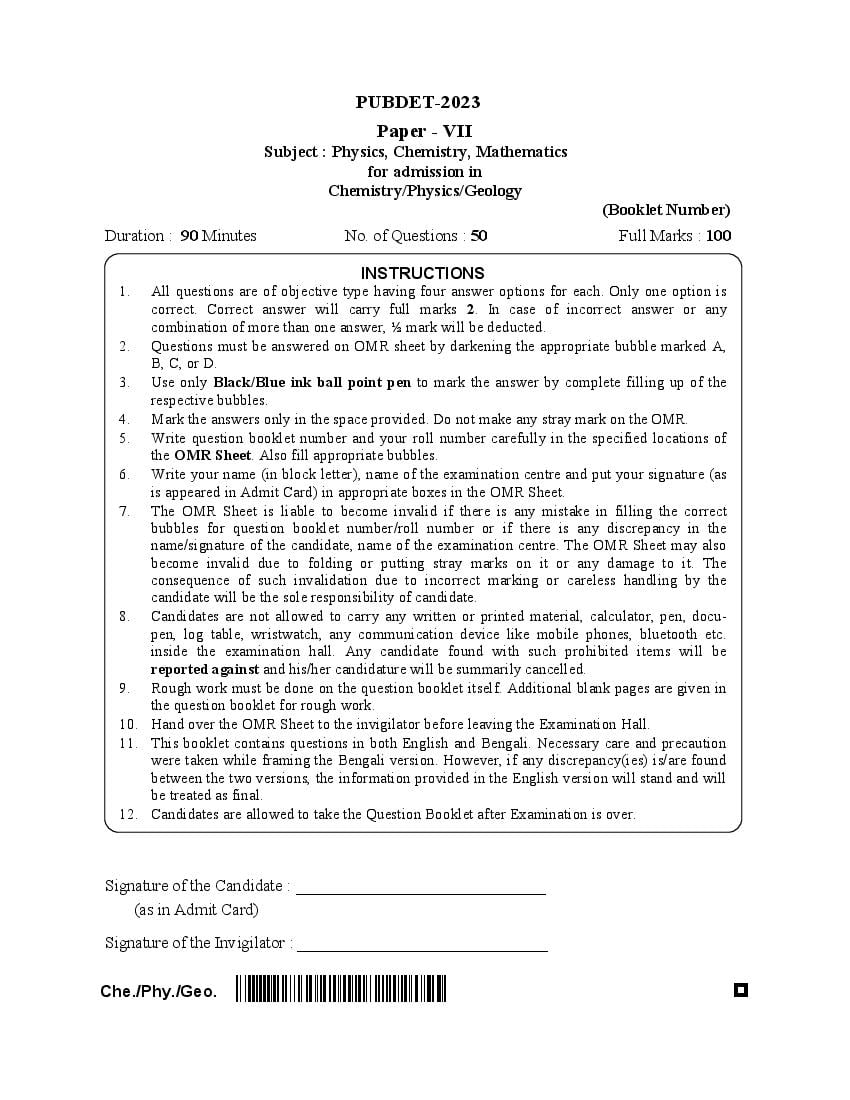
Subject : Physics, Chemistry, Mathematics
for admission in
Chemistry/Physics/Geology
(Booklet Number)
Duration : 90 Minutes No. of Questions : 50 Full Marks : 100
INSTRUCTIONS
1. All questions are of objective type having four answer options for each. Only one option is
correct. Correct answer will carry full marks 2. In case of incorrect answer or any
combination of more than one answer, ½ mark will be deducted.
2. Questions must be answered on OMR sheet by darkening the appropriate bubble marked A,
B, C, or D.
3. Use only Black/Blue ink ball point pen to mark the answer by complete filling up of the
respective bubbles.
4. Mark the answers only in the space provided. Do not make any stray mark on the OMR.
5. Write question booklet number and your roll number carefully in the specified locations of
the OMR Sheet. Also fill appropriate bubbles.
6. Write your name (in block letter), name of the examination centre and put your signature (as
is appeared in Admit Card) in appropriate boxes in the OMR Sheet.
7. The OMR Sheet is liable to become invalid if there is any mistake in filling the correct
bubbles for question booklet number/roll number or if there is any discrepancy in the
name/signature of the candidate, name of the examination centre. The OMR Sheet may also
become invalid due to folding or putting stray marks on it or any damage to it. The
consequence of such invalidation due to incorrect marking or careless handling by the
candidate will be the sole responsibility of candidate.
8. Candidates are not allowed to carry any written or printed material, calculator, pen, docu-
pen, log table, wristwatch, any communication device like mobile phones, bluetooth etc.
inside the examination hall. Any candidate found with such prohibited items will be
reported against and his/her candidature will be summarily cancelled.
9. Rough work must be done on the question booklet itself. Additional blank pages are given in
the question booklet for rough work.
10. Hand over the OMR Sheet to the invigilator before leaving the Examination Hall.
11. This booklet contains questions in both English and Bengali. Necessary care and precaution
were taken while framing the Bengali version. However, if any discrepancy(ies) is/are found
between the two versions, the information provided in the English version will stand and will
be treated as final.
12. Candidates are allowed to take the Question Booklet after Examination is over.
Signature of the Candidate : ______________________________
(as in Admit Card)
Signature of the Invigilator : ______________________________
Che./Phy./Geo.
Page 2
Che.+Phy.+Geo. 2
Page 3
1. If for the number x > 0, log1/7 x – 2+ 3 = 5 – log1/7 x,then
(A) the smallest integral value of x is 1
(B) there is no smallest value of x
1
(C) the largest value of x is
49
1
(D) x lies in the interval ,
49
log1/7 x – 2+ 3 = 5 – log1/7 x, x > 0 , qm
(A) x-Hl r¥âaj f§ZÑpwMÉ¡l j¡e qh 1 (B) x-Hl L¡e r¥âaj j¡e eC
1 1
(C) x-Hl pîÑ¡µQ j¡e qh (D) x, , A¿¹l¡m Ah¢ÙÛa
49 49
2. In complex plane, a point z moves in such a way that z z0 z z1 k , where z0 and z1
are two fixed points and k is a real constant. Then the locus of z is a conic section whose
eccentricity is
S¢Vm am HL¢V ¢h¾c¤ z Hje i¡h N¢an£m k z z0 z z1 k (kM¡e z0 J z1 c¤¢V ¢e¢cÑø ¢h¾c¤
Hhw k qm h¡Ù¹h dˤhL)z prœ z -Hl p’¡lfb qm HL¢V L¢eL pLpe k¡l EvL¾cÊa¡ qm
z1 z 0 z1 z 0 z1 z 0 z1 z0
(A) (B) (C) (D)
2k 2k k k
3. The roots of the equation x a x b x b x c x c x a 0 are
(A) negative (B) positive (C) real (D) imaginary
x a x b x b x c x c x a 0 pj£LlZl h£Sàu
(A) GZ¡aÈL (B) de¡aÈL (C) h¡Ù¹h (D) L¡Òf¢eL
4. Consider the expression f(n) = 72n + 16n – 1, n
(A) f(n) is divisible by 26. (B) f(n) is not divisible by 26.
(C) f(n) is divisible by 5. (D) f(n) is divisible by 7.
f(n) = 72n + 16n – 1, n l¡¢n¢VL ¢hhQe¡ Ll z prœ
(A) f(n), 26 à¡l¡ ¢hi¡SÉ (B) f(n), 26 à¡l¡ ¢hi¡SÉ eu
(C) f(n), 5 à¡l¡ ¢hi¡SÉ (D) f(n), 7 à¡l¡ ¢hi¡SÉ
Che.+Phy.+Geo. 3
Page 4
5. Let r sin cos sin then range of r(θ) is
cos sin cos
cos sin cos
k¢c r sin cos sin , ah r(θ)-Hl ¢hÙ¹¡l (range)qh
cos sin cos
(A) [0, 1] (B) [0, 2 2 ] (C) [–2, 2] (D) [–2 + 5,– 5 + 2]
2 0 5
6. Let A 1 2 3 . The system of linear equations AX=Y has a solution
1 5 1
x 0
(A) only for Y 0 , x (B) only for Y y , y
0 0
0
(C) only for Y y , y, z (D) for all Y 3
z
2 0 5
je Ll, A 1 2 3 z °l¢ML pj£LlZ fËZ¡m£ AX=Y -Hl pj¡d¡e BR
1 5 1
x
(A) Lhmj¡œ k¢c Y 0 , x
0
0
(B) Lhmj¡œ Y y , y -Hl rœ
0
0
(C) Lhmj¡œ Y y , y, z -Hl rœ
z
(D) pLm Y 3 Hl rœ
Che.+Phy.+Geo. 4
Page 5
x x 2 x x 2
1
7. The value of the determinant b b b b
x x 2 x x 2
1 is
c c c c
x x 2 x x 2
1
a a a a
x x 2 x x 2
1
¢eZÑ¡uL b b b b
x x 2 x x 2
1 -Hl j¡e qm
c c c c
x x 2 x x 2
1
1
(A) 0 (B) 2abc (C) abc (D)
abc
8. In ABC , A a,0 , B a, 0 and the difference between A and B is α. Then the
locus of C is
ABC ¢œi¥S A a,0 , B a,0 Hl©f k A J B -Hl A¿¹l qm α z prœ C ¢h¾c¤l
p’¡lfb qh
(A) x2 – 2xy cot – y2 = a2 (B) x2 + 2xy tan – y2 = a2
(C) x2 – 2xy tan – y2 = a2 (D) x2 + 2xy cot – y2 = a2
x
9. Let f : be continuous at x=0 and such that f x f 0 , x . Then
2
(A) value of f(x) cannot be ascertained on the given conditions
(B) f(x)=0 x
(C) f(x) is negative valued function
(D) f(x) is positive valued function for all x
AfrL¢V x=0 ¢h¾c¤a p¿¹a Hhw pLm x -Hl SeÉ f x f 0 pÇfLÑ j¡¢eu¡
x
f:
2
Qm z prœ
(A) fËcš naÑ¡hm£l Ad£e f(x) -Hl j¡e ¢el©fZ pñh eu
(B) pLm x -Hl SeÉ f(x)=0 qh
(C) f(x) GZ¡aÈL j¡e ¢h¢nø AfrL
(D) pLm x-Hl j¡el SeÉ f(x) de¡aÈL j¡e ¢h¢nø AfrL
Che.+Phy.+Geo. 5
Page 6
(A) has at least one root in (1, 3) (B) has no root in (1, 3)
(C) is not at all solvable (D) has infinitely many roots in (–2, 1)
AfrL f(x) = (x – 3)logex ¢hhQe¡ Ll z prœ x loge x = 3 – x pj£LlZ¢Vl
(A) (1, 3)-a A¿¹a HL¢V h£S BR (B) (1, 3)-a L¡e h£S eC
(C) Bc± pj¡d¡ek¡NÉ eu (D) (–2, 1)-a Ap£j pwMÉL h£S BR
2x 1
x 1
11. lim
x x 2
(A) does not exist (B) is 1
(C) is e6 (D) is e13
2x 1
x 1
lim
x x 2
(A) -Hl A¢Ù¹aÆ eC (B) qh 1
(C) qh e6 (D) qh e13
d2 y
, then the value of 1 x 2 x
dy
n
12. If y x 1 x 2 2
is
dx dx
k¢c y x 1 x 2 qu, ah 1 x 2
d2 y dy
n
2
x qh
dx dx
(A) n2y (B) –n2y (C) ny (D) –ny
cos 4x 1
13. If dx k cos 2 2x c , then k =
cot x tan x
cos 4x 1
k¢c dx k cos 2 2x c qu, a¡qm k =
cot x tan x
1 1 1 1
(A) (B) (C) (D)
4 8 4 8
Che.+Phy.+Geo. 6
Page 7
x tan 1 x
1 x 2
dx 1 x 2 f x k log x x 2 1 c , then
k¢c
x tan 1 x
1 x 2
dx 1 x 2 f x k log x x 2 1 c qu, a¡qm
(A) f(x) = tan–1 x, k = –1 (B) f(x) = tan–1 x, k = 1
(C) f(x) = 2tan–1 x, k = –1 (D) f(x) = 2tan–1 x, k = 1
15. Consider the curve :
x t 2 2 sin t 2t cos t
y 2 t 2 cos t 2t sin t
2 2
dx dy
then dt is equal to
0 dt dt
x t 2 2 sin t 2t cos t
y 2 t 2 cos t 2t sin t
2 2
dx dy
à¡l¡ ¢eZÑ£a hœ²lM¡¢V ¢hhQe¡ Ll z prœ dt -Hl j¡e qh
0 dt dt
3 2
(A) (B)
3 6
2
(C) (D) 2 + 1
3
Che.+Phy.+Geo. 7
Page 8
16. Let the characteristic equation for the ODE 22
p0 q 0 x 0 have distinct real roots
dx
dt dt
1 and 2 . Then
e1t e 2 t
(A) is a solution of the ODE.
1 2
e1t e 2 t
(B) is not a solution of the ODE.
1 2
e 1 t e 2 t
(C) is not a solution of the ODE.
1 2
e1t e 2 t
(D) + A sin t is a solution of the ODE where A is arbitrary constant.
1 2
dd22xy dx
p¡d¡lZ A¿¹lLm pj£LlZl 22 p 0 q 0 x 0 °h¢nøÉ pj£LlZl ¢iæ ¢iæ h¡Ù¹h h£S qm
dx
dt dt
1 J 2 z prœ
e1t e 2 t
(A) pj£LlZ¢Vl HL¢V pj¡d¡e
1 2
e1t e 2 t
(B) pj£LlZ¢Vl pj¡d¡e eu
1 2
e 1 t e 2 t
(C) pj£LlZ¢Vl pj¡d¡e eu
1 2
e1t e 2 t
(D) + A sin t pj£LlZ¢Vl HL¢V pj¡d¡e qh, kM¡e A kcªµR dˤhL
1 2
17. The family of curves y = ea cos x, where ‘a’ is arbitrary constant, is represented by the
differential equation
hœ²lM¡ f¢lh¡l y = ea cos x kM¡e ‘a’ -HL¢V kcªµR dˤhL, ¢ejÀ AhLm pj£LlZl à¡l¡ p§¢Qa qu
dy dy
(A) y log y + cot x =0 (B) y log y + cot x
dx dx
dy dy
(C) log y + cot x =0 (D) log y + cot x
dx dx
Che.+Phy.+Geo. 8
Page 9
point on the curve and perpendicular to it, passing through (0,0) is
hœ²lM¡ x2 – y2 = a2 ¢hhQe¡ Ll z I hœ²lM¡l Ef¢lÙÛ L¡e ¢h¾c¤a A¢ˆa ØfnÑL Hhw (0,0)
¢h¾c¤N¡j£ mðlM¡l Rc¢h¾c¤l p’¡lfb qh
(A) x2 + y2 = a2 (B) (x2 + y2)2 = a2 (x2 – y2)
(C) x2 – y2 = a2 (D) y2 = 4ax
2 x 1, 1 x 0
19. Let f : 1,1 be defined by f x 2 x , x 0
2 x 1, 0 x 1
Then
(A) f(x) attains its maximum value 2
(B) f(x) attains its minimum value 2
(C) f(x) does not attain its maximum and minimum value
(D) f(x) is a continuous function
f : 1,1 ¢eji
À ¡h pw‘¡a BR z
2 x 1, 1 x 0
f x 2 x , x 0
2 x 1, 0 x 1
(A) f(x) pîÑ¡µQ j¡e 2 f¢lNËq Ll
(B) f(x) phÑ¢ejÀ j¡e 2 f¢lNËq Ll
(C) f(x) pîÑ¡µQ J phÑ¢ejÀ j¡e L¡e¢VC f¢lNËq Ll e¡
(D) f(x) p¿¹a AfrL
The vector of magnitude 6 and perpendicular to both = 2^i+ 2^j+ k^ and = ^i– 2^j+ 2k^ is
20.
= 2^i+ 2^j + k^ , = ^i– 2^j+ 2k^ iƒlàul Efl mð J 6 j¡e ¢h¢nø iƒl¢V qh
(A) 2(2^i– ^j – 2k)
^ (B) 2(2^i– ^j– k)
^
(C) 2^i– ^j – k^ (D) (2^i– ^j– k)
^
Che.+Phy.+Geo. 9
Page 10
21. The velocity (v) of a particle moving in a straight line varies with distance (x) as shown in
figure
plm°l¢ML fb Qmj¡e HL¢V LZ¡l hN (v) he¡j c§laÆl (x) mM¢Qœ ¢eQl R¢ha cM¡e¡ quR z
The variation of its acceleration (a) with distance (x) is like
LZ¡¢Vl aÆlZ (a) he¡j c§laÆl (x) mM¢Qœ qh
(A) (B)
(C) (D)
22.
A vessel filled with water is moving horizontally with constant acceleration (a).
AB is the liquid surface when the vessel is at rest. The shape of the liquid surface (AB)
when it is accelerated will be as
HL¢V Smf§ZÑ f¡œ Ae¤i¨¢jL i¡h pj aÆlZ (a) QmR z ¢ÙÛl¡hÙÛ¡u f¡œl alml Ef¢lfªù am AB z
aÆlZpq Qm¡L¡m£e alml Ef¢lfªùaml (AB) BL«¢a qh
(A) (B)
(C) (D)
Che.+Phy.+Geo. 10
Page 11
Then
(A) the particle moves in a curved path with uniform speed
(B) the particle moves in a straight line with uniform acceleration
(C) the particle moves in a curved path with non - uniform speed
(D) the particle moves in a straight line with non - uniform acceleration
L¡e¡ HL¢V j¤q¨aÑ HL¢V Qmj¡e LZ¡l hN Hhw aÆlZl jdÉL¡l L¡Z θ (≠0) z a¡qm
(A) LZ¡¢V pjhN hœ²¡L¡l fb N¢an£m z
(B) LZ¡¢V pjaÆlZ plm°l¢ML fb N¢an£m z
(C) LZ¡¢V ApjhN hœ²¡L¡l fb N¢an£m z
(D) LZ¡¢V ApjaÆlZ plm°l¢ML fb N¢an£m z
24. A particle of mass 2 m moves to the east, and a particle of mass m moves to the west both
with speed V0. If they collide elastically and if it is observed that the mass 2 m ends up
moving northward, then its speed is
2m ill HL¢V LZ¡ f§hÑ¢cL Hhw m ill HL¢V LZ¡ f¢ÕQj¢cL, EiuC V0 hN N¢an£m z k¢c
Hcl jdÉ ¢ÙÛ¢aÙÛ¡fL pwOoÑ OV Hhw k¢c pwOoÑl fl 2m ill LZ¡¢V Ešl¢cL hl¡hl N¢an£m
qu, ah a¡l hN qh
V0
(A) V0 (B)
2
V0 V0
(C) (D)
2 3
Che.+Phy.+Geo. 11
Page 12
points 1, 2 and 3 are 1 , 2 , 3 and linear velocities are v1 , v 2 and v 3 respectively, then
(A) 3 > 2 > 1; v 3 > v2 > v1
(B) 1 = 2 > 3; v 1 = v2 < v3
(C) 1 = 2 = 3; v 1 = v2 = v3
(D) 1 = 2 = 3; v 1 = v2 < v3
¢Qœ HL¢V p¤¤oji¡h O§ZÑ¡uj¡e Q¡L¢al Efl ¢ae¢V ¢h¾c¤ 1, 2 Hhw 3 cM¡e¡ quR z k¢c HC
¢h¾c¤…¢ma L±¢ZL hN kb¡œ²j 1 , 2 , 3 Hhw °l¢ML hN kb¡œ²j v1 , v 2 Hhw v3 qu, ah
(A) 3 > 2 > 1; v 3 > v2 > v1
(B) 1 = 2 > 3; v 1 = v2 < v3
(C) 1 = 2 = 3; v 1 = v2 = v3
(D) 1 = 2 = 3; v 1 = v2 < v3
Che.+Phy.+Geo. 12
Page 13
c¤¢V al‰ (1) J (2) ¢Qœ cM¡e¡ quRz
Which of the following statements is true ?
(A) Frequencies of two vibrations are same, but the vibration (2) is leading in phase by
.
2
(B) Frequencies of two vibrations are same, but the vibration (2) lags behind (1) in phase
by .
2
(C) Amplitudes of two vibrations are different, however both are in same phase.
(D) Two vibrations have same frequency, different amplitudes but vibration (2) lags
behind vibration (1) in phase by π.
¢eQl L¡eÚ E¢š²¢V paÉ ?
(A) c¤¢V al‰l LÇf¡ˆ pj¡e, ¢L¿¹¥ (2) ew al‰ cn¡u H¢Nu b¡L z
2
(B) c¤¢V al‰l LÇf¡ˆ pj¡e, ¢L¿¹¥ (2) ew al‰ cn¡u ¢f¢Ru b¡L z
2
(C) c¤¢V al‰l ¢hÙ¹¡l Bm¡c¡ Hhw EiuC pjcn¡ pÇfæ z
(D) c¤¢V al‰l LÇf¡ˆ pj¡e, ¢hÙ¹¡l Bm¡c¡ ¢L¿¹¥ (2) ew al‰ (1) ew al‰l bL π cn¡u
¢f¢Ru b¡L z
Che.+Phy.+Geo. 13
Page 14
with A2 = 2A1, that is, the amplitude of 2 is equal to 2 times of (1) is shown in figure.
E2
The ratio of their kinetic energies is
E1
plm c¡mN¢a pÇfæ c¤¢V m ill LZ¡l plZ-pju mM¢Qœ R¢ha cM¡e¡ quR z c¤¢V c¡mN¢al
E2
¢hÙ¹¡l A1 , A2 Hhw A2 = 2A1 qm Hcl N¢an¢š²l Ae¤f¡a qh
E1
1 1
(A) (B) (C) 1 (D) 2
4 2
28. The Figure shows a cyclic process in P-T diagram
The same process in P-V diagram will be
R¢ha HL¢V BhaÑ fË¢œ²u¡l P-T mM¢Qœ cM¡e¡ quR, fË¢œ²u¡¢Vl P-V mM¢Qœ¢V qh
(A) (B)
(C) (D)
Che.+Phy.+Geo. 14
Page 15
(a) adiabatically and (b) isothermally. The final pressures in adiabatic and isothermal
processes are pad and piso respectively. Wad represents the work done in adiabatic
expansion and Wiso represents the work done in isothermal expansion. Then which of the
following statements is true ?
(A) pad < piso but Wad > Wiso (B) pad > piso and Wad > Wiso
(C) pad < piso and Wad < Wiso (D) pad > piso but Wad < Wiso
p1 Q¡f HL¢V BcnÑ NÉ¡pl Buae v1 c¤¢V fË¢œ²u¡u hs v2 qu, (a) l©Üa¡f fË¢œ²u¡u Hhw (b)
pj¡o· fË¢œ²u¡u z l©Üa¡f Hhw pj¡o· fË¢œ²u¡u A¢¿¹j Q¡f kb¡œ²j pad Hhw piso z Wad l©Üa¡f
fË¢œ²u¡u L«aL¡kÑ Hhw Wiso pj¡o· fË¢œ²u¡u L«aL¡kÑ qm ¢eQl L¡eÚ E¢š²¢V p¢WL ?
(A) pad < piso ¢L¿¹¥ Wad > Wiso (B) pad > piso Hhw Wad > Wiso
(C) pad < piso Hhw Wad < Wiso (D) pad > piso ¢L¿¹¥ Wad < Wiso
30. In the given circuit, if the points a and b are at the same potential, then
fËcš haÑe£a a Hhw b ¢h¾c¤a ¢hih pj¡e qm
C1 R1 C1 R 2
(A) (B)
C2 R 2 C 2 R1
C1 R 2 C1 C 2
(C) (D) 1
R1 C 2 R1 R 2
Che.+Phy.+Geo. 15
Page 16
31. Along the x-axis, three charges , 2q and are placed at x = 0, x = a and x = 2a
2 2
respectively. The resultant electric potential V(r) at a point P located at a distance r (r >> a)
1
from the charge – 2q is V n , where n equals to
r
q q
x -Ar hl¡hl x = 0, x = a Hhw x = 2a a kb¡œ²j ¢ae¢V Bd¡e , 2q Hhw l¡M¡ BR z – 2q
2 2
1
Bd¡e bL r (r >> a) c§laÆ P ¢h¾c¤a mì a¢sv¢hih V n , kM¡e n-Hl j¡e
r
(A) 2 (B) 3 (C) 0 (D) 1
32. OABC is a current carrying square loop. A positive charge is projected from the centre of
the loop along its diagonal AC as shown. Unit vector in the direction of initial acceleration
will be
OABC HL¢V a¢sv f¢lh¡q£ hNÑ¡L¡l m¤f z HL¢V de¡aÈL Bd¡eL m¤fl L¾cÊ bL AC LZÑ hl¡hl
R¡ys¡ qm z fË¡l¢ñL aÆlZl ¢cL hl¡hl HLL iƒl¢V qh
ˆ k ˆi ˆjˆi ˆj ˆi ˆjˆi ˆj
(A) k̂ A kA (B)B B (C) C– k̂Ckˆ k D(D)D
2 2 2 2
33. In the given circuit, potential difference across 100 Ω resistance, that is, between the points
A and B is Vi. However, if one measures the potential difference between the same points
V Vf
A and B by a voltmeter of 900 Ω resistance, the result is Vf. Then i is
Vi
fËcš haÑe£a 100 Ω l¡dl c¤¢cL A Hhw B ¢h¾c¤l jdÉ ¢hih fËic Vi z k¢c HLC A Hhw B
V V
¢h¾c¤l jdÉ 900 Ω l¡dl i¡ÒV¢jV¡l ¢cu ¢hihfËic j¡f¡ qu ah a¡ qu Vf z a¡qm i f
Vi
qm
1 1
(A) (B) 1 (C) (D) 10
10 100
Che.+Phy.+Geo. 16
Page 17
pattern on a screen. If the wavelength of the monochromatic light emitted by the source is
, then the maximum number of fringes that can be observed on the screen is
d c§laÆ Ah¢ÙÛa c¤¢V A¢iæ p¤¤pwNa Bm¡L Evp fcÑ¡u hÉ¡¢aQ¡l f¢V °a¢l Ll z k¢c Evp bL
¢eNÑa HLhZÑ£ Bm¡Ll al‰°cOÉÑ qu ah fcÑ¡u k ph¡ÑµQ pwMÉ¡l T¡ml cM¡ k¡h a¡ qm
d d d
(A) (B) (C) (D) 2
λ 2λ λ
35. In hydrogen atom, if electron moves from a lower energy level to a higher energy level,
then
(A) its kinetic energy increases while potential energy decreases.
(B) its kinetic energy decreases, but potential energy increases.
(C) both the kinetic energy and potential energy increases.
(D) kinetic energy remains the same, only the potential energy and hence the total energy
increases.
HL¢V q¡CXÊ¡Se flj¡Z¤a k¢c CmLVÊe HL¢V ¢eQl n¢š²Ù¹l bL Efll n¢š²Ù¹l Nje Ll,
ah CmLVÊel
(A) N¢an¢š² hª¢Ü f¡u ¢L¿¹¥ ¢ÙÛ¢an¢š² qÊÊ¡p f¡u z
(B) N¢an¢š² qÊÊ¡p f¡u ¢L¿¹¥ ¢ÙÛ¢an¢š² hª¢Ü f¡u z
(C) N¢an¢š² J ¢ÙÛ¢an¢š² EiuC hª¢Ü f¡u z
(D) N¢an¢š² HLC b¡L, öd¤j¡œ ¢ÙÛ¢an¢š² Hhw gmül©f j¡V n¢š² hª¢Ü f¡u z
Che.+Phy.+Geo. 17
Page 18
36. How many cyclic compounds are possible for the molecular formula C 3H6O ?
C3H6O BZ¢hL pwLa pÇfæ k±Nl La…¢m Qœ²¡L«¢a k±N pñh ?
(A) 1 (B) 2 (C) 3 (D) 4
37. Hybridisation state of all the carbon atoms (from left to right) of the following carbocation
are :
¢ejÀ¢m¢Ma L¡h¡ÑLÉ¡V¡ue¢Vl L¡hÑe flj¡Z¤…¢ml (h¡j¢cL bL X¡e¢cL) pwLl¡uZ AhÙÛ¡ qm
H2C – CH = C = CH2
(A) sp2, sp2, sp, sp2 (B) sp, sp2, sp, sp2
(C) sp3, sp2, sp2, sp2 (D) sp2, sp2, sp2, sp2
38. Two components (A and B) of same molecular formula, C 2H5NO, on treatment with
P2O5 gives X. Both A and X on treatment with alkali evolve NH 3. A and B are respectively
(A) CH3CH = N – OH and CH3CONH2
(B) HCONHCH3 and CH3CONH2
(C) CH3CONH2 and CH3CH = N – OH
(D) CH3CONH2 and HCONHCH3
C2H5NO BZ¢hL pwLa pÇfæ c¤¢V k±N (A Hhw B) P2O5Hl p¡b ¢h¢œ²u¡u X cu z A Hhw X
Eiu k±Nc¤¢V r¡ll p¡b ¢h¢œ²u¡u NH3 Evfæ Ll z A Hhw B k±Nc¤¢V kb¡œ²j
(A) CH3CH = N – OH Hhw CH3CONH2
(B) HCONHCH3 Hhw CH3CONH2
(C) CH3CONH2 Hhw CH3CH = N – OH
(D) CH3CONH2 Hhw HCONHCH3
Che.+Phy.+Geo. 18
Page 19
1. acetic anhydride
2. Br2 in HOAC
Aniline Product
3. dil. HCl
4. NaNO2 and dil. HCl
5. CuBr, HBr
(A) p – bromoaniline (B) 1, 4 –dibromobenzene
(C) p – bromoacetanilide (D) bromobenzene
e£Ql ¢h¢œ²u¡œ²j Evf¡¢ca k±N¢V qm
1. AÉ¡p¢VL AÉ¡eq¡CXÊ¡CX
2. Br2 /HOAC
AÉ¡¢e¢me Evf¡¢ca k±N
3. mO¤ HCl
4. NaNO2 Hhw mO¤ HCl
5. CuBr, HBr
(A) p – hË¡j¡AÉ¡¢e¢me (B) 1, 4 - X¡ChË¡j¡h¢”e
(C) p - hË¡j¡AÉ¡¢pV¡¢em¡CX (D) hË¡j¡h¢”e
40. The gas that is evolved on treatment of an ethereal solution of methylacetylene with a
solution of vinyl magnesium bromide in ether is
(A) methane (B) ethylene (C) acetylene (D) isoprene
¢jb¡Cm AÉ¡¢p¢V¢me J ¢ie¡Cm jÉ¡Ne¢pu¡j hË¡j¡CXl Cb¡l âhZl jdÉ ¢h¢œ²u¡u k NÉ¡p Eá¥a
qu, p¢V qm
(A) ¢jbe (B) C¢b¢me (C) AÉ¡¢p¢V¢me (D) BCp¡¢fËe
41. The IUPAC nomenclature of Na Ag CN 2 is
(A) Sodium dicyanoargentate (II)
(B) Sodium dicyanidoargentate (II)
(C) Sodium dicyanidoargentate (I)
(D) Sodium dicyanoargentate (III)
Na Ag CN 2 Hl IUPAC e¡jLlZ qm
(A) p¡¢Xu¡j X¡Cp¡u¡e¡BSѾVV (II)
(B) p¡¢Xu¡j X¡Cp¡u¡e¡CX¡BSѾVV (II)
(C) p¡¢Xu¡j X¡Cp¡u¡e¡CX¡BSѾVV (I)
(D) p¡¢Xu¡j X¡Cp¡u¡e¡BSѾVV (III)
Che.+Phy.+Geo. 19
Page 20
XeF4, SF4, O3, B2H6
e£Ql AZ¤…¢ml bL dËh¤ £u AZ¤k¤Nm ¢Q¢q²a Ll
XeF4, SF4, O3, B2H6
(A) SF4, XeF4 (B) O3, B2H6
(C) SF4, O3 (D) XeF4, B2H6
43. Aqueous solution of silver nitrate causes precipitation reactions separately with aqueous
solutions of H3PO3, HI and H2S respectively. The formula of the respective precipitates are
Sm£u ¢pmi¡l e¡CVÊV âhZl p¢qa H3PO3, HI J H2S Hl Sm£u âhZl fªbL ¢h¢œ²u¡u
AdxrfZ OV z Evfæ Adxrf…¢ml pwLa kb¡œ²j
(A) Ag2HPO3, AgI, Ag2S (B) Ag3P, Ag, S
(C) Ag, AgI, Ag2S (D) Ag3PO4, AgI, (Ag + S)
44. Which of the following orders are wrong ?
(A) Electron affinity : N < O < F < Cl
(B) First ionisation energy : Be < B < N < O
(C) Basic property : BeO < MgO < CaO < BaO
(D) Electronegativity : F > O > N > C
e£Ql L¡eÚ œ²j¢V i¥m ?
(A) CmLVÊe Bp¢š² : N < O < F < Cl
(B) fËbj Bue£ihe n¢š² : Be < B < N < O
(C) r¡lL£u djÑ : BeO < MgO < CaO < BaO
(D) a¢svGZ¡aÈLa¡ : F > O > N > C
Che.+Phy.+Geo. 20
Page 21
(A) Acidic Fe(II) Sulphate Solution (B) Cold acidic K2Cr2O7 Solution
(C) Acidic KMnO4 Solution (D) Acidic KI Solution
Sm£u H2O2 -Hl p¢qa ¢h¢œ²u¡u k ¢hL¡lL¢V hZÑq£e âhZ Evfæ Ll a¡q¡L ¢Q¢q²a Ll
(A) B¢ÇmL Fe(II) p¡mgV âhZ (B) n£am B¢ÇmL K2Cr2O7 âhZ
(C) B¢ÇmL KMnO4 âhZ (D) B¢ÇmL KI âhZ
46. X2(g) + Y2(g) 2XY (g)
At 400 K the value of Kp is 64, for the above equilibrium. If an equimolar mixture of X 2
and Y2 is heated in a closed container at 400 K, then the mole fraction of Y 2 at equilibrium
will be
X2(NÉ¡p) + Y2(NÉ¡p) 2XY (NÉ¡p)
400 K a¡fj¡œ¡u Efl¡š² p¡jÉ¢Vl p¡jÉdˤhL Kp Hl j¡e 64 z pj¡e pj¡e j¡m pwMÉ¡u HL¢V hÜ
f¡œ X2 Hhw Y2 L ¢j¢nu 400 K a¡fj¡œ¡u Ešç Ll¡ qm z p¡jÉ¡hÙÛ¡u Y2-Hl j¡m iNÀ¡wn
(mole fraction) qh,
1 4
(A) (B)
5 5
1 1
(C) (D)
8 10
47. Pressure (P) of a given mass of gaseous oxygen (obeying van der Waals equation) is given
by
RT a
P= , where V and T are the volume and temperature (K). The mass of the
2V b 4V 2
gas is
HL¢V ¢e¢cÑø JSel NÉ¡p£u A¢„Sel Q¡f (P) van der Waals pj£LlZ Ae¤k¡u£ mM¡ k¡u :
RT a
P= , kM¡e V Hhw T kb¡œ²j Buae Hhw a¡fj¡œ¡ (K) z NÉ¡p¢Vl il qm
2V b 4V 2
(A) 32 g (B) 64 g (C) 16 g (D) 4 g
Che.+Phy.+Geo. 21
Page 22
48. Adiabatic expansion of a gas (ideal) is found to obey the relation T V 3 . The value of
(= Cp, m / Cv, m) of the gas is
1
HL¢V BcnÑ NÉ¡pl l©Üa¡f pÇfËp¡lZl rœ T V 3 pÇfLÑ¢V l¢ra qu z NÉ¡p¢Vl
(= Cp, m / Cv, m) Hl j¡e qh
4 2
(A) (B)
3 3
5
(C) (D) 1
2
49. The compressibility factor for a real gas at high pressure is
EµQ Q¡f h¡Ù¹h NÉ¡pl pwejÉa¡ …ZL
RT Pb
(A) 1 + (B) 1+
Pb RT
Pb
(C) 1– (D) 1
RT
50. A buffer is prepared by mixing 10 mL of 0.4(N) CH 3CO2Na solution and 10 mL of
0.2(N) CH3CO2H solution. [Given: Ka of CH3CO2H is 1.8 10–5 and log(1.8) = 0.2553].
The pH of the resulting solution is given by
10 ¢j¢m 0.4(N) CH3CO2Na âhZ Hhw 10 ¢j¢m 0.2(N) CH3CO2H âhZ ¢j¢nËa Ll HL¢V h¡g¡l
âhZ °a¢l Ll¡ quR z [fËcš: CH3CO2H Hl Ka = 1.8 10–5 Hhw log(1.8) = 0.2553] h¡g¡l
âhZl pH qm
(A) 3.04 (B) 4.04
(C) 6.06 (D) 5.04
_______________
Che.+Phy.+Geo. 22
Page 23
Che.+Phy.+Geo. 23
Page 24
Subject : Physics, Chemistry, Mathematics
for admission in
Chemistry/Physics/Geology
pju: 90 ¢j¢eV ®j¡V fËnÀ : 50 ¢V f§ ZÑj¡e : 100
1. HC fËnÀfœl ph fËnÀC AhS¢ƒi fËnÀ Hhw fË¢a¢V fËnÀl Q¡l¢V pñ¡hÉ Ešl cJu¡ BR
k¡l HL¢V j¡œ p¢WL z p¢WL Ešl ¢Q¢q²a Llm 2 eðl f¡h z i¥m Ešl ¢Q¢q²a Llm
Abh¡ HL¡¢dL Ešl ¢Q¢q²a Llm ½ eðl L¡V¡ k¡h z
2. OMR fœ A, B, C, D ¢Q¢q²a p¢WL Ol¢V il¡V Ll Ešl ¢ca qh z
3. OMR fœ Ešl ¢ca öd¤j¡œ L¡m¡ h¡ e£m L¡¢ml hm fu¾V fe hÉhq¡l Llh z
4. OMR fœ ¢e¢cÑø ÙÛ¡e R¡s¡ AeÉ L¡b¡J L¡e¡ c¡N ch e¡ z
5. OMR fœ ¢e¢cÑø ÙÛ¡e fËnÀfœl eðl Hhw ¢eSl l¡m eðl A¢a p¡hd¡ea¡l p¡b ¢mMa
qh Hhw fËu¡Se£u Ol…¢m f§lZ Lla qh z
6. OMR fœ ¢e¢cÑø ÙÛ¡e ¢eSl e¡j J fl£r¡L¾cÊl e¡j ¢mMa qh Hhw ¢eSl (Admit
Card H Eõ¢Ma) ü¡rl Lla qh z
7. fËnÀfœl eðl h¡ l¡m eðl i¥m ¢mMm Abh¡ i¥m Ol il¡V Llm, fl£r¡bÑ£l e¡j,
fl£r¡L¾cÊl e¡j h¡ ü¡rl L¡e¡ i¥m b¡Lm Ešlfœ h¡¢am qu ka f¡l z OMR
fœ¢V i¡yS qm h¡ a¡a Ae¡hnÉL c¡N fsmJ h¡¢am qu ka f¡l z fl£r¡bÑ£l HC
dlel i¥m h¡ ApaÑLa¡l SeÉ Ešlfœ h¡¢am qm HLj¡œ fl£r¡bÑ£ ¢eSC a¡l SeÉ
c¡u£ b¡Lh z
8. j¡h¡Cm g¡e h¡ ®k ®L¡e dl®el C®mLVÌ¢eL NÉ¡®SV, LÉ¡mL¥mVl, pÔ¡CXl¦m, mNVhm,
q¡aO¢s, lM¡¢Qœ, NË¡g h¡ L¡e¡ dlel a¡¢mL¡ , Lmj CaÉ¡¢c fl£r¡Lr Be¡ k¡h e¡ z
Bem p¢V h¡Su¡ç qh Hhw fl£r¡bÑ£l JC fl£r¡ h¡¢am Ll¡ qh z
9. fËnÀfœ l¡g L¡S Ll¡l SeÉ gy¡L¡ S¡uN¡ cJu¡ BR z AeÉ L¡e¡ L¡NS HC L¡S
hÉhq¡l Llh e¡ z
10. fl£r¡Lr R¡s¡l BN OMR fœ AhnÉC f¢lcnÑLL ¢cu k¡h z
11. HC fËnÀfœ Cwl¡S£ J h¡wm¡ Eiu i¡o¡aC fËnÀ cJu¡ BR z h¡wm¡ j¡dÉj fËnÀ °al£l
pju fËu¡Se£u p¡hd¡ea¡ J paLÑa¡ Ahmðe Ll¡ quR z a¡ pšJ Ä k¢c L¡e Ap‰¢a
mrÉ Ll¡ k¡u, prœ Cwl¡S£ j¡dÉj cJu¡ fËnÀ ¢WL J Q¨s¡¿¹ hm ¢hh¢Qa qh z
12. fl£r¡no fl£r¡b£Ñl¡ fËnÀfœ¢V ¢eu k¡h z
Che.+Phy.+Geo. 24
Document Details
| Board / Org | WBJEEB |
| Exam | PUBDET |
| Type | Question Paper |
| Pages | 24 |
| Updated | 22 Jul 2026 |