PUMDET 2018 Question Paper History
Finished viewing? Save it for later —
Download PUMDET 2018 Question Paper History (PDF · 8 pages)About PUMDET 2018 Question Paper History
PUMDET 2018 Question Paper History is available here for free download. Published by WBJEEB for PUMDET, this question paper can be viewed online or downloaded as a PDF (8 pages). Candidates preparing for PUMDET can use PUMDET 2018 Question Paper History to understand the exam pattern, the type of questions asked, and the overall difficulty level.
Frequently Asked Questions
How can I download PUMDET 2018 Question Paper History?
Open this page and click the Download button to save PUMDET 2018 Question Paper History as a PDF. It is completely free on AglaSem Docs.
Is PUMDET 2018 Question Paper History free to download?
Yes. PUMDET 2018 Question Paper History can be viewed online and downloaded as a PDF free of cost on AglaSem Docs.
How many pages does PUMDET 2018 Question Paper History have?
PUMDET 2018 Question Paper History contains 8 pages, which you can read online or download together as a single PDF.
Where can I find more PUMDET study material?
You can find more PUMDET question papers, sample papers, syllabus, and answer keys on AglaSem Docs.
PUMDET 2018 Question Paper History – Text
Read the full text of this question paper below — useful to quickly search, copy and reference the content online without downloading the PDF.
📄 View text version (8 pages)
Page 1
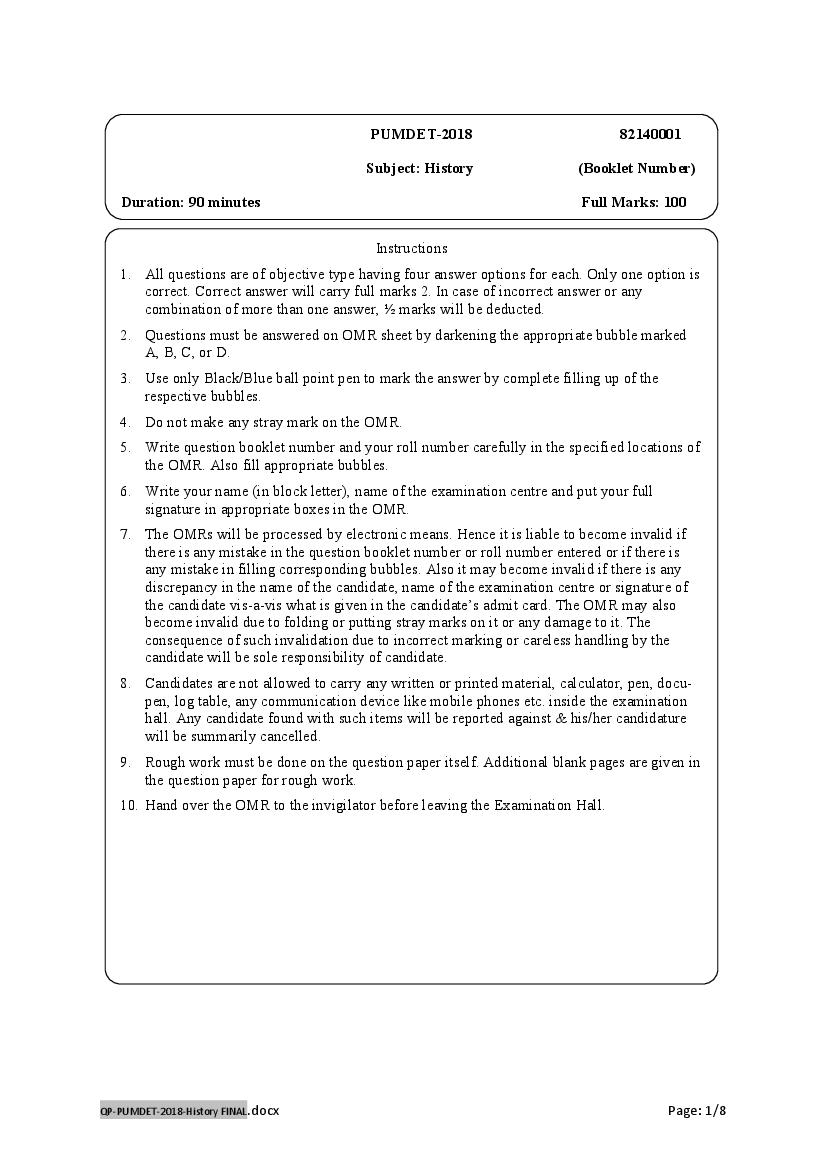
Subject: History (Booklet Number)
Duration: 90 minutes Full Marks: 100
Instructions
1. All questions are of objective type having four answer options for each. Only one option is
correct. Correct answer will carry full marks 2. In case of incorrect answer or any
combination of more than one answer, ½ marks will be deducted.
2. Questions must be answered on OMR sheet by darkening the appropriate bubble marked
A, B, C, or D.
3. Use only Black/Blue ball point pen to mark the answer by complete filling up of the
respective bubbles.
4. Do not make any stray mark on the OMR.
5. Write question booklet number and your roll number carefully in the specified locations of
the OMR. Also fill appropriate bubbles.
6. Write your name (in block letter), name of the examination centre and put your full
signature in appropriate boxes in the OMR.
7. The OMRs will be processed by electronic means. Hence it is liable to become invalid if
there is any mistake in the question booklet number or roll number entered or if there is
any mistake in filling corresponding bubbles. Also it may become invalid if there is any
discrepancy in the name of the candidate, name of the examination centre or signature of
the candidate vis-a-vis what is given in the candidate’s admit card. The OMR may also
become invalid due to folding or putting stray marks on it or any damage to it. The
consequence of such invalidation due to incorrect marking or careless handling by the
candidate will be sole responsibility of candidate.
8. Candidates are not allowed to carry any written or printed material, calculator, pen, docu-
pen, log table, any communication device like mobile phones etc. inside the examination
hall. Any candidate found with such items will be reported against & his/her candidature
will be summarily cancelled.
9. Rough work must be done on the question paper itself. Additional blank pages are given in
the question paper for rough work.
10. Hand over the OMR to the invigilator before leaving the Examination Hall.
QP-PUMDET-2018-History FINAL.docx Page: 1/8
Page 2
Page 3
1. Which among the following is not a part of the Vedas?
(A) Samhita (B) Upanishadas (C) Puranas (D) Brahmanas
2. Name the study of remains of dead organism over enormous spans of time
(A)Radiocarbon dating (B) Archaeology (C)Paleo Pathology (D) Palaeontology
3. What was the name of Chinese traveler, whose travelogue tells us about Harsha?
(A) Fa- hien
(B) Yuan Chwang
(C) It sing
(D) None of the above
4. According to the suggestion of Marshall which of the following male gods were worshipped by the
Harappan people?
(A) Pashupati (B) Vishnu (C) Indra (D) Shiva
5. The city of Kaushambi was the capital of which of the following kingdom?
(A) Magadha (B) Vatsa (C) Anga (D) Chedi
6. The ‘Saptanga Rajya’ concept in the Arthashastra does not mention
(A) Svami (The king) (B) Mitra (Ally)
(C) Danda (Justice or force) (D) Dana (Charity)
7. Who adopted the title ‘Devputra’?
(A)Kanishka (B)Harsha
(C)Samudragupta (D) Chandragupta I
8. Which period witnessed the Indo Roman Trade?
(A) 3rd Century C.E. to 4th Century C.E.
(B) 2nd Century B.C.E. to 2nd Century C.E.
(C) 3rd Century B.C.E. to 2nd Century B.C.E.
(D) 1st Century C.E. to 2nd Century C.E.
9. The concept of ‘feudalism from above’ and ‘feudalism from below’ have been propounded by?
(A) D.N.Jha
(B) Irfan Habib
(C) D.D.Kosambi
(D) B.N.S.Yadav
10. Who founded the vikramshila Mahavihara near Bhagalpur ?
(A) Devpala (B) Dharmapala (C) Mahipala (D) Amoghvarsha I
QP-PUMDET-2018-History FINAL.docx Page: 3/8
Page 4
(A) Rajaraja I (B) Mahipala
(C) Kullottunga II (D) Rajendra Chola I
12. Who wrote ‘Prithviraj Raso’?
(A)Visal deva (B) Jayadeva (C) Chand Bardai (D)Vidyapati
13. Who propounded the concept of an ‘Urban Revolution’ in medieval India?
(A) Irfan Habib (B)Mohammad Habib
(C) Satish Chandra (D) Andre wink
14. The post of Shahna-i-mandi was associated with of the following reforms?
(A) Alauddin Khalji’s price control
(B) Muhammad bin Tughlaq’s taxation in the Doab
(C) Muhammad bin Tughlaq’s transfer of the capital to Daulatabad
(D) Balban’s reforms in Iqta system
15. Mughal architecture found its first true representation in which of the following?
(A) Jahagir’s tomb (B) Humayun’s tomb
(C) Buland Darwaza (D) Taj Mahal
16. Jizya was formally abolished in
(A)1707 (B)1712
(C) 1679 (D) 1669
17. When was the Aligarh Scientific Society founded?
(A)1864 (B) 1861 (C)1868 (D) 1876
18. Who was the founder of the Parthana Samaj?
(A)Mahadev Gobind Ranade (B) K.T. Telang
(C) Atmaram Pandurang (D) N.G. Chandravarkor
19. Which among the following was a key feature of peasant and tribal movement that took place in post
1857 India?
(A) Greater awareness of colonial laws, policies among the peasants and tribals
(B) Agrarian movements were pan Indian in character
(C) Peasants began to identify themselves as an economic class
(D) The indigenous educated intelligentsia remained apathetic to the problems of the
peasantry.
QP-PUMDET-2018-History FINAL.docx Page: 4/8
Page 5
rise of nationalism in India?
(A) Imperialist School (B) Marxist School
(C) Cambridge School (D) Subaltern School
21. When was the Dacca Anushilan Samiti established?
(A)1902 (B)1905 (C) 1908 (D) 1906
22. Which of the following personalities was associated with the Central National Mohammedan
Association?
(A) Abdul Latif Khan (B) Sayyid Ahmed Khan
(C) Sayyid Amir Ali (D) Muhammad Ali
23. Who was the first president of the All India Depressed Classes Association?
(A) E.V. Ramaswamy Naicker (B) B.R.Ambedkar
(C) M.C. Rajah (D) Keshaw Rao Jedhe
24. What was the reason behind the split in the congress party in 1969?
(A) Disagreement over the congress nominee for the presidency of India
(B) The authentic nature of Mrs. Indira Gandhi
(C) The growing influence of Kamraj and his associates within the party
(D) The inability of the congress party to expand its electoral base
25. Which party launched the Punjabi Suba Movement?
(A) The Shiromani Akali Dal (B) Punjabi Democratic Party
(C) The Unionist party (D) Bahujan Samaj Party
26. Which commission recommended that 27% of central government jobs should be reserved for
Backward Castes?
(A)The First backward Classes Commission
(B) The Second Backward Classes Commission
(C) The Havnoor Commission
(D)The Mandal Commission
27. What was the main component of the new Agricultural Strategy implemented by the Indian
government?
(A)Abolition of intermediaries between the peasants and the government
(B) Creation of land ceilings and distribution of surplus land to impoverished peasantry
(C)Introduction of betterment levies
(D) Adoption of high yield variety (HYV) seeds to increase agricultural production
QP-PUMDET-2018-History FINAL.docx Page: 5/8
Page 6
(A) J. B. Kripalani (B) Shyama Prasad Mukherjee
(C) Acharya Vinoba Bhave (D) Potti Sriramulu
29. How many times have India and Pakistan faced each other in the battlefield?
(A) 3 (B) 4 (C) 2 (D) 5
30. Which state in India was the first to enact the Zamindari Abolition Act?
(A) West Bengal (B) Maharashtra
(C) Uttar Pradesh (D) Gujarat
31. When was the Bandung Conference of Afro –Asian states held?
(A)1953 (B)1955 (C)1957 (D) 1951
32. Who wrote ‘Novum Organum’?
(A) Rene Deacartes (B) Robert Boyle
(C) Francis Bacon (D) Issac Newton
33. Which historians introduced the concept of ‘longee Duree’ in analyzing historical time?
(A) Lucien Febvre (B) Pierre Channu
(C) Fernand Braudel (D) Marc Bloch
34. Which nation experienced a ‘Financial Revolution’ in late 17th and early 18th century?
(A)France (B)Prussia (C)Netherlands (D) England
35. What does the term ‘Reformation’ refer to?
(A) A restructuring of the catholic faith by the Vatican church
(B) The establishment of Protestant Christianity
(C) The remodeling of state structure in early modern Europe
(D) The creation of a new revenue structure in England
36. Who wrote the ‘Praise of folly’?
(A)John Reuchlin (B) Viltorino da Feltre
(C)Luca dell Robbia (D) Erasmus
37. When did ‘Absolutism’ rise in Europe?
(A)17th century (B)19th century (C)15th century (D) 18th century
38. When did peter the great come to power in Russia?
(A) 1694 (B) 1689 (C) 1652 (D) 1700
39. Who were the ‘Junkers’?
(A) Landed nobility of France (B) Landed nobility of Portugal
(C) Landed nobility of Spain (D) Landed nobility of Prussia
QP-PUMDET-2018-History FINAL.docx Page: 6/8
Page 7
(A)1645 (B)1646 (C)1647 (D) 1648
41. Who established the rule of the Stuart Dynasty in England?
(A) Charles I (B) Charles II (C) James I (D) James II
42. When was the ‘Tennis Court Oath’ taken?
(A) 10th June1789 (B) 20th May 1789
(C) 20th June 1789 (D) 15th September 1789
43. The term ‘Anschluss’ refers to which of the following events?
(A) German annexation of Austria (B) Hitler’s invasion of Russia
(C) Germany’s capture of Rhineland (D) Italy’s invasion of Russia
44. Who invented the ‘Water Frame’?
(A) James watt (B) James Hargreaves
(C) Richard Arkwright (D) Edmund Cartwright
45. Who among the following was not a utopian Socialist?
(A) Saint Simon (B) Robert Owen
(C) Charles Fourier (D) Friedrich Engels
46. When was the Battle of Sedan fought?
(A) 1870 (B)1866 (C) 1878 (D) 1856
47. Who wrote the book ‘Age of Revolution: 1789-1848’ ?
(A) E. H. Carr (B) John Merriman (C) L. C. B. Seamen (D) E. J. Hobsbawm
48. Which among the following was not a USA led unitary alliance?
(A) NATO (B) SEATO (C) LOMECON (D) ANZUS
49. Who among the following advocates the theory of flood to be a potential factor behind the decline of
Harappan Civilization?
1. Mortimer Wheeler
2. George F. Dales
3. Robert L.Raikes
4. H.L.Lambrick
(A)1, 2, 3 (B) 2, 3 (C)1 only (D)1, 4
50. The gandhara school of art manifests a synthesis of which of the following traditions?
1. Indian
2. Central Asian
3. Greco Roman
4. Chinese
(A) 3 only (B) 2 and 3 (C) 1 and 3 (D) All of the above
QP-PUMDET-2018-History FINAL.docx Page: 7/8
Page 8
Document Details
| Board / Org | WBJEEB |
| Exam | PUMDET |
| Type | Question Paper |
| Pages | 8 |
| Updated | 22 Jul 2026 |