TN 12th Model Question Paper Biochemsitry
Finished viewing? Save it for later —
Download TN 12th Model Question Paper Biochemsitry (PDF · 8 pages)About TN 12th Model Question Paper Biochemsitry
TN 12th Model Question Paper Biochemsitry is available here for free download. Published by Tamil Nadu Board for Class 12, this sample paper can be viewed online or downloaded as a PDF (8 pages). Candidates preparing for Class 12 can use TN 12th Model Question Paper Biochemsitry to understand the exam pattern, the type of questions asked, and the overall difficulty level.
Frequently Asked Questions
How can I download TN 12th Model Question Paper Biochemsitry?
Open this page and click the Download button to save TN 12th Model Question Paper Biochemsitry as a PDF. It is completely free on AglaSem Docs.
Is TN 12th Model Question Paper Biochemsitry free to download?
Yes. TN 12th Model Question Paper Biochemsitry can be viewed online and downloaded as a PDF free of cost on AglaSem Docs.
How many pages does TN 12th Model Question Paper Biochemsitry have?
TN 12th Model Question Paper Biochemsitry contains 8 pages, which you can read online or download together as a single PDF.
Where can I find more Class 12 study material?
You can find more Class 12 question papers, sample papers, syllabus, and answer keys on AglaSem Docs.
TN 12th Model Question Paper Biochemsitry – Text
Read the full text of this sample paper below — useful to quickly search, copy and reference the content online without downloading the PDF.
📄 View text version (8 pages)
Page 1
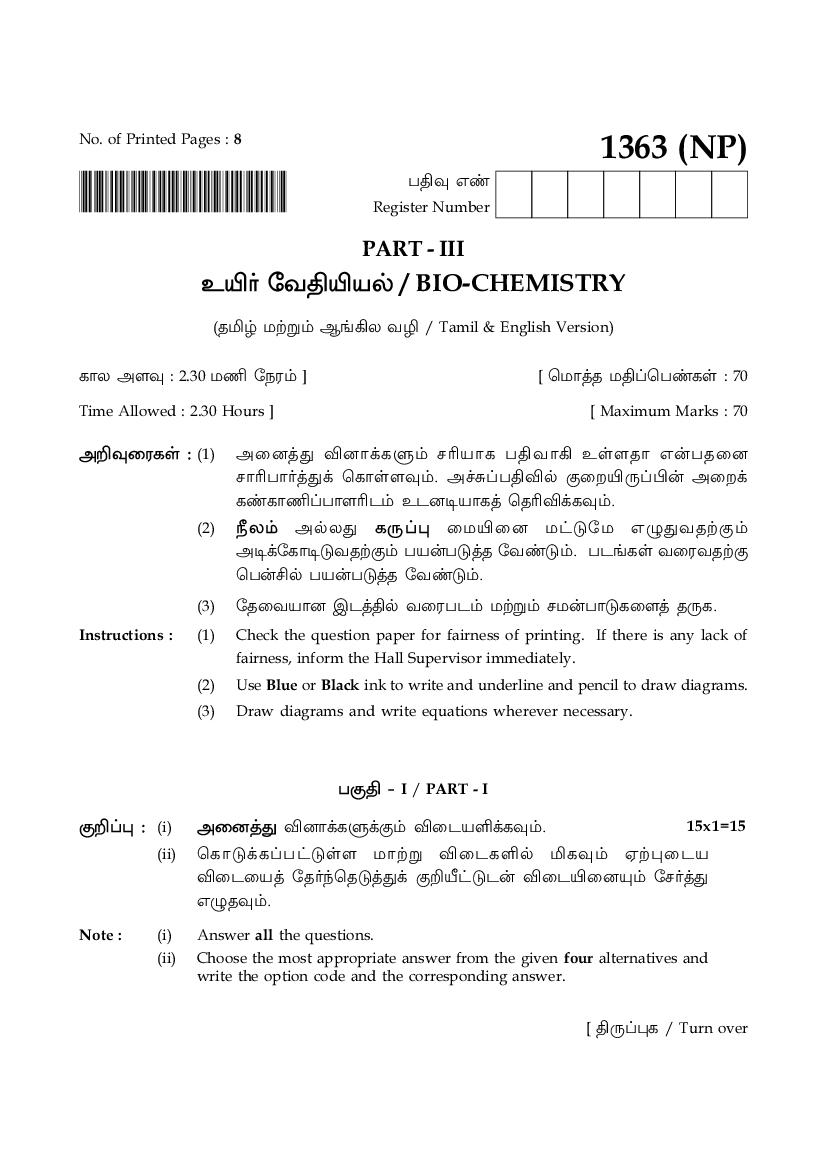
1363 (NP)
!1363NPBIOCHEMISTRY! £vÄ Gs
Register Number
PART - III
E°º ÷Áv°¯À / BIO-CHEMISTRY
(uªÌ ©ØÖ® B[Q» ÁÈ / Tamil & English Version)
Põ» AÍÄ : 2.30 ©o ÷|µ® ] [ ö©õzu ©v¨ö£sPÒ : 70
Time Allowed : 2.30 Hours ] [ Maximum Marks : 70
AÔÄøµPÒ : (1) AøÚzx ÂÚõUPЮ \›¯õP £vÁõQ EÒÍuõ GߣuøÚ
\õ›£õºzxU öPõÒÍÄ®. Aa_¨£vÂÀ SøÓ°¸¨¤ß AøÓU
PsPõo¨£õÍ›h® EhÚi¯õPz öu›ÂUPÄ®.
(2) }»® AÀ»x P¸¨¦ ø©°øÚ ©mk÷© GÊxÁuØS®
AiU÷PõikÁuØS® £¯ß£kzu ÷Ásk®. £h[PÒ ÁøµÁuØS
ö£ß]À £¯ß£kzu ÷Ásk®.
(3) ÷uøÁ¯õÚ ChzvÀ Áøµ£h® ©ØÖ® \©ß£õkPøÍz u¸P.
Instructions : (1) Check the question paper for fairness of printing. If there is any lack of
fairness, inform the Hall Supervisor immediately.
(2) Use Blue or Black ink to write and underline and pencil to draw diagrams.
(3) Draw diagrams and write equations wherever necessary.
£Sv & I / PART - I
SÔ¨¦ : (i) AøÚzx ÂÚõUPÐUS® Âøh¯ÎUPÄ®. 15x1=15
(ii) öPõkUP¨£mkÒÍ ©õØÖ ÂøhPÎÀ ªPÄ® Hئøh¯
Âøhø¯z ÷uº¢öukzxU SÔ±mkhß Âøh°øÚ²® ÷\ºzx
GÊuÄ®.
Note : (i) Answer all the questions.
(ii) Choose the most appropriate answer from the given four alternatives and
write the option code and the corresponding answer.
Page 2
1. Cµzuzvß pH :
(A) 1.3 (B) 4.7 (C) 7.4 (D) 6.1
The pH of blood is :
(a) 1.3 (b) 4.7 (c) 7.4 (d) 6.1
2. ï÷©õS÷Íõ¤ß uõ[PÀ ö\¯¾US Auß îìiiß A»Q¾ÒÍ G¢u
öuõSv Põµn©õP EÒÍx ?
(A) BºâøÚß (B) QøÍ]ß (C) Cªh÷\õÀ (D) ø»]ß
Which group of histidine causes the buffer action of Hemoglobin ?
(a) Arginine (b) Glycine (c) Imidazole (d) Lysine
3. __________ {øÓ¢u EnÂÀ AvP {øÓÄzußø© Põn¨£k®.
(A) öPõʨ¦PÒ (B) øÁmhªßPÒ
(C) Põº÷£õøím÷µm (D) ¦µu[PÒ
Foods rich in __________ have high satiety value.
(a) fats (b) vitamins
(c) carbohydrates (d) proteins
4. ö\U›iß Gߣx J¸ :
(A) Cøµ¨ø£ ShÀ íõº÷©õß (B) {³UÎU Aª»®
(C) ö|õv (D) öPõʨ¦
Secretin is a __________.
(a) Gastrointestinal Hormones (b) Nucleic Acid
(c) Enzyme (d) Fat
Page 3
5. HMP åßm ÁÈ•øÓ°À E¸ÁõUP¨£k® •UQ¯©õÚ JkUS® BØÓÀ :
(A) FAD (B) FADH2 (C) NADH (D) NADPH
The important reducing power produced in HMP shunt pathway is :
(a) FAD (b) FADH2 (c) NADH (d) NADPH
6. QøÍUPõø»]êÀ GzuøÚ «Íõ£iPÒ EÒÍÚ ?
(A) 3 (B) 5 (C) 2 (D) 4
How many irreversible steps are there in glycolysis ?
(a) 3 (b) 5 (c) 2 (d) 4
7. Cv¼¸¢x ³›¯õ E¸ÁõUP¨£kQÓx :
(A) BºâÛß (B) BºÛvß
(C) ]m¸¼ß (D) Bºâ÷Úõ \U]÷Úm
Urea is formed from :
(a) Arginine (b) Ornithine
(c) Citrulline (d) Argininosuccinate
8. A]møhÀ CoA Põº£õUê÷»ØÓ ÂøÚ°À £¯ß£k® øÁmhªß :
(A) £÷¯õmiß (B) øÁmhªß ] (C) TPP (D) FAD
__________ vitamin is involved in acetyl CoA carboxylation reaction.
(a) Biotin (b) Vitamin C (c) TPP (d) FAD
9. JP\õQ xskPÒ C¸¨£x :
(A) ½i[ CøÇ°À
(B) ÷»Q[ CøÇ°À
(C) Cµsk ö£Ø÷Óõº CøÇPÎÀ
(D) Cµsk ÷\´ CøÇPÎÀ
Okasaki fragments are present in :
(a) Leading strand
(b) Lagging strand
(c) Both the parental strands
(d) Both the daughter strands
Page 4
10. RNA ¤øµ©º E¸ÁõPz xøn¦›Áx :
(A) RNA £õ¼©÷µì (B) öí¼÷Pì
(C) ¤øµ÷©ì (D) DNA £õ¼©÷µì
__________ catalyses the synthesis of RNA primer.
(a) RNA Polymerase (b) Helicase
(c) Primase (d) DNA Polymerase
11. ï÷©õ¤¼¯õ Gߣx :
(A) AvP©õÚ ö\Àö£¸UP®
(B) PÀ½µ¼À QøÍU÷Põáß AvP©õP £iuÀ
(C) ÷uõÀ ©ØÖ® PsPÎÀ {ÓªPÎß AÍÄ SøÓuÀ
(D) AvP©õÚ Cµzu¨÷£õUS
Hemophilia is :
(a) Uncontrolled cell growth
(b) Excessive accumulation of Glycogen in liver
(c) Reduced synthesis of melanin pigment in skin and eyes
(d) Hemorrhage
12. ÷h&\õUì ÷|õ°ß ÷£õx Eh¼À AvP©õP ÷\¸® J¸ ö£õ¸Ò :
(A) ÷P[Î÷¯õø\k (B) SÐU÷Põì
(C) ÷P»U÷hõì (D) øu÷µõêß
The metabolite that accumulates in Tay Sachs disease is :
(a) ganglioside (b) glucose
(c) galactose (d) tyrosine
13. RÌUPõs£øÁPÎÀ AvP BØÓÀ öPõsh ÷\º©® Gx ?
(A) ø£÷µõ£õì÷£m (B) »õU÷hm
(C) QÎ\µõÀiøík (D) AMP
Which of the following is the high energy compound ?
(a) Pyrophosphate (b) Lactate
(c) Glyceraldehyde (d) AMP
Page 5
14. Km ©v¨¦ Gߣx :
(A) E°º ÂøÚ FUQPÒ (B) BØÓø» AÎUS® ö£õ¸Ò
(C) Tmk¨ö£õ¸Ò (D) ©õÔ¼
Km value is :
(a) Bio-catalyst (b) High Energy Compound
(c) Mixture (d) Constant
15. IgM ‰»UTÔÀ Põn¨£k® PÚzu \[Q¼ Gx ?
(A) µ (B) α (C) δ (D) κ
Type of heavy polypeptide chain present in the IgM molecule :
(a) µ (b) α (c) δ (d) κ
£Sv & II / PART - II
H÷uÝ® 6 ÂÚõUPÐUS Âøh¯ÎUPÄ®. AÁØÔÀ ÂÚõ Gs 24 &US
Pmhõ¯® Âøh¯ÎUPÄ®. 6x2=12
Answer any 6 questions in which Q.No. 24 is compulsory.
16. yshÀ uSvU TØÖ GßÓõÀ GßÚ ?
What is induced fit theory ?
17. H÷uÝ® Cµsk Cøµ¨ø£ ShÀ íõº÷©õßPøÍU SÔ¨¤kP.
List any two Gastrointestinal hormones.
18. TCA _ÇØ]°À NADH E¸ÁõUPzvÀ Dk£k® ö|õvPÎß ö£¯ºPøÍ
SÔ¨¤kP.
Name the enzymes which are involved in NADH formation in TCA cycle.
Page 6
19. øuµõUêß Aø©¨ø£ GÊxP.
Give the structure of thyroxine.
20. CßÔ¯ø©¯õu öPõÊ®¦ Aª»[PÒ GßÓõÀ GßÚ ?
What are essential amino acids ?
21. {³UÎ÷¯õøhk GßÓõÀ GßÚ ?
What is nucleotide ?
22. Áͺ]øu ©õØÓzvß ©µ¦ ÁÈU÷PõÍõÖPÒ Gߣx GßÚ ?
What is an inborn error of metabolism ?
23. £õì÷£õöáßPÎß £oPÒ ¯õøÁ ?
What is the role of Phosphogens ?
24. ö\¯ÀªS PhzxuÀ GßÓõÀ GßÚ ?
What is active transport ?
£Sv & III / PART - III
H÷uÝ® 6 ÂÚõUPÐUS Âøh¯ÎUPÄ®. AÁØÔÀ ÂÚõ Gs 33 &US
Pmhõ¯©õP Âøh¯ÎUPÄ®. 6x3=18
Answer any 6 questions in which Q.No. 33 is compulsory.
25. vµm] ÂøÚ GßÓõÀ GßÚ ?
What is agglutination ?
26. Põº÷£õøím÷µm EÔg_uø» £õvUS® PõµoPÒ ¯õøÁ ?
What are the factors affecting the rate of absorption of carbohydrate ?
27. SÐU÷Põì uõ[S® ÷\õuøÚø¯ GÊxP.
Write about Glucose Tolerance Test.
Page 7
28. {¯õ]ß Aø©¨ø£ GÊxP.
Write the structure of Niacin.
29. ¼¨¤kPÎß £¯ßPÒ H÷uÝ® ‰ßÔøÚU TÖP.
State any three functions of Lipids.
30. öµ¨Î÷P\Ûß ©õv›PÒ ¯õøÁ ?
What are the Models of Replication ?
31. ¦ØÖ÷|õ´ ö\ÀPÎß £s¦PøÍ GÊxP.
What are the characteristic features of cancer cell ?
32. ö|õv «Íõz ukzuÀ GßÓõÀ GßÚ ?
What is irreversible enzyme inhibition ?
33. £õS{ø»ø¯ £õvUS® PõµoPÒ ¯õøÁ ?
What are the factors that affect the viscosity ?
£Sv & IV / PART - IV
AøÚzx ÂÚõUPÐUS® Âøh¯ÎUPÄ®. 5x5=25
Answer all the questions.
34. (A) £µ¨¦ CÊÂø\°ß E°›¯À £¯ß£õkPøÍ GÊxP.
AÀ»x
(B) ¦µu[PÎß ö\›zuÀ £ØÔ J¸ SÔ¨¦ ÁøµP.
(a) What is the biological importance of surface tension ?
OR
(b) Give an account on digestion of proteins.
Page 8
35. (A) TCA _ÇØ]°À Dk£k® £iPøÍ ÂÁ›.
AÀ»x
(B) ³›¯õ _ÇØ] ÂøÚPøÍ Aø©¨¦hß GÊxP.
(a) Describe the steps involved in TCA cycle.
OR
(b) Write the reactions of urea cycle with structure.
36. (A) Azv÷µõìQ¼÷µõéì £ØÔ SÔ¨¦ ÁøµP.
AÀ»x
(B) {³UÎU Aª»[PÒ ]øuÄÖuø»¨ £ØÔ SÔ¨¦ ÁøµP.
(a) Give an account on atherosclerosis.
OR
(b) Give an account on catabolism of nucleic acids.
37. (A) AÀ¤Û\® ÷|õ°ß Põµnzøu²® AÔSÔPøͲ® GÊxP.
AÀ»x
(B) öPªBì©õiU öPõÒøPø¯ ÂÁ›.
(a) Give the causes and the symptom of albinism.
OR
(b) Describe chemiosmotic theory.
38. (A) ø»ß ÃÁº&£ºU Áøµ£hzøu GÆÁõÖ u¸ÂUP»õ®.
AÀ»x
(B) Cª÷ÚõS÷Íõ¦¼ßPÎß ÁøPPøÍ ÂÍUSP.
(a) How is Line-Weaver Burk plot arrived ?
OR
(b) Explain about the types of immunoglobulins.
-oOo-
Document Details
| Board / Org | Tamil Nadu Board |
| Exam | Class 12 |
| Type | Sample Paper |
| Pages | 8 |
| Updated | 22 Jul 2026 |