PUMDET 2018 Question Paper Life Sciences
Finished viewing? Save it for later —
Download PUMDET 2018 Question Paper Life Sciences (PDF · 8 pages)About PUMDET 2018 Question Paper Life Sciences
PUMDET 2018 Question Paper Life Sciences is available here for free download. Published by WBJEEB for PUMDET, this question paper can be viewed online or downloaded as a PDF (8 pages). Candidates preparing for PUMDET can use PUMDET 2018 Question Paper Life Sciences to understand the exam pattern, the type of questions asked, and the overall difficulty level.
Frequently Asked Questions
How can I download PUMDET 2018 Question Paper Life Sciences?
Open this page and click the Download button to save PUMDET 2018 Question Paper Life Sciences as a PDF. It is completely free on AglaSem Docs.
Is PUMDET 2018 Question Paper Life Sciences free to download?
Yes. PUMDET 2018 Question Paper Life Sciences can be viewed online and downloaded as a PDF free of cost on AglaSem Docs.
How many pages does PUMDET 2018 Question Paper Life Sciences have?
PUMDET 2018 Question Paper Life Sciences contains 8 pages, which you can read online or download together as a single PDF.
Where can I find more PUMDET study material?
You can find more PUMDET question papers, sample papers, syllabus, and answer keys on AglaSem Docs.
PUMDET 2018 Question Paper Life Sciences – Text
Read the full text of this question paper below — useful to quickly search, copy and reference the content online without downloading the PDF.
📄 View text version (8 pages)
Page 1
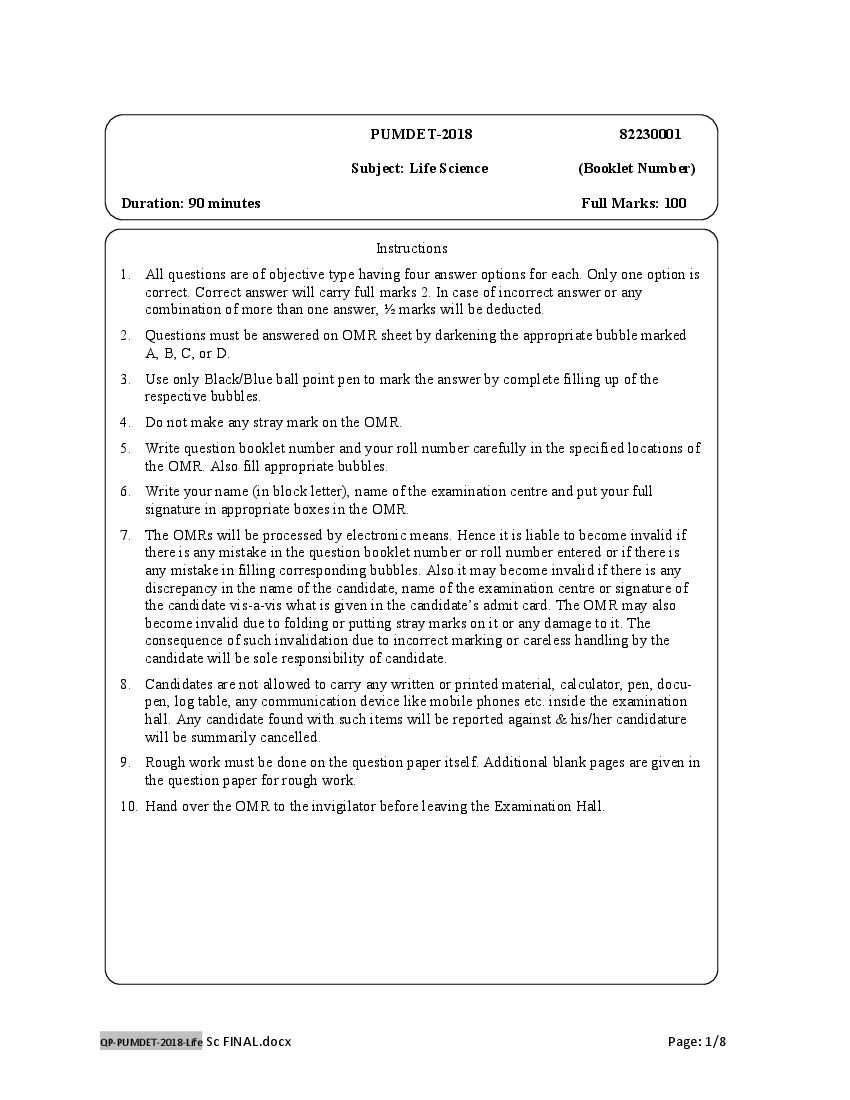
Subject: Life Science (Booklet Number)
Duration: 90 minutes Full Marks: 100
Instructions
1. All questions are of objective type having four answer options for each. Only one option is
correct. Correct answer will carry full marks 2. In case of incorrect answer or any
combination of more than one answer, ½ marks will be deducted.
2. Questions must be answered on OMR sheet by darkening the appropriate bubble marked
A, B, C, or D.
3. Use only Black/Blue ball point pen to mark the answer by complete filling up of the
respective bubbles.
4. Do not make any stray mark on the OMR.
5. Write question booklet number and your roll number carefully in the specified locations of
the OMR. Also fill appropriate bubbles.
6. Write your name (in block letter), name of the examination centre and put your full
signature in appropriate boxes in the OMR.
7. The OMRs will be processed by electronic means. Hence it is liable to become invalid if
there is any mistake in the question booklet number or roll number entered or if there is
any mistake in filling corresponding bubbles. Also it may become invalid if there is any
discrepancy in the name of the candidate, name of the examination centre or signature of
the candidate vis-a-vis what is given in the candidate’s admit card. The OMR may also
become invalid due to folding or putting stray marks on it or any damage to it. The
consequence of such invalidation due to incorrect marking or careless handling by the
candidate will be sole responsibility of candidate.
8. Candidates are not allowed to carry any written or printed material, calculator, pen, docu-
pen, log table, any communication device like mobile phones etc. inside the examination
hall. Any candidate found with such items will be reported against & his/her candidature
will be summarily cancelled.
9. Rough work must be done on the question paper itself. Additional blank pages are given in
the question paper for rough work.
10. Hand over the OMR to the invigilator before leaving the Examination Hall.
QP-PUMDET-2018-Life Sc FINAL.docx Page: 1/8
Page 2
Page 3
1. What crucial feature of penicillins is involved in its mechanism of action?
(A) β- lactam ring (B) Thiazolidine ring
(C) Acyl side chain (D) Carboxylic acid
2. Van’t Hoff equation for a solution is
(A) pv=n/RT (B) p=Vn/RT (C) pv=nRT (D) p=nVRT
3. A major contribution to non - specific host defense against viruses is provided by :
(A) IFN − γ (B) TNF − α
(C) IL-1 (D) IL-8
4. A Biome is :
(A) A specific ecosystem of endangered species of plants and animals
(B) Many similar ecosystems scattered in different parts of the world
(C) A complex biotic community with distinctive plant and animal species under a specific
climatic regime
(D) A geographical area rich in wild lives, exotic as well as endemic
5. Double fertilization is absent in which one of the following angiosperms?
(A) Grasses (B) Sedges (C) Orchids (D) Reeds
6. Match column A with column B
Column A Column B
a. Platypus 1.Ovoviviparous
b. Sea horse 2. Viviparous
c. Mice 3. Oviparous
(A) a-2, b-1, c-3 (B) a-3, b-1, c-2
(C) a-1, b-2, c-3 (D) a-3, b-2, c-1
7. An experiment with bacterial growth in a broth began with 4 cells and ended with 128 cells. How
many generations did the cells go through?
(A) 4 (B) 5 (C) 6 (D) 32
8. Microorganisms that are found to grow in jellies, syrups and brines are termed as :
(A) Acidophiles (B) Halophiles
(C) Osmophiles (D) Basophiles
9. Which type(s) of genetic transfer lead to incorporation of new DNA into the bacterial chromosome?
(i) F- mediated conjugation (ii) Hfr- mediated conjugation
(iii) Transduction (iv) Transformation
(A) i and ii only (B) i, ii, iii and iv (C) ii, iii and iv only (D) iii and iv only
QP-PUMDET-2018-Life Sc FINAL.docx Page: 3/8
Page 4
(A) One (B) Two (C) Three (D) Four
11. Pleiotrophy occurs when a gene has
(A) A complementary gene elsewhere
(B) A small effect on one trait
(C) Reversible effects on the phenotype depending on age
(D) Many effects on the phenotype
12. Which one of the following technique is particularly useful for studying gene expression?
(A) Inverted - PCR (B) AFLP - PCR (C) Nested- PCR (D) qRT - PCR
13. A DNA molecule will be double helix if the ratio of purine to pyrimidine is :
(A) 0.5 (B) 0.75 (C) 1 (D) 1.25
14. Hydroxylation of proline in collagen is mediated by
(A) Vitamin B (B) Vitamin A (C) Vitamin E (D) Vitamin C
15. The standard deviation calculated from a set of 32 observations is 5. The sum of the observations is
80. What would be the sum of the square of these observations?
(A) 2000 (B) 1000 (C) 1500 (D) 2500
16. The median of a series of numerical values is :
(A) A value for which half of the values are higher and half of the values are lower
(B) The value located exactly midway between the minimum and maximum of the series
(C) The most commonly encountered values among the series
(D) A measure of the eccentricity of the series
17. Which of the following is the first electron acceptor of Photosystem I?
(A) Ferredoxin (B) Cytochrome
(C) Iron–sulfur protein (D) Plastocyanin
18. Which of the following statement is not correct for the inflammatory response against extracellular
bacterial infections?
(A) Increased levels of IgE (B) Activation of complement
(C) Phagocytosis by macrophages (D) Swelling caused by release of vasodilators
19. For a first order reaction,what changes with time?
(A) Rate of reaction (B) Half life
(C) Rate of reaction and rate constant (D) Rate constant and half life
QP-PUMDET-2018-Life Sc FINAL.docx Page: 4/8
Page 5
(A) Competition (B) Predation (C) Flood (D) Disease
21. What kind of sound does a bat emit during echolocation?
(A) Ultrasonic sound (B) Supersonic sound
(C) Audible sound (D) Both supersonic and audible sound
22. Decomposer food chain begins from :
(A) Detritus (B) Dead organic matter
(C) Herbivores (D) Carnivores
23. Species with a disproportionately large effect on its environment relative to its abundance is known
as
(A) Dominant species (B) Keystone species
(C) Umbrella species (D) Indicator species
24. Why mitochondrial DNA (mt DNA) is considered as one of the best marker for population and
evolutionary studies?
(A) Mitochondrial DNA inheritance is uniparental
(B) Mitochondrial DNA undergoes spontaneous mutation
(C) Mitochondrial DNA is circular
(D) Mitochondrial genes are specific to mitochondrial DNA
25. The partial diploid formed as a result of gene transfer in bacteria is called
(A) Zygote (B) Haplozygote (C) Prozygote (D) Merozygote
26. What information can be generated by interrupted mating experiments with bacterial cells?
(A) Levels of DNA homology (B) DNA nucleotide sequences
(C) Proteomics of the bacteria (D) Bacterial genome maps
27. Which one of the following is a hereditary disease?
(A) Cystic fibrosis (B) Poliomyelitis (C) Herpes (D) Cholera
28. Based on the first law of thermodynamics, which one of the following is correct?
(A) For an isothermal process, q = + w
(B) For an isochoric process, ∆u = −q
(C) For an adiabatic process, ∆u = −w
(D) For a cyclic process, q = − w
QP-PUMDET-2018-Life Sc FINAL.docx Page: 5/8
Page 6
(A) Both the arms of a chromosome
(B) Only one arm of a chromosome
(C) Two non–homologous chromosomes
(D) Two homologous chromosomes
30. The result of a statistical test, denoted by P, shall be interpreted as follows:
(A) The null hypothesis is rejected if p< 0.05
(B) The null hypothesis is rejected if p>0.05
(C) The alternative hypothesis is rejected if p> 0.05
(D) The null hypothesis is accepted if p< 0.05
31. A double stranded DNA molecule has 100000 bp (100 kb). What would be the length of the DNA
molecule?
(A) 20 μm (B) 17 μm (C) 34 μm (D) 64 μm
32. Polenske value is an indicator of
(A) Volatile fatty acids (B) Hydroxy fatty acids
(C) Non volatile fatty acids (D) Unsaturated fatty acids
33. The flow of electrons from CoQ to NADH is not possible due to ∆G value of
(A) +16.6 kcal (B) -16.6 kcal (C) -8.8 kcal (D) +8.8 kcal
34. Which of the following has no DNA binding motif?
(A) Helix – turn- helix (B) Zinc fingers
(C) Helix – loop - helix (D) Isoleucine zipper
35. The enzyme that catalyzes peptide bonding during translation, is located in the
(A) Smaller subunit of the ribosome
(B) Larger subunit of the ribosome
(C) Leader region of the mRNA
(D) Intron regions of the mRNA
36. Tautomeric form of cytosine pairs with
(A) Rare imino forms of Adenine (B) Normal form of Guanine
(C) Rare enol form of Thymine (D) Normal form of Adenine
QP-PUMDET-2018-Life Sc FINAL.docx Page: 6/8
Page 7
(A) The strong intermolecular force that results from the motion of electrons that creates
temporary dipoles in molecules.
(B) The strong intermolecular force that results from the motion of protons that creates
temporary dipoles in molecules.
(C) The weak intermolecular force that results from the motion of electrons that creates
temporary dipoles in molecules.
(D) The weak intermolecular force that results from the motion of protons that creates
temporary dipoles in molecules.
38. Which one of the following is a helix breaker amino acid?
(A) Alanine (B) Methionine (C) Lysine (D) Proline
39. Which of the following virulence factors of E.coli is important for attachment to host epithelial cells
in the urinary tract infection?
(A) α- hemolysin (B) Urease
(C) K1 antigen (D) Pilli
40. Which of the following cytokines play a role in terminating inflammatory responses?
(A) IL-2 (B) IL-4 (C) TGF-β (D) IFN-γ
41. The single most important characteristic of diarrhoea caused by Vibrio cholerae is
(A) Profound watery diarrhoea (B) Severe abdominal pain
(C) Massive bloody diarrhoea (D) Renal insufficiency
42. Which one of the following microorganisms is responsible for ringworm?
(A) Viruses (B) Bacteria
(C) Fungi (D) Protozoa
43. To create a knock out mice, a gene used to transfect mice replaces the endogenous gene copy in the
genome by a technique called :
(A) Site specific recombination (B) Homologous recombination
(C) Transposition (D) Illegitimate recombination
44. mi RNA regulates the expression of a gene by :
(A) Disrupting post - translational modification of pre-mRNA
(B) Disrupting translation
(C) Disrupting replication
(D) Disrupting transcription
QP-PUMDET-2018-Life Sc FINAL.docx Page: 7/8
Page 8
(A) A homozygous dominant and the heterozygous form
(B)Two homozygous forms
(C) Two heterozygous forms
(D) A homozygous recessive and a heterozygous forms
46. The maximum number of tripeptides that can be formed from the naturally occurring amino acids is:
(A) 8000 (B) 6470 (C) 7465 (D) 5360
47. The leading strand starts DNA replication by using
(A) DNA ligase (B) Helicase (C) DNA Polymerase I (D) RNA primer
48. What will happen if P53 gene is inactive in a cell?
(A) Cell division will not take place
(B) Cell cycle will be arrested at G2/M check points
(C) The controlled death of damaged cell would not take place, resulting cancer
(D) Kinetochore will not attach to the spindle fibres
49. The protection against small pox by prior infection with cowpox represents
(A) Antigenic specificity (B) Antigenic cross reactivity
(C) Innate immunity (D) Passive protection
50. There are 80 thymine and 40 guanine bases in a short stretch of double stranded DNA. The total
number of nucleotides in this DNA fragment is
(A) 480 (B) 240 (C) 120 (D) 60
QP-PUMDET-2018-Life Sc FINAL.docx Page: 8/8
Document Details
| Board / Org | WBJEEB |
| Exam | PUMDET |
| Type | Question Paper |
| Pages | 8 |
| Updated | 22 Jul 2026 |