PUMDET 2018 Question Paper Philosophy
Finished viewing? Save it for later —
Download PUMDET 2018 Question Paper Philosophy (PDF · 10 pages)About PUMDET 2018 Question Paper Philosophy
PUMDET 2018 Question Paper Philosophy is available here for free download. Published by WBJEEB for PUMDET, this question paper can be viewed online or downloaded as a PDF (10 pages). Candidates preparing for PUMDET can use PUMDET 2018 Question Paper Philosophy to understand the exam pattern, the type of questions asked, and the overall difficulty level.
Frequently Asked Questions
How can I download PUMDET 2018 Question Paper Philosophy?
Open this page and click the Download button to save PUMDET 2018 Question Paper Philosophy as a PDF. It is completely free on AglaSem Docs.
Is PUMDET 2018 Question Paper Philosophy free to download?
Yes. PUMDET 2018 Question Paper Philosophy can be viewed online and downloaded as a PDF free of cost on AglaSem Docs.
How many pages does PUMDET 2018 Question Paper Philosophy have?
PUMDET 2018 Question Paper Philosophy contains 10 pages, which you can read online or download together as a single PDF.
Where can I find more PUMDET study material?
You can find more PUMDET question papers, sample papers, syllabus, and answer keys on AglaSem Docs.
PUMDET 2018 Question Paper Philosophy – Text
Read the full text of this question paper below — useful to quickly search, copy and reference the content online without downloading the PDF.
📄 View text version (10 pages)
Page 1
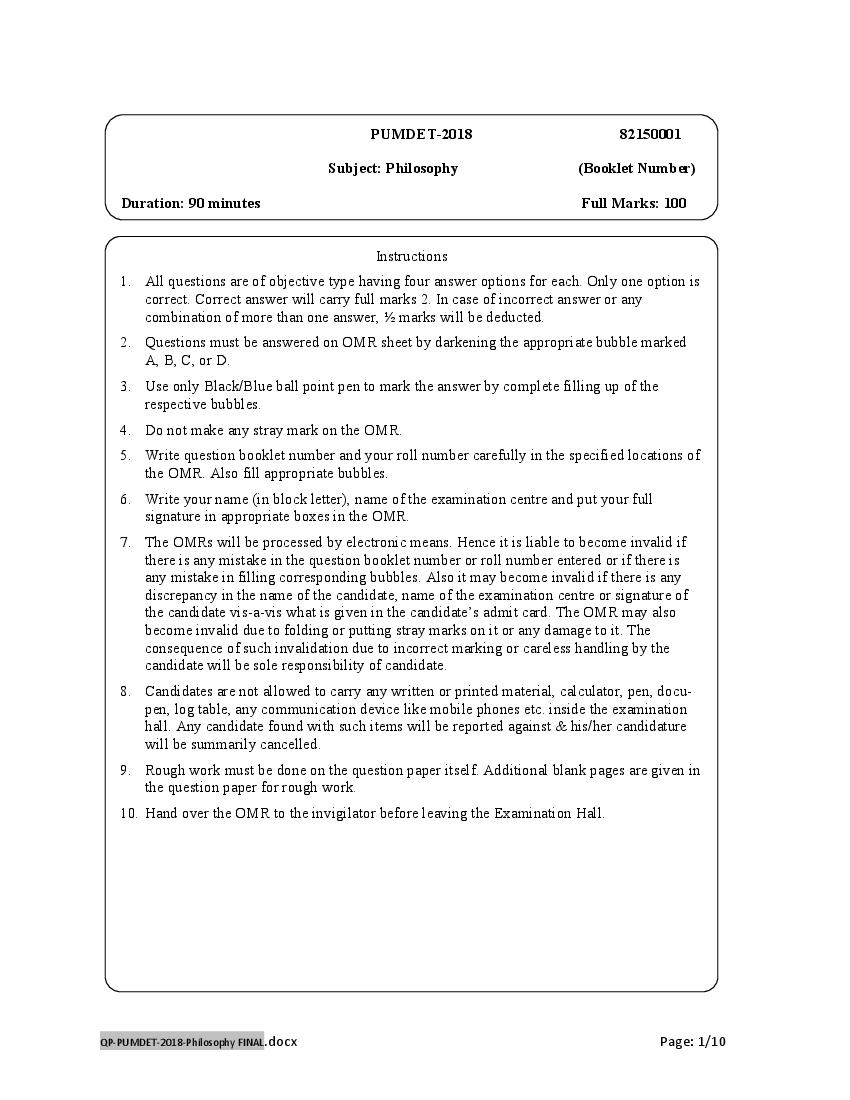
Subject: Philosophy (Booklet Number)
Duration: 90 minutes Full Marks: 100
Instructions
1. All questions are of objective type having four answer options for each. Only one option is
correct. Correct answer will carry full marks 2. In case of incorrect answer or any
combination of more than one answer, ½ marks will be deducted.
2. Questions must be answered on OMR sheet by darkening the appropriate bubble marked
A, B, C, or D.
3. Use only Black/Blue ball point pen to mark the answer by complete filling up of the
respective bubbles.
4. Do not make any stray mark on the OMR.
5. Write question booklet number and your roll number carefully in the specified locations of
the OMR. Also fill appropriate bubbles.
6. Write your name (in block letter), name of the examination centre and put your full
signature in appropriate boxes in the OMR.
7. The OMRs will be processed by electronic means. Hence it is liable to become invalid if
there is any mistake in the question booklet number or roll number entered or if there is
any mistake in filling corresponding bubbles. Also it may become invalid if there is any
discrepancy in the name of the candidate, name of the examination centre or signature of
the candidate vis-a-vis what is given in the candidate’s admit card. The OMR may also
become invalid due to folding or putting stray marks on it or any damage to it. The
consequence of such invalidation due to incorrect marking or careless handling by the
candidate will be sole responsibility of candidate.
8. Candidates are not allowed to carry any written or printed material, calculator, pen, docu-
pen, log table, any communication device like mobile phones etc. inside the examination
hall. Any candidate found with such items will be reported against & his/her candidature
will be summarily cancelled.
9. Rough work must be done on the question paper itself. Additional blank pages are given in
the question paper for rough work.
10. Hand over the OMR to the invigilator before leaving the Examination Hall.
QP-PUMDET-2018-Philosophy FINAL.docx Page: 1/10
Page 2
Page 3
Directions (Questions 1 – 3): Out of the following alternatives, choose the one which best expresses
the meaning of the given word.
1. Intimidate
(A) Harass (B) Frighten (C) Bluff (D) Hint
2. Mellifluous
(A) Sweet (B) Stupid (C) Stale (D) Tasteful
3. Magnanimous
(A) Loyal (B) Kind (C) Generous (D)Loving
Directions (Questions 4 – 6): Fill in the blanks with suitable prepositions given below.
4. He is willing to make a concession ______ the demands of his employees.
(A) for (B) with (C) on (D) to
5. The teacher is angry _____ Rabi.
(A) with (B) on (C) upon (D) of
6. The new government took _____ last year.
(A) after (B) up (C) over (D) out
Directions (Questions 7 – 10): In each of the following questions choose the word opposite in
meaning to the given word.
7. Immerse
(A) Disinter (B) Douse (C) Engross (D) Disappear
8. Astute
(A) Cowardly (B) Wicked (C) Foolish (D) Impolite
9. Subjugate
(A) Enrich (B) Enslave (C) Free (D) Liberate
10. Capricious
(A) Satisfied (B) Scattered (C) Steadfast (D) Insured
Directions (Questions 11 – 13): Choose the most suitable ‘one word’ for the given expressions.
11. One who is determined to exact full vengeance for wrongs done to him
(A) Vindicator (B) Vindictive (C) Virulent (D) Usurper
QP-PUMDET-2018-Philosophy FINAL.docx Page: 3/10
Page 4
(A) Indictment (B) Allegation (C) Accusation (D) Acrimony
13. An unexpected stroke of good luck
(A) Fortune (B) Breakthrough (C) Windfall (D) Boon
Directions (Questions 14 – 17): Pick out the most effective word from the given alternatives to fill in
the blanks to make the sentence meaningfully complete.
14. It was the help he got from his friends which _____ him through the tragedy.
(A) sustained (B) supported (C) boosted (D) helped
15. The speaker did not properly use the time as he went on _____ on one point alone.
(A) dilating (B) deliberating (C) diluting (D) devoting
16. The unruly behaviour of the students _____ their teacher.
(A) tempered (B) aggrieved (C) impeached (D) incensed
17. Sourav was to reach that afternoon but was ___ up at Delhi for some personal work.
(A) Held (B) kept (C) Delayed (D)
detained
Directions (Questions 18 – 20): Out of the following alternatives, choose the one which can correctly
substitute the italicized part of the given sentence. If the sentence is correct as it is, the answer is ‘no
improvement’.
18. In her views, they are going to present a report soon.
(A) as (B) for (C) with (D) no
improvement
19. They cooked a conspiracy to overthrow the monarch.
(A) hatched (B) created (C) fabricated (D) no improvement
20. He returned with two burning mugs of coffee and set them down on her desk.
(A) heating (B) blazing (C) steaming (D) no improvement
Logical reasoning
Directions (Q 21-24): In each of the following questions, a statement is given, followed by
conclusions. Choose the best option.
QP-PUMDET-2018-Philosophy FINAL.docx Page: 4/10
Page 5
Conclusions:
I. Disparity between rich and poor results in revolution.
II. Revolution overhauls society.
(A) Only conclusion I follows (B) Only conclusion II follows
(C) Neither I nor II follows (D) Both I and II follow.
22. Statement: Although the education system has progressed from the point of view of the number of
schools, most of them are ill-equipped and have not achieved excellence in imparting education.
Conclusions:
I. In future, we should provide good teachers and equipment to these schools.
II. We need not open any more schools in the future.
(A) Only conclusion I follows (B) Only conclusion II follows;
(C) Neither I nor II follows (D) Both I and II follow.
23. Statement: A large majority of the work force in India is unorganized. Most of them earn either the
minimum or uncertain wages while others are engaged in sundry jobs.
Conclusions:
I. The workers in the organized sector get better facilities and stay longer in their jobs.
II. Some workers in the unorganized sector of the work force have a regular and fixed
income.
(A) Only conclusion I follows (B) Only conclusion II follows;
(C) Neither I nor II follows (D) Both I and II follow.
24. Statement: People who speak too much against the dowry are those who had taken it themselves.
Conclusions:
I. It is easier said than done.
II. People have double standards.
(A) Only conclusion I follows (B) Only conclusion II follows
(C) Neither I nor II follows (D) Both I and II follow.
Directions (Q 25-26): These questions are based on the following information.
( I ) 'A * B' means 'A is brother of B'
( II ) 'A / B' means 'B is mother of A'
( III ) 'A – B' means 'A is father of B'
( IV ) 'A + B' means 'B is sister of A'
25. Which of the following means L is daughter of H?
(A) L + K / J – H (B) H – J * R + L (C) L – J * H / K (D) L + W * R / H
QP-PUMDET-2018-Philosophy FINAL.docx Page: 5/10
Page 6
(A) Daughter (B) Sister (C) Niece (D) Aunt
Directions (27 to 29): Read the following information to answer the given questions.
In an Exhibition seven cars of different companies - Cadillac, Ambassador, Fiat, Maruti, Mercedes,
Bedford and Fargo are standing facing to east in the following order :
Cadillac is next to right of Fargo. Fargo is fourth to the right of Fiat. Maruti car is between
Ambassador and Bedford. Fiat which is third to the left of Ambassador, is at one end.
27. Which of the cars are on both the sides of cadillac car?
(A) Ambassador and Maruti (B) Maruti and Fiat
(C) Fargo and Mercedes (D) Ambassador and Fargo
28. Which of the following statement is correct?
(A) Maruti is next left of Ambassador. (B) Bedford is next left of Fiat.
(C) Bedford is at one end. (D) Fiat is next second to the right of Maruti.
29. Which one of the following statements is correct?
(A) Fargo car is in between Ambassador and Fiat.
(B) Cadillac is next left to Mercedes car.
(C) Fargo is next right of Cadillac.
(D) Maruti is fourth right of Mercedes.
Directions (Q 30-34): In each of the questions below are given two or more statements followed by
two conclusions numbered I and II. You have to take the given statements to be true even if they
seem to be a at variance from commonly known facts. Read all the conclusions and then decide
which of the given conclusions logically follows from the given statements disregarding commonly
known facts.
30. Statements:
No giraffe is a leopard
All leopards are kangaroos
All kangaroos are wolfs
Conclusions:
I. All kangaroos can never be giraffes
II. All giraffes are definitely wolfs.
(A) Only conclusion I follows. (B) Only conclusion II follows.
(C) Either conclusion I or conclusion II follows. (D) Both conclusions I and II follows.
QP-PUMDET-2018-Philosophy FINAL.docx Page: 6/10
Page 7
Some fruits are mangos.
All mangos are guavas.
No guava is a banana.
Conclusions:
I. All guavas are fruits.
II. Some guavas are fruits
(A) Only conclusion I follows. (B) Only conclusion II follows.
(C) Either conclusion I or conclusion II follows. (D) Both conclusions I and II follows.
32. Statements:
Some fruits are mangos.
All mangos are guavas.
No guava is a banana.
Conclusions:
I. All fruits are bananas.
II. No mango is a banana.
(A) Only conclusion I follows. (B) Only conclusion II follows.
(C) Either conclusion I or conclusion II follows. (D) Both conclusions I and II follows.
33. Statements:
All locks are keys.
Some keys are pockets.
Conclusions:
I. No pocket is lock.
II. At least some pockets are keys.
(A) Only conclusion I follows. (B) Only conclusion II follows.
(C) Either conclusion I or conclusion II follows. (D) Both conclusions I and II follows.
QP-PUMDET-2018-Philosophy FINAL.docx Page: 7/10
Page 8
No book is a pen.
All pens are pencils
All pencils are erasers.
Conclusions:
I. All pens are erasers.
II. At least some erasers are pencils.
(A) Only conclusion I follows. (B) Only conclusion II follows.
(C) Either conclusion I or conclusion II follows. (D) Both conclusions I and II follows.
Direction (Q 35-38) : Find the Odd Man Out
35. 6, 18, 24, 120
(A) 6 (B) 15 (C) 24 (D) 120
36. 81:243, 16:64, 64:192, 25:75
(A) 81:243 (B) 16:64 (C) 64:192 (D) 25:75
37. 5-15-20, 10-30-40, 4-12-15, 25-50-75
(A) 5-15-20 (B) 10-30-40 (C) 4-12-15 (D) 25-50-75
38. 679, 888, 945, 943
(A) 679 (B) 888 (C) 945 (D) 943
Direction (Q 39 - 40) : Choose the best option from the alternatives
39. Event (a): Senior students ragged junior students.
Event (b): Senior students were suspended.
(A) ‘a’ is the effect and ‘b’ is its immediate and principal cause.
(B) ‘a’ is the immediate and principal cause and ‘b’ is its effect.
(C) ‘a’ is an effect but ‘b’ is not its immediate and principal cause.
(D) ‘b’ is an effect but ‘a’ is not its immediate and principal cause.
QP-PUMDET-2018-Philosophy FINAL.docx Page: 8/10
Page 9
Event (b): India is the largest democratic country in the world.
Options:
(A) ‘a’ is the effect and ‘b’ is its immediate and principal cause.
(B) ‘a’ is the immediate and principal cause and ‘b’ is its effect.
(C) ‘a’ is an effect but ‘b’ is not its immediate and principal cause.
(D) None of these
Direction (Q 41-43): Each Question has a problem and two statements numbered I and II giving
certain information. You have to decide if the information given in the statements is sufficient for
answering the problem.
41. How is d related to a?
I. b is the brother of a.
II. b is d’s son.
(A) The data in statement I alone are sufficient to answer the question
(B) The data in statement II alone are sufficient to answer the question;
(C) The data even in both the statements together are not sufficient to answer the question;
(D) The data in both the statements together are needed;
42. Who is c’s partner in a game of cards involving four players a, b, c and d?
I. d is sitting opposite to a.
II. b is sitting right of a and left of d.
(A) The data in statement I alone are sufficient to answer the question;
(B) The data in statement II alone are sufficient to answer the question;
(C) The data either in I or II alone are sufficient to answer the question;
(D) The data even in both the statements together are not sufficient to answer the question;
43. What day is the fourteenth of a given month?
I. The last day of the month is a Wednesday.
II. The third Saturday of the month was seventeenth.
(A) The data in statement I alone are sufficient to answer the question;
(B) The data in statement II alone are sufficient to answer the question;
(C) The data either in I or II alone are sufficient to answer the question;
(D) The data even in both the statements together are not sufficient to answer the question;
QP-PUMDET-2018-Philosophy FINAL.docx Page: 9/10
Page 10
44. A software engineer has the capability of thinking 100 lines of code in five minutes and can type 100
lines of code in 10 minutes. He takes a break for five minutes after every ten minutes. How many
lines of codes will he complete typing after an hour?
(A) 250 (B) 220 (C) 150 (D) 200
45. Nikhil gets Rs.250 from his parents every week for his expenses. He puts Rs.5 in his piggy bank on
every day except Sunday when he puts Rs.10 in the piggy bank. He eats subsidized lunch in the
college canteen for Rs. 10 on all college days except Saturday when he treats himself to the special
lunch for Rs.25. Bus fare to college is Rs.4 each way. He has got a holiday on Sunday. This week,
Nikhil wants to buy a book which costs Rs.100. For this, he was walking to and from the college. He
is left with Rs.3 after buying the book. Assuming no other expenses, how many times did Nikhil
walk this week?
(A) 2 (B) 3 (C) 4 (D) 5
46. a, b, c and d are four friends who live in the same area and work for the children in a nearby slum.
One of them cooks the children breakfast and each of the other three teaches a different subject from
mathematics, reading & writing and drawing. They study mechanical engineering, psychology,
medicine and economics. Neither the economics nor the psychology student cooks breakfast. b does
not teach reading & writing. d is the medical student, and he does not cook breakfast. c teaches
drawing. a studies mechanical engineering. Who teaches mathematics?
(A) a (B) b (C) c (D) d
47. A monkey starts climbing up a tree 20ft. tall. Each hour, it hops 3ft. and slips back 2ft. How much
time would it take the monkey to reach the top?
(A) 21 hours (B) 12 hours (C) 18 hours (D) 15 hours
48. If a light flashes every 6 seconds, how many times will it flash in ¾ of an hour?
(A) 450 (B) 451 (C) 350 (D) 425
Direction (Q 49-50) : Choose the best option from the alternatives:
49. A train always has
(A) Rails (B) Driver (C) Guard (D) Engine
50. Which one of the following is always found in 'Bravery'?
(A) Experience (B) Power (C) Courage (D) Knowledge
QP-PUMDET-2018-Philosophy FINAL.docx Page: 10/10
Document Details
| Board / Org | WBJEEB |
| Exam | PUMDET |
| Type | Question Paper |
| Pages | 10 |
| Updated | 22 Jul 2026 |