PUMDET 2018 Question Paper Political Sciences
Finished viewing? Save it for later —
Download PUMDET 2018 Question Paper Political Sciences (PDF · 11 pages)About PUMDET 2018 Question Paper Political Sciences
PUMDET 2018 Question Paper Political Sciences is available here for free download. Published by WBJEEB for PUMDET, this question paper can be viewed online or downloaded as a PDF (11 pages). Candidates preparing for PUMDET can use PUMDET 2018 Question Paper Political Sciences to understand the exam pattern, the type of questions asked, and the overall difficulty level.
Frequently Asked Questions
How can I download PUMDET 2018 Question Paper Political Sciences?
Open this page and click the Download button to save PUMDET 2018 Question Paper Political Sciences as a PDF. It is completely free on AglaSem Docs.
Is PUMDET 2018 Question Paper Political Sciences free to download?
Yes. PUMDET 2018 Question Paper Political Sciences can be viewed online and downloaded as a PDF free of cost on AglaSem Docs.
How many pages does PUMDET 2018 Question Paper Political Sciences have?
PUMDET 2018 Question Paper Political Sciences contains 11 pages, which you can read online or download together as a single PDF.
Where can I find more PUMDET study material?
You can find more PUMDET question papers, sample papers, syllabus, and answer keys on AglaSem Docs.
PUMDET 2018 Question Paper Political Sciences – Text
Read the full text of this question paper below — useful to quickly search, copy and reference the content online without downloading the PDF.
📄 View text version (11 pages)
Page 1
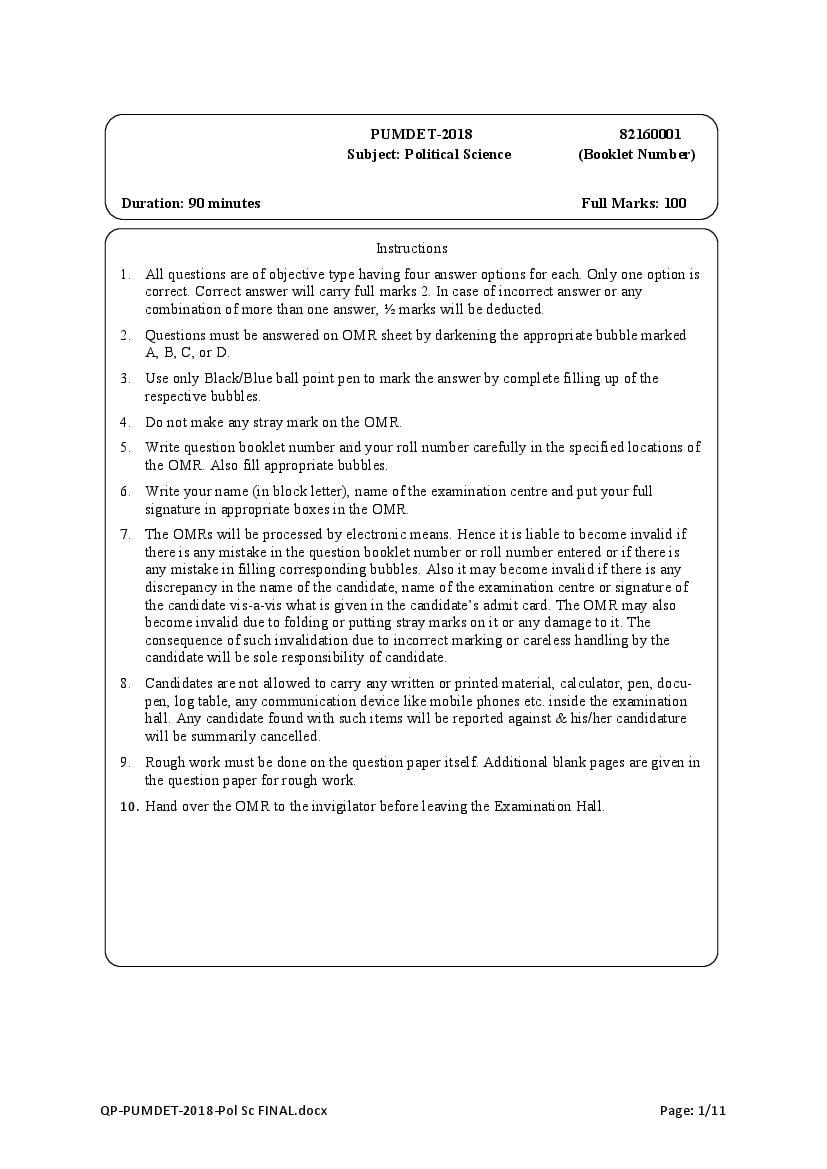
Subject: Political Science (Booklet Number)
Duration: 90 minutes Full Marks: 100
Instructions
1. All questions are of objective type having four answer options for each. Only one option is
correct. Correct answer will carry full marks 2. In case of incorrect answer or any
combination of more than one answer, ½ marks will be deducted.
2. Questions must be answered on OMR sheet by darkening the appropriate bubble marked
A, B, C, or D.
3. Use only Black/Blue ball point pen to mark the answer by complete filling up of the
respective bubbles.
4. Do not make any stray mark on the OMR.
5. Write question booklet number and your roll number carefully in the specified locations of
the OMR. Also fill appropriate bubbles.
6. Write your name (in block letter), name of the examination centre and put your full
signature in appropriate boxes in the OMR.
7. The OMRs will be processed by electronic means. Hence it is liable to become invalid if
there is any mistake in the question booklet number or roll number entered or if there is
any mistake in filling corresponding bubbles. Also it may become invalid if there is any
discrepancy in the name of the candidate, name of the examination centre or signature of
the candidate vis-a-vis what is given in the candidate’s admit card. The OMR may also
become invalid due to folding or putting stray marks on it or any damage to it. The
consequence of such invalidation due to incorrect marking or careless handling by the
candidate will be sole responsibility of candidate.
8. Candidates are not allowed to carry any written or printed material, calculator, pen, docu-
pen, log table, any communication device like mobile phones etc. inside the examination
hall. Any candidate found with such items will be reported against & his/her candidature
will be summarily cancelled.
9. Rough work must be done on the question paper itself. Additional blank pages are given in
the question paper for rough work.
10. Hand over the OMR to the invigilator before leaving the Examination Hall.
QP-PUMDET-2018-Pol Sc FINAL.docx Page: 1/11
Page 2
Page 3
i. The collective power to take decisions about a community.
ii. The mechanisms by which power is exercised by one group over another.
iii. The use of state power to achieve the good of the community.
iv. The use of state power to exercise power over another.
(A) Only ii & iii (B) Only iii & iv
(C) All of them (D) None of them
2. Match the types of sovereignty with their proponents in the table given.
Types of sovereignty proponents
a. Political 1. Locke
b. Legal 2. Barker
c. Popular 3. Rousseau
d. Pluralist 4. Austin
(A) a – 3 , b – 2 , c – 1, d – 4 (B) a – 1,b – 4, c – 3 , d – 2
(B) a – 2 , b – 3, c – 4 , d – 1 (D) a – 4 , b – 1 , c – 2 , d – 3
3. Which branch of feminism states, “the planet earth is a living organism”
(A) The Gaia tradition (B) Liberal feminism
(C) Socialist tradition (D) Radical feminism
4. How is Peter Kropotkin best identified?
(A) Neo-Liberal (B) Ethical socialist
(C) Neo-Marxist (D) Anarchist
5. Who among the following identified four sources of justice, “religion, nature, economics and
ethics.”
(A) Ernest Barkes (B) Harold Laski
(C) Woodrow Wilson (D) Henry Maine
6. With which event(s) is Dr. Ambedkar associated:
a) 3 temple satyagrohas, none supported by congress
b) Participation in Ganapati festivities
c) Mahad Conference of 1927.
d) The Southborough conference on franchise.
(A) only b (B) a, b, and c (C) only d (D) All
QP-PUMDET-2018-Pol Sc FINAL.docx Page: 3/11
Page 4
movement.”
(A) Sir syed Ahmed Khan (B) M. N Roy
(C) Bipin Bihari Pal (D) Nathuram Godse
8. Identify the speaker: “The congress conducted itself on the complacent assumption that all Indians
profess the same religion, speak the same language, have the same way of life.”
(A) Sir syed Ahem Khan (B) Dr. Ambedkar
(C) Jawaharlal Nehru (D) M.N. Roy
9. Match between list A and list B
Types of sovereignty proponents
a. Bankim Chandra Chattopadhyay 1. Influenced by Shibli Numani and
Jamaluddin Afghani
b. Rammohan Roy 2. “Socialism is not in our blood”
c. M.S. Golwalkar 3. Unitarian
d. Abul Kalam Azad 4. National Religion
(A) a – 1 , b – 2 , c – 4 , d – 3 (B) a – 2 , b – 3 , c – 4 , d – 1
(C) a – 2 , b – 1, c – 3 , d – 4 (D) a – 4 , b – 3 , c – 2 , d – 1
10. Who said, “ My notion of democracy is that under it the weakest should have the same opportunity
as the strongest.”
(A) Acharya Narendra Deva (B) Kenneth Galbraith
(C) M.K. Gandhi (D) Rajendra Prasad
11. Which of the following reflects plato’s ideas?
a) All types of music to be forbidden
b) Doctors to be always on standby
c) The young should not see war
d) The happiness of guardians symbolizes happiness of all
(A) only d (B) a, b & c only (C) None (D) All
12. Choose the incorrect sentence:
(A) People living under Roman Law, found it very safe to be ruled by Rome.
(B) The state in Rome was powerful, but not all-absorbing.
(C) Cicero completely accepted Plato’s ideas in his conclusion.
(D) Cicero transmitted the stoic idea of equality.
QP-PUMDET-2018-Pol Sc FINAL.docx Page: 4/11
Page 5
1) Machianelli
2) Cicero
3) Marsilius of Padua
4) Hobbes
(A) 1, 2, 3, 4 (B) 2, 3, 4, 1 C) 4, 3, 2, 1 (D) 2, 3, 1, 4
14. Who said, “The state is a relation between political inferiors and a political superior, and law is its
command”?
(A) Thomas Hobbes (B) Jean Bodin
(C) J.J Rousseau (D) Hugo Grotius
15. Choose the correct statement.
(A) The combination of dialectics with materialism does not transform them.
(B) Marxist humanism precedes dialectical materialism
(C) Engel’s Anti-Duhring gave final shape to dialectical materialism
(D) The term dialectical materialism was first used in 1848
16. With which concept are the words “Ideal types” most commonly associated:
(A) Marxian revolution (B) Maoist communes
(C) Weberian bureaucracy (D) Lenin’s concept of state
17. What is “war on terror”?
(A) Centrality of power politics. (B) Coercion of national loyalties.
(C) Shared experience of suffering in war (D) Instant global communication
18. Match the authors with their books.
Authors Books
a. Mearsheimer 1. Theory of International Politics
b. Rousseau 2. The state of war
c. Thucydides 3. The peloponnesian war
d. Waltz 4. The Tragedy of Great Power Polities
(A) a – 1, b – 3, c – 2, d – 4 (B) a – 2, b – 1, c – 4, d – 3
(C) a – 3, b – 2, c – 1, d – 4 (D) a – 4, b – 2, c – 3, d – 1
19. Which country external to SAARC has persuaded the members to allow Afghanistan to be a
member?
(A) Russia (B) PRC (C) US (D) France
QP-PUMDET-2018-Pol Sc FINAL.docx Page: 5/11
Page 6
a) Iran
b) China
c) Japan
d) U.S
e) S. Korea
f) Australia
(A) only a & b (B) All (C) b, c, e, f (D) None
21. Arrange the events in reverse chronological order:
a) First Review conference of NPT in Geneva.
b) Partial Ban Treaty enters into force.
c) U.S announces its National Missile Defence Act.
d) Democratic People’s Republic of Korea announces it has tested a nuclear weapon.
(A) b, a, c, d (B) d, c, a, b (C) a, b, c, d (D) c, b, a, d
22. Liberalism in I.R theory stands for:
(A) intra – paradigm debate (B) belief in force and balance of power
(C) promotion of western democratic values (D) war is unnecessary and outmoded
23. Who said “Women, colonies and natural resources share systematic exploitation”?
(A) Cynthia Enloe (B) Simone de Beauvoir
(C) Maria Mies (D) J.S. Mill
24. Which system of International Politics “….was the product of elite collusion which resulted in
international relations being ‘arranged’”?
(A) The cold war (B) The Balance of Power
(C) The First world war (D) The war of Roses.
25. In which session of the congress was participation in elections resolved:
(A) Lucknew Congress, 1936 (B) Maripura Congress, 1938
(C) Tripura Congress, 1939 (D) Madras Congress, 1937
26. In whose writing is the distinction between ‘the thematic’ and ‘problematic in nationalist thought
found?
(A) Bhikhu Parekh (B) Sudipta Kaisraj
(C) Asish Nandy (D) Partha Chattterjee
QP-PUMDET-2018-Pol Sc FINAL.docx Page: 6/11
Page 7
Event Year
a) Kesari is published 1. 1916
b) Congress split 2. 1880
c) Indian Press Act 3. 1907
d) Indian Home Rule League 4. 1910
(A) a – 4, b – 3,c – 1,d – 2 (B) a – 3, b – 1,c – 4, d – 2
(C) a – 2,b – 3, c – 4, d – 1 (D) a – 1, b – 2, c – 3, d – 4
28. Who coined the term “ Composite Patriotism”?
(A) Aurobindo Ghosh (B) Bipin Chandra Pal
(C) Jawaharlal Nehru (D) M.N.Roy
29. Which movement was planned as a co-stage programme at the Andhra PCC?
(A) Non- cooperation (B) Quit India
(C) INA Revolt (D) Civil Disobediences
30. The Praja Party (1929) was founded under the leadership of:
(A) Jitendralal Banerjee, Naresh Sengupta, Bipin Chandra Pal
(B) Fazlul Huq, Akram Khan and Abdur Rahim
(C) Abdur Rahim, Akram Khan and M.N. Roy
(D) Akram Khan, Bipin Chandra Pal, M.N.Roy
31. Match List Ι with List ΙΙ
List I List II
a) Art 330 1. Reservation of beats of SC & ST in Lok Sabha
b) Art 336 2. Special Provisions for Anglo-Indians in certain services
c) Art 338 3. National Commission for S.C. & S.T.
d) Art 340 4. Appointment of commission to investigate the conditions of
backward classes.
(A) a – 3, b – 2, c – 4, d – 1 (B) a – 1, b – 2, c – 3, d – 4
(C) a – 2, b – 3, c – 1, d – 4 (D) a – 2, b – 4, c – 1, d – 3
32. Which of the following authors penned the first book on state politics in India?
(A) Myron Weiner (B) Lawrence laez
(C) Rajni Kothari (D) Iqbal Narain
QP-PUMDET-2018-Pol Sc FINAL.docx Page: 7/11
Page 8
inegalitarian; populist; authoritarian – inegalitarian ”?
(A) Maurice Dunerger (B) Jean Blondel
(C) M. Ostrogorski (D) None of these
34. Which statements relating to the Cabinet secretariat are correct?
a) The Portfolio system of Lord Canning was its predecessor.
b) It is responsible for the general administration of parliament.
c) It monitors in to Ministerial coordination
d) Tries to balance between new and old policy initiatives.
(A) a and b (B) a and c (C) c and d (D) only b
35. Choose the correct statements relating to the VIIth schedule.
a) The 3 lists exhaustively enumerate on all possible subjects.
b) The courts interpret the scope of the power’s liberally.
c) The scope for application of residuary powers is very strong
d) Legislative powers cannot be expanded in any other way.
(A) a & b only (B) a, b and c (C) b & d only (D) a, b, and d
36. The OBOR, a Chinese initiative includes
a) cultural collaboration
b) economic collaboration
c) It stands for our Belt and our Road
d) Mitigation of conflict
(A) a & b (B) b, c & d (C) a, c & d (D) None of the above
37. The Sardar Swaran Singh Committee’s advice on Fundamental Duties:
a) Parliament may regulate punishment on non-compliance
b) Such law cannot be questioned by court
c) It should be a fundamental duty to pay taxes
d) None of these
(A) a & b (B) a, b and c (C) d only (D) a and c
QP-PUMDET-2018-Pol Sc FINAL.docx Page: 8/11
Page 9
(A) Cambodia, LAOS PDR, Myanmar, Thailand, Vietnam,
(B) Myanmar, Thailand, Philippines, Cambodia, Laos PDR,
(C) Cambodia, Vietnam, Philippines, Bangladesh and Thailand
(D) Myanmar, Vietnam, Laos PDR, Bangladesh and Thailand
39. The second Administrative Reforms Commission was appointed by the GOI in
(A) 1966 (B) 1990 (C) 2005 (D) 2010
40. Assertion (A): Lord Ripon’s Resolution of 1882 was the ‘Magna Carta’ of local government
Reason (R): Lord Ripon is regarded as the father of local self government in India.
Which of the following statement is correct regarding the ‘assertion’ and the ‘reason’ given?
(A) Both A & R are true and R is the correct explanation of A.
(B) Both A & R are true but R is not the correct explanation of A.
(C) A is true but R is false
(D) A is false but R is true.
41. Identify the neo-liberal political economist.
(A) John Locke (B) Frederich Hayek
(C) Adam Smith (D) Amartya Sen
42. Who initiated the approach known as the ‘Copenhagen School’ in security studies?
(A) Robert Gilpin (B) Harsh V Pant
(C) David East (D) B. Buzan
43. Match the authors with their books.
Author Book
a) F. Fukuyama 1. The Rise of European Liberalism
b) H. J. Laski 2. A Vindication of the Rights of women
c) J. S. Mill 3. The subjection of women
d) Mary Wollstonecraft 4. The End of History and the last Man
(A) a – 1, b – 3, c – 4, d – 2 (B) a – 4, b – 1, c – 3, d – 2
(C) a – 4, b – 3, c – 2, d – 1 (D) a – 3, b – 2, c – 1, d – 4
QP-PUMDET-2018-Pol Sc FINAL.docx Page: 9/11
Page 10
a) Imagined Communities
b) A life Beyond Comparison
c) Language and Power
d) The Spectre of Comparison
(A) only a & d (B) All (C) a, c & d (D) a & c
45. The 1974 Land Boundary Agreement between India and Bangladesh included the concurrence of
which states:
(A) West Bengal, Mizoram, Tripura, Nagaland
(B) Tripura, Nagaland and West Bengal
(C) Assam, Mizoram, West Bengal & Meghalaya
(D) Assam, Meghalaya, Tripura & West Bengal
46. Identify the oldest department under GOI:
(A) The Ministry of Law and Justice
(B) The Home Ministry
(C) Ministry of External Affairs
(D) The Finance Ministry
47. The Spiritual revolution of Shri Aurobindo was based on which philosophy?
(A) Satyamenajayeta (truth shall prevail)
(B) Sachchidananda (Supreme reality)
(C) Sadbhavana (truthful thoughts)
(D) Saduyavhar (good behaviour)
48. “The very ward ‘sannyasin’ means the divine outlaw” - who said this?
(A) Rabindranath Tagore (B) Jayprokash Narayan
(C) Swami Vivekananda (D) Subhas Chandra Bose
QP-PUMDET-2018-Pol Sc FINAL.docx Page: 10/11
Page 11
Author Book
a) Emile Durkheim 1. Elementary Aspects of peasant Insurgency in colonial
India
b) Talcott Parsons 2. The structure of Social Action
c) Seymore M. Lipect 3. Rules of Sociological Method
d) Ranajit Guha 4. Political Man
(A) a – 3, b – 2, c – 4, d – 1 (B) a – 1, b – 4, c – 3, d – 2
(C) a – 1, b – 2, c – 4, d – 3 (D) a – 2, b – 3, c – 1, d – 4
50. Michels “ Iron Law of Oligarchy” means,
(A) Parties are disciplined and organized
(B) Members are excluded from decision making.
(C) Parties are democratic.
(D) Parties lead to be oligarchic.
(A) a, b & c (B) a, b & d (C) All (D) None
QP-PUMDET-2018-Pol Sc FINAL.docx Page: 11/11
Document Details
| Board / Org | WBJEEB |
| Exam | PUMDET |
| Type | Question Paper |
| Pages | 11 |
| Updated | 22 Jul 2026 |