PSEB 11th Class Syllabus 2027 Agriculture
Finished viewing? Save it for later —
Download PSEB 11th Class Syllabus 2027 Agriculture (PDF · 3 pages)About PSEB 11th Class Syllabus 2027 Agriculture
PSEB 11th Class Syllabus 2027 Agriculture is available here for free download. Published by Punjab Board for Class 11, this syllabus can be viewed online or downloaded as a PDF (3 pages). Candidates preparing for Class 11 can use PSEB 11th Class Syllabus 2027 Agriculture to understand the exam pattern, the type of questions asked, and the overall difficulty level.
Frequently Asked Questions
How can I download PSEB 11th Class Syllabus 2027 Agriculture?
Open this page and click the Download button to save PSEB 11th Class Syllabus 2027 Agriculture as a PDF. It is completely free on AglaSem Docs.
Is PSEB 11th Class Syllabus 2027 Agriculture free to download?
Yes. PSEB 11th Class Syllabus 2027 Agriculture can be viewed online and downloaded as a PDF free of cost on AglaSem Docs.
How many pages does PSEB 11th Class Syllabus 2027 Agriculture have?
PSEB 11th Class Syllabus 2027 Agriculture contains 3 pages, which you can read online or download together as a single PDF.
Where can I find more Class 11 study material?
You can find more Class 11 question papers, sample papers, syllabus, and answer keys on AglaSem Docs.
PSEB 11th Class Syllabus 2027 Agriculture – Text
Read the full text of this syllabus below — useful to quickly search, copy and reference the content online without downloading the PDF.
📄 View text version (4 pages)
Page 1
PSEB 11th Class
Syllabus 2027
Agriculture
EXAM YEAR TYPE SUBJECT
Punjab Class 11 2027 Syllabus Agriculture
Notes · Sample Papers · Previous Year Papers · Mock Tests
Page 2
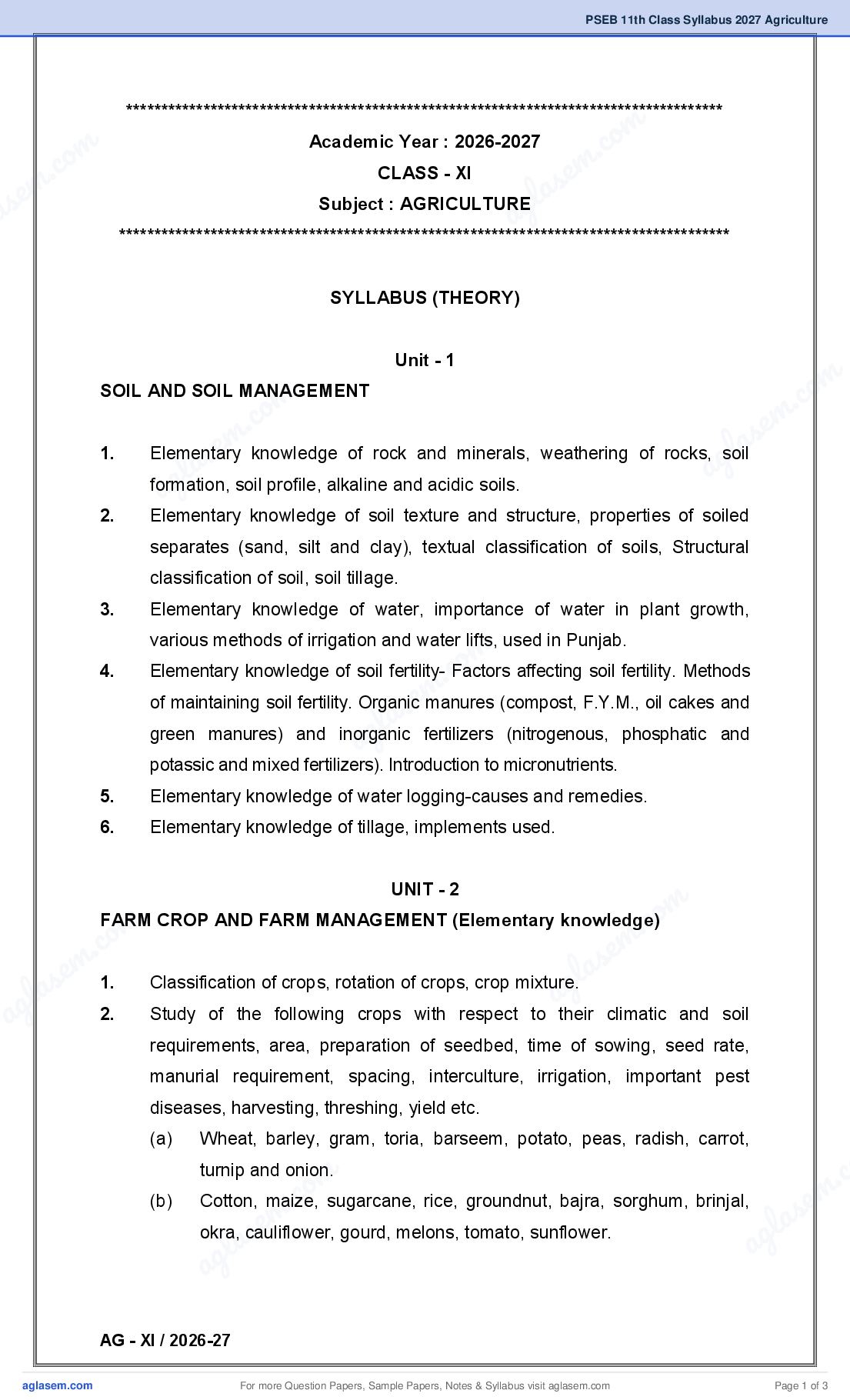
*************************************************************************************
m c. o
c. o m
Academic Year : 2026-2027
s e
em la
CLASS - XI
as Subject : AGRICULTURE
a g
***************************************************************************************
SYLLABUS (THEORY)
m
Unit - 1
SOIL AND SOIL MANAGEMENT
om . co
em l a s
1.
Elementary knowledge of rock and minerals, weathering of
a
rocks,
g
soil
ag soil profile, alkaline and acidic soils.
formation,
2. Elementary knowledge of soil texture and structure, properties of soiled
separates (sand, silt and clay), textual classification of soils, Structural
classification of soil, soil tillage.
3. Elementary knowledge of water, importance of water in plant growth,
m
c. o
various methods of irrigation and water lifts, used in Punjab.
m
4. Elementary knowledge of soil fertility- Factors affecting soil fertility. Methods
s e
a
l fertilizers (nitrogenous, phosphatic and
of maintaining soil fertility. Organic manures (compost, F.Y.M., oil cakes and
green manures) and inorganic
a g
potassic and mixed fertilizers). Introduction to micronutrients.
5. Elementary knowledge of water logging-causes and remedies.
6. Elementary knowledge of tillage, implements used.
m
UNIT - 2
m c. o
c. o m
FARM CROP AND FARM MANAGEMENT (Elementary knowledge)
s e
s em 1. Classification of crops, rotation of crops, crop mixture.gla
gla 2. Study of the following crops with respect to atheir climatic and soil
a
requirements, area, preparation of seedbed, time of sowing, seed rate,
manurial requirement, spacing, interculture, irrigation, important pest
diseases, harvesting, threshing, yield etc.
(a) Wheat, barley, gram, toria, barseem, potato, peas, radish, carrot,
o
turnip and onion.
m . c
.c sugarcane, rice, groundnut, bajra, sorghum, brinjal, sem
em gourd, melons, tomato, sunflower. a
(b) Cotton, maize,
s g l
la a
okra, cauliflower,
a g
For more Question Papers, Sample Papers, Notes & Syllabus visit Page 1 of 3
Page 3
layout of orchards: Cultivation of mango, guava, grapes, citrus, ber and
peaches, important pests and diseases of fruit and their control.
4. Common weeds of the Punjab and their control.
5. Farm Management-Study of farming as business, costs of farm operations
of major crops; sowing, intercultural, harvesting and threshing, cost and
income returns from major crops, simple farm records and accounts.
UNIT - 3
AGRICULTURE BIOLOGY – BOTANY
1. Biology-its definitions, comparison of living and non-living things, difference
between animals and plants.
2. Cell-structure and cell division in plants, simple tissues in plants.
3. Elements of plant classification including major groups with common examples.
4. Study of the forms, structure and functions of root, stem, leaf and flower.
5. Vegetative reproduction-natural and artificial.
6. Seed structure of gram, pea, maize and castor and germination of seed.
Conditions necessary for germination. Dispersal of seed.
7. Elementary study of bacteria and fungi and their economic importance.
UNIT - 4
AGRICULTURE BIOLOGY – ZOOLOGY
1. Study of animal cell-its structure and division of animals.
2. Study of simple tissues in animals.
3. Study of animal classification indicating major phyla with examples.
4. Protozoa-Study of Amoeba and Entamoeba.
5. Study of external characters of Liver fluke, Ascaris, Earthworm and their
economic importance.
6. Study of general characters of insects with specific reference to the study
of external characters of ak-grass hopper.
7. Study of external characters of frog, fish and rabbit.
8. Economic importance of mammals.
******************
For more Question Papers, Sample Papers, Notes & Syllabus visit Page 2 of 3
Page 4
SYLLABUS (PRACTICAL)
m c. o
c. o s e m
em 1. la
SOIL MANAGEMENT AND CROP CULTURE
as a g
Identification of soil by feel and touch method. Measurement of land.
2. Familiarity with farm implements and their handling, ploughing, preparation
of seed-bed, sowing and harvesting of major field crops and vegetables
and their harvesting.
3. Identification of common weeds, crops and their seed and fruit trees.
m
om
AGRICULTURE BIOLOGY
. co
m
PART-A
Generalsesurvey of plant kingdom, study of simple tissues of plant, structure
l a a g
andgform of root, stem, leaf and flower. Demonstration of grafting, layering,
a
budding, cutting,; Demonstration of studies of bacteria and fungi.
PART-B
1. General survey of animal kingdom.
2. Study of external characters of amoeba, liver fluke, ascaris, earthworm, ak-
m
co
grass, hopper, frog, fish and rabbit.
.
s em
l a
Note:
Students will do all the g
apractical work of the farm attached to the
school and record in the practical note book maintained for this
purpose.
*******************
m
m c. o
c. o s e m
s em la
gla ag
a
m . c
c. o s e m
sem g l a
la a
ag
For more Question Papers, Sample Papers, Notes & Syllabus visit Page 3 of 3