Odisha CPET 2021 Question Paper Biotech
Finished viewing? Save it for later —
Download Odisha CPET 2021 Question Paper Biotech (PDF · 9 pages)About Odisha CPET 2021 Question Paper Biotech
Odisha CPET 2021 Question Paper Biotech is available here for free download. Published by Odisha Exams for Odisha CPET, this question paper can be viewed online or downloaded as a PDF (9 pages). Candidates preparing for Odisha CPET can use Odisha CPET 2021 Question Paper Biotech to understand the exam pattern, the type of questions asked, and the overall difficulty level.
Frequently Asked Questions
How can I download Odisha CPET 2021 Question Paper Biotech?
Open this page and click the Download button to save Odisha CPET 2021 Question Paper Biotech as a PDF. It is completely free on AglaSem Docs.
Is Odisha CPET 2021 Question Paper Biotech free to download?
Yes. Odisha CPET 2021 Question Paper Biotech can be viewed online and downloaded as a PDF free of cost on AglaSem Docs.
How many pages does Odisha CPET 2021 Question Paper Biotech have?
Odisha CPET 2021 Question Paper Biotech contains 9 pages, which you can read online or download together as a single PDF.
Where can I find more Odisha CPET study material?
You can find more Odisha CPET question papers, sample papers, syllabus, and answer keys on AglaSem Docs.
Odisha CPET 2021 Question Paper Biotech – Text
Read the full text of this question paper below — useful to quickly search, copy and reference the content online without downloading the PDF.
📄 View text version (9 pages)
Page 1
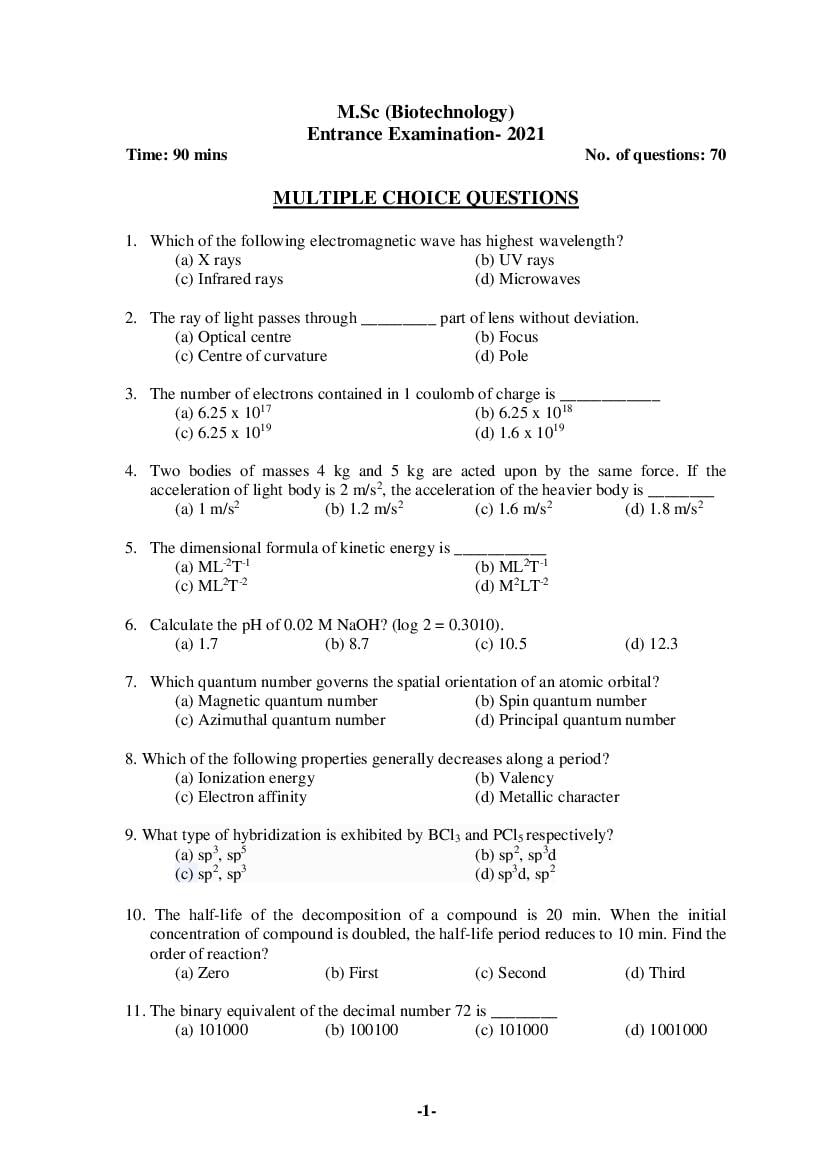
Entrance Examination- 2021
Time: 90 mins No. of questions: 70
MULTIPLE CHOICE QUESTIONS
1. Which of the following electromagnetic wave has highest wavelength?
(a) X rays (b) UV rays
(c) Infrared rays (d) Microwaves
2. The ray of light passes through _________ part of lens without deviation.
(a) Optical centre (b) Focus
(c) Centre of curvature (d) Pole
3. The number of electrons contained in 1 coulomb of charge is ____________
(a) 6.25 x 10¹⁷ (b) 6.25 x 10¹⁸
19
(c) 6.25 x 10 (d) 1.6 x 10¹⁹
4. Two bodies of masses 4 kg and 5 kg are acted upon by the same force. If the
acceleration of light body is 2 m/s2, the acceleration of the heavier body is ________
(a) 1 m/s2 (b) 1.2 m/s2 (c) 1.6 m/s2 (d) 1.8 m/s2
5. The dimensional formula of kinetic energy is ___________
(a) ML-2T-1 (b) ML2T-1
(c) ML2T-2 (d) M2LT-2
6. Calculate the pH of 0.02 M NaOH? (log 2 = 0.3010).
(a) 1.7 (b) 8.7 (c) 10.5 (d) 12.3
7. Which quantum number governs the spatial orientation of an atomic orbital?
(a) Magnetic quantum number (b) Spin quantum number
(c) Azimuthal quantum number (d) Principal quantum number
8. Which of the following properties generally decreases along a period?
(a) Ionization energy (b) Valency
(c) Electron affinity (d) Metallic character
9. What type of hybridization is exhibited by BCl3 and PCl5 respectively?
(a) sp3, sp5 (b) sp2, sp3d
(c) sp2, sp3 (d) sp3d, sp2
10. The half-life of the decomposition of a compound is 20 min. When the initial
concentration of compound is doubled, the half-life period reduces to 10 min. Find the
order of reaction?
(a) Zero (b) First (c) Second (d) Third
11. The binary equivalent of the decimal number 72 is ________
(a) 101000 (b) 100100 (c) 101000 (d) 1001000
-1-
Page 2
(a) 5 (b) 7 (c) 12 (d) 16
13. The 1st January of 2021 is Friday. What date 1st January 2023 will fall?
(a) Sunday (b) Tuesday (c) Thursday (d) Saturday
14. A train is moving at a speed of 132 km/hr. If the length of the train is 110 meters, how
long will it take to cross a railway platform of 165 meters long?
(a) 7 sec (b) 7.5 sec (c) 8 sec (d) 8.5 sec
15. The sum of three numbers is 98. If the ratio of the first and second is 2:3 and that of
the second to the third is 5:8. Find out the second number?
(a) 58 (b) 48 (c) 30 (d) 20
16. Which one of the following statement is correct?
(a) More is the degree of unsaturation in fat, more is the safonification number.
(b) Shorter the average chain length of fatty acids, higher is safonification number.
(c) Safonification number reveals the quantity of free fatty acid present in a fat.
(d) Safonification number is a measure of the number of –OH groups in the fat.
17. Which of the following glycosidic linkage is found in cellulose?
(a) Glucose (1→4) Glucose (b) Glucose (1→6) Glucose
(c) Glucose (1→4) Glucose (d) Glucose (1→6) Glucose
18. Which of the followings are known as helix breakers?
(a) Threonine (b) Proline and glycine
(c) Valine (d) Isoleucine and leucine
19. Which step of the TCA cycle is involved in the reduction of FAD?
(a) Isocitrate to Oxaloacetate (b) Succinyl CoA to Succinate
(c) Fumarate to Malate (d) Succinate to Fumarate
20. The non-competitive inhibitor of an enzyme catalyzed reaction …………..
(a) Increases Km and increases Vmax
(b) Increases Km and reduces Vmax
(c) Reduces Km and increases Vmax
(d) Reduces Km and reduces Vmax
21. The coenzymes FMN and FAD are derived from __________ vitamin.
(a) Vitamin C (b) Vitamin B1
(c) Vitamin B2 (d) Vitain B6
22. Methylated purines and pyrimidines are characteristically present in ________ .
(a) mRNA (b) hnRNA (c) rRNA (d) tRNA
23. In the conversion of lactic acid to glucose, three reactions of glycolyic pathway are
circumvented. Which of the following enzymes do not involved in the process?
(a) Phosphoenol pyruvate carboxykinase (b) Pyruvate carboxylase
(c) Pyruvate kinase (d) Glucose-6 phosphatase
-2-
Page 3
(a) 6-phosphogluconate decarboxylase (b) Glucolactone hydrolase
(c) 6-phosphogluconate dehydrogenase (d) Transaldolase
25. The common precursor molecule that involves in the biosynthesis of triacylglycerol
and phospholipids is ___________
(a) Glycerol 3-phosphate (b) 1-acylglycerol 3-phosphate
(c) Dihydroxyacetone phosphate (d) 1,2-diacylglycerol phosphate
26. Which one of the following compound does not act as second messenger during
signaling process?
(a) Triacylglycerol (b) cAMP
(c) Diacylglycerol (d) cGMP
27. Which of the following cases, the first base of the anticodon pairs with three codons?.
(a) When the 1st base of the anticodon is A or C.
(b) When the 1st base of the anticodon is A or G.
(c) When the 1st base of the anticodon is G or U.
(d) When the 1st base of the anticodon is Inosine.
28. Which of the following is not the component of rRNA present in eukaryotes?
(a) 5S rRNA (b) 16S rRNA
(c) 18S rRNA (d) 28S rRNA
29. Which of the following transcription termination technique involves RNA dependent
ATPase activity?
(a) Rho dependent (b) Intercalating agents
(c) Rho independent (d) Rifampicin
30. Which segments of the attenuator together form repression loop in trytophan operon?
(a) Segment 1-2 (b) Segment 2-3
(c) Segment 2-4 (d) Segment 1-4
31. A bacterial population increases from 103 to 109 cells in 10 hours. Calculate the
number of generations per hour?
(a) 20 (b) 10 (c) 4 (d) 2
32. Which of the following antibiotics inhibit protein synthesis by binding with the 50S
subunit of ribosome?
(a) Chloramphenicol (b) Streptomycin
(c) Tetracyclin (d) Penicillin
33. Which of the following statement is INCORRECT for Archaebacteria?
(a) The Cell wall is not made up of peptidoglycan
(b) The cell membrane have branched chain hydrocarbons
(c) The cell wall has both D- and L- form of amino acids
(d) The first amino acid to initiate polypeptide chain is methionine
34. Which of the following viruse replicate in the cytoplasm?
(a) SV40 (b) Adenovirus (c) Herpes simplex virus (d) Vaccinia virus
-3-
Page 4
Column-1 Column-2
i. Corynebacterium diphtheriae a. Blocks release of acetylcholine
ii. Clostridium tatani b. Binds to class-II MHC molecule
iii. Clostridium botulinum c. Inactivates EF-2 by ADP ribosylation
iv. Staphylococcus aureus d. Blocks release of inhibitory neurotransmitter
glycine
(a) i-c, ii-d, iii-a, iv-b (b) i-d, ii-c, iii-a, iv-b
(c) i-b, ii-c, iii-a, iv-d (d) i-c, ii-b, iii-a, iv-d
36. People with Klinefelter syndrome have 47 chromosomes including three sex
chromosomes (XXY). What is the term to describe the aberration that occurs dring
meiosis that results in abnormal chromosome number?
(a) Crossing over
(b) Non-disjunction
(c) Pairing of homologous chromosome
(d) Independent assortment
37. If individuals of genotype AaBbCc are intercrossed, how many different F2
phenotypes can appear assuming complete co-dominance at all loci?
(a) 8 (b) 9 (c) 27 (d) 64
38. The deviation from the Hardy-Weinberg assumption of infinitely large population size
results in ___________
(a) Genetic lethal (b) Heterozygote advantage
(c) Consangunity (d) Genetic drift
39. Down’s syndrome is caused by presence of a third copy of chromosome 21 associated
with chromosome 21 pair. The genetic condition is known as trisomy 21, which is
caused by ____________
(a) Frame-shift mutation (b) Chromosome nondisjunction
(b) Fragile X syndrome (d) Chromosome translocation
40. A plant of genotype AB/ab is test crossed with ab/ab. If the two loci are 10 map units
apart, what proportion of progeny will be AB/ab?
(a) 5% (b) 10% (c) 20% (d) 45%
41. Which of the following is not a function of rough endoplasmic reticuum?
(a) N-linked glycosylation of proteins (b) Folding of polypeptide chains
(c) O-linked glycosylation of proteins (d) Specific proteolytic cleavage
42. Which of the following is the marker enzyme for Golgi apparatus?
(a) Acetyl-CoA synthetase (b) Galactosyl transferase
(c) Pyruvate kinase (d) Cytochrome oxidase
43. If the number of bivalents are 10 in Prophase-I, what is the number of chromosomes
during Anaphase-II?
(a) 10 (b) 20 (c) 30 (d) 40
-4-
Page 5
(a) phosphorylation of mitotic cyclins by Cdks
(b) transient increase in the cytosolic GTP concentration
(c) activation of mitotic Cdk-cyclins through the phosphatase activity
(d) phosphorylation of Cdks located inside catalytic site of Cdk-cyclin complex
45. Which of the following is associated with the hyperpolarization of cell membrane?
(a) Activation of voltage-gated K+ channels
(b) Activation of the Na+ leaky channel
(c) Activation of Ca2+ voltage gated channel
(d) Activation of voltage-gated Na+ channel
46. Which of the following disease is not an autoimmune disease?
(a) Rheumatoid arthritis (b) Lupus erythematosus
(c) Bovine spongiform encephalitis (d) Grave’s disease
47. Which of the following is not true for T-cell receptor (TCR)?
(a) TCRs are not antigen specific.
(b) TCR is membrane bound.
(c) TCR does not appear in a soluble form as B-cell receptor does.
(d) TCRs are specific for antigen combined with molecules encoded by MHC.
48. Which of the following statements about complements are correct?
P. Classical pathway is initiated by IgM and certain IgG subclasses of antibodies.
Q. Alternative and lectin pathways are antibody independent.
R. The complement system mediates opsonization of bacteria.
S. Nucleated cells are more resistant to complement mediated lysis than RBCs
(a) P and Q (b) Q and S
(c) P, Q and R (d) P, Q, R and S
49. Choose the mismatch.
(a) IgG: the most abundant type in serum
(b) IgA: Major antibody in secretions such as saliva, tears and breast milk
(c) IgD: Protects against pathogens invading through gut mucosa
(d) IgE: least abundant and play important role in hypersisitivity
50. Which statements are correct about the cell mediated immune response?
P. It is dependent upon the humoral response.
Q. It is usually used to respond to virus-infected cells.
R. It involves direct recognition of the antigen by killer T-cells.
S. It requires that the antigen be presented to killer T-cells by an MHC protein.
(a) P and S (b) Q and S
(c) P, Q and S (d) P, Q, R and S
51. Which of the following rule is not considered to design primers for PCR?
(a) Tm of both primers
(b) Length of primers
(c) A+G content of both the primers
(d) Complementarity between the primers
-5-
Page 6
The number of bands visible by (i) reducing SDS-PAGE, (ii) isoelectric focusing and
(iii) native PAGE are _____________ respectively.
(a) i-2, ii-1 and iii-1 (b) i-2, ii-2 and iii-2
(c) i-4, ii-1 and iii-1 (d) i-4, ii-2 and iii-2
53. The absorbance of a solution X of concentration 0.005 mg/ml is found to be 0.49 at
540 nm using 1 cm cuvette. What is the absorbance, if the solution X is diluted twice
and the measurement is taken in 5 cm cuvette?
(a) 0.049 (b) 0.098 (c) 0.245 (d) 1.225
54. Which chromatographic technique is not suited for protein separation, because the
proteins get denatured by it?
(a) Ion exchange chromatography (b) Affinity chromatography
(c) Reverse phase chromatography (d) Size exclusion chromatography
55. Which of the microscopy techniques relies on the specimen interfering with the
wavelength of light to produce a high contrast image without the need of dyes or any
damage to the sample?
(a) Electron microscopy (b) Phase contrast microscopy
(c) Bright field light microscopy (d) Fluorescence microscopy
56. Mean haemoglobin level of 100 persons was estimated to be 100 gm% with standard
deviation of 1 gm%. Calculate the standard error?
(a) 0.1 gm% (b) 1 gm%
(c) 10 gm% (d) 100 gm%
57. The mean weight of 100 children was 12 kg with standard deviation of 3 kg. Calculate
the percent coefficient of variation?
(a) 25% (b) 35% (c) 45% (d) 60%
58. Poisson distribution is applied for _________.
(a) Regular random variable (b) Discrete random variable
(c) Irregular random variable (d) Constant time function
59. Calculate the variance of the given dataset: 4, 7, 6, 3, 7 and 3?
(a) 2 (b) 4 (c) 6 (d) 8
60. A dice is tossed 5 times. What is the probability of getting exactly 2 Four?
(a) 0.028 (b) 0.161 (c) 0.167 (d) 0.333
61. To code 50 amino acids in a polypeptide chain, what will be the minimum number of
nucleotides in its cistron?
(a) 50 (b) 153 (c) 300 (d) 306
62. Choose the mismatch.
(a) Phagemid Part of M13 genome with plasmid DNA
(b) P1-derived artificial chromosome Combined features of P1 vector & BACs
(c) Shuttle vector Yeast episomal plasmids
(d) Ti plasmid Agrobacterium rhizogenes
-6-
Page 7
performed for 10 cycles. How many molecules of amplicons will be generated?
(a) 1.024 x 10⁴ (b) 1.024 x 10⁵
(c) 2.024 x 10⁴ (d) 2.024 x 10⁵
64. Which of the following role does opines play in Crown gall disease?
(a) Source of carbon, nitrogen and energy for Agrobacterium
(b) Transfer of T-DNA to plant cells
(c) Attachment of Agrobacterium to the plants
(d) Induction of expression of vir genes
65. Genetically engineered male sterile crop plants may be produced by inserting _____
(a) BT toxin gene (b) barnase gene
(c) lectin gene (d) chitinase gene
66. The genes required to transfer rice plant into ‘Golden rice’ were obtained from _____
(a) Carrot and Cotton (b) Daffodil and E.coli bacterium
(c) Sunflower and Cotton (d) Daffodil and Erwinia bacterium
67. Match the columns.
Column-1 Column-2
(i) Cyanogen bromide (a) Carboxyl side of aromatic amino acids
(ii) Trypsin (b) Asparagine-glycine bonds
(iii) Chymotrypsin (c) Carboxyl side of lysine and arginine
(iv) Hydroxylamine (d) Carboxyl side of methonine
(v) 2-Nitro-5-thiocyanobenzoate (e) Amino side of cysteine
(a) i-c, ii-d, iii-a, iv-e, v-b (b) i-d, ii-c, iii-a, iv-b, v-e
(c) i-b, ii-c, iii-a, iv-e, v-d (d) i-c, ii-b, iii-a, iv-d, v-e
68. The protein binding regions of DNA are identified by __________ .
(a) DNA fingerprinting (b) Southern blotting
(c) DNA foot printing (d) Northern blotting
69. Which of the following reporter gene expression does not require addition of specific
substrate for detection?
(a) Luciferase (b) -Glucuronidase
(c) Green fluorescent protein (d) -Glucosidase
70. Choose the mismatch.
(a) Jacob’s syndrome 44 + XYY
(b) Turner’s syndrome 44 + XO
(c) Huntington’s chorea 44 + XXXY
(d) Down’s syndrome 2N + 1
********
-7-
Page 8
-8-
Page 9
Document Details
| Board / Org | Odisha Exams |
| Exam | Odisha CPET |
| Type | Question Paper |
| Pages | 9 |
| Updated | 22 Jul 2026 |