TN 12th Model Question Paper Economics
Finished viewing? Save it for later —
Download TN 12th Model Question Paper Economics (PDF · 12 pages)About TN 12th Model Question Paper Economics
TN 12th Model Question Paper Economics is available here for free download. Published by Tamil Nadu Board for Class 12, this sample paper can be viewed online or downloaded as a PDF (12 pages). Candidates preparing for Class 12 can use TN 12th Model Question Paper Economics to understand the exam pattern, the type of questions asked, and the overall difficulty level.
Frequently Asked Questions
How can I download TN 12th Model Question Paper Economics?
Open this page and click the Download button to save TN 12th Model Question Paper Economics as a PDF. It is completely free on AglaSem Docs.
Is TN 12th Model Question Paper Economics free to download?
Yes. TN 12th Model Question Paper Economics can be viewed online and downloaded as a PDF free of cost on AglaSem Docs.
How many pages does TN 12th Model Question Paper Economics have?
TN 12th Model Question Paper Economics contains 12 pages, which you can read online or download together as a single PDF.
Where can I find more Class 12 study material?
You can find more Class 12 question papers, sample papers, syllabus, and answer keys on AglaSem Docs.
TN 12th Model Question Paper Economics – Text
Read the full text of this sample paper below — useful to quickly search, copy and reference the content online without downloading the PDF.
📄 View text version (12 pages)
Page 1
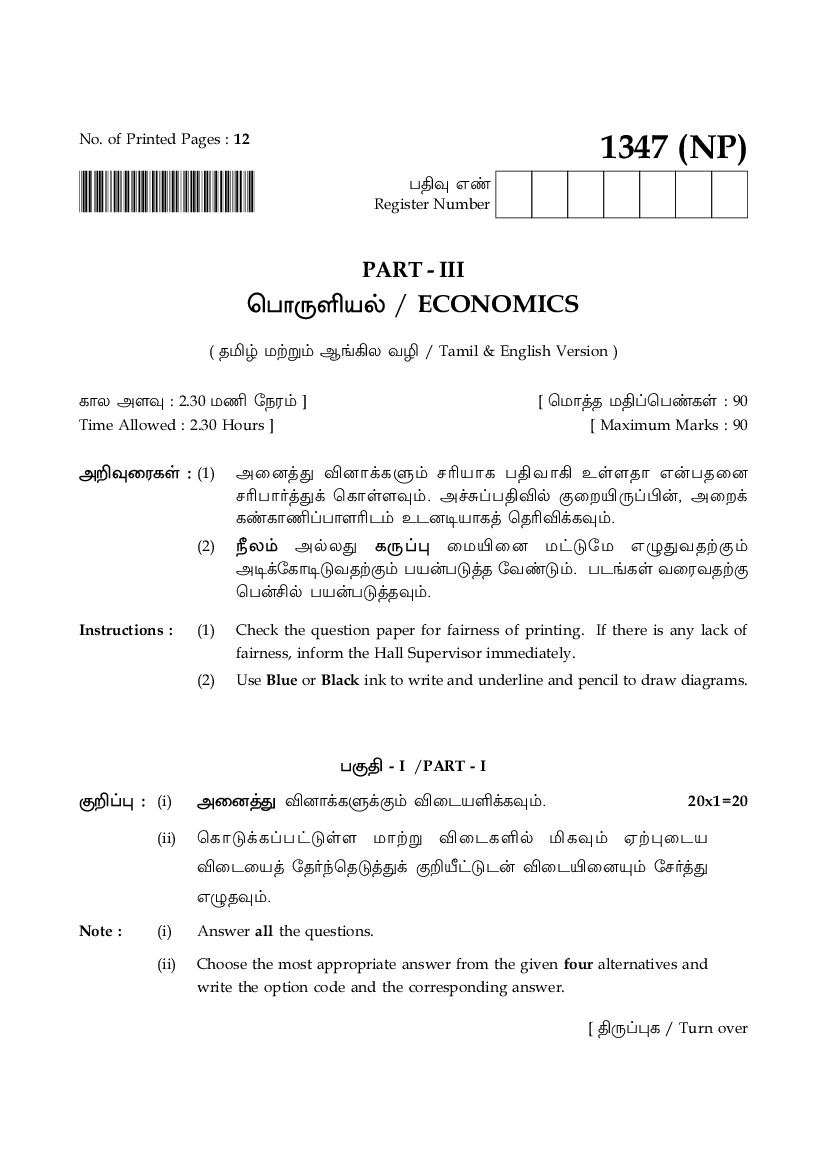
1347 (NP)
!1347NPEconomics! £vÄ Gs
Register Number
PART - III
ö£õ¸Î¯À / ECONOMICS
( uªÌ ©ØÖ® B[Q» ÁÈ / Tamil & English Version )
Põ» AÍÄ : 2.30 ©o ÷|µ® ] [ ö©õzu ©v¨ö£sPÒ : 90
Time Allowed : 2.30 Hours ] [ Maximum Marks : 90
AÔÄøµPÒ : (1) AøÚzx ÂÚõUPЮ \›¯õP £vÁõQ EÒÍuõ GߣuøÚ
\›£õºzxU öPõÒÍÄ®. Aa_¨£vÂÀ SøÓ°¸¨¤ß, AøÓU
PsPõo¨£õÍ›h® EhÚi¯õPz öu›ÂUPÄ®.
(2) }»® AÀ»x P¸¨¦ ø©°øÚ ©mk÷© GÊxÁuØS®
AiU÷PõikÁuØS® £¯ß£kzu ÷Ásk®. £h[PÒ ÁøµÁuØS
ö£ß]À £¯ß£kzuÄ®.
Instructions : (1) Check the question paper for fairness of printing. If there is any lack of
fairness, inform the Hall Supervisor immediately.
(2) Use Blue or Black ink to write and underline and pencil to draw diagrams.
£Sv - I /PART - I
SÔ¨¦ : (i) AøÚzx ÂÚõUPÐUS® Âøh¯ÎUPÄ®. 20x1=20
(ii) öPõkUP¨£mkÒÍ ©õØÖ ÂøhPÎÀ ªPÄ® Hئøh¯
Âøhø¯z ÷uº¢öukzxU SÔ±mkhß Âøh°øÚ²® ÷\ºzx
GÊuÄ®.
Note : (i) Answer all the questions.
(ii) Choose the most appropriate answer from the given four alternatives and
write the option code and the corresponding answer.
[ v¸¨¦P / Turn over
Page 2
1. Qh¨£¸ø© C»UPnzvß B]›¯º :
(A) BÀL¤µm ©õºåÀ (B) C»¯ÚÀ µõ¤ßì
(C) Bh® ìªz (D) \õ•÷ÁÀ\ß
The author of scarcity definition is :
(a) Alfred Marshall (b) Lionel Robbins
(c) Adam Smith (d) Samuelson
2. £Çø©¨ ö£õ¸Íõuõµ® Gߣx :
(A) Pmhøͨ ö£õ¸Íõuõµ® (B) £n¯À ö£õ¸Íõuõµ®
(C) ußÛøÓĨ ö£õ¸Íõuõµ® (D) \¢øu¨ ö£õ¸Íõuõµ®
Traditional economy is a :
(a) Command economy (b) Monetary economy
(c) Subsistence economy (d) Market economy
3. CßÔ¯ø©¯õu, Á\v, Bh®£µ £sh[PÒ Gߣx :
(A) £¯ß£õmiøÚ ¤›¨£x
(B) ÷uøÁø¯¨ ¤›¨£x
(C) C»Á\ £sh[PøÍ ÁøP¨£kzxÁx
(D) ¸¨£[PøÍ ÁøP¨£kzxÁx
Necessaries, comforts and luxuries are :
(a) Classification of utility
(b) Classification of demand
(c) Classification of free goods and services
(d) Classification of wants
4. ~Pº÷Áõº Ga\® Gߣx :
(A) ÷uøÁ=AΨ¦ (B) ÷uøÁ > AΨ¦
(C) uSv Âø»−Esø© Âø» (D) MVn=TVn− TVn−1
Consumer surplus is :
(a) Demand=Supply (b) Demand > Supply
(c) Potential Price−Actual Price (d) MVn=TVn−TVn−1
Page 3
5. CÖv {ø» £¯ß£õk §ä⯩õS® ÷£õx :
(A) ö©õzu¨ £¯ß£õk AvP›UPz öuõh[SQÓx
(B) ö©õzu¨ £¯ß£õk SøÓ¯z öuõh[SQÓx
(C) ö©õzu¨ £¯ß£õk ªP SøÓ¢u AÍøÁ GmkQÓx
(D) ö©õzu¨ £¯ß£õk Ea\ AÍøÁ GmkQÓx
When marginal utility becomes Zero :
(a) The total utility starts increasing
(b) The total utility starts decreasing
(c) The total utility reaches the minimum
(d) The total utility reaches the maximum
6. ÷uøÁ°ß AvP›¨ø£ Cuß ‰»® Põn»õ® :
(A) ÷uøÁ ÁøÍ÷Põmiß Ea\ ¦ÒÎ
(B) ÷uøÁ ÁøÍ÷Põmiß RÌ ¦ÒÎ
(C) ÷uøÁ ÁøÍ÷Põk Ch® ö£¯ºÁx
(D) J÷µ ÷uøÁ ÁøÍ÷PõmiÀ |Pº¢x ö\À¾uÀ
Increase in demand is shown by :
(a) The highest point on the demand curve
(b) The lowest point on the demand curve
(c) Shifts of the demand curve
(d) Movement along the same demand curve
7. SÖUSz ÷uøÁ ö|QÌa] Gvº©øÓ GsnõP C¸¢uõÀ :
(A) X £sh•® Y £sh•® £v½mk¨ £sh[PÒ
(B) X £sh•® Y £sh•® {øÓÁõÚ £v¼PÒ
(C) X £sh•® Y £sh•® EÓÁØÓøÁ
(D) X £sh•® Y £sh•® EhÝÖ¨ £sh[PÒ
When cross elasticity of demand is negative :
(a) X and Y goods are substitutes
(b) X and Y goods are perfect substitutes
(c) X and Y goods are not related
(d) X and Y goods are complementary
[ v¸¨¦P / Turn over
Page 4
8. \©{ø» ¦ÒΰÀ :
(A) Âø» {ø»¯õÚx
(B) ÷uøÁ²® AΨ¦® \©®
(C) A¨¦ÒΰÀ ÷uøÁU÷Põk AΨ¦U ÷Põmøh öÁmk®
(D) ÷©ØTÔ¯ AøÚzx®
At the point of equilibrium :
(a) Only one price prevails
(b) Quantity demanded=Quantity supplied
(c) The demand curve intersects the supply curve
(d) All the above
9. Eأzv Gߣx :
(A) ©õØÖ ©v¨¦ (B) öuõÈÀ~m£®
(C) £¯ß£õmiß AÈÄ (D) £¯ß£õmøh E¸ÁõUSuÀ
Production refers to :
(a) Exchange value (b) Technology
(c) Destruction of utility (d) Creation of utility
10. öÁØÔPµ©õÚ öuõÈÀ •øÚ÷Áõº GߣÁº :
(A) £À÷ÁÖ EØ£zv P»øÁPøÍ wº©õÛ¨£Áº
(B) SøÓ¢u T¼ø¯ ÁÇ[S£Áº
(C) ¦øÚuø» £¯ß£kzx£Áº
(D) Chº uõ[Pø» ©Ö¨£Áº
A successful entrepreneur is one who :
(a) Decides different combinations of factors of production
(b) Pays the lowest wage
(c) Accepts innovations
(d) Avoids risks
Page 5
11. \µõ\› ©õÓõa ö\»Ä CuÚõÀ ÁSUS®÷£õx QøhUS® :
(A) TVC/Q (B) AC/Q (C) TC /Q (D) TFC/Q
Average fixed cost is obtained by dividing :
(a) TVC/Q (b) AC/Q (c) TC/Q (d) TFC/Q
12. __________ vmh ÁøÍ÷Põk GÚ AøÇUP¨£kQÓx.
(A) }shPõ»a ö\»ÄU ÷Põk (B) SÖQ¯Põ»a ö\»ÄU ÷Põk
(C) \µõ\› ö\»ÄU ÷Põk (D) CÖv{ø»a ö\»ÄU ÷Põk
__________ is called the planning curve.
(a) Long run average cost curve (b) Short run average cost curve
(c) Average cost curve (d) Marginal cost curve
13. G¢u {ø»°À J¸ {ÖÁÚ® \©{ø»¨ ö£Ö® :
(A) MR=AR (B) MR=AC (C) MC=MR (D) MC=AC
A firm can achieve equilibrium when its :
(a) MR=AR (b) MR=AC (c) MC=MR (d) MC=AC
14. {øÓĨ ÷£õmi°À ÷uøÁU÷Põk CÆÁõÖ C¸US® :
(A) RÌ÷|õUQ \›¢x ö\À¾® (B) ö\[SzuõP C¸US®
(C) ÷©À÷|õUQ \›¢x ö\À¾® (D) Qøh©mh©õP C¸US®
Under perfect competition, the demand curve is :
(a) Downward sloping (b) Vertical
(c) Upward sloping (d) Horizontal
[ v¸¨¦P / Turn over
Page 6
15. £sh ÷ÁÖ£õk __________ ß ]Ó¨¦ C¯À£õS®.
(A) •ØÖ›ø©¯õͺ ÷£õmi (B) C¸Áº •ØÖ›ø©
(C) {øÓĨ ÷£õmi (D) •ØÖ›ø©
Product differentiation is the salient feature of :
(a) Monopolistic competition (b) Duopoly
(c) Perfect competition (d) Monopoly
16. ÷£›¯À ö£õ¸Íõuõµzvß ø©¯¨ ¤µa\øÚ :
(A) Ámi²® £n•®
(B) £nUöPõÒøP ©ØÖ® {vUöPõÒøP
(C) Á¸©õÚ•® ÷Áø» Áõ´¨¦®
(D) Âø»²® öÁαk®
The central problem of Macro Economics is :
(a) Interest and Money
(b) Monetary Policy and Fiscal Policy
(c) Income and Employment
(d) Price and Output
17. Á¸©õÚ {ºn¯® £ØÔ¯ Gί ÷Põm£õmøh ÂÍUP Rß_ __________
£¯ß£kzvÚõº.
(A) EØ£zvø¯²® ö\»øÁ²®
(B) ö£¸UQø¯²® ©ØÖ® •kUQø¯²®
(C) ~PºøÁ²® •u½møh²®
(D) Jmkö©õzu ÷uøÁ²® Jmk ö©õzu AΨ¦®
To explain the simple theory of income determination, Keynes used ________.
(a) Production and Expenditure
(b) Multiplier and accelerator
(c) Consumption and investment
(d) Aggregate demand and aggregate supply
Page 7
18. ~PºÄ \õº¦, __________ ©ØÖ® __________ BQ¯ CµskUS® Cøh÷¯¯õÚ
öuõhºø£ ÂÍUSQÓx.
(A) Á¸©õÚ®, ÷\ª¨¦ (B) ö\»Ä, •u½k
(C) ~PºÄ, Á¸©õÚ® (D) ö\»Ä, ÷\ª¨¦
Consumption function explains the relationship between _________ and _________.
(a) Income, Savings (b) Expenditure, Investment
(c) Consumption, Income (d) Expenditure, Savings
19. £nU öPõÒøPø¯ A©À£kzxÁx :
(A) ø©¯ Á[Q (B) uÛ¯õº xøÓ
(C) ø©¯ Aµ_ (D) ©õ{» Aµ_
Monetary policy is controlled by :
(a) Central Bank (b) Private Sector
(c) Central Government (d) State Government
20. §ä⯠{v {ø» AÔUøP°À JÆöÁõ¸ Bsk® J¸ __________ BP
HØÖUöPõÒͨ£kQÓx.
(A) ¦v¯ Bsk (B) PÀ¯õsk
(C) Ai¨£øh Bsk (D) {v¯õsk
In zero based budget every year is considered as a :
(a) New year (b) Academic year
(c) Base year (d) Financial year
[ v¸¨¦P / Turn over
Page 8
£Sv & II / PART - II
H÷uÝ® HÊ ÂÚõUPÐUS Âøh¯ÎUPÄ®. AÁØÔÀ ÂÚõ Gs 30 &ØS
Pmhõ¯©õP Âøh¯ÎUPÄ®. 7x2=14
Answer any seven questions and question number 30 is compulsory.
21. ö£õ¸Íõuõµ® £ØÔ BÀ¤µm ©õºå¼ß C»UPn® ¯õx ?
State Alfred Marshall’s definition of Economics.
22. ¸¨£[PÐUPõÚ Põµn[PÒ ¯õøÁ ?
What are the causes of wants ?
23. ÷uøÁ ö|QÌa]°ß ÁøPPÒ ¯õøÁ ?
What are the types of elasticity of demand ?
24. \©•ÔĨ ¦ÒÎ GßÓõÀ GßÚ ?
What is break even point ?
25. Âø» ÷£uzvß Cµsk {£¢uøÚPÒ ¯õøÁ ?
What are the two conditions for price discrimination ?
26. ©õØÖ Fv¯® Gߣx ¯õx ?
What is transfer earnings ?
27. ÷£õ¼ Áõµ® GßÓõÀ GßÚ ?
What is quasi-rent ?
Page 9
28. CÖv {ø» ~PºÄ |õmhzvØS `zvµ® u¸P.
Give the formula for Marginal Propensity to Consume.
29. Phß AÍÄU ÷Põm£õmiß P¸ÂPÒ ¯õøÁ ?
What are the instruments of quantitative credit control ?
30. ÷£µõ]›¯º ö\¼U÷©Ûß Á› & C»UPnzvøÚU TÖP.
State the Definition of a tax According to Prof. Seligman.
£Sv & III / PART - III
H÷uÝ® HÊ ÂÚõUPÐUS Âøh¯ÎUPÄ®. ÂÚõ Gs 40 &ØS
Pmhõ¯©õP Âøh¯ÎUPÄ®. 7x3=21
Answer any seven questions and question number 40 is compulsory.
31. Bh® ìªzvß ö\ÀÁ C»UPnzøu¨ £ØÔ¯ SøÓ£õkPøÍ Bµõ´P.
Examine the criticisms against Adam Smith’s wealth definition.
32. P»¨¦ ö£õ¸Íõuõµzvß |ßø©PøÍ ÂÍUSP.
Explain the merits of a mixed economy.
33. EØ£zv Áõ´¨¦ ÁøÍ÷Põk SÔ¨¤kÁx GßÚ ?
What does a production possibility curve refer ?
34. QL£ß ¦vøµ¨ £ØÔ ]Ö SÔ¨¦ ÁøµP.
Write a short-note on Giffen Paradox.
[ v¸¨¦P / Turn over
Page 10
35. A[Põi Põ»zvÀ \©{ø» Âø» GÆÁõÖ wº©õÛUP¨£kQÓx ?
How is equilibrium price determined in the market period ?
36. öuõÈÀ •øÚ÷Áõ›ß £oPÒ ¯õøÁ ?
What are the functions of entrepreneur ?
37. •ØÖ›ø©ø¯ Pmk¨£kzx® ÁÈ•øÓPÒ ¯õøÁ ?
What are the methods of controlling monopoly ?
38. CÖv {ø» EØ£zvz vÓß £QºÄU ÷Põm£õmiß SøÓ£õkPÒ ¯õøÁ ?
What are the limitations of Marginal Productivity Theory of Distribution ?
39. Rß]ß Á¸©õÚ {ºn¯® £ØÔ¯ Gί ÷Põm£õmiß Gk÷PõÒPøÍ
ÂÍUSP.
What are the assumptions of Keynesian theory of Simple Income Determination ?
40. £sh©õØÖ •øÓ°À EÒÍ ¤µa\øÚPøÍ ÂÍUSP.
Explain the difficulties of barter system.
£Sv & IV / PART - IV
AøÚzx ÂÚõUPÐUS® Âøh¯ÎUPÄ®. 7x5=35
Answer all the questions.
41. (A) \©uº©zvß £s¦PøͲ®, Auß ]Ó¨¦PÎÀ GøÁ÷¯Ý®
|õßQøÚ²® ÂÍUSP.
AÀ»x
(B) SøÓ¢x ö\À £¯ß£õk Âv°øÚ £h® Áøµ¢x ÂÍUP® u¸P.
(a) Explain the features and any four merits of socialism.
OR
(b) Describe the Law of Diminishing Marginal Utility with a diagram.
Page 11
42. (A) \©÷|õUS ÁøÍ÷Põmk B´Âß Gk÷PõÒPÒ ¯õøÁ ? \©÷|õUS
ÁøÍ÷Põk ÁȯõP ~Pº÷Áõº \©{ø»ø¯ ÂÍUSP.
AÀ»x
(B) Âø»z ÷uøÁ ö|QÌa]°ß ¦ÒÎ •øÓ°À AÍÂkÁøu ›ÁõP
GÊxP.
(a) What are the assumptions of indifference curve analysis ? Explain consumer’s
equilibrium using indifference curve approach.
OR
(b) Explain the point method of measurement of price elasticity of demand in detail.
43. (A) ÷uøÁ Âvø¯U TÖP. ÷uøÁ Âv°ß Âv»USPÒ ¯õøÁ ?
AÀ»x
(B) \©{ø» Âø» GÆÁõÖ wº©õÛUP¨£kQÓx Gߣøu Áøµ£hzxhß
ÂÍUSP.
(a) State the law of demand. What are the exceptions to the law of demand ?
OR
(b) Explain the determination of equilibrium price with a diagram.
44. (A) \©AÍÄ EØ£zvU ÷PõkPÒ GßÓõÀ GßÚ ? Auß C¯À¦PøÍ
ÂÍUSP.
AÀ»x
(B) J¸ {ÖÁÚ® ÷©ØöPõÒЮ £À÷ÁÖ ö\»ÄPøÍ ÂÍUSP.
(a) What are isoquants ? Describe their characteristics.
OR
(b) Explain various costs incurred by a firm.
[ v¸¨¦P / Turn over
Page 12
45. (A) SÖQ¯ Põ»zvÀ, {øÓĨ ÷£õmi°À Âø» ©ØÖ® £shzvß AÍÄ
GÆÁõÖ {ºn°UP¨£kQßÓÚ ?
AÀ»x
(B) •ØÖ›ø©¨ ÷£õmi°À Âø» ©ØÖ® £sh[PÒ AÍÄ GÆÁõÖ
wº©õÛUP¨£kQÓx Gߣøu ÂÍUSP.
(a) How is price and output determined in the short-run under perfect
competition ?
OR
(b) Explain the price and output determination under monopolistic competition.
46. (A) ›UPõº÷hõÂß ÁõµU÷Põm£õmiøÚ Bµõ´P.
AÀ»x
(B) J.B. ÷\°ß A[Põi Âv°øÚ vÓÚõ´P.
(a) Examine Ricardian theory of RENT.
OR
(b) Critically examine J.B. Say’s Law of Markets.
47. (A) £n AÍÃmkU ÷Põm£õmøh ÂÁ›UPÄ®.
AÀ»x
(B) {vUöPõÒøP°ß ÷|õUP[PÒ GøÁ÷¯Ý® I¢vøÚ ÂÁ›UP.
(a) Describe the quantity theory of money.
OR
(b) Explain any five of the objectives of fiscal policy.
-oOo-
Document Details
| Board / Org | Tamil Nadu Board |
| Exam | Class 12 |
| Type | Sample Paper |
| Pages | 12 |
| Updated | 09 Jun 2026 |