Odisha CPET 2021 Question Paper Anthropology (Science)
Finished viewing? Save it for later —
Download Odisha CPET 2021 Question Paper Anthropology (Science) (PDF · 11 pages)About Odisha CPET 2021 Question Paper Anthropology (Science)
Odisha CPET 2021 Question Paper Anthropology (Science) is available here for free download. Published by Odisha Exams for Odisha CPET, this question paper can be viewed online or downloaded as a PDF (11 pages). Candidates preparing for Odisha CPET can use Odisha CPET 2021 Question Paper Anthropology (Science) to understand the exam pattern, the type of questions asked, and the overall difficulty level.
Frequently Asked Questions
How can I download Odisha CPET 2021 Question Paper Anthropology (Science)?
Open this page and click the Download button to save Odisha CPET 2021 Question Paper Anthropology (Science) as a PDF. It is completely free on AglaSem Docs.
Is Odisha CPET 2021 Question Paper Anthropology (Science) free to download?
Yes. Odisha CPET 2021 Question Paper Anthropology (Science) can be viewed online and downloaded as a PDF free of cost on AglaSem Docs.
How many pages does Odisha CPET 2021 Question Paper Anthropology (Science) have?
Odisha CPET 2021 Question Paper Anthropology (Science) contains 11 pages, which you can read online or download together as a single PDF.
Where can I find more Odisha CPET study material?
You can find more Odisha CPET question papers, sample papers, syllabus, and answer keys on AglaSem Docs.
Odisha CPET 2021 Question Paper Anthropology (Science) – Text
Read the full text of this question paper below — useful to quickly search, copy and reference the content online without downloading the PDF.
📄 View text version (11 pages)
Page 1
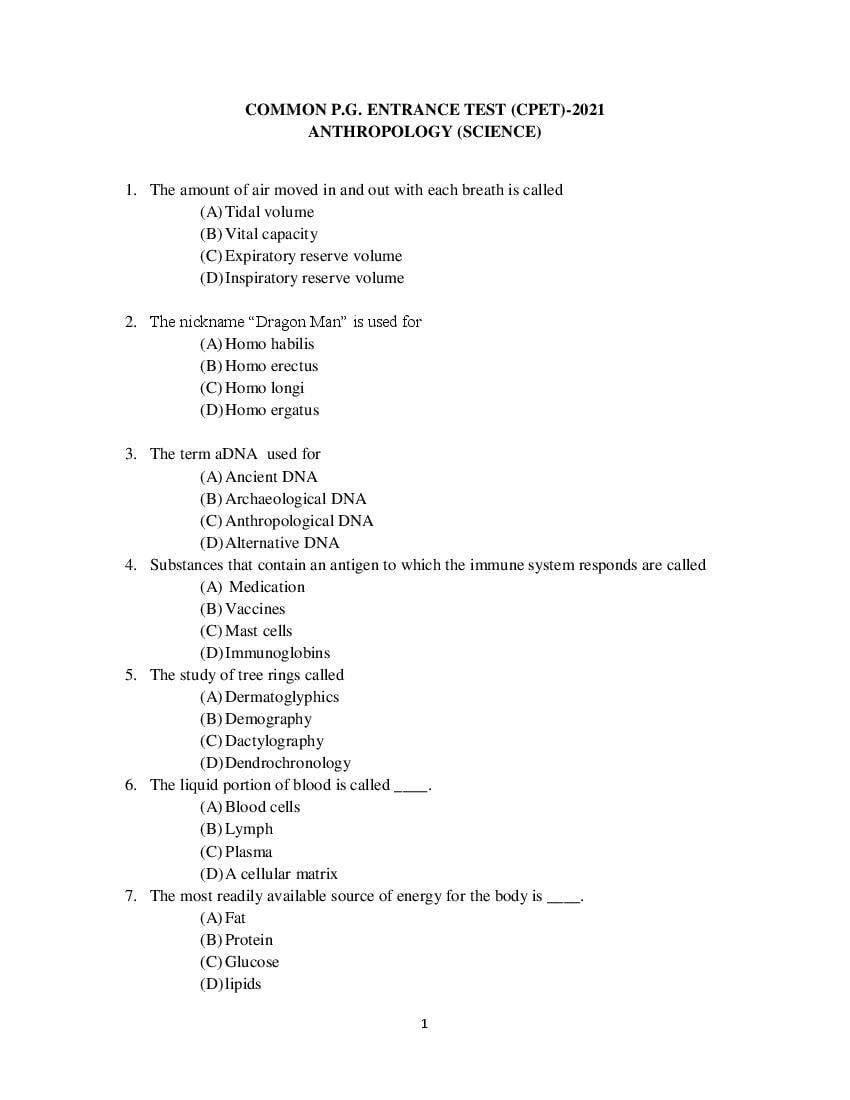
ANTHROPOLOGY (SCIENCE)
1. The amount of air moved in and out with each breath is called
(A) Tidal volume
(B) Vital capacity
(C) Expiratory reserve volume
(D) Inspiratory reserve volume
2. The nickname “Dragon Man” is used for
(A) Homo habilis
(B) Homo erectus
(C) Homo longi
(D) Homo ergatus
3. The term aDNA used for
(A) Ancient DNA
(B) Archaeological DNA
(C) Anthropological DNA
(D) Alternative DNA
4. Substances that contain an antigen to which the immune system responds are called
(A) Medication
(B) Vaccines
(C) Mast cells
(D) Immunoglobins
5. The study of tree rings called
(A) Dermatoglyphics
(B) Demography
(C) Dactylography
(D) Dendrochronology
6. The liquid portion of blood is called ____.
(A) Blood cells
(B) Lymph
(C) Plasma
(D) A cellular matrix
7. The most readily available source of energy for the body is ____.
(A) Fat
(B) Protein
(C) Glucose
(D) lipids
1
Page 2
(A) Isotonic
(B) Hypotonic
(C) Hypertonic
(D) Atonic
9. The A, B, O blood groups were discovered by
(A) Gregor Mendel
(B) Wat son
(C) Charles Darwin
(D) Karl Landsteiner
10. Which are necessary for t he format ion of bon es and teet h?
(A) Calcium and phosphorous
(B) Sodium and potassium
(C) Calcium and magnesium
(D) Calcium and sodium
11. Holocene epoch is known as age of:
(A) Man
(B) Reptile
(C) Dinosaur
(D) Fish
12. Approximately what proportion of the human genome is made up of non-coding DNA?
(A) 1 %
(B) 1.5 %
(C) 50 %
(D) 98.5 %
13. The human mtDNA constitutes ________ base pairs.
(A) 16,569
(B) 17,569
(C) 18,569
(D) 19,569
14. The book Descent of Man is authored by_______
(A) TH Huxley
(B) LH Morgan
(C) T. Dobzhansky
(D) CR Darwin
2
Page 3
(A) increases
(B) decreases
(C) remain unchanged
(D) first decreases and then increases
16. The DNA marker which is inherited only through the female parent and thus evolves in a
way that allows trees of relationship to be easily constructed is called as ________
(A) autosomal DNA
(B) Y-chromosome
(C) MtDNA
(D) cDNA
17. Among the following communities, which one exhibits the fastest evolution in high
altitude adaptation?
(A) The Tibetans
(B) The Bantus
(C) The Ethiopians
(D) The Andes
18. According to _______, the body size is large in cold climates and small in warm
climates.
(A) Bergmann’s Rule
(B) Golger’s Rule
(C) Cope’s Rule
(D) Allens rule
19. The word “Ethno” in Ethnobotany refers to?
(A) Region- Locality- People
(B) Culture
(C) Civilization
(D) All of Above
20. The concept of “Culture” from the ethical prospective ….
(A) Is the outcome of the architectural part of our environment?
(B) Is the outcome of the man-made part of our environment?
(C) Is an isolated view of the world?
(D) Comprises of beliefs which produce an unacceptable view of the society
21. Autonomy is one of the main principles of bioethics , which mean:
(A)Selfishness
(B)Self-awareness
(C)Self-promotion
(D)Self-governance
3
Page 4
the biological world.
(A) Bio-piracy
(B) Biosafety
(C) Bioethics
(D) Bio-patents
23. GEAC stands for ______
(A) Genetic Ethical Approval Committee
(B) Genetic Engineering Active Commission
(C) Genetic Ethical Active Commission
(D) Genetic Engineering Approval Committee
24. _______ is the right granted by a government to an inventor to prevent others from the
commercial use of his invention.
(A) Piracy
(B) Ethics
(C) Biosafety
(D) Patents
25. Various measures taken to prevent any risks to normal organisms from transgenic
organisms are known as ______
(A) Biosafety
(B) Patent
(C) bio-patent
(D) bio-piracy
26. The practice of giving birth to a baby for another women who is unable to have babies
herself is called:
(A) Invitro fertilization
(B) Surrogacy
(C) Cloning
(D) Genetic mutation
27. IPR means:
(A) Intellectual Property Right
(B) Indian Property right
(C) Intellectual Privacy Right
(D) International Privacy Right
4
Page 5
(A) 2123/2123
(B) 2133/2133
(C) 2103/2103
(D) 0123/0123
29. Which is the largest cell in the human body?
(A) Macrophage
(B) Ovum
(C) Granule cell
(D) None of the above
30. What are osteocytes?
(A) A type of white blood cell
(B) A type of bone cell
(C) A type of brain cell
(D) None of the above
31. Humans have ____ bones in the vertebrate column
(A) 52
(B) 32
(C) 33
(D) 53
32. The 1918 flu pandemic, also called the Spanish Flu was caused by
(A) H1N1 influenza A virus
(B) SARS coronavirus 2
(C) Influenza C virus
(D) Simian virus 5
33. If a disease jumps from a non-human animal to a human, then it is termed as
(A) Zoonotic disease
(B) Infectious disease
(C) Congenital disease
(D) Iatrogenic disease
34. Which of the following vitamins cannot be produced by our body?
(A) vitamin A
(B) vitamin K
(C) vitamin C
(D) All of the above
5
Page 6
(A) Attachment of probes to DNA fragments
(B) Transfer of DNA fragments from electrophoretic gel to a nitrocellulose sheet
(C) Comparison of DNA fragments to two sources
(D) Transfer of DNA fragments to electrophoretic gel from cellulose membrane
36. ELISA is
(A) Using radiolabelled second antibody
(B) Usage of RBCs
(C) Using complement-mediated cell lysis
(D) Addition of substrate that is converted into a coloured end product
37. The first transgenic plant to be produced is
(A) Brinjal
(B) Tobacco
(C) Rice
(D) Cotton
38. Excision and insertion of a gene is called
(A) Biotechnology
(B) Genetic engineering
(C) Cytogenetics
(D) Gene therapy
39. RNA interference helps in
(A) Cell proliferation
(B) Micropropagation
(C) Cell defence
(D) Cell differentiation
40. ___________ is a vestigial organ.
(A) Intestinal villi
(B) Papillae
(C) Vermiform appendix
(D) None of the above
41. In males, the gene for colour blindness is located in________.
(A) X-chromosome
(B) Y-chromosome
(C) Both X and Y chromosome
(D) Either X-chromosome or Y-chromosome
6
Page 7
(A) Fossils of early birds and their ancestors
(B) Fossils of early humans and their ancestors
(C) Fossils of early fish and its descendants
(D) Fossils of early reptiles and its descendants
43. A holotype is a ______
(A) A single physical example of an organism known to have been used when the
species was described
(B) A term used to describe special type of bones found exclusively in birds
(C) A recently formed fossil specimen
(D) None of the above
44. Radiocarbon dating can help find the age range of biological specimens no older than:
(A) 50,000 years
(B) 100,000 years
(C) 500,000 years
(D) 1,000,000 years
45. The scientific study of the structure of bones, skeletal elements and microbone
morphology is called:
(A) Herpetology
(B) Osteology
(C) Entomology
(D) None of the above
46. When was the first draft of Human Genome Project was published in the journal Nature
(A) 1999
(B) 2000
(C) 2001
(D) 2007
47. Mode of DNA replication is
(A) Conservative and bidirectional
(B) Semiconservative and unidirectional
(C) Semiconservative and bidirectional
(D) Conservative and unidirectional
48. Antibiotics are the most effective on:
(A) Bacteria
(B) Virus
(C) Fungi
(D) None of the above
7
Page 8
(A) Maize
(B) Barley
(C) Sucrose
(D) None of the above
50. Which technique is used to detect AIDS?
(A) Northern blot and ELISA
(B) Immunoblot and ELISA
(C) Western blot and ELISA
(D) Southern blot and ELISA
51. The vaccines prepared through recombinant DNA technology are
(A) Third generation vaccines
(B) First-generation vaccines
(C) Second-generation vaccines
(D) None
52. _________ is one of the most prevalent hotspots of biodiversity in India
(A) Himalayas
(B) Western Ghats
(C) Ganges
(D) None of the above
53. _______ is the basic unit of classification and a taxonomic rank
(A) Species
(B) Genus
(C) Class
(D) Order
54. Global warming can significantly be controlled by _____________
(A) Increasing solid waste
(B) Reducing water wastage
(C) Burning human-generated waste
(D) Reducing fossil fuel consumption
55. ___________ occurs when the death of the last individual in a species occurs.
(A) Adaptation
(B) Phylogenic diversity
(C) Speciation
(D) Extinction
56. A plant cell wall is mainly composed of
(A) Protein
(B) Cellulose
(C) Lipid
(D) Starch
8
Page 9
(A) The partial pressure of oxygen
(B) Increased levels of CO2 in blood
(C) Cold temperatures
(D) None of the above
58. Allelopathy refers to
(A) Inhibition of growth of one species by another by the production of toxins
(B) Inhibition of sporulation of pathogen by the host
(C) Altering the reproductive cycle of one organism by another
(D) Inhibition of growth of one species by another by preventing reproduction
59. The ratio between energy flow at different points in a food chain is known as
(A) Ecological capacity
(B) Ecological efficiency
(C) Ecological assimilation
(D) Ecological potential
60. The ability of a population to increase under ideal environmental conditions is called
(A) Natality
(B) Carrying capacity
(C) Biotic potential
(D) Absolute natality
61. Which one is a ‘K’ selected species?
(A) Aspergillus
(B) Taraxacum
(C) Human
(D) Grass
62. All species of Lemur are endemic to which area?
(A) Madagascar
(B) Seychelles Island
(C) Galapagos Island
(D) New Caledonia
63. Plant species with a wide range of genetic distribution evolve into a local population
known as
(A) Ecotype
(B) Population
(C) Ecosystem
(D) Biome
9
Page 10
(A) Positive selection
(B) Negative selection
(C) Frequency-dependent selection
(D) Mutation-selection balance
65. Nitrogen fixation is the conversion of
(A) N2 to N
(B) N2 to NH3
(C) N2 to NO3–
(D) N2 to urea
66. Louise Joy Brown was the first human to have been born after conception by
(A) In vitro fertilisation (IVF)
(B) Cloning
(C) Stem cell therapy (SCT)
(D) Genetic Engineering
67. Kary Mullis is associated with the development of __________
(A) DNA Finger Printing
(B) Stem cell isolation
(C) PCR technique
(D) IVF technique
68. Down syndrome, Klinefelter syndrome, and Turner syndrome all result from _________
during meiosis
(A) Independent assortment
(B) Crossing-over
(C) Recombination
(D) Nondisjunction
69. The study of aging is known as
(A) Auxology
(B) Gerontology
(C) Physiology
(D) Demography
70. Who was given the first gene therapy?
(A) Henrietta Lacks
(B) Louise Brown
(C) Ashanti De Silva
(D) William F anderson
10
Page 11
Document Details
| Board / Org | Odisha Exams |
| Exam | Odisha CPET |
| Type | Question Paper |
| Pages | 11 |
| Updated | 22 Jul 2026 |