Odisha CPET 2021 Question Paper Bioinformatics
Finished viewing? Save it for later —
Download Odisha CPET 2021 Question Paper Bioinformatics (PDF · 11 pages)About Odisha CPET 2021 Question Paper Bioinformatics
Odisha CPET 2021 Question Paper Bioinformatics is available here for free download. Published by Odisha Exams for Odisha CPET, this question paper can be viewed online or downloaded as a PDF (11 pages). Candidates preparing for Odisha CPET can use Odisha CPET 2021 Question Paper Bioinformatics to understand the exam pattern, the type of questions asked, and the overall difficulty level.
Frequently Asked Questions
How can I download Odisha CPET 2021 Question Paper Bioinformatics?
Open this page and click the Download button to save Odisha CPET 2021 Question Paper Bioinformatics as a PDF. It is completely free on AglaSem Docs.
Is Odisha CPET 2021 Question Paper Bioinformatics free to download?
Yes. Odisha CPET 2021 Question Paper Bioinformatics can be viewed online and downloaded as a PDF free of cost on AglaSem Docs.
How many pages does Odisha CPET 2021 Question Paper Bioinformatics have?
Odisha CPET 2021 Question Paper Bioinformatics contains 11 pages, which you can read online or download together as a single PDF.
Where can I find more Odisha CPET study material?
You can find more Odisha CPET question papers, sample papers, syllabus, and answer keys on AglaSem Docs.
Odisha CPET 2021 Question Paper Bioinformatics – Text
Read the full text of this question paper below — useful to quickly search, copy and reference the content online without downloading the PDF.
📄 View text version (11 pages)
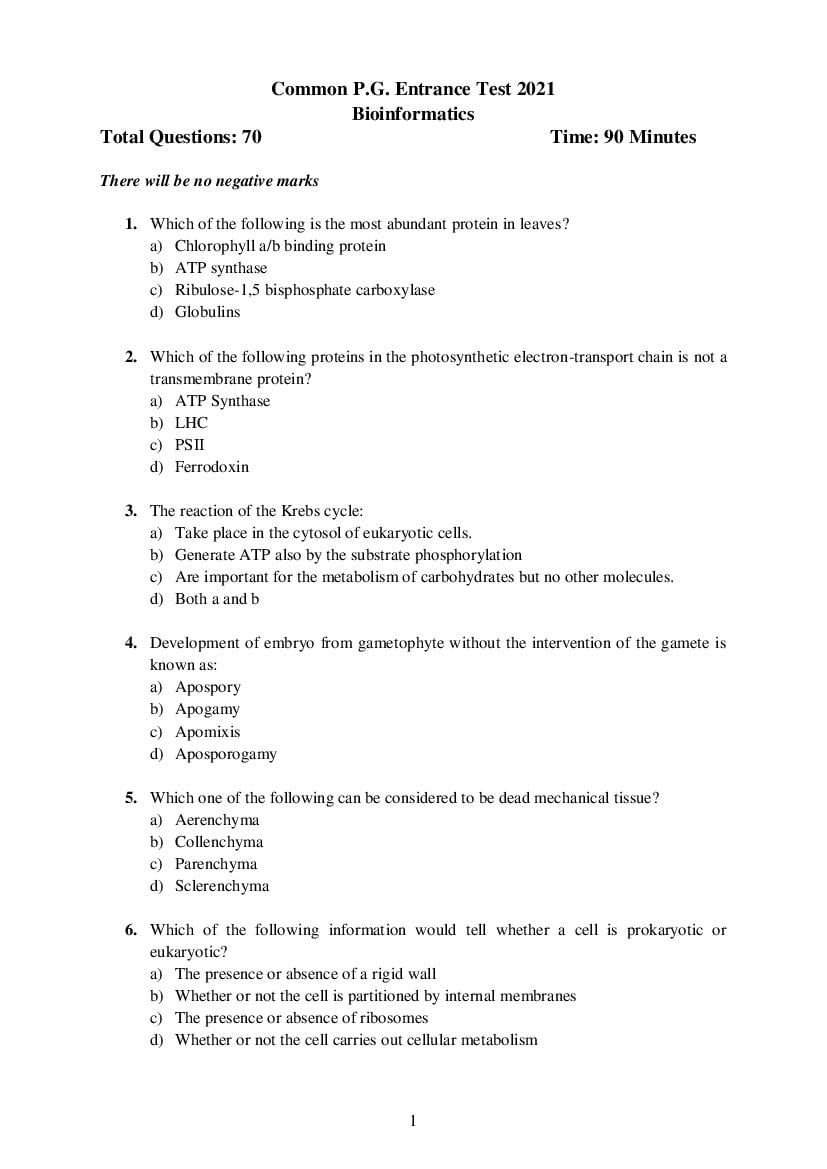
Page 1
Bioinformatics
Total Questions: 70 Time: 90 Minutes
There will be no negative marks
1. Which of the following is the most abundant protein in leaves?
a) Chlorophyll a/b binding protein
b) ATP synthase
c) Ribulose-1,5 bisphosphate carboxylase
d) Globulins
2. Which of the following proteins in the photosynthetic electron-transport chain is not a
transmembrane protein?
a) ATP Synthase
b) LHC
c) PSII
d) Ferrodoxin
3. The reaction of the Krebs cycle:
a) Take place in the cytosol of eukaryotic cells.
b) Generate ATP also by the substrate phosphorylation
c) Are important for the metabolism of carbohydrates but no other molecules.
d) Both a and b
4. Development of embryo from gametophyte without the intervention of the gamete is
known as:
a) Apospory
b) Apogamy
c) Apomixis
d) Aposporogamy
5. Which one of the following can be considered to be dead mechanical tissue?
a) Aerenchyma
b) Collenchyma
c) Parenchyma
d) Sclerenchyma
6. Which of the following information would tell whether a cell is prokaryotic or
eukaryotic?
a) The presence or absence of a rigid wall
b) Whether or not the cell is partitioned by internal membranes
c) The presence or absence of ribosomes
d) Whether or not the cell carries out cellular metabolism
1
Page 2
is:
a) Mixotrophy
b) Endosymbiosis
c) Meiosis
d) Conjugation
8. The Protozoans that cause malaria in humans are:
a) Radiolarians
b) Trichosomes
c) Spozozoans
d) Dinoflagellates
9. The very first vertebrates were:
a) Cartilaginous fish
b) Fishes with jaws
c) Amphibians
d) Jawless fish
10. The development of adult characteristics in a molting insect is promoted by:
a) Thyroxine
b) Ecdysone
c) Juvenile hormone
d) A pheromone
11. Rapid but non-antigen specific immune responses are produced by the:
a) Adaptive Immune system
b) Innate Immune system
c) Leukocytes
d) Lymphatic System
12. Mostly the antibodies are synthesized by:
a) Central lymphoid organs
b) Peripheral lymphoid organs
c) Primary lymphoid organs
d) Macrophages
13. There are five classes of the antibodies (IgM, IgD, IgG, IgE, IgA). What determines the
class to which and antibody belongs?
a) Structure of the light chain
b) Variable region of the antibody
c) Structure of the heavy chain constant region
d) Stage of the infection
2
Page 3
a) Infected with pathogen
b) Immunized with an antigen
c) Exposed to an antigen
d) None of the above
15. The Oral Polio Vaccine (OPV) administered to children in India, is:
a) Inactivated polio vaccine
b) Live attenuated poliovirus
c) Subunit vaccine specific for oral route
d) Recombinant subunit vaccine
16. Transcription is the transfer of genetic information from:
a) DNA to RNA
b) tRNA to mRNA
c) DNA to mRNA
d) mRNA to tRNA
17. Meiosis II is similar to mitosis in which way:
a) Sister Chromatids separates during anaphase
b) The daughter cells are diploid
c) Homologous chromosomes synapse
d) DNA replicates before the division
18. Hershey and Chase experiment proving DNA as the genetic material was based on the
principle:
a) Transduction
b) Transformation
c) Transcription
d) Translation
19. Genes whose products are constantly needed by the cell for cellular activity are called:
a) Structural genes
b) Metabolic genes
c) Constitutive genes
d) Smart Genes
20. A DNA molecule that has the ability to replicate autonomously is called:
a) Plasmid
b) Chromosome
c) Genome
d) Replicon
21. The bacterial enzyme that changes positively supercoiled DNA into negatively
supercoiled DNA is:
3
Page 4
b) DNA Gyrase
c) Single Strand binding protein
d) Polymerase
22. Satellite DNA consists of:
a) Extrachromosomal DNA
b) Short repetitive nucleotide sequences
c) Ribosomal RNA genes
d) Single gene regions
23. The synthesis of mRNA on DNA template is:
a) Bidirectional with the help of primer
b) Unidirectional with the help of primer
c) Unidirectional
d) Bidirectional
24. Full expression of lac operon requires:
a) Lacotose and cAMP
b) Allolactose and cAMP
c) Lactose
d) Allolactose
25. A DNA mutation that results in no change in protein product produced is termed as:
a) Missense mutation
b) Nonsense mutation
c) Silent Mutation
d) Frameshift Mutation
26. Which of the following is an imino acid?
a) Histidine
b) Glycine
c) Cysteine
d) Proline
27. The high solubility of amino acids in water is due to:
a) Presence of side chain
b) Dipolar ion structure
c) Unipolarity
d) The hydrophilic nature of the amino group
28. On a Ramchandran plot the entries for hemoglobin would be clustered around
a) All four corners
4
Page 5
c) The left handed α-helix conformation
d) The right handed α-helix conformation
29. The forces that maintain the three dimensional structure of a protein is mainly:
a) Non-covalent
b) Covalent
c) Coordinate
d) Covalent and non-covalent
30. Most abundant protein in the human body?
a) Hemoglobin
b) Myosin
c) Trypsin
d) Troponin
31. A double stranded DNA has 30% Thymine. The percentage of cytosine is:
a) 30%
b) 20%
c) 60%
d) 15%
32. Melting temperature of DNA is the temperature at which:
a) DNA melts completely
b) 50% of the DNA is denatured
c) 80% of the DNA is denatured
d) None of the above
33. DNA is a genetic material can be evidenced by the fact that:
a) Chromosomes are made up of DNA
b) DNA is not present in cytoplasm
c) Transformation and transduction in bacteria are caused by DNA only
d) DNA is concentrated in nucleus
34. DNA sequencing by Sanger’s method involves the use of:
a) Ribonucleotide
b) 3’- deoxyribonucleotide
c) 2’, 3’-dideoxyribonucleotide
d) Fluorodinitrobenzene
35. Chargaff’s rule state that:
a) in RNA, A=U, and in DNA, A=T
5
Page 6
c) (A+T)/(G+C) is always 1
d) A+G/T+C=1
36. Which of the following genotype represents heterozygous condition?
a) TT
b) tt
c) Tt
d) RR
37. How many types of gametes are possible from a diploid organism having genotype
AaBBCC?
a) 2
b) 6
c) 3
d) 10
38. A gene which hides the action of another gene is termed as:
a) Co-dominant gene
b) Epistatic gene
c) Hypostatic gene
d) Lethal gene
39. If a man of blood group AB marries a woman if blood group A whose father was of
blood group O, to what different blood groups can this man and woman expect their
children to belong?
a) A, AB, B
b) A, AB
c) AB, O
d) A, O, B
40. A cross between F1 hybrid and its homozygous recessive parent is called:
a) Out cross
b) Monohybrid Cross
c) Test cross
d) Dihybrid Cross
41. A virion is a:
a) Naked, infectious piece of RNA
b) Complete, Infectious virus particle
c) Nucleic acid without a capsid
d) A naked, infectious piece of DNA
42. Which of the following is an example of chemolithoautotroph?
a) Sulphur-oxidizing bacteria
6
Page 7
c) Nitrifying bacteria
d) All of these
43. Which of the following sequence has helped in identifying euaryotes, eubacteria and
archaebacterial cell types?
a) Signature Sequence
b) Signal Sequence
c) Shine-Dalgarno Sequence
d) Amino Acid Sequence
44. Which of the following has its antiviral action attributed to the interference of protein
synthesis?
a) Amantadine
b) Interferons
c) Acycloguanosine
d) 5’-iododeoxyuridine
45. Which of the following is not the biofertilisers producing bacteria?
a) Nostoc
b) Anabaena
c) Clostridium
d) Both (a) and (b)
46. Proteins are separated in SDS –electrophoresis on the basis of their:
a) Size
b) Charge
c) Amino acid composition
d) Charge and Shape
47. Molecular weight of an unknown protein can be found out by:
a) Electrophoresis
b) Ion-Exchange chromatography
c) Affinity chromatography
d) None of the above
48. A reporter gene is used to:
a) Identify regulatory sequences from the upstream regions of other genes
b) Determine if a protein binds to a given sequence element.
c) Determine if a gene contains introns.
d) Determine the stability of a protein
49. The polymerase enzyme used in PCR is:
a) DNA polymerase I
7
Page 8
c) Reverse Transcriptase
d) DNA polymerase II
50. Which of the following technique is used to inactive a gene by altering the DNA?
a) Homologous recombination
b) Antisense nucleic acid blocks
c) Antibody microinjection
d) Introduction of dominant inhibitory mutants
51. Chi square is zero when:
a) Expected frequency is lesser than the observed frequency
b) Expected frequency is equal to the observed frequency
c) Expected frequency is double that of the observed frequency
d) Expected frequency is greater than the observed frequency
52. For drawing a frequency polygon of a continuous frequency distribution, we plot the
points whose ordinates are the frequency of the respective classes and abscissa are
respectively:
a) Upper limits of the classes
b) Lower limits of the classes
c) Class marks of the classes
d) Upper limits of preceding clases
53. In a survey of 278 women, 195 were found to be working. If a women is selected at
random, the probability that she is not working is:
a) 83/278
b) 195/278
c) 112/278
d) 1
54. Which of the following is not an event?
a) Getting no head when two coins are tossed simultaneously
b) Getting an even number when a die is rolled
c) Drawing a ball from an urn containing balls of different colours
d) Selecting a student having less than 40% marks in Mathematics
55. Mode is the:
a) Least frequent value
b) Middle most value
c) Most frequent value
d) None of these
56. Which of the following tools used to compare two sequence?
a) EMBOSS
8
Page 9
c) BLAST
d) FASTA
57. Who created the first bioinformatics database?
a) Pearson
b) Dayhoff
c) Richard Durbin
d) Needleman-Wunsch
58. The computational method that try to find the best matching between two molecules, a
receptor and ligand is known as:
a) Molecular docking
b) Molecular matching
c) Molecular fitting
d) Molecular affinity check
59. Which of the following is a structural database?
a) EMBL
b) Genebank
c) PDB
d) DDBJ
60. Which of the following is the first molecular biology server?
a) NCBI
b) ExPASy
c) EBI
d) RCSB
25
61. If 125𝑥 = 5𝑥 then x is equal to:
a) ½
b) 2
c) 3
d) 1
62. The angles of a triangle are in the ratio 3:5:4. The smallest angle of the triangle is:
a) 60o
b) 30o
c) 50o
d) 45o
63. A chord is at a distance of 8 cm from the centre of a circle of radius 17 cm. The length
of the chord is:
a) 25 cm
b) 12.5 cm
c) 30 cm
d) 9 cm
64. The length of altitude of an equilateral triangle having side 8 cm is:
a) 4√3 cm
9
Page 10
c) 4√5 cm
d) 8 cm
65. The ratio of radii of two spheres is 4:3. The ratio of their volumes is:
a) 64:27
b) 27:64
c) 16:9
d) 9:16
66. A gas can be converted into liquid state by applying:
a) High pressure and high temperature
b) Low pressure and low temperature
c) Low pressure and high temperature
d) High pressure and low temperature
67. Which of the following will show Tyndall effect?
a) Salt solution
b) Copper sulphate solution
c) Starch solution
d) Sugar Solution
68. The gases exert more pressure on the walls of the container because:
a) Particles in gaseous state move randomly at high speed
b) Particles in gaseous state are tightly packed
c) Particles have low kinetic energy
d) Particles have large mass
69. A girl is carrying a school bag of 3 kg mass on her back and moves 200 m on a leveled
road. The work done against the gravitational force will be (g = 10 m/s 2):
a) 6 x 10³ J
b) 6 J
c) 0.6 J
d) Zero
70. The value of acceleration due to gravity:
a) is same on equator and poles
b) is least on poles
c) is least on equator
d) increases form pole to equator
10
Page 11
Document Details
| Board / Org | Odisha Exams |
| Exam | Odisha CPET |
| Type | Question Paper |
| Pages | 11 |
| Updated | 22 Jul 2026 |