Karnataka 1st PUC Model Question Paper 2022 for Biology (English Medium)
Finished viewing? Save it for later —
Download Karnataka 1st PUC Model Question Paper 2022 for Biology (English Medium) (PDF · 4 pages)About Karnataka 1st PUC Model Question Paper 2022 for Biology (English Medium)
Karnataka 1st PUC Model Question Paper 2022 for Biology (English Medium) is available here for free download. Published by Karnataka Board for Class 11, this sample paper can be viewed online or downloaded as a PDF (4 pages). Candidates preparing for Class 11 can use Karnataka 1st PUC Model Question Paper 2022 for Biology (English Medium) to understand the exam pattern, the type of questions asked, and the overall difficulty level.
Frequently Asked Questions
How can I download Karnataka 1st PUC Model Question Paper 2022 for Biology (English Medium)?
Open this page and click the Download button to save Karnataka 1st PUC Model Question Paper 2022 for Biology (English Medium) as a PDF. It is completely free on AglaSem Docs.
Is Karnataka 1st PUC Model Question Paper 2022 for Biology (English Medium) free to download?
Yes. Karnataka 1st PUC Model Question Paper 2022 for Biology (English Medium) can be viewed online and downloaded as a PDF free of cost on AglaSem Docs.
How many pages does Karnataka 1st PUC Model Question Paper 2022 for Biology (English Medium) have?
Karnataka 1st PUC Model Question Paper 2022 for Biology (English Medium) contains 4 pages, which you can read online or download together as a single PDF.
Where can I find more Class 11 study material?
You can find more Class 11 question papers, sample papers, syllabus, and answer keys on AglaSem Docs.
Karnataka 1st PUC Model Question Paper 2022 for Biology (English Medium) – Text
Read the full text of this sample paper below — useful to quickly search, copy and reference the content online without downloading the PDF.
📄 View text version (4 pages)
Page 1
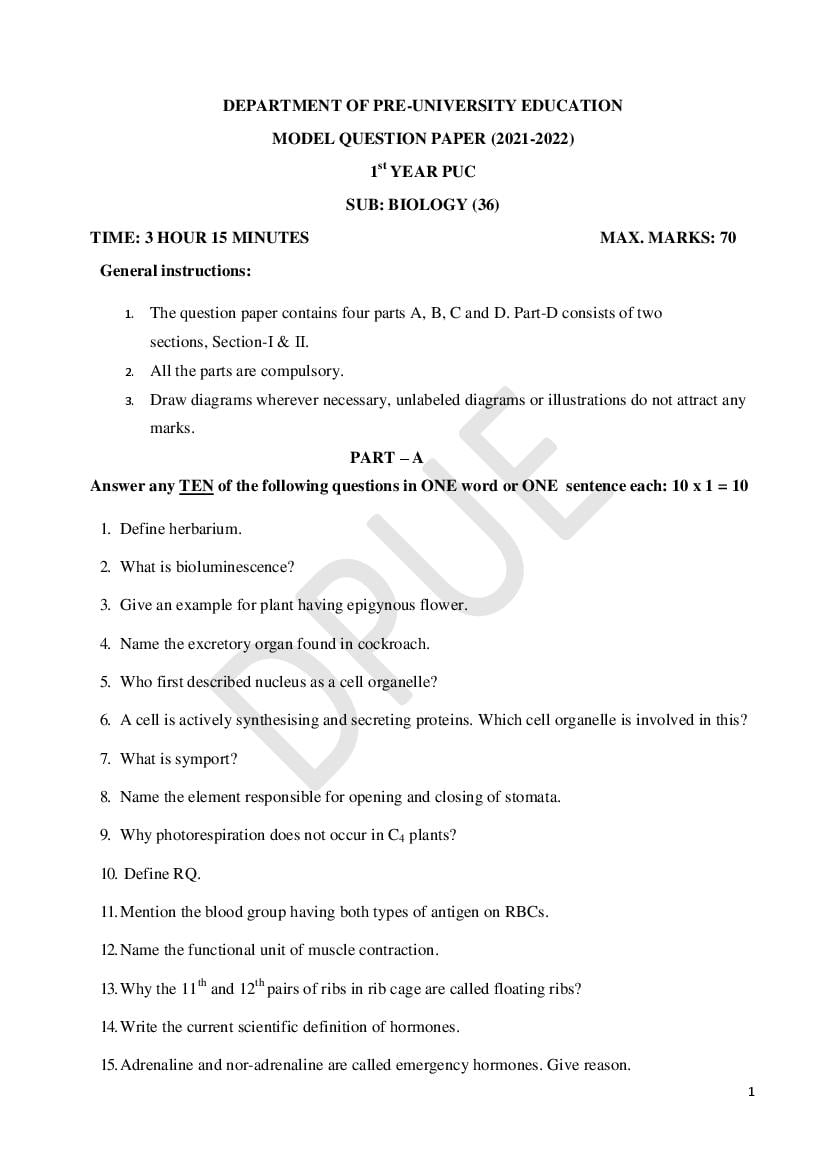
MODEL QUESTION PAPER (2021-2022)
1st YEAR PUC
SUB: BIOLOGY (36)
TIME: 3 HOUR 15 MINUTES MAX. MARKS: 70
General instructions:
1. The question paper contains four parts A, B, C and D. Part-D consists of two
sections, Section-I & II.
2. All the parts are compulsory.
3. Draw diagrams wherever necessary, unlabeled diagrams or illustrations do not attract any
marks.
PART – A
Answer any TEN of the following questions in ONE word or ONE sentence each: 10 x 1 = 10
1. Define herbarium.
2. What is bioluminescence?
3. Give an example for plant having epigynous flower.
4. Name the excretory organ found in cockroach.
5. Who first described nucleus as a cell organelle?
6. A cell is actively synthesising and secreting proteins. Which cell organelle is involved in this?
7. What is symport?
8. Name the element responsible for opening and closing of stomata.
9. Why photorespiration does not occur in C4 plants?
10. Define RQ.
11. Mention the blood group having both types of antigen on RBCs.
12. Name the functional unit of muscle contraction.
13. Why the 11th and 12th pairs of ribs in rib cage are called floating ribs?
14. Write the current scientific definition of hormones.
15. Adrenaline and nor-adrenaline are called emergency hormones. Give reason.
1
Page 2
Answer any FIVE of the following questions in 3-5 sentences each, wherever applicable:
5 x 2 = 10
16. “Viruses exhibit both living and non-living characters”. Justify the statement.
17. Mention any two commercial products obtained from algae.
18. Differentiate between endarch and exarch xylem.
19. How do co-enzymes differ from prosthetic groups?
20. “The direction of food movement in phloem can be bidirectional”. Substantiate the statement
by giving two reasons.
21. Mention the deficiency symptoms of essential elements in plants.
22. Write the steps involved in conversion of ammonia into nitrate by soil bacteria.
23. Mention any two disorders of human respiratory system.
24. Give an example each for ammonotelic and uricotelic animals.
25. Mention the types of synapse.
PART – C
Answer any FIVE of the following questions in 40-80 words each, wherever applicable:
5 x 3 = 15
26. Write the taxonomic categories of mango plant.
27. List any three modifications that enabled birds to adjust to the aerial mode of life.
28. Briefly explain the anatomical features of dorsiventral leaf.
29. Mention the location of the following connective tissues:
i) Dense regular connective tissue ii) Dense irregular connective tissue iii) Cartilage
30. Mention the function of i) Glut-4 ii) Antibody iii) Collagen
31. Briefly explain the criteria for essentiality of an element.
32. Answer the following:
i) With reference to plant development, state the meaning of „plasticity‟. (1)
2
Page 3
33. Draw a neat labeled diagram of human respiratory system.
34. Diagrammatically represent the structure of nephron.
35. What are joints? Mention any two types of joints.
PART- D
Section-I
Answer any FOUR of the following questions in 200-250 words each, wherever applicable:
4 x 5 = 20
36. Describe the salient features of pteridophytes.
37. Assign the following animals to their respective phyla.
i)Adamsia ii) Ascaris iii) Pila iv) Asterias v) Balanoglossus
38. Write the floral formula and floral diagram of family Solanaceae.
39. Draw a neat labeled diagram of alimentary canal of earthworm.
40. Answer the following:
i) Mention one function each for chloroplast, mitochondrion and cytoskeleton. (3)
ii) Classify the chromosomes based on the position of centromere. (2)
41. Answer the following:
i) Draw a diagrammatic view of cell cycle. (4)
ii) In which stage of cell cycle DNA synthesis takes place? (1)
42. Explain the pathways of water movement in the root.
43. Schematically represent Calvin cycle.
Section-II
Answer any THREE of the following questions in 200-250 words each, wherever applicable:
3 x 5= 15
44. Draw a neat labeled diagram of plant cell.
45. Write the schematic representation of citric acid cycle.
46. Name the plant growth regulators responsible for following physiological effects in
3
Page 4
i) Bolting.
ii) Apical dominance.
iii) Production of new leaves and chloroplasts in leaves.
iv) Closure of stomata.
v)Fruit ripening.
47. Explain the process of chemical digestion of carbohydrates in different parts of human
digestive system.
48. Describe the events of cardiac cycle.
49. Explain the generation and conduction of nerve impulse.
50. Write one function each for following hormones in humans.
i)Melatonin ii) Insulin iiii)Testosterone iv) Progesterone v) Thymosin
……….
4
Document Details
| Board / Org | Karnataka Board |
| Exam | Class 11 |
| Type | Sample Paper |
| Pages | 4 |
| Language | english |
| Updated | 30 Apr 2026 |