AHSEC HS 1st Year Syllabus 2026 Entrepreneurship Development
Finished viewing? Save it for later —
Download AHSEC HS 1st Year Syllabus 2026 Entrepreneurship Development (PDF · 4 pages)About AHSEC HS 1st Year Syllabus 2026 Entrepreneurship Development
AHSEC HS 1st Year Syllabus 2026 Entrepreneurship Development is available here for free download. Published by Assam Board for Class 11, this syllabus can be viewed online or downloaded as a PDF (4 pages). Candidates preparing for Class 11 can use AHSEC HS 1st Year Syllabus 2026 Entrepreneurship Development to understand the exam pattern, the type of questions asked, and the overall difficulty level.
Frequently Asked Questions
How can I download AHSEC HS 1st Year Syllabus 2026 Entrepreneurship Development?
Open this page and click the Download button to save AHSEC HS 1st Year Syllabus 2026 Entrepreneurship Development as a PDF. It is completely free on AglaSem Docs.
Is AHSEC HS 1st Year Syllabus 2026 Entrepreneurship Development free to download?
Yes. AHSEC HS 1st Year Syllabus 2026 Entrepreneurship Development can be viewed online and downloaded as a PDF free of cost on AglaSem Docs.
How many pages does AHSEC HS 1st Year Syllabus 2026 Entrepreneurship Development have?
AHSEC HS 1st Year Syllabus 2026 Entrepreneurship Development contains 4 pages, which you can read online or download together as a single PDF.
Where can I find more Class 11 study material?
You can find more Class 11 question papers, sample papers, syllabus, and answer keys on AglaSem Docs.
AHSEC HS 1st Year Syllabus 2026 Entrepreneurship Development – Text
Read the full text of this syllabus below — useful to quickly search, copy and reference the content online without downloading the PDF.
📄 View text version (4 pages)
Page 1
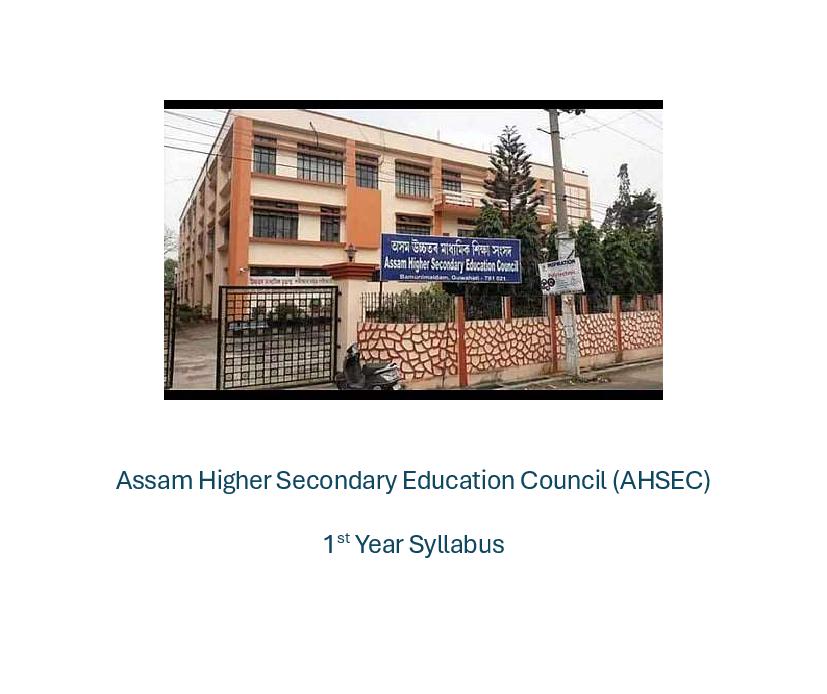
1st Year Syllabus
Page 2
ENTERPRENEURSHIP DEVELOPMENT
SYLLABUS FOR HIGHER SECONDARY COURSE
Introduction :
Introducing of Entrepreneurship in the curriculum of class XI & XII of AssamHigher Secondary
Education Council is the need of the hours. Students are the potential sources of entrepreneurs of the
future. The process of entrepreneurship will effectively imbibe a positive mindset among the budding
students. Realizing the need and importance of entrepreneurship in the formal education system, the entre-
preneurship curriculum has been designed keeping in mind of the following objectives.
Objectives :
To make students aware about need and importance of entrepreneurship in the changing
scenario.
To encourage the self-analysis (thinking) process.
To generate a spirit of work and self-employment.
To develop attitudes, interest and values among the students towards entrepreneurship
development and its contribution in the growth of individual as well as nation building.
To enable them to make realistic choice of entrepreneurship activities.
To promote entrepreneurship as a career option.
To enable them to launch, manage and grow an enterprise.
SYLLABUS FOR HIGHER SECONDARY FIRST YEAR COURSE
One Paper Time : Three Hours Marks : 100
Unitwise Distribution of Marks & Periods :
Unit Title Marks Periods
Theory Practical Theory Practical
Unit-1 Concept of Entrepreneurship 20 – 30 –
Unit-2 Development of Entrepreneurial 20 – 30 –
Quality and Motivation
Unit-3 Dynamics of Entrepreneurship 20 – 30 –
Unit-4 Government Policies and Scheme 10 – 20 –
Total : 70 30 110 70
Page 3
Unitwise Distribution of Course Contents:
Marks
Unit-1: INTRODUCTION (Concept of Entrepreneurship) 20
Concept of Entrepreneurship .
Aims and objectives of Entrepreneurship Development.
Scope (subject matter) and need of entrepreneurship development.
Evolution of entrepreneurship .
Relationship between entrepreneurship and other discipline.
Unit-2: DEVELOPING ENTREPRENEURIAL QUALITY AND MOTIVATION 20
Entrepreneurs and his/her attributes.
Base of Entrepreneurial behaviour (Needs, Drives and Motives),
Self-Analysis (Strength & Weakness), Creative thinking, Problem
analysis and Problem solving, Innovation, Convincing &
Communication skill.
Entrepreneurial motivation
Charms of becoming an entrepreneur.
Unit-3: DYNAMICS OF ENTREPRENEURSHIP 20
Different thought of entrepreneurship.
Entrepreneurship movement in India with special reference to
North East.
Opportunities. and resource identification of entrepreneurial
activities in India and a comparative study of global trend.
Entrepreneurial scope and opportunities in North East based on
its Socio-economic and cultural background.
Problems and prospects of entrepreneurship development in
North East.
Unit-3: GOVERNMENT POLITICS AND SCHEMES 10
Industrial policy resolution since independence at National,
Regional and State level.
Various Government schematic schemes and their procedural
formalities.
EVALUATION : 30
Internal Assessment: (Practical) Different topics related project work SWOT analysis of self
and project or report on local exposure visit to small enterprises and promotional institutions
etc.
External Assessment: (Theory) Written examination on the content of UNIT-1 to 4. Marks of
each UNIT should not be allocated so as to evaluate the total course as a whole.
Page 4
Notes
Model Papers Class 6 Notes
Sample Papers Class 7 Notes
Half Yearly Sample Papers Class 8 Notes
Class 9 Notes
Important Resources
Class 10 Notes
Periodic Table
Class 11 Notes
Writing Skills / Formats
Maps of India / World Class 12 Notes
Books and Solutions
NCERT Books
NCERT Book Solutions
HC Verma Chapter Wise Solutions
RD Sharma Solutions
CGBSE Solutions
Document Details
| Board / Org | Assam Board |
| Exam | Class 11 |
| Type | Syllabus |
| Pages | 4 |
| Updated | 24 Sep 2026 |