Odisha CPET 2021 Question Paper Gender Studies Women Studies
Finished viewing? Save it for later —
Download Odisha CPET 2021 Question Paper Gender Studies Women Studies (PDF · 11 pages)About Odisha CPET 2021 Question Paper Gender Studies Women Studies
Odisha CPET 2021 Question Paper Gender Studies Women Studies is available here for free download. Published by Odisha Exams for Odisha CPET, this question paper can be viewed online or downloaded as a PDF (11 pages). Candidates preparing for Odisha CPET can use Odisha CPET 2021 Question Paper Gender Studies Women Studies to understand the exam pattern, the type of questions asked, and the overall difficulty level.
Frequently Asked Questions
How can I download Odisha CPET 2021 Question Paper Gender Studies Women Studies?
Open this page and click the Download button to save Odisha CPET 2021 Question Paper Gender Studies Women Studies as a PDF. It is completely free on AglaSem Docs.
Is Odisha CPET 2021 Question Paper Gender Studies Women Studies free to download?
Yes. Odisha CPET 2021 Question Paper Gender Studies Women Studies can be viewed online and downloaded as a PDF free of cost on AglaSem Docs.
How many pages does Odisha CPET 2021 Question Paper Gender Studies Women Studies have?
Odisha CPET 2021 Question Paper Gender Studies Women Studies contains 11 pages, which you can read online or download together as a single PDF.
Where can I find more Odisha CPET study material?
You can find more Odisha CPET question papers, sample papers, syllabus, and answer keys on AglaSem Docs.
Odisha CPET 2021 Question Paper Gender Studies Women Studies – Text
Read the full text of this question paper below — useful to quickly search, copy and reference the content online without downloading the PDF.
📄 View text version (11 pages)
Page 1
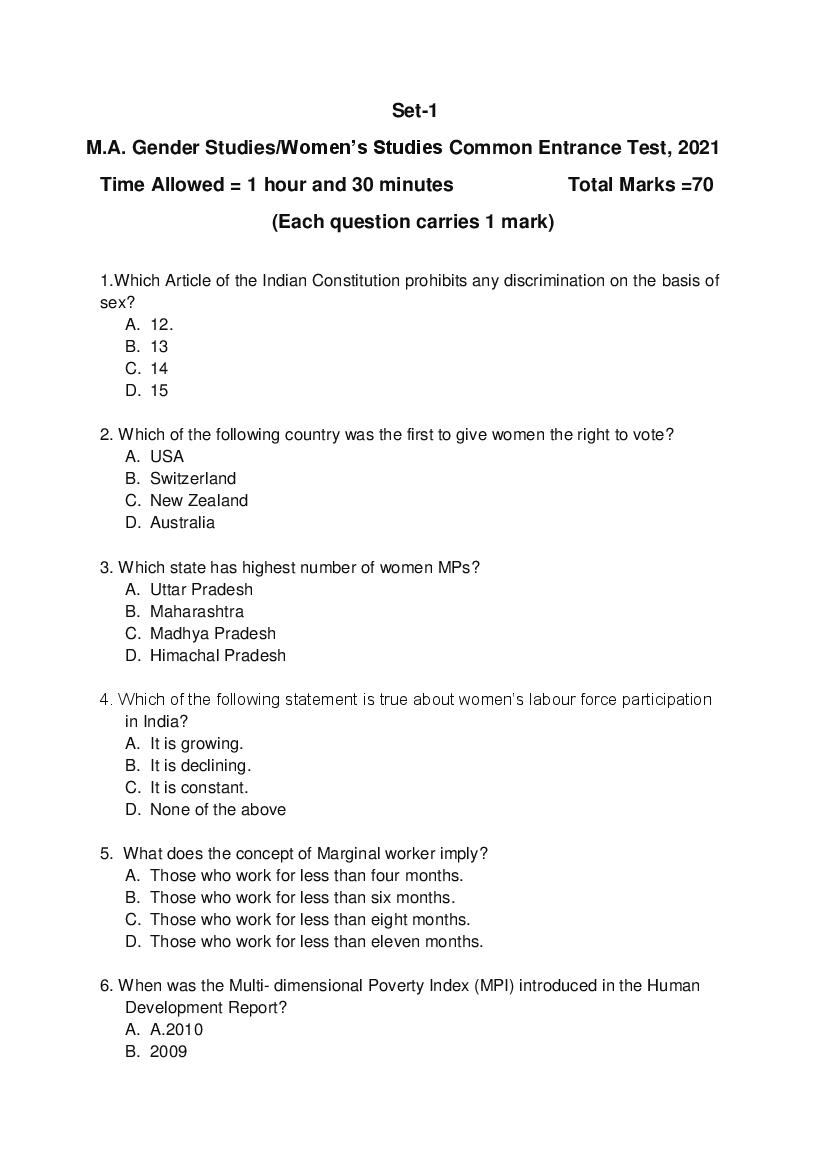
M.A. Gender Studies/Women’s Studies Common Entrance Test, 2021
Time Allowed = 1 hour and 30 minutes Total Marks =70
(Each question carries 1 mark)
1.Which Article of the Indian Constitution prohibits any discrimination on the basis of
sex?
A. 12.
B. 13
C. 14
D. 15
2. Which of the following country was the first to give women the right to vote?
A. USA
B. Switzerland
C. New Zealand
D. Australia
3. Which state has highest number of women MPs?
A. Uttar Pradesh
B. Maharashtra
C. Madhya Pradesh
D. Himachal Pradesh
4. Which of the following statement is true about women’s labour force participation
in India?
A. It is growing.
B. It is declining.
C. It is constant.
D. None of the above
5. What does the concept of Marginal worker imply?
A. Those who work for less than four months.
B. Those who work for less than six months.
C. Those who work for less than eight months.
D. Those who work for less than eleven months.
6. When was the Multi- dimensional Poverty Index (MPI) introduced in the Human
Development Report?
A. A.2010
B. 2009
Page 2
D. 2011
7. What does LPG stand for?
A. Liberal Processing Globalization
B. Liberalization Poverty Globalization
C. Liberalization, Privatization and Globalization
D. Low Pressured Gas
8. What is a provisional supposition called in a research?
A. Sample
B. Experiment
C. Conclusion
D. Hypothesis
9. Which of the following feminism stresses on women’s equality?
A. Liberal Feminism
B. Radical Feminism
C. Socialist Feminism
D. Eco Feminism
10. Which of the following pair is correctly matched?
A. Tara Ali Bag- Khilafat Movement
B. Aruna Asaf Ali- Quit India Movement
C. Madhuri Shah- Anti- arrack Movement
D. Mother Teresa- Swadeshi Movement
11. Who among the following was the first Woman Chief Minister of an Indian state?
A. Smt. Jayalalitha
B. Sheila Dikshit
C. Mrs. Sucheta Kripalini
D. Sarojini Naidu
12. Who was the mother of Abhimanyu in Mahabharat?
A. Draupadi
B. Ulupi
C. Chitrangada
D. Subhadra
13. How are the members of the Rajya Sabha elected?
A. The People
B. The members of the Lok Sabha
C. Elected members of the Legislative Assembly
Page 3
14. Who among the following wrote the ‘Laxmi Puran’?
A. Jagannath Das
B. Balaram Das
C. Sarala Das
D. None of the above
15. What does a Gender sensitive curriculum refer to?
A. A curriculum that has separate provision for women students.
B. A curriculum that excludes Mathematics and Physical Science
C. A curriculum that attempts to challenge the gender stereotypes.
D. A curriculum that includes only women’s issues.
16. Who among the following is a Sahitya Academy Award winner?
A. Shobha De
B. Amrita Saxsena
C. Amrita Pritam
D. Kishwar Desai
17. Which country declares National Holiday on ‘Women’s Day’?
A. America
B. Russia
C. China
D. India
18. Which State has the lowest child sex ratio?
A. Haryana
B. Punjab
C. Gujarat
D. Rajasthan
19. Which Article of the Constitution makes the Right to Education a Fundamental
Right?
A. Article 19
B. Article 39
C. Article 21 A
D. Article 51 A
Page 4
A. Ashwini Ponnappa
B. Geetika Jakhar
C. Mithali Raj
D. Dutee Chand
21. Which of the regions of India have low prevalence of female infanticide and
female foeticide?
A. North Eastern Region
B. South Central Region
C. North West Region
D. Southern Region
22. What for, the UNO nominated ‘Malala’ as UN Ambassador?
A. To promote Girls’ Safety and Security
B. To promote Girls’ Rights
C. To promote Girls’ Education
D. To promote Girls’ nutrition
23. Who among the following is the first Woman to receive Bharat Ratna Award?
A. Mother Teresa
B. Indira Gandhi
C. Sarojini Naidu
D. Aruna Asaf Ali
24. Which period was declared as the UN Development Decade for women?
A. A.1975 – 85
B. 1985 – 95
C. 1991 – 2000
D. 2001 – 2011
25. In which year the Hindu Marriage Act was passed?
A. 1950
B. 1952
C. 1955
D. 1956
26. Which of the following is an urban problem?
A. Slums
Page 5
C. Unemployment
D. All the above
27. Who among the following led the Narmada Bachao movement?
A. Medha Patekar
B. Neera Desai
C. Sunderlal Bahuguna
D. Sibu Soren
28. Which of the following institutions does not serve the women exclusively?
A. State Commission for women
B. State Human Rights Commission
C. Mahila Banks
D. Mahila Police stations
29. Which among the following states produces rubber in large quantities?
A. Assam
B. Kerala
C. Tamil Nadu
D. Karnataka
30.Which of the following is a permanent feature of a representative form of
government
A. Voting.
B. Decision Making.
C. Military Force.
D. None of The Above.
31. Who defined democracy as “Government of the people, by the people, for the
people”?
A. Woodrow Wilson
B. Lord Bryce
C. Abraham Lincoln
D. Laski
32. Who among the following considers poverty as a result of exploitation and not of
scarcity?
A. Weber
B. Plato
C. Marx
D. Pareto
Page 6
A. Traditional values
B. Customs
C. Folkways
D. Modern education
34. What is the full form of OBC?
A. Other Backward Class
B. Other Backward Caste
C. Over Backward Class
D. Over Backward Caste
35. When women bear the disproportionate burdens of poverty, what is it called?
A. Poverty among women
B. Unequal poverty
C. Additional poverty
D. Feminisation of poverty
36. Which of the following health programme aims at improving the health status
of women, adolescents, and children?
A. RMNCH+A
B. ICDS
C. IRDP
D. ORS
37. Who among the following is responsible for the immunization of the pregnant
ladies?
A. ASHA workers
B. Anganwadi workers
C. Village level workers
D. Both a and b
38. What is the nature of the Constitution of India?
A. Flexible
B. Rigid
C. Partly rigid and partly flexible
D. None of the above
39. Which of the following is the highest civilian award in India?
A. Padma Vibhusan
B. Padma Vhusan
C. Padma Shree
D. Bharat Ratna
Page 7
A. Arundhati Roy
B. Bell Hook
C. Gayatri Spivak
D. Anita Desai
41. To which country does Sirimavo Bandaranaike belong?
A. Sri Lanka
B. India
C. Pakistan
D. Great Britain
42. What does Gender Role stereotypes refer to?
A. Beliefs about differences between Men and Women
B. As it is revealed by the society
C. Gender identity
D. None of the above
43. Who among the following was the first women to win the title of international
grand master in chess?
A. P.V. Sindhu
B. Bachenderi Pal
C. Punita Arora
D. Bhagyashree Thipse
44. With which health programme AYUSH is associated?
A. NFHS
B. NRHM
C. RCH
D. NACO
45. Among the following women whose name is closely associated with Central
Social Welfare Board?
A. Dr. Annie Besant
B. Aruna Asaf Ali
C. Vijayalakshmi Pandit
D. Durgabai Deshmukh
46.In which year, the Equal Remuneration Act was enacted?
A. 1956
B. 1966
Page 8
D. 1986
47. Which of the following is used in pencils?
A. Graphite
B. Silicon
C. Sulphite
D. Dolomite
48.What is the chemical formula for water?
A. Na AIO2
B. H2O
C. AI2O3
D. NH3
49. What is the common name for washing soda?
A. Sodium Carbonate
B. Sodium Bicarbonate
C. Calcium Carbonate
D. Calcium Bicarbonate
50. Which among the following Kavya of Sanskrit, deal with court intrigues & access
to power of Chandragupta Maurya?
A. Mrichhakatika
B. Ritusamhara
C. Kumarasambhava
D. Mudrarakshahsa
51. Which king started the organization of Kumbh fair at Allahabad?
A. Harshavardhana
B. Dhruvasena Ii
C. Narshimhvarman
D. Akabar
52. What does Upanishads deal with?
A. Politics
B. Philosophy
C. Medicine
D. Social life
Page 9
Pakistan?
A. Alamgirpur
B. Harappa
C. Rangapur
D. Mohenjo-Daro
54. Who was the main male God worshipped by Indus people?
A. Lord Vishnu
B. Vishnu
C. Brahma
D. Indra
55. Which organisation in India makes National Income estimates?
A. Planning Commission
B. Reserve Bank of India
C. Central statistical organisation
D. Indian statistical Institute
56.Who has authored the book 'Freedom Behind Bars '?
A. Kiran Bedi
B. Nelson Mandela
C. Sobha Dey
D. Arundhati Ray
57. Who has authored the Book “Guide”?
A. Sobha Dey
B. Munshi Premchand
C. R.K.Narayan
D. None of the above
58. Who has authored the the famous book ' The Daughter of the East ' ?
A. Ms. Tashlima Nasrin
B. Mrs. Benazir Bhutto
C. Sobha Dey
D. Arundhati Ray
59.Where is the Union Budget is always presented first?
A. Union Cabinet
A. The Lok Sabha
B. The Rajya Sabha
C. Joint Session of the Parliament
Page 10
A. The Supreme Court
B. The Parliament
C. The Constitution
D. All the above
61. Which among the following is a socially constructed phenomena, that shifts and
changes over time?
A. Gender
B. Femininity
C. Masculinity
D. All the above
62. ‘Aravanis’ or ‘Hijras’ is a term associated with----------
A. Devadasis
B. Transgenders
C. Lesbians
D. Bisexuals
63. How many goals are there in SDG?
A. 13.
B. 15
C. 16.
D. 17
64. Which of the following explains ‘Crude birth Rate’?
A. Number of children below five years of age per thousand of women in the
reproductive age group per year.
B. Number of births per thousand of women in the reproductive age group per
year.
C. Number of births per thousand of the population per year.
D. Total number of births per year in the country.
65. Watson and Skinner both contributed to which school of psychology?
A. Functionalism
B. Cognitive
C. Socio-cultural
D. Behaviourism
66. Mark the correct answer about Gender Studies from the following.
Page 11
B. It is an academic discipline
C. Both a and b
D. It is narratives of women by women
67. What is a person who supports feminism is called?
A. Feminist
B. Female
C. Male feminists
D. None
68. Whose prophecy was “One People, One State, One leader”?
A. Stalin
B. Hitler
C. Lenin
D. Mussolini
69. Who wrote the famous feminist text ‘A Room of One’s Own’?
A. Simone De Beauvoir
B. Mary Wollstonecraft
C. Virginia Woolf
D. Joan Kelly
70. Which goal of the MDG dealt with gender equality and empowerment?
A. Goal-2
B. Goal-4
C. Goal-5
D. Goal-3
Document Details
| Board / Org | Odisha Exams |
| Exam | Odisha CPET |
| Type | Question Paper |
| Pages | 11 |
| Updated | 22 Jul 2026 |