TN 12th Model Question Paper History
Finished viewing? Save it for later —
Download TN 12th Model Question Paper History (PDF · 12 pages)About TN 12th Model Question Paper History
TN 12th Model Question Paper History is available here for free download. Published by Tamil Nadu Board for Class 12, this sample paper can be viewed online or downloaded as a PDF (12 pages). Candidates preparing for Class 12 can use TN 12th Model Question Paper History to understand the exam pattern, the type of questions asked, and the overall difficulty level.
Frequently Asked Questions
How can I download TN 12th Model Question Paper History?
Open this page and click the Download button to save TN 12th Model Question Paper History as a PDF. It is completely free on AglaSem Docs.
Is TN 12th Model Question Paper History free to download?
Yes. TN 12th Model Question Paper History can be viewed online and downloaded as a PDF free of cost on AglaSem Docs.
How many pages does TN 12th Model Question Paper History have?
TN 12th Model Question Paper History contains 12 pages, which you can read online or download together as a single PDF.
Where can I find more Class 12 study material?
You can find more Class 12 question papers, sample papers, syllabus, and answer keys on AglaSem Docs.
TN 12th Model Question Paper History – Text
Read the full text of this sample paper below — useful to quickly search, copy and reference the content online without downloading the PDF.
📄 View text version (12 pages)
Page 1
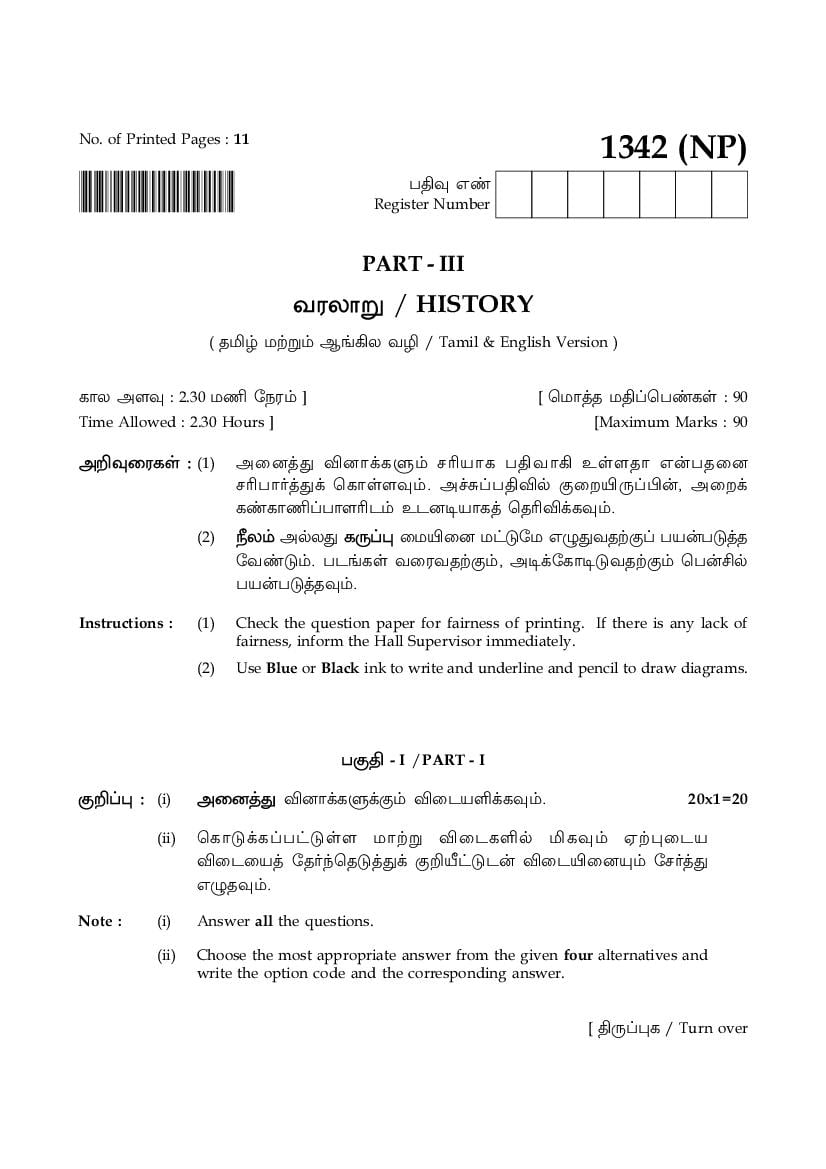
1342 (NP)
!1342NPHistory! £vÄ Gs
Register Number
PART - III
Áµ»õÖ / HISTORY
( uªÌ ©ØÖ® B[Q» ÁÈ / Tamil & English Version )
Põ» AÍÄ : 2.30 ©o ÷|µ® ] [ ö©õzu ©v¨ö£sPÒ : 90
Time Allowed : 2.30 Hours ] [Maximum Marks : 90
AÔÄøµPÒ : (1) AøÚzx ÂÚõUPЮ \›¯õP £vÁõQ EÒÍuõ GߣuøÚ
\›£õºzxU öPõÒÍÄ®. Aa_¨£vÂÀ SøÓ°¸¨¤ß, AøÓU
PsPõo¨£õÍ›h® EhÚi¯õPz öu›ÂUPÄ®.
(2) }»® AÀ»x P¸¨¦ ø©°øÚ ©mk÷© GÊxÁuØS¨ £¯ß£kzu
÷Ásk®. £h[PÒ ÁøµÁuØS®, AiU÷PõikÁuØS® ö£ß]À
£¯ß£kzuÄ®.
Instructions : (1) Check the question paper for fairness of printing. If there is any lack of
fairness, inform the Hall Supervisor immediately.
(2) Use Blue or Black ink to write and underline and pencil to draw diagrams.
£Sv - I / PART - I
SÔ¨¦ : (i) AøÚzx ÂÚõUPÐUS® Âøh¯ÎUPÄ®. 20x1=20
(ii) öPõkUP¨£mkÒÍ ©õØÖ ÂøhPÎÀ ªPÄ® Hئøh¯
Âøhø¯z ÷uº¢öukzxU SÔ±mkhß Âøh°øÚ²® ÷\ºzx
GÊuÄ®.
Note : (i) Answer all the questions.
(ii) Choose the most appropriate answer from the given four alternatives and
write the option code and the corresponding answer.
[ v¸¨¦P / Turn over
Page 2
1. £U\õº ÷£õº |øhö£ØÓ Bsk :
(A) 1773 (B) 1775 (C) 1757 (D) 1764
The Battle of Buxar took place in the year :
(a) 1773 (b) 1775 (c) 1757 (d) 1764
2. ö\°ßm áõºä ÷Põmøhø¯ Aø©zuÁº ¯õº ?
(A) ¤µõß]ì ÷h (B) ÂÀ¼¯® ö£si[ ¤µ¦
(C) Áõµß ÷íìi[ì ¤µ¦ (D) PõµßÁõ¼ì ¤µ¦
Who constructed the Fort St. George ?
(a) Francis Day (b) Lord William Bentinck
(c) Lord Warren Hastings (d) Lord Cornwallis
3. ÷|£õÍ® J¸ Á¼ø© ªUP TºUPõ Aµ\õP GÊa] ö£ØÓ Bsk :
(A) 1761 (B) 1768 (C) 1801 (D) 1814
Nepal emerged as a powerful Gurkha state in __________.
(a) 1761 (b) 1768 (c) 1801 (d) 1814
4. 1853 &B® Bsk __________ ¼¸¢x __________ US, •uÀ Cµ°À £õøu
öuõh[P¨£mhx.
(A) £®£õ´, PÀPzuõ (B) £®£õ´, A»Põ£õz
(C) £®£õ´, ¦÷Ú (D) £®£õ´, uõ÷n
The first railway line between __________ and __________ was opened in the year
1853.
(a) Bombay, Calcutta (b) Bombay, Allahabad
(c) Bombay, Pune (d) Bombay, Thane
Page 3
5. {ø»¯õÚ {»Á›z vmhzøu AÔ•P¨£kzv¯Áº :
(A) ÂÀ¼¯® ö£si[ ¤µ¦ (B) hÀíÄ] ¤µ¦
(C) PõµßÁõ¼ì ¤µ¦ (D) öÁÀö»ì¼ ¤µ¦
The Permanent Settlement was introduced by :
(a) Lord William Bentinck (b) Lord Dalhousie
(c) Lord Cornwallis (d) Lord Wellesley
6. uÚx u¢øu°ß ©øÓÄUS¨ ¤ÓS, õ£õsi¯ Pmhö£õ®©ß, __________ ß
£õøͯUPõµµõP ö£õÖ¨÷£ØÓõº.
(A) ö|À Pmk® ÷\ÁÀ (B) ug\õź
(C) v¸a]µõ¨£ÒÎ (D) £õg\õ»[SÔa]
Vira Pandya Kattabomman became the Palayakkarar of __________ after his father's
death.
(a) Nerkkattumseval (b) Thanjavur
(c) Tiruchirappalli (d) Panchalamkuruchi
7. ÷£µµ]°ß AÔUøPø¯ PõÛ[ ¤µ¦ __________ GÝ® ChzvÀ £izuõº.
(A) A»Põ£õz (B) ö\ßøÚ
(C) öhÀ¼ (D) öPõÀPzuõ
The Queen's proclamation was read by Lord Canning at :
(a) Allahabad (b) Chennai
(c) Delhi (d) Kolkatta
8. |õmk ö©õÈ ö\´vzuõÒ \mh® öPõskÁµ¨£mh Bsk Gx ?
(A) 1898 (B) 1902 (C) 1878 (D) 1882
In which year the Vernacular Press Act was passed ?
(a) 1898 (b) 1902 (c) 1878 (d) 1882
[ v¸¨¦P / Turn over
Page 4
9. ¤ßÁ¸£ÁºPÎÀ A¼Põº C¯UPzøu öuõh[Q¯Áº ¯õº ?
(A) •P©x A¼ âßÚõ (B) •P©x AÀ&íõ\ß
(C) \º ø\¯x AP©x Põß (D) \¼•À»õ Põß
Who among the following started the Aligarh Movement ?
(a) Muhammad Ali Jinnah (b) Muhammad Al Hasan
(c) Sir Syed Ahmed Khan (d) Salimullah Khan
10. C¢v¯õÂß •xö£¸® ©Ûuº GßÖ AøÇUP¨£mhÁº :
(A) uõuõ£õ´ ö|Í÷µõâ (B) ÷Põ£õ» Q¸èn ÷PõP÷»
(C) Põ¢v¯iPÒ (D) \ºuõº ÁÀ»£õ´ £m÷hÀ
__________ was known as the 'Grand Old Man of India'.
(a) Dadabhai Naoroji (b) Gopala Krishna Gokhale
(c) Gandhiji (d) Sardar Vallabhbhai Patel
11. ""_¯µõ䯮 GÚx ¤Ó¨¦›ø© Aøu |õß Aøh¢÷u w¸÷Áß'' GßÖ
•Ç[Q¯Áº ¯õº ?
(A) AµÂ¢u ÷Põè (B) \¼•À»õ Põß
(C) £õ» P[Põuµ v»Pº (D) »õ»õ »á£v µõ´
"Swaraj is my birth-right and I will have it" - who declared this ?
(a) Aurobindo Ghosh (b) Salimullah Khan
(c) Bala Gangadhar Tilak (d) Lala Lajpat Rai
12. ö\ßøÚ _÷u] \[P® {ÖÁ¨£mh Bsk :
(A) 1816 (B) 1826 (C) 1853 (D) 1852
The Madras Native Association was started in :
(a) 1816 (b) 1826 (c) 1853 (d) 1852
Page 5
13. ¤ßÁ¸ÁÚÁØÖÒ ö£›¯õº öuõh[Põu £zv›UøP Gx ?
(A) Âkuø» (B) _¯µõä¯õ
(C) Si¯µ_ (D) ¦µm]
Which of the following journal was not founded by Periyar ?
(a) Viduthalai (b) Swarajya
(c) Kudi Arasu (d) Puratchi
14. uø»ø© BÐ|›ß {ºÁõPU SÊÂÀ Ch® ö£ØÓ •uÀ C¢v¯ \mh
EÖ¨¤Úº :
(A) ø\©ß (B) ©õº¼
(C) \º \õº»ì Äm (D) Gì.¤. ]ßíõ
The first Indian law member to the Governor General's council was __________.
(a) Simon (b) Morley
(c) Sir Charles Wood (d) S.P. Sinha
15. C¢v¯ JßÔ¯zvÀ ÷\µ ©Özu Aµ_ __________.
(A) öá´§º (B) v¸Áõ[Tº
(C) øíuµõ£õz (D) ø©`º
Which of the following princely state refused to join the Indian Union ?
(a) Jaipur (b) Travancore
(c) Hyderabad (d) Mysore
[ v¸¨¦P / Turn over
Page 6
16. ¤ßÁ¸£ÁºPÎß |ÃÚ AÔ¯¼ß u¢øu GßÖ P¸u¨£k£Áº ¯õº ?
(A) öP¨Íº (B) {³mhß
(C) ÷Põ£õº{Pì (D) ¤µõß]ì ÷£Pß
Who among the following is considered as the 'Father of Modern Science' ?
(a) Kepler (b) Newton
(c) Copernicus (d) Francis Bacon
17. Áõì÷PõhPõ©õ C¢v¯õøÁ ö\ßÖ Aøh¢u Bsk __________.
(A) 1492 (B) 1497 (C) 1498 (D) 1493
Vascodagama reached India in __________.
(a) 1492 (b) 1497 (c) 1498 (d) 1493
18. Gm©sm Põºmøµm __________ Psk¤izuõº.
(A) øu¯À C¯¢vµ® (B) }µõ Cg]ß
(C) ªß ÂÍUSPÒ (D) Âø\zuÔ
Edmund Cartwright invented __________.
(a) Sewing Machine (b) Steam Engine
(c) Electric Light (d) Power Loom
19. •uÀ E»P ÷£õ›ß ÷£õx ""C¸®¦a ]¾øÁ'' GßÓ öP͵Á ¸øu ö£ØÓÁº
¯õº ?
(A) PõºÀ ©õºUì (B) öP´\º ÂÀ¼¯®
(C) îm»º (D) •÷\õ¼Û
Who was honoured by "Iron Cross" during the First World War ?
(a) Karl Marx (b) Kaiser William
(c) Hitler (d) Mussolini
20. ^ÚõÂß "ÂiöÁÒÎ' GÚ¨ ÷£õØÓ¨£mhÁº :
(A) `¯ß»õ´ (B) ¼ß÷\_
(C) hõUhº \߯õm ö\ß (D) ©õ÷\x[
Who was known as 'Morning Star of China' ?
(a) Chou-en-lai (b) Lin Tse Hsu
(c) Dr. Sun Yat Sen (d) Mao Tse Tung
Page 7
£Sv & II / PART - II
H÷uÝ® HÊ ÂÚõUPÐUS _¸UP©õP Âøh¯ÎUPÄ®. ÂÚõ Gs
30 &US Psi¨£õP Âøh¯ÎUPÄ®. 7x2=14
Explain any seven questions briefly in which question no. 30 is compulsory.
21. ÿµ[P£min® EhߣiUøP
Treaty of Srirangapattinam
22. hÀíÄ]°ß Ag\ÀxøÓ ^ºv¸zu[PÒ
Dalhousie's Postal Reforms
23. ©PÀÁõ› •øÓ
Mahalwari Settlement
24. \º áõß QµhõU
Sir John Cradock
25. µõo »m_ª £õ´
Rani Lakshmi Bai
26. £õº] ^ºv¸zu C¯UP®
Parsi Reform Movement
27. £_ø©¨ ¦µm]
Green Revolution
28. £õìhß ÷u}º ¸¢x
Boston Tea Party
29. ÷µõ®&ö£º¼ß&÷hõUQ÷¯õ Aa_
Rome-Berlin-Tokyo Axis
30. ÷£µõvUPU öPõÒøP
Extreme Nationalism
[ v¸¨¦P / Turn over
Page 8
£Sv & III / PART - III
H÷uÝ® HÊ ÂÚõUPÐUS Âøh¯ÎUPÄ®. ÂÚõ Gs 40 &US
Psi¨£õP Âøh¯ÎUPÄ®. 7x3=21
Answer any 7 questions, out of which question no. 40 is compulsory.
31. JÊ[S•øÓ \mhzvß •UQ¯ Âv•øÓPÒ £ØÔ ÂÁõvUP.
Discuss the main provisions of the Regulating Act.
32. ¤shõ›PøÍ JÈUP ÷íìi[ì ¤µ¦ ÷©ØöPõsh |hÁiUøPPøÍ &
ÂÁõvUP.
Discuss the efforts taken by Lord Hastings to eliminate the Pindaris.
33. Áõ›_ CÇUS® öPõÒøP°ß P¸zx ©ØÖ® |øh•øÓ £ØÔ GÊxP.
Explain the principle and application of the Doctrine of Lapse.
34. EÒÍõm] Aø©¨¦PÎß •UQ¯zxÁzøu¨ £ØÔ ÂÁõvUP.
Discuss the importance of Local Self-Government.
35. ußÚõm] C¯UP® £ØÔ GÊxP.
Write a note on the Home Rule Movement.
36. öµÍ»m \mh® £ØÔ ]Ö SÔ¨¦ GÊxP.
Write a short note on Rowlatt Act.
37. ¦Â°¯À Psk¤i¨¦PÐUPõÚ Põµn[PøÍ B´P.
Analyse the causes for the geographical discoveries.
38. ¤µg_¨ ¦µm]US ¤µõß_ ]¢uøÚ¯õͺPÎß £[PΨø£ B´P.
Examine the contributions of the French Philosophers to the French Revolution.
Page 9
39. µè¯ ¦µm]°ß ÂøÍÄPøÍ GÊxP.
Write a note on results of the Russian Revolution.
40. £ßÚõmkU PÇPzvß •UQ¯ EÖ¨¦PøÍ £mi¯¼mk, £ßÚõmk }v©ßÓ®
SÔzx SÔ¨¦ ÁøµP.
List out the important organs of the League of Nations and give an account of The
International Court of Justice.
£Sv & IV / PART - IV
AøÚzx ÂÚõUPÐUS® Âøh¯ÎUPÄ®. 7x5=35
Answer all the questions.
41. (A) PõµßÁõ¼ì ¤µ¦Âß ^ºv¸zu[PøÍ ©v¨¤kP.
AÀ»x
(B) ""ö£si[ ¤µ¦ \‰P ^ºv¸zu[PÒ Põ»zøu öuõh[Q øÁzuõº'' &
P¸zxU TÖP.
(a) Estimate the reforms of Lord Cornwallis.
OR
(b) "Bentinck inaugurated an era of social reforms" - Comment.
42. (A) 1806 &B® Bsk ÷Á¿º ]¨£õ´ P»PzxUPõÚ Põµn[PøÍ B´P.
AÀ»x
(B) 19 &B® ¡ØÓõsk C¢v¯õÂÀ ÷uõßÔ¯ \‰P&\©¯ ^ºv¸zu
C¯UP[PÎß •UQ¯zxÁzøu B´P.
(a) Examine the causes for the outbreak of Vellore Mutiny of 1806.
OR
(b) Examine the importance of the socio-religious reform movements of 19th century
in India.
[ v¸¨¦P / Turn over
Page 10
43. (A) C¢v¯õÂÀ ÷u]¯® ÷uõßÖÁuØPõÚ Põµn[PøÍ B´P.
AÀ»x
(B) }vUPm]°ß \õuøÚPøÍ B´P.
(a) Examine the causes for the rise of nationalism in India.
OR
(b) Examine the achievements of the Justice Party rule in Tamil Nadu.
44. (A) \©¯ ^ºv¸zuzvØPõÚ Põµn[PøÍ B´P.
AÀ»x
(B) öuõÈئµm]°ß |ßø©, wø©PøÍ B´P.
(a) Examine the causes for the Reformation.
OR
(b) Analyse the merits and demerits of the Industrial Revolution.
45. (A) •uÀ E»P¨ ÷£õ¸UPõÚ £À÷ÁÖ Põµn[PøÍU TÖP.
AÀ»x
(B) öẩ۰À |õ]\ P¸zxUPøÍ ÂÁ›zx Auß Áͺa]ø¯ B´P.
(a) Enumerate the various causes of the First World War.
OR
(b) Analyse the principles and growth of Nazism in Germany.
46. (A) ¤µõ¢v¯ £õxPõ¨¦ |hÁiUøPPÒ £ØÔ ÂÁ›.
AÀ»x
(B) C¢v¯õÄ® E»P©¯©õUP¾® & ÂÁ›.
(a) Regional Security Arrangement - Explain.
OR
(b) Explain - India and Globalization.
Page 11
47. (A) 1750 - 1850 Áøµ°»õÚ Aµ]¯À Aø©¨¦ Áͺa]PøÍ Põ»U÷Põk Põmi
ÁøµP.
AÀ»x
(B) (i) C¢v¯ Áøµ£hzvÀ RÌUPsh I¢x Ch[PøÍ SÔUPÄ®.
(A) |õU§º
(B) ©`¼¨£miÚ®
(C) £Úõµì
(D) £i¯õ»õ
(E) £÷µõhõ
(ii) hÀíÄ] ¤µ¦Âß RÌ C¸¢u B[Q» ÷£µµ]øÚ ÁøµP.
(a) Draw a time-line for the Constitutional developments from 1750 to 1850 pointing
out the important events of that period.
OR
(b) (i) Mark the following five places on the outline map of India.
(a) Nagpur
(b) Masulipatnam
(c) Benares
(d) Patiala
(e) Baroda
(ii) Draw the English Possession under Lord Dalhousie.
-o0o-
[ v¸¨¦P / Turn over
Page 12
Document Details
| Board / Org | Tamil Nadu Board |
| Exam | Class 12 |
| Type | Sample Paper |
| Pages | 12 |
| Updated | 09 Jun 2026 |