PSEB 11th Class Syllabus 2027 Business Studies
Finished viewing? Save it for later —
Download PSEB 11th Class Syllabus 2027 Business Studies (PDF · 4 pages)About PSEB 11th Class Syllabus 2027 Business Studies
PSEB 11th Class Syllabus 2027 Business Studies is available here for free download. Published by Punjab Board for Class 11, this syllabus can be viewed online or downloaded as a PDF (4 pages). Candidates preparing for Class 11 can use PSEB 11th Class Syllabus 2027 Business Studies to understand the exam pattern, the type of questions asked, and the overall difficulty level.
Frequently Asked Questions
How can I download PSEB 11th Class Syllabus 2027 Business Studies?
Open this page and click the Download button to save PSEB 11th Class Syllabus 2027 Business Studies as a PDF. It is completely free on AglaSem Docs.
Is PSEB 11th Class Syllabus 2027 Business Studies free to download?
Yes. PSEB 11th Class Syllabus 2027 Business Studies can be viewed online and downloaded as a PDF free of cost on AglaSem Docs.
How many pages does PSEB 11th Class Syllabus 2027 Business Studies have?
PSEB 11th Class Syllabus 2027 Business Studies contains 4 pages, which you can read online or download together as a single PDF.
Where can I find more Class 11 study material?
You can find more Class 11 question papers, sample papers, syllabus, and answer keys on AglaSem Docs.
PSEB 11th Class Syllabus 2027 Business Studies – Text
Read the full text of this syllabus below — useful to quickly search, copy and reference the content online without downloading the PDF.
📄 View text version (5 pages)
Page 1
PSEB 11th Class
Syllabus 2027 Business
Studies
EXAM YEAR TYPE SUBJECT
Punjab Class 11 2027 Syllabus Business Studies
Notes · Sample Papers · Previous Year Papers · Mock Tests
Page 2
.co s e m
s em BUSINESS STUDIES g l a
a a
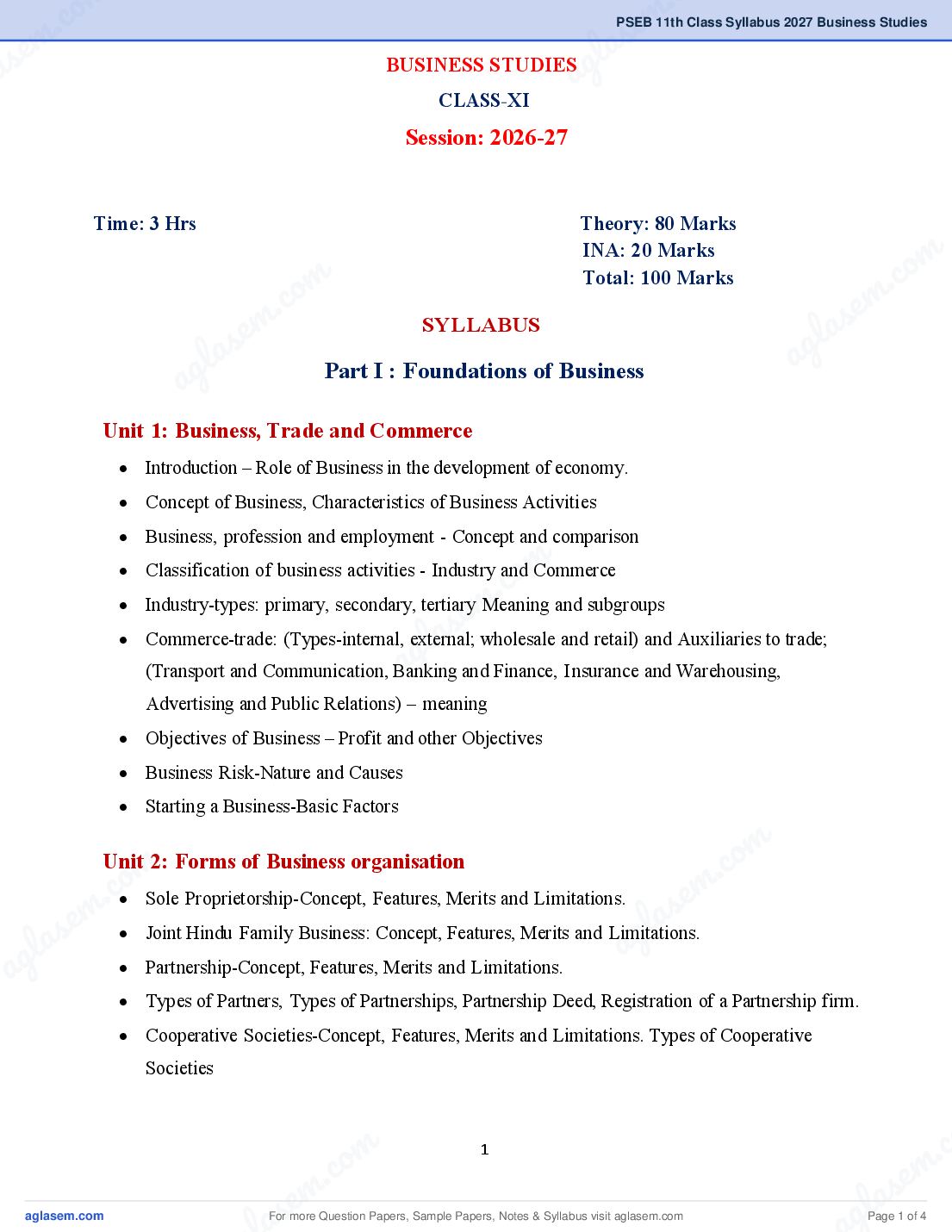
CLASS-XI
Session: 2026-27
Time: 3 Hrs Theory: 80 Marks
INA: 20 Marks
m
om
Total: 100 Marks . co
. c e m
e m SYLLABUS
l as
l as ag
ag Part I : Foundations of Business
Unit 1: Business, Trade and Commerce
Introduction – Role of Business in the development of economy.
Concept of Business, Characteristics of Business Activities
Business, profession and employment - Concept and comparison
o m
Classification of business activities - Industry and Commerce
Industry-types: primary, secondary, tertiarym
. c
s e Meaning and subgroups
a
l wholesale and retail) and Auxiliaries to trade;
Commerce-trade: (Types-internal, external;
g
a and Finance, I nsurance and Warehousing,
(Transport and Communication, Banking
Advertising and Public Relations) – meaning
Objectives of Business – Profit and other Objectives
Business Risk-Nature and Causes
Starting a Business-Basic Factors
m
Unit 2: Forms of Business organisation
m
c. o Sole Proprietorship-Concept, Features, Merits and Limitations.
m .co
s e
s em Joint Hindu Family Business: Concept, Features, Merits and Limitations.
g l a
g la a
a Partnership-Concept, Features, Merits and Limitations.
Types of Partners, Types of Partnerships, Partnership Deed, Registration of a Partnership firm.
Cooperative Societies-Concept, Features, Merits and Limitations. Types of Cooperative
Societies
m . c
c. o
1
e m
em as
s
For more Question Papers, Sample Papers, Notes & Syllabus visit
glPage 1 of 4
Page 3
Company.
Choice of form of business organisation
Unit 3: Private, Public and Global Enterprises
Introduction, Public Sector and Private Sector Enterprises – Concept
Forms of Organising Public Sector Enterprises: Departmental Undertakings,
Statutory Corporations and Government Company (Concept, Features, Merits and
Limitations)
Changing Role of Public Sector.
Joint Ventures: Concepts, types, and benefits.
Global Enterprises – Feature, Public Private Partnership – concept.
Unit 4: Business Services
Business Services – Meaning, Nature, Difference between services and goods.
Types of services
Banking: Types of banks, functions of a commercial banks, e-Banking – Meaning and benefits.
Insurance – Functions , Principles and Types – Life, Fire and Marine Insurance.
Communication Services, Postal Services, Telecom Services.
Transportation.
Warehousing: Concepts, types and functions.
Unit 5: Emerging Modes of Business
e-Business: concept, scope and benefits. Traditional Business versus e-Business.
Limitations of e-Business.
Online Transactions, Security and Safety of e-Transactions, e-Business Risks
Resources Required for Successful e-business Implementation.
Unit 6: Social Responsibilities of Business and Business Ethics
Concept of social responsibility, Need for Social Responsibility.
Arguments for and against social Responsibility.
Kinds of Social Responsibility
2
For more Question Papers, Sample Papers, Notes & Syllabus visit Page 2 of 4
Page 4
.co s e m
s em Social Responsibility towards Different Interest Groups. g l a
a a
Business and Environmental Protection
Business Ethics – Concept and Elements.
Part II : Corporate Organisation, Finance and Trade
m
Unit 7: Formation of a Company
om . co
. c e m
Introduction, Promotion of a company
m as
Functions ofsaePromoter, Documents Required – Memorandum of Association, Articles ofgl
g la etc. a
a
Association
Incorporation
Capital Subscription
One Person Company.
Unit 8: Sources of Business Finance
m
Meaning, nature and significance of business finance
m .co
s e
Classification of Sources of funds, Sources of finance- Retained Earnings, Trade Creditor,
g l a
Factoring, Lease Financing, Public Deposits, Commercial Papers, Issue of Shares- Equity
a
Shares, Preferences Shares, Debentures, Commercial Banks, Financial Institutions.
International Financing- Global Depository Receipt (GDRs), American Depository Receipt
(ADRs), Indian Depository Receipt (IDRs), Foreign Currency Convertible Bonds (FCCBs).
Factors affecting the choice of the source of funds.
m
.co
Unit 9: MSME and Business Entrepreneurship
m
c. o Micro, Small and Medium Enterprises: Meaning and role s e m
e m Problems associated with MSME la
las ag
ag MSME and Entrepreneurship Development.
Intellectual Property Rights- Importance and types.
m . c
c. o
3
e m
em as
s
For more Question Papers, Sample Papers, Notes & Syllabus visit
glPage 3 of 4
Page 5
Internal trade – meaning and types-Wholesale trade and retail trade, services rendered by
a wholesaler and a retailer
Types of retailing trade-Itinerant and fixed shops retailers
Fixed shop large stores-Departmental stores, chain stores – concept, features, advantages and
limitations.
Mail Order Houses, consumer cooperative store, super markets - concept, features, advantages
and limitations. Vending machines.
GST (Goods and Services Tax): Concept and key-features
Role of commerce and industry associations in promotion of internal trade.
Unit 11: International Business
International Business: concept and reasons and scope
International Business vs. Domestic Business
Benefits of International Business
Modes of entry into international business- Exporting and Importing, advantage and limitations.
Contract manufacturing, licensing and franchising, Joint Ventures, wholly-owned subsidiaries, -
meaning, advantages and limitation.
Export-Import procedures and documentation.
*****
4
For more Question Papers, Sample Papers, Notes & Syllabus visit Page 4 of 4