MBOSE Class 10 Question Bank 2027 Science
Finished viewing? Save it for later —
Download MBOSE Class 10 Question Bank 2027 Science (PDF · 110 pages)About MBOSE Class 10 Question Bank 2027 Science
MBOSE Class 10 Question Bank 2027 Science is available here for free download. Published by Meghalaya Board for Class 10, this question bank can be viewed online or downloaded as a PDF (110 pages). Candidates preparing for Class 10 can use MBOSE Class 10 Question Bank 2027 Science to understand the exam pattern, the type of questions asked, and the overall difficulty level.
Frequently Asked Questions
How can I download MBOSE Class 10 Question Bank 2027 Science?
Open this page and click the Download button to save MBOSE Class 10 Question Bank 2027 Science as a PDF. It is completely free on AglaSem Docs.
Is MBOSE Class 10 Question Bank 2027 Science free to download?
Yes. MBOSE Class 10 Question Bank 2027 Science can be viewed online and downloaded as a PDF free of cost on AglaSem Docs.
How many pages does MBOSE Class 10 Question Bank 2027 Science have?
MBOSE Class 10 Question Bank 2027 Science contains 110 pages, which you can read online or download together as a single PDF.
Where can I find more Class 10 study material?
You can find more Class 10 question papers, sample papers, syllabus, and answer keys on AglaSem Docs.
MBOSE Class 10 Question Bank 2027 Science – Text
Read the full text of this question bank below — useful to quickly search, copy and reference the content online without downloading the PDF.
📄 View text version (60 pages)
Page 1
MBOSE Class 10
Question Bank 2027
Science
EXAM YEAR TYPE SUBJECT
Meghalaya Class 10 2027 Question Bank Science
Notes · Sample Papers · Previous Year Papers · Mock Tests
Page 2
m .co
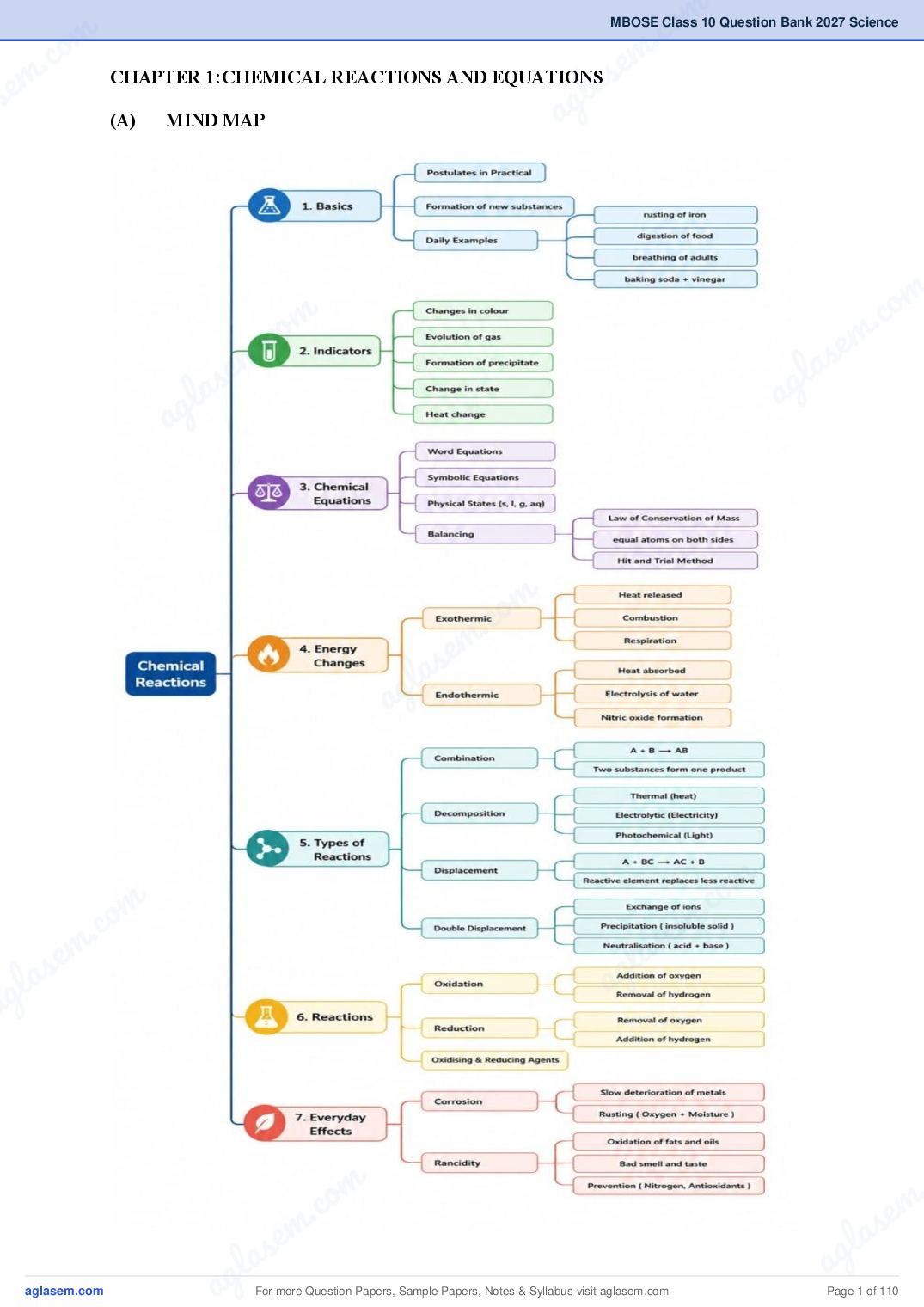
c. o CHAPTER 1:CHEMICAL REACTIONS AND EQUATIONS se
m
m la
se (A) MIND MAP a g
m
m c. o
.co s e m
em la
l a s a g
ag
m
. co
s em
g l a
a
m
m .co
c. o se
m
s em g la
gla a
a
m .
.co s e m
e m l a
l a s a g
ag For more Question Papers, Sample Papers, Notes & Syllabus visit Page 1 of 110
Page 3
• Chemical Reaction: When one or more substance, undergo a chemical change, with the
absorption or release of energy so as to form one or more products.
• Reactant: Substance(s) that take(s) part in chemical reaction.
• Product: The new substance(s) formed as a result of a chemical reaction
• Chemical Equation: The statement that describe a chemical reaction in terms of symbols
and formulae.
• Skeletal equation: A chemical equation expressed in symbols and formulae, such that the
numbers of atoms of different elements towards the side of reactants is not equal to the
number of atoms of the same element towards the side of products.
• Balance chemical equation: A chemical equation in which the number of atoms of each
element is same on both sides of reactant and product.
• Chemical combination reaction: When two substances react to form a new compound.
• Chemical decomposition reaction: When a compound decomposes on heating or
absorbing some kind of energy so as to form two or more substances.
• Thermal decomposition reaction: A chemical compound when decomposes on heating
so as to form two or more substances(elements or compounds).
• Photo chemical decomposition reaction: A chemical reaction in which a compound
decomposes into simpler substances on the absorption of light energy.
• Electrolytic decomposition reaction: A chemical reaction in which a compound
decomposes into simpler substances on passing electric current.
• Chemical displacement reaction: When a more active element displaces a less active
element from its aqueous ionic compound.
• Chemical double displacement reaction: A chemical reaction in which two ionic
compounds in their aqueous solution, react by exchanging their ions/ radicals, to form two
new compounds.
• Precipitation reaction: The aqueous solution of two ionic compounds when reacts by
exchanging their ions /radicals to form two or more new compounds such that one of the
products formed is an insoluble salt, and hence formed as precipitate. The double
displacement reactions are said to be precipitation reactions.
• Precipitate: An insoluble solid that is formed when two solutions react with each other
and separate out from the solution.
• Neutralisation: When an acid reacts with a base to form salt and water.
• Exothermic reaction: A chemical reaction which proceeds with the release of heat
energy.
• Endothermic Reaction: A chemical reaction which proceeds with the absorption of heat
energy.
• Oxidation: is a process in which there is addition of oxygen or removal of hydrogen.
• Reduction: is a process in which there is addition of hydrogen or removal of oxygen.
• Corrosion: the slow destruction of metals on exposure to the environment due to
oxidation.
• Rancidity: The oxidative deterioration of food stuff containing fats/oils.
**********
For more Question Papers, Sample Papers, Notes & Syllabus visit Page 2 of 110
Page 4
m .co
c. o CHAPTER 2: ACIDS, BASES AND SALTS
e m
em l a s
s a g
(A) MIND MAP
m
m c. o
.co s e m
em la
l a s a g
ag
m
. co
s em
g l a
a
m
m .co
c. o se
m
s em g la
gla a
a
m .
.co s e m
e m l a
l a s a g
ag For more Question Papers, Sample Papers, Notes & Syllabus visit Page 3 of 110
Page 5
• Acids: Substances that donate hydrogen ions (H⁺) in solution. They are characterised
by a sour taste, the ability to turn blue litmus red, and a pH less than 7. Examples:
hydrochloric acid (HCl), sulphuric acid (H2SO4), lemon juice, vinegar etc.
• Bases: Substances that accept hydrogen ions (H⁺) or donate hydroxyl ions (OH⁻) in
solution. They are characterised by a bitter taste, the ability to turn red litmus blue, and a
pH greater than 7. Examples: sodium hydroxide (NaOH), potassium hydroxide (KOH),
soap, baking soda etc.
• Indicators: Substances that change colour in the presence of acids or bases, helping to
identify them. Examples include litmus solution, turmeric, and phenolphthalein.
• Litmus: Blue litmus turns red in acids; red litmus turns blue in bases.
• Turmeric: Remains yellow in acids but turns reddish-brown in bases.
• Phenolphthalein: Colourless in acids and pink in bases.
• Methyl Orange: Red in acids and yellow in bases.
• Chemical Properties of Acids and Bases
Acids react with:
▪ Metals to produce salt and hydrogen gas.
▪ Metal carbonates and metal hydrogen carbonates to produce salt, carbon
dioxide and water.
▪ Bases to form salt and water (neutralisation).
Bases react with:
▪ Acids to produce salt and water (neutralisation).
▪ Certain metals like zinc and aluminium to produce salt and hydrogen gas.
• The strength of acids/bases depends on the number of H⁺ or OH⁻ ions produced in
water.
• Strong acids/bases ionise completely in water.
• Weak acids/bases ionize partially in water.
• pH: pH measures the acidity or basicity of a solution.
• pH Scale:
A scale used to measure the acidity or basicity of a solution, ranging from 0 to 14.
Solutions with:
▪ pH less than 7: Acidic
▪ pH = 7: Neutral
▪ pH greater than 7: Basic
• Importance of pH in everyday life
o Our body functions properly within a narrow pH range (7-7.8)
o Tooth decay begins when the mouth pH falls below 5.5.
o Antacids help reduce excess stomach acid.
o Farmers treat acidic soil with quick lime or slaked lime to improve soil
fertility.
• Salts: Ionic compounds formed when the hydrogen of an acid is replaced by a metal or
ammonium ion.
• Salts may be acidic (NH4Cl), basic (Na2CO3) or neutral (NaCl) depending on the acids and
bases from which they are formed.
• Chemicals from Common Salt
(a) Sodium Hydroxide (NaOH)
Prepared by the chlor-alkali process.
For more Question Papers, Sample Papers, Notes & Syllabus visit Page 4 of 110
Page 6
m .co
c. o
e m
em l a s
s g
Used in making soaps, paper and detergents.
(b) Bleaching Powder [𝑪𝒂𝑶𝑪𝒍₂]
Prepared by passing chlorine over dry slaked lime. a
Used for bleaching cotton and paper, disinfecting drinking water and as an oxidising
agent.
(c) Baking Soda (𝑵𝒂𝑯𝑪𝑶₃)
Used in baking powder, fire extinguishers and as an antacid.
(d) Washing Soda (𝑵𝒂₂𝑪𝑶₃ · 𝟏𝟎𝑯₂𝑶)
m
Used for cleaning clothes, softening hard water and in glass, soap and paper industries.
•
m
Water of Crystallisation: It is the fixed number of water molecules chemically attached to a
c. o
salt.
.co s e m
Examples:
em la
l a s
▪ Copper sulphate: 𝑪𝒖𝑺𝑶₄ · 𝟓𝑯₂𝑶
a g
ag
▪ Washing soda: 𝑵𝒂₂𝑪𝑶₃ · 𝟏𝟎𝑯₂𝑶
𝟏
• Plaster of Paris: CaSO4. 𝟐 H2O.
Uses: for casts to immobilise broken bones, cast for statues, toys and for making fire proof
materials etc.
**********
m
. co
s em
g l a
a
m
m .co
c. o se
m
s em g la
gla a
a
m .
.co s e m
e m l a
l a s a g
ag For more Question Papers, Sample Papers, Notes & Syllabus visit Page 5 of 110
Page 7
(A) MIND MAP
For more Question Papers, Sample Papers, Notes & Syllabus visit Page 6 of 110
Page 8
m .co
c. o (B) SUMMARY
e m
m a s
se a g l differentiated by their
Metals and non-metals are distinct categories of elements,
physical and chemical properties.
Physical Properties:
• Metals are:
o Lustrous (shiny).
o They are malleable (can be beaten into thin sheets).
o They are ductile (can be drawn into wires).
m
o They are good conductors of heat and electricity.
m c. o
o They are sonorous (produce a ringing sound when struck).
.co e m
o Most metals are hard except Sodium (Na) and Potassium (K) which are soft metals.
em
o Most metals are solid at room temperature except Mercury (Hg) (liquid at room
la s
l a s
temperature). Gallium (Ga) and Caesium (Cs) (melt at room temperature).
a g
ag
• Non-Metals are:
o Generally dull (non-lustrous) except Iodine.
o Soft and Brittle (break easily) except Diamond (hardest substance known).
o Neither malleable nor ductile.
o Poor conductors of heat and electricity except Graphite (conductor of electricity).
o Usually not sonorous.
Chemical Properties Metals and Non-metals:
• Reaction with Oxygen
m
co
o Metals react with oxygen to form metal oxides, which are generally basic in nature.
.
em
o Non-metals also react with oxygen to form non-metal oxides, which are generally
a s
acidic.
l
g Zinc oxide (ZnO)
o Amphoteric oxides: Metal oxides which react with both acids and bases to form salt
a
and water. Eg. Aluminium oxide (Al₂O₃),
• Reaction with Water
Different metals react differently with water.
o Potassium and sodium react vigorously with cold water.
o Calcium reacts less vigorously with cold water.
o Magnesium reacts with hot water.
o Iron reacts with steam.
m
co
o Copper, silver and gold do not react with water.
m .
c. •o
Non-metals generally do not react with water.
m
se
Reaction with Dilute Acids
s em la
Metals above hydrogen in the reactivity series react with dilute acids to produce salt and
la
hydrogen gas. Non-metals generally do not react with dilute acids.
a g
ag • Reaction with Salt Solutions
A more reactive metal displaces a less reactive metal from its salt solution.
• Reactivity Series: The arrangement of metals in decreasing order of their reactivity.
Metals can be arranged in a reactivity series based on their tendency to lose electrons and
form positive ions. This series helps predict the outcome of reactions between metals and
other substances.
The decreasing order of reactivity is:
m .
K > Na > Ca > Mg > Al > Zn > Fe > Pb > (H) > Cu > Hg > Ag > Au
.co s e m
e m l a
l a s a g
ag For more Question Papers, Sample Papers, Notes & Syllabus visit Page 7 of 110
Page 9
• Metals lose electrons to form positive ions (cations). Eg: Iron, copper, zinc, aluminium
etc.
• Non-metals gain electrons to form negative ions (anions). Eg: Oxygen, carbon, sulphur,
nitrogen etc.
The attraction between oppositely charged ions forms an ionic bond.
Properties of Ionic Compounds
➢ Hard and brittle.
➢ High melting and boiling points.
➢ Conduct electricity in molten or aqueous state.
➢ Usually soluble in water.
Occurrence of Metals
Metals occur:
o In Free State (gold, silver, platinum).
o Combined state as ores (iron, aluminium, zinc).
An ore is a mineral from which a metal can be extracted economically.
Extraction of Metals
• Highly Reactive Metals are obtained by electrolysis. Eg: Sodium, Potassium, Calcium.
• Moderately Reactive Metals are extracted by reduction using carbon. Eg: Zinc, Iron,
Lead.
• Less Reactive Metals are obtained by simply heating their ores or by simple reduction.
Eg: Mercury, Copper.
Refining of Metals
Impure metals are purified by electrolytic refining. Eg: Copper
Corrosion
Corrosion is the gradual destruction of metals due to reaction with air, moisture or
chemicals. Examples:
▪ Rusting of iron.
▪ Black coating on silver.
▪ Green coating on copper.
Prevention of Corrosion
• Painting, Oiling or greasing, Galvanisation, Alloying, Electroplating
Alloys
An alloy is a homogeneous mixture of a metal with another metal or non-metal.
Examples:
Brass = Copper + Zinc
Bronze = Copper + Tin
Solder = Lead + Tin
Stainless Steel = Iron + Chromium + Nickel + Carbon
**********
For more Question Papers, Sample Papers, Notes & Syllabus visit Page 8 of 110
Page 10
m .co
c. o CHAPTER 4:
e m
em l a s
s g
CARBON AND ITS COMPOUNDS
(A) MIND MAP a
m
m c. o
.co s e m
em la
l a s a g
ag
m
. co
s em
g l a
a
m
m .co
c. o se
m
s em g la
gla a
a
m .
.co s e m
e m l a
l a s a g
ag For more Question Papers, Sample Papers, Notes & Syllabus visit Page 9 of 110
Page 11
• Carbon is a versatile element and carbon compounds play important roles in life
processes and by meeting our daily needs
• Covalent bonds are formed between two similar or different atoms by sharing
electrons in their valence shell such that both of them can achieve the structure of the
nearest noble gas.
Tetravalency: Carbon has four valence electrons and forms covalent bonds by sharing
electrons with other atoms. Carbon also forms compounds containing single, double
and triple covalent bonds between carbon atoms.
Catenation: Catenation is the ability of an atom to form strong covalent bonds with other
atoms of the same element, creating long straight chains, branched chains, or ring
structures
Saturated and Unsaturated Compounds:
• Saturated hydrocarbons (Alkanes): Contain only single bonds between carbon
atoms.
• Unsaturated hydrocarbons (Alkenes and Alkynes): Contain double or triple
bonds.
Homologous Series: A family of organic compounds with the same functional group and
similar chemical properties. Successive members differ by a –CH₂– group.
Functional Groups: Atoms or group of atoms that determine the chemical properties of
carbon compounds.
▪ Alcohol (–OH)
▪ Aldehyde (–CHO)
▪ Ketone (>C=O)
▪ Carboxylic acid (–COOH)
Chemical Properties of Carbon Compounds:
▪ Combustion – burns in oxygen to produce carbon dioxide, water, and heat.
▪ Oxidation – addition of oxygen or removal of hydrogen.
▪ Addition reaction – occurs in unsaturated compounds.
▪ Substitution reaction – occurs in saturated compounds.
Ethanol (C₂H₅OH) is used as a fuel, solvent, and in medicines.
Ethanoic acid (CH₃COOH), also called acetic acid, is the main component of vinegar and is
used as a preservative.
• When ethanol reacts with ethanoic acid, an ester is formed, producing a pleasant
smell.
This reaction is called esterification.
• Soaps: Soaps are sodium or potassium salts of long-chain carboxylic acids (fatty
acids).
• Detergents: Detergents are ammonium or alkyl benzene sulphonate salts of a long
chain of carboxylic acids.
• Soaps clean by forming micelles, which trap oil and grease in water. However, soaps
do not work well in hard water because they form scum. Detergents work effectively in both
soft and hard water.
**********
For more Question Papers, Sample Papers, Notes & Syllabus visit Page 10 of 110
Page 12
m .co
c. o CHAPTER 5:
e m
em l a s
s g
LIFE PROCESSES
(A) MIND MAP
a
m
m c. o
.co s e m
em la
l a s a g
ag
m
. co
s em
g l a
a
m
m .co
c. o se
m
s em g la
gla a
a
m .
.co s e m
e m l a
l a s a g
ag For more Question Papers, Sample Papers, Notes & Syllabus visit Page 11 of 110
Page 13
Life Processes
Life processes are the basic functions that keep living organisms alive:
Nutrition, Respiration, Transportation and Excretion.
1. Nutrition
• Definition: The process of obtaining and using food for energy, growth, and repair.
• Types:
o Autotrophic – organisms make their own food.
It is of two types: Photosynthesis; Chemosynthesis.
o Heterotrophic – organisms depend on others.
It is primarily of three types; Parasitic, Saprophytic and Holozoic.
Photosynthesis:
• 6CO₂ + 6H₂O --(Sunlight, Chlorophyll)--> C₆H₁₂O₆ + 6O₂
• Requirements: Sunlight, chlorophyll, carbon dioxide, water.
• Human digestion pathway:
Mouth → Oesophagus → Stomach → Small Intestine → Large Intestine →
Rectum → Anus
• Enzymes: Salivary amylase, Pepsin, Bile, Pancreatic enzymes.
2. Respiration
• Breakdown of food to release energy.
• Aerobic: Uses oxygen, more energy, CO₂ + H₂O.
• Anaerobic: No oxygen, less energy, lactic acid (muscles) or alcohol + CO₂ (yeast).
• Respiratory pathway: Nostrils → Nasal cavity → Trachea → Bronchi → Lungs →
Alveoli.
3. Transportation
• Humans: Heart, blood and blood vessels.
• Arteries carry blood away from heart;
• veins carry blood toward the heart;
• capillaries exchange materials.
• Blood:
o RBCs carry oxygen,
o WBCs fight infection,
o Platelets clot blood,
o Plasma transports substances.
o Double circulation: Pulmonary and systemic.
o Plants: Xylem transports water/minerals; phloem transports food.
4. Excretion
• Removal of metabolic wastes.
• Parts: Kidneys, ureters, urinary bladder, urethra.
• Nephron is the functional unit.
• Urine formation: Filtration, reabsorption, secretion.
• Plants remove wastes via storage, stomata and shedding leaves.
**********
For more Question Papers, Sample Papers, Notes & Syllabus visit Page 12 of 110
Page 14
m .co
c. o CHAPTER 6:
e m
em l a s
s g
CONTROL AND COORDINATION
a
(A) MIND MAP
m
m c. o
.co s e m
em la
l a s a g
ag
m
. co
s em
g l a
a
m
m .co
c. o se
m
s em g la
gla a
a
m .
.co s e m
e m l a
l a s a g
ag For more Question Papers, Sample Papers, Notes & Syllabus visit Page 13 of 110
Page 15
• What is Control and Coordination?
o Control and coordination help organisms respond to stimuli. Animals use the
nervous and endocrine systems.
o Plants use hormones and growth responses.
• Control and Coordination in Animals
▪ Neuron is the structural and functional unit.
▪ Parts: Dendrites, Cell body (Cyton), Axon.
▪ Nerve impulses travel from receptors to brain/spinal cord and then to
effectors.
• Reflex Action
▪ A quick automatic, involuntary response.
Example: Pulling hand from a hot object.
▪ Reflex Arc: Receptor → Sensory neuron → Spinal cord → Motor
neuron → Effector.
• Human Brain
▪ Forebrain: Thinking, memory, voluntary actions.
▪ Midbrain: Visual and auditory reflexes.
▪ Hindbrain: Balance, breathing, heartbeat, swallowing.
▪ Protection: Skull, meninges, cerebrospinal fluid.
• Coordination in Plants
▪ Tropic movements: Phototropism, Geotropism, Hydrotropism,
Thigmotropism, Chemotropism.
▪ Nastic movement: Mimosa leaves fold on touch.
• Plant Hormones
▪ Auxin–growth;
▪ Gibberellin–stem growth/seed germination;
▪ Cytokinin–cell division;
▪ ABA–growth inhibition and dormancy.
▪ Ethylene-ripening of fruits
• Hormones in Animals
▪ Pituitary–Growth hormone;
▪ Thyroid–Thyroxine;
▪ Pancreas–Insulin;
▪ Adrenal–Adrenaline;
▪ Testes–Testosterone;
▪ Ovaries–Oestrogen.
• Nervous vs Hormonal Control
▪ Nervous: electrical, fast, short-lasting, through nerves.
▪ Hormonal: chemical, slow, long-lasting, through blood.
**********
For more Question Papers, Sample Papers, Notes & Syllabus visit Page 14 of 110
Page 16
m .co
c. o Chapter 7: How Do Organisms Reproduce?
e m
em l a s
s a g
(A) MIND MAP
m
m c. o
.co s e m
em la
l a s a g
ag
m
. co
s em
g l a
a
m
m .co
c. o se
m
s em g la
gla a
a
m .
.co s e m
e m l a
l a s a g
ag For more Question Papers, Sample Papers, Notes & Syllabus visit Page 15 of 110
Page 17
• Reproduction is the biological process by which organisms produce new
individuals of the same species. It ensures continuity of species and introduces
variations.
• Types of Reproduction
▪ Asexual reproduction: One parent, no gametes, genetically similar
offspring.
▪ Methods: Binary fission, Multiple fission, Budding, Fragmentation,
Regeneration, Spore formation, Vegetative propagation.
• Sexual Reproduction
▪ Involves two parents. Male and female gametes fuse during fertilisation
to produce genetically varied offspring.
• Reproduction in Flowering Plants
▪ Flower parts: Stamen (male), Carpel/Pistil (female).
▪ Pollination: Self and Cross.
▪ Fertilisation forms a zygote.
▪ After fertilisation: Zygote→Embryo, Ovule→Seed, Ovary→Fruit.
• Reproduction in Human Beings
▪ Male: Testes, Scrotum, Vas deferens, Penis.
▪ Female: Ovaries, Fallopian tubes, Uterus, Vagina.
▪ Fertilisation occurs in the fallopian tube. Embryo develops in the uterus.
• Puberty
▪ Growth of reproductive organs, hormonal changes, secondary sexual
characteristics, reproductive maturity.
• Reproductive Health
▪ Contraceptive methods: Condoms, Oral pills, Copper-T, Vasectomy,
Tubectomy.
▪ Importance: Prevents unwanted pregnancy, family planning, reduces
STIs.
• Important Diagrams
▪ Binary fission in Amoeba, Budding in Hydra, Spore formation in
Rhizopus
▪ Flower structure
▪ Male and Female reproductive systems.
• Must Remember
▪ Asexual vs Sexual reproduction,
▪ Methods with examples
▪ Parts of flower
▪ Pollination
▪ Fertilisation
▪ Human reproductive systems
▪ Embryo development
▪ Contraceptive methods.
**********
For more Question Papers, Sample Papers, Notes & Syllabus visit Page 16 of 110
Page 18
m .co
c. o CHAPTER 8:
e m
em l a s
s g
HEREDITY
a
(A) MIND MAP
m
m c. o
.co s e m
em la
l a s a g
ag
m
. co
s em
g l a
a
m
m .co
c. o se
m
s em g la
gla a
a
m .
.co s e m
e m l a
l a s a g
ag For more Question Papers, Sample Papers, Notes & Syllabus visit Page 17 of 110
Page 19
• Heredity is the transmission of traits from parents to offspring through genes. It
explains similarities and differences between parents and offspring.
• Variations: Variation is the difference in characteristics among individuals.
• Importance:
▪ Helps adaptation.
▪ Increases survival.
▪ Basis of evolution.
▪ Types:
o Inherited variations.
o Acquired variations (not inherited).
• Mendel's Experiments
▪ Gregor Johann Mendel is the Father of Genetics.
▪ He experimented on pea plants and concluded that traits are controlled
by genes.
▪ Some traits are dominant while others are recessive.
• Important Terms
▪ Gene: Basic unit of heredity.
▪ Alleles: Different forms of the same gene.
▪ Dominant trait: Expressed with one dominant allele.
▪ Recessive trait: Expressed only with two recessive alleles.
• Monohybrid Cross
▪ Example: TT × tt
▪ F1 Generation: All Tall (Tt)
▪ F2 Generation:
▪ Genotypic ratio: 1 TT : 2 Tt : 1 tt
▪ Phenotypic ratio: 3 Tall : 1 Dwarf
• Sex Determination in Humans
▪ Humans have 23 pairs of chromosomes.
▪ Female: XX
▪ Male: XY
▪ The father's sperm determines whether the child is XX (girl) or XY
(boy).
**********
For more Question Papers, Sample Papers, Notes & Syllabus visit Page 18 of 110
Page 20
m .co
c. o CHAPTER 9:
e m
em l a s
s g
LIGHT – REFLECTION AND REFRACTION.
(A) MIND MAP a
m
m c. o
.co s e m
em la
l a s a g
ag
m
. co
s em
g l a
a
m
m .co
c. o se
m
s em g la
gla a
a
m .
.co s e m
e m l a
l a s a g
ag For more Question Papers, Sample Papers, Notes & Syllabus visit Page 19 of 110
Page 21
• Light is a form of energy that produces the sensation of sight.
• Reflection is the bouncing back of light into the same medium after striking a
surface.
▪ Laws of Reflection
▪ The angle of incidence (∠i) is equal to the angle of reflection (∠r).
▪ The incident ray, reflected ray, and the normal at the point of incidence
all lie in the same plane.
• Spherical Mirrors:
▪ Concave Mirror: A spherical mirror whose reflecting surface is curved
inwards. Itconverges parallel rays to a point.It forms a virtual and erect
image when the object is placed between focus (F) and pole (P) of the
mirror. In other cases, it always forms a real, inverted image of the
object, if the object is placed beyond focus (F).
▪ Uses: as Shaving mirrors, Dentist's mirrors, Vehicle headlights and
torches, Solar furnaces
▪ Convex Mirror: A spherical mirror whose reflecting surface is curved
outwards. It Diverges light rays. It always forms virtual, erect and
diminished image of the object whatever may be the position of the
object in front of the mirror.
▪ Uses: as a Rear-view mirrors in vehicles, Security mirrors in shops
• Important Terms
▪ Pole (P): Centre of the mirror.
▪ Centre of Curvature (C): Centre of the sphere of which the mirror is a
part.
▪ Radius of Curvature (R): Distance between P and C.
▪ Principal Axis: Straight line passing through P and C.
▪ Principal Focus (F): Point where rays parallel to the principal axis meet
(in case of concave) or appear to diverge (in case of convex) mirror.
▪ Focal Length (f): Distance between P and F.
▪ Relation: R = 2f
▪ Real image: The image which can be obtained on the screen is called
real image. It is inverted with respect to the object.
▪ Virtual image: The image which cannot be obtained on the screen is
called a virtual image. It is erect with respect to the object.
▪ Mirror Formula
1 1 1
▪ =v+ u
f
▪ Magnification of Mirror
h′ 𝑣
m= =−
h 𝑢
• Refraction of Light: is the bending of light when it passes from one transparent
medium to another because its speed changes.
• Laws of Refraction
▪ The incident ray, refracted ray and normal lie in the same plane.
For more Question Papers, Sample Papers, Notes & Syllabus visit Page 20 of 110
Page 22
m .co
c. o
e m
em l a s
s g
▪ The ratio of sine of angle of incidence to the sine of angle of refraction
a
is a constant, for the light of a given colour and for the given pair of
media.
sin i
= constant (Snell's Law)
sin r
▪ This constant is called the refractive index (n).
• Lenses
▪ Convex Lens: Thicker at the centre. It converges light rays. It can form
real or virtual images.It forms a virtual and erect image when the object
m
c. o
is placed between focus (F1) and the optical centre (O) of the lens. In
m
co m
other cases, it always forms a real, inverted image of the object, if the
m▪ . object is placed beyond focus (F1).
s e
a s e Uses: in Magnifying glass, Camera, Microscope, Human eye
g la
l a
ag
correction(Hypermetropia)
▪ Concave Lens: Thinner at the centre. It diverges light rays. It Always
forms a virtual, erect and diminished image.
▪ Uses: in Spectacles for Myopia, door eye viewers
1 1 1
• Lens Formula: f = v − u
h′ v
• Magnification of Lens: m = h = u
• Power of a Lens: the reciprocal of its focal length in metre. Its SI Unit is Dioptre
m
(D)
1
. co
em
P=
s
f
l a
• Convex lens → Positive power
•
•
Concave lens → Negative power
Important Sign Convention ag
According to the New Cartesian Sign Convention:
▪ All distances are measured from the pole (mirror) or optical centre
(lens).
▪ Distances measured in the direction of incident light are positive.
▪ Distances measured opposite to the direction of incident light are
m
negative.
m .co
▪ Heights above the principal axis are positive.
c. o m
▪ Heights below the principal axis are negative.
em
**********
la se
las a g
ag
m .
.co s e m
e m l a
l a s a g
ag For more Question Papers, Sample Papers, Notes & Syllabus visit Page 21 of 110
Page 23
(A) MIND MAP
For more Question Papers, Sample Papers, Notes & Syllabus visit Page 22 of 110
Page 24
m .co
c. o (B)
e m
em l a s
s g
SUMMARY
• Human Eye – Structure & Function
a
The human eye is a light sensitive organ that helps us see objects by forming
images on the retina.
• Main Parts:
▪ Cornea: Transparent front layer; allows light to enter.
▪ Iris: Controls the size of the pupil.
▪ Pupil: Opening through which light enters the eye.
m
▪ Lens: Convex lens that focuses light on the retina.
m c. o
co
▪ Ciliary muscles: Change the curvature of the lens (for focusing).
.
▪ Retina: Screen where a real and inverted image is formed.
e m
em
▪ Optic nerve: Sends signals to the brain.
la s
l a s
• Power of Accommodation
a g
ag
▪ The ability of the eye lens to adjust its focal length to see objects at
different distances clearly.
▪ Near point of the eye is 25 cm. The eye Lens becomes thicker to see
nearby objects.
▪ Far point of the eye is infinity. The eye Lens becomes thinner to see
distance objects.
• Defects of Vision & Correction
m
▪ Myopia (near-sightedness)
. co
- Can see nearby objects clearly, distant objects appear blurred.
em
- Image forms in front of retina.
l
- Corrected using concave lens.
a s
a g
▪ Hypermetropia (far-sightedness)
- Can see distant objects clearly, nearby objects appear blurred.
- Image forms behind retina.
- Corrected using convex lens.
▪ Presbyopia
- Age-related defect; difficulty seeing nearby objects.
- Corrected using convex lenses.
• Refraction of Light Through a Prism
m
co
▪ Dispersion of light: Splitting of white light into its component colours
m .
c. o m
on passing through a glass prism is called dispersion of light.
em la se
▪ Spectrum: The band of colour components of a light beam obtained on
las g
a white screen when passed through a glass prism is called spectrum.
g
• Atmospheric Refraction: When the light rays pass through the atmosphere a
a having different densities and refractive indices, then refraction takes place. This is
known as atmospheric refraction.
- Twinkling of stars occurs due to atmospheric refraction.
- Advanced sunrise and delayed sunset happen due to bending of light.
• Scattering of Light
- The sky appears blue because shorter wavelengths scatter more.
- Sun appears red at sunrise/sunset due to scattering of blue light.
m .
co m
**********
m . s e
se g l a
l a a
ag For more Question Papers, Sample Papers, Notes & Syllabus visit Page 23 of 110
Page 25
(A) MIND MAP
For more Question Papers, Sample Papers, Notes & Syllabus visit Page 24 of 110
Page 26
m .co
c. o (B)
e m
em l a s
s g
SUMMARY
• a
Electric Charge: Property of matter that causes attraction or repulsion.
o Two types: Positive (+), Negative (−)
o Like charges repel, unlike attract.
o SI unit: Coulomb (C)
• Electric Current (I): The flow of electric charge (electrons) in a definite direction in
𝑄
a conductor. 𝐼 = 𝑡 .
m
o SI Unit: Ampere (A)
c. o
o 1 Ampere = 1 Coulomb of charge flowing per second.
m
co m
o The electric current is measured by ammeter
•
m . s e
la
Potential Difference: is the work done to move a unit charge from one point to
s
another.
e g
l a a
ago SI Unit: Volt (V).
𝑊
o Formula:𝑉 = 𝑄
o The potential difference is measured by voltmeter
• Ohm’s Law: at constant temperature, the current flowing through a conductor is
directly proportional to the potential difference across its ends.
o Formula: V = IR
• Resistance (R): The opposition or obstruction offered by a conductor to the flow of
electrons is called electric resistance.
m
o SI unit of resistance is ohm (Ω).
. co
o Resistance depends on: length of a conductor, area of cross section,
em
temperature and nature of the material.
a s
𝑙
l
o Resistance 𝑅 = 𝜌 𝐴
•
a g
Resistivity: Resistivity is a property of the material of a conductor.
o SI unit is Ohm-metre (Ωm).
• Combination of Resistors
(a) Series Combination: Same current flows through all resistors.
o Total resistance:𝑅 = 𝑅₁ + 𝑅₂ + 𝑅₃ + …….
(b) Parallel Combination: Same potential difference across each resistor.
1 1 1 1
o Formula: = 𝑅 + 𝑅 + 𝑅 + ……..
𝑅 1 2 3
m
• Electric Power: Electric power is the rate at which electrical energy is consumed.
m .co
o SI of electric power Unit: Watt (W).
c. o se
m
o 1 kilowatt (kW) = 1000 W.
em • la
o Formula: P = VI, P = I²R, P = V²/R
las Electrical Energy: Electrical energy consumed is:
a g
g
o E = Pt
a •
o Commercial unit: kilowatt-hour (kWh)
Heating Effect of Electric Current: When current passes through a resistor, heat is
produced.
• Joule's Law of Heating: H = I²Rt
o Applications: In Electric iron, Heater, Toaster, Electric kettle, Geyser
• Electric Fuse: An electric fuse is a safety device made of a wire with a low melting
point.
m .
o It melts when excess current flows.
.co e m
o Protects electrical appliances from overload and short circuit.
e m
**********
l as
l a s a g
ag For more Question Papers, Sample Papers, Notes & Syllabus visit Page 25 of 110
Page 27
(A) MIND MAP
For more Question Papers, Sample Papers, Notes & Syllabus visit Page 26 of 110
Page 28
m .co
c. o (B)
e m
em l a s
s g
SUMMARY
• a
Magnetic Effect of Electric Current: When electric current flows through a
conductor, it produces a magnetic field around it.
• Magnetic Field: A magnetic field is the region around a magnet or a current-carrying
conductor where its influence can be felt.
o Magnetic Field represented by magnetic field lines.
o They form closed loops.
o The direction of magnetic field lines:
m
c. o
▪ North → South.(Outside the magnet) and
m
co
▪ South → North.(Inside the magnet)
.
o No two field lines intersect.
e m
•
em
Magnetic Field Due to Electric Current
la s
l a s a g
agProduces circular magnetic field lines around it.
(a) Straight Current-Carrying Conductor
o
o Direction given by Right-Hand Thumb Rule:
o Thumb → current direction
o Fingers → magnetic field direction
(b) Circular Loop
o Magnetic field lines become concentric circles near the wire.
m
co
o At the centre, field lines are nearly straight and parallel.
.
em
o Strength increases with: Increase in current, More number of turns
s
• Solenoid: A solenoid is a coil of many circular turns of insulated wire. Produces a
g l a
magnetic field similar to a bar magnet. Inside the solenoid: strong and uniform field.
a
• Electromagnet: A solenoid with a soft iron core becomes an electromagnet. Strength
depends on: Current, Number of turns, Nature of core
• Force on a Current-Carrying Conductor: A conductor carrying current in a
magnetic field experiences a force.
o Direction given by Fleming’s Left-Hand Rule:
o Thumb → force
o Fore finger → magnetic field
o Central finger → current
m
co
• Domestic Electric Circuits: Household circuits include:
m .
c. o m
o Live wire (red) → carries current
em se
o Neutral wire (black) → returns current
s
o Earth wire (green) → safety
g l a
gla • Safety Devices
a
a o Fuse: Made of thin wire with low melting point, Protects from overloading
• MCB (Miniature Circuit Breaker): Automatically switches off during overload
**********
m .
.co s e m
e m l a
l a s a g
ag For more Question Papers, Sample Papers, Notes & Syllabus visit Page 27 of 110
Page 29
(A) MIND MAP
For more Question Papers, Sample Papers, Notes & Syllabus visit Page 28 of 110
Page 30
m .co
c. o (B)
e m
em l a s
s g
SUMMARY
•
a
Environment: The environment includes all living (biotic) and non-living (abiotic)
components that interact with one another.
• Ecosystem
An ecosystem is a functional unit where living organisms interact with each other and
with the non-living environment.
o Biotic: Producers, Consumers, Decomposers.
o Abiotic: Air, Water, Soil, Sunlight, Temperature, Minerals.
m
• Food Chain
m
A food chain shows the flow of food and energy.
c. o
.co
Example: Grass → Grasshopper → Frog → Snake → Eagle.
s e m
•
em
Trophic levels: Producers, Primary consumers, Secondary consumers, Tertiary
la
l a s
consumers.
a g
ag
• Food Web
A food web is a network of interconnected food chains. It provides stability to the
ecosystem.
• Flow of Energy
o The Sun is the ultimate source of energy.
o Energy flows in one direction: Sun → Producers → Consumers →
Decomposers.
m
o 10% Law: Only about 10% of energy is transferred to the next trophic
. co
level.
em
• Decomposers
o Examples: Bacteria and fungi.
l a s
• a g
o Functions: Break down dead organisms and recycle nutrients.
Biodegradable and Non-biodegradable Substances
o Biodegradable: Vegetable waste, paper, cotton, leaves.
o Non-biodegradable: Plastic, glass, metals, pesticides.
• Biological Magnification
Increase in the concentration of harmful chemicals at successive trophic levels. Top
consumers accumulate the highest concentration.
•
m
Ozone Layer
m .co
o The ozone layer protects Earth from harmful UV rays.
c. o se
m
o Cause of depletion: CFCs.
em • la
o Effects: Skin cancer, cataracts, damage to plants and animals.
las Waste Management (3Rs)
a g
ag
o Reduce: Use fewer resources.
o Reuse: Use items again.
o Recycle: Convert waste into useful products.
**********
m .
.co s e m
e m l a
l a s a g
ag For more Question Papers, Sample Papers, Notes & Syllabus visit Page 29 of 110
Page 31
Multiple Choice Questions (MCQ) oxidation reaction?
[Chemistry] (A) Water freezing into ice
1. Which of the following is not a (B) Salt dissolving in water
physical change? (C) Sugar melting in pan
(A) Boiling of water to give water vapour (D) Iron rusting when exposed to air
(B) Melting of ice to give water Answer: (D)
(C) Dissolution of salt in water 8. Which of the following is a
(D) Combustion of Liquefied Petroleum decomposition reaction
Gas (LPG) (A) Burning of food
Answer: (D) (B) Photosynthesis
2. A colorless gas that smells like (C) Digestion of food
burning sulphur and causes coughing (D) Rusting of iron
is Answer: (B)
(A) Hydrogen 9. MnO2 + 4HCl →MnCl2 +2H2O + Cl2
(B) Sulphur dioxide Identify the substance oxidised in the
(C) Sulphur trioxide above equation.
(D) Nitrogen dioxide (A) MnCl2
Answer: (B) (B) HCl
3. Barium chloride on reacting with (C) H2O
ammonium sulphate forms barium (D) MnO2
sulphate and ammonium chloride. Answer: (B)
Which of the following correctly 10. In which reaction does a solid get
represents the type of the reaction separated from the solution?
involved? (A) Neutralization reaction
(A) Displacement reaction (B) Precipitation reaction
(B) Oxidation reaction (C) Redox reaction
(C) Combination reaction (D) Displacement reactions
(D) Double displacement reaction Answer: (B)
Answer: (D) 11. The main cause of rancidity of foods
4. Which of the following is (are) an is the reaction of fats and oils by
endothermic process (es)? (A) Hydrolysis
(A) Dilution of sulphuric acid (B) Substitution
(B) Freezing of water (C) Oxidation
(C) Condensation of water vapours (D) Reduction
(D) Evaporation of water Answer: (C)
Answer: (D) 12. Which of the following completes
5. Which one of the following processes and balances the equation
involve chemical reactions? Ca(OH)2(s) + __ →CaCO3+H2O
(A) Storing of oxygen gas under pressure (A) CO2 (g)
in a gas cylinder (B) H2 (g)
(B) Liquefaction of air (C) N2 (g)
(C) Keeping petrol in a china dish in the (D) O2 (g)
open Answer: (A)
(D) Heating copper wire in presence of 13. Consider the following chemical
air at high temperature reaction:
Answer: (D) 3Fe (s) + 4H2O (g) → Fe3O4 (s) + 4H2 (g)
6. Which of the following indicates Which statement correctly describes
chemical equation the physical state and role of water
(A) Change in size (H2O) in this process?
(B) Change in mass (A) Water is in liquid state and acts as an
(C) Formation of precipitate oxidizing agent.
(D) Change in position (B) Water is in liquid state and acts as a
Answer: (C) reducing agent.
For more Question Papers, Sample Papers, Notes & Syllabus visit Page 30 of 110
Page 32
m .co
c. o (C) Water is in gaseous state (steam) and
e m
em l a s
s g
(C) Sodium chloride and water
a
acts as an oxidizing agent. (D) Barium hydroxide and ammonium
(D) Water is in gaseous state (steam) and chloride
acts as a reducing agent. Answer: (B)
Answer: (C) 18. Silver articles are highly prized for
14. A student rubs a magnesium ribbon their brilliance, but they gradually
with sandpaper before burning it in turn black when exposed to open air
the air. What is the fundamental for a long time. This is primarily
purpose of this step? caused by a chemical reaction with
m
(A) To increase the surface temperature which environmental component?
c. o
of the ribbon for rapid ignition. (A) Oxygen gas to form silver oxide
m
co m
(B) To remove a protective layer of basic (Ag2O).
m .
magnesium carbonate from its (B) Carbon dioxide gas to form silver
s e
s e la
surface. carbonate (Ag2CO3).
l a
(C) To convert magnesium into a highly (C) Hydrogen sulphide gas to form a
a g
ag
volatile state. layer of silver sulphide (Ag2S).
(D) To ensure that moisture from the (D) Nitrogen gas to form silver nitride
surroundings does not extinguish the (Ag3N).
flame. Answer: (C)
Answer: (B) 19. When hydrogen sulphide gas (H2S) is
15. A balanced chemical equation is passed through a blue solution of
strictly governed by which copper sulphate, a black precipitate
fundamental law of nature? of copper sulphide is formed, and
(A) Law of Definite Proportions sulphuric acid remains in the
m
co
(B) Law of Multiple Proportions solution. This reaction is a classic
(C) Law of Conservation of Mass
. example of a:
s em
(D) Law of Gaseous Volumes (A) Combination reaction
l a
Answer: (C) (B) Displacement reaction
16. To prevent structural failure and
economic loss in infrastructure a g (C) Double displacement reaction
(D) Decomposition reaction
projects, engineering teams coat Answer: (C)
structural iron beams with paint or 20. Water is removed when substance 'X'
zinc layers. How does this is heated, as well as its colours
intervention protect the metal? changes from green, then substance
(A) It chemically converts the iron into a X is
noble metal like platinum. (A) Ca SO4
(B) It creates a physical barrier that (B) CuSO4
m
co
prevents iron from interacting with (C) FeSO4
m .
c. o
oxygen and moisture. (D) BaSO4
m
se
(C) It absorbs environmental moisture to Answer: (C)
em la
speed up safe internal reactions. 21. Which of the following is true for
las (D) It creates an alkaline medium that acids?
a g
g
dissolves acidic rain before contact. (A) Bitter and change red litmus to Blue.
a Answer: (B)
17. A group of students wants to design a
(B) Sour and change red litmus to blue.
(C) Sour and change blue litmus to red.
cost-effective self-heating emergency (D) Bitter and change blue litmus to red.
food pouch. They need a chemical Answer: (C)
reaction that releases a safe, 22. An aqueous solution turns red
significant amount of heat energy litmus solution blue. Excess
upon activation. Which of the addition of which of the following
following pairs of reactants should solution would reverse the change?
m .
they select? (A) Baking powder
.co e m
(A) Ammonium nitrate and water (B) Lime
(B) Calcium oxide and water
e m
(C) Ammonium hydroxide solution
l as
l a s a g
ag For more Question Papers, Sample Papers, Notes & Syllabus visit Page 31 of 110
Page 33
Answer: (D) Answer: (C)
23. To protect tooth decay, we are 29. Blue colour copper sulphate turns
advised to brush our teeth regularly. white on heating due to loss of water,
The nature of the toothpastes but blue colour returns due to
commonly used is (A) Heat
(A) acidic (B) Hydration
(B) neutral (C) Evaporation
(C) basic (D) Loss of ion
(D) corrosive Answer: (B)
Answer: (C) 30. A person suffering from acute gastric
24. Which of the following statements is acidity after overeating is advised to
correct about an aqueous solution of take an antacid. Which chemical
an acid and of a base? property and compound combination
(i) Higher the pH, stronger the acid represents the safest and most
(ii) Higher the pH, weaker the acid effective mechanism for relief?
(iii) Lower the pH, stronger the base A) Strong base like Sodium hydroxide
(iv) Lower the pH, weaker the base (NaOH) to rapidly react with
(A) (i) and (iii) stomach acid.
(B) (ii) and (iii) B) Weak base like Magnesium
(C) (i) and (iv) hydroxide [Mg(OH)2] to mildly
(D) (ii) and (iv) neutralise excess hydrochloric acid.
Answer: (D) C) Strong acid like Dilute Nitric acid
25. Which one of the following can be (HNO3) to compete with stomach
used as an acid–base indicator by a fluids.
visually impaired student? D) Neutral salt like Sodium chloride
(A) Litmus (NaCl) to dilute the concentration of
(B) Turmeric gastric juice.
(C) Vanilla essence Answer: (B)
(D) Petunia leaves 31. Four students measured the pH of
Answer: (C) four unknown solutions P, Q, R, and
26. A student notices after eating sour S and recorded the values as 2, 7, 10,
candy, their teeth feel sensitive. What and 14 respectively. Which solution
could be the reason for this. contains the highest concentration of
(A) The candy makes the teeth stronger hydronium ions (H3O+)?
(B) The candy increases the pH level , A) Solution P
making the mouth more basic B) Solution Q
(C) The candy decreases the pH level, C) Solution R
making the mouth more acidic. D) Solution S
(D) The candy has no effect on pH level Answer: (A)
Answer: (C) 32. A solid compound ‘X’ reacts
27. A student adds water to concentrated vigorously with dilute hydrochloric
acid instead of acid to water. What acid to evolve a gas ‘Y’. When gas
will happen ? ‘Y’ is passed through lime water, the
(A) no reaction solution turns milky. However,
(B) explosion or splashing passing excess gas ‘Y’ causes the
(C) cooling milkiness to completely disappear.
(D) neutralisation Identify ‘X’ and ‘Y’.
Answer: (B) A) X =Calcium oxide, Y=Oxygen
28. Baking soda is heated during B) X=Calcium carbonate, Y=Carbon
cooking. Gas released is dioxide
(A) oxygen C) X=Sodium chloride, Y=Hydrogen
(B) nitrogen chloride
(C) carbon dioxide D) X=Sodium hydroxide, Y=Hydrogen
For more Question Papers, Sample Papers, Notes & Syllabus visit Page 32 of 110
Page 34
m .co
c. o Answer: (B)
e m
em l a s
s g
purpose of adding tartaric acid to this
a
33. Which of the following salts is mixture?
formed by the combination of a weak (A) To speed up the thermal
acid and a strong base, and what will decomposition of sodium hydrogen
be the nature of its aqueous solution? carbonate.
A) Ammonium chloride (NH4Cl); (B) To neutralize the bitter-tasting
Acidic solution sodium carbonate formed during
B) Sodium acetate (CH3COONa); Basic heating.
solution (C) To bleach the flour and give the cake
m
C) Sodium chloride (NaCl); Neutral a bright white appearance.
c. o
solution (D) To preserve the cake and prevent
m
co m
D) Ammonium carbonate [(NH4)2CO3); bacterial growth over time.
m .
Amphoteric solution Answer: (B)
s e
s e la
Answer: (B) 37. When small pieces of zinc metal are
l a
34. A chemical compound ‘Z’ is added to a test tube containing a
a g
ag
extensively used in the textile dilute solution of sodium hydroxide
industry for bleaching cotton and and heated, a gas is evolved. What is
linen, as well as a disinfectant in the identity of this gas, and how is it
water treatment plants to make water safely confirmed in a laboratory?
free of pathogens. Identify the (A) Oxygen gas (O2), which rekindles a
compound ‘Z’ and its chemical glowing wooden splinter.
formula. (B) Carbon dioxide gas (CO2), which
(A) Washing soda, Na2CO3.10H2O turns lime water milky.
(B) Bleaching powder, CaOCl2 (C) Hydrogen gas (H2), which burns with
m
co
(C) Baking soda, NaHCO3 a characteristic ‘pop’ sound when a
(D) Plaster of Paris, CaSO4. ½ H2O
. burning matchstick is brought near.
s em
Answer: (B) (D) Nitrogen dioxide gas (NO2), which is
l a
35. The pH of a human mouth decreases recognized by its characteristic
below 5.5 after meals due to the
action of bacteria on residual food a g brown fumes.
Answer: (C)
particles. What physical damage does 38. In the industrial ‘Chlor-alkali
this cause, and how can it be process’, the electrolysis of an
prevented based on chemical aqueous solution of sodium chloride
principles? (brine) yields three highly valuable
(A) It causes tooth decay by corroding products. Which row in the options
the calcium phosphate tooth enamel; correctly maps the products formed
it can be prevented by using basic at the anode, cathode, and within the
m
co
toothpaste. electrolytic solution?
m .
c. o
(B) It sharpens tooth enamel by A) Anode: Hydrogen; Cathode:
m
se
dissolving soft plaque; no treatment Chlorine; Solution: Sodium
em la
is necessary. carbonate
las (C) It alters the biological taste buds
a g
B) Anode: Chlorine; Cathode:
g
permanently; it can be prevented by Hydrogen; Solution: Sodium
a consuming citric fruits.
(D) It turns the saliva into a highly volatile
hydroxide
C) Anode: Oxygen; Cathode: Sodium;
organic liquid; it can be prevented by Solution: Hydrochloric acid
avoiding water. D) Anode: Chlorine; Cathode: Oxygen;
Answer: (A) Solution: Bleaching powder
36. Baking powder is a common Answer: (B)
ingredient used to make cakes soft 39. Which of the following is a natural
and spongy. It is a mixture of baking source of citric acid
m .
soda (sodium hydrogen carbonate) (A) Spinach
.co e m
and a mild edible acid like tartaric (B) Apple
e m
acid. What is the fundamental (C) Lemon
l as
l a s a g
ag For more Question Papers, Sample Papers, Notes & Syllabus visit Page 33 of 110
Page 35
Answer: (C) Answer: (C)
40. Which of the following is acidic in 47. Which of the following metals do not
nature? react with cold as well as hot water?
(A) Human blood (A) sodium
(B) Lime juice (B) calcium
(C) Antacid (C) magnesium
(D) Lime water (D) iron
Answer: (B) Answer: (D)
41. The ability of metals to be drawn into 48. Thermite is a mixture of iron (III)
thin wire is known as oxide and
(A) ductility (A) zinc powder
(B) malleability (B) sodium
(C) sonority (C) potassium
(D) conductivity (D) aluminium powder
Answer: (A) Answer: (D)
42. A metal X reacts with oxygen to 49. The highly reactive metals like
form an amphoteric oxide. What Sodium, Potassium and Magnesium,
could X must likely be etc. are extracted by the
(A) Sodium (A) electrolysis of their molten chloride
(B) Aluminium (B) electrolysis of their molten oxides
(C) Magnesium (C) reduction by aluminium
(D) Iron (D) reduction by carbon
Answer: (B) Answer: (A)
43. Cinnabar is an ore of 50. Which of the following non-metal is
(A) Mercury lustrous?
(B) Zinc (A) Sulphur
(C) Copper (B) Oxygen
(D) Lead (C) nitrogen
Answer: (A) (D) Iodine
44. Which of the following methods is Answer: (D)
suitable for preventing an iron frying 51. Stainless steel is a very useful
pan from rusting? material for our life. In stainless steel
(A) Applying grease. iron is mixed with
(B) Applying paint. (A) Ni and Cr
(C) Applying a coating of zinc (B) Cu and Cr
(D) Applying a coat of Lead (C) Ni and Cu
Answer: (C) (D) Cu and Au
45. Which of the following used for Answer: (A)
dissolution of gold? 52. A non- metal which is stored in water
(A) Hydrochloric acid is
(B) Sulphur acid (A) sulphur
(C) Nitric acid (B) silicon
(D) Aqua- regia (C) phosphorus
Answer: (D) (D) carbon
46. An elements' positioning in the Answer: (C)
reactivity series governs its natural 53. The metal that is not malleable at
occurrence. Which of the following room temperature is
pairs of metals can coexist (A) copper
seamlessly in nature in their native or (B) zinc
elemental metallic state? (C) lead
(A) Sodium and Potassium (D) tin
(B) Copper and Iron Answer: (B)
(C) Gold and Platinum
For more Question Papers, Sample Papers, Notes & Syllabus visit Page 34 of 110
Page 36
m .co
c. o 54. To prevent accidental fires inside
e m
em l a s
s g
59. Ionic compounds conduct electricity
a
laboratory storage cabinets, highly in:
reactive elements must be completely (A) Solid state
isolated from ambient air and (B) Molten state
atmospheric humidity. Which of the (C) Solid and dry state
following fluids is safely used to (D) Solid only
submerge raw Sodium metal? Answer: (B)
(A) Distilled water 60. Brass is an alloy of
(B) Concentrated alcohol (A) Copper and Tin
m
(C) Kerosene oil (B) Iron and Carbon
c. o
(D) Liquid nitrogen (C) Copper and Zinc
m
co m
Answer: (C) (D) Aluminium and Copper
m .
55. Metal oxides are generally classified Answer: (C)
s e
s e la
by their chemical behavior when 61. Which of the following metals are
l a
interacting with aqueous solutions. obtained by electrolysis of their
a g
ag
However, oxides of Aluminium chlorides in molten state
(Al2O3) and Zinc (ZnO) show a (A) Mg
specific dual nature. What term is (B) Ag
used to describe such oxides? (C) Zn
(A) Acidic oxides (D) Cu
(B) Basic oxides Answer: (A)
(C) Amphoteric oxides 62. Name the below compound from its
(D) Neutral oxides structure:
Answer: (C)
m
c.(A)o Ethane
56. A production jeweler mixes copper
with pure 24-carat gold to formulate
s em (B) Ethanol
22-carat gold ornaments. What
l a
mechanical and structural
improvement does this mixing
process provide to the final jewelry a g (C) Ethene
(D) Propanol
piece? Answer: (B)
(A) Decreases the overall density to make 63. Which amongst the following is not a
it lightweight free state of carbon?
(B) Enhances structural hardness to make (A) diamond
it resistant to bending (B) graphite
(C) Sharpens the melting point to make (C) petrol
melting easier (D) coke
m
co
(D) Significantly elevates electrical Answer: (C)
m .
c. o
conductivity 64. Covalent compounds generally have:
m
se
Answer: (B) (A) High melting point
em la
57. In the electrolytic refining of copper (B) Low melting and boiling points
las the electrolyte used is
a g
(C) High electrical conductivity
g
(A) CuO (D) Hard crystalline structure
a (B) CuCl2
(C) acidified CuSO4(aq)
Answer: (B)
65. Carbon forms large molecules due to:
(D) CuSO4(s) (A) Catenation
Answer: (C) (B) Allotropy
58. An alloy used for making electrical (C) Valency
heating elements is (D) Reactivity
(A) Solder Answer: (A)
(B) Brass 66. Organic compounds having the same
m .
(C) Nichrome
co
molecular formula but different
. e m
(D) Bronze structural formulae are called
Answer: (C)
e m
(A) Allotropes
l as
l a s a g
ag For more Question Papers, Sample Papers, Notes & Syllabus visit Page 35 of 110
Page 37
(C) Isobars 73. An ester with a sweet, fruity
(D) Isotopes fragrance is boiled with an aqueous
Answer: (B) sodium hydroxide (NaOH) solution.
67. The functional group –COOH This specific process is widely
belongs to: utilised in factories to manufacture:
(A) Alcohol (A) Industrial synthetic petrol
(B) Aldehyde (B) Domestic soaps
(C) Carboxylic acid (C) Commercial vinegar
(D) Ketone (D) Artificial polymers
Answer: (C) Answer: (B)
68. Hard water reduces the effectiveness 74. Ordinary laundry soaps fail to clean
of: clothes efficiently when mixed with
(A) Detergents hard municipal water because:
(B) Soap (A) Hard water degrades the hydrocarbon
(C) Acids chains into gas.
(D) Alcohol (B) Calcium and magnesium ions react
Answer: (B) with soap to form an insoluble sticky
69. A hydrocarbon which does not scum.
belong to the same homologous (C) Soaps turn hard water highly acidic,
series of carbon compounds is neutralising the active ingredients.
(A) C₄H₁₀ (D) The soap molecules completely
(B) C₆H₁₄ dissolve into water clusters and
(C) C₇H₁₄ cannot trap dirt.
(D) C₁₀H₂₂ Answer: (B)
Answer: (C) 75. Pure ethanoic acid readily freezes
70. Amongst C3H8, C4H10, C5 H12 and into a solid white crystalline mass in
C5H10 the homologues are: cold winter climates. This property is
(A) C4H10 and C5H12 only the direct historical basis for calling
(B) C3H8 and C4H10 only this substance:
(C) C5H10 and C5H12 only (A) Commercial Vinegar
(D) C3H8, C4H10 and C5 H12 only (B) Glacial Acetic Acid
Answer: (D) (C) Ethanol Solvent
71. In graphite, each carbon atom is (D) Saturated Soap Matrix
bonded to three other carbon atoms Answer: (B)
in the same plane. What happens to 76. A chef notices that the exterior bases
the fourth valence electron? of her shiny steel pans are turning
(A) It forms an extra ionic bond with a black and dusty over a gas stove.
neighbouring layer. What evaluation should she make?
(B) It is completely lost to form a carbon (A) The gas is premium and has too
free radical. much fuel energy.
(C) It remains free/delocalised, allowing (B) The air inlets of the gas stove are
graphite to conduct electricity. clogged, causing wasteful incomplete
(D) It forms a localized triple bond combustion.
between alternate carbon pairs. (C) The steel metal is undergoing an
Answer: (C) internal substitution reaction.
72. Industrial hydrogenated vegetable (D) This is a standard clean combustion
ghee is manufactured from liquid behaviour for saturated LPG gas.
vegetable oils using a nickel catalyst. Answer: (B)
This reaction is categorized as a/an: 77. Methane and chlorine gases are
(A) Substitution reaction mixed together in a clear flask. Under
(B) Displacement reaction which specific experimental
(C) Addition reaction condition will a substitution reaction
(D) Dehydration reaction take place?
For more Question Papers, Sample Papers, Notes & Syllabus visit Page 36 of 110
Page 38
m .co
c. o (A) Storing the flask in a dark
e m
em l a s
s g
slaked lime, making it a distinctly
a
underground locker. endothermic process.
(B) Exposing the flask to bright, active Reason (R): Chemical reactions that
sunlight. result in a measurable release of
(C) Adding high amounts of liquid hard thermal energy into the surroundings
water. are designated as exothermic
(D) Keeping the flask in ice at exactly 0 reactions.
degrees Celsius. Answer: (D)
Answer: (B) 83. Assertion (A): Packed food
m
78. What is the official IUPAC name of formulations rich in lipids and oils
c. o
the compound CH3-CH2-CHO? experience a drastic deterioration in
m
co m
(A) Propanone smell and taste when exposed to open
(B) Propanol
m . atmospheric air over prolonged
s e
s e la
(C) Propanal durations.
l a
(D) Propanoic acid Reason (R): Unsaturated and
a g
ag
Answer: (C) saturated fatty acids undergo direct
79. Carboxylic acids are obtained from chemical oxidation upon exposure to
alcohols by ambient air, forming volatile,
(A) pyrolysis malodorous compounds through
(B) hydrolysis rancidity.
(C) reduction Answer: (A)
(D) oxidation 84. Assertion (A): Adding dilute
Answer: (D) hydrochloric acid to active zinc
80. Which catalyst is used in granules causes rapid effervescence,
m
co
hydrogenation of vegetable oils? turning blue litmus paper red by the
(A) Copper
. evolved gas.
s em
(B) Zinc Reason (R): Zinc is positioned
l a
(C) Nickel higher than hydrogen in the
(D) Iron
Answer: (C) a g electrochemical activity series,
allowing it to displace hydrogen from
dilute mineral acids.
Direction (81 to 100): Two statements Answer: (D)
are given – one labelled Assertion 85. Assertion (A): Respiration is
(A)and the other labelled Reason (R). considered an exothermic reaction.
Read the statements carefully and Reason (R): Energy is released
choose the option that correctly during respiration in the form of heat.
describes statements A and R. Answer: (A)
m
co
86. Assertion (A): Acids have sour taste.
m .
c. o
(A) Both A and R are true and R is the Reason (R): Acids release H+ ions.
m
se
correct explanation of A. Answer: (A)
em la
(B) Both A and R are true but R is NOT 87. Assertion (A): Concentrated acids
las the correct explanation of A.
a g
are diluted by adding water to acid.
g
(C) A is true but R is false. Reason (R): Dilution of concentrated
a (D) A is false but R is true.
81. Assertion (A): Photosynthesis taking
acid is a highly exothermic process.
Answer: (D)
place in green plants is classified as 88. Assertion (A): Onion and clove oil
an endothermic reaction. can be used as olfactory indicators.
Reason (R): Chlorophyll-bearing Reason (R): Their smell changes in
plants absorb radiant solar energy to acidic and basic medium.
convert carbon dioxide and water Answer: (A)
into chemical energy (glucose). 89. Assertion (A): Bases change red
m .
Answer: (A) litmus solution into blue litmus
.co e m
82. Assertion (A): Quicklime (CaO) solution.
e m
reacts violently with water to produce
l as
l a s a g
ag For more Question Papers, Sample Papers, Notes & Syllabus visit Page 37 of 110
Page 39
ions in aqueous solution. 98. Assertion (A): Ethane is a saturated
Answer: (B) hydrocarbon.
90. Assertion (A): Plaster of Paris Reason (R): Ethane contains a
should be stored in a moisture proof double bond between carbon atoms.
container. Answer: (C)
Reason (R): Plaster of Paris is a 99. Assertion (A): Carbon compounds
powdery mass that absorbs water to burn with a yellow sooty flame.
form a hard solid mass, gypsum. Reason (R): Saturated carbon
Answer: (A) compounds burn with a clean flame.
91. Assertion (A): Ionic compounds like Answer: (D)
Sodium Chloride (NaCl) act as 100. Assertion (A): Ethanoic acid reacts
highly efficient conductors of with ethanol in presence of conc.
electricity when dissolved in water or sulphuric acid to form ester.
maintained in a molten state, yet fail Reason (R): Esters have a fruity
to conduct electricity in their solid smell and are used in perfumes.
crystalline state. Answer: (B)
Reason (R): The application of heat **********
or a solvent breaks down the strong
inter-ionic forces, allowing the ions
to move freely toward electrodes.
Answer: (A)
92. Assertion (A): Copper does not react
with dilute HCl.
Reason (R): Copper is more reactive
than hydrogen.
Answer: (C)
93. Assertion (A): Aluminium is used to
make aircraft bodies.
Reason (R): Anodising makes
aluminium corrosion resistant.
Answer: (B)
94. Assertion (A): Zinc reacts with
steam to form zinc oxide and
hydrogen.
Reason (R): Zinc is more reactive
than iron.
Answer: (B)
95. Assertion(A):Galvanisation prevents
iron from rusting.
Reason (R):Zinc is more reactive
than iron.
Answer: (A)
96. Assertion (A): Carbon forms a large
number of compounds.
Reason (R): Carbon has the unique
ability to form bonds with other
carbon atom.
Answer: (A)
97. Assertion (A): Diamond is a bad
conductor of electricity.
Reason (R): In diamond, each carbon
atom is bonded to four other carbon
atoms.
For more Question Papers, Sample Papers, Notes & Syllabus visit Page 38 of 110
Page 40
m .co
c. o
e m
em l a s
s g
Multiple Choice Questions (MCQ) Answer: (B)
a
[BIOLOGY] 8. The function of bile is to:
(A) Digest proteins
1. Bile juice is stored in (B) Digest carbohydrates
(A) liver (C) Emulsify fats
(B) pancreas (D) Absorb water
(C) gall bladder Answer: (C)
(D) kidney 9. The digestion of proteins begins in
Answer: (C) the:
m
2. Which of the following statements (A) Mouth
c. o
about autotrophs is incorrect? (B) Stomach
m
co m
(A) They synthesise carbohydrates from (C) Small intestine
m .
carbon dioxide and water in the (D) Large intestine
s e
s e la
presence of sunlight and chlorophyll. Answer: (B)
l a
(B) They store carbohydrate in the form 10. The opening and closing of stomata
a g
ag
of starch. is controlled by:
(C) They convert carbon dioxide and water (A) Guard cells
into carbohydrates in the absence of (B) Epidermal cells
sunlight. (C) Xylem
(D) They constitute the first trophic level (D) Phloem
in food chain. Answer: (A)
Answer: (C) 11. The balanced equation for
3. Alveoli are found in photosynthesis is:
(A) lungs (A) CO₂ + O₂ → Glucose
m
co
(B) heart (B) CO₂ + H₂O → Glucose + O₂
(C) kidney
. (C) 6CO₂ + 6H₂O → C₆H₁₂O₆ + 6O₂
s em
(D) stomach (D) Glucose + O₂ → CO₂ + H₂O
l a
Answer: (A) Answer: (C)
4. Saliva contains an enzyme called
(A) amylase a g 12. Which enzyme digests proteins in the
stomach?
(B) lipase (A) Amylase
(C) pepsin (B) Pepsin
(D) trypsin (C) Lipase
Answer: (A) (D) Maltase
5. The normal Systolic Pressure is about Answer: (B)
(A) 120 mm of Hg 13. The energy released during cellular
(B) 100 mm of Hg respiration is used to synthesise
m
co
(C) 115 mm of Hg (A) Ribosome
m .
c. o
(D) 125 mm of Hg (B) RBC
m
se
Answer: (A) (C) ATP
em la
6. The kidneys in human beings are (D) Mitochondria.
las apart of the system for Answer: (C)
a g
g
(A) Nutrition 14. The end product of anaerobic
a (B) Respiration
(C) Excretion
respiration in yeast is:
(A) Lactic acid
(D) Transportation (B) Ethanol and carbon dioxide
Answer: (C) (C) Oxygen
7. The breakdown of pyruvate to give (D) Water
carbon-dioxide, water and energy Answer: (B)
take place in 15. Which of the following is not a part
(A) Cytoplasm of the human respiratory system?
m .
(B) Mitochondria
co
(A) Trachea
. e m
(C) Nucleus (B) Lungs
(D) Chloroplast
e m
(C) Bronchi
l as
l a s a g
ag For more Question Papers, Sample Papers, Notes & Syllabus visit Page 39 of 110
Page 41
Answer: (D) (A) Diffusion
16. The function of the lining of mucus (B) Osmosis
in the nasal passage of human beings (C) Translocation
is to (D) Absorption
(A) increase the temperature of the Answer: (C)
inhaled air 24. The functional unit of the kidney is:
(B) move the air in and out (A) Neuron
(C) filter the air that we breathe in (B) Nephron
(D) absorb oxygen from the air. (C) Alveoli
Answer: (C) (D) Artery
17. The first step of respiration takes Answer: (B)
place in the: 25. Artificial kidney is used in the
(A) Cytoplasm process called:
(B) Mitochondria (A) Transpiration
(C) Nucleus (B) Dialysis
(D) Chloroplast (C) Respiration
Answer: (A) (D) Photosynthesis
18. The red colour of blood is due to: Answer: (B)
(A) Plasma 26. Which of the following is an
(B) Platelets excretory product of plants?
(C) Haemoglobin (A) Resin
(D) WBCs (B) Gum
Answer: (C) (C) Latex
19. The most common gas liberated (D) All of these
during aerobic respiration, anaerobic Answer: (D)
respiration and fermentation is 27. Which part of the nephron reabsorbs
(A) carbon monoxide useful substances like glucose and
(B) carbon dioxide water?
(C) oxygen (A) Glomerulus
(D) water vapour (B) Bowman’s capsule
Answer: (B) (C) Renal tubule
20. The pumping organ of the human (D) Ureter
circulatory system is: Answer: (C)
(A) Lungs 28. Which part of the excretory system
(B) Kidney stores urine?
(C) Heart (A) Kidney
(D) Brain (B) Ureter
Answer: (C) (C) Urinary bladder
21. Which chamber of the heart receives (D) Urethra
oxygenated blood from the lungs? Answer: (C)
(A) Right atrium 29. Which part of the neuron receives
(B) Right ventricle signals?
(C) Left atrium (A) Axon
(D) Left ventricle (B) Dendrite
Answer: (C) (C) Cell body
22. Which part of the plant mainly loses (D) Nucleus
water during transpiration? Answer: (B)
(A) Roots 30. Reflex actions are controlled by:
(B) Stem (A) Brain
(C) Leaves (B) Spinal cord
(D) Flowers (C) Nerves
Answer: (C) (D) Muscles
23. The process by which food is Answer: (B)
For more Question Papers, Sample Papers, Notes & Syllabus visit Page 40 of 110
Page 42
m .co
c. o 31. The chemical substance released at
e m
em l a s
s g
(D) Estrogen
a
synapse is: Answer: (B)
(A) Hormone 39. Which hormone is responsible for
(B) Neurotransmitter male secondary sexual characters?
(C) Enzyme (A) Estrogen
(D) Protein (B) Progesterone
Answer: (B) (C) Testosterone
32. Motor neurons carry impulses from: (D) Insulin
(A) Receptor to brain Answer: (C)
m
(B) Brain to muscles 40. Hormones are transported through:
c. o
(C) Brain to sensory nerves (A) Nerves
m
co m
(D) Spinal cord to brain (B) Blood
Answer: (B)
m . (C) Lymph only
s e
s e la
33. The long part of a neuron that carries (D) Muscles
l a
impulses away is: Answer: (B)
a g
ag
(A) Dendrite 41. Which of the following is a plant
(B) Axon hormone?
(C) Cell body (A) Insulin
(D) Nucleus (B) Thyroxin
Answer: (B) (C) Oestrogen
34. Folding of leaves in Mimosa pudica (D) Cytokinin
is an example of: Answer: (D)
(A) Tropic movement 42. The gap between two neurons is
(B) Growth movement called a
m
co
(C) Nastic movement (A) Axon
(D) Phototropism
. (B) Synapse
s em
Answer: (C) (C) Dendrite
l a
35. Which hormone regulates (D) Cell body
carbohydrate, protein and fat
metabolism? a g Answer: (B)
43. The main organ for control and
(A) Insulin co-ordination in animals
(B) Glucagon (A) Nerve
(C) Thyroxin (B) Muscle tissue
(D) Adrenaline (C) Brain
Answer: (C) (D) Blood
36. Which plant hormone promotes cell Answer: (C)
division? 44. Iodine is necessary for the synthesis
m
co
(A) Cytokinin of which hormone?
m .
c. o
(B) Auxin (A) Adrenaline
m
se
(C) Ethylene (B) Thyroxine
em la
(D) Abscisic acid (C) Auxin
las Answer: (A) (D) Insulin
a g
g
37. Which hormone is called the Answer: (B)
a “emergency hormone”?
(A) Thyroxine
45. In a neuron, conversion of electrical
signal to a chemical signal occurs at/
(B) Insulin in
(C) Adrenaline (A) Cell body.
(D) Testosterone (B) Axonal end.
Answer: (C) (C) Dendrite end.
38. Diabetes is caused due to deficiency (D) Axon
of: Answer: (B)
m .
(A) Thyroxine 46. Electrical impulse travels in a neuron
.co e m
(B) Insulin from
(C) Adrenaline
e m l as
l a s a g
ag For more Question Papers, Sample Papers, Notes & Syllabus visit Page 41 of 110
Page 43
body (C) Embryo
(B) Cell body→ Dendrite → axon→ (D) Ovule
axonal end Answer: (B)
(C) Dendrite →Cell body→ axon→ 54. What provides oxygen and nutrition
axonal end to the developing embryo in the
(D) Axonal end→ axon → Cell body → female body?
Dendrite (A) Fallopian tube
Answer: (C) (B) Ovary
47. Which of the following statements is (C) Uterus
correct about receptors? (D) Placenta
(A) Gustatory receptor detect taste while Answer: (D)
olfactory receptors detect smell. 55. In a flower, the parts that produce
(B) Both Gustatory and olfactory male and female gametes (germ
receptors detect smell cells) are
(C) Auditory receptor detect smell and (A) stamen and anther
olfactory receptors detect taste. (B) filament and stigma
(D) Olfactory receptor detect taste and (C) anther and ovary
Gustatory receptors detect smell. (D) stamen and style
Answer: (A) Answer: (C)
48. The main function of abscisic acid in 56. Which of the following is the correct
plants is to sequence of events of sexual
(A) Increase the length of cells reproduction in a flower?
(B) Promote cell division (A) pollination, fertilisation, seedling,
(C) Inhibit growth embryo
(D) Promote of stem growth (B) seedling, embryo, fertilisation,
Answer: (C) pollination
49. The growth of pollen tubes towards (C) pollination, fertilisation, embryo,
ovule is due to seedling
(A) Hydrotropism (D) embryo, seedling, pollination,
(B) Chemotropism fertilization
(C) Geotropism Answer: (C)
(D) Phototropism 57. In Spirogyra, asexual reproduction
Answer: (B) takes place by
50. Seeds in plants are formed after (A) breaking up of filaments into smaller
(A) Germination bits
(B) Fertilisation (B) division of a cell into two cells
(C) Pollination (C) division of a cell into many cells
(D) Growth (D) formation of young cells from older
Answer: (B) cells.
51. Binary fission in Amoeba occurs in: Answer: (A)
(A) Any plane 58. The correct sequence of reproductive
(B) Longitudinal plane stages seen in flowering plants is
(C) Transverse plane (A) gametes, zygote, embryo, seedling
(D) Fixed plane (B) zygote, gametes, embryo, seedling
Answer: (A) (C) seedling, embryo, zygote, gametes
52. The regeneration ability is seen in: (D) gametes, embryo, zygote, seedling
(A) Amoeba Answer: (A)
(B) Planaria 59. Vegetative propagation refers to
(C) Paramecium formation of new plants from
(D) Euglena (A) stem, roots and flowers
Answer: (B) (B) stem, roots and leaves
53. The fertilised egg is called: (C) stem, flowers and fruits
(A) Foetus (D) stem, leaves and flowers
For more Question Papers, Sample Papers, Notes & Syllabus visit Page 42 of 110
Page 44
m .co
c. o Answer: (B)
e m
em l a s
s g
65. Which is NOT a Mendelian ratio?
a
60. Factors responsible for the rapid (A) 3:1
spread of bread mould on slices of (B) 1:2:1
bread are (C) 9:3:3:1
(i) large number of spores (d) 2:2
(ii) availability of moisture and Answer: (D)
nutrients in bread 66. Genetic variation is maximum in:
(iii) presence of tubular branched (A) Asexual reproduction
hyphae (B) Sexual reproduction
m
(iv) formation of round shaped (C) Cloning
c. o
sporangia (D) Mitosis
m
co m
(A) (i) and(iii) Answer: (B)
(B) (ii) and (iv)
m . 67. A dominant trait is one which:
s e
s e la
(C) (i) and (ii) (A) Appears only in homozygous
l a
(D) (iii) and (iv) condition
a g
ag
Answer: (C) (B) Masks the recessive trait
61. Which of the following statements (C) Disappears in F1 generation
are true for flowers? (D) Never appears
(i) Flowers are always bisexual Answer: (B)
(ii) They are the sexual 68. The basic unit of heredity is:
reproductive organs (A) Cell
(iii) They are produced in all groups (B) Gene
of plants (C) Tissue
(iv) After fertilisation they give rise (D) Chromosome
m
co
to fruits Answer: (B)
(A) (i) and(iv)
. 69. If a round, green seeded plant (RR
s em
(B) (ii) and(iii) yy) is crossed with wrinkled, yellow
l a
(C) (i) and(iii) seeded pea plant (rr YY) the seeds
(D) (ii) and (iv)
Answer: (D) a g produced in F1 generation are:
(A) Round and yellow
62. In Figure, the parts A, B and C are (B) Round and green
sequentially (C) Wrinkled and green
(D) Wrinkled and yellow
Answer: (A)
70. Characters transmitted from parents
to offspring are present in
(A) cotyledon, plumule and radicle (A) cytoplasm
m
co
(B) plumule, radical and cotyledon (B) ribosome
m .
c. o
(C) plumule, cotyledon and radicle (C) golgi bodies
m
se
(D) radicle, cotyledon and plumule (D) genes
em la
Answer: (C) Answer: (D)
las 63. In human females, an event that
a g
71. Offspring formed as a result of
g
reflects onset of reproductive phase is sexual reproduction exhibit more
a (A) growth of body
(B) changes in hair pattern
Variations because
(A) sexual reproduction is a lengthy
(C) change in voice process
(D) menstruation (B) genetic material comes from two
Answer: (D) parents of the same species
64. Embryo sac is found in (C) genetic material comes from two
(A) endosperm parents of different species
(B) embryo (d) genetic material comes from many
m .
(C) ovule parents
.co e m
(D) seed Answer: (B)
Answer: (C)
e m
72. Reproduction is essential for living
l as
l a s a g
ag For more Question Papers, Sample Papers, Notes & Syllabus visit Page 43 of 110
Page 45
(A) keep the individual organism alive involves reuse of materials after
(B) fulfil their energy requirement processing?
(C) maintain growth (A) Incineration
(D) continue the species generation after (B) Recycling
generation (C) Landfill
Answer: (D) (D) Dumping
73. During adolescence, several changes Answer: (B)
occur in the human body. Mark one 80. A basket of vegetables contains
change associated with sexual carrot, potato, radish and tomato.
maturation in boys Which of them represent the correct
(A) loss of milk teeth homologous structures?
(B) increases in height (A) Carrot and potato
(C) cracking of voice (B) Carrot and tomato
(d) weight gain (C) Radish and carrot
Answer: (C) (D) Radish and potato
74. A cross between a tall plant (TT) and Answer: (C)
short pea plant(tt) resulted in progeny 81. In which trophic level autotrophs are
that were all tall plants because placed?
(A) tallness is the dominant trait (A) First
(B) shortness is the dominant trait (B) Second
(C) tallness is the recessive trait (C) Third
(D) height of pea plant is not governed by (D) Last
gene ‘T’ or ‘t’ Answer: (A)
Answer: (A) 82. Which of the following constitute
75. Which organisms break down dead food chain?
plants and animals? (A) Grass, Wheat and Mango
(A) Producers (B) Grass, Goat and human
(B) Decomposers (C) Grass, Cow and Elephant
(C) Consumers (D) Grass, Fish and Goat
(D) Herbivores Answer: (B)
Answer: (B) 83. Which of the following are
76. The interconnected food chains form Environment Friendly Practices?
(A) Trophic level (A) Carrying cloth bags to put purchases
(B) Ecosystem in while shopping
(C) Food web (B) Switching off unnecessary lights and
(D) Biosphere fans
Answer: (C) (C) Walking to school instead of getting
77. Increase in concentration of harmful your mother to drop you on her
chemicals in higher trophic levels is scooter.
called: (D) All of the above
(A) Decomposition Answer: (D)
(B) Bio-magnification 84. Biotic components of an ecosystem
(C) Photosynthesis consist of:
(D) Respiration (A) Producers
Answer: (B) (B) consumers
78. Which of the following best explains, (C) decomposers
why food chains are short? (D) All of the above
(A) Producers are few Answer: (D)
(B) Energy transfer efficiency is low 85. Depletion of ozone is mainly
(C) Carnivores cannot digest plants due to
(D) Decomposers consume most (A) chlorofluoro carbon
organisms (B) carbon monoxide
Answer: (B) (C) methane
For more Question Papers, Sample Papers, Notes & Syllabus visit Page 44 of 110
Page 46
m .co
c. o (D) pesticides
e m
em l a s
s g
Answer: (D)
a
Answer: (A) 92. Assertion: Brain is a delicate organ
86. An eco-system includes which is protected from injury.
(A) all living organisms Reason: Only the bony box protects
(B) non-living organisms. the brain from any shock.
(C) both living and non-living Answer: (C)
organisms. 93. Assertion: Plants do have a nervous
(D) sometimes living organisms and system for control and coordination.
sometimes non-living organisms. Reason: Plants use electro chemical
m
Answer: (C) means to convey information from
c. o
87. In a food chain, the third trophic cell to cell.
m
co m
level is always occupied by: Answer: (D)
(A) carnivores
m . 94. Assertion: Reflex arc works faster
s e
s e la
(B) herbivores than thinking process of brain.
l a
(C) decomposers Reason: Reflex arc works in case of
a g
ag
(D) producers those animals that do not have
Answer: (A) thinking process.
88. Which one of the following is an Answer: (C)
artificial ecosystem? 95. Assertion: Amoeba reproduces by
(A) Ocean binary fission.
(B) crop field Reason: All unicellular organisms
(C) lake reproduce by asexual method.
(D) forest Answer: (A)
Answer: (B) 96. Assertion: In human beings, the
m
co
Direction: In the following Questions female plays a major role in
(89 to 100), the Assertion and Reason
. determining the sex of the offspring.
s em
have been put forward. Read the Reason: Women have two X
l a
statements carefully and choose the chromosomes.
correct alternative from the following:
(A) Both the Assertion and the Reason a g Answer: (D)
97. Assertion: A bisexual flower
are correct and the Reason is the produces ova as well as the pollen.
correct explanation of the Assertion. Reason: Ova and pollen are
(B) The Assertion and the Reason are produced in the carpel.
correct but the Reason is not the Answer: (C)
correct explanation of the Assertion. 98. Assertion: Variation is high in
(C) Assertion is true but the Reason is sexually reproducing organisms
false. compared to asexually reproducing
m
co
(D) Assertion is false but the reason is organisms.
m .
c. o
true Reason: Inaccuracies during DNA
m
se
89. Assertion: When air is blown copying give rise to variation.
em la
through lime water, it turns milky. Answer: (B)
las Reason: Air contains 78% nitrogen
a g
99. Assertion: Vegetarian food habit is
g
and 21% oxygen. more beneficial to organisms.
a Answer: (B)
90. Assertion: Veins have thin walls to
Reasons: Only 10% energy is
available as food from one trophic
collect blood from different organs. level to the next.
Reason: Blood in veins are not Answer: (A)
under pressure. 100. Assertion: Decomposers act as
Answer: (A) cleaning agents of environment.
91. Assertion: All proteins in our food Reason: The decomposers recycle
are digested in small intestine only. waste material in hydrosphere.
m .
Reason: The protein digesting Answer: (C)
.co e m
enzymes are released into small **********
intestine and stomach.
e m l as
l a s a g
ag For more Question Papers, Sample Papers, Notes & Syllabus visit Page 45 of 110
Page 47
[PHYSICS] (B) Change in direction of light
(C) Change in wavelength
1. The refractive index of water is (D) None
approximately: Answer: (A)
(A) 1.0 9. What will be the nature of the image
(B) 1.33 if the object is placed beyond C
(C) 2.0 (concave mirror):
(D) 0.5 (A) Real, diminished, inverted
Answer: (B) (B) Virtual, diminished, erect
2. A lens that converges parallel rays of (C) Real, erect, magnified
light is: (D) Virtual, magnified, inverted
(A) Concave lens Answer: (A)
(B) Convex lens 10. Which of the following lenses would
(C) Cylindrical lens you prefer to use while reading small
(D) Plane lens letters found in a dictionary?
Answer: (B) (A) A convex lens of focal length 50 cm.
3. A concave lens always forms an (B) A concave lens of focal length 50
image that is: cm.
(A) Real and inverted (C) A convex lens of focal length 5 cm.
(B) Virtual and erect (D) A concave lens of focal length 5 cm.
(C) Real and erect Answer: (C)
(D) None 11. The bending of light when it passes
Answer: (B) from one medium to another is
4. The distance of image from a plane called:
mirror is: (A) Reflection
(A) Greater than object distance (B) Dispersion
(B) Less than object distance (C) Refraction
(C) Equal to object distance (D) Diffraction
(D) Zero Answer: (C)
Answer: (C) 12. Object placed at focus of converging
5. The phenomenon in which left lens gives image:
appears right and right appears left in (A) At infinity
a mirror is called: (B) Virtual and erect
(A) Reflection (C) Real and inverted
(B) Lateral inversion (D) At focal point
(C) Refraction Answer: (A)
(D) Dispersion 13. In order to obtain large images of the
Answer: (B) teeth of patients, the dentist holds the
6. Mirrors used in vehicles as rear-view concave mirror in such a manner that
mirrors are: the teeth are positioned:
(A) Plane mirrors (A) at the focus of mirror
(B) Concave mirrors (B) between pole and focus of the mirror
(C) Convex mirrors (C) between focus and the centre of
(D) Cylindrical mirrors curvature of the mirror
Answer: (C) (D) at the centre of curvature of the
7. If refractive index = 1.5, speed of mirror
light in material is: Answer: (B)
(A) 1.5 × 10 8 m/s 14. A full-length image of a distant tall
(B) 2 × 10 8 m/s building can definitely be seen by
(C) 3 × 10⁸ m/s using
7
(D) 2 × 10 m/s (A) A concave mirror.
Answer: (B) (B) A convex mirror.
8. The cause of refraction is: (C) A plane mirror
For more Question Papers, Sample Papers, Notes & Syllabus visit Page 46 of 110
Page 48
m .co
c. o (D) Both concave as well as plane mirror
e m
em l a s
s g
22. An object is placed in front of a
a
Answer: (B) concave lens. For all positions of the
15. Which of the following materials object, the image formed is always
cannot be used to make a lens? (A) Real, diminished and inverted
(A) Water (B) Virtual, diminished and erect
(B) Glass (C) Real, enlarged and erect.
(C) Plastic (D) Virtual, enlarged and erect.
(D) Clay. Answer: (B)
Answer: (D) 23. A light ray travels from a denser to a
m
16. When the image is virtual, erect and rarer medium. The speed of light ray
c. o
of the same size as the object, then, (A) Decreases and bends towards the
m
co m
magnification is normal.
(A) +1
m . (B) Increases and bends away from the
s e
s e la
(B) –1 normal.
(C) 0
l a (C) Decreases and bends away from the
a g
ag
(D) +2 normal.
Answer: (A) (D) Increases and bends towards the
17. The unit of power of a lens is Answer: (B)
(A) Meter 24. A material medium having the lowest
(B) Centimetre optical density is
(C) Diopter (A) Water
(D) Millimetre (B) Air
Answer: (C) (C) Glass
18. The laws of reflection hold good for (D) Diamond
m
co
(A) Plane mirror only Answer: (B)
(B) Concave mirror only
. 25. If the power of a lens is -4.0 D, then
s em
(C) Convex mirror only it means that the lens is a
l a
(D) All mirrors irrespective of their (A) Concave lens of focal length + 25 cm
shape.
Answer: (D) a g (B) Convex lens of focal length + 25 cm
(C) Concave lens of focal length −25cm.
19. Magnification produced by a rear- (D) Convex lens of focal length −25cm.
view mirror fitted in vehicles is Answer: (C)
(A) Less than one 26. Advance sunrise is due to:
(B) More than (A) Dispersion
(C) Equal to 1 (B) Atmospheric refraction
(D) Can be more or less than 1 depending (C) Scattering
on the position of the object in front (D) Reflection
m
co
of it Answer: (B)
m .
c. o
Answer: (A) 27. The colour of the sun at sunrise
m
se
20. The radius of curvature of a spherical appears red due to:
em la
mirror is 3 cm. What is its focal (A) Reflection
las length? (B) Refraction
a g
g
(A) 1.5 cm (C) Scattering
a (B) 3 cm
(C) 4.5 cm
(D) Dispersion
Answer: (C)
(D) 6 cm 28. A myopic person has a far point at 2
Answer: (A) m. The power of lens required is:
21. The speed of light in air is (A) –0.5 D
(A) 3× 10⁸ m/s (B) +0.5 D
(B) 3× 10⁻⁸ m/s (C) –2 D
(C) 3× 10¹⁸ m/s (D) +2 D
m .
(D) 3× 10³ m/s Answer: (A)
.co e m
Answer: (A)
e m l as
l a s a g
ag For more Question Papers, Sample Papers, Notes & Syllabus visit Page 47 of 110
Page 49
(A) Elongation of eyeball sunset and the apparent sunset is
(B) Weakening of ciliary muscles about
(C) Damage to retina (A) 2 minutes
(D) Increase in pupil size (B) 3 minutes
Answer: (B) (C) 4 minutes
30. Twinkling of stars is maximum (D) 5 minutes.
when: Answer: (A)
(A) Stars are overhead 37. Person suffering from cataract has
(B) Stars are near horizon (A) Elongated eyeball
(C) At noon (B) Excessive curvature of eye lens
(D) During rain (C) Weakened ciliary muscles
Answer: (B) (D) Opaque eye lens
31. Which of the following parts of the Answer: (D)
eye is responsible for changing the 38. A normal eye can see objects clearly
shape of the lens to focus light onto that are between
the retina? (A) Our eye and infinity
(A) Pupil (B) 25 cm and infinity
(B) Iris (C) 50 cm and infinity
(C) Ciliary muscles (D) 100 cm and infinity
(D) Cornea Answer: (B)
Answer: (C) 39. The danger signals installed at the
32. The band of the colored components top of tall buildings are red in colour.
of a light beam is called its These can be easily seen from a
(A) Spectrum distance because among all other
(B) Dispersion colours, the red light
(C) Reflection (A) Is scattered the most by smoke or fog
(D) Refraction (B) Is scattered the least by smoke or fog
Answer: (A) (C) Is absorbed the most by smoke or fog
33. On which part of the human eye, the (D) Moves fastest in air.
image of an object is formed? Answer: (B)
(A) Retina 40. The focal length of the eye lens
(B) Cornea increases when eye muscles
(C) Eyeball (A) Are relaxed and lens becomes thinner
(D) Iris (B) Contract and lens become thicker
Answer: (A) (C) Are relaxed and lens becomes thicker
34. The least distance of distinct vision (D) Contract and lens become thinner
for a young adult with normal vision, Answer: (A)
is about 41. Two resistors of 2 Ω and 4 Ω are
(A) 25 m connected in parallel. Equivalent
(B) 2.5 m resistance is:
(C) 2.5 cm (A) 3.13 Ω
(D) 25 cm (B) 1.33 Ω
Answer: (D) (C) 2 Ω
35. The human eye can focus on objects (D) 3 Ω
at different distances by adjusting the Answer: (B)
focal length of the eye lens. This is 42. A wire is stretched to double its
due to length. Its resistance becomes:
(A) Accommodation (A) Same
(B) Presbyopia (B) Double
(C) Near sightedness (C) Four times
(D) Far sightedness (D) Half
Answer: (A) Answer: (C)
For more Question Papers, Sample Papers, Notes & Syllabus visit Page 48 of 110
Page 50
m .co
c. o 43. A bulb of power 60 W operates at
e m
em l a s
s g
Answer: (B)
a
220V. Current drawn is 51. Electrical resistivity of a given
approximately: metallic wire depends upon
(A) 0.27 A (A) Its length
(B) 2.7 A (B) Its thickness
(C) 0.5 A (C) Its shape
(D) 1 A (D) Nature of the material
Answer: (A) Answer: (D)
44. A fuse protects a circuit by: 52. SI unit of electric charge is:
m
(A) Increasing current (A) Watt
c. o
(B) Decreasing voltage (B) Kilowatt
m
co m
(C) Melting when current is high (C) Coulomb
m
(D) Stopping voltage
. (D) Ampere
s e
s e la
Answer: (C) Answer: (D)
l a
45. In a parallel circuit, the current is: 53. Which of the following terms does
a g
ag
(A) Same everywhere not represent electrical power in a
(B) Different in each branch circuit?
(C) Zero (A) I2R
(D) Infinite (B) IR2
Answer: (B) (C) VI
46. If resistance increases, current will: (D)
V2
(A) Increase R
(B) Decrease Answer: (B)
(C) Remain same 54. Kilowatt-hour is the unit of
m
co
(D) Become zero (A) Resistivity
.
Answer: (B) (B) Conductivity
em
(C) Electrical energy
s
47. Nichrome wire is used in heating
a
(D) Electrical power
l
devices because it has:
g
Answer: (C)
a
(A) High conductivity
(B) High resistance 55. An electric bulb is rated 220 V and
(C) Low resistance 100W. When it is operated on 110 V,
(D) Low melting point the power consumed will be
Answer: (B) (A) 100 W
48. A wire has resistance 10 Ω. If its (B) 75 W
length is doubled, the new resistance (C) 50 W
becomes: (D) 25 W
(A) 5 Ω Answer: (D)
m
56. The device used to measure the
co
(B) 10 Ω
m .
current in a circuit is
c. o
(C) 20 Ω
m
se
(D) 40 Ω (A) Ammeter
em la
Answer: (C) (B) Voltmeter
s g
(C) Galvanometer
la a
49. In household wiring appliances are
g
connected in: (D) Battery
a (A) Series Answer: (A)
(B) Parallel 57. A piece of wire of resistance R is cut
(C) Both into five equal parts and then
(D) None connected in parallel. If the
Answer: (B) equivalent resistance of this
50. A 220 V supply is connected to a combination is R, then the ratio R/ R’
1100W heater. Current drawn is: is
1
(A) 2 A (A) 25
m .
(B) 5 A
co
1
m
(B) 5
. e
(C) 10 A
m s
(C) 5
e a
(D) 0.5 A
s g l
(D) 25
l a a
ag For more Question Papers, Sample Papers, Notes & Syllabus visit Page 49 of 110
Page 51
58. The conductors of resistance of 10 (C) 20 A
ohm and 12ohm are connected in (D) 0.3 A
series to a 6 V battery. What is the Answer: (D)
total resistance of the circuit? 65. At the time of short circuit, the
(A) 60 ohms electric current in the circuit
(B) 18 ohms (A) Vary continuously
(C) 16 ohms (B) Does not change
(D) 22 ohms (C) Reduces substantially
Answer: (D) (D) Increases heavily
59. Which device is used to measure the Answer: (D)
potential difference between two 66. In domestic electric circuits the
poles in an electric circuit? wiring with 15 A current rating is for
(A) Ammeter the electric devices which have
(B) Voltmeter (A) Higher power ratings such as
(C) Galvanometer geysers.
(D) Rheostat (B) Lower power ratings such as fans
Answer: (B) (C) Metallic bodies and low power
60. The maximum resistance which can ratings.
be made using four resistors, each of (D) Non-metallic bodies and low power
resistance ½ ohm is ratings
(A) 2 ohms Answer: (A)
(B) 1 ohm 67. Which option explains Fleming’s
(C) 2.5 ohms left-hand rule?
(D) 8 ohms (A) When a current-carrying conductor is
Answer: (A) moved with force, it creates a
61. An electric kettle consumes 1 KW of magnetic field.
electric power when operated at 220 (B) When a conductor is moved inside a
V. The minimum rating of the fuse magnetic field, the current is
wire to be used for it is produced in the conductor.
(A) 1 A (C) When the magnetic field is moved
(B) 2 A relative to the conductor, the current
(C) 4 A is produced in the conductor.
(D) 5 A (D) When a current-carrying conductor is
Answer: (D) placed in a magnetic field, it
62. Unit of electric power may be experiences a force from the
expressed as magnetic field.
(A) Volt Ampere Answer: (D)
(B) Kilowatt-hour 68. The front face of a circular loop of a
(C) Watt second wire is the North Pole, the direction
(D) Joule second of current in this face of the loop will
Answer: (A) be:
63. An electric iron of resistance 20 ohm (A) Clockwise
draws a current of 5 A. The heat (B) Anticlockwise
developed in the iron in 30 seconds is (C) Towards North
(A) 15000 J (D) Towards South
(B) 6000 J Answer: (B)
(C) 1500 J 69. In all the electrical appliances, the
(D) 3000 J switches are put in the
Answer: (A) (A) Live wire
64. A charge of 100 C flows through a (B) Earth wire
bulb in 5 minutes. How much current (C) Neutral wire
is flowing through the bulb? (D) All of above
(A) 500 A Answer: (A)
For more Question Papers, Sample Papers, Notes & Syllabus visit Page 50 of 110
Page 52
m .co
c. o 70. Appliances that have a metal body
e m
em l a s
s g
(B) Circular
a
are generally connected to the earth (C) Parabolic
wire. What is the reason to earth (D) Elliptical
these wires? Answer: (B)
(A) To prevent the excess current 77. Magnetic field due to a current
(B) To prevent the leakage of current through a straight conductor depends
(C) To provide extra current to the on
appliance (A) Current
(D) To provide high resistance to the (B) Distance from the wire
m
appliance (C) Both a and b
c. o
Answer: (B) (D) Cross second sectional area of the
m
co m
71. The strength of magnetic field inside wire
m .
a long current carrying straight Answer: (C)
s e
s e la
solenoid is 78. In a horizontal conductor, the
l a
(A) More at the ends than at the centre. direction of current is from east to
a g
ag
(B) Minimum in the middle west. Then, the direction of magnetic
(C) Same at all points field to a point directly above it will
(D) Found to increase from one end to be
the other. (A) Clockwise
Answer: (C) (B) Anticlockwise
72. Which of these devices work due to (C) Clockwise, if viewed from East
the magnetic effect of electric (D) Anticlockwise, if viewed from East
current? Answer: (C)
(A) LED bulb 79. To avoid risk of electrical shock,
m
co
(B) Electric bell which phenomenon is used?
(C) Electric heater
. (A) Overloading
s em
(D) Mobile charger (B) Short circuiting
l a
Answer: (B) (C) Earthing
73. What is the resistance of a lamp
operating at 280V with a current a g (D) None of these.
Answer: (C)
0.7A? 80. Force on a current carrying conductor
(A) 400 Ω in a magnetic field depends on
(B) 250 Ω (A) Direction of current
(C) 196 Ω (B) Direction of Magnetic field
(D) 150 Ω (C) Both (A) and (B)
Answer: (A) (D) Length of the wire.
74. Magnetic effect of current was Answer: (C)
m
co
discovered by
m .
c. o
(A) Oersted The following questions (81 to 100)
m
se
(B) Faraday consist of two statements- Assertion
em la
(C) Bohr (A)and Reason(R). Answer these
las (D) Ampere
a g
questions, selecting the appropriate
g
Answer: (A) option given below:
a 75. The most important safety device
used for protecting the circuits from
(A) Both A and R are true and R is the
correct explanation for A
short circuiting or overloading is (B) Both A and R are true but R is not
(A) Earth wire the correct explanation for A
(B) Fuse (C) A is true but R is false.
(C) Stabilizer (D) A is false but R is true.
(D) Electric meter 81. Assertion (A): Light does not travel
Answer: (B) in the same direction in all the media.
m .
76. The magnetic field lines due to a Reason (R): The speed of light does
.co e m
straight wire carrying a current are not change as it enters from one
(A) Straight
e m
transparent medium to another.
l as
l a s a g
ag For more Question Papers, Sample Papers, Notes & Syllabus visit Page 51 of 110
Page 53
82. Assertion (A): The height of an Tyndall effect.
object is always considered positive. Reason (R): The colour of the
Reason (R): An object is always scattered light depends on the size of
placed above the principal axis in the the scattering particles.
upward direction. Answer: (B)
Answer: (A) 91. Assertion (A): Tungsten metal is
83. Assertion (A): Refractive index has used for making filaments of
no units. incandescent lamps.
Reason (R): The refractive index is Reason (R): The melting point of
a ratio of two similar quantities. Tungsten is very low.
Answer: (A) Answer: (C)
84. Assertion (A): Light travels faster in 92. Assertion (A): A cell is a device
glass than in air. which converts chemical energy into
Reason (R): Glass is denser than air. electrical energy.
Answer: (D) Reason (R): Cell maintains a
85. Assertion (A): Concave mirrors are constant potential difference between
used as make-up mirrors. its terminals for a long time.
Reason (R): When the face is held Answer: (B)
within the focus of a concave mirror, 93. Assertion (A): Alloys are commonly
then a diminished image of the face used in electrical heating devices like
is seen in the concave mirror. electrical iron, toasters etc.
Answer: (C) Reason (R): Alloys do not oxidize
86. Assertion (A): White light is (burn) readily at high temperatures.
dispersed into its seven-colour Answer: (A)
components by a prism. 94. Assertion (A): Longer wires have
Reason (R): Different colours of greater resistance and the smaller
light bend through different angles wires have lesser resistance.
with respect to the incident ray as Reason (R): Resistance is inversely
they pass through a prism. proportional to the length of the wire.
Answer: (A) Answer: (C)
87. Assertion (A): Danger signals are 95. Assertion (A): One circuit with 15 A
made of red colour. current rating is used for appliances
Reason (R): Velocity of red light in such as geysers and air coolers.
air is maximum, so signals are visible Reason (R): Appliances with
even in dark. metallic body are connected to an
Answer: (C) earth wire with low resistance.
88. Assertion (A): The rainbow is a Answer: (B)
natural spectrum of sunlight in the 96. Assertion (A): On changing the
sky. direction of flow of current through a
Reason (R): Rainbow is formed in straight conductor, the direction of a
the sky when the sun is overhead and magnetic field around the conductor
water droplets are also present in air. is reversed.
Answer: (C) Reason (R): The direction of
89. Assertion (A): The sky looks dark magnetic field around a conductor
and black instead of blue in outer can be given in accordance with left
space. hand thumb rule.
Reason (R): No atmosphere Answer: (C)
containing air in the outer space to 97. Assertion (A): On freely suspending
scatter sunlight. a current carrying solenoid, it comes
Answer: (A) to rest in geographical N-S direction.
90. Assertion (A): The phenomenon Reason (R): One end of current
of scattering of light by the carrying straight solenoid behaves as
For more Question Papers, Sample Papers, Notes & Syllabus visit Page 52 of 110
Page 54
m .co
c. o
e m
em l a s
s g
a North Pole and the other end as a
a
south Pole, just like a bar magnet.
Answer: (A)
98. Assertion (A): Two magnetic field
lines around a current carrying
straight wire do not intersect each
other.
Reason (R): The magnitude of the
magnetic field produced at a given
m
point increases as the current through
c. o
the wire increases.
m
co m
Answer: (B)
m .
99. Assertion (A): Magnetic field lines
s e
s e la
do not intersect each other.
l a
Reason (R): Magnetic field lines are
a g
ag
imaginary lines, the tangent to which
at any point gives the direction of the
field at that point.
Answer: (A)
100. Assertion (A): A compass needle is
placed near a current carrying wire.
The deflection of the compass needle
decreases when the magnitude of an
electric current in the wire is
m
co
increased.
Reason (R): Strength of a magnetic
.
s em
field at a point near the conductor
l a
increases on increasing the current.
Answer: (D)
********** a g
m
m .co
c. o se
m
s em g la
gla a
a
m .
.co s e m
e m l a
l a s a g
ag For more Question Papers, Sample Papers, Notes & Syllabus visit Page 53 of 110
Page 55
VERY SHORT ANSWER TYPE (SO4)3 +NaOH → Al(OH)3 +Na2SO4
QUESTIONS [2 MARKS] Answer:
Al 2(SO4)3 +6NaOH →
[CHEMISTRY] 2Al(OH)3 ↓ +3Na2SO4
formation of insoluble product
1. State two characteristics of the Al(OH)3 is indicated by an arrow
chemical reaction which takes place pointing downwards.
when dilute sulphuric acid is poured 7. (i)Which term is used to indicate the
over zinc granules. development of unpleasant smell and
Answer: taste in fat and oil containing foods
If dil.H2SO4 is poured over Zinc due to aerial oxidation (when they
granules then the following are kept exposed for a considerable
characteristics are observed time)?
(i) Rise in temperature. (ii)What are anti-oxidants? Why are
(ii) Hydrogen gas is released. they added to fat and oil containing
2. Balance the following chemical foods?
equations: Answer:
(i) NH3 →N2 + H2 (i)Rancidity” is used to indicate the
(ii) C + CO2 → CO development of foul smell and taste.
Answer: (ii)Oxidation preventing substances
(i) 2NH3 → N2 + 3H2 are called Anti-oxidants. They are
(ii) C + CO2→ 2CO added to fats and oils to prevent
3. (i)What gas is released when rancidity.
zinc reacts with dilute hydrochloric 8. A solution of sodium sulphate is
acid? added to barium chloride, a white
Zn +HCl → ZnCl2 +H2 solid form. Name the solid and
(ii) Write the chemical formula of classify the type of reaction.
quick lime and slaked lime. Answer:
Answer: Solid formed is barium sulphate.
(i) Hydrogen gas is released Type of reaction is Double
(ii)Quicklime (CaO); Slaked lime displacement (precipitation)
[Ca(OH)2] 9. A small amount of ferrous sulphate
4. Why do gold and silver not corrode is heated in a hard glass tube
in moist air? (i)Write the chemical equation
Answer: (ii)What type of reaction is taking
Gold and silver are amongst the least place?
reactive metals. These metals do not Answer:
react with oxygen (in the air) and (i) 2FeSO4 → Fe2O3 +SO2 +SO3
water (present as moisture in the (ii) Thermal decomposition reaction
air).Therefore, silver and gold do not 10. Identify the substances that are
corrode in moist air oxidised and the substances that are
5. A light sensitive compound ‘X’ of reduced in the following reactions:
silver is used in photography. On (i) 4Na(s) + O2 (g) → 2Na2O(s)
exposure to sunlight it changes to (ii) CuO(s) + H2(g) →Cu(s) + H2O(l)
grey. (i) Identify ‘X’ (ii) Identify Answer:
the type of chemical reaction (i)Substance oxidised is Na and the
Answer: substance reduced is O2
(i) Silver chloride (ii)Substance oxidised is H2 and the
(ii) Decomposition reaction. substance reduced is CuO
6. Rewrite the following equation in a 11. What happens when a piece of:
balanced form showing in it that (i) Silver metal is added to a copper
For more Question Papers, Sample Papers, Notes & Syllabus visit Page 54 of 110
Page 56
m .co
c. o
e m
em l a s
s g
sulphate solution? Also, write the acid reacts with an active metal.
a
balanced chemical equation if the Formic acid (Methanoic acid)
reaction occurs. HCOOH is present in ant sting.
(ii)Aluminium metal is added 16. What is an alkali? Give an example.
to dilute hydrochloric acid? Answer:
Answer: A base which is soluble in water is
(i)Silver metal being less reactive known as alkali, for example NaOH,
than copper cannot displace copper KOH.
from copper sulphate solution. 17. Write one word for the following:
m
Therefore, no reaction occurs. (i) Water soluble base
c. o
(ii)Aluminium is a reactive metal, it (ii) A substance which dissociates on
m
co m
displaces hydrogen from dilute dissolving in water to produce
m .
hydrochloric acid solution producing hydrogen ions
s e
s e la
hydrogen gas. (iii) A reaction between an acid with
l a
12. 2g of barium hydroxide is taken in a a base to form salt and water.
a g
ag
test tube and added with 1g of (iv) A substance which dissociates
ammonium chloride while mixing on dissolving in water to produce
with the help of a glass rod. As the hydroxide ions.
bottom of the test tube is touched Answer:
(i) How does it feel and why? (i) Alkali
(ii) Name type of reaction. (ii) Acid
Answer: (iii) Neutralisation reaction
(i) 2g of barium hydroxide when (iv) Base
mixed with 1g of ammonium 18. Why are pickles and curd not stored
m
co
chloride, the test tube feels very cold in copper and brass vessels?
to the touch due to absorption of heat
. Answer:
s em
from its surroundings Sour substances like pickles, curd are
l a
(ii)Type of reaction endothermic acidic in nature or have in them
reaction which is a chemical reaction
that absorbs heat a g acids. Thus, they are not kept in
metal containers because when kept
13. What do you mean by decomposition in brass or copper vessels they react
reaction? Give one example. to form toxic (poisonous) substances
Answer: which may prove harmful when
A type of chemical reaction in which consumed.
a single reactant breaks down to give 19. A knife which is used to cut fruit is
simpler products is known as dipped immediately into water
decomposition reaction. containing drops of blue litmus
m
co
e.g.:𝐶𝑎𝐶𝑂3(𝑠)→ 𝐶𝑎𝑂(𝑠)+𝐶O2(𝑔) solution. The colour of the solution is
m .
14. Fresh milk has a pH of 6. When it
c. o
changed to red .What inference can
m
se
changes to curd, will its pH value be drawn about the nature of the fruit
em la
increase or decrease? Why? and why?
las g
Answer:
a
Answer:
g
Milk when changed to curd, its pH The fruit used is citrus fruit and its
a value will decrease, because curd
contains acid so H+ ions increase
juice contains an acid, that is why the
traces of acid remained in the knife
and thus, pH will decrease. which when dipped in blue litmus
15. (i)Which gas is usually liberated solution turned it to red.
when an acid reacts with an active 20. Why does bleaching powder smell
metal? strongly of chlorine and does not
(ii)Name the acid present in ant dissolve completely in water?
sting. Answer:
m .
Answer: Bleaching powder reacts with carbon
.co e m
Hydrogen gas is liberated when an dioxide in the air to release chlorine
e m l as
l a s a g
ag For more Question Papers, Sample Papers, Notes & Syllabus visit Page 55 of 110
Page 57
odour thus even when stored it are:
continues to decompose giving i) presence of oxygen (air)
chlorine smell. Also due to the ii) presence of water (moisture)
presence of insoluble components 26. Define the following terms:
like calcium hydroxide it does not (a) minerals
dissolve completely in water. (b) ores
21. While constructing a house a builder Answer:
selects marble flooring, marble table a) Minerals: minerals are naturally
tops for the kitchen where vinegar occurring compounds of a metal
and juice of lemon, tamarind etc are mixed with earthly impurities.
more often used for cooking. Will b) Ores: Ores are minerals from
you agree to this selection and why? which metals can be extracted
Answer: profitably.
No , the substance like vinegar, 27. What is roasting?
tamarind etc, contain acids which Answer:
when accidentally fall on marble will Roasting is the process of heating
react with the marble causing sulphide ore in the presence of
discoloration etc. excess air to convert it into oxide.
22. How would you distinguish between Example:
baking powder and washing soda by 2ZnS + 3O₂ → 2ZnO + 2SO₂
heating? 28. What is calcination?
Answer: Answer:
The chemical formula of baking Calcination is the process of heating
powder is sodium hydrogen carbonate ore in the absence or
carbonate (NaHCO3), whereas that of limited supply of air to form oxide.
washing soda is sodium carbonate Example:
(Na2CO3. 10 H2O).Sodium hydrogen ZnCO₃ → ZnO + CO₂
carbonate on heating gives CO2 gas 29. Name two metals which will displace
which will turn limewater milky hydrogen from dilute acids and two
whereas no such gas is obtained from metals which will not.
sodium carbonate. Answer:
23. A salt solution conducts electricity Two metals which will displace
but distilled water does not. hydrogen from dilute acids are
Answer: magnesium and Zinc. Two metals
A salt solution conducts electricity which will not displace hydrogen
because dissolving salt releases free from dilute acids are silver and gold.
moving charged particles called ions. 30. What are hydrocarbons? Name the
Distilled water lacks these ions, simplest hydrocarbon.
hence, cannot conduct electricity. Answer:
24. Why is sodium kept immersed in Compounds of carbon in which their
kerosene oil? molecules are composed of only
Answer: carbon and hydrogen atoms are
Sodium is a highly reactive metal called hydrocarbons. The simplest
reacts vigorously with oxygen and hydrocarbon is methane, CH4.
moisture in the air and may catch 31. Why are covalent compounds
fire. In order to prevent sodium from generally poor conductors of
reacting with oxygen, it is kept electricity?
immersed in kerosene oil. Answer:
25. What are the conditions necessary It is because the covalent compounds
for rusting? do not have positive ions or negative
Answer: ions in their fused state. Thus, when
electric potential is applied no ions
For more Question Papers, Sample Papers, Notes & Syllabus visit Page 56 of 110
Page 58
m .co
c. o
e m
em l a s
s g
migrate to the opposite poles and drinking by making it denatured
a
hence no conduction of electric alcohol.
current takes place. 36. People use a variety of methods to
32. Define the terms: wash clothes. Usually after adding
(a) catenation the soap, they ‘beat’ the clothes on a
(b) isomerism stone, or beat it with a paddle, scrub
Answer: with a brush or the mixture is
a) Catenation: The property of agitated in a washing machine. Why
carbon to link with other carbon is agitation necessary to get clean
m
atoms or the atoms of other elements clothes?
c. o
with single double or triple covalent Answer:
m
co m
bonds so as to form a large number A soap molecule has two parts
m .
of compounds is called catenation. namely hydrophobic and
s e
s e la
b) Isomerism: The phenomenon due hydrophilic. With the help of these, it
l a
to which there exists two or more attaches to the grease or dirt particle
a g
ag
organic compounds having the same and forms a cluster called micelle.
molecular formula but different These micelles remain suspended as
structural formula and hence a colloid. To remove these micelles,
different physical and chemical it is necessary to agitate clothes.
properties is called isomerism. 37. What is rust? State two ways to
33. What is meant by the term functional prevent rusting of iron.
group? Write the names of the Answer:
functional groups present in When iron is exposed to moist air for
(a) ethanol a long time acquires a coating of a
m
co
(b) ethanoic acid brown flaky substance called rust.
Answer:
. Rusting of iron can be prevented by
s em
A functional group in an organic painting, oiling, greasing,
l a
compound is an atom or a group of galvanisation, chrome plating,
atoms that is usually the site of
chemical reactivity of an organic a g anodising or making alloys (any
two).
molecule. The functional group 38. Give the two important uses of
present in ethanol is alcohol (-OH). Baking Soda.
The functional group present in Answer:
ethanoic acid is carboxylic acid The uses of Baking Soda are:
(-COOH). i) Sodium hydrogen carbonate is
34. What is vinegar? Write its chemical also, an ingredient in antacids.
formula and chemical name. Being alkaline, it neutralises excess
m
co
Answer: acid in the stomach and provides
m .
c. o
5-8% solution of acetic acid in water relief.
m
se
is called vinegar. The chemical ii)It is also used in soda-acid fire
em la
formula is CH3COOH. The chemical extinguishers.
las name is ethanoic acid.
a g
39. What is the common name of the
g
35. What is denatured alcohol? What is compound CaOCl2? Give its two
a the need to denature alcohol?
Answer:
uses.
Answer:
Ethanol when mixed with poisonous The common name of the compound
substances like methanol and CaOCl2is Bleaching Powder. The uses
pyridine makes it unfit for human of Bleaching Powder are as follows:
consumption and is called denatured a) To make drinking water free from
alcohol. Ethanol is an important germs.
industrial solvent. To prevent the b) As an oxidising agent in many
m .
misuse of ethanol produced for chemical industries.
c. o m
40. Why do ionic compounds have high
e
industrial use, it is made unfit for
em s
melting points?
s g l a
la a
ag For more Question Papers, Sample Papers, Notes & Syllabus visit Page 57 of 110
Page 59
The ionic compounds are made up combination reduces the emission of
of positive and negative ions which unburnt hydrocarbons making it eco-
have the strong force of attraction friendly.
between opposite charged ions. So, 45. Why is zinc applied to iron objects?
a lot of heat energy is required to What property of zinc is used here?
break this force of attraction or Answer:
ionic bond. That is why ionic Zinc coating is applied on iron
compounds have high melting objects to protect it from rusting.
points. Zinc when exposed to the air forms
41. What is hydrogenation? What is its zinc oxide which is stable and
industrial application? adherent thus protects iron when
Answer: used in galvanisation.
The addition of hydrogen to an **********
unsaturated compound in the
presence of nickel or palladium
catalyst to obtain a saturated
compound is called hydrogenation.
Hydrogenation is used in industry to
prepare vegetable ghee from
vegetable oils.
42. Why detergents are better cleansing
agents than Soap? Explain.
Answer:
Detergent is preferred over soaps due
to the following reasons:
a) Detergent can be used in hard
water for washing whereas soaps
cannot be used in hard water as
soaps form scums that stick to the
fabric and make the cleaning
difficult.
b) Detergent can be used in acidic
solution but soaps decompose in
acidic solution and forms free fatty
acids.
43. A gas is evolved when ethanol
reacts with sodium. Name the gas
evolved and also write the balanced
chemical equation of the reaction
involved.
Answer:
When ethanol reacts with sodium,
then hydrogen gas is evolved. This
reaction can be given by following
equation:
2Na+2CH3CH2OH →
2CH3CH2ONa+H2
44. Why is ethanol added to petrol?
Answer:
Ethanol is added to petrol because it
burns completely and gives rise to
only carbon dioxide and water on
For more Question Papers, Sample Papers, Notes & Syllabus visit Page 58 of 110
Page 60
m .co
c. o
e m
em l a s
s g
VERY SHORT ANSWER TYPE The walls of the small intestine
a
QUESTIONS [2 MARKS] contain numerous finger like
[BIOLOGY] projections called villi present in the
inner lining. These villi are covered
46. What is nutrition? Why is it with a large number of blood
necessary for living organisms? capillaries which helps in the quick
Answer: absorption of food.
Nutrition is the process of intake and 53. How is oxygen and carbon dioxide
utilisation of food by an organism. It transported in human beings?
m
is necessary for energy, growth, Answer:
c. o
repair and maintenance of the body. When we breathe in, the oxygen rich
m
co m
47. What is the difference between air reaches the alveoli which are
autotrophic
m . and heterotrophic surrounded by thin blood vessels.
s e
s e la
nutrition? The oxygen diffuses from the alveoli
Answer:
l a walls into the blood vessels which is
a g
ag
Autotrophic nutrition: Organisms then transported to the different parts
make their own food from simple of the body with the help of
substances like CO₂ and water (e.g., haemoglobin. Carbon dioxide
green plants). produced as a waste diffuses into the
Heterotrophic nutrition: Organisms blood from the different cells in the
depend on others for food (e.g., body which enters the alveoli and is
humans, animals). removed from the lungs through the
48. Write the balanced chemical nostrils.
equation for photosynthesis. 54. How are the lungs designed in
m
co
Answer: human beings to maximise the area
6CO₂+12H₂O→C₆H₁₂O₆+6H₂O+6O₂
. for exchange of gases?
s em
(in presence of sunlight and Answer:
l a
chlorophyll) In the lungs, there are special
49. What is the role of chlorophyll in
photosynthesis? a g structures called alveoli or air sacs.
This provides maximum surface area
Answer: for the exchange of gases. The
Chlorophyll traps sunlight and alveoli have very thin walls which
converts light energy into chemical are richly supplied with blood
energy required for photosynthesis. vessels to help with the exchange of
50. What is holozoic nutrition? Give one gases.
example. 55. Give reasons for the following:
Answer: (i) The lung alveoli are covered with
m
c. o
Holozoic nutrition involves blood capillaries.
m
(ii) The wall of the trachea is
c. o
ingestion, digestion, absorption,
em
assimilation and egestion of food. supported by cartilage rings.
em
For example: human beings. Answer:
l a s
las g
(i) The gaseous exchange in the
diffusion. aThe alveolar air is very
51. What is the function of saliva in
g
digestion? alveoli occurs by the process of
a Answer:
Saliva contains salivary amylase rich in oxygen. The blood takes up
which breaks down starch into oxygen from the alveolar air and
maltose and makes food soft for releases carbon dioxide to the
swallowing. alveolar air. The blood capillaries
52. How is the wall of the small intestine around the alveoli helps in the
adapted for performing the function process of diffusion of oxygen from
of absorption of food? higher concentration in the alveoli to
m .
Answer: the blood.
.co m
ii)The rings of cartilage around the
m s e
se g l a
l a a
ag For more Question Papers, Sample Papers, Notes & Syllabus visit Page 59 of 110
Document Details
| Board / Org | Meghalaya Board |
| Exam | Class 10 |
| Type | Question Bank |
| Pages | 110 |
| Updated | 04 Nov 2026 |