HBSE Class 9 Syllabus 2024 Social Science
Finished viewing? Save it for later —
Download HBSE Class 9 Syllabus 2024 Social Science (PDF · 23 pages)About HBSE Class 9 Syllabus 2024 Social Science
HBSE Class 9 Syllabus 2024 Social Science is available here for free download. Published by Haryana Board for Class 9, this syllabus can be viewed online or downloaded as a PDF (23 pages). Candidates preparing for Class 9 can use HBSE Class 9 Syllabus 2024 Social Science to understand the exam pattern, the type of questions asked, and the overall difficulty level.
Frequently Asked Questions
How can I download HBSE Class 9 Syllabus 2024 Social Science?
Open this page and click the Download button to save HBSE Class 9 Syllabus 2024 Social Science as a PDF. It is completely free on AglaSem Docs.
Is HBSE Class 9 Syllabus 2024 Social Science free to download?
Yes. HBSE Class 9 Syllabus 2024 Social Science can be viewed online and downloaded as a PDF free of cost on AglaSem Docs.
How many pages does HBSE Class 9 Syllabus 2024 Social Science have?
HBSE Class 9 Syllabus 2024 Social Science contains 23 pages, which you can read online or download together as a single PDF.
Where can I find more Class 9 study material?
You can find more Class 9 question papers, sample papers, syllabus, and answer keys on AglaSem Docs.
HBSE Class 9 Syllabus 2024 Social Science – Text
Read the full text of this syllabus below — useful to quickly search, copy and reference the content online without downloading the PDF.
📄 View text version (23 pages)
Page 1
ii
iii
iv
v
% %
% %
% %
% %
% %
.
1
Page 2
2
Page 3
3
Page 4
Page 5
Page 6
6
Page 7
IV
IV
IV
IV
IV
7
Page 8
IV
IV
IV BSEH Publication
NCERT
NCERT
NCERT
8
Page 9
Page 10
Syllabus and Chapter wise division of Marks (2023-24)
Class- 9 Subject: Social Science Code: 017
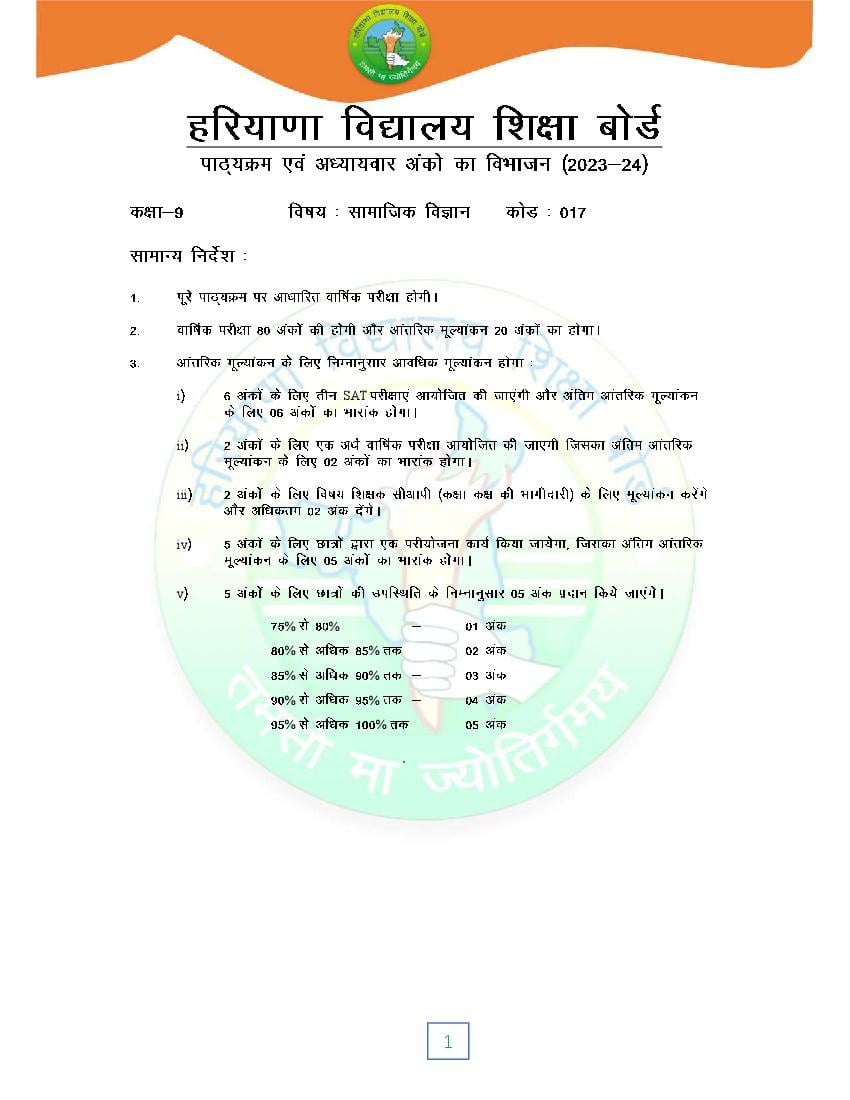
General Instructions:
1. There will be Annual Examination based on the entire syllabus.
2. The Annual Examination will be of 80 marks and 20 marks weightage
shall be for Internal Assessment.
3. For Internal Assessment:
There will be periodic Assessment that would include:
i. For 6 marks- Three SAT exams will be conducted and will
have a weightage of 06 marks towards the final Internal
Assessment.
ii. For 2 marks- One Half yearly exam will be conducted and
will have a weightage of 02 marks towards the final Internal
Assessment.
iii. For 2 marks- Subject teacher will assess and give maximum
02 marks for CRP(Class Room Participation).
iv. For 5 marks- A project work to be done by students and will
have a weightage of 05 marks towards the final Internal
Assessment.
v. For 5 marks- Attendance of students will be awarded 05
marks as:
75% to 80%- 01 marks
Above 80% to 85%- 02 marks
Above 85% to 90%- 03 marks
Above 90% to 95%- 04 marks
Above 95% - 05 marks
10
Page 11
Class- 9 Subject: Social Science Code: 017
Sr. No. Chapter Marks
1 History:Our Unit-1 8
Bharat-IV 1) Social and Cultural Renaissance of India
(23) 2) Elements of National Awakening
3) Moderates and Nationalists( from 1857AD to
1919AD)
Unit-2 8
4) Indian Revolutionary Movement (from 1857AD
to 1918AD)
5) Indian Revolutionary Movement ( from 1919AD
to 1947 AD)
6) Mahatma Gandhi and Indian Freedom Struggle
for Independence
Unit-3 7
7) Role of Indian National Army and NetaJi
8) Partition of India, integration of Princely States
and Rehabilitation of the Displaced,
9) Role of Haryana in the Indian National
Movement.
2 Contemporary Unit-1 11
India-I (21) 1) India- Size and Location
2) Physical Features of India
3) Drainage
Unit-2 10
4) Climate
5) Natural Vegetation and Wild Life
6) Population
3 Democratic Unit-1 11
Politics-I 1) What is Democracy? Why Democracy?
(21) 2) Constitutional Design
3) Electoral Politics
Unit-2 10
4) Working of Institutions
5) Democratic Rights
4 Economics : Unit-1 7
(15) 1) The story of Village Palampur
2) People as Resources
Unit-2 8
3) Poverty as a Challenge
4) Food Security
Total 80
Internal Assessment 20
Grand Total 100
11
Page 12
OUR BHARAT - IV
1) SOCIAL AND CULTURAL RENAISSANCE OF INDIA
Raja Ram Mohan Roy and Brahma Samaj
PrarthnaSamaj
Swami Dayanand and AryaSamaj
Swami Vivekanand and Ramkrishn Mission
Cultural Nationality and Maharishi Arvind and Dr.Hedgewar
Movements against Casteism and Untouchability ( elevation of
disadvantaged castes )
2) Elements of National Awakening
Movements of Social Reforms
Resistance to the Exploitative Economic Policy of the British
The Great Revolution of the 1857 AD
Impact of Research on the Glorious history of India
Racial Arrogance in the British and the Maltreatments of Indians
Role of Newspapers
Role of National literature
Lord lytton ‘ Repressive Policies
Contribution of Western Education and Indian intellectuals
Influence of the Contemporary International Events
Establishment of the Various Political Organisations
3) Moderates and Nationalists ( From 1857 AD to 1919 AD )
Moderates
Nationalists
Movement against Partition of Bengal
Swadeshi and Boycott Movement
Luckhnow Pact
4) Indian Revolutionary Movement (fron 1857 AD to 1918 AD )
Beginning of the Revolutionary Movement
Aims and Methods of the Revolutionaries
Spread of Revolutionary Movements
Indian Revolutionaries in Abroad
12
Page 13
Jallianwala Bagh Massacre
Hindustan Prajatantra Sangh and Kakori incident
Bhagatsingh , Rajguru and Sukhdev
Armoury raid of Chittagong
Martyrdom of Chandrashekhar Azad and Udham Singh
Revolt of Royal Indian Navy
6) Mahatma Gandhi and Indian struggle for Independence
Early life
Satyagrah against Rowlatt Act
Khilafat Movement
Non- Cooperation Movement
Civil disobedience Movement
Individual Satyagrah
Quit India Movement
Gandhi Jinnah Talk
Independence of India
Mahatma Gandhi after Independence
7) Role of Indian National Army and Netaji
Early life of Netaji Subhash Chandra Bose
His entry into National Politics
Netaji Subhash Chandra Bose as President of Congress
Second World War and Subhash Chandra Bose ‘ arrival in
Germany
Formation of Indian National Army
8) Partition of India , Integration of Princely States and Rehabilitation
of displaced
Indian Independence act 1947
Partition of India
Reason for Partition of India
Integration of Princely States
Rehabilitation of the Displaced
9) Role of Haryana in the Indian national movement
Rule of British East India Company
Role of Haryana in the National Movement
Chaudhary Chhotu Ram
Haryana as a Separate state
13
Page 14
1) What is Democracy ? Why Democracy ?
What is Democracy ?
Features of Democracy
Why Democracy ?
Broader meaning of Democracy
2) Constitutional Design
Democratic Constitution in South Africa
Why do we need a Constitution ?
Making of The Indian Constitution
Guiding Values of The Indian Constitution
3) Electoral Politics
Why elections ?
What is our System of Elections ?
What makes Election In India Democratic ?
4) Working of Institutions
How Is The Major Policy Decision taken ?
Parliament
Political Executive
The Judiciary
5) Democratic Rights
Life without Rights
Rights in A Democracy
Rights In The Indian Constitution
Expanding Scope Of Rights
14
Page 15
1) India : Size and Location
Location
Size
India and The World
India ‘ s Neighbours
2) Physical Features of India
Major Physiographic Divisions
- The Himalayan Mountains
- The Northern Plains
- The Peninsular Plateaus
- The Indian Desert
- The Coastal plains
- The Islands
3) Drainage
Concept
Drainage System In India
The Himalayan Rivers
- Indus River System , Ganga River System ,
Brahmputra River System
The Peninsular Rivers
-The Narmada Basin , The Tapi Basin , The Godavari Basin ,
The Mahanadi Basin , The Krishna Basin , The Kaveri Basin
Lakes
Role of River In Economy
River Pollution
4) Climate
Concept
Climate Controls
Factors Affecting India ‘ Climate
Latitude , Altitude , Pressure and Winds
The Seasons
- Cold Weather Season , Hot Weather Season , Advancing
Monsoon Season ( The Rainy Season ) , Retreating / Post
Monsoons ( The Transition Season )
Distribution of Rainfall
Monsoon As A Unifying Bond
15
Page 16
Concept
Ecosystem
Types of Vegetation
-Tropical Evergreen Forests , Tropical Deciduous Forests ,
Thorn Forests and Shrubs , Mountain Forests , Mangrove Forests .
Wildlife
6) Population
Population Size and Distribution
- India ‘ s Population Size and Distribution by Numbers ,
- India ‘ s Population Distribution by Density
Population Growth and Process of Population Change
- Population Growth
- Process of Population Change / Growth
ECONOMICS
1) The Story Of Village Palampur
Overview
Organisation Of Production
Farming In Palampur
Non -Farm Activities In Palampur
2) People As A Resource
Overview
Economic Activities by Men And Women
Quality Of Production
Unemployment
3) Poverty As A Challenge
Overview
Two Typical Cases of Poverty
Poverty As Seen By Social Scientists
Poverty Line
Poverty Estimates
Vulnerable Groups
Interstate Disparities
Global Poverty Scenario
Causes Of Poverty
Anti Poverty Measures
The Challenges Ahead
16
Page 17
Overview
What Is Food Security?
Why Food Security?
Who Are Food Insecure?
Food Security In India
What Is Buffer Stock?
What Is Public Distribution System?
Current Status Of The Public Distribution System
Role Of Cooperatives in Food Security
17
Page 18
History section:-
Chapter-4 Indian Revolutionary Movement (from 1857 AD to 1918 AD )
The region where Kuka Movement was spread (Punjab),
Alipur conspiracy case (Calcutta)
Cellular Jail (Andaman)
Chapter -5 Indian Revolutionary Movement (from 1919 AD to 1947 AD )
Jalianwalabagh Massacre (Amritsar), The place where Bhagat
Singh threw bomb (National Assembly Delhi, The place where
Bhagat Singh was hanged (Lahore), The place where train was
looted by revolutionaries (Kakori , Uttar Pardesh), Martyrdom
place of Chander Shekhar Azad (Alfred Park , Allahabad) Royal
Navy revolt 1946 (Mumbai)
Chapter-6 Mahatama Gandhi and Independence Struggle of India
Birth place of Mahatama Gandhi (Porbandar , Gujarat), The places
where Mahatama Gandhi lead his starting Satyagraha (Champaran,
Khera , Ahamdabad -Strike by Cotton Mill workers), The place
where the resolution of the Non – Cooperation movement was
passed in the annual session of the congress in 1920 (Nagpur), The
place from where Civil- Disobedience movement was started
(Dandi, Gujarat) The place from where Quit India Movement was
started in 1942 (Mumbai), Puran Swaraj resolution was passed
(Lhore)
Geography Section:- (India Map)
(Identification, locating and labelling)
Chapter -1 India – Size and Location
India : States and Capitals
IST , Tropic of Cancer
India’ Neighbours
Chapter -2 Physical Features of India
18
Page 19
Vindhyas , The Satpuras , Eastern and Western Ghats
Mountain Peaks : Mt. Everest , Kanchenjunga , K2
Plateaus : Deccan Plateau, Chhotanagpur Plateau , Malwa Plateau
Plains : Ganga- Brahamputra Plain , East Coastal Plains , West Coastal
Plains
Islands : Andaman and Nicobar Islands , Lakshadweep Islands
Chapter -3 Drainage
Rivers : a) The Himalayan Rivers - Indus ,Ganges, Satluj ,Brahamputra
b) The Peninsular Rivers – Narmada, Tapi ,Mahanadi ,Godavari ,
Krishna ,Kaveri
Lakes : Wular , Sambhar , Pulicat , Chilika
Chapter-4 Climate
Area receiving Highest Rainfall : Mawsynram
Area receiving Winter Rainfall : Tamil Nadu Coast
Chapter- 5 Natural Vegetation and Wildlife
Vegetation Types : Tropical Evergreen Forest , Tropical Deciduous
Forest, Thorn Forest , Mountain Forest , Mangrove Forest
Wildlife Reserves : Dachigam , Rajaji , Corbet , Sariska , Ranthambhor,
Gir , Kanha , Simplipal, Kaziranga ,Manas , Bandipur
Chapter 6- Population
State having Highest and Lowest Density of Population
19
Page 20
Class- 9 Subject: Social Science Code: 017
Month Name of Book/unit Subject Matter Teaching Revision
Periods Periods
April Contemporary India-I India- Size and Location 6 2
History : Our Bharat IV Social and Cultural 6 2
Renaissance of India
May Contemporary India-I Physical Features of India 4 2
Democratic Politics I What is Democracy? Why 4 2
democracy?
History our Bharat-IV Elements of National 6 2
Awakening
June Activities to be Map Practice-India (States
Assigned During and Their Capitals),Physical
Summer Break Features of India,
Project or Survey on
Democracies of the World.
Photo or story collection of
Indian Social Reformers
July Contemporary India-I Drainage 6 2
Economics The Story of Village 4 2
Palampur
History our Bharat-IV Moderates and Nationalists 6 2
(1857- 1919 )
August Democratic Politics-I Constitutional Design 4 2
History our Bharat-IV Indian Revolutionary 6 2
Movement (1857 -1918)
Economics People as Resource 4 2
20
Page 21
September Democratic Politics-I Electoral Politics 4 2
History our Bharat-IV Indian Revolutionary 6 2
Movement (1919-1947)
October Contemporary India-I Climate 4 2
Democratic Politics-I Working of Institution 4 2
History our Bharat-IV Mahatma Gandhi and Indian 6 2
Struggle for Independence
November Contemporary India-I Natural Vegetation and 6 2
Wildlife
Economics Poverty as a Challenge 4 2
History our Bharat-IV Azad Hind Fauj and Role of 6 2
Netaji
December Democratic Politics-I Democratic Rights 4 2
Contemporary India-I Population 6 2
History our Bharat-IV Partition of India, Integration 6 2
of Princely States and
Rehabilitation of the
Displaced
January History our Bharat-IV Role of Haryana in the Indian 6 2
National Movement
Economics Food security in India 4 2
February Revision
March Annual examination
21
Page 22
Subject teachers are advised to direct the students to prepare
notebook of the Terminology/Definitional Words used in the chapters
for enhancement of vocabulary or clarity of the concept.
Prescribed Books:
1. 1. Social Science- History our Bharat-IV World (Text Book for class IX,
)BSEH Publication
2. Democratic Politics-I NCERT (text book of Political Science)
3. Contemporary India-I NCERT (text book of Geography)
4. Economics NCERT (Text book of Economics)
22
Page 23
Class-9 Subject: Social Science Code: 017
Type of Marks Number Description Total
Question Marks
Essay Type 5 4 Internal options will be given in 20
Questions all the questions.1 question
from each section viz. History,
Geography, Pol. Sc and Eco.
Short Answer 3 5 Write any three points. No. of 15
Type Questions questions (History-2,Geog.-2,
Pol.Sc.-1)
Very Short 2 6 Write any 2 points. No. of 12
Answer Type questions( History-2, Geog.-
Question 2,Pol.Sc.-1, and Eco.-1)
Multiple Choice 1 20 20 Multiple Choice Question. 20
Questions (His-6,Geog-3, Pol.Sc.-7 and
Eco.-4)
Case Study 4 2 Questions will be based on the 8
Based Questions given case study from Pol. Sc.
and Economics. Each will
comprise 4 questions.
Map Skill Based 5 1 One Location based question 5
Questions (2+3) consist two section “A” and
“B” will be asked from History
and Geography.
(Section “A” History -2,
Section “B” Geography-3)
Total 38 80
23
Document Details
| Board / Org | Haryana Board |
| Exam | Class 9 |
| Type | Syllabus |
| Pages | 23 |
| Updated | 30 Apr 2026 |