ICAR AIEEA PG 2022 Question Paper Veterinary Science
Finished viewing? Save it for later —
Download ICAR AIEEA PG 2022 Question Paper Veterinary Science (PDF · 25 pages)About ICAR AIEEA PG 2022 Question Paper Veterinary Science
ICAR AIEEA PG 2022 Question Paper Veterinary Science is available here for free download. Published by ICAR for AIEEA PG, this question paper can be viewed online or downloaded as a PDF (25 pages). Candidates preparing for AIEEA PG can use ICAR AIEEA PG 2022 Question Paper Veterinary Science to understand the exam pattern, the type of questions asked, and the overall difficulty level.
Frequently Asked Questions
How can I download ICAR AIEEA PG 2022 Question Paper Veterinary Science?
Open this page and click the Download button to save ICAR AIEEA PG 2022 Question Paper Veterinary Science as a PDF. It is completely free on AglaSem Docs.
Is ICAR AIEEA PG 2022 Question Paper Veterinary Science free to download?
Yes. ICAR AIEEA PG 2022 Question Paper Veterinary Science can be viewed online and downloaded as a PDF free of cost on AglaSem Docs.
How many pages does ICAR AIEEA PG 2022 Question Paper Veterinary Science have?
ICAR AIEEA PG 2022 Question Paper Veterinary Science contains 25 pages, which you can read online or download together as a single PDF.
Where can I find more AIEEA PG study material?
You can find more AIEEA PG question papers, sample papers, syllabus, and answer keys on AglaSem Docs.
ICAR AIEEA PG 2022 Question Paper Veterinary Science – Text
Read the full text of this question paper below — useful to quickly search, copy and reference the content online without downloading the PDF.
📄 View text version (24 pages)
Page 1
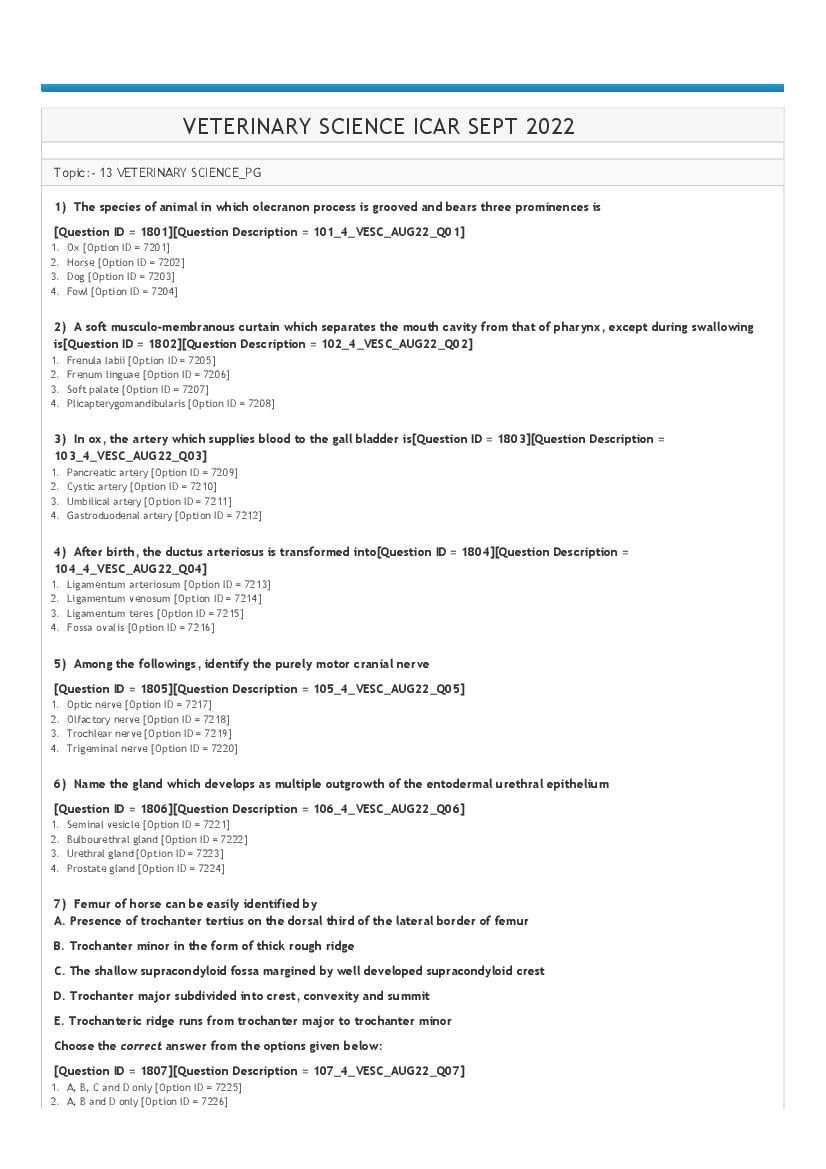
Topic:‐ 13 VETERINARY SCIENCE_PG
1) The species of animal in which olecranon process is grooved and bears three prominences is
[Question ID = 1801][Question Description = 101_4_VESC_AUG22_Q01]
1. Ox [Option ID = 7201]
2. Horse [Option ID = 7202]
3. Dog [Option ID = 7203]
4. Fowl [Option ID = 7204]
2) A soft musculo‐membranous curtain which separates the mouth cavity from that of pharynx, except during swallowing
is[Question ID = 1802][Question Description = 102_4_VESC_AUG22_Q02]
1. Frenula labii [Option ID = 7205]
2. Frenum linguae [Option ID = 7206]
3. Soft palate [Option ID = 7207]
4. Plicapterygomandibularis [Option ID = 7208]
3) In ox, the artery which supplies blood to the gall bladder is[Question ID = 1803][Question Description =
103_4_VESC_AUG22_Q03]
1. Pancreatic artery [Option ID = 7209]
2. Cystic artery [Option ID = 7210]
3. Umbilical artery [Option ID = 7211]
4. Gastroduodenal artery [Option ID = 7212]
4) After birth, the ductus arteriosus is transformed into[Question ID = 1804][Question Description =
104_4_VESC_AUG22_Q04]
1. Ligamentum arteriosum [Option ID = 7213]
2. Ligamentum venosum [Option ID = 7214]
3. Ligamentum teres [Option ID = 7215]
4. Fossa ovalis [Option ID = 7216]
5) Among the followings, identify the purely motor cranial nerve
[Question ID = 1805][Question Description = 105_4_VESC_AUG22_Q05]
1. Optic nerve [Option ID = 7217]
2. Olfactory nerve [Option ID = 7218]
3. Trochlear nerve [Option ID = 7219]
4. Trigeminal nerve [Option ID = 7220]
6) Name the gland which develops as multiple outgrowth of the entodermal urethral epithelium
[Question ID = 1806][Question Description = 106_4_VESC_AUG22_Q06]
1. Seminal vesicle [Option ID = 7221]
2. Bulbourethral gland [Option ID = 7222]
3. Urethral gland [Option ID = 7223]
4. Prostate gland [Option ID = 7224]
7) Femur of horse can be easily identified by
A. Presence of trochanter tertius on the dorsal third of the lateral border of femur
B. Trochanter minor in the form of thick rough ridge
C. The shallow supracondyloid fossa margined by well developed supracondyloid crest
D. Trochanter major subdivided into crest, convexity and summit
E. Trochanteric ridge runs from trochanter major to trochanter minor
[Question ID = 1807][Question Description = 107_4_VESC_AUG22_Q07]
1. A, B, C and D only [Option ID = 7225]
2. A, B and D only [Option ID = 7226]
Page 2
4. A, C and E only [Option ID = 7228]
8) Flexor muscles of hip are
A. Sartorius
B. Iliopsoas
C. Semitendinosus
D. Quadriceps femoris
E. Tensor fascia lata
[Question ID = 1808][Question Description = 108_4_VESC_AUG22_Q08]
1. A, B, C and D only [Option ID = 7229]
2. B, C, D and E only [Option ID = 7230]
3. A, B, D and E only [Option ID = 7231]
4. A, B, C and E only [Option ID = 7232]
9) Identify the foramen/foramina which is/are not found in the occipital bone of ox
A. Foramen magnum
B. Hypoglossal foramen
C. Foramen orbitorotundum
D. Condyloid foramen
E. Foramen laceraum
[Question ID = 1809][Question Description = 109_4_VESC_AUG22_Q09]
1. B and D only [Option ID = 7233]
2. A and C only [Option ID = 7234]
3. B and E only [Option ID = 7235]
4. C and E only [Option ID = 7236]
10) Match List I with List II
List I List II
A. Rumen I. Transitional epithelium
B. Trachea II. Simple squamous epithelium
C. Ureter III. Stratified squamous keratinized epithelium
D. Bicarotid trunkIV. Pseudostratified columnar ciliated epithelium
[Question ID = 1810][Question Description = 110_4_VESC_AUG22_Q10]
1. A ‐III, B ‐I, C ‐IV, D ‐II [Option ID = 7237]
2. A ‐III , B ‐IV , C ‐I , D ‐II [Option ID = 7238]
3. A ‐II , B ‐I , C ‐IV , D ‐III [Option ID = 7239]
4. A ‐III, B ‐II, C ‐IV, D ‐I [Option ID = 7240]
11) Match List I with List II
List I List II
A. Ovulation fossa I. Bitch
B. Uterine cotyledons II. Cow
C. Very long flexuous cornua of uterus III. Mare
D. Very short uterine body with extremely long narrow hornIV. Sow
[Question ID = 1811][Question Description = 111_4_VESC_AUG22_Q11]
1. A ‐III , B ‐II , C ‐IV , D ‐I [Option ID = 7241]
2. A ‐II , B ‐III, C ‐IV , D ‐I [Option ID = 7242]
3. A ‐III , B ‐II, C ‐I , D ‐IV [Option ID = 7243]
4. A ‐IV , B ‐II , C ‐III , D ‐I [Option ID = 7244]
Page 3
A. Acrosomal phase
B. Golgi phase
C. Cap phase
D. Maturation phase
Choose the correct answer from the options given below
[Question ID = 1812][Question Description = 112_4_VESC_AUG22_Q12]
1. B, C, A, D [Option ID = 7245]
2. C, B, A, D [Option ID = 7246]
3. A, B, C, D [Option ID = 7247]
4. C, A, B, D [Option ID = 7248]
13) Arrange the following events of avian egg formation in a serial order
A. Shell components (matrix, shell cuticle, and inorganic material) are formed
B. Released secondary oocyte from the ovary is grasped by infundibulum
C. The bilaminar shell membrane is formed
D. Albumin is added to egg
E. Storage of egg before laying
Choose the correct answer from the options given below
[Question ID = 1813][Question Description = 113_4_VESC_AUG22_Q13]
1. B, C, D, A, E [Option ID = 7249]
2. B, A, C, D, E [Option ID = 7250]
3. B, D, C, A, E [Option ID = 7251]
4. B, C, A, D, E [Option ID = 7252]
14) Arrange general features of embryonic development in sequential order
A. Growth
B. Cell proliferation
C. Integration
D. Differentiation
Choose the correct answer from the options given below
[Question ID = 1814][Question Description = 114_4_VESC_AUG22_Q14]
1. B, A, D, C [Option ID = 7253]
2. B, C, D, A [Option ID = 7254]
3. A, B, D, C [Option ID = 7255]
4. B, D, A, C [Option ID = 7256]
15) Match List I with List II
List I List II
A. Diencephalon I. Medulla oblongata
B. Mesencephalon II. Pons
C. Metencephalon III. Thalamus
D. MyelencephalonIV. Corpora qudrigemina
[Question ID = 1815][Question Description = 115_4_VESC_AUG22_Q15]
1. A ‐II, B ‐IV, C ‐III, D ‐ I [Option ID = 7257]
2. A ‐IV, B ‐III, C ‐II, D ‐I [Option ID = 7258]
3. A ‐III, B ‐IV, C ‐I, D ‐II [Option ID = 7259]
4. A ‐III, B ‐IV, C ‐II , D ‐I [Option ID = 7260]
16) Identify the statements which are true for the histological structure of kidney
A. Parenchyma of the kidney is divided into outer cortex and an inner medulla
Page 4
C. The major part of each nephron is found in medulla
D. Numerous renal corpuscles are arranged in renal cortex
E. PCT is lined with simple low cuboidal epithelium whereas, DCT is lined with simple tall cuboidal epithelium with brush
border
[Question ID = 1816][Question Description = 116_4_VESC_AUG22_Q16]
1. A, B and D only [Option ID = 7261]
2. A, C and E only [Option ID = 7262]
3. A, B and E only [Option ID = 7263]
4. A, B and C only [Option ID = 7264]
17) Given below are two statements, one is labelled as Assertion A and the other is labelled as Reason R
Assertion A : In cow/calf, for amputation of horn or debudding cornual nerve block is given close to the frontal crest of
frontal bone.
Reason R : The cornual nerve is the sensory branch of lacrimal nerve, which is the division of ophthalmic branch of
trigeminal nerve. Cornual nerve emerges behind the orbit and ascends along the frontal crest, runs superficially covered by
skin and frontalis muscle. Therefore to desensetize the structures present at the base and around the horn, cornual nerve
block is given close to the frontal crest of frontal bone.
In light of the above statements, choose the correct answer from the options given below
[Question ID = 1817][Question Description = 117_4_VESC_AUG22_Q17]
1. Both A and R are true and R is the correct explanation of A [Option ID = 7265]
2. Both A and R are true but R is NOT the correct explanation of A [Option ID = 7266]
3. A is true but R is false [Option ID = 7267]
4. A is false but R is true [Option ID = 7268]
18) Given below are two statements, one is labelled as Assertion A and the other is labelled as Reason R
Assertion A : In bovine, the biopsy of gall bladder is taken at the ventral part of the 10th or 11th intercostal space against
the abdominal wall.
Reason R : In bovine, gall bladder is a pear shaped sac and lies partially in contact with the visceral surface of liver, but
largely against the abdominal wall at the ventral part of the 10th and 11th intercostals space. Therefore, biopsy of gall
bladder is taken at the ventral part of the 10th or 11th intercostals space against the abdominal wall
In light of the above statements, choose the correct answer from the options given below
[Question ID = 1818][Question Description = 118_4_VESC_AUG22_Q18]
1. Both A and R are true and R is the correct explanation of A [Option ID = 7269]
2. Both A and R are true but R is NOT the correct explanation of A [Option ID = 7270]
3. A is true but R is false [Option ID = 7271]
4. A is false but R is true [Option ID = 7272]
19) Given below are two statements
Statement I: Central canal is lined with columnar ciliated epithelium and helps in CSF circulation
Statement II: The choroid plexus which lay in the central canal assist in filtration of CSF
In light of the above statements, choose the most appropriate answer from the options given below
[Question ID = 1819][Question Description = 119_4_VESC_AUG22_Q19]
1. Both Statement I and Statement II are correct [Option ID = 7273]
2. Both Statement I and Statement II are incorrect [Option ID = 7274]
3. Statement I is correct but Statement II is incorrect [Option ID = 7275]
4. Statement I is incorrect but Statement II is correct [Option ID = 7276]
20) Given below are two statements
Statement I: Placentomes is the combination of maternal and foetal cotyledons in the placenta of bovines.
Statement II: Placentomes is a syndesmochorial type of placenta which occurs in bovine
In light of the above statements, choose the most appropriate answer from the options given below
[Question ID = 1820][Question Description = 120_4_VESC_AUG22_Q20]
Page 5
2. Both Statement I and Statement II are incorrect [Option ID = 7278]
3. Statement I is correct but Statement II is incorrect [Option ID = 7279]
4. Statement I is incorrect but Statement II is correct [Option ID = 7280]
21) The stain Basic Fuchsin is an example of[Question ID = 1821][Question Description = 121_4_VESC_AUG22_Q21]
1. Differential stain [Option ID = 7281]
2. Negative stain [Option ID = 7282]
3. Impregnation stain [Option ID = 7283]
4. Simple stain [Option ID = 7284]
22) A secondary immune response[Question ID = 1822][Question Description = 122_4_VESC_AUG22_Q22]
1. Can be induced by a single dose of antigen [Option ID = 7285]
2. Occurs after several months [Option ID = 7286]
3. Has a very short lag period [Option ID = 7287]
4. Occurs only against microbial toxins [Option ID = 7288]
23) Morbilli viruses are a type of[Question ID = 1823][Question Description = 123_4_VESC_AUG22_Q23]
1. Single stranded, negative sense RNA viruses [Option ID = 7289]
2. Single stranded, positive sense RNA viruses [Option ID = 7290]
3. DNA viruses [Option ID = 7291]
4. Double‐stranded RNA virus [Option ID = 7292]
24) Brucellergin test is an example of[Question ID = 1824][Question Description = 124_4_VESC_AUG22_Q24]
1. Type II hypersensitivity reaction [Option ID = 7293]
2. Type IV hypersensitivity reaction [Option ID = 7294]
3. Type I hypersensitivity reaction [Option ID = 7295]
4. Type III hypersensitivity reaction [Option ID = 7296]
25) The form of macrophage lining the sinuses of liver is[Question ID = 1825][Question Description =
125_4_VESC_AUG22_Q25]
1. Microglial cell [Option ID = 7297]
2. Histiocyte [Option ID = 7298]
3. Kupffer cell [Option ID = 7299]
4. Hepatocyte [Option ID = 7300]
26) The germinal centre of the lymph node mainly consists of
[Question ID = 1826][Question Description = 126_4_VESC_AUG22_Q26]
1. T cells [Option ID = 7301]
2. B cells [Option ID = 7302]
3. Plasma cells [Option ID = 7303]
4. Macrophages [Option ID = 7304]
27) Clostridium perfringens is responsible for causing
A. Lamb dysentery
B. Black leg
C. Braxy
D. Enterotoxemia
[Question ID = 1827][Question Description = 127_4_VESC_AUG22_Q27]
1. A and C only [Option ID = 7305]
2. A and D only [Option ID = 7306]
3. A, B and C only [Option ID = 7307]
4. A, B, C and D [Option ID = 7308]
28) The innate pathways for the activation of complement system include
A. Classical pathway
B. Alternative pathway
C. Lectin pathway
D. TLR pathway
Page 6
1. A and B only [Option ID = 7309]
2. B and C only [Option ID = 7310]
3. A, B and C only [Option ID = 7311]
4. A, B and D only [Option ID = 7312]
29) Which of the following selective media may be utilized for the detection of Salmonella
A. Xylose Lysine Deoxycholate Agar
B. Hektoen Enteric Agar
C. MacConkey agar
D. Wilson and Blair Bismuth Sulphite Agar
[Question ID = 1829][Question Description = 129_4_VESC_AUG22_Q29]
1. B only [Option ID = 7313]
2. A, B and D only [Option ID = 7314]
3. A and C only [Option ID = 7315]
4. A, C and D only [Option ID = 7316]
30) Among the following, the type of particulate adjuvants is/are
A. Liposomes
B. Alum
C. Immune stimulating complexes (ISCOMs)
D. Microparticles
[Question ID = 1830][Question Description = 130_4_VESC_AUG22_Q30]
1. A only [Option ID = 7317]
2. A and B only [Option ID = 7318]
3. A, B and C only [Option ID = 7319]
4. A, C and D only [Option ID = 7320]
31) Match List I with List II
List I List II
Virus family Budding site for the newly formed virion
A. Poxviridae I. Endoplasmic reticulum
B. Herpesviridae II. Nuclear membrane
C. Rhabdoviridae III. Golgi membrane
D. Coronaviridae IV. Plasma membrane
[Question ID = 1831][Question Description = 131_4_VESC_AUG22_Q31]
1. A ‐IV , B ‐III , C ‐I , D ‐II [Option ID = 7321]
2. A ‐III , B ‐IV , C ‐II , D ‐I [Option ID = 7322]
3. A ‐III , B ‐II , C ‐IV , D ‐I [Option ID = 7323]
4. A ‐II , B ‐III , C ‐I , D ‐IV [Option ID = 7324]
32) Match List I with List II
List I List II
Graft Description
A. Autograft I.Grafts transplanted between two genetically identical individuals
B. Allograft II.Grafts transplanted between animals of different species
C. Isograft III.Grafts transplanted from one point to another of the same animal
D. Xenograft IV.Grafts transplanted between genetically different members of same species
[Question ID = 1832][Question Description = 132_4_VESC_AUG22_Q32]
Page 7
2. A‐III, B‐IV, C‐I, D‐II [Option ID = 7326]
3. A‐I, B‐II, C‐III, D‐IV [Option ID = 7327]
4. A‐II, B‐III, C‐I, D‐IV [Option ID = 7328]
33) Match List I with List II
List I List II
Types of MicroscopyApplication
A. Bright field I. For observing the ultrastructural features of microorganisms
B. Dark field II. For observing gross morphological features of microorganisms
C. Phase contrast III. For observing some characteristic morphological feature in living state and in fluid suspension
D. Electron IV. For observing the cellular structures in living cells of larger microorganisms
[Question ID = 1833][Question Description = 133_4_VESC_AUG22_Q33]
1. A ‐IV, B ‐III , C ‐I , D ‐II [Option ID = 7329]
2. A ‐III, B ‐IV , C ‐I , D ‐II [Option ID = 7330]
3. A ‐I , B ‐II , C ‐III , D ‐IV [Option ID = 7331]
4. A ‐II , B ‐III , C ‐IV , D ‐I [Option ID = 7332]
34) Arrange the following heavy chain constant region genes of the immunoglobulin molecule from 5 prime to 3 prime in a
corrct order
A. IGHM
B. IGHD
C. IGHG
D. IGHE
E. IGHA
Choose the correct answer from the options given below
[Question ID = 1834][Question Description = 134_4_VESC_AUG22_Q34]
1. A, B, C, D, E
[Option ID = 7333]
2. A, C, D, B, E
[Option ID = 7334]
3. A, D, E, C, B
[Option ID = 7335]
4. A, E, B, C, D
[Option ID = 7336]
35) Arrange the following structural layers of Gram negative bacterial cell from outside towards inside
A. Outer membrane
B. Peptidoglycan
C. Capsule
D. Cytoplasmic membrane
Choose the correct answer from the options given below
[Question ID = 1835][Question Description = 135_4_VESC_AUG22_Q35]
1. A, B, C, D [Option ID = 7337]
2. A, C, D, B [Option ID = 7338]
3. C, A, B, D [Option ID = 7339]
4. C, D, B, A [Option ID = 7340]
36) Arrange the events that occurs in one life cycle of lytic bacteriophage in a order
A. Adsorption
B. Injection of Phage DNA
C. Releases of progeny phages
Page 8
E. Replication of the phage DNA
Choose the correct answer from the options given below
[Question ID = 1836][Question Description = 136_4_VESC_AUG22_Q36]
1. A, B, C, D, E [Option ID = 7341]
2. A, B, E, D, C [Option ID = 7342]
3. A, C, B, D, E [Option ID = 7343]
4. A, C, E, D, B [Option ID = 7344]
37) Given below are two statements, one is labelled as Assertion A and the other is labelled as Reason R
Assertion A : In a cell culture, the concentration of DI (Defective Interference) particles increases greatly with the serial
passage at high multiplicity
Reason R : Their shortened genomes require less time to be replicated
In light of the above statements, choose the correct answer from the options given below
[Question ID = 1837][Question Description = 137_4_VESC_AUG22_Q37]
1. Both A and R are true and R is the correct explanation of A [Option ID = 7345]
2. Both A and R are true but R is NOT the correct explanation of A [Option ID = 7346]
3. A is true but R is false [Option ID = 7347]
4. A is false but R is true [Option ID = 7348]
38) Given below are two state
Statement I: The envelope spikes of all paramyxoviruses are composed of the fusion protein (F) and HN glycoproteins
Statement II: F is responsible for the fusion of the viral envelope with the plasma membrane of the host cell
In light of the above statements, choose the correct answer from the options given below
[Question ID = 1838][Question Description = 138_4_VESC_AUG22_Q38]
1. Both Statement I and Statement II are true [Option ID = 7349]
2. Both Statement I and Statement II are false [Option ID = 7350]
3. Statement I is true and Statement II is false [Option ID = 7351]
4. Statement I is false and Statement II is true [Option ID = 7352]
39) Given below are two statements, one is labelled as Assertion A and the other is labelled as Reason R
Assertion A : Mouse IgD is susceptible to destruction by protease in serum and hence, cannot be detected in serum
Reason R : Mouse IgD has got short hinge region and no inter chain disulfide bonds
In light of the above statements, choose the correct answer from the options given below
[Question ID = 1839][Question Description = 139_4_VESC_AUG22_Q39]
1. Both A and R are true and R is the correct explanation of A
[Option ID = 7353]
2. Both A and R are true but R is NOT the correct explanation of A
[Option ID = 7354]
3. A is true but R is false
[Option ID = 7355]
4. A is false but R is true
[Option ID = 7356]
40) Given below are two statements, one is labelled as Assertion A and the other is labelled as Reason R
Assertion A : For diagnosis of dermatophytosis the clinical materials such as skin scrapings, hairs and nails can be observed
under microscope by wet mount preparation with 5 % KOH
Reason R : The KOH acts as a clearing agent which digests the proteinaceous host cell debris and leaves the sugar containing
fungal cell wall.
In light of the above statements, choose the correct answer from the options given below
[Question ID = 1840][Question Description = 140_4_VESC_AUG22_Q40]
1. Both A and R are true and R is the correct explanation of A
Page 9
2. Both A and R are true but R is NOT the correct explanation of A
[Option ID = 7358]
3. A is true but R is false
[Option ID = 7359]
4. A is false but R is true
[Option ID = 7360]
41) Redia stage is absent in the life cycle of which of the following parasites
A. Dicrocoelium dendriticum
B. Prosthogonimus ovatus
C. Chlonorchis sinensis
D. Schistosoma incognitum
[Question ID = 1841][Question Description = 141_4_VESC_AUG22_Q41]
1. A, B and C only [Option ID = 7361]
2. B, C and D only [Option ID = 7362]
3. A, B and D only [Option ID = 7363]
4. A and C only [Option ID = 7364]
42) Arrange the following trematodes on the basis of their size starting from the smallest to the largest
A. Fasciola hepatica
B. Heterophyes heterophyes
C. Opisthorchis tenuicollis
D. Notocotylus attenuates
E. Clonorchis sinensis
Choose the correct answer from the options given below
[Question ID = 1842][Question Description = 142_4_VESC_AUG22_Q42]
1. B, E, C, D, A [Option ID = 7365]
2. D, C, B, A, E [Option ID = 7366]
3. D, B, E, C, A [Option ID = 7367]
4. B, D, C, E, A [Option ID = 7368]
43) Match List I with List II
List I List II
(Parasite) (Intermediate host)
A. Avitellina centripunctata I. Beetels
B. Raillietina cesticillus II. Earthworms
C. Davainea proglottina III. Psocids
D. Amoebotaenia cuneata IV. Gastropod molluscs
[Question ID = 1843][Question Description = 143_4_VESC_AUG22_Q43]
1. A ‐ II, B ‐ III, C ‐ IV, D ‐ I [Option ID = 7369]
2. A ‐ III, B ‐ I, C ‐ IV, D ‐ II [Option ID = 7370]
3. A ‐ II, B ‐ I, C ‐ III, D ‐ IV [Option ID = 7371]
4. A ‐ IV, B ‐ III, C ‐ I, D ‐ II [Option ID = 7372]
44) Cutaneous larva migrans is caused by the larvae of
A. Ancylostoma braziliense
B. Bunostomum phlebotomum
C. Capillaria hepatica
D. Gnathostoma spp.
Page 10
1. A, B and C only [Option ID = 7373]
2. A, B and D only [Option ID = 7374]
3. C and D only [Option ID = 7375]
4. A, C and D only [Option ID = 7376]
45) ‘Pilobolus’ fungus helps in the translation of which of the following lungworms to herbage[Question ID = 1845]
[Question Description = 145_4_VESC_AUG22_Q45]
1. Muellerius capillaris [Option ID = 7377]
2. Dictyocaulus viviparous [Option ID = 7378]
3. Metastrongylus spp. [Option ID = 7379]
4. Protostrongylus spp. [Option ID = 7380]
46) Given below are two statements, one is labelled as Assertion A and the other is labelled as Reason R
Assertion A : Oesophagostomum columbinum is a serious pathogen of sheep and 200‐300 adult worms can cause a severe
disease.
Reason R : Adult worms are voracious blood suckers and cause severe anaemia.
In light of the above statements, choose the correct answer from the options given below
[Question ID = 1846][Question Description = 146_4_VESC_AUG22_Q46]
1. Both A and R are true and R is the correct explanation of A [Option ID = 7381]
2. Both A and R are true but R is NOT the correct explanation of A [Option ID = 7382]
3. A is true but R is false [Option ID = 7383]
4. A is false but R is true [Option ID = 7384]
47) Tumour like growth and occasionally ulceration in the stomach of equines is caused by the larvae of[Question ID =
1847][Question Description = 147_4_VESC_AUG22_Q47]
1. Stable Fly [Option ID = 7385]
2. Gasterophilus spp. [Option ID = 7386]
3. Oestrus ovis [Option ID = 7387]
4. Hypoderma spp. [Option ID = 7388]
48) Borrelia anserina, the causative agent of fowl spirochaetosis, is transmitted by
A. Menopon gallinae
B. Echidnophaga gallinacea
C. Argas persicus
D. Dermanyssus gallinae
[Question ID = 1848][Question Description = 148_4_VESC_AUG22_Q48]
1. A, B and D only [Option ID = 7389]
2. B and D only [Option ID = 7390]
3. B, C and D only [Option ID = 7391]
4. C and D only [Option ID = 7392]
49) Match List I with List II
List I List II
(Arthropod) (Parasite/ Disease transmitted)
A. Hyalomma anatolicum anatolicum I. Babesia bigemina
B. Rhipicephalus microplus II. Theileria equi
C. Haemphysalis spinigera III. Bovine Tropical Theileriosis
D. Rhipicephalus appendiculatus IV. Kyasanur Forest Disease
[Question ID = 1849][Question Description = 149_4_VESC_AUG22_Q49]
1. A ‐ III, B ‐ I, C ‐ IV, D ‐ II [Option ID = 7393]
2. A ‐ II, B ‐ I, C ‐ III, D ‐ IV [Option ID = 7394]
3. A ‐ III, B ‐ I, C ‐ II, D ‐ IV [Option ID = 7395]
4. A ‐ II, B ‐ III, C ‐ IV, D ‐ I [Option ID = 7396]
50) Given below are two statements, one is labelled as Assertion A and the other is labelled as Reason R
Page 11
Reason R : Anaemia occurs due to depression in erythropoiesis, erythrophagocytosis, lysis of RBCs due to hemolysins
produced by trypanosomes, hemodilution, disseminated intravascular coagulopathy and mechanical destruction of RBCs due
to lashing movement of trypanosomes
In light of the above statements, choose the correct answer from the options given below
[Question ID = 1850][Question Description = 150_4_VESC_AUG22_Q50]
1. Both A and R are true and R is the correct explanation of A [Option ID = 7397]
2. Both A and R are true but R is NOT the correct explanation of A [Option ID = 7398]
3. A is true but R is false [Option ID = 7399]
4. A is false but R is true [Option ID = 7400]
51) Deficiency of fat‐soluble vitamins occurs in[Question ID = 1851][Question Description = 151_4_VESC_AUG22_Q51]
1. Amoebiosis [Option ID = 7401]
2. Giardiosis [Option ID = 7402]
3. Cryptosporidiosis [Option ID = 7403]
4. Balantidiosis [Option ID = 7404]
52) Which of the following are source of infection of Toxoplasma
A. Blood transfusion
B. Organ transplant
C. Green vegetables
D. Arthropods
[Question ID = 1852][Question Description = 152_4_VESC_AUG22_Q52]
1. A, B and D only [Option ID = 7405]
2. B, C and D only [Option ID = 7406]
3. A, B and C only [Option ID = 7407]
4. C and D only [Option ID = 7408]
53) Given below are two statements
Statement I: Heavy infection of Eimeria bovis causes bloody diarrhoea in calves below 1 month of age
Statement II: Gamonts are the most pathogenic stage in the life cycle of Eimeria bovis
In light of the above statements, choose the correct answer from the options given below
[Question ID = 1853][Question Description = 153_4_VESC_AUG22_Q53]
1. Both Statement I and Statement II are true [Option ID = 7409]
2. Both Statement I and Statement II are false [Option ID = 7410]
3. Statement I is true but Statement II is false [Option ID = 7411]
4. Statement I is false but Statement II is true [Option ID = 7412]
54) Arrange the following stages in sequential order of their development during the life cycle of Plasmodium gallinaeceum
in domestic fowl
A. Phanerozoites
B. Metacryptozoites
C. Cryptozoites
D. Gametocytes
Choose the correct answer from the options given below
[Question ID = 1854][Question Description = 154_4_VESC_AUG22_Q54]
1. A, B, C, D [Option ID = 7413]
2. C, B, A, D [Option ID = 7414]
3. C, B, D, A [Option ID = 7415]
4. A, C, B, D [Option ID = 7416]
55) Given below are two statements
Statement I: Theileria equi is more pathogenic than Babesia caballi in equines
Page 12
commonly seen in T. equi infected horses
In light of the above statements, choose the correct answer from the options given below
[Question ID = 1855][Question Description = 155_4_VESC_AUG22_Q55]
1. Both Statement I and Statement II are true [Option ID = 7417]
2. Both Statement I and Statement II are false [Option ID = 7418]
3. Statement I is true but Statement II is false [Option ID = 7419]
4. Statement I is false but Statement II is true [Option ID = 7420]
56) An anticoccidial that may be effective against bovine tropical theileriosis is[Question ID = 1856][Question Description =
156_4_VESC_AUG22_Q56]
1. Amprolium [Option ID = 7421]
2. Salinomycin [Option ID = 7422]
3. Halofuginone [Option ID = 7423]
4. Monensin [Option ID = 7424]
57) Nutmeg liver occurs in[Question ID = 1857][Question Description = 157_4_VESC_AUG22_Q57]
1. Cirrhosis [Option ID = 7425]
2. Infarction [Option ID = 7426]
3. Amyloidosis [Option ID = 7427]
4. Chronic venous congestion [Option ID = 7428]
58) Marbled appearance of lung paranchyma separated by thick yellowish interlobular septa is observed in[Question ID =
1858][Question Description = 158_4_VESC_AUG22_Q58]
1. Haemorrhagic septicemia [Option ID = 7429]
2. Contagious Bovine Pleuropneumonia [Option ID = 7430]
3. Tuberculosis [Option ID = 7431]
4. Rhinosporidiosis [Option ID = 7432]
59) Which of the following events are critical in development of irreversible cell injury
A. Loss of membrane integrity
B. Loss of mitochondrial function
C. Lipid accumulation
D. Calcium influx
[Question ID = 1859][Question Description = 159_4_VESC_AUG22_Q59]
1. A, B and D only
[Option ID = 7433]
2. A, B and C only
[Option ID = 7434]
3. B, C, and D only
[Option ID = 7435]
4. A and C only
[Option ID = 7436]
60) Match List I with List II
List I List II
A. Vitamin D intoxication I. Squamous metaplasia
B. Avitaminosis A II. Photosensitization
C. Rubber jaw III. Metastatic calcification
D. Lantana poisoning IV. Osteodystrophia fibrosa
[Question ID = 1860][Question Description = 160_4_VESC_AUG22_Q60]
1. A ‐ II, B ‐ I, C ‐ IV, D ‐ III [Option ID = 7437]
2. A ‐ III, B ‐ I, C ‐ IV, D ‐ II [Option ID = 7438]
3. A ‐ I, B ‐ III, C ‐ II, D ‐ IV [Option ID = 7439]
4. A ‐ III, B ‐ IV, C ‐ I, D ‐ II [Option ID = 7440]
Page 13
Assertion A : Adrenaline should not be used to treat hypotension caused by phenothiazine derivatives
Reason R : Phenothiazine derivatives cause alpha adrenergic blockade
In light of the above statements, choose the correct answer from the options given below
[Question ID = 1861][Question Description = 161_4_VESC_AUG22_Q61]
1. Both A and R are true and R is the correct explanation of A [Option ID = 7441]
2. Both A and R are true but R is NOT the correct explanation of A [Option ID = 7442]
3. A is true but R is false [Option ID = 7443]
4. A is false but R is true [Option ID = 7444]
62) Given below are two statements, one is labelled as Assertion A and the other is labelled as Reason R
Assertion A : Cattle are less prone to caecal dilatation and torsion as compared to buffaloes
Reason R : Free end of the caecum is devoid of mesentry in cattle
In light of the above statements, choose the correct answer from the options given below
[Question ID = 1862][Question Description = 162_4_VESC_AUG22_Q62]
1. Both A and R are true and R is the correct explanation of A [Option ID = 7445]
2. Both A and R are true but R is NOT the correct explanation of A [Option ID = 7446]
3. A is true but R is false [Option ID = 7447]
4. A is false but R is true [Option ID = 7448]
63) Parker‐ker suture technique is used in[Question ID = 1863][Question Description = 163_4_VESC_AUG22_Q63]
1. Nerve anastomosis [Option ID = 7449]
2. Intestinal anastomosis [Option ID = 7450]
3. Tendon suturing [Option ID = 7451]
4. Cystorrhaphy [Option ID = 7452]
64) X‐ rays were discovered in year
[Question ID = 1864][Question Description = 164_4_VESC_AUG22_Q64]
1. 1895 [Option ID = 7453]
2. 1885 [Option ID = 7454]
3. 1985 [Option ID = 7455]
4. 1905 [Option ID = 7456]
65) The spinal nerves blocked in paravertebral anaesthesia in cattle are
A. T11
B. T12
C. T13
D. L1
E. L2
[Question ID = 1865][Question Description = 165_4_VESC_AUG22_Q65]
1. A, B and D only [Option ID = 7457]
2. C, D and E only [Option ID = 7458]
3. A, B and C only [Option ID = 7459]
4. B, C and D only [Option ID = 7460]
66) Bulla osteotomy is indicated for providing drainage to
[Question ID = 1866][Question Description = 166_4_VESC_AUG22_Q66]
1. Guttural pouch
[Option ID = 7461]
2. External ear
[Option ID = 7462]
3. Middle ear
[Option ID = 7463]
4. Internal ear
Page 14
67) Sequential order of the steps of radiographic film processing is
A. Fixing
B. Drying
C. Developing
D. Rinsing
E. Washing
Choose the correct answer from the options given below
[Question ID = 1867][Question Description = 167_4_VESC_AUG22_Q67]
1. A, B, C, D, E [Option ID = 7465]
2. C, D, A, E, B [Option ID = 7466]
3. B, A, D, C, E [Option ID = 7467]
4. E, D, C, B, A [Option ID = 7468]
68) Match List I with List II
List I List II
A. Dissociative anaesthetic I. Chlorhexidine
B. Antiseptic II. Phencyclidine
C. Barbiturate III. Thiamylal
D. Benzodiazepine derivativeIV. Midazolam
V. Naloxone
[Question ID = 1868][Question Description = 168_4_VESC_AUG22_Q68]
1. A ‐ II , B ‐I , C ‐III , D ‐IV [Option ID = 7469]
2. A ‐I , B ‐II , C ‐III , D ‐IV [Option ID = 7470]
3. A ‐II , B ‐I , C ‐IV , D ‐V [Option ID = 7471]
4. A ‐V , B ‐IV , C ‐I , D ‐II [Option ID = 7472]
69) Match List I with List II
List I List II
A. Otitis externaI. Excessive flow of tears
B. Epiphora II. Drooping of eyelids
C. Corneal ulcer III. Membranoplasty
D. Ptosis IV. Zepp's operation
V. Bulla osteotomy
[Question ID = 1869][Question Description = 169_4_VESC_AUG22_Q69]
1. A ‐ II , B ‐I , C ‐III , D ‐IV
[Option ID = 7473]
2. A ‐V , B ‐III , C ‐I , D ‐ IV
[Option ID = 7474]
3. A ‐IV , B ‐I , C ‐III , D ‐II
[Option ID = 7475]
4. A ‐II , B ‐IV , C ‐III, D ‐I
[Option ID = 7476]
70) Correct sequential order of stages of fracture healing is
A. Cellular Proliferation
B. Haematoma formation
C. Consolidation
D. Callus formation
E. Remodeling
Page 15
[Question ID = 1870][Question Description = 170_4_VESC_AUG22_Q70]
1. A, B, C, D, E [Option ID = 7477]
2. B, A, D, C, E [Option ID = 7478]
3. D, C, A, B, E [Option ID = 7479]
4. B, C, A, D, E [Option ID = 7480]
71) Which nerve blocks are indicated for ocular surgery
A. Auriculopalpebral Nerve block
B. Peterson Nerve block
C. Infraorbital Nerve block
D. Supraorbital Nerve block
E. Retrobulbar Nerve block
[Question ID = 1871][Question Description = 171_4_VESC_AUG22_Q71]
1. A, B and D only [Option ID = 7481]
2. A, B, D and E only [Option ID = 7482]
3. C, D and E only [Option ID = 7483]
4. A, C and D only [Option ID = 7484]
72) Inflammation of the outermost layer of the uterus is called as[Question ID = 1872][Question Description =
172_4_VESC_AUG22_Q72]
1. Endometritis [Option ID = 7485]
2. Perimetritis [Option ID = 7486]
3. Parametritis [Option ID = 7487]
4. Metritis [Option ID = 7488]
73) Which of the following hormone can be used for superovulation in cattle
A. FSH
B. PMSG
C. GnRH
D. Progesterone
E. Estrogen
[Question ID = 1873][Question Description = 173_4_VESC_AUG22_Q73]
1. A, B and C only [Option ID = 7489]
2. A, B and D only [Option ID = 7490]
3. C and D only [Option ID = 7491]
4. A and B only [Option ID = 7492]
74) Inter‐oestrous length of 30‐35 days in bovine is an indication of[Question ID = 1874][Question Description =
174_4_VESC_AUG22_Q74]
1. Delayed ovulation [Option ID = 7493]
2. 3r d degree endometritis [Option ID = 7494]
3. Early embryonic mortality [Option ID = 7495]
4. Fertilization failure [Option ID = 7496]
75) Which of the following is a definite sign of oestrous in bovines?[Question ID = 1875][Question Description =
175_4_VESC_AUG22_Q75]
1. Restlessness [Option ID = 7497]
2. Frequent urination [Option ID = 7498]
3. Mounting on other cows [Option ID = 7499]
4. Standing to be mounted [Option ID = 7500]
76) Match List I with List II
List I List II
Page 16
B. Tubal Patency II. Cuboni test
C. Trichomoniasis III. Bartlett test
D. Endometritis IV. R.B.P test
V. White side test
[Question ID = 1876][Question Description = 176_4_VESC_AUG22_Q76]
1. A ‐II , B ‐I , C ‐III , D ‐V [Option ID = 7501]
2. A ‐ I , B ‐III , C ‐II , D ‐IV [Option ID = 7502]
3. A ‐I , B ‐II , C ‐III , D ‐IV [Option ID = 7503]
4. A ‐I , B ‐II , C ‐III , D ‐V [Option ID = 7504]
77) Given below are two statements, one is labelled as Assertion A and the other is labelled as Reason R
Assertion A : Hydramnios is gradual progressive accumulation of fluid in amniotic sac
Reason R : Hypertrophy of endometrial glands leads to increased secretion of viscid and transparent fluid in the uterine
lumen
In light of the above statements, choose the correct answer from the options given below
[Question ID = 1877][Question Description = 177_4_VESC_AUG22_Q77]
1. Both A and R are true and R is the correct explanation of A [Option ID = 7505]
2. Both A and R are true but R is NOT the correct explanation of A [Option ID = 7506]
3. A is true but R is false [Option ID = 7507]
4. A is false but R is true [Option ID = 7508]
78) Given below are two statements, one is labelled as Assertion A and the other is labelled as Reason R
Assertion A : 24‐48 hours of preanaesthetic fasting is recommended in large ruminants
Reason R : Fasting in ruminants increases the volume of saliva and more chances of regurgitation
In light of the above statements, choose the correct answer from the options given below
[Question ID = 1878][Question Description = 178_4_VESC_AUG22_Q78]
1. Both A and R are true and R is the correct explanation of A [Option ID = 7509]
2. Both A and R are true but R is NOT the correct explanation of A [Option ID = 7510]
3. A is true but R is false [Option ID = 7511]
4. A is false but R is true [Option ID = 7512]
79) What should be the correct order of administration (earliar to later) of following anaesthetic drugs in a balanced
anaesthetic protocol for dogs
A. Propofol
B. Isoflurane
C. Atropine sulphate
D. Acepromazine
[Question ID = 1879][Question Description = 179_4_VESC_AUG22_Q79]
1. A, B, C, D [Option ID = 7513]
2. A, D, A, B [Option ID = 7514]
3. C, D, A, B [Option ID = 7515]
4. A, D, B, C [Option ID = 7516]
80) Which of the following are the examples of amide linked local anaesthetic?
A. Tetracaine
B. Lidocaine
C. Bupivacaine
D. Hexacaine
E. Mepivacaine
[Question ID = 1880][Question Description = 180_4_VESC_AUG22_Q80]
Page 17
2. B, C and E only [Option ID = 7518]
3. A and D only [Option ID = 7519]
4. C and E only [Option ID = 7520]
81) Primary contraction cycle of bovine start with
[Question ID = 1881][Question Description = 181_4_VESC_AUG22_Q81]
1. Monophasic contraction of rumen [Option ID = 7521]
2. Monophasic contraction of reticulum [Option ID = 7522]
3. Biphasic contraction of rumen [Option ID = 7523]
4. Biphasic contraction of reticulum [Option ID = 7524]
82) Strength of Isotonic sodium bicarbonate is
[Question ID = 1882][Question Description = 182_4_VESC_AUG22_Q82]
1. 1% [Option ID = 7525]
2. 1.3% [Option ID = 7526]
3. 2.5% [Option ID = 7527]
4. 5% [Option ID = 7528]
83) Characteristic ping sound on simultaneous auscultation and percussion in LDA can be heard over[Question ID = 1883]
[Question Description = 183_4_VESC_AUG22_Q83]
1. Upper third of 9th‐12th ribs of left abdominal wall [Option ID = 7529]
2. Lower third of 9th‐12th ribs of left abdominal wall [Option ID = 7530]
3. Upper third of 9th‐12th ribs of right abdominal wall [Option ID = 7531]
4. Lower third of 9th‐12th ribs of right abdominal wall [Option ID = 7532]
84) Blitz Therapy is used for[Question ID = 1884][Question Description = 184_4_VESC_AUG22_Q84]
1. Listeriosis [Option ID = 7533]
2. Encephalitis [Option ID = 7534]
3. Mastitis [Option ID = 7535]
4. Coccidiosis [Option ID = 7536]
85) Smallest spatial unit providing uniform conditions for life is knowns as
[Question ID = 1885][Question Description = 185_4_VESC_AUG22_Q85]
1. Biotype [Option ID = 7537]
2. Biocenosis [Option ID = 7538]
3. Biome [Option ID = 7539]
4. Biocide [Option ID = 7540]
86) “Pipe stem” feces in cattle is caused by[Question ID = 1886][Question Description = 186_4_VESC_AUG22_Q86]
1. Babesia bigemina [Option ID = 7541]
2. Babesia bovis [Option ID = 7542]
3. Babesia major [Option ID = 7543]
4. Babesia divergens [Option ID = 7544]
87) Fourth heart sound is audible in
A. Young cattle
B. Pigs
C. Equines
D. Sheep
[Question ID = 1887][Question Description = 187_4_VESC_AUG22_Q87]
1. A and B only [Option ID = 7545]
2. A and C only [Option ID = 7546]
3. B and C only [Option ID = 7547]
4. A, C and D only [Option ID = 7548]
88) Cystitis is clinically characterized by
A. Scant and frequent urination
B. Prolonged urination posture
Page 18
D. High rise of body temperature
[Question ID = 1888][Question Description = 188_4_VESC_AUG22_Q88]
1. A and B only [Option ID = 7549]
2. A, B and D only [Option ID = 7550]
3. B, C and D only [Option ID = 7551]
4. A, B and C only [Option ID = 7552]
89) The dose rate of Amprolium for treatment of coccidiosis in calves is
A. 10 mg/kg body weight for 5 days
B. 65 mg/kg body weight once
C. 30 mg/kg body weight for 14 days
D. 100 mg/kg body weight once
[Question ID = 1889][Question Description = 189_4_VESC_AUG22_Q89]
1. A and D only
[Option ID = 7553]
2. C and D only
[Option ID = 7554]
3. A and C only
[Option ID = 7555]
4. A and B only
[Option ID = 7556]
90) Which of the following hold true for testing of positive reactor of tuberculosis by Single Intradermal test
A. Caudal fold at base of tail gives higher specificity
B. Cervical fold gives higher sensitivity
C. Measuring the reaction at 48‐72 hours gives maximum sensitivity
D. Measuring the reaction at 96 hours gives maximum specificity
E. The site of injection and time of measurement of the reaction does not effect the sensitivity and specificity
[Question ID = 1890][Question Description = 190_4_VESC_AUG22_Q90]
1. A and B only [Option ID = 7557]
2. E only [Option ID = 7558]
3. C and D only [Option ID = 7559]
4. A, B, C and D only [Option ID = 7560]
91) Given below are two statements, one is labelled as Assertion A and the other is labelled as Reason R
Assertion A: In case of choke, the horse commonly regurgitate feed and water through nostrils
Reason R: This is due to anatomic characteristics of soft palate in equids
In light of the above statements, choose the correct answer from the options given below
[Question ID = 1891][Question Description = 191_4_VESC_AUG22_Q91]
1. Both A and R are true and R is the correct explanation of A [Option ID = 7561]
2. Both A and R are true but R is NOT the correct explanation of A [Option ID = 7562]
3. A is false but R is true [Option ID = 7563]
4. Both A and R are false [Option ID = 7564]
92) Given below are two statements, one is labelled as Assertion A and the other is labelled as Reason R
Assertion A: The bottle jaw condition is seen in fasciolosis
Reason R: Hypokalemia leads to fluid accumulation
Page 19
[Question ID = 1892][Question Description = 192_4_VESC_AUG22_Q92]
1. Both A and R are true and R is the correct explanation of A [Option ID = 7565]
2. Both A and R are true but R is NOT the correct explanation of A [Option ID = 7566]
3. A is false but R is true [Option ID = 7567]
4. A is true but R is false [Option ID = 7568]
93) Given below are two statements, one is labelled as Assertion A and the other is labelled as Reason R
Assertion A: Measurement of plasma or serum potassium is not a reliable indicator of body potassium status
Reason R: Potassium being intracellular cation, estimation of potassium in RBCs gives better reflection of body potassium
status
In light of the above statements, choose the correct answer from the options given below
[Question ID = 1893][Question Description = 193_4_VESC_AUG22_Q93]
1. Both A and R are true and R is the correct explanation of A
[Option ID = 7569]
2. Both A and R are true but R is NOT the correct explanation of A
[Option ID = 7570]
3. A is false but R is true
[Option ID = 7571]
4. A is true but R is false
[Option ID = 7572]
94) Given below are two statements, one is labelled as Assertion A and the other is labelled as Reason R
Assertion A: Endotoxaemia leads to acute and severe neutropenia
Reason R: Leukocyte migration and sequestration causes neutropenia
In light of the above statements, choose the correct answer from the options given below
[Question ID = 1894][Question Description = 194_4_VESC_AUG22_Q94]
1. Both A and R are true and R is the correct explanation of A [Option ID = 7573]
2. Both A and R are true but R is NOT the correct explanation of A [Option ID = 7574]
3. A is false but R is true [Option ID = 7575]
4. A is true but R is false [Option ID = 7576]
95) Match List I with List II
List I List II
A. Machinery murmur I. E.coli
B. Guttural pouch empyemaII. Myoglobinuria
C. Edema disease in pig III. Chondroids
D. Tying up IV. Patent ductus arteriosus
[Question ID = 1895][Question Description = 195_4_VESC_AUG22_Q95]
1. A ‐II , B ‐ III, C ‐IV , D ‐ I [Option ID = 7577]
2. A ‐ IV, B ‐III , C ‐ I, D ‐ II [Option ID = 7578]
3. A ‐ IV, B ‐I , C ‐ III, D ‐II [Option ID = 7579]
4. A ‐II , B ‐I , C ‐ III, D ‐ IV [Option ID = 7580]
96) Match List I with List II
List I List II
A. Dry cow therapy I. Babesia bigemina
B. Red Water DiseaseII. Theileria parva
C. Turning sickness III. Anthrax
D. Ragpicker disease IV. Mastitis
[Question ID = 1896][Question Description = 196_4_VESC_AUG22_Q96]
1. A ‐ IV, B ‐ I, C ‐II , D ‐ III
Page 20
2. A ‐IV , B ‐ III, C ‐II , D ‐ I
[Option ID = 7582]
3. A ‐ II, B ‐ III, C ‐ I, D ‐ IV
[Option ID = 7583]
4. A ‐III , B ‐I , C ‐II , D ‐ IV
[Option ID = 7584]
97) Match List I with List II
List I List II
A. Sigurdsson vaccineI. Downer cow syndrome
B. Big knee II. Rat flea
C. Spread eagling III. Johne's disease
D. Black death IV. Caprine arthritis encephalitis
[Question ID = 1897][Question Description = 197_4_VESC_AUG22_Q97]
1. A ‐IV, B ‐III , C ‐I, D ‐II
[Option ID = 7585]
2. A ‐ III, B ‐IV, C ‐I, D ‐ II
[Option ID = 7586]
3. A ‐III, B ‐IV, C ‐I, D ‐II
[Option ID = 7587]
4. A ‐II , B ‐IV, C ‐I, D ‐III
[Option ID = 7588]
98) Arrange the etiology of Talfan disease, Lyme disease, Blight and Nairobi disease in correct order
A. Borrelia burgdorferi
B. Porcine enterovirus
C. Bunya virus
D. Morexella bovis
Choose the correct answer from the options given below
[Question ID = 1898][Question Description = 198_4_VESC_AUG22_Q98]
1. B, A, D, C [Option ID = 7589]
2. C, A, B, D [Option ID = 7590]
3. B, D, A, C [Option ID = 7591]
4. D, C, A, B [Option ID = 7592]
99) Arrange the Type I, Type II, Type III and Type IV hypersensitivity reaction in the order of the immune
responses/reactions they elicits
A. Immediate hypersensitivity
B. Arthus type reaction
C. Cell mediated hypersensitivity
D. Auto‐immune reaction
Choose the correct answer from the options given below
[Question ID = 1899][Question Description = 199_4_VESC_AUG22_Q99]
1. A, C, D, B [Option ID = 7593]
2. A, C, B, D [Option ID = 7594]
3. A, B, C, D [Option ID = 7595]
4. A, D, C, B [Option ID = 7596]
100) Arrange the dose of opiate analgesics namely Butorphanol, Meperidine, Pentazocine and Morphine sulphate used in
treatment of equine colic in the correct sequence
A. 0.025‐0.1 mg/kg IV
Page 21
C. 0.5‐1.0 mg/kg IV
D. 0.05‐0.01 mg/kg IV
Choose the correct answer from the options given below
[Question ID = 1900][Question Description = 200_4_VESC_AUG22_Q100]
1. A, B, C, D [Option ID = 7597]
2. A, C, B, D [Option ID = 7598]
3. B, A, C, D [Option ID = 7599]
4. D, C, A, B [Option ID = 7600]
101) The word 'Drug, originated from a word 'Drogue' (a dry herb) that belongs to which of the following languages
[Question ID = 1901][Question Description = 201_4_VESC_AUG22_Q101]
1. German [Option ID = 7601]
2. French [Option ID = 7602]
3. English [Option ID = 7603]
4. Spanish [Option ID = 7604]
102) The process in which the drug diffuses across the membrane in the direction of its concentration gradient and the
membrane plays no active role in the process, is called
[Question ID = 1902][Question Description = 202_4_VESC_AUG22_Q102]
1. Active transport [Option ID = 7605]
2. Facilitated diffusion [Option ID = 7606]
3. Passive diffusion [Option ID = 7607]
4. Specialized transport [Option ID = 7608]
103) The rate and extent of absorption of a drug from a dosage form as determined by its concentration‐time curve in
blood or by its excretion in urine is referred as
[Question ID = 1903][Question Description = 203_4_VESC_AUG22_Q103]
1. Bioequivalence [Option ID = 7609]
2. Distribution [Option ID = 7610]
3. Redistribution [Option ID = 7611]
4. Bioavailability [Option ID = 7612]
104) Synthetic/phase‐II reactions involve[Question ID = 1904][Question Description = 204_4_VESC_AUG22_Q104]
1. Oxidation [Option ID = 7613]
2. Reduction [Option ID = 7614]
3. Hydrolysis [Option ID = 7615]
4. Glucuronide conjugation [Option ID = 7616]
105) Given below are two statements
Statement I: Reaginic antibodies (IgE) are uaually get fixed to the mast cells.
Statement II: These antibodies are associated with the Type‐I (anaphylactic) reaction in the body.
In light of the above statements, choose the correct answer from the options given below
[Question ID = 1905][Question Description = 205_4_VESC_AUG22_Q105]
1. Both Statement I and Statement II are true [Option ID = 7617]
2. Both Statement I and Statement II are false [Option ID = 7618]
3. Statement I is true but Statement II is false [Option ID = 7619]
4. Statement I is false but Statement II is true [Option ID = 7620]
106) Which of the following agent(s) is/are insecticide in nature ?
A. Malathion
B. DDT
C. Deltamethrin
D. Paraquat
Page 22
1. A, B and D only [Option ID = 7621]
2. C and D only [Option ID = 7622]
3. D only [Option ID = 7623]
4. A, B and C only [Option ID = 7624]
107) Oral LD50 (mg/kg) of malathion in buffaloes is[Question ID = 1907][Question Description = 207_4_VESC_AUG22_Q107]
1. 100 [Option ID = 7625]
2. 200 [Option ID = 7626]
3. 10 [Option ID = 7627]
4. 55 [Option ID = 7628]
108) Which of the following is/are organic herbicide(s) ?
A. 2, 4‐D
B. 2, 4, 5‐T
C. Atrazine
D. Sodium arsenite
[Question ID = 1908][Question Description = 208_4_VESC_AUG22_Q108]
1. A, B and D only [Option ID = 7629]
2. B, C and D only [Option ID = 7630]
3. A, B and C only [Option ID = 7631]
4. D only [Option ID = 7632]
109) Which of the following is/are cyanogenic plant(s) ?
A. Prunus amygdalus
B. Zea mays
C. Sorghum halepense
D. Beta vulgaris
[Question ID = 1909][Question Description = 209_4_VESC_AUG22_Q109]
1. A, B and D only
[Option ID = 7633]
2. A, B and C only
[Option ID = 7634]
3. B and D only
[Option ID = 7635]
4. D only
[Option ID = 7636]
110) Neurolathyrism is associated with
A. Lathyrus sativus
B. Pteridium aquilinum
C. Beta vulgaris
D. Oxalis pescaprae
[Question ID = 1910][Question Description = 210_4_VESC_AUG22_Q110]
1. A, B and D only [Option ID = 7637]
2. C and D only [Option ID = 7638]
3. A only [Option ID = 7639]
4. D only [Option ID = 7640]
111) Match List I with List II
List I List II
Page 23
B. Primarily bacteriostaticII. Penicillin cephalosporin
C. Primarily bactericidal III. Ciprofloxacin
D. Inhibit DNA gyrase IV. Vancomycin
[Question ID = 1911][Question Description = 211_4_VESC_AUG22_Q111]
1. A ‐ II, B ‐ I, C ‐ IV, D ‐ III [Option ID = 7641]
2. A ‐ III, B ‐ II, C ‐ IV, D ‐ I [Option ID = 7642]
3. A ‐ IV, B ‐ III, C ‐ II, D ‐ I [Option ID = 7643]
4. A ‐ I, B ‐ II, C ‐ III, D ‐ IV [Option ID = 7644]
112) Match List I with List II
List I List II
A. Cotrimoxazole I. Nalidixic acid
B. Silver sulfadiazine II. Sulfadoxine
C. Long acting sulfonamideIII. Used topically as 1% cream
D. Quinolones IV. Trimethoprim and sulfamethoxazole
[Question ID = 1912][Question Description = 212_4_VESC_AUG22_Q112]
1. A ‐ II, B ‐ I, C ‐ III, D ‐ IV [Option ID = 7645]
2. A ‐ IV, B ‐ III, C ‐ II, D ‐ I [Option ID = 7646]
3. A ‐ III, B ‐ II, C ‐ I, D ‐ IV [Option ID = 7647]
4. A ‐ I, B ‐ III, C ‐ IV, D ‐ II [Option ID = 7648]
113) Match List I with List II
List I List II
A. Acid‐resistant alternative to penicillin GI. Methicillin
B. Penicillinase‐resistant penicillin II. Penicillin V
C. Extended spectrum penicillin III. Tazobactam
D. β‐lactamase inhibitor IV. Ampicillin
[Question ID = 1913][Question Description = 213_4_VESC_AUG22_Q113]
1. A ‐ II, B ‐ I, C ‐ IV, D ‐ III [Option ID = 7649]
2. A ‐ IV, B ‐ III, C ‐ II, D ‐ I [Option ID = 7650]
3. A ‐ III, B ‐ IV, C ‐ II, D ‐ I [Option ID = 7651]
4. A ‐ IV, B ‐ II, C ‐ III, D ‐ I [Option ID = 7652]
114) Given below are two statements
Statement I: Metoprolol is a β‐adrenergic receptor blocker.
Statement II: Nifedipine is a potassium channel opener.
In light of the above statements, choose the correct answer from the options given below
[Question ID = 1914][Question Description = 214_4_VESC_AUG22_Q114]
1. Both Statement I and Statement II are true [Option ID = 7653]
2. Both Statement I and Statement II are false [Option ID = 7654]
3. Statement I is true but Statement II is false [Option ID = 7655]
4. Statement I is false but Statement II is true [Option ID = 7656]
115) Given below are two statements
Statement I: Verapamil is phenyl alkylamine in chemical nature.
Statement II: Nifedipine is dihydropyridine in chemical nature.
In light of the above statements, choose the correct answer from the options given below
[Question ID = 1915][Question Description = 215_4_VESC_AUG22_Q115]
1. Both Statement I and Statement II are true [Option ID = 7657]
2. Both Statement I and Statement II are false [Option ID = 7658]
3. Statement I is true but Statement II is false [Option ID = 7659]
4. Statement I is false but Statement II is true [Option ID = 7660]
Page 24
Statement I: Strychnine is not a covulsant.
Statement II: Doxapram is an analeptic agent.
In light of the above statements, choose the correct answer from the options given below
[Question ID = 1916][Question Description = 216_4_VESC_AUG22_Q116]
1. Both Statement I and Statement II are true [Option ID = 7661]
2. Both Statement I and Statement II are false [Option ID = 7662]
3. Statement I is true but Statement II is false [Option ID = 7663]
4. Statement I is false but Statement II is true [Option ID = 7664]
117) Given below are two statements, one is labelled as Assertion A and the other is labelled as Reason R
Assertion A : Tricyclic antidepressants (TCAs) and related drugs inhibit NET and SERT.
Reason R : NET and SERT mediate active reuptake of biogenic amines NA and 5‐HT into their respective neurones and thus
potentiate TCAs.
In light of the above statements, choose the correct answer from the options given below
[Question ID = 1917][Question Description = 217_4_VESC_AUG22_Q117]
1. Both A and R are true and R is the correct explanation of A [Option ID = 7665]
2. Both A and R are true but R is NOT the correct explanation of A [Option ID = 7666]
3. A is true but R is false [Option ID = 7667]
4. A is false but R is true [Option ID = 7668]
118) Given below are two statements, one is labelled as Assertion A and the other is labelled as Reason R
Assertion A : Primidone is a deoxybarbiturate which is converted by liver to phenobarbitone and phenylethyl malonamide.
Reason R : Its antiepileptic activity is mainly due to these active metabolites because half life of primidone is more than that
of its active metabolites.
In light of the above statements, choose the correct answer from the options given below
[Question ID = 1918][Question Description = 218_4_VESC_AUG22_Q118]
1. Both A and R are true and R is the correct explanation of A [Option ID = 7669]
2. Both A and R are true but R is NOT the correct explanation of A [Option ID = 7670]
3. A is true but R is false [Option ID = 7671]
4. A is false but R is true [Option ID = 7672]
119) Given below are two statements, one is labelled as Assertion A and the other is labelled as Reason R
Assertion A : Many bacteria are inherently insensitive to penicillin‐G
Reason R : In such bacteria, the target enzymes and PBPs are located deeper under lipoprotein barrier where penicillin‐G is
unable to penetrate or have low affinity for penicillin‐G
In light of the above statements, choose the correct answer from the options given below
[Question ID = 1919][Question Description = 219_4_VESC_AUG22_Q119]
1. Both A and R are true and R is the correct explanation of A [Option ID = 7673]
2. Both A and R are true but R is NOT the correct explanation of A [Option ID = 7674]
3. A is true but R is false [Option ID = 7675]
4. A is false but R is true [Option ID = 7676]
120) Given below are two statements
Statement I : Antimotility opioid drugs afford only symptomatic relief in diarrhoea.
Statement II : The major action of those drugs appears to be mediated through ∝‐adrenoceptors located on enteric
neuronal network.
In light of the above statements, choose the correct answer from the options given below
[Question ID = 1920][Question Description = 220_4_VESC_AUG22_Q120]
1. Both Statement I and Statement II are true [Option ID = 7677]
2. Both Statement I and Statement II are false [Option ID = 7678]
3. Statement I is true but Statement II is false [Option ID = 7679]
4. Statement I is false but Statement II is true [Option ID = 7680]
Document Details
| Board / Org | ICAR |
| Exam | AIEEA PG |
| Type | Question Paper |
| Pages | 25 |
| Updated | 24 Sep 2026 |