ICAR AIEEA PG 2022 Question Paper Dairy Science
Finished viewing? Save it for later —
Download ICAR AIEEA PG 2022 Question Paper Dairy Science (PDF · 21 pages)About ICAR AIEEA PG 2022 Question Paper Dairy Science
ICAR AIEEA PG 2022 Question Paper Dairy Science is available here for free download. Published by ICAR for AIEEA PG, this question paper can be viewed online or downloaded as a PDF (21 pages). Candidates preparing for AIEEA PG can use ICAR AIEEA PG 2022 Question Paper Dairy Science to understand the exam pattern, the type of questions asked, and the overall difficulty level.
Frequently Asked Questions
How can I download ICAR AIEEA PG 2022 Question Paper Dairy Science?
Open this page and click the Download button to save ICAR AIEEA PG 2022 Question Paper Dairy Science as a PDF. It is completely free on AglaSem Docs.
Is ICAR AIEEA PG 2022 Question Paper Dairy Science free to download?
Yes. ICAR AIEEA PG 2022 Question Paper Dairy Science can be viewed online and downloaded as a PDF free of cost on AglaSem Docs.
How many pages does ICAR AIEEA PG 2022 Question Paper Dairy Science have?
ICAR AIEEA PG 2022 Question Paper Dairy Science contains 21 pages, which you can read online or download together as a single PDF.
Where can I find more AIEEA PG study material?
You can find more AIEEA PG question papers, sample papers, syllabus, and answer keys on AglaSem Docs.
ICAR AIEEA PG 2022 Question Paper Dairy Science – Text
Read the full text of this question paper below — useful to quickly search, copy and reference the content online without downloading the PDF.
📄 View text version (21 pages)
Page 1
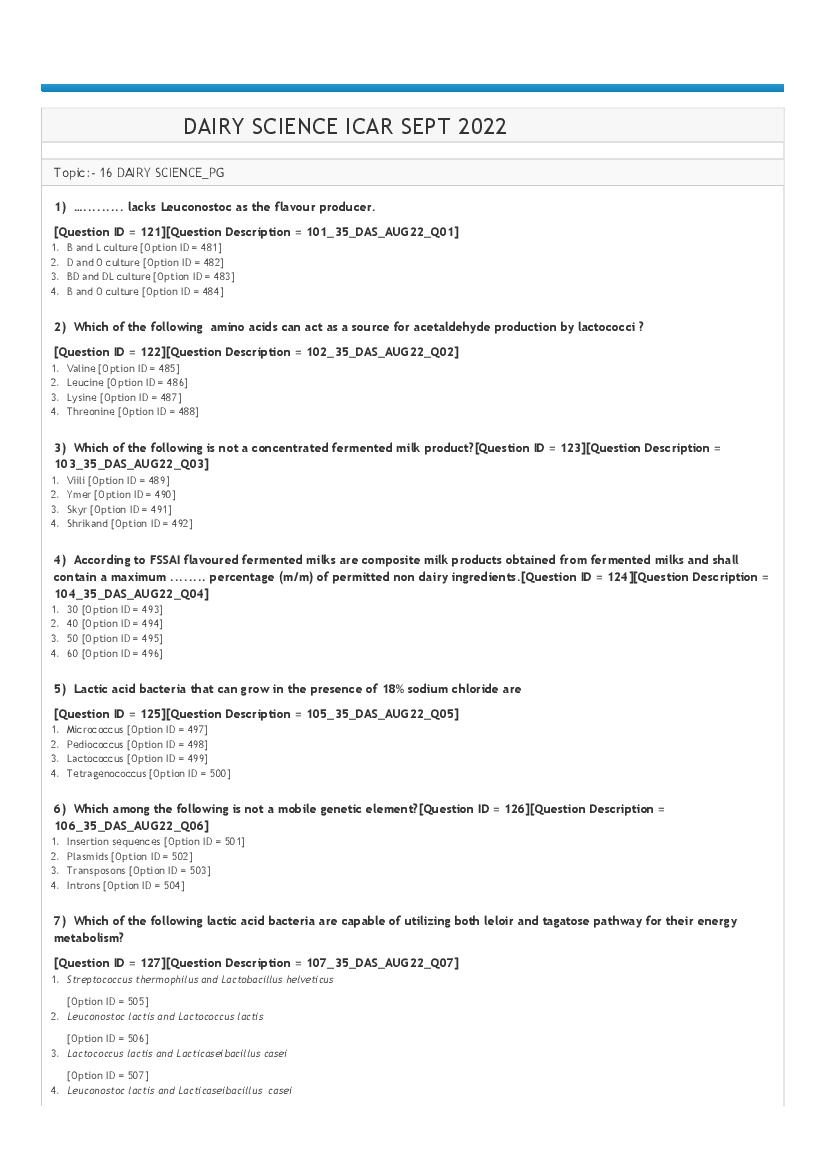
Topic:‐ 16 DAIRY SCIENCE_PG
1) …......... lacks Leuconostoc as the flavour producer.
[Question ID = 121][Question Description = 101_35_DAS_AUG22_Q01]
1. B and L culture [Option ID = 481]
2. D and O culture [Option ID = 482]
3. BD and DL culture [Option ID = 483]
4. B and O culture [Option ID = 484]
2) Which of the following amino acids can act as a source for acetaldehyde production by lactococci ?
[Question ID = 122][Question Description = 102_35_DAS_AUG22_Q02]
1. Valine [Option ID = 485]
2. Leucine [Option ID = 486]
3. Lysine [Option ID = 487]
4. Threonine [Option ID = 488]
3) Which of the following is not a concentrated fermented milk product?[Question ID = 123][Question Description =
103_35_DAS_AUG22_Q03]
1. Viili [Option ID = 489]
2. Ymer [Option ID = 490]
3. Skyr [Option ID = 491]
4. Shrikand [Option ID = 492]
4) According to FSSAI flavoured fermented milks are composite milk products obtained from fermented milks and shall
contain a maximum ........ percentage (m/m) of permitted non dairy ingredients.[Question ID = 124][Question Description =
104_35_DAS_AUG22_Q04]
1. 30 [Option ID = 493]
2. 40 [Option ID = 494]
3. 50 [Option ID = 495]
4. 60 [Option ID = 496]
5) Lactic acid bacteria that can grow in the presence of 18% sodium chloride are
[Question ID = 125][Question Description = 105_35_DAS_AUG22_Q05]
1. Micrococcus [Option ID = 497]
2. Pediococcus [Option ID = 498]
3. Lactococcus [Option ID = 499]
4. Tetragenococcus [Option ID = 500]
6) Which among the following is not a mobile genetic element?[Question ID = 126][Question Description =
106_35_DAS_AUG22_Q06]
1. Insertion sequences [Option ID = 501]
2. Plasmids [Option ID = 502]
3. Transposons [Option ID = 503]
4. Introns [Option ID = 504]
7) Which of the following lactic acid bacteria are capable of utilizing both leloir and tagatose pathway for their energy
metabolism?
[Question ID = 127][Question Description = 107_35_DAS_AUG22_Q07]
1. Streptococcus thermophilus and Lactobacillus helveticus
[Option ID = 505]
2. Leuconostoc lactis and Lactococcus lactis
[Option ID = 506]
3. Lactococcus lactis and Lacticaseibacillus casei
[Option ID = 507]
4. Leuconostoc lactis and Lacticaseibacillus casei
Page 2
8) A sour milk product of Japan that is prepared from skim milk is
[Question ID = 128][Question Description = 108_35_DAS_AUG22_Q08]
1. Yoke [Option ID = 509]
2. Ymer [Option ID = 510]
3. Calpis [Option ID = 511]
4. Skyr [Option ID = 512]
9) Which of the following biochemical test function is based on the ability of organisms to produce Acetylmethyl carbinol
with creatine?
[Question ID = 129][Question Description = 109_35_DAS_AUG22_Q09]
1. Horrell Elliker test
[Option ID = 513]
2. Indole test
[Option ID = 514]
3. Creatine test
[Option ID = 515]
4. Methyl red test
[Option ID = 516]
10) The bacteriocin that is coming under 'lanthionine containing peptides'is
[Question ID = 130][Question Description = 110_35_DAS_AUG22_Q10]
1. Nisin [Option ID = 517]
2. Lacticin F [Option ID = 518]
3. Lactococcin A [Option ID = 519]
4. Helveticin [Option ID = 520]
11) The pathogens applicable in the food safety criteria of fermented milk products are ........................................
and ............................... as per FSSAI[Question ID = 131][Question Description = 111_35_DAS_AUG22_Q11]
1. Salmonella and Bacillus cereus [Option ID = 521]
2. Bacillus cereus and Listeria monocytogenes [Option ID = 522]
3. Salmonella and Listeria monocytogenes [Option ID = 523]
4. Salmonella and Sulphite reducing Clostridium [Option ID = 524]
12) Maximum titratable acidity permitted for Srikhand as per Food Safety Standards and Regulations is ................
(percent lactic acid)
[Question ID = 132][Question Description = 112_35_DAS_AUG22_Q12]
1. 0.4 [Option ID = 525]
2. 0.6 [Option ID = 526]
3. 1.4 [Option ID = 527]
4. 1.6 [Option ID = 528]
13) The interaction between propionibacteria and lactobacilli in Swiss cheese changes from ...................to
..........................when lactic acid is accumulated and lactobacilli starts to benefit from its removal by propionibacteria.
[Question ID = 133][Question Description = 113_35_DAS_AUG22_Q13]
1. Commensalism to Mutualism [Option ID = 529]
2. Mutualism to Commensalism [Option ID = 530]
3. Amensalism to Competition [Option ID = 531]
4. Competetion to Amensalism [Option ID = 532]
14) In the scheme for microbiological testing for water,temperatures for taking colony count are ................ and
.............[Question ID = 134][Question Description = 114_35_DAS_AUG22_Q14]
1. 42oC and 30 oC [Option ID = 533]
2. 37oC and 30 oC [Option ID = 534]
3. 30oC and 22 oC [Option ID = 535]
4. 37oC and 22oC [Option ID = 536]
15) The time from initial adsorption of phages to release of phages is called .............
[Question ID = 135][Question Description = 115_35_DAS_AUG22_Q15]
Page 3
[Option ID = 537]
2. Latent period
[Option ID = 538]
3. Withdrawal period
[Option ID = 539]
4. Burst period
[Option ID = 540]
16) Genus of lactic acid bacteria that possess a DNA base composition with GC% 57 ‐65 is ......................... .
[Question ID = 136][Question Description = 116_35_DAS_AUG22_Q16]
1. Bifidobacterium [Option ID = 541]
2. Pediococcus [Option ID = 542]
3. Leuconostoc [Option ID = 543]
4. Streptococcus [Option ID = 544]
17) Which statement is not true for Pseudolysogeny?[Question ID = 137][Question Description = 117_35_DAS_AUG22_Q17]
1. Pseudolusogeny is also known as a phage carrier state [Option ID = 545]
2. Pseudolysogeny occurs when a bacterial culture carries a temperate phage while maintaining an active population. [Option ID = 546]
3. Pseudolysogeny occurs when a bacterial culture carries a lytic phage while maintaining an active population. [Option ID = 547]
4. Repeated culture purification helps in eliminating phages from a pseudolysogenenous culture. [Option ID = 548]
18) In the manufacture of Yakult, fermentation time given is ‐‐‐‐‐‐‐‐‐‐‐‐‐‐‐‐‐‐‐.
[Question ID = 138][Question Description = 118_35_DAS_AUG22_Q18]
1. 24 hours [Option ID = 549]
2. 48 hours [Option ID = 550]
3. 72 hours [Option ID = 551]
4. More than 72 hours [Option ID = 552]
19) Unable to grow at 45o C,but able to grow in 0.3% Methylene blue and capable of hydrolysing arginine is true for
............................. .
[Question ID = 139][Question Description = 119_35_DAS_AUG22_Q19]
1. Leuconostoc
[Option ID = 553]
2. Lactococcus
[Option ID = 554]
3. Bifidobacterium
[Option ID = 555]
4. Brevibacterium
[Option ID = 556]
20) Which is not applicable for iodophores in dairy plant sanitation?
[Question ID = 140][Question Description = 120_35_DAS_AUG22_Q20]
1. Shows good activity aganist yeast and mold.
[Option ID = 557]
2. More effective in alkaline pH
[Option ID = 558]
3. Less effective at elevated temperature.
[Option ID = 559]
4. Stable than chlorine in the presence of organic matter.
[Option ID = 560]
21) One of the causative organism responsible for toxi‐infection through milk products is
[Question ID = 141][Question Description = 121_35_DAS_AUG22_Q21]
1. Bacillus subtilis
[Option ID = 561]
2. Pseudomonas aeruginosa
Page 4
3. Clostridium perfringens
[Option ID = 563]
4. Klebsiella pneumoniae
[Option ID = 564]
22) Thermonuclease test is used for detection of
[Question ID = 142][Question Description = 122_35_DAS_AUG22_Q22]
1. Escherichia coli
[Option ID = 565]
2. Salmonella spp.
[Option ID = 566]
3. Enterococci spp.
[Option ID = 567]
4. Staphylococci spp.
[Option ID = 568]
23) The specific medium for isolation of Shigella spp. is[Question ID = 143][Question Description =
123_35_DAS_AUG22_Q23]
1. Cefsulodin‐Irgasan‐Novobiocin (CIN) agar [Option ID = 569]
2. De Man, Rogosa and Sharpe agar [Option ID = 570]
3. Desoxycholate citrate agar [Option ID = 571]
4. Cycloheximide and amphotericin B agar [Option ID = 572]
24) Match List I with List II
List I List II
(Disease / Condition) (Test)
A. Typhoid i. Delvo test
B. Antibiotics in milk ii. Dick test
C. Scarlet fever iii. Phosphatase test
D. Pasteurization iv. Widal test
Choose the correct answer from the options given below:
[Question ID = 144][Question Description = 124_35_DAS_AUG22_Q24]
1. A – ii, B – i, C – iii, D – iv [Option ID = 573]
2. A – iv, B – iii, C – ii, D – i [Option ID = 574]
3. A – iii, B – i, C – iv, D – ii [Option ID = 575]
4. A – iv, B – i, C – ii, D ‐ iii [Option ID = 576]
25) The defects encountered in UHT milk during storage is
[Question ID = 145][Question Description = 125_35_DAS_AUG22_Q25]
1. loss of vitamins
[Option ID = 577]
2. mold button formation
[Option ID = 578]
3. gelation/coagulation
[Option ID = 579]
4. leakiness
[Option ID = 580]
26) Which of the following known as “Cold sterilization” is used to reduce the microbial load of dairy liquids?
[Question ID = 146][Question Description = 126_35_DAS_AUG22_Q26]
1. Tyndallization [Option ID = 581]
2. Thermization [Option ID = 582]
3. Microfiltration [Option ID = 583]
4. Stassanization [Option ID = 584]
27) Given below are two statements, one is labelled as Assertion A and the other is labelled as Reason R
Page 5
Reason R : The separation is carried out at around 40o C which is a congenial temperature for microbial growth and the
cream and skim milk obtained, if used for standardization, would seed high number of microorganisms
In light of the above statements, choose the correct answer from the options given below
[Question ID = 147][Question Description = 127_35_DAS_AUG22_Q27]
1. A is true but R is false
[Option ID = 585]
2. A is false but R is true
[Option ID = 586]
3. Both A and R are true but R is NOT the correct explanation of A
[Option ID = 587]
4. Both A and R are true and R is the correct explanation of A
[Option ID = 588]
28) Ingestion of pre formed toxins already synthesized in the food brings about poisoning syndrome in consumer called;
[Question ID = 148][Question Description = 128_35_DAS_AUG22_Q28]
1. Food Infection
[Option ID = 589]
2. Food Intoxication
[Option ID = 590]
3. Toxi‐Infection
[Option ID = 591]
4. Immune deficiency
[Option ID = 592]
29) Which of the following organism is responsible for food infection[Question ID = 149][Question Description =
129_35_DAS_AUG22_Q29]
1. Staphylococcus aureus [Option ID = 593]
2. Salmonella typhi [Option ID = 594]
3. Bacillus cereus [Option ID = 595]
4. Escherichia coli [Option ID = 596]
30) The aflatoxin is a toxic metabolite mainly produced by
[Question ID = 150][Question Description = 130_35_DAS_AUG22_Q30]
1. Aspergillus flavus & Aspergillus ambiguus [Option ID = 597]
2. Aspergillus flavus & Aspergillus parasiticus [Option ID = 598]
3. Aspergillus parafelis & Aspergillus terreus [Option ID = 599]
4. Aspergillus flavus & Aspergillus niger [Option ID = 600]
31) The causative organism for late blowing defect in canned milk products is
[Question ID = 151][Question Description = 131_35_DAS_AUG22_Q31]
1. Coliforms Species [Option ID = 601]
2. Clostridium Species [Option ID = 602]
3. Pseudomonas Species [Option ID = 603]
4. Bacillus Species [Option ID = 604]
32) Match List I with List II
List I List II
(Type of Spoilage) (Causative microorganism)
A. Sweet curdling i. B. cereus var mycoides
B. Ropiness ii. Streptococcus liquifaciens
C. Bitty cream iii. Pseudomonas fragi
D. Fruit flavour iv. S. lactis var hollandicus
Choose the correct answer from the options given below:
[Question ID = 152][Question Description = 132_35_DAS_AUG22_Q32]
1. A – i, B – ii, C – iii, D – iv [Option ID = 605]
2. A – ii, B – iv, C – i, D – iii [Option ID = 606]
Page 6
4. A – ii, B – iii, C – i, D ‐ iv [Option ID = 608]
33) The carcass of the animal affected with which of the following disease should not be subjected to post mortem
examination
[Question ID = 153][Question Description = 133_35_DAS_AUG22_Q33]
1. Tuberculosis
[Option ID = 609]
2. Anthrax
[Option ID = 610]
3. Foot and Mouth disease
[Option ID = 611]
4. Botulism
[Option ID = 612]
34) Given below are two statements, one is labelled as Assertion A and the other is labelled as Reason R
Assertion A: Water is the most important source of salmonella
Reason R: Water frequently gets contaminated through faecal matter
In light of the above statements, choose the most appropriate answer from the options given below
[Question ID = 154][Question Description = 134_35_DAS_AUG22_Q34]
1. Both A and R are correct and R is the correct explanation of A [Option ID = 613]
2. Both A and R are correct but R is NOT the correct explanation of A [Option ID = 614]
3. A is correct but R is not correct [Option ID = 615]
4. A is not correct but R is correct [Option ID = 616]
35) The following test is used to differentiate the faecal coliforms from non faecal counterparts in dairy industry.
[Question ID = 155][Question Description = 135_35_DAS_AUG22_Q35]
1. Presumptive coliform test [Option ID = 617]
2. Confirmatory coliform test [Option ID = 618]
3. Most Probable Number method [Option ID = 619]
4. Eijkman’s test [Option ID = 620]
36) The selective medium used for the isolation of Bacillus cereus from milk and other foods is[Question ID = 156][Question
Description = 136_35_DAS_AUG22_Q36]
1. Eosine Methylene blue agar [Option ID = 621]
2. Mannitol Egg Yolk Polymyxin agar [Option ID = 622]
3. MRS agar [Option ID = 623]
4. Neomycin blood agar [Option ID = 624]
37) Given below are two statements
Statement I: Streptococcus pyogenes has been known to be pathogenic to human beings
Statement II: Streptococcus agalactiae has been known to be pathogenic to human beings
In light of the above statements, choose the most appropriate answer from the options given below
[Question ID = 157][Question Description = 137_35_DAS_AUG22_Q37]
1. Both Statement I and Statement II are correct [Option ID = 625]
2. Both Statement I and Statement II are incorrect [Option ID = 626]
3. Statement I is correct but Statement II is incorrect [Option ID = 627]
4. Statement I is incorrect but Statement II is correct [Option ID = 628]
38) The organisms which can survive as well as multiply in the pasteurization temperature in milk are known as[Question ID
= 158][Question Description = 138_35_DAS_AUG22_Q38]
1. Psychrotrophs [Option ID = 629]
2. Thermodurics [Option ID = 630]
3. Thermophiles [Option ID = 631]
4. Mesophiles [Option ID = 632]
39) Given below are two statements, one is labelled as Assertion A and the other is labelled as Reason R
Page 7
Reason R: Accumulation of free fatty acids in the dairy products by activity of lipases results in rancidity defect
In light of the above statements, choose the most appropriate answer from the options given below
[Question ID = 159][Question Description = 139_35_DAS_AUG22_Q39]
1. Both A and R are correct and R is the correct explanation of A [Option ID = 633]
2. Both A and R are correct but R is NOT the correct explanation of A [Option ID = 634]
3. Both A and R are not correct and there is no relation between A and R [Option ID = 635]
4. A is correct but R is not correct [Option ID = 636]
40) The results of IMViC test to differentiate E. coli and Enterobacter aerogenes is as follows
i) E. coli is positive for Indole and Methyl red tests
ii) Enterobacter aerogenes is positive for Indole and Methyl red tests
iii) E. coli is positive for Voges Proskauer’s and Citrate utilization tests
iv) Enterobacter aerogenes is positive for Voges Proskauer’s and Citrate utilization tests
Choose the correct answer from the options given below:
[Question ID = 160][Question Description = 140_35_DAS_AUG22_Q40]
1. Both (i) and (iv) are correct [Option ID = 637]
2. Both (i) and (ii) are correct [Option ID = 638]
3. Both (iii) and (iv) are correct [Option ID = 639]
4. Both (ii) and (iii) are correct [Option ID = 640]
41) Which of the following yeast ferments lactose?
[Question ID = 161][Question Description = 141_35_DAS_AUG22_Q41]
1. Saccharomyces cereviceae
[Option ID = 641]
2. Kluyveromyces fragilis
[Option ID = 642]
3. Torula cremoris
[Option ID = 643]
4. Candida lipolytica
[Option ID = 644]
42) The Orla –Jensen group of Limosilactobacillus fermentum is
[Question ID = 162][Question Description = 142_35_DAS_AUG22_Q42]
1. Betabacterium [Option ID = 645]
2. Thermobacterium [Option ID = 646]
3. Streptobacterium [Option ID = 647]
4. Alphabacterium [Option ID = 648]
43) The sweet curdling in pasteurized milk may be due to
[Question ID = 163][Question Description = 143_35_DAS_AUG22_Q43]
1. Bacillus subtilis [Option ID = 649]
2. Bacillus polymixa [Option ID = 650]
3. Bacillus stearothermophilus [Option ID = 651]
4. Bacillus circulans [Option ID = 652]
44) Mycobacterium tuberculosis is an "index organism for pasteurisation" and it has the following characteristics
A. Acid‐fast bacterium
B. Motile by means of corkscrew motion
C. Causes tuberculosis in man and animals
D. Can be detected within a day on normal growth medium
E. Shows negative for urease enzyme activity
Page 8
[Question ID = 164][Question Description = 144_35_DAS_AUG22_Q44]
1. A, and B only [Option ID = 653]
2. A and C only [Option ID = 654]
3. A and D only [Option ID = 655]
4. A and E only [Option ID = 656]
45) Which of the following Gram‐positive bacterium shows Aesculin hydrolysis?
A. Enterococcus species
B. Listeria species
C. Mycobacterium species
D. Lactobacillus fermentum
E. Streptococcus thermophilus
Choose the correct answer from the options given below:
[Question ID = 165][Question Description = 145_35_DAS_AUG22_Q45]
1. A, B and D only [Option ID = 657]
2. A, B, and C only [Option ID = 658]
3. A, B, and E only [Option ID = 659]
4. C, D, and E only [Option ID = 660]
46) Which are the relevant personnel hygienic practices for a milker?
A. Free from infectious diseases
B. Hands to be cleaned with soap and water before milking
C. Nails to be cut regularly
D. Efficient disposal of manure and waste
E. Clean Milking Competitions for milkers
Choose the correct answer from the options given below
[Question ID = 166][Question Description = 146_35_DAS_AUG22_Q46]
1. A, B, and C [Option ID = 661]
2. A, B, and D [Option ID = 662]
3. B, C, and D [Option ID = 663]
4. C, D, and E [Option ID = 664]
47) Match List I with List II
List I List II
Microorganisms Characteristics
A. Escherichia coli I. Urease enzyme activity
B. Enterobacter aerogenes II. H2S production
C. Salmonella III. IMViC ++‐‐
D. Proteus IV. IMViC ‐‐++
V. Hippurase enzyme activity
Choose the correct answer from the options given below:
[Question ID = 167][Question Description = 147_35_DAS_AUG22_Q47]
1. A ‐ I, B ‐ II, C ‐ III, D ‐ IV [Option ID = 665]
2. A ‐ II, B ‐III , C ‐IV , D ‐ V [Option ID = 666]
3. A ‐III , B ‐IV, C ‐ II, D ‐ I [Option ID = 667]
4. A ‐IV , B ‐ V, C ‐ I , D ‐ II [Option ID = 668]
48) Match List I with List II
List I List II
Microorganisms Shape and Arrangement
A. StaphylococcusI. Tetrads
B.Streptococcus II. Packets of 8 cells
C. Sarcina III. Cocci in chains
Page 9
V. Cocci in pairs
Choose the correct answer from the options given below:
[Question ID = 168][Question Description = 148_35_DAS_AUG22_Q48]
1. A ‐IV, B ‐ III, C ‐II, D ‐ I [Option ID = 669]
2. A ‐ II, B ‐III , C ‐IV , D ‐ V [Option ID = 670]
3. A ‐ I, B ‐III , C ‐ IV, D ‐ V [Option ID = 671]
4. A ‐V , B ‐I , C ‐ II, D ‐ III [Option ID = 672]
49) Which of the following molds produces Aflatoxin in animal feed?
A. Aspergillus flavus
B. Aspergillus parasiticus
C. Aspergillus niger
D. Geotricum candidum
E. Alternaria tolerance
Choose the correct answer from the options given below:
[Question ID = 169][Question Description = 149_35_DAS_AUG22_Q49]
1. A, B and D only [Option ID = 673]
2. A and B only [Option ID = 674]
3. B and C only [Option ID = 675]
4. C and D only [Option ID = 676]
50) Given below are two statements, one is labelled as Assertion A and the other is labelled as Reason R
Assertion A : Sweet curdling is a defect caused by aerobic spore‐forming bacteria due to the production of rennin‐like
enzyme and often is accompanied by bitterness
Reason R : Generally, more acid production is observed during sweet curdling in dairy product
In light of the above statements, choose the correct answer from the options given below
[Question ID = 170][Question Description = 150_35_DAS_AUG22_Q50]
1. Both A and R are true and R is the correct explanation of A [Option ID = 677]
2. Both A and R are true but R is NOT the correct explanation of A [Option ID = 678]
3. A is true but R is false [Option ID = 679]
4. A is false but R is true [Option ID = 680]
51) Unclean flavor production in milk arises from
A. Dimethyl sulhide
B. Gram ‐ve psychrotrophic rods
C. Hydrogen Sulphide
D. Gram +ve cocci
[Question ID = 171][Question Description = 151_35_DAS_AUG22_Q51]
1. A and B only [Option ID = 681]
2. B and C only [Option ID = 682]
3. C and D only [Option ID = 683]
4. A and D only [Option ID = 684]
52) Match List I with List II
List I List II
Abnormal Colouration Causative Organism
A. Blue colouration I. Pseudomonas synxantha
B. Yellow colouration II. Pseudomonas syncyanea
C. Red colouration III. Serratia marcescens
D. Green colouration IV. Chromobacterium violacein
V. Pseudomonas fluorescence
Choose the correct answer from the options given below:
[Question ID = 172][Question Description = 152_35_DAS_AUG22_Q52]
Page 10
[Option ID = 685]
2. A ‐II , B ‐III , C ‐ IV, D ‐ V
[Option ID = 686]
3. A ‐ III, B ‐ IV, C ‐ I, D ‐ V
[Option ID = 687]
4. A ‐IV , B ‐ I, C ‐ II, D ‐ III
[Option ID = 688]
53) Given below are two statements
Statement I: Dry milking and fat milking have been preferable over wet milking procedure
Statement II: Fat milking is superior over dry milking as it avoids injury to teats resulting in low bacterial contamination in
milk
In light of the above statements, choose the correct answer from the options given below
[Question ID = 173][Question Description = 153_35_DAS_AUG22_Q53]
1. Both Statement I and Statement II are true
[Option ID = 689]
2. Both Statement I and Statement II are false
[Option ID = 690]
3. Statement I is true but Statement II is false
[Option ID = 691]
4. Statement I is false but Statement II is true
[Option ID = 692]
54) Summer mastitis in dairy animals is caused by
A. Streptococcus agalactiae
B. Staphylococcus aureus
C. Corynebacterium pyogenes
D. Hydroteae irritans
[Question ID = 174][Question Description = 154_35_DAS_AUG22_Q54]
1. A, and B only [Option ID = 693]
2. B and C only [Option ID = 694]
3. C and D only [Option ID = 695]
4. A and D only [Option ID = 696]
55) Given below are two statements, one is labelled as Assertion A and the other is labelled as Reason R
Assertion A : Milk from animals treated for mastitis is not suitable for the production of fermented milk products
Reason R : Treated mastitis milk contains antibiotic residues
In light of the above statements, choose the correct answer from the options given below
[Question ID = 175][Question Description = 155_35_DAS_AUG22_Q55]
1. Both A and R are true and R is the correct explanation of A
[Option ID = 697]
2. Both A and R are true but R is NOT the correct explanation of A
[Option ID = 698]
3. A is true but R is false
[Option ID = 699]
4. A is false but R is true
[Option ID = 700]
56) Given below are two statements
Statement I: Cheese prepared from milk of cows affected by subclinical mastitis results in lower yield and quality
Statement II: Increased RCT leads to loose final texture of cheese
Page 11
[Question ID = 176][Question Description = 156_35_DAS_AUG22_Q56]
1. Both Statement I and Statement II are true
[Option ID = 701]
2. Both Statement I and Statement II are false
[Option ID = 702]
3. Statement I is true but Statement II is false
[Option ID = 703]
4. Statement I is false but Statement II is true
[Option ID = 704]
57) Which of the following bacteria isolated from mastitis milk can be specifically confrimed by CAMP test?
A. Streptococcus agalactiae
B. Streptococcus dysagalactiae
C. Staphylococcus aureus
D. Staphylococcus epidermidis
E. Staphylococcus intermedius
Choose the correct answer from the options given below
[Question ID = 177][Question Description = 157_35_DAS_AUG22_Q57]
1. A, B, C, D, E [Option ID = 705]
2. A and B only [Option ID = 706]
3. A, B and C only [Option ID = 707]
4. B, C and D only [Option ID = 708]
58) The appearance of rusty brown color on the walls of the tubes in the Hotis test for mastitic milk is mainly due to
.........
[Question ID = 178][Question Description = 158_35_DAS_AUG22_Q58]
1. Staphylococcus aureus [Option ID = 709]
2. Streptococcus agalactiae [Option ID = 710]
3. Staphylococcus aureus and Streptococcus agalactiae [Option ID = 711]
4. Streptococcus uberis [Option ID = 712]
59) Name the emetic toxin produced by Bacillus cereus.
[Question ID = 179][Question Description = 159_35_DAS_AUG22_Q59]
1. Cerrulide [Option ID = 713]
2. Prodigiocin [Option ID = 714]
3. Aletrnarin [Option ID = 715]
4. Glyceride [Option ID = 716]
60) Match List I with List II
List I List II
Causative Organism Disease/Syndrome
A. Staphylococcus aureusI. Cholera
B. E.coli O157: H7 II. Guillain Barre Syndrome
C. Campylobacter jejuni III. Toxic Shock Syndrome
D. Vibrio cholera IV. Haemolytic uremic syndrome
V. Emesis
Choose the correct answer from the options given below:
[Question ID = 180][Question Description = 160_35_DAS_AUG22_Q60]
1. A ‐ II, B ‐ III, C ‐IV , D ‐ V [Option ID = 717]
2. A ‐ III, B ‐ IV, C ‐ I, D ‐ II [Option ID = 718]
3. A ‐ III, B ‐IV , C ‐ II, D ‐ I [Option ID = 719]
4. A ‐ IV, B ‐V , C ‐I , D ‐ II [Option ID = 720]
61) The number of amino acid residues in glycomacropeptide (GMP) are
Page 12
1. 44 [Option ID = 721]
2. 54 [Option ID = 722]
3. 64 [Option ID = 723]
4. 84 [Option ID = 724]
62) Which of the following statement is incorrect with respect to rennet coagulation of milk?
[Question ID = 182][Question Description = 162_35_DAS_AUG22_Q62]
1. Coagulation does not occur below 15°C. [Option ID = 725]
2. An increase in enzyme concentration results in reduction of rennet coagulation time [Option ID = 726]
3. Calcium content mainly influences the secondary phase of coagulation. [Option ID = 727]
4. Rennet coagulation time generally decreases with the severity of heat treatment. [Option ID = 728]
63) During ripening of cheeses, citrate metabolism leads to formation of
[Question ID = 183][Question Description = 163_35_DAS_AUG22_Q63]
1. Butyric acid [Option ID = 729]
2. Propionic acid [Option ID = 730]
3. Diacetyl [Option ID = 731]
4. Lactic Acid [Option ID = 732]
64) Which of the following can be used as an index of heat treatment of milk?[Question ID = 184][Question Description =
164_35_DAS_AUG22_Q64]
1. Lactose content [Option ID = 733]
2. Urea content [Option ID = 734]
3. Malic acid content [Option ID = 735]
4. Lactulose content [Option ID = 736]
65) n‐Octanal is the product of autoxidation of……………………….[Question ID = 185][Question Description =
165_35_DAS_AUG22_Q65]
1. Oleic acid [Option ID = 737]
2. Linoleic acid [Option ID = 738]
3. Alpha‐linolenic acid [Option ID = 739]
4. Gamma‐Linolenic acid [Option ID = 740]
66) Discoloration of milk powder during storage is due to....[Question ID = 186][Question Description =
166_35_DAS_AUG22_Q66]
1. Caramalization [Option ID = 741]
2. Lactose crystallization [Option ID = 742]
3. Maillard reaction [Option ID = 743]
4. Autooxidation [Option ID = 744]
67) Which of the following statement is true with respect to Lobry de Bruyn‐Alberda van Ekenstein rearrangement of
lactose in milk during heating?
[Question ID = 187][Question Description = 167_35_DAS_AUG22_Q67]
1. Glucose moiety of lactose is changed to fructose [Option ID = 745]
2. Galactose moiety of lactose is changed to fructose [Option ID = 746]
3. Glucose moiety of lactose is oxidized to gluconic acid [Option ID = 747]
4. Galactose moiety of lactose is galactitol [Option ID = 748]
68) Polenske value of ghee represents
[Question ID = 188][Question Description = 168_35_DAS_AUG22_Q68]
1. Steam volatile and water insoluble fatty acids
[Option ID = 749]
2. Water soluble saturated fatty acids
[Option ID = 750]
3. Steam volatile and water soluble fatty acids
[Option ID = 751]
4. Water insoluble unsaturated fatty acids
[Option ID = 752]
69) Physical agents responsible for denaturation of food proteins are
Page 13
B. Heat
C. High Pressure Processing
D. Ultrasound
E. Agitation
[Question ID = 189][Question Description = 169_35_DAS_AUG22_Q69]
1. A, B and D only
[Option ID = 753]
2. A, B and C only
[Option ID = 754]
3. A, B, C and D only
[Option ID = 755]
4. E only
[Option ID = 756]
70) End product of milk fermentation which acts as preservative[Question ID = 190][Question Description =
170_35_DAS_AUG22_Q70]
1. Lactic acid [Option ID = 757]
2. Formic acid [Option ID = 758]
3. Malic acid [Option ID = 759]
4. Ascorbic acid [Option ID = 760]
71) At Natural pH of milk the casein occur in the form of
[Question ID = 191][Question Description = 171_35_DAS_AUG22_Q71]
1. Gel
[Option ID = 761]
2. Coagulum
[Option ID = 762]
3. Micelle
[Option ID = 763]
4. Emulsion
[Option ID = 764]
72) Which of the following is not a natural color?
[Question ID = 192][Question Description = 172_35_DAS_AUG22_Q72]
1. Annatto [Option ID = 765]
2. Sunset Yellow [Option ID = 766]
3. Caramel [Option ID = 767]
4. Carotene [Option ID = 768]
73) The fat globule size in milk ranges from
[Question ID = 193][Question Description = 173_35_DAS_AUG22_Q73]
1. 0.2 ‐ 22.0 μm
[Option ID = 769]
2. 20 ‐ 200 nm
[Option ID = 770]
3. 50 ‐ 80 μm
[Option ID = 771]
4. 0.2 ‐ 22.0 nm
[Option ID = 772]
74) Packaged food containing Monosodium glutamate shall carry on the label the following
A. Contains MSG
B. Not recommended for infants below 12 months
Page 14
D. Not for lactose‐intolerant infants
Choose the correct answer from the options given below:
[Question ID = 194][Question Description = 174_35_DAS_AUG22_Q74]
1. A, B and D only
[Option ID = 773]
2. A and B only
[Option ID = 774]
3. B and C only
[Option ID = 775]
4. A only
[Option ID = 776]
75) Butylated hydroxy anisole is[Question ID = 195][Question Description = 175_35_DAS_AUG22_Q75]
1. Antioxidant [Option ID = 777]
2. Flavor enhancer [Option ID = 778]
3. Pesticide [Option ID = 779]
4. Permitted color [Option ID = 780]
76) Chemical preservative is defined as a chemical compound that
[Question ID = 196][Question Description = 176_35_DAS_AUG22_Q76]
1. Retard microbial activity
[Option ID = 781]
2. Increase nutritional value of food
[Option ID = 782]
3. Enhance sensory properties of product
[Option ID = 783]
4. Speeds up alterations caused by microorganisms
[Option ID = 784]
77) As per FSSAI, which of the following statement is true about permitted preservative in ghee[Question ID = 197]
[Question Description = 177_35_DAS_AUG22_Q77]
1. Any food grade antioxidant [Option ID = 785]
2. Only BHA [Option ID = 786]
3. No preservative is permitted [Option ID = 787]
4. Both BHA and BHT can be added [Option ID = 788]
78) Which of the following is not a permitted acidulant for preparation of paneer as per FSSAI regulations?
[Question ID = 198][Question Description = 178_35_DAS_AUG22_Q78]
1. Citric acid [Option ID = 789]
2. Lactic acid [Option ID = 790]
3. Glucono delta lactone [Option ID = 791]
4. Tartaric acid [Option ID = 792]
79) Which of the following is a correct standard for khoa under FSSR"?
A. Minimum fat should be 30% on dry matter basis
B. Maximum titratable acidity 0.9% lactic acid
C. It may have added starch and sugar
D. Extracted fat from khoa shall meet the standard of butter
E. Minimum total solids should be 40%
Choose the correct answer from the options given below:
[Question ID = 199][Question Description = 179_35_DAS_AUG22_Q79]
1. A, B and D only [Option ID = 793]
2. A, B, C and D only [Option ID = 794]
3. A, B and E only [Option ID = 795]
Page 15
80) "Maximum peroxide value permitted in ghee by FSSR"
[Question ID = 200][Question Description = 180_35_DAS_AUG22_Q80]
1. Not defined [Option ID = 797]
2. 0.6 Milliequivalent of Oxygen/Kg fat [Option ID = 798]
3. 0.4 Milliequivalent of Oxygen/Kg fat [Option ID = 799]
4. <2 milliequivalent of oxygen/kg fat of="" oxygen/kg=""> [Option ID = 800]
81) Which among the following cannot control oxidative rancidity in whole milk powder?[Question ID = 201][Question
Description = 181_35_DAS_AUG22_Q81]
1. Addition of tocopherol [Option ID = 801]
2. Flushing of inert gas [Option ID = 802]
3. Vacuum packaging [Option ID = 803]
4. Addition of sodium alginate [Option ID = 804]
82) In Kjeldahl method for estimation of milk protein, which among the following is used as a digestion mixture?
[Question ID = 202][Question Description = 182_35_DAS_AUG22_Q82]
1. Copper sulphate and sodium tartarate [Option ID = 805]
2. Copper sulphate and potassium chromate [Option ID = 806]
3. Copper sulphate and potassium iodide [Option ID = 807]
4. Copper sulphate and potassium sulphate [Option ID = 808]
83) The number of milligrams of potassium hydroxide required to neutralize the free fatty acids present in one gram of
ghee sample is known as[Question ID = 203][Question Description = 183_35_DAS_AUG22_Q83]
1. Degree of acidity [Option ID = 809]
2. Kirschner value [Option ID = 810]
3. Acid value [Option ID = 811]
4. RM value [Option ID = 812]
84) Which of the following are two indices used for heat classification of milk powder based on level of whey protein
denaturation?[Question ID = 204][Question Description = 184_35_DAS_AUG22_Q84]
1. Casein number and NPN [Option ID = 813]
2. WPNI and casein number [Option ID = 814]
3. Total nitrogen and WPNI [Option ID = 815]
4. Total casein and NPN [Option ID = 816]
85) Match List I with List II
List I List II
Milk constituentsMethods
A. Lactose I. Karl Fischer Titration
B. Fat II. Lowry method
C. Moisture III. Chloramine‐T‐ method
D. Protein IV. Babcock method
Choose the correct answer from the options given below:
[Question ID = 205][Question Description = 185_35_DAS_AUG22_Q85]
1. A ‐II , B ‐III , C ‐ I, D ‐ IV [Option ID = 817]
2. A ‐III , B ‐IV , C ‐II , D ‐ I [Option ID = 818]
3. A ‐II , B ‐IV , C ‐I , D ‐III [Option ID = 819]
4. A ‐III, B ‐IV , C ‐I , D ‐ II [Option ID = 820]
86) Halphen's test is used to detect the presence of which adulterant in ghee?[Question ID = 206][Question Description =
186_35_DAS_AUG22_Q86]
1. Cotton seed oil [Option ID = 821]
2. Sesame oil [Option ID = 822]
3. Tallow [Option ID = 823]
4. Coconut oil [Option ID = 824]
87) Which of the following compounds, is not used to monitor Maillard reactions in milk product.
[Question ID = 207][Question Description = 187_35_DAS_AUG22_Q87]
1. Furosine
Page 16
2. Pyridosine
[Option ID = 826]
3. HMF
[Option ID = 827]
4. Fucose
[Option ID = 828]
88) Which of the following enzymes facilitates the transport of citrate into bacterial cells?
[Question ID = 208][Question Description = 188_35_DAS_AUG22_Q88]
1. Citrate dehydogenase
[Option ID = 829]
2. Citrate permease
[Option ID = 830]
3. Hexokinase
[Option ID = 831]
4. Citrate phosphatase
[Option ID = 832]
89) Which among the following reactions is not favoured by an increase in the moisture content of the milk powder?
[Question ID = 209][Question Description = 189_35_DAS_AUG22_Q89]
1. Enzymic reaction
[Option ID = 833]
2. Caking
[Option ID = 834]
3. Microbial growth
[Option ID = 835]
4. Fat oxidation
[Option ID = 836]
90) Which among the following will not contribute to the iodine value of ghee?
[Question ID = 210][Question Description = 190_35_DAS_AUG22_Q90]
1. Palmitoleic acid [Option ID = 837]
2. Linoleic acid [Option ID = 838]
3. Palmitic acid [Option ID = 839]
4. Arachidonic acid [Option ID = 840]
91) Which of the following indicators is used for determination of saponification value of ghee?
[Question ID = 211][Question Description = 191_35_DAS_AUG22_Q91]
1. Starch [Option ID = 841]
2. Iron alum [Option ID = 842]
3. Methylene blue [Option ID = 843]
4. Phenolphthalein [Option ID = 844]
92) The indicator used for estimation of salt content in butter by Volhard's method is[Question ID = 212][Question
Description = 192_35_DAS_AUG22_Q92]
1. Ferroin [Option ID = 845]
2. Ferric ammonium sulphate [Option ID = 846]
3. Potassium dichromate [Option ID = 847]
4. Potassium chromate [Option ID = 848]
93) 'Churning of cream into butter is a process of phase reversal', this theory was given by
[Question ID = 213][Question Description = 193_35_DAS_AUG22_Q93]
1. Hooker and King [Option ID = 849]
2. Fisher and Hooker [Option ID = 850]
3. Fisher and Holt [Option ID = 851]
4. Walstra and Jenness [Option ID = 852]
Page 17
[Question ID = 214][Question Description = 194_35_DAS_AUG22_Q94]
1. Maltol [Option ID = 853]
2. Ascorbyl stearate [Option ID = 854]
3. Monopotassium glutamate [Option ID = 855]
4. Inosinic acid [Option ID = 856]
95) Colostrum has low heat stabilty due to its[Question ID = 215][Question Description = 195_35_DAS_AUG22_Q95]
1. High sodium content [Option ID = 857]
2. High fat content [Option ID = 858]
3. High protein content [Option ID = 859]
4. Low sodium content [Option ID = 860]
96) Which of the following acts as a precusor for the production of acetaldehyde in yoghurt?
[Question ID = 216][Question Description = 196_35_DAS_AUG22_Q96]
1. Serine [Option ID = 861]
2. Lysine [Option ID = 862]
3. Threonine [Option ID = 863]
4. Methionine [Option ID = 864]
97) Given below are two statements
Statement I: The wettabilty of milk powders is affected by cystallization of lactose.
Statement II: Storage of milk powder above glass transition temperature is deterimental to wettability as it promotes lactose
crystallization and caking.
In light of the above statements, choose the correct answer from the options given below
[Question ID = 217][Question Description = 197_35_DAS_AUG22_Q97]
1. Both Statement I and Statement II are true [Option ID = 865]
2. Both Statement I and Statement II are false [Option ID = 866]
3. Statement I is true but Statement II is false [Option ID = 867]
4. Statement I is false but Statement II is true [Option ID = 868]
98) __________ present in milk can scavenge radicals and exhibit antioxidant activity.
[Question ID = 218][Question Description = 198_35_DAS_AUG22_Q98]
1. Sulphydryl oxidase [Option ID = 869]
2. Superoxide dismutase [Option ID = 870]
3. Phosphatase [Option ID = 871]
4. Mutase [Option ID = 872]
99) Average lactose content in whey powder is
[Question ID = 219][Question Description = 199_35_DAS_AUG22_Q99]
1. 20% [Option ID = 873]
2. 30% [Option ID = 874]
3. 15% [Option ID = 875]
4. 70% [Option ID = 876]
100) Given below are two statements
Statement I: Oxidative rancidty in ghee can be assessed by determination of peroxide value.
Statement II: Peroxide value is an indicator of products of secondary oxidation
In light of the above statements, choose the correct answer from the options given below
[Question ID = 220][Question Description = 200_35_DAS_AUG22_Q100]
1. Both Statement I and Statement II are true [Option ID = 877]
2. Both Statement I and Statement II are false [Option ID = 878]
3. Statement I is true but Statement II is false [Option ID = 879]
4. Statement I is false but Statement II is true [Option ID = 880]
101) Which of the following dairy products has a maximum limit for “Total ash” as per FSSAI‐ standards?
[Question ID = 221][Question Description = 201_35_DAS_AUG22_Q101]
1. Medium fat dairy whitener [Option ID = 881]
Page 18
3. Paneer [Option ID = 883]
4. Processed cheese [Option ID = 884]
102) Which milk protein can withstand heating at 140o C for 20 minutes without coagulation?
[Question ID = 222][Question Description = 202_35_DAS_AUG22_Q102]
1. α ‐ lactalubumin [Option ID = 885]
2. β ‐ lactoglobulin [Option ID = 886]
3. Immunoglobulin [Option ID = 887]
4. Casein [Option ID = 888]
103) Which of the following statements are true regarding transfat?
A. Deep frying leads to conversion of cis fatty acids to trans fatty acids
B. Cis fatty acids have straight carbon chain while trans fatty acids have bent carbon chain
C. Trans fatty acids have straight carbon chain while cis fatty acids have bent carbon chain
D. Deep freezing leads to conversion of cis fatty acids to trans fatty acids
[Question ID = 223][Question Description = 203_35_DAS_AUG22_Q103]
1. A and B only [Option ID = 889]
2. A and C only [Option ID = 890]
3. B and C only [Option ID = 891]
4. B and D only [Option ID = 892]
104) Which of the following roles is not associated with indigenous enzymes in milk?
[Question ID = 224][Question Description = 204_35_DAS_AUG22_Q104]
1. Deterioration of milk/ products [Option ID = 893]
2. Antimicrobial effect [Option ID = 894]
3. Nutritional benefit [Option ID = 895]
4. Index of thermal history of milk [Option ID = 896]
105) Given below are two statements
Statement I: β‐ lactose anhydride is the common form of lactose crystals.
Statement II: α‐ lactose monohydrate crystallises at a temperature above 93.5o C from saturated solution of lactose.
In light of the above statements, choose the correct answer from the options given below
[Question ID = 225][Question Description = 205_35_DAS_AUG22_Q105]
1. Both Statement I and Statement II are true [Option ID = 897]
2. Both Statement I and Statement II are false [Option ID = 898]
3. Statement I is true but Statement II is false [Option ID = 899]
4. Statement I is false but Statement II is true [Option ID = 900]
106) According to FSSAI standards continuous flow process must be applied for ……………… .
[Question ID = 226][Question Description = 206_35_DAS_AUG22_Q106]
1. Pasteurised milk
[Option ID = 901]
2. Sterilised milk
[Option ID = 902]
3. UHT treated milk
[Option ID = 903]
4. Boiled milk
[Option ID = 904]
107) Statement 1 ‐ Human milk contain higher concentrations of lactoferrin, NPN, and lactose than that of cow milk
Statement II ‐ Human milk contain higher concentrations of lactose and lactoferrin than that of cow milk while
concentration of NPN is more in cow milk than that of human milk
[Question ID = 227][Question Description = 207_35_DAS_AUG22_Q107]
1. Both Statement I and Statement II are correct [Option ID = 905]
2. Both Statement I and Statement II are incorrect [Option ID = 906]
Page 19
4. Statement I is incorrect but Statement II is correct [Option ID = 908]
108) Match the following enzymes with their related compounds/activity
LIST I LIST II
A Alkaline phosphatase I Mastitis infection
B Plasmin II Pasteurisation efficiency
C Lactoproxidase III Age gelation
D Catalase IV Alpha lactalbumin
E Lactose synthetase V Cold pasteurisation
[Question ID = 228][Question Description = 208_35_DAS_AUG22_Q108]
1. A ‐ II, B ‐ III , C ‐ IV , D ‐ V, E ‐ I [Option ID = 909]
2. A ‐ II, B ‐ I , C ‐ V , D ‐ IV, E ‐ III [Option ID = 910]
3. A ‐ II, B ‐ III , C ‐ IV , D ‐ I, E ‐V [Option ID = 911]
4. A ‐ II, B ‐ III , C ‐ V , D ‐ I, E ‐ IV [Option ID = 912]
109) Which of the following is the source of contamination of milk with vinyl chloride?
[Question ID = 229][Question Description = 209_35_DAS_AUG22_Q109]
1. Detergents [Option ID = 913]
2. Pesticides [Option ID = 914]
3. Mould infestation [Option ID = 915]
4. Packaging material [Option ID = 916]
110) Presence of ……………….. in milk is detected by preparation of soap from fat part of milk.
[Question ID = 230][Question Description = 210_35_DAS_AUG22_Q110]
1. Lard [Option ID = 917]
2. Mineral oil [Option ID = 918]
3. Coconut oil [Option ID = 919]
4. Vanaspathi [Option ID = 920]
111) Given below are two statements
Statement I: Both lactoferrin and lactoperoxidase have antimicrobial potential
Statement II: Human milk is a rich source of both lactoferrin and lactoperoxidase
In light of the above statements, choose the correct answer from the options given below:
[Question ID = 231][Question Description = 211_35_DAS_AUG22_Q111]
1. Both Statement I and Statement II are true [Option ID = 921]
2. Both Statement I and Statement II are false [Option ID = 922]
3. Statement I is true but Statement II is false [Option ID = 923]
4. Statement I is false but Statement II is true [Option ID = 924]
112) Which is the correct descending order of level of saturated fatty acids in following fats of animal origin?
[Question ID = 232][Question Description = 212_35_DAS_AUG22_Q112]
1. milk fat > beef > pig > chicken > marine fish [Option ID = 925]
2. beef >milk fat > chicken > pig >marine fish [Option ID = 926]
3. chicken >beef > pig >marine fish >milk fat [Option ID = 927]
4. milk fat > beef > pig > marine fish> chicken [Option ID = 928]
113) Match the following physico chemical constants with properties /fatty acid profile of lipids
List I List II
Physico chemical constants Properties /fatty acid profile
A. Iodine number I. Free and esterified
B. Melting point II. Volatile water insoluble
C. Reichert Meissl III. Degree of unsaturation
D. Polenske IV. Volatile water soluble
E.Saponification number V. Spreadability
Choose the correct answer from the options given below:
[Question ID = 233][Question Description = 213_35_DAS_AUG22_Q113]
1. A ‐III , B ‐V , C ‐II , D ‐IV, E‐I [Option ID = 929]
Page 20
3. A ‐ II , B ‐IV , C ‐III , D ‐I, E‐V [Option ID = 931]
4. A ‐V , B ‐III , C ‐IV , D ‐II, E‐I [Option ID = 932]
114) Which of the following techniques is not a procedure for estimation of protein in milk?
[Question ID = 234][Question Description = 214_35_DAS_AUG22_Q114]
1. Picric acid method [Option ID = 933]
2. Formol titration [Option ID = 934]
3. Kjeldahl method [Option ID = 935]
4. Dye binding method [Option ID = 936]
115) Given below are two statements
Statement I: Homogenisation increases susceptibility of milk to lipolytic rancidity
Statement II: Homogenisation decreases susceptibility of milk to autoxidative changes
In light of the above statements, choose the most appropriate answer from the options given below
[Question ID = 235][Question Description = 215_35_DAS_AUG22_Q115]
1. Both Statement I and Statement II are correct [Option ID = 937]
2. Both Statement I and Statement II are incorrect [Option ID = 938]
3. Statement I is correct but Statement II is incorrect [Option ID = 939]
4. Statement I is incorrect but Statement II is correct [Option ID = 940]
116) Which of the following compounds is available in sterilized milk?
[Question ID = 236][Question Description = 216_35_DAS_AUG22_Q116]
1. Caseinate [Option ID = 941]
2. Lactone [Option ID = 942]
3. Lactulose [Option ID = 943]
4. Fatty acid [Option ID = 944]
117) Which of the following is the most abundant organic acid in milk?
[Question ID = 237][Question Description = 217_35_DAS_AUG22_Q117]
1. Citric acid [Option ID = 945]
2. Acetic acid [Option ID = 946]
3. Butyric acid [Option ID = 947]
4. Pyruvic acid [Option ID = 948]
118) Lactose in milk occurs in form of
[Question ID = 238][Question Description = 218_35_DAS_AUG22_Q118]
1. True solution
[Option ID = 949]
2. Colloidal dispersion
[Option ID = 950]
3. Associated with milk proteins
[Option ID = 951]
4. Suspension form
[Option ID = 952]
119) Protein content of chicken (% by weight of edible portion) ranges between
[Question ID = 239][Question Description = 219_35_DAS_AUG22_Q119]
1. 5‐8% [Option ID = 953]
2. 12‐15% [Option ID = 954]
3. 20‐25% [Option ID = 955]
4. 1‐3% [Option ID = 956]
120) Match the compounds in List I with their properties in List II
List I List II
Componds Properties
A. Lactitol I. Antitumour agent
B. Lactobionic acid II. Slow release of ammonia
Page 21
D. Lactulose IV. Non nutritive sweetner
E. Lactones V. Organ preservation
Choose the correct answer from the options given below:
[Question ID = 240][Question Description = 220_35_DAS_AUG22_Q120]
1. A ‐ IV, B ‐ V , C ‐ II , D ‐ I, E ‐ III
[Option ID = 957]
2. A ‐ IV, B ‐ V , C ‐ III , D ‐ II, E ‐ I
[Option ID = 958]
3. A ‐ V, B ‐ IV , C ‐ I , D ‐ II, E ‐ III
[Option ID = 959]
4. A ‐ III, B ‐ IV , C ‐ V , D ‐ II, E ‐ I
[Option ID = 960]
Document Details
| Board / Org | ICAR |
| Exam | AIEEA PG |
| Type | Question Paper |
| Pages | 21 |
| Updated | 24 Sep 2026 |