NBSE Class 12 Question Paper 2025 All Subjects
Finished viewing? Save it for later —
Download NBSE Class 12 Question Paper 2025 All Subjects (PDF · 148 pages)About NBSE Class 12 Question Paper 2025 All Subjects
NBSE Class 12 Question Paper 2025 All Subjects is available here for free download. Published by Nagaland Board for Class 12, this question paper can be viewed online or downloaded as a PDF (148 pages). Candidates preparing for Class 12 can use NBSE Class 12 Question Paper 2025 All Subjects to understand the exam pattern, the type of questions asked, and the overall difficulty level.
Frequently Asked Questions
How can I download NBSE Class 12 Question Paper 2025 All Subjects?
Open this page and click the Download button to save NBSE Class 12 Question Paper 2025 All Subjects as a PDF. It is completely free on AglaSem Docs.
Is NBSE Class 12 Question Paper 2025 All Subjects free to download?
Yes. NBSE Class 12 Question Paper 2025 All Subjects can be viewed online and downloaded as a PDF free of cost on AglaSem Docs.
How many pages does NBSE Class 12 Question Paper 2025 All Subjects have?
NBSE Class 12 Question Paper 2025 All Subjects contains 148 pages, which you can read online or download together as a single PDF.
Where can I find more Class 12 study material?
You can find more Class 12 question papers, sample papers, syllabus, and answer keys on AglaSem Docs.
NBSE Class 12 Question Paper 2025 All Subjects – Text
Read the full text of this question paper below — useful to quickly search, copy and reference the content online without downloading the PDF.
📄 View text version (147 pages)
Page 1
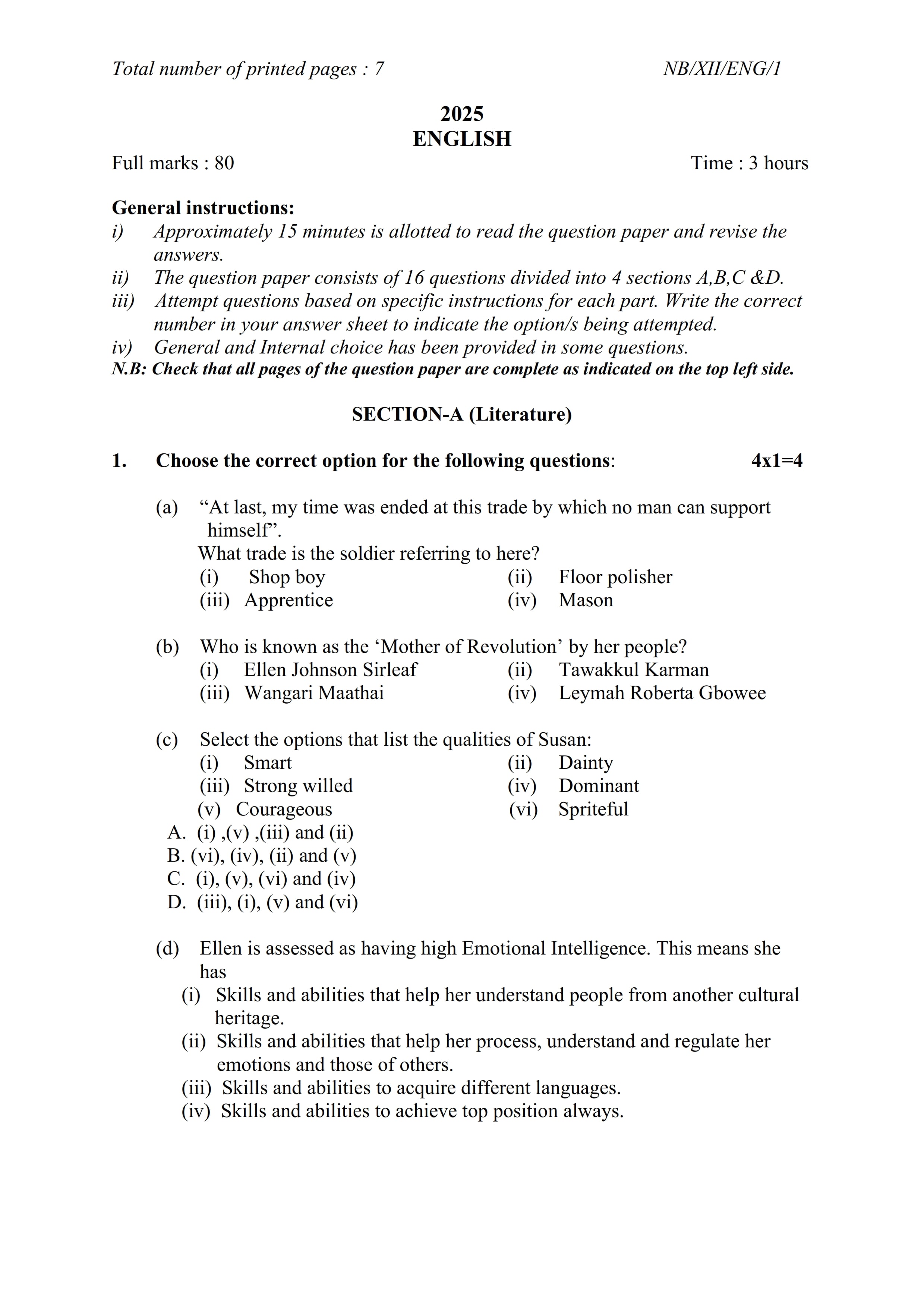
2025
ENGLISH
Full marks : 80 Time : 3 hours
General instructions:
i) Approximately 15 minutes is allotted to read the question paper and revise the
answers.
ii) The question paper consists of 16 questions divided into 4 sections A,B,C &D.
iii) Attempt questions based on specific instructions for each part. Write the correct
number in your answer sheet to indicate the option/s being attempted.
iv) General and Internal choice has been provided in some questions.
N.B: Check that all pages of the question paper are complete as indicated on the top left side.
SECTION-A (Literature)
1. Choose the correct option for the following questions: 4x1=4
(a) “At last, my time was ended at this trade by which no man can support
himself”.
What trade is the soldier referring to here?
(i) Shop boy (ii) Floor polisher
(iii) Apprentice (iv) Mason
(b) Who is known as the ‘Mother of Revolution’ by her people?
(i) Ellen Johnson Sirleaf (ii) Tawakkul Karman
(iii) Wangari Maathai (iv) Leymah Roberta Gbowee
(c) Select the options that list the qualities of Susan:
(i) Smart (ii) Dainty
(iii) Strong willed (iv) Dominant
(v) Courageous (vi) Spriteful
A. (i) ,(v) ,(iii) and (ii)
B. (vi), (iv), (ii) and (v)
C. (i), (v), (vi) and (iv)
D. (iii), (i), (v) and (vi)
(d) Ellen is assessed as having high Emotional Intelligence. This means she
has
(i) Skills and abilities that help her understand people from another cultural
heritage.
(ii) Skills and abilities that help her process, understand and regulate her
emotions and those of others.
(iii) Skills and abilities to acquire different languages.
(iv) Skills and abilities to achieve top position always.
Page 2
2. Answer the following questions in 30-40 words:
3x2=6
(a) What did Hardimont promise to do for Jean-Victor after learning about his
past life?
(b) How did grandma’s frog story inspire Susan?
(c) What was the excuse Bill and Sam made up to convince the boy to go
home?
3. Answer the following questions in about 150 words:
a. ‘A Voice for Freedom’ explores the struggles faced by those who are
silenced and oppressed. It advocates the desire for freedom and the
importance of speaking out against oppression. Do you agree with the
given statement? Elucidate.
Or 5
b. Define Emotional Intelligence. Explain the four factors of Emotional
Intelligence.
4. Choose the correct answer from the alternatives given: 3x1=3
a. In the sonnet, ‘Let Me Not To The Marriage of True Minds’ Shakespeare’s
notion of ideal love is juxtaposed with the problem of
(i) Instability (ii) Unsteadiness
(iii) Unfaithfulness (iv) Flux and change
b. Let not the man who is beast or who thinks he is God come near me.
Identify the poetic device used in these lines.
(i) Simile (ii) Personification
(iii) Metaphor (iv) Alliteration
c. Ah! As the heart grows older
It will come to such sights colder
By and by, nor spare a sigh…
Read the statements and then select the option that best describes the given
statements.
Statement i: As we grow older, we are less likely to be sad.
Statement ii: As we grow older, we do not have time to sight.
Statement iii: We are accustomed to the sight of the falling leaves with the
passage of time.
A. Statement i is false, statement ii is true, statement iii cannot be inferred.
B. Statement i and iii are true, statement ii cannot be inferred.
C . Statement i cannot be inferred, statement ii is false, statement iii is true.
D. Statement i and ii are false, statement iii is true.
5. Read the lines from the poem and answer the following questions:
a. …..are you grieving
Over Goldengrove unleaving?
Leaves, like the things of man, you
With your fresh thoughts care for, can you?
Page 3
(i) Who is ‘You’ referred to here? 1
(ii) Why is the person grieving? 1
(iii) What does ‘ fresh thoughts’ represent here? 1
Or
b. Forward, The Light Brigade!
Was there a man dismay’d?
Not tho’ the soldier knew
Someone had blunder’d:
Theirs not to make reply,
Theirs not to reason why,
Theirs but to do and die:
(i) What was the blunder? (1)
(ii) What are they not to do? (1)
(iii) What was the price paid for the blunder? (1)
6. Answer the following question in about 120 words:
a. Describe how the central idea of the poem ‘Let Me Not To The Marriage Of
True Minds’ is presented through different images.
Or 4
b. Louis MacNeice’s poem ‘ Prayer Before Birth’ paints a picture of a world
devoid of love, compassion and remorse. Substantiate your answer with
reasons.
7. a. But here’s a parchment with the seal of Caesar:
I found in his chest, ‘tis his will.
Let but the commons hear this testament,
Which, pardon me, I do not mean to read-
And they would go and kiss dead Caesar’s wounds,
And dip their napkins in his sacred blood,
Yea, beg a hair of him for memory
And, dying, mention it within their wills,
Bequeathing it as a rich legacy
Unto their issue.
(a) What parchment does Antony reveal to the Roman citizens? 1
(b) What influence does he claim it will have on the citizens if he reads it out?
2
(c) How did the citizens react to this? 2
Or
b. Trace the progression of the citizen’s reactions to Mark Antony’s speech. (5)
Page 4
8. Answer any two of the following questions in about 150 words: 2x5=10
(a) Give the character sketch of Virginia Otis, highlighting the key aspects of
her personality.
(b) Comment on the supernatural elements in the Canterville Ghost.
(c) Describe the meeting of the Canterville Ghost with his new found ghost
friend .
SECTION –B (Reading)
9. 1. As per the famous Daniel Bell, ‘Technology like art, is the soaring exercise of
human imagination’. It is also most difficult to imagine the world today
without the internet and cellphones, but this has not always been the case. It has
taken 30 years and four industrial revolutions to reach the world we live in
today. Modern technology has become so advanced that it is on the brink of
replacing human activities and human emotions. One such advanced form of
technology includes AI or machine learning.
2. Artificial Intelligence is a part of technology that can process information
and make decisions without human supervision .Researchers have been
working hard on the technology for a very long time, but AI has now become
an integral part of our everyday lives. Many useful characteristics such as
navigation apps, video suggestions, facial recognition, and smart assistants are
a by-product of artificial intelligence.
3. According to researchers, there are four broad classifications of AI. The first
includes ‘Reactive Machine’ where these machines do not have any memory
storage capacity but can process information and make situation- based
decisions. These machine learning devices use algorithms and are frequently
used in gaming software such as chess and ludo. It is very easy for such
programs to think of a million permutations and combinations and reach the
most suitable results that even the champions of the field have to take a bow in
front of these programmes.
4. The second type of AI is called ‘Limited Memory’ technology and has taken
the entire world by storm. Not only can such devices take situation-based
decisions, but they also store previously analyzed data for future use. A good
example of ‘limited memory’ technology is the video recommendation system
on any video streaming platform like Youtube. Once the AI figures out the
likes and dislikes of the user, it can make decisions on the user’s behalf and
recommend shows and videos as per the user’s interest. The ‘limited memory’
technology has become an easy way to influence and manipulate the data in
masses as they use the thought process of the person himself. Although this is
a revolutionary feat, it has also made people more vulnerable and prone to
wasteful online shopping and other unusual activities.
5. The third type of AI, which has not seen much progress yet, includes
‘Theory of Mind’. The idea is to develop a technology that can store and
process data and have a human -like thought process that will allow the
machine to make important decisions during a crisis. Scientists are working
Page 5
continuously on this project and have come up with some humanoid robots, but
the results have not been good enough to replace human work and services.
However, we can hope in the future to have a lot of robot doing our work.
6. The fourth type of AI is the ‘self-awareness’ program which seems almost
unachievable at this time. It refers to the knowledge of identifying oneself from
given surroundings. A machine that would be self-aware would have its own
emotions and its own thought process. If someday in the future, science is able
to evolve to create ‘self-aware machines’, the human race could achieve
immortality. And although this idea sounds difficult to believe, it has its
supporters in many advanced scientists such as Stephen Hawking and Albert
Einstein. These scientists believed that it was possible to store and replicate
human consciousness.
7. AI has indeed made the world smaller and life more achieveable. The
distance that would take months to travel, years ago, now can be traversed in a
matter of a few hours. There is no place on earth that humans cannot reach. AI
has helped increase the duration of the entire human population by making
health facilities cheaper and more accessible. But like every coin has two faces,
AI technology has its pros and cons. We have become so addicted to our
devices like mobile games, alexa and many more that we’ve replaced them for
physical human interaction. Not only is AI taking away our social life, but it is
also increasing health issues. Weaken eyesight, obesity, and cardiovascular
issues are just common diseases resulting from the continuous use of
technology sitting in one place .Thus, we must be reasonable with using any
sort of technology.
Based on your reading of the passage, answer the following questions given below:
a. What is the primary characteristic of Artificial Intelligence (AI) that sets it apart
from other technologies? 1
(i) Ability to learn and adapt
(ii) Reliance on human supervision
(iii) Lack of problem- solving capabilities
(iv) Incapability of processing information
b. Which of the following is NOT a common application of AI in our daily lives? 1
(i) Navigation apps
(ii) Video suggestions
(iii) Manual labour
(iv) Smart assistants
c. How do Reactive Machines make decisions? 1
(i) Based on past experience
(ii) By analyzing future possibilities
(iii) Intuitively
(iv) Based on the current situation
d. What is Artificial Intelligence? 1
e. What did scientists like Stephen Hawking and Albert Einstein believe? 1
Page 6
f. Find a word in the passage which means the same as ‘duplicate’ . 1
g. What are the pros and cons of AI technology? 2
10. Read the following passage and prepare notes on the contents of the
passage and summarize in about 80 words using the notes that you have
made: 4+3=7
Cholesterol is a waxy substance that is present in our body. It’s an important
component of our cell walls and other tissues, but it is thought to be harmful if in
excess. It can lead to blockages caused by the plague formation in the heart’s arteries
causing heart disease and heart attacks. Such blockages can also happen in arteries, in
the legs or in the brain. Cholesterol is produced in the liver, and the amount produced
is influenced by our genes. The food we consume, too, has effect on cholesterol
levels. Fatty foods high in simple sugars such as cold drinks increase cholesterol
levels. Lack of physical activity and exercise also leads to elevated levels.
We can reduce cholesterol levels by following a heart- healthy lifestyle,
which include regular physical activity for at least 30 minutes daily and a diet high in
fruits and vegetables and low in saturated sugar. Red yeast rice has been shown to be
effective in lowering cholesterol. Include garlic and flaxseeds in your daily diet. Olive
oil, canola oil or other oil rich in monounsaturated fatty acids can be used for cooking
in order to reduce cholesterol through food.
The ill-effects of high cholesterol take time to show, and you may not
realize until it’s too late. Cholesterol, by itself is important because it insulates nerve
cells and membranes. Being a fatty substance, it does not dissolve in the blood and is
packaged into protein. There are ‘good’ HDL cholesterol and ‘bad’ LDL cholesterol.
Bad cholesterol can stick to the smooth lining of the blood vessels, where it is
absorbed, while HDL mops up excess bad cholesterol and removes it from blood
vessels.
Exercise five days a week, whether you are overweight or underweight.
Aerobic exercises like walking, cycling, swimming, slow jogging, dancing etc for 45
minutes, and aerobic exercises like weight training and sprinting, will help increase
good and reduce bad cholesterol. In order to maximize your cardiovascular fitness,
aerobic exercises should raise your heart rate to a certain level. This level is called
your target zone. Always warm up, stretch and cool down- relax –before and after any
workout to avoid injuries. All these contribute to a healthier and fitter life.
SECTION-C (Writing)
11. You are Daisy/ Max of 108, Green Cottage, Duncan Road Dimapur. You have
lost your pet dog. Write a classified advertisement for the lost column of a local
daily.
Or 4
Read the following paragraph and express your opinion in not more than 50
words on whether you agree or disagree with the ideas mentioned in it.
Computer games have been extremely popular for decades now and
almost every household has at least one computer. However, it can be seen that
playing these games causes social, educational and personal problems of several
kinds both to youngsters and society. Firstly, young children who spend a great
Page 7
deal of time in front of a monitor are not playing sport. As a result, they are
mostly likely to be overweight and less healthy. In addition, addiction to games
add to many problems such as the lack of interaction and social skills with their
family and friends. If we wish children to grow up to become well-adjusted
members of society, these games should be more tightly controlled.
12. You are Jack/ Marina, an academic counselor. You have been invited to
Crestwood Higher Secondary School, Kiphire to give a speech to motivate the
students on ‘Balancing academic and extra-curricular activities in today’s busy
world’. Write the speech in about 150-200 words.
Or 5
Write an article in about 150-200 words on the topic ‘Impact of Advertisement
on the Younger Generation.’
13. You had made a prepaid purchase of a Rolex Oyster Perpetual watch from
Flipkart. It’s been ten days after the expected date of arrival of the product but
you still have not received it. On enquiring, Flipkart denies any responsibility as
their record shows that it has been dispatched on time. Write a letter to the
Manager, Blue Dart Express, Kohima inquiring about the parcel lost in transit. 6
SECTION – D (Grammar)
14. Rewrite the following as directed: 3x1=3
a. I___________ on my assignments for a while. (Future Continuous Tense)
b. They flew for five hours travelling to the U.S. (Present Perfect Tense)
c. My friend ordered a pizza for her younger sister. (Past Perfect Tense)
15. Write the meaning of the following idioms and phrases and make sentences
of your own: 3x1=3
a. Let the cat out of the bag
b. Cut and dried
c. Waste your breath
16. Insert the blanks with correct modals: 4x1=4
a. It________be extremely difficult for a child to do this puzzle task.
b. Lima______speak in four languages fluently.
c. Peter _____have helped his mother in preparing the dishes.
d. Did Tom _____pay the fine?
*****************************************
Page 8
2025
EDUCATION
Full marks : 80 Time : 3 hours
General instructions:
i. Approximately 15 minutes is allotted to read the question paper and revise the answers.
ii. The question paper consists of 28 questions.
iii. Marks are indicated against each question.
iv. Answers to questions carrying 1 mark should not exceed one sentence.
v. Answers to questions carrying 2 marks should not exceed 50 words.
vi. Answers to questions carrying 4 marks should not exceed 100 words.
vii. Answers to questions carrying 6 marks should not exceed 200 words.
viii. Answers to questions carrying 8 marks should not exceed 300 words.
N.B: Check that all pages of the question paper are complete as indicated on the top left side.
(The figures in the margin indicate full marks to the questions)
Choose the correct answer from the given alternatives in questions 1 to 10.
1. Which stage represents a period of intensive growth and change in nearly all aspects of a
child’s physical, mental, social and emotional life? 1
(a) Conception (b) Infancy
(c) Childhood (d) Adolescence
2. Which law states that “in successive generations variations tend to move towards the
average of the species of which they form a part.”? 1
(a) Like begets like (b) Law of Variation
(c) Law of Regression (d) Law of Motion.
3. The awareness about oneself is called__________. 1
(a) Reality Contact (b) Self-Concept
(c) Impulse Control (d) Positive thoughts
4. Who stated “Interest is latent attention and attention is interest in action”? 1
(a) Ross (b) William James
(c) Woodworth (d) Mc Dougall
5. The anarchic or multifactor theory was put forward by___________. 1
(a) Johnson (b) Gardner
(c) Charles Spearman (d) E.L Thorndike
6. Braile should be used for the_________ children 1
(a) The defective in speech (b) The deaf and hard of hearing
(c) Crippled (d) The blind and near blind
7. Naro was a pre-school teacher, she used to give sweets to the students whenever they
answer the questions correctly. The kind of reinforcement used by Naro is______ 1
(a) Negative reinforcement (b) Positive reinforcement
(c) Partial reinforcement (d) Continuous reinforcement
Page 9
8. Mary was mentally stressed out for the past one year. She is emotionally disturbed and
depressed. She experiences visual disturbances, hear voices and negative comments about
her that others do not. She is experiencing___________ 1
(a) Illusion (b) Sensory processing disorder
(c) Hallucination (d) Obsessive compulsive disorder
9. Peter has the habit of saying ”yes” to everything and takes constructive criticism
personally so she has___________ 1
(a) Bad habits that show lack of Self-esteem
(b) Bad conversation and Social skills habits
(c) Bad habits that are just gross
(d) Personal bad habits
10. Avi like surprises, get energised by being with others and also like public
acknowledgement. What type of personality does she have? 1
(a) Introvert (b) Extrovert
(c) Ambivert (d) Conservative
11. Write one function each: 1+1=2
i. Cerebellum
ii. Medula Oblongata
12. Differentiate between voluntary and involuntary attention. 1+1=2
13. What is Readiness according to Thorndike? 2
14. How does habit bring uniformity? 2
15. Mention the 3R’S of habit formation. 2
16. Find the I.Q of a child whose mental age is 5 and chronological age is 4. 2
17. Give two limitations of the questionnaire method. 1+1=2
18. Lendi do not have any disease or any physical defect but her health is not so sound.
Suggest any two provisions to help her overcome this problem. 1+1=2
19. Mention the mechanism of Heredity. 4
20. What are the four basic attributes of Anarchic theory? 4
21. Discuss the nature of personality. 4
22. What is arithmetic mean? Calculate arithmetic mean from the data showing marks of
students in a class in education test: 2+2=4
40, 50, 55, 58, 78
Page 10
23. Read the following passage carefully and answer the questions given below: - 1×4=4
Mental health is a state of mental wellbeing in which an individual realises his or her
own abilities, can cope with the normal stress of life, can work productively and is able
to make contributions to his or her community. It is an integral component of health and
well being that strengthen an individual and collective abilities to make decisions, built
relationships and shape the world we live in. in our day-to day lives, there are various
factors that might affect the mental well-being of an individual such as peer pressure,
family or personal relationship problems, career stress etc. a person starts to
unconsciously feel negative about things around him/her their social presence is reduced
and there is a constant feeling of stress and anxiety in the body as well as mind. Looking
after one’s mental health can help a person maintain their ability to enjoy life. This
involves balancing their activities, responsibilities and efforts to achieve psychological
resilience.
a) Why is mental Health important?
b) What are the aspects that influence the mental health?
c) Name any two symptoms that deteriorate mental health?
d) How can we truly live life to the fullest?
24. a. Differentiate between Growth and Development.
Or 6
b. Suggest any six preventive measures of Maladjustment
25. a. Describe any two developmental characteristics of adolescence period. 3+3=6
Or
b. What is the relevance of Spearman’s two factor theory? (6)
26. a. Define interest. What are the nature and characteristics of interest. 1+5=6
Or
b. State the Educational implications of Individual Differences. (6)
27. a. Discuss any eight branches of Psychology. 1×8=8
Or
b. Explain the different types of Environment. (8)
28. a. Define forgetting. what are the factors influencing forgetting? 2+6=8
Or
b. Describe any two situational tests that are considered more accurate. (4+4=8)
***************************
Page 11
2025
PSYCHOLOGY
Full marks: 80 Time : 3 hours
General instructions:
i. Approximately 15 minutes is allotted to read the question paper and revise the answers.
ii. The question paper consists of 28 questions.
iii. Marks are indicated against each question.
iv. Answers to questions carrying 1 mark should not exceed one sentence.
v. Answers to questions carrying 2 marks should not exceed 50 words.
vi. Answers to questions carrying 4 marks should not exceed 100 words.
vii. Answers to questions carrying 6 marks should not exceed 200 words.
viii. Answers to questions carrying 8 marks should not exceed 300 words.
N.B: Check that all pages of the question paper are complete as indicated on the top left side.
(The figures in the margin indicate full marks to the questions)
Choose the correct answer from the given alternatives in questions 1 to 10.
1. Group test of General Mental Ability was developed by. 1
(a) Prayag Mehta (b) S. Jalota.
(c) Uday Shankar (d) Pramila Pathak
2. Asen has the skill of understanding the motives, feelings and behaviour of other people,
she is said to have. 1
(a) Spatial Intelligence (b) Intrapersonal Intelligence
(c) Interpersonal Intelligence (d) Naturalistic Intelligence
3. According to Charak Samhita, personality can be classified on the basis of three humoural
elements called. 1
(a) Rajas Guna (b) Tamas Guna
(c) Tridosha (d) Prakriti
4. Kaito believes in being able to effectively complete assigned class assignments and achieve
goals. Kaito exhibits 1
(a) Self-efficacy (b) Self-concept
(c) Self-esteem (d) Self-control
5. Who proposed the Logotherapy? 1
(a) Victor Frankl (b) Carl Rogers
(c) Freiderick (d) Aron Beck
6. An unexpected travel away from home, the assumption of a new identity and the inability
to recall the previous identity represents 1
(a) Dissociative identity disorder (b) Depersonalisation disorder
(c) Dissociative fugue (d) Dissociative amnesia
7. In children, aggressive behaviour like dominating and bullying others without provocation
is seen in: 1
(a) Verbal aggression (b) Physical aggressions
(c) Hostile aggression (d) Proactive aggression
Page 12
8. Unwanted behaviour can be reduced and wanted behaviour can be increased
simultaneously through 1
(a) Aversive conditioning (b) Differential reinforcement
(c) Negative reinforcement (d) positive reinforcement
9. Sede is usually targeted whenever any theft occurs within the class. The phenomenon
behind this is: 1
(a) Scapegoating (b) Learning
(c) Stereotype (d) Discrimination
10. Savali behaviour always improves in the presence of others is known as: 1
(a) Imitation. (b) Social inhibition.
(c) Social facilitation (d) Interaction
11. List any two characteristics of personalities. 1+1=2
12. Explain Social Identity. 2
13. Give any two features of General Adaption Syndrome (GAS) 1+1=2
14. Aso always fears whenever she enter in some new or unfamiliar situation. Identify the
disorder. Briefly explain. 1+1=2
15. What is Token economy? 2
16. Briefly elaborate the concept of dysfunctional cognitive structures. 2
17. What is meant by the term Self-fulfilling prophecy? 2
18. Explain any two features of attitudes. 1+1=2
19. Our intelligence is the result of heredity (nature) and environment (nurture)Discuss. 4
20. Read the following passage carefully and answer the questions given below:
Stress is a common experience that effects everyone at some point in their lives. While
stress is often perceived negatively, it can also serve as a motivator, pushing individuals to
overcome obstacles and achieve their goals.
One of the key strategies for managing stress is developing resilience, resilience
is the ability to bounce back from difficult situations and adapt to change. Another
important aspect of managing stress is time management effective time management
allows individuals to prioritize task, set realistic goals and avoid procrastination. It can
help to reduce the feeling of being overwhelmed and increase their productivity. In
conclusion while stress is an inevitable part of life it can be managed effectively through
resilience and time management. 2+2=4
(a) What is Resilience?
(b) How can effective time management help in reducing stress?
21. What are the characteristics of Psychotherapeutic approaches? 4
22. Explain the factors that influence attitude formation. 1×4=4
Page 13
23. Why is it important to be a member of a group? Write any two points on how you can
influence the society positively. 2+2=4
24. a. “Intelligence is not a single entity rather distinct type of intelligence exist” Explain with
reference to Howard Gardner theory of intelligence 6
Or
b. Freud believed that people avoid anxiety mainly by developing defense mechanisms.
Explain any three kinds of defense mechanisms (3×2=6)
25. a. Explain any three aspects of stress on psychological functioning. 3×2=6
Or
b. Which therapy encourages the client to seek personal growth and actualize their potential?
Explain any two therapies on these principles. (3+3=6)
26. a. What is social Loafing? Explain why it occurs. 2+4=6
Or
b. Explain any three sources of prejudice. (3×2=6)
27. a. Discuss how Alferd Binet assessment of intelligence relate to William Stern’s intelligence
quotient 8
Or
b. Discuss any four approaches to behavioral analysis in assessment of personality. (4×2=8)
28. a. Stress is a silent killer and is on the increase. Suggest any four techniques that you think
will be helpful to manage stress. 4×2=8
Or
b. While speaking in public, the patient changes topics frequently, is this a positive or
negative symptom of Schizophrenia? Describe the other symptoms or sub -types of
Schizophrenia. (4+4=8)
***************************
Page 14
2025
ENTREPRENEURSHIP
Full marks: 70 Time: 3 hours
General Instructions:
i) Approximately 15 minutes is allotted to read the question paper and revise the
answers.
ii) The question paper consists of 25 questions. All questions are compulsory.
iii) Answer to questions carrying 2 marks should not exceed 50 words.
iv) Answer to questions carrying 4 marks should not exceed 100 words.
v) Answer to questions carrying 6 marks should not exceed 200 words.
vi) Answer to questions carrying 8 marks should not exceed 300 words.
vii) Internal choice has been provided in 6 marks and 8 marks questions.
N.B: Check that all pages of the question paper is complete as indicated on the top left
side.
Choose the correct answer from the given alternatives in questions 1 to 10.
1. Information gathered from various sources must be ____________. 1
a) Analysed b) Verified
c) Utilised properly d) All of the above.
2. Weights and Measures Act is a_______________. 1
a) Economic factor b) Political factor
c) Legal factor d) Social factor.
3. Market driven idea is also known as_____________. 1
a) Demand driven idea b) Service driven
c) Price driven d) None of the above.
4. Enterprise employing more than ______persons have to apply for EPF number. 1
a) 20 b) 25
c) 15 d) 30.
5. The most important element of business plan are____________. 1
a) Marketing plan b) Financial plan
c) Human resource plan d) All of the above.
6. Which of the following is not a major component of marketing plan? 1
a) Product b) Promotion
c) Price d) Policy.
Page 15
7. Which right is generally applied to literary work, music, composition, poems, etc? 1
a) Patents b) Copyright
c) Trademark d) Trade secret.
8. _______is related to coordination and cooperation between all the activities of
value chain. 1
a) Linkage b) Value chain analysis
c) Primary activities d) Competitive advantage.
9. _________measures the profitability of the company from common stockholders
point of view. 1
a) ROI b) ROE
c) EBITDA d) None of the above.
10. ______is the quantity at which the ordering cost is equal to the inventory cost. 1
a) Maximum inventory level b) Minimum inventory level
c) Economic order quantity d) Cost of storage of material.
11. Name two elements of business opportunity. 2
12. Write two systems of inheritance under Hindu Law. 2
13. State any two features of good business plan. 2
14. Increase in sale by 10% in next quarter is a ‘SMART’ goal. Do you agree?
Give reason for your answer. 2
15. Write any two features of franchise. 2
16. Explain any two types of acquisition. 2
17. Write any two classifications of budget according to time. 2
18. Explain four ways of market assessment. 4
19. Explain four considerations of vendor management. 4
20. Define venture capital. State three considerations of venture finance. 1+3= 4
21. a. Write any six recent technological changes of Indian market.
Or 6
b. “Problem identification helps in spotting opportunity and creating a business idea”.
Explain.
Page 16
22. a. Explain any six objectives of budgeting.
Or 6
b. Excessive working capital results in unnecessary accumulation of wastage of
capital whereas shortage of working capital effects the smooth flow of operating
cycle. In the light of the statement, discuss any six factors affecting working capital.
23. a. Write six functions of IDBI.
Or 6
b. Explain the main features of venture capital.
24. a. Explain the benefits of private company over public company. 8
Or
b. “Financial plan is a critical section of business plan as it translates all the other parts
of business in anticipated financial results”. Do you agree? Explain various
components of financial plan. (1+7=8)
25. a. Define channels of distribution. Explain seven functions of distribution channels.
1+7=8
Or
b. In spite of best efforts of entrepreneurs and management, a business may fail. In the
light of the statement, explain any eight causes of business failure. (8)
********************************
Page 17
2025
ALTERNATIVE ENGLISH
Total Marks: 80 Time: 3 hours
General instructions:
i) Approximately 15 minutes is allotted to read the question paper and revise the
answers.
ii) The question paper consists of 23 questions divided into 3 sections A, B, & C.
iii) Attempt questions based on specific instructions for each part. Write the correct
number in your answer sheet to indicate the option/s being attempted.
iv) General and Internal choice have been provided in some questions.
N.B: Check that all pages of the question paper is complete as indicated on the top left side.
SECTION – A (LITERATURE)
PROSE
1. Choose the correct answer from the alternatives given: 4x1=4
a. Nehru says that _____________ gives a complete and dogmatic answer to
the quest of mankind.
(i) science (ii) religion
(iii) philosophy (iv) history
b. According to Bertrand Russell there are several factors that contribute to
wisdom. The factor he considers first is ___________.
(i) a sense of proportion
(ii) comprehensiveness
(iii) emancipation
(iv) awareness of the ends of human life
c. Which followers are full of inconvenience and taint business through want
of secrecy?
(i) Costly followers (ii) Glorious followers
(iii) Espials (iv) Ordinary followers
d. Who brought an old primer to the class in ‘The Last Lesson’?
(i) The former postmaster (ii) The former Mayor
(iii) Franz (iv) Old Hauser
2. Why does Nehru see man’s story as being more important than those of other
beings? 2
3. According to Russell, why is comprehensiveness alone not enough to constitute
wisdom? 2
Page 18
4. How was M. Hamel dressed on the last day of the French lesson? Why was he
leaving? 2+1=3
5. a. Explain with reference to the context:
“With every increase of knowledge and skill, wisdom becomes more
necessary, for every such increase augments our capacity of realizing
our purposes, and therefore augments our capacity for evil, if our
purposes are unwise.”
Or 4
b. What does M. Hamel say about the importance of French language?
6. a. The mind has carried man a long way in his voyage of discovery. As he has
learnt to understand Nature more he has utilized it and harnessed it to his
own advantage, and thus he has won more power. But sadly he has not
always known how to use this new power, and he has often misused it.
Science itself has been used by him chiefly to supply him with terrible
weapons to kill his brother and destroy the very civilization that he has
built up with so much labour.
(i) What has led man to the voyage of discoveries? 1
(ii) How did science become a bondage of destruction? 1
(iii) Give any two reasons on how man misused the new power. 2
(iv) Based on the given lines, what can be the synonym of the word
‘civilisation’? 1
a. Advancement b. Society
c. Ambition d. Excellence
Or
b. It is good discretion not to make too much of any man at the first; because
one cannot hold out that proportion. To be governed (as we call it) by one
is not safe; for it shows softness, and gives a freedom to scandal and
disreputation; for those that would not censure or speak ill of a man
immediately will talk more boldly of those who are so great with them…
(i) What does the speaker mean by ‘good discretion’? (1)
(ii) An apt antonym for the word ‘hold’ is (1)
a. save b. release
c. keep d. protect
(iii) What does the speaker mean by ‘too much of any man at the
first’? (1)
(iv) What kind of freedom to scandal and disreputation is the speaker
talking about? (2)
Page 19
POETRY
7. Choose the correct answer from the alternatives given: 2x1=2
a. John Donne in his poem ‘Death Be Not Proud’ presents ______and
_______ as the pictures of Death.
(i) poppy and charms (ii) kings and desperate men
(iii) rest and sleep (iv) poison and war
b. What are the weavers weaving at the fall of night?
(i) Robes of a newborn child (ii) Dead man’s funeral shroud
(iii) Marriage veils of a queen (iv) Plumes of a peacock
8. “And all the men and women merely players.” Why are the men and women
merely players? 2
9. What is the significance of the reference to the statue of Neptune by the Duke? 2
10. Critically analyse the lines given below in about 60-90 words. Answer any
one (1). 1x4=4
a. And then the justice,
In fair round belly with good capon lined,
With eyes severe and beard of formal cut,
Full of wise saws and modern instances;
b. Weavers weaving at break of day,
Why do you weave a garment so gay?...
Blue as the wing of a halcyon wild,
We weave the robes of a newborn child.
11. a. Death, be not proud, though some have called thee
Mighty and dreadful, for thou art not so,
For those whom thou think’st thou dost overthrow,
Die not, poor Death, nor yet canst thou kill me.
(i) Identify the poetic device used for the word ‘Death’. 1
(ii) What does the speaker mean by ‘dost overthrow’? 1
(iii) How does the speaker condemn death? 2
(iv) Why does the speaker say ‘nor yet canst thou kill me’? 1
Or
b. Or blush, at least. She thanked men, - good! But thanked
Somehow – I know not how – as if she ranked
My gift of a nine-hundred-years old name
With anybody’s gift. Who’d stoop to blame.
(i) Who is ‘she’ referred to here? (1)
(ii) What does ‘My gift of a nine-hundred-years-old name’ mean? (1)
Page 20
(iii) What do these lines tell us about the character of the Duke? (1)
(iv) Why is the speaker displeased with the woman being referred to? (2)
DRAMA
12. What was the reaction of Uncle James towards Philip at the beginning of the
play and why? 2
13. Well, I think that Philip’s four years out there have made him more of a man;
He doesn’t seem somehow like a boy who can be told what to do.
a. Who is the speaker here? 1
b. What does the speaker mean by the above statements? 2
14. a. Give the character sketch of Aunt Emily.
Or 5
b. Explain the generation gap in society in the context of the conflict between
Uncle James and Philip regarding the latter’s employment.
FICTION
15. Who is Estella’s biological mother? 1
16. Describe the convict in the marshes. 2
17. What was Pip’s great expectation? Why did he want to achieve that? 1+2=3
18. a. Break their hearts, my pride and hope,
Break their hearts and have no mercy.
(i) Who said this and to whom? 1
(ii) By ‘their hearts’, whose hearts is the speaker referring to? 1
(iii) Why does the speaker say the given statement? 2
Or
b. Yes, Pip, dear boy, I’ve made a gentleman on you! Its’s me wot has done
it! I swore that time, sure as ever I earned a guinea, that guinea should
go to you. I swear afterwards, sure as ever I spec’lated and got rich, you
should get rich. I live rough, that you should live smooth; I worked hard
that you should be above work…
(i) “I’ve made a gentleman on you!” Here who is ‘I’ referred to? (1)
(ii) What does Pip learn from the speaker? (1)
(iii) Why does the speaker confess about his earnings to Pip? (2)
19. a. Give a character sketch of Pip.
Or 5
b. Explain the theme of ‘social class’ from the novel ‘Great Expectations’.
Page 21
SECTION – B (GRAMMAR)
20. Fill in the blanks with suitable prepositions: 3x1=3
a. ________ the rains, we had a great evening.
b. Sentilong settled at Kohima ______ Nagaland.
c. I have not spoken to her _______ a month.
21. Insert correct conjunctions: 3x1=3
a. Kevi ran fast, __________ he could not win the race.
b. Please wait for me _________ I return.
c. It has been long _________ I met her.
22. a. Correct the following sentences and rewrite them: 2x1=2
(i) I will meet you on the evening.
(ii) He knows how to cook but his wife don’t.
b. Choose the right word given within the brackets to complete these
sentences: 2x1=2
(i) Where did you (lose/loose) your bag?
(ii) She has been denied (access/excess) to a lawyer.
SECTION – C (READING)
23. Read the passage given below and answer the questions that follow:
1. While there is no denying that the world loves a winner, it is important that
you recognize the signs of stress in your behavior and be healthy enough to enjoy
your success. Stress can strike anytime, in a fashion that may leave you unaware
of its presence in your life. While a certain amount of pressure is necessary for
performance, it is important to be able to recognize your individual limit. For
instance, there are some individuals who accept competition in a healthy fashion.
There are others who collapse into weeping wrecks before an exam or on
comparing mark sheets and finding their friend has scored better.
2. Stress is a body reaction to any demands or changes in its internal and
external environment. Whenever there is a change in the external environment
such as temperature, pollutants, humidity working conditions, it leads to stress. In
these days of competition when a person makes up his mind to surpass what has
been achieved by others, leading to an imbalance between demands and resources,
it causes psychological stress. It is a part and parcel of everyday life.
3. Stress has different meaning, depending on the stage of life you are in. The
loss of a toy or a reprimand from the parents might create a stress shock in a child.
An adolescent who fails an examination may feel as if everything has been lost
and life has no further meaning. In an adult, the loss of his or her companion, job
or professional failure may appear as if there is nothing more to be achieved.
Page 22
4. Such signs appear in the attitude and behavior of the individual as muscle
tension in various parts of the body, palpitation and high blood pressure,
indigestion and hyperactivity. Ultimately the result is self-destructive behavior
such as eating and drinking too much, smoking excessively, relying on
tranquilisers. There are other signs of stress such as trembling, shaking, nervous,
blinking, dryness of throat and mouth and difficulty in swallowing.
5. The professional under stress behaves as if he is a perfectionist. It leads to
depression, lethargy and weakness. Periodic mood shifts also indicate the stress
status of the students, executives and professionals.
6. In a study sponsored by World Health Organisation and carried out by
Harvard School of Public Health, the global burden of diseases and injury
indicated that stress diseases and accidents are going to be the major killers in
2020.
a. Why is it important to recognize the signs of stress in your behavior? 1
(i) To recognize your individual limit
(ii) To score better marks
(iii) To enjoy success
(iv) Because stress can strike anytime
b. What cause psychological stress? 1
(i) Changes in external and internal environment
(ii) When a person decides to surpass an existing achievement leading
to imbalance in demands and resources.
(iii) Factors such as temperatures, pollutant, humidity, working
condition, etc.
(iv) Changes in occupation
c. What are the signs of stress? 1
(i) A person is always in a happy mood
(ii) A person becomes a workaholic
(iii) A person becomes despondent
(iv) A person becomes self-destructive
d. Select the most suitable title for the above passage. 1
(i) Stress: Understanding the impact on your mind and body
(ii) Importance of mental health
(iii) The stress epidemic
(iv) Stress management
Page 23
e. Find the antonym of the word ‘praise’ from paragraph 3. 1
f. Complete the sentence with appropriate inference with reference to the
following: 1
Stress can have __________ meaning depending on the person’s age.
g. Mention two consequences of stress. 2
h. Find the synonyms of – 1+1=2
(i) Beat (paragraph 2)
(ii) Depending (paragraph 4)
***************************
Page 24
2025
HINDI
Total Marks: 80 Time: 3 hours
General instructions:
i) Approximately 15 minutes is allotted to read the question paper and revise the answers.
ii) The question paper consists of 24 questions divided into 4 sections A, B, C & D.
iii) Attempt questions based on specific instructions for each part. Write the correct number
in your answer sheet to indicate the option/s being attempted.
iv) General and Internal choice have been provided in some questions.
N.B: Check that all pages of the question paper is complete as indicated on the top left side.
SECTION – A (पठन पररक्षण)
1. ननम्ननिनखत गद्यांश को पढ़कर पूछे गए प्रश्नों के उत्तर दीनिए :-
रयष्ट्र के वि िमीन कय टुकडय ही नहीं बनकक हमयरी सयांस्कृ नतक नवरयसत होती हैं िो
हमें अपने पूवविों से परां परय के रूप में प्रयप्त होती हैं। निसमें हम बडे होते हैं नशक्षय पयते
हैं, और सयांस िेते हैं – हमयरय अपनय रयष्ट्र कहियतय है और उसकी परयधीनतय व्यनि की
परतांत्रतय की पहिी सीढ़ी होती हैं। ऐसे ही स्वतांत्र रयष्ट्र की सीमयओं में िन्म िेने वयिे
व्यनि कय धमव, ियनत, भयषय यय सांप्रदयय कु छ भी हो, आपस में स्नेह होनय स्वयभयनवक है।
रयष्ट्र के निए िीनय और कयम करनय उसकी स्वतांत्रतय तथय नवकयस के निए कयम करने की
भयवनय रयष्ट्रीयतय कहियती हैं।
िब व्यनि ककसी दूसरे व्यनि से धमव, ियनत, कु ि के आधयर पर व्यवहयर करतय है
तो उसकी दृनि सांकुनित हो ियती है। रयष्ट्रीयतय की अननवययव शतव है – देश को
प्रयथनमकतय, भिे ही हमें ‘स्व' को नमटयनय पडे। महयत्मय गयाँधी, सुभयषिांद्र बोस आकद के
कययों से पतय िितय है कक रयष्ट्रीयतय की भयवनय के कयरण उन्हें अननगनत कि उठयने पडे
ककतु वे अपने ननश्चय में अटि रहे। व्यनि को ननिी अनस्तत्व कययम रखने के निए
पयरस्पररक सभी सीमयओं की बयधयओं को भुियकर कययव करनय ियनहए तभी उसकी नीनतययाँ
– रीनतययाँ रयष्ट्रीय कही िय सकती हैं।
िब – िब भयरत में फू ट पडी तब – तब नवदेनशयों ने शयसन ककयय। ियहे ियनतगत
भेदभयव हो यय भयषयगत – तीसरय व्यनि उससे ियभ उठयने कय यत्न अवश्य करे गय। आि
देश में अनेक प्रकयर के आांदोिन िि रहे हैं। कहीं भयषय को िेकर सांघषव हो रहय है तो
कहीं धमव यय क्षेत्र के नयम पर िोगों को ननकयिय िय रहय हैं निसकय पररणयम हमयरे
सयमने है। आदमी अपने अांह में नसमटतय िय रहय हैं। फिस्वरूप रयष्ट्रीय बोध कय अभयव
पररिनक्षत हो रहय हैं।
कदए गए प्रश्नों में से सही उत्तर िुनकर निनखए :-
a. नवरयसत ककस रूप में प्रयप्त होती हैं? 1
(i) पूवविों के रूप में (ii) रयष्ट्रीयतय के रूप में
(iii) परां परय के रूप में (iv) स्वभयनवक रूप में
Page 25
b. स्वतांत्र रयष्ट्र में आपस में _________ स्वभयनवक है। 1
(i) घृणय (ii) स्नेह
(iii) नफरत (iv) िडयई
c. रयष्ट्रीयतय की अननवययव शतें हैं – 1
(i) देश को प्रयथनमकतय (ii) देश की उपेक्षय
(iii) देश से नफरत (iv) इनमें से कोई नहीं
d. आि देश में ककतने प्रकयर के आांदोिन िि रहे हैं? 1
(i) एक प्रकयर (ii) दो प्रकयर
(iii) तीन प्रकयर (iv) अनेक प्रकयर
e. हमें अपने पूवविों से परां परय के रूप में क्यय प्रयप्त होती हैं? 1
f. व्यनि की दृनि कब सांकुनित हो ियती हैं? 1
g. रयष्ट्रीयतय क्यय है? 2
h. व्यनि को ननिी अनस्तत्व को कययम रखने के निए क्यय करनय ियनहए? 2
SECTION – B (सांरिनय)
2. ननम्ननिनखत प्रश्नों में से ककसी एक प्रश्न कय उत्तर 150 से 200 शब्दों में दीनिए :-
a. ‘प्ियनस्टक थैनियों कय उपयोग’ फययदे तथय नुकसयन नवषय पर एक वस्तुननष्ठ
ननबांध निनखए।
अथवय 6
b. मोबयइि फोन के उपयोग से होने वयिे ियभ – हयनन नवषय पर दो नमत्रों के
बीि वयतयवियप निनखए।
3. ननम्ननिनखत प्रश्नों में से ककसी एक प्रश्न कय उत्तर 50 शब्दों में दीनिए :-
a. मुकद्रत कय व्ययकरण एवां सांरिनय सांबांधी त्रुरटयों को सांशोनधत करते हुए सांपयदन
कीनिए :-
हरय झांडी कदखयते ही रे िगयडी िोहय की पटरी पर दौडने िगय। कु छ ययत्री ियय
पी रहय थय तो कु छ बयतें में खोये हुए मग्न थे। गयडी कब अगिय स्टेशन पहुाँिी, पतय
ही नहीं ििी। कु छ ययनत्रयों वहीं उतर गये बिे शेष सब आगे ििे गए।
अथवय 4
b. अपने नवद्यिय में आयोनित होने वयिे ‘नशक्षक कदवस’ पर अपने नवद्यिय के
सभी नशक्षकों को आमांनत्रत करते हुए एक ननमांत्रण पत्र निनखए।
Page 26
SECTION – C (व्ययकरण एवां अनुवयद)
4. ननम्ननिनखत शब्दों के सांनध – नवच्छेद कीनिए :- 2×1=2
(a) महोदय (b) उकियस
5. ननम्ननिनखत सयमयनसक पदों कय नवग्रह कीनिए :- 2×1=2
(a) महयत्मय (b) रयत – कदन
6. ननम्ननिनखत शब्दों के दो – दो पययवयवयिी शब्द निनखए :- 2×1=2
(a) पृथ्वी (b) आांख
7. ननम्ननिनखत मुहयवरों के अथव निखकर वयक्य में प्रयोग कीनिए :- 2×1=2
(a) गिय छू टनय (b) खुशी से फू िय न समयनय
8. अनुप्रयस अिांकयर ककसे कहते हैं? एक उदयहरण द्वयरय स्पि कीनिये। 2
9. छांद ककतने प्रकयर के होते हैं? उनके नयम निनखए। 2
10. हहदी में अनुवयद कीनिए :- 3
The ceremonial dresses of both men and women in Nagaland are quite splendid.
The men carry colourful spears decorated with dyed goat hair, their headgear is
made of bamboo woven with flowers and feathers, there are arm bands made of
elephant tusks and necklaces of wild boar teeth.
SECTION – D (सयनहत्य)
गद् – भयग
11. ननम्ननिनखत नवककपों में से सही उत्तर िुनकर निनखए :-
a. पूस कय महीनय ककस तरह कय होतय है? 1
(i) भीषण ठां ड कय (ii) वषयव कय
(iii) अत्यनधक गमी कय (iv) तेि हवय ििने कय
b. मयाँ ने सयमने वयिे िडकों को ियय पर क्यों बुिवययय? 1
(i) तनु से दोस्ती करने के निए
(ii) तनु उनके सयथ पढ़यई करें
(iii) तनु उनके सयथ कफकम देखने ियए
(iv) तनु उनके सयथ घूमने ियए
c. सबसे बडय पत्थर ककसकय प्रतीक थय? 1
(i) सोप्फू न्यो के पुत्र कय (ii) कोसोहो कय
(iii) बरसयती कय (iv) सोप्फू न्यो कय
Page 27
d. बयररश होने की आशांकय से बच्चों की टोिी इांद्र भगवयन से ककस प्रकयर पयनी के
निए प्रयथवनय करते हैं? 1
(i) भूख हडतयि करते हुए (ii) मांकदर में भोग िगयते हुए
(iii) ियकयरे िगयते हुए (iv) तीथव ययत्रय करते हुए
12. िेखक के मन में पैसे िोडने के प्रनत कै सी धयरणय होती हैं? 2
13. गयाँव की निययाँ कोसोहो तथय िेन्यूये से क्यों ििती थी? 2
14. आि की तथयकनथत आधुननक पीढ़ी न तो पूरी तरह अपने परां परयगत मूकयों से मुि हो
पयई है और न ही नये मूकयों को पूरी तरह अपनय पयई है। इस कथन की समीक्षय
कीनिए। 3
15. ननम्ननिनखत कथन, ककसने, ककससे तथय क्यों कहें है :- 1+1+2=4
a. “मुझे आपनत्त है। िब प्रस्तयव हहदी में है तो सांस्थय कय नयम भी हहदी में
होनय ियनहए।“
अथवय
b. “देख भइयय, रूठ मत, मेरी बयत सुन यह सब अांधनवश्वयस नही है।“
16. ननम्ननिनखत प्रश्नों में से ककसी एक प्रश्न कय उत्तर दीनिए :-
a. थोडी देर में अियव िि उठय। उसकी िौ ऊपरी पनत्तयों को छू – छू कर भयगने
िगी थी। उस अनस्थर प्रकयश में बगीिे के नवशयि वृक्ष ऐसे मयिूम होते थे, उस
अथयह अांधकयर को अपने नसरों पर सांभयिे हुए हैं। अांधकयर के उस आनांद सयगर
से यह प्रकयश एक नौकय के समयन नहितय – मिितय हुआ ियन पडतय हैं। हककू
अियव के सयमने बैठय आग तयप रहय थय। एक क्षण में उसने दोहरी उतयरकर बगि
में दबय िी, दोनों पयांव फै िय कदए, मयनों ठां ड को ििकयर रहय हो, ‘तेरी िी में आए
सो कर। ठां ड की असीम शनि पर नविय पयकर वह नविय – गवव को हृदय में
नछपय नहीं सकतय थय।‘
(i) पनत्तयों को कौन छू रहय थय? 1
(ii) अांधकयर को ककसने अपने नसर पर उठय रखय थय? 1
(iii) नौकय के समयन ककसे बतययय गयय है? 1
(iv) हककू ने ठां ड को ककस प्रकयर ििकयरय है? 1
(v) हककू ने ककस पर नविय प्रयप्त ककयय थय? 1
अथवय
b. बयियर आमांनत्रत करतय है कक आओ मुझे िूटो और िूटों। सब भूि ियओ, मुझे
देखो। मेरय रूप और ककसके निए है? मैं तुम्हयरे निए हाँ। नहीं कु छ ियहते हो, तो
देखने में क्यय हरि है। अिी आओ भी इस आमांत्रण में यह खूबी है कक आग्रह
नहीं है, आग्रह नतरस्कयर िगयतय है। िेककन ऊाँिे बयियर कय आमांत्रण मूक होतय है
और उससे ियह िगती है। ियह मतिब अभयव। िौक बयियर में खडे होकर आदमी
Page 28
को िगने िगतय है कक उसके पयस िो है कयफी नहीं है और ियनहए। मेरे यहयाँ
ककतनय पररनमत है और यहयाँ ककतनय अतुनित है ओह!
(i) बयियर क्यों आमांनत्रत करतय है? (1)
?
(ii) आग्रह क्यय िगयतय है (1)
(iii) ऊाँिे बयियर कय आमांत्रण कै सय होतय है? (1)
(iv) िौक बयियर में खडे आदमी को क्यय िगतय हैं? (1)
(v) ‘पररनमत' कय अथव है – (1)
(a) अथयह (b) सीनमत
पद् भयग
17. ननम्ननिनखत नवककपों में से सही नवककप िुनकर निनखए :-
a. कनव को बयररश के मौसम में ककसकी ययद आती है? 1
(i) घर की (ii) दोस्तों की
(iii) प्रेनमकय की (iv) गयाँव की
b. खरगोश की आांखें कै सी होती हैं? 1
(i) ियि (ii) छोटी
(iii) पीिी (iv) बडी
18. मययके में आई बहन के निए कनव ने घर को पररतयप कय घर क्यों कहय है? 2
19. कनव ने क्यय सहषव स्वीकयरय है कनवतय के आधयर पर निनखए। 2
20. a. ियने क्यय ररश्तय है, ियने क्यय नयतय है,
नितनय भी उडेितय हाँ, भर – भर कफर आतय है।
(i) यह पांनिययाँ ककस कनवतय से िी गई है? 1
(ii) इस कनवतय के कनव कौन है? 1
(iii) इन पांनियों के मयध्यम से कनव क्यय कहनय ियहतय है? 2
अथवय
b. आि पयनी नगर रहय है, बहुत पयनी नगर रहय है,
रयत भर नगरतय रहय, प्रयण मन नगरतय रहय है।
(i) यह पांनि ककस पयठ से िी गई है? (1)
(ii) इस कनवतय के कनव कौन है? (1)
(iii) इस पांनि कय आशय स्पि कीनिये। (2)
21. ननम्ननिनखत पद्यांश में से एक की सांदभव एवां प्रसांग सनहत व्ययख्यय कीनिए :-
a. राम – नाम मणि – दीप धरू, जीह दे हरी द्वार।
तुिसी भीतर बयनहरौ, िो ियहनस उनिययर।।
अथवय 1+1+3=5
Page 29
b. दुननयय कय सबसे पतिय कयगि उड सके ,
बयांस की सबसे पतिी कमयनी उड सके ,
कक शुरू हो सके सीरटयों, ककिकयररयों और नततनियों इतनी नयिुक दुननयय।
कथय सयनहत्य
22. ननमविय को तोतयरयम के पयस बैठने में सांकोि क्यों होतय थय? 2
23. उदय भयनुियि के यहयाँ ननमविय के नववयह की तैययररययां कै सी िि रही थी? 3
24. ननम्ननिनखत गद्यांश को पढ़कर पूछे गए प्रश्नों के उत्तर दीनिए:-
a. ननमविय को अब कु छ अच्छय िगतय थय तो वह सुधय से बयतें करनय थय। वह वहयाँ
ियने कय अवसर ढू ांढती रहती थी। बच्ची को अब वह अपने सयथ न िे ियनय ियहती
थी। पहिे िब बच्ची को अपने सभी िीिें खयने को नमिती थी, तो वह वहयाँ ियकर
हांसती खेिती थी। अब वहयाँ ियकर उसे भूख िगती थी। ननमविय उसे घूर – घूरकर
देखती, मुरिययाँ बयांधकर धमकयती पर िडकी भूख की रट िगयनय न छोडती।
इसनिए ननमविय उसे अपने सयथ न िे ियती थी। सुधय के पयस बैठकर उसे मयिूम
होतय कक मैं आदमी हाँ। उतनी देर के निए वह हितयओं से मुि हो ियती।
(i) ननमविय को अब क्यय अच्छय िगतय थय? 1
(ii) ननमविय अब बच्ची को अपने सयथ क्यों नहीं िे ियनय ियहती थी? 1
(iii) बच्ची क्यय रट िगयनय नही छोडती थी? 1
(iv) सुधय के पयस बैठ कर ननमविय को कै सय िगतय थय? 1
(v) ननमविय बच्ची को कै से धमकयती थी? 1
अथवय
b. यह कहकर ककययणी कमरे में ििी गई। आांगन में आकर उसने एक बयर आकयश
की ओर देखय, मयनो तयरयगण को सयक्षी दे रही हैं कक मैं इस घर से ककतनी
ननदवयतय से ननकयिी िय रही हाँ। रयत के ग्ययरह बि गये थे। घर में सन्नयटय छय
गयय थय, दोनों बेटों की ियरपयई उसी कमरे में रहती थी। वह अपने कमरे में आई,
देखय िन्द्रभयनु सोयय है, सबसे छोटय सूयवभयनू ियरपयई पर उठ बैठय है। मयतय को
देखते ही वह बोिय – तुम तहयां दई ती अम्मय?
(i) ककययणी कहयाँ ििी गई? (1)
(ii) ककययणी ककसको सयक्षी दे रही थी? (1)
(iii) ककययणी के कमरे में ककसकी – ककसकी ियरपयई थी? (1)
(iv) दोनों बेटों के क्यय नयम थे? (1)
(v) ‘तुम तहयां दई ती अम्मय?’ ककसने और ककससे कहय? (1)
**************************************
Page 31
Page 32
Page 33
Page 34
Page 35
2025
TENYIDIE
Total Marks: 80 Time: 3 hours
General instructions:
i) Approximately 15 minutes is allotted to read the question paper and revise the
answers.
ii) The question paper consists of 19 questions divided into 4 sections A, B, C & D.
iii) Attempt questions based on specific instructions for each part. Write the correct
number in your answer sheet to indicate the option/s being attempted.
iv) General and Internal choice have been provided in some questions.
N.B: Check that all pages of the question paper is complete as indicated on the top left side.
SECTION – A (Kesi Mhaphrü)
1. Thedzeu phrülie di ketsokebako kelashülie:
1. We kepelemia kechü Kepenuopfü ze keperokecü pie mhathokezhatho-u chüya,
sidi kethodie phrü, kecha chü, kehouki nu vo ituoya. Hauha puotou zo derei we
mhapuo le ketsolie motayakezhau sü, themia mu themia donu keperokecü.
Ketholeshü nu ngukelie Kepenuopfü ze keperokecü mu u siezanuomia ze
keperokecü unie kedziese sei tuoya.
2. Tuokepra 20 nu thezho kerie diako Kepenuopfü ze keperokecü die khakeshü
ngulie. Süsie thezho kekrei sorouko u siezanuomia ze keperokecü die khakeshü
ngulie. We huoniehuo khrielie mota ro, we kepero kebau bierhuokewau rübei
monyü Kepenuopfü ze kepero kebau sa bierhuowaya, kekreilamonyü thezho
kenieu varhuokeshüu kephoumata zokecü la.
3. Jisu kelhou mehoshü ro, Jisue kijü nu lhoukecü teiki, puotei kekreitsatie pie
themia khruohi, mu themia kekhrie mhatho chü phishükecü ngulieya. We thie
kepelemia üdi themia khrie pfülie moketamia ba phite. Kehouko nu shürhei
phikecü mhie kecha chüya derei themia ze keperokecü nu themia khrie pfülie
motaya. Themia kekra rei thie nyiu nyilie ro, u tha kerükrie puo ngu-u ngulie ro idi
themia ze kepero kebau sü pie mhathokemo mhie tuotaya. Mia puoe pukecü
hakemhie, themia ha kesia zhü gei zhüta tse, puo keleu vo puo shükeiraka, puo ki
puo lie, puo mhatho-u nu monyü, puo mu puo Kepenuopfü unie keperokecü
kimhie di lhouwate shikecü lelie ro kesia zhü gei phi zorei rünoukemo ze
kesewalie lho isi.
4. We kimhie di u siezanuomia ze keperokecüu sede ta? Thiethie kelhou nu themia
ze keperokecü nu se morosuotho-u sü ‘kekhrie’ zo. Süla we Kepenuopfü
khriekelie mu u siezanuomia khriekelie unie shükho kekreiwalie kenjükecü ngulie.
We thie mha hakoha le menuoshü di u kele chü kesa lalie morosuo ba. We
Page 36
khunhie vo Kepenuopfü mhodzü thakelie ki puo zatsa kethamia chülietuo me?
Sükisü kediu puo zatsa kethako üse, “A puo japie nieko ketsüko nieko vor di kijü
chülie tse nunu kedi kesepie nieko merütuoketau weliecie” (Mathi 25:34) isi.
5. Mha hako phrü mu medo lakeshü geinu n nou chü chükesa lalie üro thie sikelieu
dieze chüshülie. Mhakevikechü la thie hau puotei kevitho
Ketsokecü:
(a) We kepelemia kechü _________ ze keperokecü pie mhakezhatho-u
chüya. 1
(i) Phichümia (ii) Siezanuomia
(iii) U krünuo (iv) Kepenuopfü
(b) We thie __________ üdi themia khrie pfülie moketamia ba phite. 1
(i) Kepelemia (ii) Zhapumia
(iii) Thejakepfümia (iv) Ruokuomia
(c) Tuokepra 20 nu thezho kitsuoko Kepenuopfü ze keperokecü die khakeshü
ngulie ga? 1
(i) Kenieko (ii) Seko
(iii) Diako (iv) Pengouko
(d) Kedipuo kechü la thie hau puotei kevitho ga? 1
(i) Dieze (ii) Mha kevi kechü
(iii) Kekhrie (iv) Kepele
(e) ‘Shükho’ ikecü dieca hayo puo kepetsou dieu thushülie. 1
(f) ‘Varhuokewa’ dieca hau puo ze kemhiekecü cau khashülie. 1
(g) We huoniehuo khrielie mota ro kedipuo bierhuowaya ga? 2
(h) Themia ha kesia zhü gei zhüta ro kedipuo le petuotaya üsi ga? 2
SECTION – B (Thedze Kezo)
2. Hanie puo (1) kedapie dieca 150-200 mese nunu thushülie:
a. ‘Kedietho zho-ue kevitho’ (honesty is the best policy) icü cayie hau
geinu ese thushülie.
Moro 6
b. Kephrünuomia khrietho kenie-e leshüki nu rüli (recess) keba teiki
Dzükou thechü keziviu nu vo mha mehoshü nyü di kerüchü keba Rüchüdie
(dialogue) puo thushülie.
Page 37
3. Hanie puo (1) kedapie thushülie:
a. Noe Kevi/Kevinuo vorkezhü Cacü zha 20, 2025 ki n nuo-u/nuopfü kiya
tuoü ba. Süu pemvü di Kethezhokecü Phreikie (formal invitation) puo
thushülie. Morokesuo kepfhesilie keviko khashülie. Dieca 50 mese nu
thushülie.
Moro 4
b. Diecha khakeshüko se di khune kemhiekecü (copy editing) chüshülie:
Menga ikecü ha dieca kekuo puo, hau kenyü sieso-u zo. Hau ca si pevikelie
geinu thezho kevi medzi di lhoulieya. Shürho shürheilieya, thehie chü
lhoulieya mu kenyimia chülieya. Hau liro themia zhorüli dzephrü mu mhale
bode puo. Themia zomonyü Kepenuopfü nei chükecü chadi puo rei zo.
Kemenga si kecü sü mha kesuo, ketheva kephouma morei themia mu
Kepenuopfü mhodzü nu shuo ücü kheko si di chü mo, rütse mu thi di
therhiekelie mhasi mu mhale ko zo. Ca kekrei puo la ro ketheziekecü cau
nunu par. Kehoupuorei kijü nu lhou vor di puo thuo puo la rei mu
kekreimia la rei chüshükezhü puo mese nu chülie mota ro puo mhale
puotou moketa rhiu nunu thamele partaya. Kemenga ca kesimia mu
kelemia u zho u rüli suoketa cha jü. Hau geinu mia puoe menoudi
lhoulieya. Sümho rei kekreimia se pfülieya.
SECTION – C (Diezho)
4. Hako chatha khakeshü medzi di kelashülie: 12x1=12
a. Kisama-e thechü kemeyie puo. (Diecha hau nu zaliu thashülie)
b. Rüdikemo dietho puo pie diecha chüshülie.
c. Kepenuopfü pelelie mu mha kevi chülie. (Diekheu rhieshülie)
d. Kephrünuoko teisonhie leshüki nu vor seiya. (Diecha nu puotei diebau
thashülie)
e. Supuo die hau pu ba ga? (‘Supuo’ hau pie miakra dieza nu thushülie)
f. A thie likhuo kesa puo khrülie. (Kerheiro kejü thenuthepfu zakieu
rhieshülie)
g. ________ teikhrie bu a lie va phrewate. (Ungo pfhephra thushülie)
h. Puo mithu kezha puo ba. (Ketsakekra dietso rhieshülie)
i. Puo kidepuo pie tuota ga? (Ketsokecü dieba kiu nu ba ga?)
j. ‘Cha’ hau se tsüle nu thushülie.
k. Uko pete pherete. (Zasou-u thashülie)
l. Azuo tezie nu mhachü ba. (Diepeu rhieshülie)
5. Hakhro kebau Tenyidie nu thuyie chüshülie: 3
The ceremonial dresses of both men and women in Nagaland are quite splendid.
The men carry colourful spears decorated with dyed goat hair, their headgear is
Page 38
made of bamboo woven with flowers and feathers, there are arm bands made of
elephant tusks and necklaces of wild boar teeth.
SECTION – D (Diemvü)
Thedze
6. Hako donu puotou-u kedashülie: 4x1=4
a. Virüzoumo nuo nhicu-u za supuo ga?
(i) Vipephu-o (ii) Mengubeizo
(iii) Lhouvituo (iv) Ngao
b. Vitsonyü krünie za liro __________.
(i) Lhouvozoü mu Khonyü (ii) Khonyü mu Shürheinyü-ü
(iii) Vitso mu Shürheinyü-ü (iv) Khriemo mu Kedisenyü
c. U pfutsanuoko kelhou teiki supuoe tsia krüshü kemochie miapuorei tsia du
kenyü üsi ga?
(i) Tsiakrau (ii) Liedepfü
(iii) Zievomia (iv) Kemevo-u
d. Suomia üse ‘Terhuomia sieso’ üya ga?
(i) Phichümia (ii) Pehümia
(iii) Krütamia (iv) Mhakesimia
7. U Tenyimia kelhouzho nu kedipuo keprei la u ngumvümia vie cü mu krieya
mo ga? 2
8. Thedze ‘Hai di lhou vo zotuo me’icüu nu thiesie themia kimhie taketuo
kethu-u pushü ga? 2
9. U pfutsanuoko kelhou teiki kimhiecü mia üse Krüta üya ga? 3
10. a. Viphezou sü rüna kimhiecü puo ga? Kedisenyü mu Vitsonyü unie
nhicu nu kedziese kevor dze thushülie.
Moro 2+2=4
b. U pfutsanuoko kelhou teiki thehouba se kemeyie phi vor ücü kimhie
di pulie vi ga? Mu thehoutheba nu kedipuo chü, silie mu dojülieya
üsi ga?
11. a. Suomia kedikechüki puo diecha hako puya ga?
(i) Hou! No tsie haita hieluo monyü, ba di avu keperhie sashü
monyü. 1
(ii) Suomianie puo ruonuo suo,
Page 39
A thu theshietheü geipie kezhü ngu di! 2
(iii) A ruo a ra chü mo ho,
Mia a ketshüketou, a ketsekeshü la ho. 2
Moro
b. Hou, lukonuomia suomia soso rei di, kemhie zapfü be,
mia razou nyiepou chü ba ketho-e,
(i) Die hau supuo pu ga?Puotou-u kedashülie – (1)
(a) Keviphuü (b) Keviphuü zuo
(c) Vipephu-o (d) Virünoumo zuo
(ii) Lukonuomia sü suomia pu ba ga? (1)
(iii) Keviphuü die kicüpuo pushü ga? (2)
(iv) Keviphuü-e kedipuo khapie Mengubeizo tsüshü ga? (1)
Geizo
12. Hako donu puotou-u kedashülie: 2x1=2
a. Kewhimia rüzhü tei vor ro supuo rhei ba thenyüsieya ga?
(i) Neilasa (ii) Suosahie
(iii) Sazo (iv) Lhouphi
b. _________ kra kebara kelhou chatha vi baya.
(i) Khriesarüümia (ii) Nhicunuomia
(iii) Phichümia (iv) Thepfumia
13. ‘Kenei kekra ki ketho yopuo vi’ icü geizo-u nu ükezo-ue themia kimhiekecümia
üse ruokuothomiaü pu ga? 2
14. ‘Kekhriethoko’ geizo-u nu ükezopfüe suomia bu rhei pecha ba di puo rei
nhicumia kemhie kedipuo mengu üdi pu ga? 2
15. Geizo diecha hanie puo (1) kedapie puoca vatshashülie: 1x4=4
a. Mha kevi cha puo nuonuoko tsü,
Ketha ngu ru kedichienu shi,
Tsie ki kelhou a mhi pie kengu,
Phichü tuo mo nhicumia rübei.
Moro
b. Cie mepfü nu zivilie moro,
Cie ser nu kekuo therüta,
Cie hiedia nu mhanyilie lhota,
Cie hiepengou pralieta derei.
16. a. Kepenuopfü nhameyiepounuo
Rütso thuo rei chü kezivishü
Page 40
Kezha tuoi themianuo ha bu
U kepou se zhapu chütuoü
Kepenuopfü nei chülie thienyü.
(i) Diecha hako supuo zoshü ga? 1
(ii) Suomia pie nhamenyiepounuo ze kemejüshü ga? Mu kedipuo
la ga? 1+1=2
(iii) Ükezomia-e khriesarüümia ki puo kemengu kimhiecü puo
pushü ga? 2
Moro
b. No we lhou sie mele sedelie,
Kenienuo nie merü kelho chü,
Mhathomhachü pete nie rüdie,
Kerülei tei pejüyaluolie.
(i) Diecha hako geizo kiu nunu se par ga? (1)
(ii) Puokrüe puo gei kedipuo merü ba üsi ga? (2)
(iii) Thenumia bu kedipuo kejü la ja tuo monyü supuo nei chülie di
teigei kedi nu uya kevimia chülienu pu ga? (2)
Noudo Dze
17. ‘Kepenuopfü u se ba’ rüsie hau supuo thushü ga? Tsieteiu nu themia kekra
kedipuo kele se lhou phi tuote üsi ga? 1+1=2
18. Ruopfükhrielie-e puo se mhodzü khunhie puo nuonuoko, puo tsunuoko
kieshü di kedipuo se uko tarhoshü üsi ga? 3
19. a. Hieko kikru la nnie teigeidieliemia zotelie, kidepuo rei hieko
khrieta ga?
(i) ‘Hieko kikru’ hau supuo kikru ga? 1
(ii) Suomia üse uko kikru la teigeidieliemia mhieta üdi pu ga? 1
(iii) Kedipuo la diecha hau pushü ga? 3
Moro
b. No thenumia geinu penuo vor mote me? N Puo kilonser chü ba mu nieko
mhanyi bacü la no thenumia pesepie hadepuo chüshü me?
(i) Diecha hako suomia pu ga? (1)
(ii) Supuo thenumia kepese mhatho kimhiecü puo chüshü üsi ga? (2)
(iii) Kilonser nuo-u kelhou tha kimhiecü puo nunu lhou vor üsi ga? (2)
***************************
Page 41
2025
SUMI (SÜTSAH)
Total Marks: 80 Time: 3 hours
General instructions:
i) Approximately 15 minutes is allotted to read the question paper and revise the
answers.
ii) The question paper consists of 21 questions divided into 4 sections A, B, C & D.
iii) Attempt questions based on specific instructions for each part. Write the correct
number in your answer sheet to indicate the option/s being attempted.
iv) General and Internal choice have been provided in some questions.
N.B: Check that all pages of the question paper is complete as indicated on the top left side.
KOKÜPHA – A (Akipphi)
1. Hi aqhou yepüakeu akivishi phino iniji akeu khochile lo:
1. Khaghi ni sülimi lakhi lije Nisheli ipi keu ache. Nisheli ye kinikülü bolono
pekighimi. Aphu tipau lo apumi lakhi ache. Pa je Pheo pa ye kumülhomi bolono
pekighimi.
2. Iti lono Pheo ngo Nisheli pama aghili la lono kuthulu che. Kichimi
shivekethiu ghi pama küküsü cheuve.
3. Ikemu Pheo no hitoi kümsü Ino Nisheli ini Pinamu apu-aza no nikujo akibo
shini keu pulo tsüno nani. Tighenguno kijili lakhi Pheo no Nisheli kupüzü pama
aküzü lono küpütsa-a. Muchomi lakhi no pama miqea no pama tsa chiluve pa je ye
Kutupa.
4. Pheo nopi Anisheo! “Ino putho lono ozüa mishi lo kukhunike no ye
anhemgha kutope ipape wunima?” Nisheli ghi alo pive. Amuchou no ti chilu veno,
Pheo no ighi miphi lono Nisheli züa phivilo aki kukhu eno li ye Pheo kughashi pa
papesü chewuve.
5. Pama ala kushuwo lo chewu ve kethiu Pheo sütsa toi mokehu lipi ghi
cheno, atsala vü ipighi kelo Pheo kumove aghi kelo liye qa auve. Kutupa no li
ghozü jü pühave tighenguno pa no li küghape asübo lo phedaveno ghiqhive püzü
aphu lo idewove.
6. Ghulo lakhi Pheo no aghami gholo ashi hawu. Pheo no Nisheli ghiqhive
keu ghasülo haighilu. Tile ihulokeu shi tsüqu-tsüghuve Pheo no asübo lakhi ijepe
ngoa Nisheli no axamunu ilhouve keu no pa kichiqo shitsü. Aghami no pa
hapupove aye axamunu no pa papeno pa kicheqo shitsüa kehu, Pheo ye ighono pa
kümüzaqhia. Pa no wonikelo axamunu kitila yethape pa kini lo chepu wove. Pa no
Page 42
putho lo zühughi kelo Nisheli pumolu. Li no pa vilo “Kutupa noghenguno niliyo
küghüna mulavae, Nisheli no pi Ino timi dolo ghi osüshope ake no ye kushiye
ighüzave kea?” Thonau Pheo no pa ngu eno pa kini juke loye aji kutomo aghi keu
ithulu no pa müloghime shive. Nisheli no axamunu ilhouve keu pe ‘Anishe
xamunu’ ipi cheni.
(a) Khaghi ni sülimi lakhi li je ye khuu kea? 1
(i) Li je ye Nisheli
(ii) Li je ye Nikhuli
(iii) Li je ye Nishela
(iv) Li je ye Nitoli
(b) Apumi lakhi pa je khuu kutoi kemi kea? 1
(i) Pa je ye khumtsa eno ighono ghenimi
(ii) Pa je ye Pheo eno kumulhomi lakhi
(iii) Pa je ye Akhakhu kinimi lakhi
(iv) Pa je ye Khukixi khukuchumi lakhi
(c) Pheo ngo Nisheli pama ye khileno kuthulu eno kishive kea? 1
(i) Pama ye alulo huke lono kuthulu no xü ache
(ii) Pama ye asükighe la lono kuthulu no kumtsa asüghewu ache
(iii) Pama akiphi ki lono kuthulu no kümtsa phiwu che
(iv) Pama ye aghili la lono kuthulu no küküsü che
(d) Khuu no Pheo no ighimiphi lono Nisheli sasü wuve kea? 1
(i) Pheo no sasü wuve
(ii) Khuu no mu sasü wumoe
(iii) Kutupa no sasü wuve
(iv) Nisheli no ili süsü wuve
(e) A-a kümsa lo achipiu tsa shepichi tsü lo: 1
___________ kibo shitsü mo nani.
(f) Akütsü lo tsa (title) achipiu kishe phetsülo: 1
(i) Aghasa xamunu
(ii) Anishe xamunu
(iii) Ayiko xamunu
(iv) Lapu xamunu
(g) Hipaqo ye kiu kea? 1+1=2
(i) Kinimi
(ii) Kumülhoni
Page 43
(h) Akhudo 6 lo akeu ye khuno khuu kicheqo shitsü eno pa ye kishive kea?
Khuno kuu lhove kea? 2
KOKÜPHA – B (Akiye)
2. Lakhi likhi atsathi 150-200 dolono yelo:
a. Ghili kiye: Lhoxü pighi keu lo ameküa.
Momu 6
b. Oje Ikavi/Ikali shino opu nokujo akuküpütsa (dialogue) lono the akeu
dolo Computer class luni keu opu sasü küpütsa keu yelo. Aje sükeu nu
eno qokiphe lame khijehi sünani keno yelo.
3. Hiküma dolo lakhi yelo:
a. Yekumüzü (copy editing) eno ngomichi süno yelo:
athiu angushuu no ighipu ashi khila wuvea kea? Pi iniju anenguno iqora,
iqira ipike tileshino angushuu no anengu hekulupe lavela lo vesüve ke
tighenguno anengu ye lavela lo xücheni pike tishi no angushuu ye aki lo
wove.
Momu 4
b. Kuküsü (Invitation) lono oje Viluto/Viluli shino no kiphiki lo akiyetou kiqi
lono no classmi qo vilo shikükami tsala ikhilu niye akeu lo kümütsü ighi
mosakheu pilo eno shikükamiqo lau kuküsü akivishi ye lo atsala, ado eno a-
a khileno shini keno yelo.
KOKÜPHA – C (Tsayeh eno Pekide)
4. Jeshe achipiu pe atsajo kümsa lo shepichi tsülo: 4x1=4
a. Li ye li lini _______ pühave.
b. Delhi ye ________ kije.
c. Timi ________ thiveni pütsa.
d. Itimi ________ kümtsü nguno akiviu.
5. Atsa küqü akeu shikümzü tsülo: 4x1=4
a. Anhemügha hupama hilau khipuwolo.
b. Nono ma-akupu lono ighi ani o kümgha.
c. Angu no angushu che.
d. Akha hipau polo aukhu kutomo ani.
6. Sülekutho hipaqo kiqi yehlo: 4x1=4
a. Ashikimthe toi
b. Aji küküpütsa
c. Atsü baxa lo ikulo
d. Angakihe kugho
Page 44
7. Sumi tsahlo pekide suvelo: 3
The ceremonial dresses of both men and women in Nagaland are quite splendid.
The men carry colourful spears decorated with dyed goat hair, their headgear is
made of bamboo woven with flowers and feathers, there are arm bands made of
elephant tusks and necklaces of wild boar teeth.
KOKÜPHA – D (Tsaiko Kughakiche)
Kughakiche
8. Achipiu khokichile kishephe tsü lo: 4x1=4
a. Khuno ghami no Shesülimi lau asügha luche kea?
(i) Hebolimi (ii) Ighanumi
(iii) Chisholimi (iv) Chishilimi
b. Kughenguno Lora Raja ye timiqo azaku pipeve
(i) Akukau shipemonike
(ii) Aqemi shipemoni ke
(iii) Alu kümlami shipemoni ke
(iv) Akükau qholo müla pemonike
c. Gen. Kaito ye khuuno ghami kea?
(i) Ghukiye (ii) Vishepu
(iii) Kivukhu (iv) Ghukhuyi
d. Kalalishi nipuje ye khu kea?
(i) Khakhuli (ii) Khunili
(iii) Tsünela (iv) Akhüshi
9. Sümi ahukilau (Mokokchung Division) lo ayelütüghiu je khu eno pa
gholotimi khijehino ayeluve kea? 1+1=2
10. Kalalishi nipu je khuu kea? Pama khileno kusholu no panipu shive kea? 1+1=2
11. Shesu no Hebo vilo, “Chisho ye o sasü aghü shiniye ani puzu noye kushi ani
kea?”ipi. Ilaghi chisho viloghi titoi pi. Shesü no pama dolo kidiakeu hu no
kuchou küghashi pama ye kimithi kile thuve. Khu ghenguno khu pama
kimithikile che kea? Okükümüsü lo ye kiu vethalu ani kea? Kishi xü
masa kea? 3
12. a. Nagami Khristo yeluve kethiu alhoaye khipaqo qhiveno kiu toi keu
küxü xü wuve kea? 2+2=4
Page 45
Momu
b. Gen. Kaito ye ittilo kishi akusami sasü ili che kea? Army Captain
ye panoqo vilo kiu shilopi kea? (2+2=4)
13. a. Noye hile ngokeve no atolomi yeghi lo povelo, kughengu Lora Raja no
O pithive niyeamüqü shithuva. Ikemu Godadhor no ishi khochile, kujomo
sheo, ni ye kushi po ani kea? Ikemu pa nipu no ighono aghoshi no ye kiu
kiu shimu atolo Konyakmi yeghi lo pove lo ipi auve kehu pa ye Konyakmi
yeghi lo pove.
(i) No ye hile ngokeve no atolomi yeghi lo pove lo khuno khu
vilo pi ani kea? 1
(ii) Lora Raja no opithiveni ye amüqü shithuva khu pithive
niyeshi kea? 1
a) Joymoti b) Raja
c) Godadhor d) Ahom
(iii) Pa nipu no aghoshi pi auve pa nipu je khu kea? 1
(iv) Khuno yeghi lo pove lopi kea? 1
(v) Pa ye pove keo mokea? 1
Momu
b. “ Noye a-a momu akutho ato hipau ithi ani ma?” ipi iniju aye pa no pi
“Hi ghi ighütsü qa, isükighe la, iyeh kighela, eno ikighithiqa.” Ipi pa
khochile.
(i) Hi ye khuuno kiphi lo ani kea? (1)
(ii) Noye a-a momu akutho ato hipau ithi ani ma? Khuno khu iniju
kea? (1)
(iii) Hi ghi ighütsü qa khu no pi kea? (1)
(iv) Kushi hipaqo iniju akea? (1)
(v) Pa ye khu tsa ini pe hipaqo shi kea? (1)
a. Pa thiküzüu tsa ini pesü
b. Pa chepu tsa ini pesü
c. Pa nipu tsa ini pesü
d. Pa küsau tsa ini pesü
Leshe
14. Achipiu khochile tsülo: 2x1=2
a. Khuu no leshe lono aghi kuwo shecheghi kea?
(i) Tüghünakha leshe (ii) Viyishe Nagutomi
(iii) Arkha leshe (iv) Azüküzü kinnhi leshe
b. Tüghünakha leshe lo liye anguku khijehi pusüthimo no aghi kea?
(i) Anguku 8 pesü (ii) Anguku 9 pesü
(iii) Anguku 10 pesü (iv) Anguku 11 pesü
Page 46
15. Ghukhe kivi lono Hokhüli no lau
Juküsü vilo ye Hevishe papu
Ikujo apuh assü kümtsa ghi
Thukighimi kumo ghoshi wono
Kushiye leshe kiyeu ye hipaqo pi ani kea? 2
16. Khuu no kiu ghenguno aghi kuwo Shekhani cheghi kea? 2
17. Mütsümishei keu lono lakhi likhi atsathi 60-90 dolono ku pi ani
keno yelo: 1x4=4
a. O yesükha no no ye sapu kixi no o shomhi shi pokha
O Hoishe Ana kimichi puno ghi ishehe!
No züta lekupu hi pesü ayina khigha cheila.
b. Iluh kuccho aye, Ino chehu juno
Ighu ilou kishe chini keno
Pinaimu Ni ye apuh aza kishimi no
Kutotsü ye Ni lotsü no akiviu philuni chemo ye.
18. a. Alukichi paju kinheshu chewo.
Tiye nilu kumoye ipu nono luye
Punu kishimi no ilu ghuza kivi
Lukha aye lukupuwo,
Shoinapu tsüna yemoye.
(i) Khuno leshe lono atsa hipaqo pi ani kea? 1
(ii) Ni lu kumo ye khuu no lu kea? 1
(iii) Punu kishimi no nilu lukhava khu no luve tsü kea? 1
(iv) Lukha aye ipi akeu ye kupi ani kea? 1
(v) Shoinapu tsüna yemo ye kupi ani kea? 1
Momu
b. O hoishe! Inu Ilhoshe noghi
Alokivi shi auve ye shim lave ala!
O hoishe Ino ala kütau ye
I je ku kunulo kichemi
Akuxumi nu kimiye alo.
(i) Khuno leshe lono pi ani kea? (1)
(ii) Ilhoshe papu je ye khu kea? (1)
(iii) Ilhoshe papu ye khilauno ale shipuwo tsü kea? (1)
(iv) Papu ye kushi ke lono thive kea? (1)
(v) Alokivi shi auve ye _______ mlave ala. (1)
a) xüche b) shi
c) to d) vi
Page 47
Lotsüh Kiyye
19. Appu ye khile zü kelono kiu samo pumolu eno khila wu kea? 1+1=2
20. Appu no kiu phuwu chekea? Alhikishiu no khila wunishi che kea? Kimiyemi
no khuu phu che kea? 1+1+1=3
21. a. Niye ambe khemi shini, Apuh no kiu mu pimove no inaqoyive. Thoghiu
apuh huno Jolabo kuloti lono Milhomi Spanish shuna muqo küthu
akeu appu tsü. Hipaqo ye alu lono ithulu keqo ke. Hipaqo pe o
mhoghi shipeni shiae. Ikemu hipaqo pesü ambe lojiqo qhulu lo eno
olah lo sawulo. Apuh no paw kükümügha appu shou bevetsü.
(i) Khuno niye ambe khemi shini ipi kea? 1
(ii) Apuh ye kiu thime pe appu tsü kea? Aje ghi yeh lo. 1+1=2
(iii) Thime appu tsükeqo ye khilano süghi eno kuushipeni patsü kea? 2
Momu
b. I je ye Melchizedek amouchou nopi Ni ye Salem lono lono punue ipi lu
nani. Appu huye Salem khile ani keno mutha. Salem ye kiu toi kepi layi?
Pa no aghola likhimu ithi nishi kehu. Pa ye aghola mu mütha ke. No ye
kiu shicheni kea? Amuchou no nughi pi “Ni ye Salem lo akükau ke. Pa ye
ighono pa kümzave. Amuchou no pa vilo no ye ambe khijehi ani kepi iniju.
Lukumkha ani ipive. Appu ye ambe 6 tsügho pe pa tsüve.
(i) Hiye khu pama küpütsa keu kea? (1)
(ii) Niye Salem lono punue ipi lu nani hiye khuu kea? (1)
(iii) Pa ye ambe khiyehi pe patsüve kea? (1)
a) 3 küthü pe patsü
b) 4 Bidi pe patsü
c) 5 pungu pe patsü
d) 6 tsügho pe patsü
(iv) Niye Salem lo akukau hiye khuu kea? Eno appu je ye khuu kea?
(1+1=2)
***************************
Page 48
2025
AO
Total Marks: 80 Time: 3 hours
General instructions:
i) Approximately 15 minutes is allotted to read the question paper and revise the
answers.
ii) The question paper consists of 19 questions divided into 4 sections A, B, C &D.
iii) Attempt questions based on specific instructions for each part. Write the correct
number in your answer sheet to indicate the option/s being attempted.
iv) General and Internal choice have been provided in some questions.
N.B: Check that all pages of the question paper is complete as indicated on the top left side.
SHILEM – A (Züngang aser langzüang)
1. Agüja aliba olenji junga züngang aser tasüngdangbatemji langzüang:
1. Khen mapang ka nung kanga takar aser ochishir nisung ka Risangnok liasü.
Pa temeranger asoajen tajung den tobur tajung merahtaket aser tashitait, tetemjen
nisung ka liasü. Kinungtsü Temsenna aser tena jaboso waluba, Akikaba na liasü.
2. Jabaso anaji nübu majung dang par kanga takar aküm. Anungji kika süchi
ajak katema kaa yimer chiyungdakja liasü.Yamaji par kibong kanga temoatsü
manung pelatepa liasü.Yimer nungi khonang naroküm teperi ngua aser paria yimer
kanga meima sensaker yaria aru.Nisung onsara jungrabaji oda yimeri memoai
aoksaa tesasatsüka tanur den kinungtsü toktsür süadok.Tebutsüi jabaso anaji tera
nübu junga mesütet.Tebu meliaka jabaso anaji nisung tajung, tena dak yimeri
kanga sakloka meima liasü.Saka ano oda tejashitsüka tena toktsür tetsüa süadok
aser lajar aküm.
3. Walubai tenu kikaba dang kanga meima tenati tsüraburi toktsüba sen, kiset
shiruru aser tsük timi amshia tena kanga azükarua tsürabur aliba mapang dang
nungi tali takaba aküm. Par yimtak tebu tembar Naklongba liasü.Tsürabur taküm
alidang mepelateti tenük merema liasü.Ano kodang tembar kinungtsü asü idang-
jiang tali pela liasü.Saka tema nungbo kanga sasa temulung shirangseta sayu, iba
dangji anemsü ta ajar.Kechiyong jembiba aser mapa balala.Adianu anaji sübong
tajung aika liasü. Item rongnung sübong ka kanga balaka tulu, apetasongmaket
onsara tajung ka dena liasü. Waluba dangi tebu tembaji arua, “nebui küdang
sübong ka apua lir” ta ashi. Iba o angashia adianu anaji kanga shisabulu aser yimer
tambur tebu tembar ajak dang kibok nung asüngdangtep saka tiyazü ta kuli angu.
4. Iba o atema tenati yim jazüka yim salang nung o aka. Yimertemi
Naklongba aitsü, saka obendang magizüki Naklongbai ain adoka yimer den kanga
rara aser azüngashia züngtepdi ta yimden nung o benlok.Iba densa par yimtak süli
aoba arasener ka sangmongpi nisung ka liasü. Naklongbai tamasabo oda par
sübong aika lirji melamela pa nem agütsütsü ta bilema liasü. Yimertemi yim
Page 49
salang nung temezünger arasenerji asür Risangnok dangi asüyimi ludaktsütsü
lemtet.Sangmongpiji süli or asü yim nung Risangnok dang ner jabaso ana dang ne
tembai nai apua agia aliba atema süpong meshir ta ashi.
5. Idangji asüri asüng ni yimtaki arutsü ta osang agütsü. Anungji tananüji
yimer ajak anembonga amung. Teroto nungbo yimer ajak ki shibanger asürji koda
arutsü aser kechi koma ataloktsü ratamata tulu nung ola madoki kilung nung ata
ali.
6. Yimdong ajak azüng azünga alidang aser nisungtem mulung ammang agi
nembang ama alidang mepet agi anüng ajak sübang aser mangmanga aküm. Oagi
talang nung anüngtom nungi ola tila ka jangja jangja a yimkongi angashia nisung
ola den külemi shientsüzü shi arishir ama arua atong. Tongtibangsa par jabaso
anati yongyabaji tebu tanelai kechi shidir ta yongyaseta ano atentena ata liasü.
Anüng tom nungi ola tejangja agi reptetrepteta yamai ayimoktsü. Hai asen
yimertem, ni nenok tonga arua jembiner saka lungpak agi tongdanger ni maruteter.
Angang! ni akhümli dang meranga inyakba den tiabai moatsüyong ozü rongsen
agi yimer ajak peladakja peridaktsüogo. Ni shinga danga sentsühtsüa mali.
Anungji kari sentsühtsüa lir ta bilema lira dang shiang, ta ayimoktsü, saka shinga
ola madok nung “Alima nung ochi mashirbo akoksatsü”. Alima nung tangar dak
tenük jalua merumerurapang paji asüyim nung meyutsüngbai obendangtsü ta shia
olaji tila küma oadok.
7. Joko tananepji ajak pei mapai aotsü asoshi sangwali ki lapoka akhi ama ki
semtep, naklongba den ajuruteptsü parnok par kidangi ao, saka ki melapoki liasü.
Yimer jatepa par jadang, melangzük nung, ki lapoka atu.Par kinunger ajak
süadoker liasü.Kibong ajunga anentsüh agi nembang ama aküm.Tansütsü otsü tulu
aküm.Ochi mashi, merumeru aser tangar mokokachiba tatem nung peibo peisa
akoksar ta otsü nung jembir.
Tasüngdangbatem:
Agüja aliba nungi shitak ojang shimteta langzüang: 4x1=4
(a) Adianu anaji sübong tajung _______ liasü.
(i) aika (ii) tera
(iii) kar (iv) talubusa
(b) Tsüraburi toktsüba rongsen nung iba ya maden ________.
(i) sen (ii) sentsüh
(iii) tsük (iv) sü
(c) Nisung aser asür naji ________ agi tongdanger majurutet.
(i) tzüyim (ii) ali
(iii) lungren (iv) lungpak
Page 50
(d) Asü yim nungi ________ ajanga Risangnok par yimtaki aru.
(i) arasener (ii) waluba aser tenu
(iii) yimertem (iv) yimden
(e) Risangnokji komala nisung ka liasü? 1
(f) Yimertemi par kibong den koma benshi? 1
(g) Risangnok tembarji shiba aser pai kechi inyak? 2
(h) Iba otsü nungi nai kechi angazüker? 2
SHILEM – B (Olem)
2. Ana rongnung ka shimteta ojang 150-200 tashi nung langzüang:
a. ‘Asüngteta aliba tamaitsü aser temoatsü’.Otsünu ka züluang.
Mesüra 6
b. ‘Tim kibalenbu’ indang ner medemer nena tsüngda sensaksem ka
züluang.
3. Ana rongnung ka shimteta langzüang:
a. Agüja aliba pongtem ya lirumedema yangluang:
Tulur kaji tsungrem nungi anguba maongka tulu lir. Alima nungbo
parnokji nubor asoshi tanapupa jenjang akitba tsüngrem ama lir. Tulur
tim awashi meteta jembiteter ji tia taka. Kechiaser parnoki tulur
maongka angutsü. Tulur ten tabeto jembibaji yimya tajung.
Tenükmerema, tashiyem amshia masü. Kulakkubonga masü, tangar
kar aija masü, saka timi jimbishinütsu metettsüla.
Mesüra 4
b. Na Akümla/Akümba kibong nung tambusang/tantsüla nenu tanutsüla/iba
ita nung küm ter ajunger. Tasoba benjong amungtsü adianu aser
kiyonger jaokba shiti ka züluang.
SHILEM – C (Orrlem)
4. Itemi langzüang: 12x1=12
a. Nüngja teratet shiang.
b. Ne _________ nisung ka noktaka lir. (Pular ojang enokang)
c. Limalar wadang ajaki meranga inyakdagi.(Koba mapanglem)
d. Tesangwara.(Rasem, ojangra aser Ralok sadanga sayuang)
e. Pai kechi ashir junga mangateter. (Koba oren nung aden)
f. Angu/ango ojangji amshia oren kaka yangluang.
g. Pai telok nung koma jembitet asenoki ashitsü makok. (Koba oren/oyim
nung aden?)
h. Merenla ajemalu tetsür ka. (Koba ojang pukhumna)
i. Mapanglem telemsa kwi lir?
Page 51
j. ‘Merang’ (Iba ojangra nung Rasem asu Ralok inokang)
k. Oyim/oren telemsa tenüngtem shiang.
l. Mamatsü/mamatzü (Tetezü balala adoka oren kaka yangluang)
5. Itemi Ao oshi nung meyipang: 3
The ceremonial dresses of both men and women in Nagaland are quite splendid.
The men carry colourful spears decorated with dyed goat hair, their headgear is
made of bamboo woven with flowers and feathers, there are arm bands made of
elephant tusks and necklaces of wild boar teeth.
SHILEM – D (Kaket keno zülu)
Otsü
6. Agüja aliba nungi ojang shitak shimteta langzuang: 4x1=4
a. Lijabai yarla aser tenu tena nem chipo ana agütsü ka temedaktsü ninang
chipo aser ka ________.
(i) tamang chipo (ii) tesangwa chipo
(iii) mepet chipo (iv) mi chipo
b. ‘Naga Club’ ya _______ küm tenzük.
(i) 1818 (ii) 1918
(iii) 1928 (iv) 1947
c. Tsungremi tetsür yanglutsü asoshi tebur _________ nungiang agitet.
(i) tekolakret (ii) tetsüngret
(iii) tesaret (iv) taburet
d. Balaluyu nung tatembang o _________ agutsür.
(i) tebu yimer (ii) yimdeni
(iii) yimsüsür kati (iv) kidongi
7. Yimeri kechisa shia Lijaba magizük? 2
8. Mapa inyakdak awashi tamajung pezü shiang. 2
9. “Asenok taküm nung talenba ana lir.”
(i) Iba oren shibai shiba dang ashiba lir. 1
(ii) Talenba anaji kechisa tatsü agi rasaa shiang? 2
10. a. Tetsüri maginüba tebur yimya tamajung ana shiang. Tawa tanü sapua
atalokba tashiyim agi tetsür raksatsür ibala mapa tamajung inyakertemji
koma azüoktsüla? 1+3=4
Page 52
Mesüra
b. Kechiba tokonglu ayimba ya rongsen lalushipongba den saku ta züngshir
rajema züluang. (4)
11. a. “Shikiraki, ibai asen tsürabur tetsütebou mapang kanga dang tangtibang
süa amshiba ojang ka.”
(i) Shikiraki tetezü tatsü agi ratetjang. 2
(ii) Akhi anogo tenla agütsüba yimya kar rasaa shiang. 3
Mesüra
b. “Keyir benjongji kanga asüngteta amungtsüla.”
(i) Keyir benjongji kechi? (1)
(ii) Iba benjong nung rongsen lalushibongba koma melenshitsüla? (4)
Sangro
12. Item tasüngdangbatem nungi shitak shimteta langzüang: 2x1=2
a. Kechi mapang ka nung takarsang kinungtsü asü?
(i) aam ita (ii) am ita
(iii) ami ita (iv) meyi mapang
b. Kinü tanur dak menemba ronem dang ______ ta ajar.
(i) nura ronem (ii) kinü sanem
(iii) tesanem (iv) nurazüknem
13. “Pa dakbo sempet balala lir.”
(i) Iba oren shibai shiba indang ashir? 1
(ii) Kechi tensa ka nung agüja aliba oren ya jembi? 1
14. Putu anashi süia arudang Lungtrok otsüren koma melenshi rateta züluang. 2
15. a. Shibai shiba saakba ata liasü? Ano pai kechi asüngdangtsü indang
jembi? 2+2=4
Mesüra
b. ‘Par narong mesüktsü tetemsü.’ Shirnoki shirnok merenshitsü indang
ashir? Kechiba ya jembitsüsa aküm rateta shiang. (1+3=4)
16. a. Yimtabena süngküm nung,
Anembong süngo alenlok,
Kodang kari jimi,
Metangshitsür melii aküm,
Melenshiogo, lungtrok otsü.
(i) Iba oren koba sangro nungi shibai mejem. 1
(ii) Anempong tetezü kechi 1
(iii) Agüja aliba orentemji rasaa zuluang. 3
Page 53
Mesüra
b. Takarsangi hopta shia an ka,
Tiar nem….shi lepsaa teti agütsü?
(i) Agüja aliba orentem koba sangro nungi agitet? (1)
(ii) Tiar nem kechiba an agütsü? (2)
(iii) Kechiba aser shiba nem shi agütsüba ashir? (2)
Yimdangjem
17. Etiben aniseni arurji kechi yim nungi shibasa liasü? 2
18. Na asüngdangi sübong ka anir arua lir.
(i) Iba o shirnoki shiba dang ashi? 1
(ii) Iba osang angashir jagi koma benshi. 2
19. a. Süngrong dang ankongnawa anur amensang to.
(i) Iba oren shibai shiba den jembiba oren lir? 1+1=2
(ii) Iba aonungji kechi atalok rateta züluang. 3
Mesüra
b. Pai Etiben dang pa tsütenmung amungtsüji la dang alui oang ta ashi.
(i) ‘Pai’ ji shiba. (1)
(ii) Tsütenmung amungnü tatalokba otsü tatungi rasaa züluang. (4)
***************************
Page 54
2025
LOTHA
Total Marks: 80 Time: 3 hours
General instructions:
i) Approximately 15 minutes is allotted to read the question paper and revise the
answers.
ii) The question paper consists of 20 questions divided into 4 sections A, B, C & D.
iii) Attempt questions based on specific instructions for each part. Write the correct
number in your answer sheet to indicate the option/s being attempted.
iv) General and Internal choice have been provided in some questions.
N.B: Check that all pages of the question paper is complete as indicated on the top left side.
CHIRO – A (Ekhao)
1. Motsü shi khae zesi oküpoe engao jiang janlana :
1. Otsük oso mmhon to ephyo shi ko licho topvü lo mmhontsowo osi ekümo
ematha longshi tsotso ji. Shi jo otsi orang lona tsüphokata, ejü eli thanpo osonoki
mmhom, zotoro mmhom jiang lona, elani opyonori mmhontsowo, ejüpomo tsaka
phyoka jiang lona tajokata tssentsükata. Otsük oso lo ephyo erüv mpathaka na
mekana nochonori na ekhyingthaka na otsi-orang mekana ejüeli elümoto li lia,
vanlanyilan ntssomo tvü lo vana khyingroe loroe ekümo zümzüm to vanlia, limhae
Roza mpa to tssoa vanlia, ematha nli osi vancho nnchüng .
2. Limha shi lo mozhü mono thüngoe ratssen mmhomden elani tsüktssen
thüngche jiang mozhü mmhon mmhon elani nochonori tsseni zephen kikyonikyo
lantaro yanche shyuchei otsük oso nmhon evamo kyon jiang ji talüngi vanta vanra.
Tokhatolia ovüngthüng na nti na nno na otsük mmhona vana vamo jiang esüa jo
ntssoala. Ntio tssole yiphyo lona ha heto phyoe elio ji esüa ‘E nkathovü
tanglanchio ji jo talüngi mmhomo ji lona mmhonka ta’.
3. Otsük oso lo nochonori shi jo ekyongo lo jo ete na ntangshon nlio ji
yakchia chiyiala, to tsüktssen jiang yakchia engathethoka la. Nochonori ji na otsük
oso lo tssolia vanlanyilan lo tssolia ezüp osi epüp hansi yiala, sülan sülani jo odon
nlia na echü nungra hansi yiala.
4. Yiphyo motsünga heto ha lia, ‘Otsük mmhom ji jo eli’ shi lo ndongkae
limhatsü Hoho soying lo okho chiro motsünga W.H.O. shina limhae kyon kvütata
vancho sana topvü na nochonori nli na otsük mmhona vani noying ematha ekümo
vantav lo kyokvü elüm tsso kae elhi tssota rothaka, elani tssota yia vana. Heto
elhilüpta yia evamo jiang lo ekyoerong pia liphongtsü osi liphongro topvü na
otsük oso mmhona vantav lo lanka khosha lanchi nzanchia zeyata tssota yira vana.
Page 55
Shiang yakchia ete pyimtsümotsüi jiang thüngi na jo enhünga echungren shi lo
kyon vanta evamo shiang harishi elio to zecheta la.
Engoa shiang akvülo elamo ji ethüngi erana: 4x1=4
(a) Ntangshon nlio ji yakchia ntio hansi yiala?
(i) Ezüp osi epüp (ii) Ezüp osi eman
(iii) Ezüp osi ematha (iv) Ezüp osi mense
(b) Otsükoso mmhomo ji jo ntio lona tssentsükacho la? Shi lo njüo ji jo
(i) Osonoki mmhom (ii) Zotoro mmhom
(iii) Opyonori mmhom (iv) Khaphen mmhontsowo
(c) L.H.S. shi yichak jo ntio la?
(i) Limhatsü Hoho Soying (ii) Longsae Hoho Soying
(iii) Lakhüti Hoho Soying (iv) Longidang HohoSoying
(d) E nochonoria na mmhonkathokvü eyilao ochoang thüngi woala? (Shilo
lhitssoyi ji jo)
(i) Nochonori (ii) Eyiloa
(iii) Thüngi (iv) Woala
(e) Kyon ekümo mmhontsowo ji jo ntio la? 1
(f) Otsük oso lo nochonori shi jo ekyongo jo ntio yakchia chiyiala? 1
(g) W.H.O. shi yichak jo ntio la? 1
(h) Otsük oso mmhomo ji jo ntio ntio lona tssentsükacho sana eni erana. 1
(i) ‘Tsütsailan’ to ephyo shi yichak esütao tvü pia. 1
(j) W.H.O. shi na ntio elhi tssoa rothoka? 1
CHIRO – B (Eramo)
2. Oküpoe pi elio jiang lo na ni lümcho motsünga (1) yitsüng 150-200 na epemo
erana:
a. Yiphongran: Thangshi ji na kyon ji benrithokala
Mekana 6
b. Thyutasanta/jantasanta shi erana:
Nina zhütüngshi nshüi ni kümhüngala. Nina nipo thüngi thangshi jiang lo
ewov tsükona woe-wolana thyutasanta ji erana.
3. Oküpoe pi elio jiang lona ni lümcho motsünga erana:
a. Yiren pi elio shi khae zesi elanchoe eranchoa (copy-editing):
Enhungaren shilo lo yithenkako shi jo ntsenran nzua yiphen lankvü opvü
motsunga. Yithenkako shi yikchia ete na limhatsü yivon, ete liphong yivon
osi ete nkonjan topvü lo ntio tsoa osü yia vancho sena hojiang ete kipüngi
Page 56
hansi oyi khatala. Hoji tsükona yithen kako shi jo kyong nzontsü okho jiang
ntsiran osi üntsijan piphen opvü tsoto motsünga.
Mekana 4
b. Etsa kako yitsüng 50 harüma na erana:
Pinnacle School, Kohima na chopük choro lo nzyu ochümi yantso pita
tsüngon ji khitav sala. Hoji tsükona kvürio, püngnoden elani ekhae
nonghori to jiang thong tssoa etsa kako opvü opo thüngi janthokvü tsükona
yitsüng 50 harüma erana.
CHIRO – C (Lothayi Nsanlan)
4. Shiang janlana:
a. Yiren jo ntio la? Yiren olan olan jiang lona eni erana. 2
b. Yitsünga tae na janlana: 1+1=2
(i) Pyimtsümotsüi mmhatathi na janhyao.
(ii) Odongi tssothia chungoe.
c. Yichak esütao tvü pia: 1+1=2
(i) Shilo
(ii) Nkolo
5. Etssyuchi epio ji ephan janlana:
a. Onte na shilo rov alo? (Yiren shi yintsa kümtoka) 1
b. Ombo oyilov jo tsüktssen thüngi yanpiyanthan tssocho. (Shilo
mhachungyi ji sekata) 1
c. Ni ekümrümo jiang ______ zeta. (Tongphiyioyi/Tepfüyi khi pyingthoka) 1
d. Hayio! Ni ha rocho ke. (Yiren shi jo ntio nchümcho phyochokchicho
sana erana) 1
e. Onte na myuetso tso lo nte tsacho. (Ovon tongphia) 1
f. Yitsüng ‘eküm’ shi lhitssoyi (verb) kümthoka. 1
6. Yiren shiang Lothayi na khophia: 3
The ceremonial dresses of both men and women in Nagaland are quite splendid.
The men carry colourful spears decorated with dyed goat hair, their headgear is
made of bamboo woven with flowers and feathers, there are arm bands made of
elephant tusks and necklaces of wild boar teeth.
Page 57
CHIRO – D (Motsüran Ekhao)
7. Engao shiang akvü lona elamo ji ethüngi erana: 4x1=4
a. 1881 lo okhati Ronal Ross na Indian _______ thüngwoe elhi etssov
etümtok ji hungcho.
(i) Rasantsü okhen (ii) Rasantsü mozhümono
(iii) Kisü nsüngrüi (iv) Orhong eha
b. Ntio nzyu lo Prussia na Denmark thüngi ori tssokacho la?
(i) 1854 (ii) 1864
(iii) 1874 (iv) 1884
c. ‘Nina ayio amoatsi to a hunga’ shi jo ocho na phyocho la?
(i) Boaz (ii) Naomi
(iii) Ruth (iv) Malilo
d. ‘Lomyak Tssüng’to ndana wontssatssüng oha kvüta woe olongo na ozhü
na erüki hansi oyi loroe jiang kipüngi pontüng ethüm-ethüm na chitae
ntongi vayia la?
(i) 5 (ii) 6
(iii) 7 (iv) 8
8. Ross na ntio yanchecho la? Osi ombo na jikanika 20 ji jo ntio tsüngon to
tsayicho la? 2
9. Nungkha na mmhorü kvüri ji woni hansi phonglan motsünga jani hoji lona
zechile ntio yan hungchicho la? 2
10. Ronald Ross opo tsükona motsü tara erana. 3
11. a. Nkolo reni jo loroe jo kvüto sota rocho sana erana.
Mekana 4
b. Orpha na pyonta eyen esüa ono ntsüppa thüng ono na Ruth thüngi
kvülo ezocho la? Tole Ruth na kvüto janlancho la?
12. a. Aühm, ana nzyu ethüm lo myak-longa man benrhümkhoka.
(i) Yiren shi jo ocho phyocho la? 1
(ii) Nungkha na Tssirolo lomyako ji erana. 4
Mekana
b. Ana nte nkhichoyio, nte tssolanphyolan kvüi ha njüna müngsipheni a
hansi ewov a chokatala.
(i) Yiren shi jo ocho thüngi ezocho la? (1)
Page 58
(ii) Henry Dunanat na kvütolyui donphen emyumvü ji yanchecho
sana erana. (4)
Chungiyi
13. Engao shiang akvülo elamo ji ethüngi janlana: 2x1=2
a. Jülamo khyingroe jo tssikya phonglan mhana oyi ntio yan tssocho la?
(i) Phiro (ii) Koroyan
(iii) Tiyilongchüm (iv) Wokhayan
b. ‘Mongsangosü’ to epyo ji yichak jo.
(i) Ojü mmhom (ii) Otsi mmhom
(iii) Oyuhan mmhom (iv) Osü mmhom
14. Chungiyi ‘Janchoe Nzoe’ ji lo ocho na opo osi opvü jancho nzocho la? Ntio
tsükona jancho nzoe ji thüng ralo ti wo to ezocho la? 1+1=2
15. Chungiyi ‘Randan Teriv’ ji lo khennsoe ji na ombo eküm ji ntio , ntio khi elani
ochoang yakchia ehüngpvüi mmhom epiv tsükona phyocho la? 2
16. a. Yanaloyi Menkitong chenthe lo loroe yio,
Kio opo na tsoyo to ni tssothok le,
Kio opvü na tsoyo to ni tssothok le,
Elüm tosi enga la moa la to.
Shi mmhona eroroa erana.
Mekana 4
b. Ni rünyucho ehungo zothev kila,
Yamo hanpong khfüa to e randania,
Sükhying ratsen mmhayile to e randania,
Therolani yanthanshanri mmhayile to e randania.
Shi mmhona eroroa erana.
17. a. Jipo lan shiang tssothimori osi onte na ntio meta fükae khicho sana erana.
(i) Tsüngomo (ii) Chüm
(iii) Jungli (iv) Kyong
Mekana 5
b. Orae odong motsünga omboti ezao ji tona odong rentarenta na ezao ji to
echümpota ji kyon ekümo lo rakata eroroa erana.
Nchümntan Motsü
18. Opvüopo jiang na ngaro jiang kvüto püngnota rocho la? 2
Page 59
19. Zikao nongho eküm ji hungri na erana. 3
20. a. Kvüthüng yantsüi lantsae sanphia wotacho sana choni etsoe oson
oki nliv eryuemhen lo oyam kihi esanta vanrao jiang zesi Zikao
nungra jiang chiyilancho.
(i) Zikao nungra thüng ombo shom jiang na kvüto ezotacho la? 1
(ii) Zikao na jo oshom jiang thüngi kvüto janlancho la? 1
(iii) Zikao shom jiang jo kvütvü kyonden la? 1
(iv) Zikao na opo mona yisi sülo jo kvüto nchümcho sana erana. 2
Mekana
b. Tsütsailan teriv tae mpato tssolia yantso to ephyo jijo tsentsü sayia.
(i) Merangta ji ntio ekhav picho la? (1)
(ii) Ntio yantso hungcho la? (1)
(iii) Yantso ji ochona picho la? (1)
(iv) Motsü ji hüngri na erana. (2)
***************************
Page 60
2025
HISTORY
Full marks: 80 Time: 3 hours
General instructions:
i) Approximately 15 minutes is allotted to read the question paper and revise the
answers.
ii) The question paper consists of 28 questions.
iii) Marks are indicated against each question.
Answer to questions carrying 2 marks should not exceed 50 words.
Answer to questions carrying 4 marks should not exceed 100 words.
Answer to questions carrying 6 marks should not exceed 200 words.
Answer to questions carrying 8 marks should not exceed 300 words.
N.B: Check that all pages of the question paper are complete as indicated on the top left
side.
Choose the correct answer from the given alternative: 10x1=10
1. Which of the following statement about Mahajapadas are correct? 1
I. Mahajapadas were Magadha, Koshala, Gandhara and Avanti only
II. Most Mahajapadas were ruled by kings
III. Some, known as Ganas or Sanghas, were oligarchies ruled under rajas
IV. Each Mahajapadas had a capital city, which was often fortified
(a) I, II & IV (b) II, III & IV
(c) I, III & IV (d) I, II & IV
2 The following questions consist of two statements – Assertion (A)
and Reason (R)
A: At the apex of whole administration was the Mauryan Emperor who
was the fountain – head of all authority.
R: His powers were unlimited. He was the law giver, the supreme judge,
the commander of the army and the chief executive.
Choose the appropriate answer from the option given below; 1
(a) Both A & R are true and R is the correct explanation of A
(b) Both A & R are true but R is not the correct explanation of A
(c) A is true but R is false
(d) A is false but R is true
3. Identify the incorrect statement regarding Mahabharata . 1
(a) It is been written in the Mahabharata at many places that it is itihas.
(b) It has been mentioned in Adaiparma that the annals of the Bharata
dynasty are recorded in the work.
(c) Sage Ved Vyas wrote the itihas after the war was over.
(d) The archaeological excavations have discovered the submerged city
of Dwarka in the state of Gujarat.
Page 61
4. Match the following: 1
Column A Column B
a. Polaj i. Occasionally left fallow
b. Parati ii. Out of cultivation for more than five years
c. Chachar iii. Land always being cultivated
d. Banjar iv. Remain fallow for about four years
(a) A-ii, B-i, C-iv, D-iii (b) A-iii, B-ii, C-iv, D-i
(c) A-iv, B-i, C-ii, D-iii (d) A-iii, B-i, C-iv, D-ii
5. The following questions consist of two statements – Assertion (A)
and Reason (R)
A: Bhakti-Sufi thinkers used various languages to express their ideas.
R: Bhakti-Sufi thinkers emphasized love for humanity and inner purity.
Choose the appropriate answer from the option given below; 1
(a) Both A & R are true and R is the correct explanation of A
(b) Both A & R are true but R is not the correct explanation of A
(c) A is true but R is false
(d) A is false but R is true
6. Match the following: 1
Column A Column B
a. Ravidas i. Jat
b. Kabir ii. Barber
c. Dhanna iii. Cobbler
d. Saina iv. Weaver
(a) A-iii, B-iv, C-i, D-ii (b) A-ii, B-iii, C-iv, D-i
(c) A-iv, B-iii, C-i, D-ii (d) A-iii, B-i, C-iv, D-ii
7. The British favoured the Santhals more than the Paharias because 1
(a) Paharias were a nomadic group
(b) Paharias refused to practice shifting agriculture
(c) Santhals agreed to collect Mahua from the forests
(d) Santhals were ready to clear forests and plough which the Paharias
refused
8. Consider the following statements and choose the correct option. 1
(A)The greased cartridges were to be used in the new Enfield Rifles
(B) The British Officers tried to explain to the sepoys that cartridges were
not greased. It was a rumour.
(a) Only (A) is correct (b) Only (B) is correct
(c) Both (A) & (B) are correct (d) Both (A) & (B) are wrong
9. The worth mentioning features of the Salt March was 1
(a) Due to it, Mahatma Gandhi became famous
Page 62
(b) It was the first national movement where women participated equally
(c) This march made the British realize that their colonial rule would
soon come to an end.
(d) All the above
10. The constitution came into being on 1
(a) January 26 1950 (b) January 26 1949
(c) January 26 1951 (d) January 26 1940
11. Ashoka’s inscriptions mention five major political centres in the Empire.
Give the names of any four political centres of the Mauryas. 2
12. ‘There are limits to what epigraphy can reveal’. Justify this statement. 2
13. Highlight the conditions of Hampi Bazaar today. 2
14. Who were the Alvars and the Nayanars? 2
15. Mention any two great principles of Ramananda. 2
16. ‘In order to protect the interest of the cultivators, the British Government
passed laws from time to time’. Mention any two laws passed by the
British Government. 2
17. Can the Revolt of 1857 be considered as a Sepoy Mutiny? Cite any two
examples in support of your views. 2
18. The British land revenue policy further gave a set back to the position
and authority of the Taluqdars. Justify the statement. 2
19. Mahabharata is a dynamic text. Justify. 4
20. Give any four features of the land settlement and revenue collection
introduced by Lord Cornwallis in Bihar, Bengal and Orissa. 4
21. What were the schemes of communal award? 4
22. Read the source below and answer the questions that follows:
Village Panchayats
Every Panchayat was headed by a headman known as Muqaddam or
Mandal. Headman held office as long as he enjoyed the confidence of the
village elders. In case, he lost the confidence of the elders, he was dismissed by
them. The income of the panchayat was the contributions made by individuals
to a common financial pool. These funds were used for entertaining revenue
officials and community welfare activities. Often these funds were also used for
construction purpose. An important function of the panchayat was to ensure
Page 63
that the caste boundaries among the various communities living in the village
were not disturbed. They also performed judicial functions like levy fines and
inflicts punishment.
Source: Raghunath: Themes in Indian History
a. What happened when Mandal lost the confidence of the village elders? (1)
b. How did the panchayat receive financial assistance? (1)
c. Based on the passage, identify the important functions of the
panchayats in the village administration. (2)
23. Read the source below and answer the questions that follow:
Colin Mackenzie- Surveyor
In 1815, Colin Mackenzie was appointed the first Surveyor General of India.
He embarked on collecting local histories and surveying historic sites in order
to better understand India’s past and make governance of the colony easier. He
says that “it struggled long under the miseries of bad management … before
the south came under the influence of the British Government”. By studying
Vijayanagara, Mackenzie believed that the East India Company could gain
“much useful information on many of these institutions, laws and customs
whose influence still prevails among the various tribes of native forming the
general mass of the population to this day”.
Source: Raghunath: Themes in Indian History
a. According to Colin Mackenzie, how was the study of the Vijayanagara
useful to the East India Company? (2)
b. How did Mackenzie try to rediscover the Vijayanagara Empire? (2)
24. a. “Many reconstruction of the Harappan religion have been done on the
basis of influence”. Confirm the statement with examples. 6
Or
b. How do the archaeologists try to reconstruct the past? How do the
archaeologists trace social economic difference? (4+2=6)
25. a. Describe the Constituent Assembly of India.
Or 6
b. What were the ideals expressed in the Objective Revolution?
26. a. Write about the religious practices of the Early Vedic and Later vedic
period. 4+4=8
Or
b. Mention any two differences between the Hinayana and the Mahayana
sect of Buddhism. What were the influences of Buddhism in Indian
society? (2+6=8)
Page 64
27. a. Who was Albiruni? What did he write about the condition of India?
Or 1+7=8
b. Who was Ibn Battuta? What did he write about the condition of India?
28. On the map given below, 6 (six) areas have been numbered as 1, 2, 3, 4,
5 and 6. Name these numbered places which represent the
following: 6x1=6
(a) Lothal (Harappa)
(b) Sanchi Stupa
(c) Kalinga War
(d) Gandhi Irwin Pact
(e) Origin of Bhakti Movement
(f) INC session of 1026
Question for visually impaired students
(a) Where is Lothal located?
(b) Where is Sanchi Stupa located?
(c) Where was Kalinga War fought?
(d) Where was Gandhi Irwin pact signed?
(e) Name the place where Bhakti Movement originated?
(f) Where was the INC session of 1926 held?
***********************
Page 65
2025
ACCOUNTANCY
Full marks: 70 Time: 3 hours
General Instructions:
i) Approximatley 15 minutes is allotted to read the question paper and revise the answers.
ii) The question paper consists of 25 questions. All questions are compulsory.
iii) Answer to questions carrying 2 marks should not exceed 50 words.
iv) Answer to questions carrying 4 marks should not exceed 100 words.
v) Answer to questions carrying 6 marks should not exceed 200 words.
vi) Answer to questions carrying 8 marks should not exceed 300 words.
vii) Internal choice has been provided in 6 marks and 8 marks questions.
N.B: Check that all pages of the question paper is complete as indicated on the top left
side.
Choose the correct answer from the given alternatives in questions 1 to 10.
1. Forming a Partnership Deed is __________________. 1
a) Mandatory b) Mandatory in writing
c) Non-Mandatory d) None of the above.
2. Realisation Account is a ___________________. 1
a) Nominal A/C b) Real A/C
c) Personal A/C d) Real A/C as well as Personal A/C.
3. The portion of the capital which can be called up only on the winding up of the
company is called____________. 1
a) Authorised Capital b) Capital Reserve
c) Unpaid Capital d) Reserve Capital.
4. Discount on issue of debentures is in the nature of _____________. 1
a) Revenue loss b) Capital loss
c) Deferred revenue expenditure d) None of the above.
5. Public deposits appear in a company’s Balance Sheet under ____________. 1
a) Intangible assets b) Current liabilities
c) Long term provisions d) Long term borrowings.
6. Securities premium appears in the Company’s Balance Sheet under which sub-
head___________. 1
a) Share capital b) Long term provision
c) Short term borrowings d) Reserve and surplus.
Page 66
7. Ideal quick ratio is___________________. 1
a) 1:1 b) 1:2
c)1:3 d) 2:1.
8. _____________helps to assess the short term solvency of a business. 1
a) Turnover ratio b) Solvency ratio
c) Liquidity ratio d) Profitability ratio.
9. Cash Flow Statement is prepared for financial planning of______________. 1
a) Long range b) Medium range
c) Short range d) Very long range.
10. Under which Accounting Standard (AS) Cash Flow Statement is prepared? 1
a) AS-4 (Revised) b) AS-1(Revised)
c) AS-5 (Revised) d) AS-3( Revised).
11. A, B and C are partners sharing profits in the ratio of 3:2:1. They admit ‘D’ for ¼th
share. It is agreed that ‘B’ would retain his original share. Calculate new profit
sharing ratio. 2
12. Write any two nature of limited liability of partnership. 2
13. A, B and C are partners in a firm whose books are closed on 31st March each year. A
died on 30th June 2022 and according to the agreement the share of profits of deceased
partner upto the date of death is to be calculated on the basis of the average profits for
the last five years. The net profits for the last 5 years have been: 2018 14,000; 2019
18,000, 2020 16,000; 2021 10,000(loss) and 2022 16,000. Calculate A’s share
of the profits upto the date of death. 2
14. Write any two difference betweeen equity shares and preference shares. 2
15. X Limited purchased assets worth 2,20,000 and also took over the liabilities (creditors)
of 40,000 of Y Limited for a purchase consideration of 1,92,000. X Limited paid
the purchase cosideration by issuing 12% debentures of 100 each at a premium of
20%.
Pass necessary journal entries in the books of X Limited. 2
16. Why would an investor prefer to invest partly in shares and partly in debentures of a
company? 2
17. List any two objectives of preparing the financial statements. 2
Page 67
18. A and B are partners in a firm. Their capital accounts showed the balance on April 1,
2022 as 4,00,000 and 3,00,000 respectively. On August 1, 2022 they introduced
further capitals of 50,000 and 40,000 respectively. B withdrew 15,000 from his
capital on 1st March 2023. Interest is allowed at 6% per annum on the capitals.
Compute interest on capitals for the year ending 31st March 2023. 4
19. Differentiate between sacrificing ratio and gaining ratio on any four basis of
differences. 4
20. Glaxo Limited intends to come out with public issue of 50,000 equity shares of 10
each at a premium of 10 per share. The company has the following options for the
issue of its equity shares:
i) Issue price is payable 10 on application and 10 on allotment;
ii) Issue price is payable 4 on application ; 10 on allotment and balance on first
and final call.
Questions:
a) Is it possible for the company to accept any of the above options? Can the company
opt for calling the entire 20 on application itself? 2
b) If option ii) is adopted by the company, determine the amount that will be credited to
share Capital Account from Share Allotment Account and why? 2
21. a. Alex Limited was registered with an authorised Capital of 60,00,000 divided into
60,000 equity shares of 100 each . Company issued 25,000 equity shares at a
premium of 20 per share, payable as follows: 30 on application; 45 on allotment
(including premium); 20 on 1st call and 25 on Second and Final call. All shares
were subscribed and all the money was duly received. Share issue expenses
amounted to 40,000 which were fully written off against securities premium. Pass
necessary journal entries.
Or 6
b. Explain any six differences between reserve capital and capital reserve.
22. a. X Limited issued 2,000 shares, 15% debentures of 100 each at par, payable
as follows: 25 on application; 25 on allotment and 50 on 1st call and final call.
Applications were received for 3,000 debentures. Applications for 1,600
debentures were accepted in full. Applications for 600 debentures were alloted 400
debentures and the rest were rejected. All moneys due were received except final
call on 100 debentures. Pass necessary journal entries.
Or 6
b. Z Limited purchased machinery from K Limited and paid K Limited as follows:
i) By issuing 5,000 equity shares of 10 each at a premium of 30%.
ii) By issuing 1000, 8% debentures of 100 each at a discount of 10%.
iii) Balance by giving a promissory note of 48,000 payable after two months.
Pass necessary journal entries for the purchase of Machinery and payment to
K Limited in the books of Z Limited.
Page 68
23. a. From the following particulars obtained from the books of Alpha Limited.
Prepare a Comparative Statement of Profit & Loss :
Note 2023 2022
Particulars
No. ( (
Revenue from operations 50,00,000 40,00,000
Purchases of stock in trade 40,00,000 30,00,000
Changes in inventory 10,00,000 8,00,000
Other expenses 5,00,000 4,00,000
Other incomes 2,50,000 2,00,000
Or 6
b. Calculate:
i) Gross Profit Ratio ii) Operating Ratio iii) Operating Profit Ratio
iv) Inventory Turnover Ratio from the following informations:
Particulars
Purchases 1830000
Direct expenses 410000
Opening Inventory 3,60,000
Closing Inventory 4,40,000
Operating expenses 5% of sales
Revenue from operations 3000000
Current Assets (including inventory) 7,00,000
Current Liabilities 2,00,000
24.a. X, Y and Z were partners sharing profits in the ratio of 3:2:1, as at 31st March
2022, their Balance Sheet stood as under:
Balance Sheet of X,Yand Z as at 31st March 2022
Liabilities Assets
Sundry Creditors 44,000 Cash at Bank 22,000
Reserve 90,000 Stock 1,20,000
Capitals Debtors 64,000
X - 2,00,000 Investments 2,50,000
Y - 1,50,000 Fixed Assets 1,28,000
Z- 1,00,000 4,50,000
5,84,000 5,84,000
Y died on 31st July 2022. The Partnership Deed provides that the executors of
the deceased partner are entitled to:
i) The capital is to be credited to his Account at the time of his death.
ii) His share of reserves
Page 69
iii)His share of profits on the date of death based on the average profits of the
last three completed years, less 10% and
iv)Goodwill according to his proportion of the total profits for the three
preceeding years, which were 80,000; 1,30,000 and 1,50,000 respectively.
The investments were sold at par and Y’s executor’s were paid off.
Prepare Partner’s Capital Accounts, Y’s Executor’s Account, and Balance Sheet of
the surviving partners X and Z.
Or 8
st
b. The following is the Balance Sheet of A and B as at 31 March 2023. The profit
sharing ratios of the partners are 3:2.
Balance Sheet of A, B and C as at 31st March 2023
Liabilities Assets
Creditors 97,500 Land & Buildings 30,000
A’s Capital 85,000 Motor vehicles 18,300
B’s Capital 63,000 1,48,000 Stock 72,800
Debtors 1,13,200
Less: Provision
for bad debts 2,450 1,10,750
Cash at Bank 13,650
2,45,500 2,45,500
The partners decided to dissolve the firm on and from the date of the balance
sheet. Motor vehicles and stock were sold for cash at 16,950 and 77,600
respectively and all debtors were realised in full. Land and building were sold at
43,500. Creditors were paid off subject to discount of 1,700. Expenses of
realisation were 1,250.
Prepare Realisation Account, Bank Account and Partners Capital Accounts
to close the books of the firm as a result of its dissolution.
Page 70
25. a. Following are the Balance Sheets of Sewak Limited as at 31st March 2022 and 2021.
Balance Sheets of Sewak Limited as at 31.03.2022 & 2021
Note 31.3.2022 31.3.2021
Particulars
No. ( ) ( )
I. Equity & Liabilities
1. Shareholders’ Funds:
a) Share Capital 7,00,000 4,00,000
b) Reserves & Surplus 1 (-3,35,000) (-50,000)
2.Non - Current Liabilities:
a) Long term borrowings 2 4,00,000 2,00,000
3. Current Liabilities:
a) Short term borrowings 3 22,000 30,000
b) Trade payables 1,28,000 80,000
c) Other current liabilities 4 20,000 10,000
Total 9,35,000 6,70,000
II. Assets
1. Non - current Assets:
a) Property, Plant & Equipment
& Intangible Assets:
i) Property, Plant & Equipment
b) Non- current Investments 5,00,000 3,00,000
2. Current Assets: 1,40,000 2,00,000
a)Inventories
b) Trade Receivables 1,00,000 50,000
c) Cash and cash equivalents 1,70,000 1,00,000
25,000 20,000
Total 9,35,000 6,70,000
Notes:
31.03.2022 31.03.2021
1. Reserve & Surplus
Profit & Loss balance 3,35,000 50,000
2. Long term borrowings:
9% Debentures 4,00,000 2,00,000
3. Short term borrowings
Cash credit 22,000 30,000
4. Other Current Liabilities:
Outstanding Expenses 20,000 10,000
Additional Information:
i) A piece of machinery costing 70,000 on which depreciation charged was 40,000
was sold for 30,000. During the year 1,40,000 depreciation was charged on machinery.
ii) Share issue expenses of 15,000 were incurred and written off from the statement of
Profit & Loss in 2021 & 2022.
Prepare a Cash Flow Statement.
Or 8
Page 71
b. The Balance Sheets of A Limited as at 31st March, 2024 and 31st March, 2023:
Balance Sheets of A Limited as at 31st March 2024 & 2023
Particulars Note 31.3.2024 31.3.2023
No.
I. EQUITY & LIABILITIES
1. Shareholders’ Funds:
a)Share Capital 60,000 50,000
b) Reserves & Surplus 1 41,000 46,000
2. Non-Current Liabilities:
a) Long term borrowings 25,000 20,000
3. Current Liabilities:
a) Trade payables 12,000 10,000
b) Short term provision 2 17,000 20,000
Total 1,55,000 1,46,000
II. ASSETS
1. Non- current Assets:
a)Property, Plant & Equipment & Intangible
Assets:
i) Property, Plant & Equipment (Machinery) 1,00,000 90,000
2. Current Assets:
a) Inventories 24,000 20,000
b) Trade Receivables 26,000 32,000
c) Cash and cash equivalents 5,000 4,000
Total 1,55,000 1,46,000
Note:
31.03.2024 31.03.2023
1. Reserve and Surplus
General Reserve 8,000 5,000
Prifit or Loss Balance 33,000 41,000
41,000 46,000
2. Short term provision:
Income Tax Provision 17,000 20,000
Additional Information:
i) Depreciation written off on machine was 18,000.
ii) Interest paid on long term borrowings amounted to 3,000.
iii) Income tax of 15,000 has been paid.
Prepare a Cash Flow Statement.
***************************
Page 72
2025
CHEMISTRY
Total marks : 70 Time : 3 hours
General instructions:
i) Approximately 15 minutes is allotted to read the question paper and revise the
answers.
ii) The question paper consists of 34 questions. All questions are compulsory.
iii) Marks are indicated against each question.
iv) Internal choice has been provided in some questions.
N.B: Check that all pages of the question paper is complete as indicated on the top left side.
1. Which of the following pairs will not form an ideal solution? 1
(a) Benzene and Toluene (b) Ethanol and Acetone
(c) n- hexane and n-heptane (d) Bromoethane and Chloroethane.
2. The correct statement in a cell of zinc and copper is 1
(a) zinc acts as cathode and copper as anode
(b) zinc acts as anode and copper as cathode
(c) the standard reduction potential of zinc is more than that of copper
(d) the flow of electrons is from copper to zinc.
3. Which one of the following is a pseudo first order reaction? 1
(a) Hydrogenation of ethene
(b) Hydrolysis of ethyl acetate in the presence of dilute acid
(c) Combination of H2 and Br2
(d) Decomposition of NH2 on a platinum surface.
4. Which of the following transition metals does not show variable oxidation
state? 1
(a) Ti (b) Cr (c) Cu (d) Sc.
5. Which of the following is a paramagnetic complex? 1
(a) [Ni(H2O)6]2+ (b) [Ni(CO)4]
2+
(c) [Zn(NH3)4] (d) [Co(NH3)6].
6. The position of –Br in the compound in CH3−CH=CHC(Br)(CH3)2 can be
classified as 1
(a) allyl (b) aryl (c) vinyl (d) secondary
Page 73
7. Salicyaldehyde can be prepared from phenol by 1
(a) Schotten-Baumann reaction (b) Kolbe’s reaction
(b) Reimer-Tiemann reaction (d) Cannizzaro reaction.
8. Which of the following is not a characteristic of carbonyl compounds? 1
(a) They have a polarized C=O bond.
(b) They undergo nucleophilic addition reactions.
(c) They show geometric isomerism.
(d) They can be reduced to alcohol.
9. Benzene diazonium chloride on hydrolysis gives 1
(a) phenol (b) chlorobenzene (c) benzene (d) aniline
10. The only vitamin with metal atom in it is 1
(a) Vitamin A (b) Vitamin K (c) Vitamin B12 (d) Vitamin E
11. What is ebullioscopic constant? 1
12. Why Fe is a transition metal but Hg is not a transition metal? 1
13. Write the IUPAC name of K3[Al(C2O4)3]. 1
14. Why are ethers relatively inert compounds? 1
15. Why do amines react as nucleophiles? 1
16. Complete the reaction: 1
CH3CH2NH2 + CHCl3 + 3KOH(alc.) → ?
17. 2.82 g of glucose (C2H12O6) are dissolved in 30 g of water. Calculate the
mole fraction of glucose and water. 2
18. The conversion of molecules X to Y follows second order kinetics. If
concentration of X is increased to three times, how will it affect the rate of
formation of Y? 2
19. a. Which one of the following La(OH)3 and Lu(OH)3 is more basic
and why?
Or 2
b. Which is a stronger reducing agent Cr2+ or Fe2+ and why?
20. Write the equation for the preparation of propan-2-ol from Grignard reagent. 2
Page 74
21. I. Define Swarts reactions.
II. Write the IUPAC name of the compound ClCH2C≡CCH2Br. 2
22. a. Differentiate between amylose and amylopectin.
Or 2
b. Why amino acid behaves like salts in aqueous solution?
23. a. A solution contains 0.896 g of K2SO4 in 500ml solution. Its osmotic
pressure is found to be 0.690 atm at 27⁰C. Calculate the value of
Van’t-Hoff factor. (R= 0.082atm mol-1K-1).
Or 3
b. A 5% solution (by mass) of cane sugar in water has freezing point of
271K. Calculate the freezing point of a 5% glucose in water, if the
freezing point of pure water is 273.15K. [Given Kf = 1.86KKgmol-1].
24. Represent the galvanic cell in which the reaction takes place- 3
Zn (s) + 2 Ag+ (aq) → Zn2+ (aq) + 2 Ag (s).
i) Which of the electrode is negatively charged?
ii) The carrier of the current in the cell.
iii) Write the reaction at each electrode.
25. a. If time taken for half of the first order reaction to complete is t1,
3
whereas that for th of the reaction to complete is t2. How are
4
t1 and t2 related to each other.( log 4 = 0.60)
Or 3
b. The rate of a particular reaction triples when temperature changes
from 50⁰C to 100⁰C. Calculate the activation energy of the reaction.
[log 3 = 0.47, R = 8.314 JK-1mol-1].
26. I. What are heteroleptic complexes? Give example.
II. On the basis of crystal field theory, write the electronic configuration of
d5 ion for high spin complex.
III. Draw the geometrical isomers of [Co(NH3)Cl(en)2]2+. 3
27. I. Show the preparation of 1-iodobutane from but-1-ene.
II. Write the SN2 mechanism for the reaction of chlorobutane to butanol. 3
28. a. Explain Kolbe’s reaction with the chemical equation involved in it.
Or 3
b. What happens when-
i) anisole reacts with HI?
ii) ethanol reacts with CH3COCl/pyridine?
iii) phenol is oxidized with Na2Cr2O7/H+?
Page 75
29. Complete the following reaction: 3
ether
i) CH3MgCl + CO2 ?
H 3O
dil.NaOH
ii) 2 CH3−CHO ?
H2
iv) CH3−CH=CH−COCl ?
Pd BaSO4
30. (i) Name the reaction when benzene diazonium chloride is treated with
cupruous chloride.
(ii) Why are aryl diazonium ion more stable than akyl diazonium ion? 3
31. (i) What is isoelectric point?
(ii) What is the effect of denaturation on the structure of proteins? 3
32. a. (i) State Kohlrausch law of independent migration of ions.Write one
application.
(ii) The conductivity of 0.001028 mol L-1 acetic acid is 4.95 × 10⁻⁵Scm-1.
Calculate its dissociation constant if Λ⁰m for acetic acid is
390.5 Scm2mol-1.
Or 5
b. (i) Write the oxidation and reduction reaction for corrosion of iron in
atmosphere.
(ii) Calculate how long it will take to deposit 1 g of chromium when
a current of 1.25A, flows through a solution of chromium III
sulphate. (Molar mass of Cr = 52, F = 96500C).
33. Explain the following with reason:- 5
i) Transition metals and their compounds show catalytic activities.
ii) Actinoid contraction is greater from element to element than
lanthanoid contraction.
iii) Sc3+ is colourless whereas Ti3+ is coloured in an aqueous solution.
34. a. (i) Convert benzene to acetophenone.
(ii) Write the chemical reaction of Tollen’s reagent with propanone
and propanal.
(iii) Write the reaction involved in Wolf-Kishner reduction.
Or 5
b. (i) Show the formation of ketal from acetone.
(ii) Why are the boiling point of carboxylic acids higher than the
corresponding alcohol?
(iii) Arrange the following compounds in the increasing order of their
acidic strength: ClCH2COOH, CH2ClCH2COOH and FCH2COOH.
**********************
Page 76
2025
SOCIOLOGY
Full marks : 80 Time : 3 hours
General instructions:
i. Approximately 15 minutes is allotted to read the question paper and revise the answers.
ii. The question paper consists of 28 questions.
iii. Marks are indicated against each question.
iv. Answers to questions carrying 1 mark should not exceed one sentence.
v. Answers to questions carrying 2 marks should not exceed 50 words.
vi. Answers to question carrying 4 marks should not exceed 100 words.
vii. Answers to questions carrying 6 marks should not exceed 200 words.
viii. Answers to questions carrying 8 marks should not exceed 300 words
N.B: Check that all pages of the question paper are complete as indicated on the top left side.
Choose the correct answer from the given alternatives from questions 1 to 10.
1. Several factors has promoted the unity of India despite its vast diversity, which of the following
is not one of them? 1
(a) geographical (b) political (c) technological (d) cultural
2. According to B.S. Guha, which racial race constitutes the bulk of the Indian population? 1
(a) Nordics (b) Mediterraneans (c) Brachycephals (d) Proto-Australoids
3. The systematic study of people and its related aspect is called: 1
(a) structures (b) population (c) demography (d) composition
4. The National Population Policy was revised in 2000. What is its long term aim? 1
(a) To provide basic reproductive and child care service
(b) To raise the age of marriage
(c) To achieve stable population
(d) To promote the small family norm
5. Which form of marriage allows a man to live with a woman at her parents’ house before
their marriage to see if they adjust to each other? 1
(a) marriage by probation (b) marriage by negotiation
(c) marriage by service (d) marriage by trail
6. “When we use the term kinship we are referring to people who are related by consanguinity or
affinity”. Whose words were these? 1
(a) Irawati Karve (b) D.M Majumdar (c) Duncan Mitchell (d) M.N Srinivas
7. Liberalisation is popularised by which of the following slogan? 1
(a) “least state, better state” (b) “better state, least state”
(c) “better state, less state” (d) “less state, better state”
8. The term ‘panch’ is ordinarily used for a group of people who takes decisions on collective
affairs of the village. What number does the word ‘Panch’ denote? 1
(a) 25 (b) 15 (c) 35 (d)05
Page 77
9. Sociological Bulletin is a bi- annual journal publication of 1
(a) Caste and Race in India (b) Modernisation in India 1977
(c) Indian Sociological Society (d) Stratification and change in India 1977
10. Which literature is not used in the study of Indian affairs or Indology? 1
(a) Persian (b) Arabic (c) Mesopotamian (d) Sanskrit
11. Give two criteria used by the Indian Census authorities to designate a town as a census town. 2
12. Why is Prajaptya Marriage an approved and acceptable marriage in a Hindu society? 2
13. What characteristics make a group of individuals classified as minorities? 2
14. Mention two measures taken by the Government of India for the Scheduled Tribes in regard
to education. 2
15. What is the one most significant value that Westernisation has created in the opinion of Srinivas
and what does it mean? 2
16. By which year was the Panchayat Act passed in all the States of India and which Amendment to
the Constitution deals with Panchayati Raj systems? 2
17. Most criticisms directed at mass media are not directed against the instruments of mass media.
What is it primarily directed at? 2
18. Identify some traditional channels of mass communication. 2
19. Describe any four features of urban community. 4
20. Read the passage given below and answer the questions that follow: 2+2=4
The joint family is the basic unit in Indian society. It is the ideal pattern and cultural norm of
family life. For generations, Indians had an unexpected prevailing tradition of the joint Hindu
family or undivided family. The joint family system in India has changed with the number of
joint families decreasing and the nuclear families increasing. It is said that about 70% of
households in India are nuclear families.
But in recent years, there has been a small shift in Indian society towards
the revival of the joint family in some urban areas. Some notable reasons for the shift are;
Economic reasons, Work from home and live with family trend, Caring for the elderly, To
maintain cultural continuity. The re-emergence of the joint family is more situational and often
temporary.
(a) What are some reasons for the shift towards the joint family from the more popular nuclear
family setting in recent times?
(b) Identify one ‘economic reason’ that you believe has influenced the shift towards joint
families.
Page 78
21. Mention any four problems of the Scheduled Caste. 4
22. Write in brief the importance of media in bringing about social change. 4
23. Explain the four characteristics of social movements. 4
24. a. Discuss unity in diversity in India. 6
Or
b. What is Casteism? Mention any four attempts made by Caste organisations to strengthen
their identity. (2+4=6)
25. a. Explain the structure of Panchayati Raj institutions as recommended by Mehta Committee.
6
Or
b. Write the meaning of ‘land reforms’ and identify the social consequences it has brought to the
agrarian structure of the country. (2+4=6)
26. a. Elaborate Yogendra Singh’s view on tradition and modernity. 6
Or
b. Explain the structural features of Caste according to G.S. Ghurye.
27. a. Discuss the beliefs and rituals practiced in the Naga traditional religion. 8
Or
b. Explain in brief the emergence of Nagaland as a State. What are the special provisions given
to Nagaland in the Constitution of India and why? (4+4=8)
28. a. Briefly explain the two points of views about modernisation from tradition to modernity.
Write about the process of modernisation in the colonial and post-colonial phase. 4+4=8
Or
b. Explain some of the Social Consequences of Industrialisation in India. 8
*******************************
Page 79
2025
BUSINESS STUDIES
Full mark: 80 Time: 3 hours
General Instructions:
i) Approximately 15 minutes is allotted to read the question paper and revise the
answers.
ii) The question paper consists of 28 questions. All questions are compulsory.
iii) Answer to questions carrying 2 marks should not exceed 50 words.
iv) Answer to questions carrying 4 marks should not exceed 100 words.
v) Answer to questions carrying 6 marks should not exceed 200 words.
vi) Answer to questions carrying 8 marks should not exceed 300 words.
vii) Internal choice has been provided in 6 marks and 8 marks questions.
N.B: Check that all pages of the question paper is complete as indicated on the top left
side.
Choose the correct answer from the given alternatives in questions 1 to 10.
1. Who formulates overall organizational goals and strategies for their achievements? 1
a) Top Level Management b) Middle Level Management
c) Bottom Level Management d) All of the above.
2. Management is an/a _____________concerned with personal application of
knowledge and creativity to achieve the desired results. 1
a) Art b) Science
c) Profession d) All of the above.
3. Just after the declaration of Lok Sabha Election 2009 results, the Bombay Stock
Exchange price index (sensex) rose by 2100 points in a day. Identify the environment
factor which let to this rise. 1
a) Economic environment b) Social environment
c) Political environment d) Legal environment.
4. Once plans are drawn, it is difficult for the managers to change them irrespective of
changes in the environment. This planning disadvantage is ____________. 1
a) Planning leads to rigidity b) Planning reduces creativity
c) Planning does not gurante success d) Planning is time consuming.
Page 80
5. Shine Limited aims to increase sales of their product to 10,000 units. The production
manager of the company suggest that before making any plan a statement of expected
result in numerical terms should be prepared. Identify the type of plan in this case. 1
a) Objective b) Budget
c) Strategy d) Policy.
6. It is easier to fix responsibilities in_________ organisation. 1
a) Formal b) Informal
c) Centralisation d) Decentralisation.
7. Which one is the third step in the process of organizing? 1
a) Establishing, reporting relationships
b) Assignment of duties
c) Departmentalisation
d) Identification by division of work.
8. Name the function which reviews the operation in business unit. 1
a) Planning function b) Staffing function
c) Controlling function d) Directing function.
9. Who is the king in a free market economy? 1
a) Producer b) Wholesaler
c) Consumer d) Retailer.
10. Name the quality certification used in case of food products_________. 1
a) BSI b) AGMARK
c) HALLMARK d) ISI.
11. Write two social objectives of business. 2
12. A work is assigned to a group of 10 workers by the production manager. They
were to produce 100 units each. Among them Ramu fall sick. The other
workers refused to divide his work among themselves and concentrate only
on the production of their own individual target of production.
i) Which principle of Fayol is violated? 1
ii) What does it state? 1
13. Distinguish between time study and motion study. 2
Page 81
14. Name the type of communication network 1+1=2
i) ii)
15. State four features of marketing. 2
16. Virmanu Limited manufacturing toothpaste pack their first tubes followed by
cardboard boxes. 20 boxes of toothpastes were then placed in corrugated boxes
and distributed to various distributors.
i) How many layers of packing were done? 1
ii) What was the purpose of third level of packing? 1
17. Write any two responsibilities of a consumer. 2
18. Mr. Dixit bought olive oil from Global Departmental Store and took the cash
memo of ₹500 which he paid to them. Later on he found that MRP of olive oil
was ₹425 only but the shopkeeper had put a sticker of ₹500 on the original price.
i) Do you think that the customer right is violated here? If yes, name it. 2
ii) Is Mr. Dixit a responsible customer? Give reason. 2
19. Pizza Hut is a chain stores making pizzas located at different states. The store has
divided the whole process of making pizzas into small tasks or units. Instead of
assigning the whole job of making pizza to one employee, different employees are
given the task of making pizza bases, preparing toppings, baking of pizza, packaging
etc. As a result, each employee has gained perfection and specialization in his job and
improved his efficiency and effectiveness.
i) Which Principle of Fayol is followed by Pizza Hut? 1
ii) State the principle. 1
iii) Write any two positive effects of the principle identified above. 2
20. Explain any four importance of management. 4
21. Explain any four characteristics of business environment. 4
22. Write the advantages of critical point control and management by exception. 4
23. Explain any four characteristics of a good brand name. 4
Page 82
24. a. Sigma Limited made the annual plan for the ensuring year on the
assumption that the sales of its product will rise in near future. Subsequently,
the major development took place when a new technology came in the market
and also some new competitors with low priced quality product extended the
market. These two unexpected development were found to negatively affect
the sales of Sigma Limited.
i) Which function of management is considered above and write the meaning? 2
ii) Should Sigma Limited continue with same plan? 1
iii) Explain any three limitations of management function which is considered
in (i). 3
Or
b. Explain the following features of planning:
i) Planning is pervasive. (2)
ii) Planning is continuous. (2)
iii) Planning is futuristic. (2)
25. a. Distinguish between formal organization and informal organization.
Or 6
b. Distinguish between delegation and decentralization on six basis.
26. a. Explain six semantic barriers to effective communication.
Or 6
b. Explain the non- financial incentives that can be given to motivate the
employees for improving their performance.
27. a. Training is beneficial both for the organization as well as for the employees.
Explain any four benefits of training towards the organization and any four
towards the employees. 8
Or
b. Ravi tyres has some vacant posts in their company. In order to fill up the same, it
adopted a process of identifying and choosing the best person out of a number of
prospective candidates for a job and for this purpose the company conducted many
steps like preliminary screening, selection test, final interviews and medical test.
Through these steps, he selected persons out of many states like Karnataka, Delhi,
Andhra Pradesh and Rajasthan.
i) Identify and give the meaning in the above case as one of the function of
management has been highlighted. (2)
ii) Name the aspect of function of management considered above and write
the meaning. (2)
iii) Which value has been identified in the above case? (1)
iv) Explain any three important test for selection of employees. (3)
Page 83
28. a. i) Explain any four features of capital structure. 4
ii) Calculate the earnings per share (EPS) of XYZ Company Limited. 4
XYZ Company Limited
Particulars
₹
Total funds used 45,00,000
Interest rate 10%
Tax rate 50%
Earning Before Interest and Tax( EBIT) 5,00,000
Debt :
Case 1 Nil
Case 2 15,00,000
Case 3 25,00,000
Or
b. What is meant by working capital? How is it calculated?
Discuss any six determinants of working capital requirements. (1+1+6=8)
**********************
Page 84
2025
POLITICAL SCIENCE
Full marks : 80 Time : 3 hours
General instructions:
i) Approximately 15 minutes is allotted to read the question paper and revise the
answers.
ii) The question paper consists of 28 questions.
iii) Marks are indicated against each question.
N.B: Check to ensure that all pages of the question paper are complete as indicated on
the top left side.
Choose the correct answer from the given alternatives in questions 1 – 10 (1x10=10)
1. ‘The Congress System’ or ‘One Party Dominance System’ was characterized by
(a) Absence of other political parties (b) Voting rights to all adults
(c) Absence of competition for power (d) Use of ballot papers
2. Which of the following Amendment Act restored the term of the Lok Sabha to 5 years?
(a) 41st Amendment Act, 1976 (b) 42nd Amendment Act, 1976
(c) 43rd Amendment Act, 1977 (d) 44th Amendment Act, 1978
3. The National Front Government that decided to implement Mandal Commission
Report in 1990 was headed by
(a) Shri I.K. Gujral (b) Shri V.P. Singh
(c) Shri Chandra Shekhar (d) Shri Deve Gowda
4. Which among the following were the main themes of the G-20 Summit held in New
Delhi, September 2023?
(i) Battling the climate crisis
(ii) Giving a voice to the global south
(iii) Combat international terrorism
(iv) Enhancing women’s participation as decision makers
Codes
(a) (i), (ii) and (iv) (b) (ii), (iii) and (iv)
(c) (i), (iii) and (iv) (d) (i), (ii) and (iii)
5. The ideological differences between the USA and the Soviet Union gave rise to a
situation known as
(a) Bi-polar world (b) Non-Aligned Movement
(c) Cold war (d) Alliance formation
6. Why was LTTE formed as a militant organization in Sri Lanka?
(a) For the liberation of Sri Lanka (b) For a separate Tamil state
(c) For the protection of Sinhalese (d) For the protection of lands
7. Which among the following organ is described as the ‘enforcement’ or the
‘executive’ wing of the United Nations?
(a) Security Council (b) The Secretariat
(c) International Court of Justice (d) The General Assembly
Page 85
8. Which among the following have been the objectives of every WHO’s program?
(i) Fighting disease
(ii) Fostering development
(iii) Assistance to countries facing environmental issues
(iv) Health promotion and health education
Codes
(a) (i), (ii) and (iii) (b) (i), (iii) and (iv)
(c) (i), (ii) and (iv)) (d) (ii), (iii) and (iv)
9. Which of the following countries were members of the Triple Alliance?
(i) Prussia (ii) Italy
(iii) Russia (iv) Austria
Codes
(a) (i), (ii) and (iii) (b) (i), (ii) and (iv)
(c) (i), (iii) and (iv) (d) (ii), (iii) and (iv)
10. ‘Globalization did affect state sovereignty’. What type of consequence is this?
(a) Economic (b) Cultural
(c) Social (d) Political
Answer the questions in about 50 words 2x8=16
11. Write any two implications of the Jammu and Kashmir Reorganization Act,
2019 that ended the special status for Jammu and Kashmir. (2)
12. Briefly explain ceiling on landholdings. (2)
13. Mention any two criticisms of pressure groups based on assessment of its role. (2)
14. What is meant by ‘nuclear deterrence’? (2)
15. Write any two points against the relevance of Non-Aligned Movement. (2)
16. What is ASEAN Way? Name any two member countries of ASEAN. (1+1=2)
17. State the two main provisions of the Indo-Sri Lanka Accord of 1987. (2)
18. Write the meaning of ‘free flow of capital’ under a global economy with
an example. (1+1=2)
Answer the questions in about 100 words 4x5=20
19. When was the Shimla Agreement signed? Mention three main provisions
of the Agreement. (1+3=4)
20. Explain four causes that led to the disintegration of Soviet Union. (4)
21. Examine any two circumstances leading to globalization. (4)
22. Read the following passage carefully and answer the questions that follow.
(1+1+1+1=4)
Just before independence, it was announced by the British Government that with the
end of their rule over India, the paramountcy of the British Crown over the princely
states would also lapse. This meant that all the states, as many as 565 in all, would
become legally independent. The British Government took the view that all these
states were free to join either India or Pakistan or remain independent if they so
desired. This decision was left not to the people but to the princely rulers of these
states. This was a very serious problem and could threaten the very existence of a
United India.
Page 86
The problem started very soon. First of all, the ruler of Travancore announced that the
state had decided on independence. The Nizam of Hyderabad made a similar
announcement the next day. Rulers like the Nawab of Bhopal were averse to joining
the Constituent Assembly. (Internet source)
i. The ruler of Hyderabad was popularly referred to as
(a) Maharaja (b) Nawab
(c) Nizam (d) Tipu
ii. Which of the following was the largest princely state of India?
(a) Kashmir (b) Hyderabad
(c) Junagarh (d) Manipur
iii. Which of the following was not a choice given to the princely states by the
British?
(a) Free to join India (b) Free to join Pakistan
(c) Free to remain independent (d) Free to be with the British Crown
iv. The decision of the British Crown in allowing the princely states the freedom of
choice was a
(a) Threat to the United India (b) Boon to India’s development
(c) Favorable step for integration (d) Cause of the partition of India
23. Read the passage given below and answer the questions that follow: (1+1+2=4)
With the US as the world’s biggest power, the issue arises as to whether the UN can
balance the USA’s global hegemony. With unrivaled economic and military might,
the US can afford to overlook the UN and also wield immense economic and
administrative influence inside the organization.
Following the collapse of the Soviet Union, the globe became a unipolar world.
However, analysts from throughout the world believe that America’s unipolar era is
drawing to a close. Because the UN is headquartered in the US and the US being the
single greatest donor, it can effectively halt any policy that the US perceives to be
detrimental to its interest. As a result, the UN does not provide an adequate check on
USA’s dominance. However, the UN has supplied a forum and helped bring together
different nations to discuss divisive issues and, in several instances, to speak out
against the USA’s actions. While the UN is not a flawless organization, it has
undoubtedly played a significant constructive part in the world’s development and in
solving conflicts. With the growing interaction and interdependence all over the
world, it is hard to think that people could survive without an international
organization like the UN. (Internet source).
i. What is a unipolar world?
ii. State one factor that makes US as the world’s biggest power.
iii. Mention any two important roles of the UN in this unipolar world.
Page 87
Answers the questions in about 200 words. 6x3=18
24. a. Examine any six roles and functions of the NITI Aayog.
Or (6)
b. Examine any three consequences and effects of the declaration of Emergency.
25. a. Analyze the main tasks of the pressure groups. (6)
Or
b. Analyze any three advantages and three difficulties of coalition
governments in India. (3+3=6)
26. a. Mention six points that should be done to make the United Nations
more effective and more relevant.
Or (6)
b. Examine any three traditional modes of protection against threat to security.
Answer the questions in about 300 words 8x2=16
27. a. What is a political party? Briefly explain six main features of the
party system in India. (2+6=8)
Or
b. Examine the factors responsible for the dominance of the Congress
party during the first three General Elections in India. (8)
28. a. Explain three ways in which the present Chinese economy differ from the
state-owned or the command economy. Write any two results of the
China’s new economic policy. (6+2=8)
Or
b. Examine any four causes responsible for the conflicts between India and
Pakistan. (8)
************************
Page 88
2025
PHYSICS
Total marks : 70 Time : 3 hours
General instructions:
i) Approximately 15 minutes is allotted to read the question paper and revise the
answers.
ii) The question paper consists of 34 questions. All questions are compulsory.
iii) Marks are indicated against each question.
iv) Internal choice has been provided in some questions.
N.B: Check that all pages of the question paper is complete as indicated on the top left side.
1. If both the charges and distance between them is doubled, then the new
electrostatic force will be 1
(a) F (b) 2F (c) 3F (d) 4F
2. The maximum current that can be drawn from a cell is when 1
(a) R=0 (b) r=0 (c) R>r (d) r>R
3. A bar magnet of magnetic moment M is cut into two parts of equal lengths.
The magnetic moment and pole strength of either part is 1
M m m
(a) , (b) M,
2 2 2
M
(c) ,m (d) M,m
2
4. A magnetic field of flux density 1.0 Wbm-2 acts normal to a 80 turn coil of
0.01m2 area. If this coil is removed from the field in 0.1s. The emf induced
is 1
(a) 6V (b) 7V (c) 8V (d) 9V.
5. Which of the following rays is not an electromagnetic wave? 1
(a) Gamma rays (b) X-rays
(c) Microwaves (d) Beta rays.
6. If the critical angle for total internal reflection from a medium to vacuum is
30⸰, then velocity of light in medium is (velocity of light = 3×10⁸ ms-1). 1
(a) 1.5 × 10⁸ ms-1 (b) 0.75 × 10⁸ ms-1
(b) 3 × 10⁸ ms-1 (d) 2 × 10⁸ ms-1.
Page 89
7. When a photon is accelerated (from rest) through a potential difference of
one volt, the kinetic energy gained by it is equal to 1
(a) 1837eV (b) 1 eV
1
(c) eV (d) none of the above.
1837
8. Rutherford’s model of the atom was unstable, because 1
(a) nuclei will break down
(b) electrons move in circular orbits
(c) orbiting electrons radiate energy
(d) electrons are repelled by nucleus.
9. A transistor has an current gain of 0.95. If the change in emitter current is
100 mA, then the change in the collector current is 1
(a) 95 mA (b) 99.05 mA
(c) 100.95 mA (d) 100 mA.
10. In a communication system, noise is most likely to affect the signal in the 1
(a) transmission medium (b) transmitter
(c) information source (d) destination.
11. The test charge used to measure electric field at a point should be
vanishingly small. Why? 1
12. A current of 5.0 A flows through a press of resistance 11Ω. Calculate the
energy consumed by the press in 5 minutes. 1
13. Name two useful devices based on the phenomenon of mutual induction. 1
14. Define impact parameter. 1
15. What type of feedback is required in an oscillator. Why? 1
16. Define sky wave propagation. 1
17. A long wire carries a steady current. It is bent into a circle of one turn and
the magnetic field at the centre of the coil is B. It is then bent into a circular
loop of ‘n’ turns. Find the new magnetic field at the centre of the coil. 2
18. Deduce an expression to show that an atom behaves as a magnetic dipole. 2
19. a. Show that the displacement current produced is equal to the
conduction current, when a capacitor is discharged.
Or 2
b. State the principle of production of electromagnetic waves. What
is the value of velocity of these waves?
Page 90
20. a. The radius of oxygen nuclei (8O16) is 2.8 × 10⁻¹⁵ m. Calculate the
radius of the lead nucleus (82Pb205).
Or 2
b. Find out the binding energy per nucleon of an α-particle in MeV.
The masses of α-particle, proton and neutron are 4.00150 u,
1.00728 u and 1.00867 u respectively.
21. How does the potential barrier change, when a p-n junction is reverse
biased? Can the potential barrier be measured by putting a sensitive
voltmeter across its terminal? 2
22. Which is the basic mode of communication used in satellite communication?
Write the expression for the maximum line of sight with distance ‘d’
between two antennae having heights h1 and h2. 2
23. a. Two point charges q1= 3 C and q2 = − 3C are located 20cm apart
in vacuum.
i) What is the electric field at the mid-point of the line joining the
two charges?
ii) If a test charge of magnitude 1.5 × 10⁻⁹C is placed at this point,
what is the force experienced by this charge?
Or 3
b. Find the equivalent capacitance of the capacitors in the network
shown below. Also, calculate the total charge in the network when
a 100V battery is connected across the combination. Given that
C1=C5= 1 F , C2=C3=C4 =2 F .
24. a. Find the expression of resistivity of a conductor in terms of
relaxation time. What is the effect of temperature on the resistivity?
Or 3
b. Using Kirchoff’s rules, deduce the balanced condition of a Wheatstone
bridge. Name a practical device where Wheatstone bridge principle is
applied.
Page 91
25. a. Using Ampere circuital law, find the magnitude of magnetic field
along the axis of a current carrying solenoid. What kind of magnetic
field is produced due to a straight solenoid?
Or 3
b. A rectangular coil of N turns having area A is placed in a uniform
magnetic field B. The coil makes an angle θ with respect to the
direction of the field. When current I is passed to the coil, a torque
acts on it. Find the magnitude of torque acting on the coil.
26. Find the induced emf developed in a conductor of length ‘l’ moving with
velocity V in transverse magnetic field of strength B. What factors governs
the direction of emf? 3
27. A double convex lens has 10 cm and 15 cm as its two radii of curvature.
The image of an object, placed 30 cm from the lens, is formed at 20 cm
from the lens on the other side. Find the refractive index of the material
of the lens. What will be the focal length? What will be the focal length
of the lens if it is immersed in water of refractive index 1.33? 3
28. State two essential conditions, which must be satisfied for two light sources
to be coherent. Two light waves of amplitudes a1 and a2 interfere with each
I max a a2 2
other. Show that ( 1 ) . 3
I min a1 a2
29. Discuss de-Broglie concept of matter waves with the help of relevant
expressions. 3
30. Explain the energy level diagram of a hydrogen atom. 3
31. With a circuit diagram, explain how a junction diode can act as a full-wave
rectifier. 3
32. a. Derive an expression for the electric field at a point on a
perpendicular bisector of an electric dipole moment. If Ea and Eb
are the electric field on the axial line and perpendicular bisector of
dipole, then show Ea = 2Eb. Also, what is the direction of electric
dipole moment vector of an electric dipole?
Or 5
b. State and prove Gauss theorem. Two infinite parallel planes have
uniform charge densities . What is the electric field -
i) in the region between the planes and
ii) outside the plates?
Page 92
33. a. Define alternating current and root mean square value of alternating
IO
current. Prove that Irms = , where I O is peak value of current.
2
Or 5
b. Establish an expression for the average power in a LCR series
circuit. Prove mathematically that the average power over a complete
cycle of alternating current through an ideal inductor is zero. What
is the value of power factor at resonance?
34. Discuss the phenomenon of refraction through a prism and show that
A + D = i + e, where the symbols have their usual meaning. Also, find
the refractive index of the material of prism at minimum deviation
position. 5
**********************
Page 93
2025
FUNDAMENTALS OF BUSINESS MATHEMATICS
Full marks: 80 Time: 3 hours
General Instructions:
i) Approximately 15 minutes is allotted to read the question paper and revise the
answers.
ii) The question paper consists of 28 questions. All questions are compulsory.
iii) Questions 1 to 10 carry 1 mark each.
iv) Questions 11 to 18 carry 2 marks each.
v) Questions 19 to 23 carry 4 marks each.
vi) Questions 24 to 26 carry 6 marks each.
vii) Questions 27 and 28 carry 8 marks each.
viii) Internal choice has been provided in 6 marks and 8 marks questions.
N.B: Check that all pages of the question paper is complete as indicated on the top
left side.
Choose the correct answer from the given alternatives in questions 1 to 10.
1. Which of the following is not a set? 1
a) The collection of whole number less than 200
b) The collection of boys in your class
c) The collection of talented actors in Hollywood
d) The collection of all books written by Tulsian.
2. If , then the value of x is _________. 1
a) 3 b)
c) 6 d) .
3. Which of the following is the formula for calculating the inverse of a matrix? 1
a) b)
c) d) .
4. The inverse of a matrix is____________. 1
a) b)
c) d) None of the above.
Page 94
5. Sacrificing ratio=___________. 1
a) New ratio - Old ratio b) Old ratio - New ratio
c) New ratio + Old ratio d) None of the above.
6. For the purpose of calculation of bill of exchange, it is customary to take
the leap year consisting of ______________. 1
a) 365 days b) 366 days
c) 364 days d) None of the above.
7. Days of grace calculated in average due date is___________________. 1
a) Not considered b) Must be considered
c) Should not be ignored d) None of the above.
8. In order to obtain income of 1,000 from 5% stock at 110, one must make
an investment of ________________. 1
a) 20,000 b) 22,000
c) 11,000 d) 10,000.
9. Minimize Z=4x+6y, x+y ≥ 1, x ≥ 0, y ≥ 0 is ___________ . 1
a) 10 b) 12
c) 8 d) 4.
.
10. If 8 litres of water is mixed with x litres of milk and water is 10% of the
mixture, then the value of x is ____________. 1
a) 80 litres b) 72 litres
c) 70 litres d) 10 litres.
11. A and B are two sets having 3 elements in common, if n(A) =4 and n(B)=5,
find: n(A×B) and n{(A×B) ∩ (B×A)}. 2
12. Let A= {−1,0,1,2} B = {−2, −1,0,1,7} show that the function ƒ: A→B: ƒ (x)=x3−1
is one-one into. 2
13. In a business A, B and C makes a profit of 20,000 at the end of each year. If the
capital of A: capital of B =2:3 and capital of B: capital of C =2:5, find their
profits. 2
14. If the banker gained on a sum due in 4 months at 3% is 20. Find the true
discount. 2
15. How much stock can be purchased by investing 4,640 in 5% stock at 110⅞
and brokerage ⅛ % and stamp duty 5%? What is the annual income? 2
Page 95
16. If a person invests a certain sum in 5% stock at 90 and an equal sum in 8%
stock at 120. If his income from the later source exceeds his income from the
former by 62. How much does he invest? 2
17. Write one advantage and one limitation of linear programming. 2
18. In a 35litre mixture of milk and water there is 60% milk. How much of
milk should be added to make the water 35% of the total? 2
19. If A = {−1,0,2,5,6,11 } , B= { −2,−1,0,18,108 }and f(x) = x2−x−2, then examine
if ƒ(A)=B. 4
20. A, B and C started a business sharing profits/losses in the ratio of their capitals.
The proportion of capital between A and B is 2:3 and that between B and C is
5:6. At the end of the year C received 6,000 more than B. Find the share of
profit of each partner. 4
21. A bill was drawn on 20th July 2023 at 3 months after sight and was accepted on
presentation on 1st August 2023. It was discounted on 23rd August 2023 at 5%
per annum. Interest realised was 792. Find the value of the bill. 4
22. A man sells 3,500 stock in 4% at and invest the proceed in 3% stock
at . Calculate the change in his income, brokerage being ⅛% in each case. 4
23. Graph the system of linear in-equations. Name the geometric figure so formed
and find the order pair representing the vertices of the figure. 4
2x+3y ≤ 9
x+4y ≤ 4
x, y ≥ 0
24. a. Out of 300 students in a college, 30 students speak all the three languages,
English, Nagamese and Hindi, 60 speak English and Nagamese, 90 speak
Nagamese and Hindi, 75 speak English and Hindi, 36 speak English only, 15
speak Nagamese only and 24 speak Hindi only. How many students does not
speak any of the three languages? (Using algebra of sets method)
Or 6
b. A school awarded 10 medals in badminton, 15 medals in carrom and 12
medals in table tennis. If these medals went to a total of 25 students and only
2 students get medals in all the three sports. How many received medals in
exactly two of the three sports?
Page 96
1 2 3 1 2 3
25.a. Find a matrix X such that X 0 2 1 4 5 2
4 5 2 0 2 1
Or 6
b. Given the National Income Determination Model
Y= C+I+G
C=a+b[Y-T]
T=d+tY
Where Y, C and T are endogenous variables and I, G are exogeneous
variables, a, b, d and t are constants. Write down the above system of
equations in matrix form and solve for the endogenous variables.
26. a. Three vats A, B and C are filled with a mixture of spirit and water, the ratio
of their volumes is 6:3:1. The ratio of spirit and water in vat A, B and C are
3:1, 4:1 and 5:2. If ⅔ of the mixture of A, ½ of the mixture of B and ⅓ of the
mixture of C are mix together, then find the ratio of spirit and water in the
new mixture thus formed.
Or 6
b. A shopkeeper wishes to mix tea at 80, 90, 110 and 120 per Kg
respectively, how must he mixed them using the 1st two kinds in the
proportion of 2:1 and the last two kinds in the proportion of 3:2 so that by
selling the mixture at 100 per Kg he may earn 1 of the receipt as his
20
clear profit.
27.a. i) Write Crammer’s Rule.
ii) The sum of three numbers is 6. By adding the first and third and subtracting
the second we get 2. If we multiply the first number by 2, add the second
number and subtract the third number we get 1. Find the number (using
Crammer’s Rule).
Or 8
1 bc a (b c)
b. i) Evaluate without expanding 1 ca b(c a )
1 ab c(a b)
ii) The equilibrium conditions for three related markets are given by
3P1 P2 P3 32
the equations 15P1 6 P2 5P3 5 .
5P1 2 P2 P3 1
Find the equilibrium price for each market using determinants method.
Page 97
28. a. In a development plan of a military cantonment, a contractor has taken a
contract to build 10 houses of class I and 20 houses of class II. The matrix
below shows the amount of each raw materials in truck to be used in each
class of house.
Sand Bricks Stone
Class I 7 8 4
Class II 10 7 5
i) Find how many trucks of each raw materials the contractor should order.
(Use matrix algebra)
ii) If sand 3,300 per truck, bricks cost 5,500 per truck and stone cost
2,000 per truck. Find
a) The cost of raw material for each type of house.
b) The total cost of raw materials for all the houses.
Or 8
3 4
b. i) If A then prove by mathematical induction that
1 1
1 2n 4n
An where n is positive integer.
n 1 n
ii) A shopkeeper has in stock 40 dozen notebooks, 30 dozen pens and 12
dozen pencils. If the selling price are 20 per note book, 10 per pen
and 5 per pencil, Find the total amount, the shopkeeper will get after
selling all the items in the stock. (Use matrix algebra)
********************
Page 98
2025
ECONOMICS
Total marks : 80 Time : 3 hours
General instructions:
i) Approximately 15 minutes is allotted to read the question paper and
revise the answers.
ii) The question paper consists of 28 questions.
iii) Marks are indicated against each question.
iv) Answers to questions carrying 1 mark should not exceed one sentence.
v) Answers to questions carrying 2 marks should not exceed 50 words.
vi) Answers to questions carrying 4 marks should not exceed 80 words.
vii) Answers to questions carrying 6 marks should not exceed 120 words.
viii) Answers to questions carrying 8 marks should not exceed 200 words.
N.B: Check that all pages of the question paper is complete as indicated on the top left side.
Choose the correct answer from the given alternative:
1. If tea leaves are used in a restaurant for brewing tea and the drinkable tea is
sold to the customers, then the tea leaves will be 1
a) final good b) intermediate good
c) consumption good d) capital good
2. RBI was established in the year 1
a) 1933 b) 1934
c) 1935 d) 1936
3. Banks are able to create credit many times more than the initial deposit
through 1
a) secondary deposit b) advancing loans
c) accepting deposits d) providing overdraft facility
4. A fiscal policy measure to correct situation of excess demand is a/ an 1
a) increase in government expenditure
b) decrease in government expenditure
c) increase in price level
d) decrease in taxes
5. Read the following statements and choose the correct alternative: 1
Statement I: Zamindari system was introduced by the British to ensure proper
control over the revenue system in India
Statement II: Zamindars were given full freedom to collect and keep the rent
collected by them
Page 99
a) Both statement I and II are false
b) Both statement I and II are true
c) Statement I is false and statement II is true
d) Statement I is true and statement II is false
6. What does TRAI stand for? 1
a) Telecom Regulation Authority of India
b) Telecom Regulating Authority of India
c) Telecom Regulatory Authority of India
d) Telecom Regulated Authority of India
7. Which of the following is an active factor of production? 1
a) land b) capital
c) entrepreneur d) labour
8. Identify the type of unemployment in which people are employed only
during a part of the year 1
a) disguised b) seasonal
c) structural d) frictional
9. Which of the following is the objective of economic planning? 1
a) rise in prices b) self sufficiency
c) more cyclical fluctuations d) environment protection
10. Who was the ex-officio chairman of the planning commission? 1
a) President b) Finance Minister
c) Home Minister d) Prime Minister
11. What is a leakage? Write two examples. 1+ ½ + ½ = 2
12. Mention any two characteristics of Green GNP. 2
13. If disposable income is 1,000 and saving is 250, find out APC. 2
14. Distinguish frictional unemployment and structural unemployment. 2
15. What was the condition of education in India on the eve of independence? 2
16. State any four agricultural policies adopted by the government to favour
agricultural sector. 2
17. Explain briefly “social sector development” as a role of the government. 2
18. How is economic growth and economic development defined by Schumpter? 2
19. Mention any four points of difference between micro economics and macro
economics. 4
Page 100
20. Define real national income. Write three advantages of real national income.
1+3 = 4
21. “Money as a store of value helps to shift purchasing power from present to
the future”. Explain. 4
22. Explain any two demerits of globalization. 4
23. Explain any two features of economic planning. 4
24. a. What is expenditure method? Explain the steps involved in estimating
national income by expenditure method. 1+5 = 6
Or
b. Explain any three components of domestic income. (6)
25. a. Explain any three expansionary fiscal policy tools.
Or 6
b. Explain the implications of fiscal deficit.
26. a. Make a comparative study of per capita income between India and China
on the basis of Purchasing Power Parity.
Or 6
b. Make a comparative study of Foreign Direct Investment (FDI) between
India and China.
27. a. What is saving function? Derive the saving curve from the consumption
curve with the help of a diagram.
Or 8
b. Explain how is under employment equilibrium achieved with the help
of a diagram.
Alternate question for the visually impaired students:
a. What is meant by break-even point? Explain with the help of an example.
Or 6+2= 8
b. Explain the working of investment multiplier with an example.
28. a. Explain the role and importance of cooperative societies in rural credit
market in India.
Or 8
b. Explain any four factors contributing to environmental degradation in
India.
*************************
Page 101
2025
BIOLOGY
Total marks : 70 Time : 3 hours
General instructions:
i) Approximately 15 minutes is allotted to read the question paper and revise the
answers.
ii) All questions are compulsory. Marks are indicated against each question.
iii) The question paper consists of two parts – Part A and Part B.
Each part contain 15 questions.
iv) Internal choice has been provided in some questions.
v) Write the answers of Part A and Part B in separate answer books.
Marks shall not be awarded if the answers of both the Parts are written in one
book nor marks awarded if answers of Part A are written in the answer book of
Part B and vice-versa.
N.B: Check that all pages of the question paper is complete as indicated on the top left side.
PART - A
1. A typical angiosperm anther is dithecous which means that it is 1
(a) one lobed and the lobe has one theca
(b) two lobed and each lobe has two theca
(c) one lobed and the lobe has two theca
(d) two lobed and each lobe has one theca
2. The first restriction endonuclease isolated was 1
(a) Hind I (b) Hind II
(c) Sal I (d) Eco RI
3. Match the process in column I with their uses in column II and choose the
correct option: 1
Column I Column II
A) ELISA i) Direct introduction of rDNA
B) PCR ii) Gene amplification
C) Biolistic iii) Antigen-antibody interaction
D) Micro-injection iv) Gold coated DNA
(a) A(iv), B(iii), C(ii), D(i) (b) A(i), B(ii), C(iii), D(iv)
(c) A(ii), B(i), C(iv), D(iii) (d) A(iii), B(ii), C(iv), D(i)
4. In the equation, GPP-R=NPP, R represents 1
(a) Respiration losses (b) Radiant energy
(c) Reasoning (d) Recycling
Page 102
5. The relation between species richness and area for a wide variety of taxa on a
logarithmic scale is a 1
(a) Rectangular hyperbola (b) Straight line
(c) Sigmoid curve (d) Sine curve
6. “Pollen-pistil interaction is a dynamic process involving pollen recognition
followed by promotion or inhibition of the pollen”. Give reasons. 2
7. State the difference between chasmogamous flowers and cleistogamous
flowers. 2
8. Who first identified DNA as an acidic substance? What was it called then? 2
9. a. Define palindromic nucleotide sequence and provide an example.
Or 2
b. Give a short description on downstream processing.
10. a. Label the following parts on the anatropous ovule diagram.
Or 6x½ =3
b. Label the following parts on the structure of a young anther.
Page 103
11. a. Mention three criteria that a molecule must fulfill to act as a genetic
material.
Or 3
b. Write the techniques involved in DNA fingerprinting.
12. How is separation and isolation of DNA fragments carried out in recombinant
DNA technology? 3
13. Differentiate between primary productivity and secondary productivity. 3
14. a. What is transcription? Explain the steps in the process of transcription.
Or 5
b. Explain the experimental proof on semi-conservative nature of DNA
replication.
15. a. Define biodiversity. Explain the key components of ‘the evil quartet’ that
contribute to biodiversity loss.
Or 5
b. What happens to species diversity as we move from equator towards the
pole? Explain, why tropical regions support a higher level of biodiversity
than temperate or polar regions?
PART - B
1. Hormones secreted by the placenta to maintain pregnancy are 1
(a) HCG, HPL, progesterone, prolactin
(b) HCG, HPL, estrogens, relaxin
(c) HCG, HPL, estrogens, progesterone
(d) HCG, progesterone, estrogen, glucocorticoids
2. Assertion(A): Adaptive radiation led to evolution of many varieties of finches.
Reason(R): Originally finches were seed eaters. 1
(a) Both (A) and (R) are true and (R) is the correct explanation of (A)
(b) Both (A) and (R) are true but (R) is not the correct explanation of (A)
(c) (A) is true but (R) is false
(d) Both (A) and (R) are false
3. Virus-infected cells secrete proteins called interferons which protect non-infected
cells from further viral infection is called 1
(a) cellular barrier (b) physiological barrier
(c) physical barrier (d) cytokine barrier
4. A compound which is produced by an organism that can kill or retard the
growth of other organism is called 1
(a) xenobiotic (b) antibiotic
(c) antibody (d) probiotic
Page 104
5. The first clinical application of gene therapy over a 4 year old girl was for 1
(a) Adenosine deaminase deficiency
(b) Adenosine deficiency
(c) Growth deficiency
(d) Adenine deficiency
6. a. What is foetal ejection reflex and what does it trigger?
Or 2
b. What are STIs? Write two early symptoms of the disease.
7. Define incomplete dominance and provide an example. 2
8. How are genetically modified organisms (GMO) better than its wild gene? 2
9. Expand GEAC. What is the purpose of GEAC? 2
10 a. Give a comparison between the behaviour of chromosomes and genes
according to Mendel.
Or 3
b. How did natural selection affect the population of moth (in England)?
Briefly explain.
11. What is immunity? How is active immunity different from passive
immunity? 3
12. What are methanogens? Write a short note on biogas plant. 3
13. a. State Gause’s ‘Competitive Exclusion Principle’. Give two examples of
competition in nature.
Or 3
b. What is mutualism? Briefly explain mutualism with the wasp and fig plant
interaction.
14. a. What is an ideal contraceptive? Explain the natural and surgical method of
birth control.
Or 5
b. What is the reproductive cycle in human female called? Explain the process
in detail.
15. a. Explain Mendel’s third law of inheritance with the help of a dihybrid cross.
Or 5
b. Explain the primitive earth condition. Write any two theories related with the
origin of life.
***************************
Page 105
2025
COMPUTER SCIENCE
Total marks : 70 Time : 3 hours
General instructions:
i) Approximately 15 minutes is allotted to read the question paper and revise the
answers.
ii) The question paper consists of 21 questions. All questions are compulsory.
iii) Marks are indicated against each question.
N.B: Check that all pages of the question paper are complete as indicated on the top left side.
1. Choose the correct answer from the given alternatives: 10x1 = 10
(a) How many levels of nesting are possible in for loop?
i) 2 ii) 3
iii) both 2 and 3 iv) any number of nesting
(b) Which of the following is not a sorting technique?
i) Bubble sort ii) Selection sort
iii) Binary iv) Insertion sort
(c) What will be the output of the following code?
def multiply (x, y = 3) :
return x * y
print (multiply(2))
i) 2 ii) 6
iii) 0 iv) Error, missing one argument
(d) What mode should one use to open a file for reading and writing, but not
overwriting its contents?
i) r ii) w
iii) r+ iv) w+
(e) In which of the following algorithms, an output argument may not be
required?
i) Linear search ii) Pseudo-Random Number Generator
iii) Binary search iv) None of these
(f) How can one save a Matplotlib plot as an image file?
i) plt.save() ii) plt.write()
iii) plt.savefig() iv) plt.export()
(g) Which of the following is based on the principle of First In First out?
i) Stack ii) Queue
iii) Push iv) Pop
(h) The description of a collection of data is called a _______.
i) schema ii) table
iii) view iv) none of these
Page 106
(i) Which of the following is used to show all the tables of a given database?
i) Show tables ii) Desc
iii) Describe iv) Group by
(j) To change the values of fields in a record, which of the following is used?
i) ALTER table ii) UPDATE table
iii) FETCH iv) FETCH ALL
2. Explain the pop() function with respect to lists in Python. 2
3. What will be the output of the following code? 2
def fun 1 () :
a=5
b=a+3
print (b)
c = fun 1 ()
print (c)
4. What are the two conditions for writing a meaningful recursive function? 2
5. Explain the signature and usage of the following functions with respect to
files: (i) open (ii) read 2
6. What is Software as a Service (SaaS)? 2
7. State four features of MySQL. 2
8. What are SQL aliases? Why is it useful? 2
9. What are the arguments of the connect function of the mysql.connector? 2
10. a. Define arguments and parameters. Can a function be defined without any
parameters?
Or 3
b. Compare iteration and recursion.
11. Differentiate between a module and a package in Python. 3
12. Define the term algorithm. Also, state the features of a good algorithm. 3
13. Explain the features of matplotlib. 3
14. a. Define the following data structures:
(i) Array (ii) Tree (iii) Queue
Or 3
b. State the applications of Stack.
15. a. Explain the different types of Network.
Or 3
b. Differentiate between Peer-to-Peer Architecture and Client-Server
Architecture.
16. Explain some of the common pre-defined numeric functions. 3
Page 107
17. a. Explain the SELECT statement. Explain the use of in operator in the select
statement.
Or 3
b. Write the steps to create a primary key in a table using SQL connector.
18. a. Write a program to find 5n. Also, find its complexity.
Or 5
b. Which function is used to plot a pie chart in Matplotlib? Explain its
arguments.
19. a. Write a program to insert an element at a given position in a given list.
Or 5
b. Convert a+b* c – d/f to postfix and show each step of conversion.
20. a. Explain the seven layers of the OSI protocol suite.
Or 5
b. Explain the importance of the following devices:
(i) Repeater (ii) Routers (iii) Hub (iv) Gateway
(v) Network Interface Controller
21. a. What is MySQL? State and explain the properties of MySQL.
Or 5
b. Define cartesian product. Exemplify the concept by taking two tables
having two fields respectively. Each table should have three records.
************************
Page 108
2025
INFORMATICS PRACTICES
Total marks : 70 Time : 3 hours
General instructions:
i) Approximately 15 minutes is allotted to read the question paper and revise the
answers.
ii) The question paper consists of 22 questions. All questions are compulsory.
iii) Marks are indicated against each question.
iv) Internal choice has been provided in some questions.
N.B: Check that all pages of the question paper are complete as indicated on the top left side.
1. Choose the correct answer from the given alternatives: 10x1 = 10
(a) In fibre optic cable, data travels in the form of _______.
i) sound ii) magnetic wave
iii) light iv) none of these
(b) TCP stands for
i) Transmission Control Protocol
ii) Transfer Control Protocol
iii) Transport Control Protocol
iv) None of the above
(c) Which of the following is not true about Open Source Software?
i) Freedom to use ii) Freedom to modify
iii) Freedom to share iv) Freedom to sell
(d) Where can one see the list of bugs found in the program?
i) Output window ii) Error window
iii) Source window iv) None of these
(e) _______ is an instance of a class.
i) Methods ii) Variables
iii) Events iv) Object
(f) Which clause is used to filter data in query?
i) FILTER ii) ORDER BY
iii) WHERE iv) SEARCH
(g) _______ tag is used to create a hyper link in HTML page.
i) <A> ii) <I>
iii) <B> iv) <P>
(h) Which method of ‘Class’ class is called to register a MySQL driver?
i) forName() ii) registerDriver()
iii) getConnection() iv) None of these
Page 109
(i) In RDBMS the tables related to each other using primary key and foreign key
are called ______ and ______ table respectively.
i) Parent, child ii) primary, secondary
iii) child, parent iv) mother, child
(j) Transitive dependency is related to
i) 1NF ii) 2NF
iii) 3NF iv) 4NF
2. Write a short note on the following networking devices: 2
i) Hub ii) Modem
3. Define Java Development Kit (JDK). 2
4. Write short notes on logical error. 2
5. What are HTML tags? 2
6. What is the use of Horizontal Rule? 2
7. What is meant by presentation layer? 2
8. Write short notes on the following:
i) DML ii) DDL 2
9. What is MySQL workbench? 2
10. What is Primary key? 2
11. What is de-normalization? 2
12. What is the use of random () method? 2
13. a. What is inheritance? What are the different types of inheritances?
Or 3
b. Distinguish between Data Access Layers and Data Source Layer.
14. Discuss the various advantages of Internet. 3
15. What are the different elements of a table? 3
16. a. What is data integrity? Explain any two types of data integrities.
Or 3
b. Differentiate between INNER join and OUTER join.
17. Discuss functional dependency. 3
18. a. Explain the various screens provided to work with the Message Board
Application.
Or 3
b. Explain the various functionalities of Mind Reader Game Application.
19. a. Compare and contrast between OSI reference model and TCP/IP reference
model.
Or 5
b. What is open source concept? Explain any four advantages of open source
concept.
Page 110
20. a. Distinguish between CUI and GUI.
Or 5
b. Define a constructor. Write down the various properties of constructors.
21. a. Explain any five different data types available in MySQL.
Or 5
b. What are constraints? How do they help to maintain data integrities?
22. a. What is the importance of Boyce-Cod normal form? Explain.
Or 5
b. What is a subquery? Write down the various subquery rules.
*************************
Page 111
2025
PHILOSOPHY
Full marks: 80 Time: 3 hours
General instructions:
i) Approximately 15 minutes is allotted to read the question paper and revise the
answers.
ii) The question paper consists of 28 questions.
iii) Marks are indicated against each question.
Answer to questions carrying 2 marks should not exceed 50 words.
Answer to questions carrying 4 marks should not exceed 100 words.
Answer to questions carrying 6 marks should not exceed 200 words.
Answer to questions carrying 8 marks should not exceed 300 words.
N.B: Check that all pages are complete as indicated on the top left side.
Choose the correct answer from the given option in Questions 1-10.
1. The doctrine which holds that knowledge about reality can be obtained
by reason alone is 1
(a) Realism (b) Idealism
(c) Rationalism (d) Empiricism
2 Subjective idealism was propounded by 1
(a) George Berkeley (b) John Locke
(c) Rene Descartes (d) Spinoza
3. Cessation of suffering is found in 1
(a) The first noble truth (b) The second noble truth
(c) The third noble truth (d) The fourth noble truth
4. The traditional founder of the Yoga system is 1
(a) Baba Ramdev (b) Guru Shankaracharya
(c) Patanjali (d) Ramanuja
5. The invariable association of the middle term and the major term is called 1
(a) Vyapti (b) Prama
(c) Aparna (d) Sabda
6. In which language was Quran written? 1
(a) Arabic (b) Sanskrit
(c) Greek (d) Urdu
7. Assertion: Experience is the source of all knowledge. 1
Reason:
(a) Mind is a clean state at birth
Page 112
(b) All knowledge is a priori
(c) Analytical propositions are empty of contents
(d) The ideas are clear and distinct in our mind
8. Assertion: The final liberation from suffering is Nirvana. 1
Reason:
(a) It is the freedom from evil spirit
(b) It is the freedom from everything that binds us
(c) It is the freedom from impulses
(d) It is the freedom from sense-object contact
9. Assertion: Substance according to Vaisesika is not an idea. 1
Reason:
(a) It is real and objective
(b) It is not real
(c) it is objective
(d) It is dependent on knowledge by which it is known
10. Assertion: Anselm defines God as ‘a being than which nothing greater
could be conceived’ 1
Reason:
(a) God is the first cause of existence
(b) God is an intelligent designer
(c) God is contingency
(d) We can work out that God exist just by thinking about it
11 Define philosophy. 2
12 Distinguish between simple and complex ideas. 2
13 What is a-posteriori knowledge according to Kant? 2
14. Name any two critiques of Kant. 2
15. What is Meta ethics? 2
16. Name the orthodox schools of Indian philosophy. 2
17. What is Anekantavada? 2
18. Define the concept of maya. 2
19. Bring out the relation between science and philosophy. 4
20. Give the literal meaning of the word Nirvana. Name the Tripitakas of
Buddha’s teachings. 1+3=4
Page 113
21. Write the seven kinds of conditional judgement of the Jainas. 4
22. ‘The evolution of the world has its starting point in the contact between
Purusa and Prakirti’
a) How evolution takes place? (2)
b) What is Guna? (1)
c) What is the first product of evolution? (1)
23. What are primary qualities? Give two examples each of primary and
secondary qualities. 2+2=4
24. a) Case Study: A man was found death in your locality. The police
found out that the man allegedly committed suicide. A suicide
note has been recovered. According to police, the deceased
committed suicide as he was suffering from terminal illness
and does not want to be a burden for his near and dear ones.
i) What is suicide? Is suicide morally permissible? If so, in what
circumstances? 2+2=4
ii) Given the above circumstances, do you think the deceased took
the right step in ending his life? If yes/no, give reason. 2
Or
b) Distinguish between human cloning and therapeutic cloning. (3+3=6)
25. a) Explain any six common features of Indian philosophy.
Or 6
b) Explain the main teachings of Bhagavad Gita.
26. a) Name the kinds of valid knowledge recognized by Nyaya.
Explain any two.
Or 2+4=6
b) What is Sabda? Explain the different kinds of Sabda.
27. a) What is the nature of social philosophy? How is social philosophy
related to sociology?
Or 2+6=8
b) Define justice. Explain David Miller’s concept of social justice.
28. a) i. What are the attributes of God? (2)
ii. What are the five pillars of Islam? (2)
iii. Explain the idea of Trinity in Christianity. (4)
Or
b) Who put forward the teleological argument for the existence
of God? Explain the teleological argument for the existence
of God. 1+7=8
******************
Page 114
2025
FINANCIAL MARKETS MANAGEMENT
Marks: 70 Time: 3 hours
General instructions:
i) Approximately 15 minutes is allotted to read the question paper and revise the
answers.
ii) The question paper consists of 26 questions.
iii) Marks are indicated against each question.
iv) Internal choice has been provided in 6 marks questions.
N.B: Check that all pages of the question paper is complete as indicated on the top left side.
Choose the correct answer from the given alternatives:
1. Secondary market comprises of 1
a) Equity, derivatives and debt markets
b) Over – the – counter
c) Initial public offering
d) Bluechip index
2. NISM stands for 1
a) National Institute of Science Market
b) National Institute of Securities Market
c) NSE Institute of Securities Market
d) National Individual Securities Market
3. When did the National Stock Exchange launch the interest rate futures? 1
a) June 9, 2008 b) July 10, 2008
c) August 25, 2009 d) August 31, 2009
4. The first exchange in the world to use satellite communication technology is 1
a) BSE b) NSE
c) NYSE d) Dow Jones
5. The pre-open session is from 1
a) 9:00 am to 9:15 am b) 9:30 am to 9:45 am
c) 10:00 am to 10:15 am d) 10:30 am to 10:45 am
6. Who is responsible for post trade activities of stock exchange? 1
a) NSDL b) NSE
c) BSE d) NSCCL
Page 115
7. Limited physical market deals in the case of failure to give delivery at 1
a) 10% over the actual trade price b) 15% over the actual trade price
c) 20% over the actual trade price d) 25% over the actual trade price
8. Suppose an index contains two stocks A and B. A has a market capitalization
of 1,000 crore and B has a market capitalization of 3,000 crore, then we
attach a weight of 1
a) ¼ to movements in A and ¾ to movements in B
b) to movements in A and ¼ to movements in B
c) ¾ to movements in A and ¼ to movements in B
d) ¼ to movements in A and to movements in B
9. Counter party risk is quite high in case of 1
a) forwards contract b) futures contract
c) option contract d) swaps
10. Unsytematic risk is also called as 1
a) systematic risk
b) counterparty risk
c) company specific risk or diversifiable risk
d) business risk
11. Zhapu bought a financial asset from the RBI. This financial asset is an
instrument of short term borrowing. He has bought it because he doesn’t want
to take risk and wants an assured return. This instrument is a promissory note.
It is highly liquid. The instrument is also known as zero coupon bonds. On this
instrument, it is written T-91. Based on the above case study, answer the
following:
i) Which financial asset is indicated in the above case? 1
ii) What does T-91 denote here? 1
12. Write any two special features of outstanding orders. 2
13. Give any two corporate hierarchies for performing order modification
functionality. 2
14. Mention any two custodial trade reports. 2
15. State the two types of capital gains. 2
16. Write any two limitations of forward markets. 2
Page 116
17. Mention the four benefits of trading members of NSE. 4
18. Write any four special features of order status. 4
19. Write the four different types of order book in the NEAT system. 4
20. Many years back, Mrs. Abeni bought 200 shares of a leading automobile
company. As per the settlement procedure she paid for the shares and received
the share certificates in physical form. However, when she had sent those
certificates to the company to get them endorsed in her name, she was informed
by the company that those certificates were duplicate. Therefore, in order to
protect the investor from many such malpractices, now only screen-based
trading is done and dematerialization is compulsory.
In the context of the above case:
i) What is screen based trading? 1
ii) Give the meaning of dematerialization. 1
iii) State any two advantages of dematerialization. 2
21. Explain any four functions of a clearing bank. 4
22. Explain any four reasons of popularity of index derivatives. 4
23. a. Explain any six reforms of Indian securities market.
Or 6
b. Discuss the consequences of expulsion of trading member.
24. a. Explain any six key features of market watch screen.
Or 6
b. Explain any six supplementary functions of menu list box.
25. a. Discuss any six salient features of direct payout to investors.
Or 6
b. Explain any six dealing in securities is deemed to be fraudulent or unfair
trade practices relating to securities market.
26. a. What is forward contract? Explain the features of forward contracts. 1+5=6
Or
b. Explain the twelve futures terminologies. (12x ½ =6)
*************************
Page 117
2025
MATHEMATICS
Full marks: 80 Time: 3 hours
General instructions:
i) Approximately 15 minutes is allotted to read the question paper and revise the
answers.
ii) The question paper consists of 22 questions. All questions are compulsory.
iii) Marks are indicated against each question.
iv) Internal choice has been provided in some questions.
v) Use of simple calculators (non-scientific and non-programmable) only is permitted.
N.B: Check that all pages of the question paper are complete as indicated on the top left
side.
Section – A
1. Choose the correct answer from the given alternatives:
(a) Let 𝑓: 𝒁 → 𝒁 define as 𝑓 (𝑥) = 𝑥 . Then f is 1
(i) injective (ii) surjective
(iii) bijective (iv) neither injective nor surjective
(b) The principal value of cos is 1
√
(i) (ii) (iii) (iv)
3 𝑥−1
(c) If A = is a symmetric matrix, then 1
2𝑥 + 3 𝑥+2
(i) 𝑥 = −4 (ii) 𝑥 = 4
(iii) 𝑥 = −3 (iv) 𝑥 = 3
dy
(d) If 𝑦 = log(cos𝑥), then the value of is 1
dx
(i) (ii)−tan𝑥 (iii) −cot𝑥 (iv)
(e) The function 𝑓 (𝑥) = sin𝑥 is increasing in the interval 1
(i) 0, (ii) ,𝜋 (iii) (0, 𝜋) (iv) (0,2𝜋)
(f) The value of ∫ 𝑑𝑥 is 1
(i) 𝑙𝑜𝑔(𝑒 + 1) + 𝑐 (ii) 𝑙𝑜𝑔(𝑒 − 1) + 𝑐
(iii) 𝑙𝑜𝑔(𝑒 + 𝑒 ) + 𝑐 (iv) 𝑙𝑜𝑔(𝑒 − 𝑒 ) + 𝑐
Page 118
(g) ∫ sin2𝑥 𝑑𝑥 is equal to 1
(i) 0 (ii) 1 (iii) 2 (iv)
(h) The order of the differential equation + 3𝑠 = 0 is 1
(i) 4 (ii) 2 (iii) 1 (iv) not defined
(i) The unit vector in the direction of the vector 𝑎⃗ = 𝚤̂ + 𝚥̂ + 2𝑘 is 1
(i) 𝚤̂ + 𝚥̂ + 𝑘 (ii) 𝚤̂ + 𝚥̂ + 𝑘
√ √ √
(iii) 𝚤̂ + 𝚥̂ + 𝑘 (iv) 𝚤̂ + 𝚥̂ + 𝑘
√ √ √ √ √ √
(j) If 𝑃(A) = , 𝑃(B) = 0, then 𝑃(A/B) is 1
(i) 0 (ii) (iii) 1 (iv) not defined
Section – B
2. Find the value of tan (1) + cos − + sin − . 2
3. The bookshop of a particular school has 10 dozen chemistry books, 8 dozen physics
books, 10 dozen economics books. Their selling price are 80, 60 and 40 each
respectively. Find the total amount the bookshop will receive from selling all the
books using matrix algebra. 2
4. Examine the continuity of the function f, defined by
𝑥 + 1, 𝑖𝑓 𝑥 ≥ 1
𝑓 (𝑥 ) = at x = 1. 2
𝑥 + 1, 𝑖𝑓 𝑥 < 1
5. A balloon, which always remains spherical has a variable radius. Find the rate at
which its volume is increasing with the radius when the later is 10 cm. 2
6. Evaluate ∫ sin 𝑑𝑥. 2
7. Find the general solution of the differential equation = 4 − 𝑦 , (−2 < 𝑦 < 2). 2
8. Find the area of a parallelogram whose adjacent sides are given by the vectors
𝑎⃗ = 3𝚤̂ + 𝚥̂ + 4𝑘 and 𝑏⃗ = 𝚤̂ − 𝚥̂ + 𝑘. 2
9. If 𝑎⃑ = 2𝚤̂ + 2𝚥̂ + 3𝑘, 𝑏⃑ = −𝚤̂ + 2𝚥̂ + 𝑘 and 𝑐⃑ = 3𝚤̂ + 𝚥̂ are such that 𝑎⃗ + 𝜆𝑏⃗ is
perpendicular to 𝑐⃗, then find the value of 𝜆. 2
10. Two balls are drawn at random with replacement from a box containing 10 black
and 8 red balls. Find the probability that
i) first ball is black and second ball is red.
ii) one of them is black and other is red. 2
Page 119
Section – C
11. A confectionery shop is a place where sweets and chocolates are sold. The
table below gives information on four varieties of chocolates sold there. 4
Chocolate name Cost price ( )
Dairy milk (D) 5
5-Star (S) 10
Crunch (C) 20
Kit-kat (K) 50
Let A= {D, S, C, K} be the set containing the chocolates and
B = {5, 10, 20, 50} be the set containing their costs. A relation R is defined
on set A as, R = {(x, y): cost of x ≤ cost of y}.
Read the information given above and answer the following:
(i) Express the relation R in roster form.
(ii) Is R reflexive relation? Justify.
(iii) Is R symmetric relation? Justify.
(iv) Is R transitive relation? Justify.
3 1
12. a. If A = , show that A − 5A + 7I = 0. Using this equation find A .
−1 2
Or 4
3 3 −1
b. Express the matrix A = −2 −2 1 as the sum of a symmetric and a skew
−4 −5 2
symmetric matrix.
13. Differentiate 𝑥 + (sin ) with respect to x. 4
14. a. Integrate
Or 4
b. Evaluate ∫ log(1 + tan𝑥) 𝑑𝑥.
15. a. Find the general solution of the differential equation (𝑥 + 𝑦) = 1.
Or 4
b. Show that the given differential equation is homogeneous and solve it.
(𝑥 𝟐 − 𝑦 𝟐 )𝑑𝑥 + 2𝑥𝑦𝑑𝑦 = 0
16. Find the angle between the pair of lines = = and = = . 4
Page 120
17. Solve the Linear Programming problem graphically: Minimise Z = 3x + 5y subject to
constraints 𝑥 + 3𝑦 ≥ 3, 𝑥 + 𝑦 ≥ 2; 𝑥, 𝑦 ≥ 0. 4
18. a. Of the students in a college, it is known that 60% reside in hostel and 40% are
day scholars (not residing in hostel). Previous year results report that 30% of
all students who reside in hostel attain A grade and 20% of day scholar attain
A grade in their annual Examination. At the end of the year, one student is
chosen at random from the college and he has an A grade, what is the
probability that the student is a hosteller?
Or 4
b. In answering a question on a multiple choice test, a student either knows the
answer or guesses. Let be the probability that he knows the answer and be
the probability that he guesses. Assuming that a student who guesses at the
answer will be correct with probability . What is the probability that the
student knows the answer given that he answered it correctly?
Section – D
19. a. The sum of three number is 6. If we multiply third number by 3 and add
second number to it, we get 11. By adding first and third number, we get
double of the second number. Represent it algebraically and find the
numbers using matrix method.
Or 5
1 3 3
b. If A = 1 4 3 , then verify that A 𝑎𝑑𝑗 A = |A|I. Also find A .
1 3 4
20 a. Prove that the volume of the largest cone that can be inscribe in a sphere of
radius R is of the volume of the sphere.
Or 5
b. Show that the right circular cone of least curved surface and given volume
has an altitude equal to √2 times the radius of the base.
21. a. Using integration prove that the area of circle with centre at the origin and
radius ‘a’ is 𝜋𝑎 .
Or 5
b. Find the area of the region bounded by the ellipse 9𝑥 + 16𝑦 = 144.
Page 121
22. a. Find the shortest distance between the lines 𝑟⃗ = 𝚤̂ + 𝚥̂ + 𝜆 2𝚤̂ − 𝚥̂ + 𝑘 and
𝑟⃗ = 2𝚤̂ + 𝚥̂ − 𝑘 + 𝜇 3𝚤̂ − 5𝚥̂ + 2𝑘 .
Or 5
b. Find the shortest distance between the lines:
= = and = =
*************************************
Page 122
2025
Information Technology ES (Vocational)
Total marks: 50 Time: 2 hours
General instructions:
i) Approximately 10 minutes is allotted to read the question paper and revise the
answers.
ii) All questions are compulsory.
iii) The question paper consists of 21 questions.
iv) Marks allocated to every question are indicated against it.
N.B: Check that all pages of the question paper are complete as indicated on the top left side.
1. Choose the correct answer from the given alternatives: 10x1=10
i. Four stages of active listening include hearing, understanding, evaluating and
(a) Evaluating (b) Filtering
(c) Thinking (d) Responding
ii. Short cut key to bring up print dialog box is
(a) Ctrl+K (b) Ctrl+L
(c) Ctrl+P (d) Shift+F1
iii. The capacity to do task effectively and on time is
(a) Efficiency (b) Goal setting
(c) Time management (d) Managing quality
iv. A person or entity that receives something is
(a) Emotions (b) Filtering
(c) Prejudgements (d) Recipient
v. Episiodic series in digital format that can be easily downloaded from the internet is
(a) Whats app (b) Facebook
(c) Podcast (d) Amazon
vi. To make something less severe, serious or painful, the negative impact of something
(a) Conserve (b) Planning
(c) Compost (d) Mitigate
vii. Type of learning where the brain makes connection between two unrelated things
(a) Perceptual learning (b) Conceptual learning
(c) Associative learning (d) Attitudinal learning
viii. Core feature of ERP system is a database that can be
(a) Shared (b) Exploited
(c) Manipulated (d) Restricted
ix. Office services that typically include customer related services such as technical
support, sales and marketing is
(a) Regional office (b) Front office
(c) Telecom (d) Back office
x. Knowledge gained through observation and experimentation is
(a) Revealed knowledge (b) Priori knowledge
(c) Tacit knowledge (d) Scientific knowledge
Page 123
Answer the following questions in one word or one sentence:
2. What is self control? 1
3. What is tabulation? 1
4. What is enterprise resource planning? 1
5. What is the other name of 80/20 time management method? 1
6. What is outsourcing? . 1
7. List two components of procurement process. 1
8. What is learning? 1
9. Define knowledge. 1
Answer the following questions in 20-50 words:
10. State two ways to cope with stress. 2
11. Write briefly two reasons for starting an enterprise. 2
12. Differentiate between limited liability company and professional company. 2
13. Briefly explain two types of ERP vendors. 2
14. What is direct procurement? Give an example. 2
15. What are internal and external stakeholders? 2
16. Write two ways by which payroll outsourcing can help IT business. 2
17. What is conceptual learning? 2
Answer the following questions in 60-100 words:
18. a. Explain briefly four challenges of enterprise resource planning (ERP).
Or 4
b. Explain briefly four reasons why time management is important.
19. a. Explain briefly four benefits of procurement process.
Or 4
b. Explain briefly four limitations of BPO. .
20. Explain in brief any four characteristics of learning. 4
21. Write four common learning practices. 4
******************************************
Page 124
2025
Tourism & Hospitality (Vocational)
Total marks : 50 Time : 2 hours
General instructions :
i) Approximately 10 minutes is allotted to read the question paper and revise the answers.
ii) All questions are compulsory.
iii) The question paper consists of 21 questions.
iv) Marks allocated to every question are indicated against it.
N.B: Check to ensure that all pages of the question paper are complete as indicated on the top
left side.
1. Choose the correct answer from the given alternatives: 10x1=10
i. In active listening, comprehending the meaning of the words is
(a) Filtering (b) Understanding
(c) Evaluating (d) Responding
ii. Identify the personality disorder that is characterized by a pervasive pattern of social
inhibition and feeling of inadequacy.
(a) Suspicious (b) Aggressive
(c) Emotional and impulsive (d) Anxious
iii. The ability to work with others is called
(a) Interpersonal skill (b) Positive attitude
(c) Organizational skills (d) Management skills
iv. Under which sector of green job does recycling, composting and waste to energy
conversion fall?
(a) Agriculture (b) Appropriate technology
(c) Solid waste management (d) Conservation of natural resources
v. Which of the following is responsible to meet the needs and expectations of the guest in
hospitality?
(a) The host employee (b) The service delivery system
(c) The organisational support (d) The hospitality process
vi. Which of the following is not a law that protects women’s rights in the workplace
in India?
(a) Equal Remuneration Act, 1976
(b) Sexual Harassment of Women at Workplace Act, 2013
(c) National Action Plan for Gender Equality
(d) Provision of Transport Facility
vii. The application of insecticides to rid an area of potentially dangerous insects or
organisms is an example of
(a) Chemical control (b) Biological control
(c) Physical control (d) Ecological control
viii. It is used to alert employees and emergency personnel to the presence of hazardous
chemicals.
(a) Poison signs (b) Corrosive signs
(c) Warning signs (d) Oxidiser signs
Page 125
ix. It plays a crucial part in providing high-quality service because they help guests feel at
home, which increases brand loyalty and generate more revenue.
(a) Customer service (b) Proper etiquette
(c) Effective communication (d) Foreign language
x) The process of analysing and defining the target market is referred to as
(a) marketing strategy (b) target market segmentation
(c) marketing process (d) marketing and promotion
Answer the following questions in one word or one sentence:
2. Define active listening. 1
3. Name the two types of motivation. 1
4. Who is an entrepreneur? 1
5. State any two benefits of green jobs. 1
6. List any two ways of filling a complaint if a woman experience gender
discrimination in a workplace in India. 1
7. What is meant by personal hygiene in hospitality sector? 1
8. State any one F&B workplace hazard. 1
9. Who are customers in hospitality industry? 1
Answer the following questions in 20-50 words:
10. What is spreadsheet? Name the two types of spreadsheets. 1+1=2
11. Define hospitality. What is the ultimate goal of hospitality? 1+1=2
12. Briefly explain any two policies of the companies that need to be in place to
prevent sexual harassment. 2
13. Mention two safety procedures for safe and clean handling of the accommodation
area. 2
14. What is an inspection? State one safety measure to be taken during inspection.1 +1=2
15. Briefly explain any two varieties of amenities found in hotels. 2
16. Write two benefits of understanding foreign language in hospitality sector. 2
17. What is customer retention in hospitality sector? Write any one advantage
of customer retention and offer promotion. 1+1=2
Answer the following questions in 60-100 words:
18. a. Explain‘Atithi Devo Bhava’ in the context of hospitality.
Or 4
b. Explain four strategies that an organization can use to motivate and empower
women to utilize their skills and become more involved in decision making
processes.
19. Explain four ways through which the cleanliness of a workplace can be
maintained. 4
20. Explain four ways to minimize food service place hazards. 4
21. a. Explain four major benefits of excellent communication in tourism and
hospitality industry. 4
Or
b. What is customer interaction? Explain three importance of customers
interaction in hospitality industry. (1+3=4)
**************************************
Page 126
2025
Retail (Vocational)
Total marks : 50 Time : 2 hours
General instructions :
i) Approximately 10 minutes is allotted to read the question paper and revise the
answers.
ii) All questions are compulsory.
iii) The question paper consists of 21 questions.
iv) Marks allocated to every question are indicated against it.
N.B: Check to ensure that all pages of the question paper are complete as indicated on the top
left side.
1. Choose the correct answer from the given alternatives: 10x1=10
i. Convictions or acceptance that something is true or exists, often without evidence
or proof is known as
a) emotions b) trust
c) assumptions d) beliefs
ii. Emotional and impulsive personality disorder is characterized by
a) pervasive distrust b) emotional instability
c) social inhibition d) feeling of inadequacy
iii. It is the name of the element in which the address of the active cell is displayed.
a) Name box b) Status bar
c) Title bar d) Function wizard
iv. Which of the following is not a part of solid waste management?
a) Waste to energy b) Recycling
c) Composting d) Water treatment
v. In customer service, active listening skills are essential to
a) expand business b) increase profit margin
c) provide customer care d) analyze feedback
vi. The process of identifying and creating a new product idea along with all of its
requirement is known as
a) product planning b) product organization
c) product structure d) product distribution
vii. It is important because it allows retail businesses to optimize platforms by
understanding various aspects of customer interactions.
a) Customer management b) Customer information
c) Customer service d) Customer data
viii. It is based on how often a single customer buys from one particular outlet.
a) Customer satisfaction b) Customer loyalty
c) Customer retention d) Customer choice
ix. It can help sales associates perform each task consistently to produce the desired
outcome.
a) Checklists b) Notes
c) Dairies d) Inventories
Page 127
x. Who is responsible for guiding a team of people during a particular initiative or
towards a specific goal?
a) Team Captain b) Team Coach
c) Team Manager d) Team Leader
Answer the following questions in one word or one sentence:
2. Define active listening. 1
3. Write any two sources of motivation. 1
4. What is a spreadsheet? 1
5. What is meant by green jobs? 1
6. List any two rules for handling customer problems. 1
7. What is customer communication? 1
8. Write any two social factors affecting customer behavior. 1
9. State one responsibility of an employee in retail business. 1
Answer the following questions in 20-50 words:
10. Briefly explain any two roles and functions of an entrepreneur. 2
11. What is meant by customer problem? Mention any two types of customers
problems. 1+1=2
12. State two benefits of sharing and retrieving the customer service data
for retailers. 2
13. Briefly explain any two ways to collect customer service information. 2
14. State two reasons to justify why customer relationship management is
important. 2
15. Write two differences between CRM and eCRM. 2
16. Briefly explain two consumer service performance meters. 2
17. Give two reasons to justify why workplace appearance is important. 2
Answer the following questions in 60-100 words:
18. Explain four methods of dealing with customer service problems
by sales associate in a retail store. 4
19. Explain four process of product planning. 4
20. a. Explain any four process of customer relationship management.
Or 4
b. Explain four types of retail services.
21. a. Explain four ways that will help to identify opportunities for
improvement in customer services.
Or 4
b. Explain any four roles and responsibilities of team members in
a retail business.
***************************************
Page 128
2025
Healthcare (Vocational)
Total marks: 50 Time: 2 hours
General instructions:
i) Approximately 10 minutes is allotted to read the question paper and revise the
answers.
ii) All questions are compulsory.
iii) The question paper consists of 21 questions.
iv) Marks allocated to every question are indicated against it.
N.B: Check that all pages of the question paper are complete as indicated on the top left side.
1. Choose the correct answer from the given alternatives: 10x1=10
i. The capacity to take control and make decisions before others is known as
(a) Perseverance (b) Initiative
(c) Commitment (d) Resilient
ii. Candidiasis is a
(a) Fungal disease (b) Bacterial disease
(c) Viral disease (d) Helminthic disease
iii. Which of the following is the novel drug delivery method?
(a) Diffusion (b) Mechanical
(c) Chemical (d) Nano particle
iv. Comprehending the meaning of the word is
(a) Hearing (b) Understanding
(c) Evaluating (d) Responding
v. Glassware such as vials and ampoules for medications are placed in
(a) Black bag (b) Blue bag
(c) Red bag (d) White bag
vi. The immune system which is already present at the time of birth is known as
(a) Innate immunity (b) Acquired immunity
(c) Active immunity (d) Passive immunity
vii. Understanding one’s own needs, desire, habits , personality traits, behaviour and
feeling is called
(a) Self- awareness (b) Self-management
(c) Self-control (d) Self-motivation
viii. The use of stethoscope for listening sounds of heart and bowel is
(a) Percussion (b) Manipulation
(c) Auscultation (d) Inspection
ix. The short cut key to open format cells dialog is
(a) Ctrl + M (b) Ctrl + 2
(c) Ctrl + F2 (d) Ctrl + 1
x. An instrument for determining the range of motion of a bodily joint is
(a) Accelerometer (b) Goniometer
(c) Thermometer (d) Barometer
Page 129
Answer the following questions in one word or one sentence:
2. Give one significance of physical examination. 1
3. Define shredder. 1
4. List any two source of motivation. 1
5. What is the acronym for PACE? 1
6. Name the type of drugs used for lowering high blood pressure. 1
7. What is active immunity? 1
8. Define asepsis. 1
9. What is text box? 1
Answer the following questions in 20-50 words:
10. What is disease and pathogen? 1+1=2
11. List any two characteristics that inspire entrepreneurs. 2
12. What is capsule? Name the two types of capsule. 1+1=2
13. State two important reasons of early and accurate diagnosis of infection. 2
14. Write two possible side effects of immunisation. 2
15. Write any two basic principles of physiotherapy. 2
16. Why is confidentiality of a patient’s record important? Give two reasons. 2
17. Mention any two importance of green jobs. 2
Answer the following questions in 60-100 words:
18. a. Briefly explain any four types of bed in the hospital.
Or 4
b. Briefly explain any four physical agents used in sterilization and
disinfection.
19. a. Explain briefly the four types of intravenous injections.
Or 4
b. Explain any four techniques of disposing of a medicine.
20. In what ways is biomedical waste management crucial in the protection of
both environment and public health? Provide four reasons. 4
21. What is medical record? Briefly explain three benefits of accurate medical
documentation.. 1+3=4
**********************************
Page 130
2025
Beauty & Wellness (Vocational)
Total marks: 50 Time: 2 hours
General instructions:
i) Approximately 10 minutes is allotted to read the question paper and revise the
answers.
ii) All questions are compulsory.
iii) The question paper consists of 21 questions.
iv) Marks allocated to every question are indicated against it.
N.B: Check that all pages of the question paper are complete as indicated on the top left side.
1. Choose the correct answer from the given alternatives: 10x1=10
i. What is giving feedback to the speaker either verbally or non-verbally called?
(a) Hearing (b) Understanding
(c) Evaluating (d) Responding
ii. Which of the following shows the address of the active cell?
(a) Name box (b) Title Bar
(c) Status Bar (d) Text Box
iii. It is a business that has just begun to operate
(a) Entrepreneurship (b) Initiative
(c) Startups (d) Business Entrepreneurs
iv. Which type of skin has less sebum secretion and collagen production?
(a) Normal (b) Mature
(c) Oily (d) Combination
v. Identify the type of saree that looks beautiful with the dhati style draping and
pleated pallu.
(a) Gujarati style drape (b) Retro style drape
(c) Bengali style drape (d) Maharashtrian style drape
vi. This treatment is designed to provide both physical and psychological benefits
(a) Aromatherapy (b) Diamond facial
(c) Intraceutical facial (d) Classic facial
vii. Which of the following is not a procedure of steaming?
(a) Create a steam tent (b) Add essential oil
(c) Use hot water (d) Moisturize the face
viii. They provide advice to clients on various salon services and products.
(a) Beauty Therapist (b) Salon Receptionist
(c) Beauty Advisor (d) Salon Consultant
ix. Which of the following program includes reward points?
(a) Online Payment (b) Salon loyalty
(c) Gift cards (d) Pre-paid cards
x. To provide the body with the necessary vitamins and minerals, we need to
(a) eat balanced diet (b) exercise regularly
(c) get enough rest (d) practice good posture
Page 131
Answer the following questions in one word or one sentence:
2. Write any two barriers to active listening. 1
3. What is tabulation? . 1
4. What is meant by stress management? 1
5. What is foundation used for? 1
6. List any two primary colours. 1
7. Write any two types of facial treatments that is often combined with
diamond facial. 1
8. What is walk-in appointment booking? 1
9. Write one dress code that need to be followed in a salon. 1
Answer the following questions in 20-50 words:
10. Mention two steps to overcome personality disorder. 2
11. Briefly explain any two benefits of green jobs. 2
12. Briefly explain two steps to remove make-up. 2
13. State two steps that need to be considered while applying concealer. 2
14. What is ultrasonic exfoliation? Write one benefit of ultrasonic
exfoliation. 1+1=2
15. How does a lymphatic drainage facial machine work? 2
16. What is retail area management in salons? Describe any one way to
maintain the retail area. 1+1=2
17. Why is personal hygiene in salons essential? Give two reasons. 2
Answer the following questions in 60-100 words:
18. Explain the steps needed to be considered while applying foundation. 4
19. a. Explain four precautions to be taken while steaming.
Or 4
b. Explain the disadvantages of facial massage.
20. Explain four guidelines for accepting payments in a salon. 4
21. a. Why is maintaining good health and posture important for beauty therapist?
Briefly explain three ways to maintain good health and posture.
Or 4
b. What is professional etiquette? Explain three etiquettes to be followed
in salons.
**************************************
Page 132
2025
Electronics (Vocational)
Total marks: 50 Time: 2 hours
General instructions:
i) Approximately 10 minutes is allotted to read the question paper and revise the
answers.
ii) All questions are compulsory.
iii) The question paper consists of 21 questions.
iv) Marks allocated to every question are indicated against it.
N.B: Check that all pages of the question paper are complete as indicated on the top left side.
1. Choose the correct answer from the given alternatives: 10x1=10
i. Things that divert one’s attention from the main task or focus is
(a) Recipient (b) Prejudgements
(c) Distractions (d) Beliefs
ii. Episodic series in digital format that can be easily downloaded from the internet
(a) Whats app (b) Amazon
(c) Facebook (d) Podcasts
iii. ‘Save as’ command is a part of
(a) File menu (b) Edit menu
(c) Format menu (d) Insert menu
iv. Business that has just begun to operate
(a) Investments (b) Innovation
(c) Service (d) Startups
v. Which of the following is used to step up or step down the voltage?
(a) Generator (b) Starter
(c) Motor (d) Transformer
vi. Which of the following is not a busway system component?
(a) Slip ring (b) Joint stack
(c) Elbows (d) Off sets
vii. A load centre is also called
(a) Logical unit (b) Processing unit
(c) Control unit (d) Panel unit
viii. A conductor that serves as a common connection for two or more circuits is
(a) Busway (b) Trim
(c) MCB (d) Busbar
ix. What is the output of full wave rectifier?
(a) DC (b) Pulsating DC
(c) AC (d) Square wave
x. Squirrel cage is a type of
(a) Induction motor (b) Synchronous motor
(c) Brushed motor (d) Brushless DC motor
Page 133
Answer the following questions in one word or one sentence:
2. What is active listening? 1
3. What are organisational skills? 1
4. What is service entrance? 1
5. What is the working principle of a fuse based on? 1
6. What is load centre? 1
7. What is soft starter? 1
8. Define programmable logic controller. 1
9. List any two examples of electrical hazards. 1
Answer the following questions in 20-50 words:
10. List any two ways to manage stress. 2
11. Mention any two importances of green jobs. 2
12. Differentiate between ground fault (GFCI) and arc fault circuit interrupter
(AFCI). 2
13. What are the roles of tees and offsets in a busway system? 2
14. Differentiate between AC fuse and DC fuse. 2
15. Write two uses of electrical drives. 2
16. Write a short note on main breaker load centre. 2
17. What is meant by ‘testing’ in a control panel? Name one type of testing
performed in a control panel system. 2
Answer the following questions in 60-100 words:
18. a. Explain briefly (i) Circuit breaker (ii) Surge arrestor. 2+2=4
Or
b. What is fire extinguisher? Write three procedural steps to operate fire
extinguisher. . (1+3=4)
19. Write four differences between earthing and grounding. 4
20. What is a switch board? Explain briefly any three components of a switch
board. 1+3=4
21. a. Explain briefly the working of an alternator or AC generator.
Or 4
b. Explain the working principle of direct online starter.
******************************************
Page 134
2025
Agriculture (Vocational)
Total marks: 50 Time: 2 hours
General instructions:
i) Approximately 10 minutes is allotted to read the question paper and revise the
answers.
ii) All questions are compulsory.
iii) The question paper consists of 21 questions.
iv) Marks allocated to every question are indicated against it.
N.B: Check that all pages of the question paper are complete as indicated on the top left side.
1. Choose the correct answer from the given alternatives: 10x1=10
i. Things that distract one’s attention from the main task or focus is
(a) Beliefs (b) Prejudgements
(c) Recipient (d) Distractions
ii. Which of the following is a way to manage stress?
(a) Negative thoughts (b) Annoyed
(c) Staying calm (d) Feel upset
iii. The capacity to take control and make decisions before others is known as
(a) Initiative (b) Perseverance
(c) Indecisive (d) Shortcomings
iv. Which is short cut key for inserting a new slide?
(a) Ctrl+M (b) Ctrl+N
(c) Ctrl+O (d) Ctrl+P
v. The natural fertilizers obtained from plants and animals are called
(a) Inorganic fertilizers (b) Organic fertilizers
(c) Phosphorous fertilizers (d) Bio-fertilizers
vi. Physical techniques that control the size, shape and direction of the plant growth
(a) Pruning (b) Pinching
(c) Training (d) Physical control
vii. Which of the following grass is a favourite for golf courses?
(a) Blue grass (b) Rye grass
(c) Bent grass (d) Bermuda grass
viii. The art of sculpting plants into various forms or shapes such as creatures, birds etc is
(a) Trophy (b) Topiary
(c) Arboretum (d) Edges
ix. An orderly, geometrical layout characterizes a
(a) Japanese garden (b) Wild garden
(c) Formal garden (d) Informal garden
x. Which of the following is an example of tall shrub?
(a) Jasminum sambac (b) Ixora chinensis
(c) Bougainvilla (d) Hibiscus rosasinensis
Page 135
Answer the following questions in one word or one sentence:
2. What is vermicomposting? 1
3. Name any two insect pests of ornamental plants. 1
4. What is zoysia? 1
5. What is window gardening? 1
6. What is avenue? 1
7. Define seasonal flowers. 1
8. What is stress? 1
9. What is tabulation? 1
Answer the following questions in 20-50 words:
10. What is drip irrigation? Write one advantage of drip irrigation system. 2
11. Differentiate between service and business entrepreneurs. 2
12. Write briefly any two benefits of green jobs. 2
13. Write a short note on establishing a lawn by turfing. 2
14. Write two scopes of landscaping. 2
15. Write any two reasons why biofertilizers are crucial. 2
16. State two advantages of herbicides. 2
17. What is edge plant? Give an example. 2
Answer the following questions in 60-100 words:
18. a. Explain briefly any four operations performed for maintaining lawns. 4
Or
b. What are inorganic fertilizers? Explain briefly the three categories of inorganic
fertilizers. (1+3=4)
19. a. Explain briefly any four common diseases of ornamental plants. 4
Or
b. What are weeds? Write three ways by which weeds prevent a crop from growing.
20. What is landscaping? Write three aims of landscaping. 1+3=4
21. Explain briefly the classification of flowering and foliage trees. 4
***********************************
Page 136
2025
Automotive (Vocational)
Total marks: 50 Time : 2 hours
General instructions:
i) Approximately 10 minutes is allotted to read the question paper and revise the
answers.
ii) All questions are compulsory.
iii) The question paper consists of 21 questions.
iv) Marks allocated to every question are indicated against it.
N.B: Check that all pages of the question paper are complete as indicated on the top left side.
1. Choose the correct answer from the given alternatives: 10x1=10
i. Convictions or acceptance that something is true or exists are called
(a) Prejudgements (b) Distractions
(c) Filtering (d) Beliefs
ii. This disorder is also called avoidant personality disorder
(a) Suspicious (b) Anxious
(c) Emotional (d) Impulsive
iii. Which of the following is a short cut key to insert new slide in a presentation?
(a) Control+L (b) Control+M
(c) Control+N (d) Control+X
iv. Business person who engages in commercial and trading operations are known as
(a) Business entrepreneurs (b) Social entrepreneurs
(c) Industrial entrepreneurs (d) Service entrepreneurs
v. Which manual contains the procedure of using a particular system or device?
(a) Policy manual (b) Training manual
(c) User manual (d) Service manual
vi. Which of the following can be used to convert thermal energy into mechanical
work?
(a) Poppet valve (b) Radiator
(c) Piston (d) Turbo charger
vii. The process of aligning the steering and suspension components to ensure optimal
performance and handling is
(a) Steering adjustment (b) Steering system
(c) Suspension upgradation (d) Steering comfort
viii. Identify the correct stages of engine overhauling
(a) Testing, Inspection, Disassembly, Repair, Reassembly
(b) Inspection, Testing, Disassembly, Repair. Reassembly
(c) Disassembly, Inspection, Repair, Reassembly, Testing
(d) Inspection, Disassembly, Repair, Reassembly, Testing
ix. These lights are typically white and are mounted at the front of the vehicles
(a) Turn lights (b) Fog lamps
(c) Brake lights (d) Head lights
Page 137
x. A device that controls the passage of current between the generator and the battery
is
(a) Generator (b) Relay
(c) Regulator (d) Alternator
Answer the following questions in one word or one sentence:
2. Define active listening. 1
3. List two types of personality traits. 1
4. Write one use of spreadsheet. 1
5. Who is an entrepreneur? 1
6. What is warranty policy? 1
7. Name any two materials that is used in making connecting rod. 1
8. What is clutch? 1
9. Write one requirement of a suspension system. 1
Answer the following questions in 20-50 words:
10. Briefly explain two benefits of green jobs. 2
11. Differentiate between service manual and training manual. 2
12. What is the use of engine bearing? Write one function of engine bearing. 2
13. Differentiate between reversible and irreversible steering. 2
14. Differentiate between top overhaul and full overhaul. 2
15. List two functions of steering system. 2
16. State two functions of ignition system. 2
17. Differentiate between rechargeable and non-rechargeable battery. 2
Answer the following questions in 60-100 words:
18. a. Explain the maintenance procedure of coolant system.
Or 4
b. Explain any four valve mechanism.
19. Write two advantages and disadvantages of propeller shaft. 4
20. a. Explain briefly any four components of ignition system.
Or 4
b. Explain any four symptoms of failing starter.
21. Write four differences between electric power steering and hydraulic steering
system. 4
************************************
Page 138
2025
GEOGRAPHY
Total marks: 70 Time: 3 hours
General instructions:
i) Approximately 15 minutes is allotted to read the question paper and revise the
answers.
ii) All questions are compulsory. Marks are indicated against each question.
iii) The question paper consists of 30 questions divided into Section A and Section B.
iv) Internal choice has been provided in some questions.
N.B: Check that all pages of the question paper is complete as indicated on the top left side.
Section –A
1. Who defined Human Geography as “the description of the earth as abode of
human beings” ? 1
(a) Friedrich Ratzel (c) L.D. Stamp
(b) Ellen Sample (d) Vidal dela Blache
2. I) Mediterranean Agriculture is highly specialized commercial agriculture in which
citrus fruits are mainly grown.
II) Viticulture is the greatest speciality of this agriculture. 1
(a) Only statement I is correct
(b) Only statement II is correct
(c) Both statements are correct and related to one another
(d) Both statements are correct but not related to one another
3. What are the favorable factors for the location of industries? 1
(a) Distance (c) Energy sources
(b) Raw materials (d) All the above
4. Short distance trains which carry large number of passengers to big urban centres
from the surrounding areas in the morning and back in the evening are called 1
(a) Railways (c) Commuter trains
(b) Broad gauge trains (d) Steam engines
5. Mineral resources are very unevenly distributed over the globe. This is one of the
main reason for 1
(a) Industrial trade (c) Foreign investment
(b) International trade (d) Barter system
6. What is you meant by humanization of nature? 2
Page 139
7. What is arithmetic population density? Explain it in arithmetic form. 2
8. Why do digital divide occur between developed and developing countries? 2
9. a. What are the three key areas with which human development is measured?
Explain in brief.
Or 3
b. Give two characteristics of countries with high index value and name one
country having high index value.
10. Write a short note on viticulture. 3
11. How is Remote Sensing different from Geographical Positioning System(GIS) ?
3
12. Write short notes on the following: 3
(a) Packet stations.
(b) Inland ports.
(c) Naval ports.
13. a. What is mining? What are its two methods? How does physical and
economic factors affect mining?
Or 5
b. Differentiate between small scale and large scale industries.
14. a. Write three advantages and two disadvantages of pipeline transport.
Or 5
b. Give five advantages of air transport.
15. On the given world map, four areas are numbered. Choose any two and match
with the names given below. 1+1=2
a. Amazon Basin
b. Cape Town
Page 140
For visually impaired students in lieu of Q.no.15
a. In which continent is Amazon Basin located?
b. Cape Town is in which country?
Section - B
16. Any land which is left fallow for more than five years is known as 1
(a) Current fallow (c) Cultivable waste
(b) Wasteland (d) Net sown area
17. I. Availability of fresh water can be improved by recycling and sensing of water.
II. Well and tube-well irrigation is done by using ground water. 1
(a) Only statement I is correct
(b) Only statement II is correct
(c) Both statements are correct and statement II correctly explain statement I
(d) Both statements are correct but not related to each other
18. Which of the following is the longest highway in India? 1
(a) NH 27 (c) NH 48
(b) NH 44 (d) NH 16
19. A port is called the gateway of a country because 1
(a) A lot of travelling happens through ports
(b) It is partially on enclosed area in the sea
(c) Migration takes place through ports
(d) Exports and imports are handled through ports
Page 141
20. Some main sources of noise pollution are 1
(a) Factories, demolition works, transport vehicles
(b) Musical instruments, traffic, hospitals
(c) Festivals, sports, library
(d) Sirens, dog barking, flies
21. What is urbanization? 2
22. What is an educational town? Give one example. 2
23. What are common property resources? 2
24. Differentiate between rural and urban settlement. 2
25. Mention any three reasons for poor female participation in work in India. 3
26. Read the passage carefully and answer the following questions: 3
Energy based upon exhaustible sources such as coal, mineral oil and nuclear
minerals will not last long. Therefore, efforts are being made to obtain energy
from inexhaustible sources. These sources of energy cover biogas, biomass,
solar energy, wind energy, small-hydropower, solar photovoltaic power and
recovery of energy from urban, municipal and industrial wastes.
The importance of the renewable energy resources was recognized in the
early 1970s. It is now accepted that renewable energy resources can provide the
basis for sustainable energy development on account of their inexhaustible
nature and environment friendly character.
(a) Give one example of inexhaustible source of energy.
(b) Why do we need an alternative for exhaustible source of energy?
(c) What is the importance of renewable energy resources?
27. a. Mention the effects of air pollution on human health.
Or 3
b. What is the difference between pollution and pollutants?
28. a. Explain in brief five land-use categories as maintained by Land Revenue
Records.
Or 5
b. Explain briefly any two conventional and three non-conventional sources of
energy.
29. a. Explain in brief, the three categories of gauges found in Indian railways.
Write a short note on two major improvement that have taken place in Indian
railway.
Or 5
Page 142
b. Why is computer considered one of the greatest inventions of man in the
present day world? Mention four basic functions of a computer.
30. On the given map of India, five areas are numbered. Choose any three and
match with the names given below. 1+1+1=3
a. Digboi Oil field.
b. Jawaharlal Nehru Port.
c. Longest Canal in India.
For visually impaired students in lieu of Q.no.30
a. Which part of India is Digboi oil field located?
b. In which state is Jawaharlal Nehru port situated?
c. Where is the longest canal in India located ?
*********************************
Page 143
2025
MUSIC
Total marks : 70 Time : 3 hours
General instructions:
i) Approximately 15 minutes is allotted to read the question paper and revise the
answers.
ii) The question paper consists of 34 questions.
iii) Marks are indicated against each question.
iv) Internal choice is given in questions carrying 4 and 6 marks.
N.B: Check to ensure that all pages of the question paper is complete as indicated on the top
left side.
1. Which degrees of the scale form the pentatonic major scale? 1
2. What is the musical term used to describe music shifting to a new key to
add interest to the listener? 1
3. Name two instruments that use tenor clef. 1
4. On what chord does an imperfect cadence end? 1
5. How many ‘semiquaver triplets’ make up a crotchet beat? 1
6. What are the enharmonic equivalents of C and F ? 1
7. How is a diminished triad formed? 1
8. How is different from ? 1
9. Which major key has four flats in its key signature? 1
10. Define auxiliary notes. 1
11. Give the meanings of ‘Energico’ and ‘Niente’. 1
12. What do the term ‘Contemporary music’ means? 1
Page 144
13. Name two instruments of the early period in history of Western music. 2
14. Write the inversions of the given intervals and name the new intervals. 1+1=2
15. Draw an imperfect cadence using semibreves in the key of A major.
Use 4-part chords. 2
16. Add accented passing notes below the asterisks: 2
17. Work out the keys of the following tunes : 1+1=2
a)
b)
18. Rewrite the tunes in tenor clef so they sound at the same pitch. 1+1=2
a)
b)
19. Add the correct time signature under each asterisk mark. 2
Page 145
20.
Write a tune for cello using the first five degrees of C minor scale to
the given rhythm. Use a key signature and finish on the tonic. 2
21. Label the following: 1+1=2
a)
b)
22. Write a one octave arpeggio in the given rhythm, using key signature
on the tenor stave, descending and ascending in the key of B major. 2
Answer any five from questions 23-29.
23. Using crotchets, write 4-part chords using the chords shown by the
A major ii c
roman numerals. Double the root in each case. Use key signature. 2+2=4
a)
b) B minor iv b
24. Label the chords with roman numerals below and chord symbols above
the stave to show the chord progression: 4
25.
a)
Construct the following scales using crotchets as directed:
G melodic minor scale on the treble stave, ascending and
2+2=4
descending, with key signature.
b) E major scale on the tenor stave, descending and ascending,
without key signature.
26. Write a four-bar melody using the C pentatonic scale. Write it in two bar
phrases, the first phrase ending on G and the second phrase on C. Use
time signature on the treble stave. 4
Page 146
27. Continue the following rhythms to fit the given phrases. 2+2=4
a) Down in the grasslands, Lions are roaring, chasing the Zebra
across the plains.
Down in the grass - lands,
b) Oh, the grand old Duke of York
He had ten thousand men;
He marched them up to the top of the hill,
And he marched them down again.
Oh, the grand old Duke of York
28. Using semiquaver triplets, write a 3-note pattern broken chord in the
given key, using the appropriate triad. Finish no more than two leger
lines above the stave. Use key signature. 4
- Chord V in B minor, ascending, bass stave
29. Complete the following as directed: 2+2=4
a) Write the melody line. (add some passing notes)
D G D/F
Em/G A7 D
b) Write the bass line. (add repeated notes/octaves)
I I IV V
Page 147
Answer any three from questions 30-34.
30. Write a brief note on the classical period. 6
31. Transpose the given melodies: 3+3=6
a) down a minor third.
b) up a perfect fourth.
32. On the following scales, write the tonic, supertonic, sub-dominant
and dominant seventh triads. Label them with roman numerals below
and chord symbols above. Use key signatures and necessary
accidentals. 3+3=6
F harmonic minor, descending, on the treble stave.
a) A major, descending, on the alto stave.
b)
33. Work out the following modulations : 3+3=6
a)
Tonic chord in _______ Perfect cadence in ______
The perfect cadence is in the ______
b)
Tonic chord in _______ Perfect cadence in ______
The perfect cadence is in the ______
Page 148
34. Look at the music and answer the questions that follow: 6x1=6
a) What is the meaning of rubato?
b) What key is the music in?
c) What is the final cadence?
d) Which chord symbol belongs above bar 6?
e) What is the ornament seen in bar 5?
f) Name the passing note in the bass part, bar 7.
*********************************************