Uttarakhand Board Class 9 Syllabus 2027 Science
Finished viewing? Save it for later —
Download Uttarakhand Board Class 9 Syllabus 2027 Science (PDF · 6 pages)About Uttarakhand Board Class 9 Syllabus 2027 Science
Uttarakhand Board Class 9 Syllabus 2027 Science is available here for free download. Published by Uttarakhand Board for Class 9, this syllabus can be viewed online or downloaded as a PDF (6 pages). Candidates preparing for Class 9 can use Uttarakhand Board Class 9 Syllabus 2027 Science to understand the exam pattern, the type of questions asked, and the overall difficulty level.
Frequently Asked Questions
How can I download Uttarakhand Board Class 9 Syllabus 2027 Science?
Open this page and click the Download button to save Uttarakhand Board Class 9 Syllabus 2027 Science as a PDF. It is completely free on AglaSem Docs.
Is Uttarakhand Board Class 9 Syllabus 2027 Science free to download?
Yes. Uttarakhand Board Class 9 Syllabus 2027 Science can be viewed online and downloaded as a PDF free of cost on AglaSem Docs.
How many pages does Uttarakhand Board Class 9 Syllabus 2027 Science have?
Uttarakhand Board Class 9 Syllabus 2027 Science contains 6 pages, which you can read online or download together as a single PDF.
Where can I find more Class 9 study material?
You can find more Class 9 question papers, sample papers, syllabus, and answer keys on AglaSem Docs.
Uttarakhand Board Class 9 Syllabus 2027 Science – Text
Read the full text of this syllabus below — useful to quickly search, copy and reference the content online without downloading the PDF.
📄 View text version (7 pages)
Page 1
Uttarakhand Board
Class 9 Syllabus 2027
Science
EXAM YEAR TYPE SUBJECT
Uttarakhand Class 9 2027 Syllabus Science
Notes · Sample Papers · Previous Year Papers · Mock Tests
Page 2
.co s e m
s em l a
a 2026-27 ag
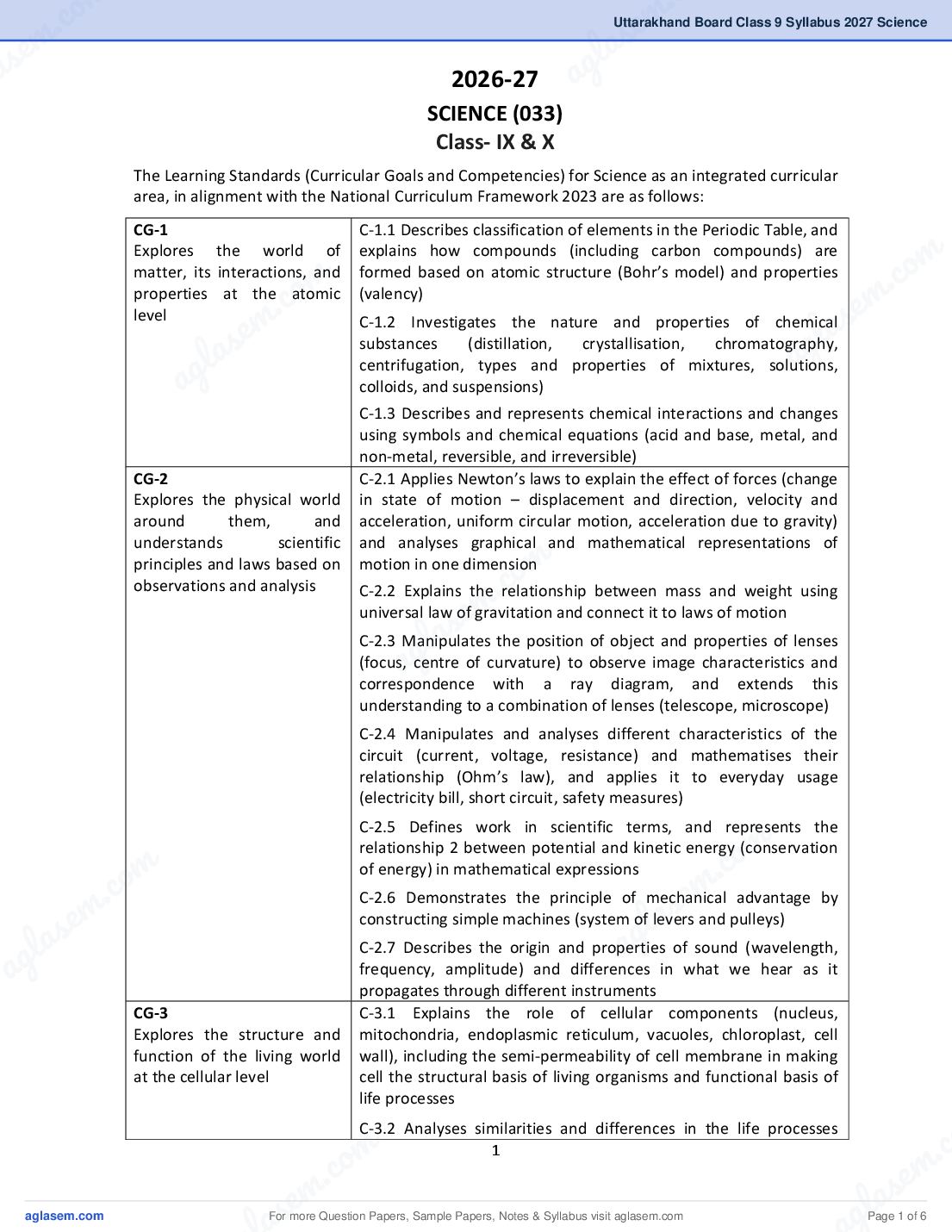
SCIENCE (033)
Class- IX & X
The Learning Standards (Curricular Goals and Competencies) for Science as an integrated curricular
area, in alignment with the National Curriculum Framework 2023 are as follows:
CG-1 C-1.1 Describes classification of elements in the Periodic Table, and
Explores the world of explains how compounds (including carbon compounds) are
m
om
matter, its interactions, and formed based on atomic structure (Bohr’s model) and properties
. co
. c
properties at the atomic (valency)
e m
level
e m C-1.2 Investigates the nature and properties of chemical
l as
l as substances (distillation, crystallisation, chromatography,
ag
ag centrifugation, types and properties of mixtures, solutions,
colloids, and suspensions)
C-1.3 Describes and represents chemical interactions and changes
using symbols and chemical equations (acid and base, metal, and
non-metal, reversible, and irreversible)
CG-2 C-2.1 Applies Newton’s laws to explain the effect of forces (change
Explores the physical world in state of motion – displacement and direction, velocity and
around them, and acceleration, uniform circular motion, acceleration due to gravity)
understands scientific and analyses graphical and mathematical representations of
m
.co
principles and laws based on motion in one dimension
observations and analysis C-2.2 Explains the relationship between mass and weight using
e m
universal law of gravitation and connect it to laws of motion
l as the position of object and properties of lenses
C-2.3 Manipulates
g of curvature) to observe image characteristics and
(focus,acentre
correspondence with a ray diagram, and extends this
understanding to a combination of lenses (telescope, microscope)
C-2.4 Manipulates and analyses different characteristics of the
circuit (current, voltage, resistance) and mathematises their
relationship (Ohm’s law), and applies it to everyday usage
(electricity bill, short circuit, safety measures)
C-2.5 Defines work in scientific terms, and represents the
m
.co
relationship 2 between potential and kinetic energy (conservation
m
.co
of energy) in mathematical expressions
m s em
C-2.6 Demonstrates the principle of mechanical advantage by
s e l a
constructing simple machines (system of levers and pulleys)
g
g la a of sound (wavelength,
C-2.7 Describes the origin and properties
a frequency, amplitude) and differences in what we hear as it
propagates through different instruments
CG-3 C-3.1 Explains the role of cellular components (nucleus,
Explores the structure and mitochondria, endoplasmic reticulum, vacuoles, chloroplast, cell
function of the living world wall), including the semi-permeability of cell membrane in making
at the cellular level cell the structural basis of living organisms and functional basis of
life processes
C-3.2 Analyses similarities and differences in the life processes
m . c
c. o
1
e m
em as
s
For more Question Papers, Sample Papers, Notes & Syllabus visit
glPage 1 of 6
Page 3
nutrients in fungi; digestion in animals), transport (transport of
water in plants; circulation in animals), exchange of materials
(respiration and excretion), and reproduction
C-3.3 Describes mechanisms of heredity (in terms of DNA, genes,
chromosomes) and variation (as changes in the sequence of DNA)
CG-4 C-4.1 Applies the knowledge of cellular diversity in organisms
Explores interconnectedness along with the ecological role organisms play (autotrophic or
between organisms and heterotrophic nutrition) to classify them into five-kingdoms
their environment C-4.2 Illustrates different levels of organisations of living organisms
(from molecules to organisms)
C-4.3 Analyses different levels of biological organisation from
organisms to ecosystems and biomes along with interactions that
take place at each level
C-4.4 Analyses patterns of inheritance of traits in terms of
Mendel’s laws and its consequences at a population level (using
models and/or simulations)
C-4.5 Analyses evidences of biological evolution demonstrating the
consequences of the process of natural selection in terms of
changes: in allele frequency in population, structure, and function
of organisms
CG-5 C-5.1 Explores how literature and the arts have influenced Science
Draws linkages between C-5.2 Examines a case study related to the use of Science in human
scientific knowledge and life from the perspective of Social Sciences and ethics (e.g., Marie
knowledge across other Curie, Jenner, treatment of patients with mental illness, the story
curricular areas of the atomic bomb, green revolution and GMOs, conservation of
biodiversity)
C-5.3 Applies scientific principles to explain phenomena in other
subjects (sound pitch, octave, and amplitude in music; use of
muscles in dance form and sports)
CG-6 C-6.1 Knows and explains the significant contributions of India to
Understands and all matters (concepts, explanations, methods) that are studied
appreciates the contribution within the curriculum in an integrated manner
of India through history and
the present times to the
overall field of Science,
including the disciplines that
constitute it
CG-7 C-7.1 States concepts that represent the most current
Develops awareness of the understanding of the matter being studied, ranging from mere
most current discoveries, familiarity to conceptual understanding of the matter as
ideas, and frontiers in all appropriate to the developmental stage of the students
areas of scientific knowledge C-7.2 States questions related to matters in the curriculum for
in order to appreciate that which current scientific understanding is well recognised to be
Science is ever evolving, and inadequate
that there are still many
unanswered questions
2
For more Question Papers, Sample Papers, Notes & Syllabus visit Page 2 of 6
Page 4
.co s e m
s em l a
g appropriate models (including
a CG-8 C-8.1 Develops accurate and a
Explores the nature of geometric, mathematical, graphical) to represent real-life events
Science by doing Science and phenomena using scientific principles and use these models to
manipulate variables and predict results
C-8.2 Designs and implements a plan for scientific inquiry
(formulates hypotheses, makes predictions, identifies variables,
accurately uses scientific instruments, represents data, primary
and secondary, in multiple modes, draws inferences based on data
and understanding of scientific concepts, theories, laws, and
m
om
principles, communicates findings using scientific terminology)
. co
. c e m
It is important to note that the Curricular Goals are interdependent, and not separate curricular
e
pieces of study.m l as
l as
(Reference: National Curriculum Framework for School Education – 2023.)
ag
ag
The competencies, as defined by the NCFSE 2023, are designed to encompass the entire secondary
stage (classes IX-XII). Attainment of the competencies shall be done through transaction of the
curriculum using appropriate pedagogy; these shall be assessed through an integrated evaluation
scheme.
CLASS- IX
m
.co
TOTAL MARKS- 100 ¿ 80 (Theory) + 20 (Internal Assessment)À
THEORY: 80 Marks
e m Time: 3:00 Hrs.
Unit No.
l as Unit Marks
I
a g and Behaviour
Matter- Its Nature 25
II Organization in the Living World 22
III Motion, Force and Work 27
IV Food; Food Production 06
Total 80
Theme: Materials
m
.co
UNIT- I : Matter- Its Nature and Behaviour
m in Our Surroundings:
c. oMatter
Definition of matter: Particulate Nature of Matter; States of Matter: solid,se
m
em characteristics; change of state- melting (absorption of heat), freezing, a evaporation (cooling by
liquid and gas and their
s g l
la a
ag
evaporation), condensation, sublimation.
Is Matter Around Us Pure: Elements, compounds and mixtures. Heterogeneous and homogenous
mixtures, colloids and suspensions. Physical and chemical changes (excluding separating the
components of a mixture); Pure and Impure substances.
Atoms and Molecules: Atoms and molecules, Law of Chemical Combination, Chemical formula of
common compounds, Atomic and molecular masses.
Structure of atom: Sub-atomic particles: Electrons, protons and neutrons, Models of atom; Valency,
Atomic Number and Mass Number, Isotopes and Isobars.
m . c
c. o
3
e m
em as
s
For more Question Papers, Sample Papers, Notes & Syllabus visit
glPage 3 of 6
Page 5
UNIT- II: Organization in the Living World
Cell - Basic Unit of life: Cell as a basic unit of life; prokaryotic and eukaryotic cells, multicellular
organisms; cell membrane and cell wall, cell organelles and cell inclusions; chloroplast, mitochondria,
vacuoles, endoplasmic reticulum, Golgi apparatus; nucleus, chromosomes - basic structure, number.
Tissues, Organs, Organ System, Organism: Structure and functions of animal and plant tissues (only
four types of tissues in animals; Meristematic and Permanent tissues in plants).
NOTE- The following additional topics are also included in the syllabus, but will not be assessed in
the examinations. Subject teachers can integrate these with existing chapters as they align well.
Health and Diseases: Health and its failure. Infectious and Non-infectious diseases, their causes and
manifestation. Diseases caused by microbes (Virus, Bacteria and Protozoans) and their prevention;
Principles of treatment and prevention. Pulse Polio programmes.
Theme: Moving Things, People and Ideas
UNIT- III: Motion, Force and Work
Motion: Distance and displacement, velocity; uniform and non-uniform motion along a straight line;
acceleration, distance-time and velocity-time graphs for uniform motion and uniformly accelerated
motion, elementary idea of uniform circular motion.
Force and Newton’s laws: Force and Motion, Newton’s Laws of Motion, Action and Reaction forces,
Inertia of a body, Inertia and mass, Momentum, Force and Acceleration
NOTE- The following additional topics are also included in the syllabus, but will not be assessed in
the examinations. Subject teachers can integrate these with existing chapters as they align well.
-Elementary idea of conservation of Momentum
Gravitation: Gravitation; Universal Law of Gravitation, Force of Gravitation of the earth (gravity),
Acceleration due to Gravity; Mass and Weight; Free fall.
Floatation: Thrust and Pressure. Archimedes’ Principle; Buoyancy.
Work, Energy and Power: Work done by a Force, Energy, power; Kinetic and Potential energy; Law of
conservation of energy (excluding commercial unit of Energy).
Sound: Nature of sound and its propagation in various media, speed of sound, range of hearing in
humans; ultrasound; reflection of sound; echo.
Theme: Food
UNIT- IV: Food Production
Plant and animal breeding and selection for quality improvement and management; Use of fertilizers
and manures; Protection from pests and diseases; Organic farming.
4
For more Question Papers, Sample Papers, Notes & Syllabus visit Page 4 of 6
Page 6
.co s e m
s em l a
a INTERNAL ASSESSMENT : 20 Marksag
1- Physics Practical 03 Marks
2- Chemistry Practical 03 Marks
3- Biology Practical 03 Marks
4- Sessional Work 03 Marks
5- Viva Voce 03 Marks
6- Continuous Assessment (Unit Test) 05 Marks
(There will be total 4 Unit Tests to be conducted throughout the year (two Unit Tests before half yearly
examination and two after half yearly examination). At the time of half yearly result preparation best of
m
two Unit Tests (I & II) marks will be taken and converted to the weightage of 05 marks. Likewise, best of
om . co
two Unit Tests (III & IV) marks will be taken and converted to the weightage of 05 marks for the annual
. c e m
result preparation.)
e m l as
l a
PRACTICALS
s ag
ag
Practicals should be conducted alongside the concepts taught in theory classes.
(LIST OF EXPERIMENTS)
1. Preparation of: Unit-I
a) a true solution of common salt, sugar and alum
b) a suspension of soil, chalk powder and fine sand in water
c) a colloidal solution of starch in water and egg albumin/milk in water and distinguish between these on the
basis of
transparency
filtration criterion
stability
m
.co
2. Preparation of Unit-I
a) A mixture
b) A compound
e m
as
using iron filings and sulphur powder and distinguishing between these on the basis of:
l
ag
(i) appearance, i.e., homogeneity and heterogeneity
(ii) behaviour towards a magnet
(iii) behaviour towards carbon disulphide as a solvent
(iv) effect of heat
3. Perform the following reactions and classify them as physical or chemical changes: Unit-I
a) Iron with copper sulphate solution in water
b) Burning of magnesium ribbon in air
c) Zinc with dilute sulphuric acid
d) Heating of copper sulphate crystals
e) Sodium sulphate with barium chloride in the form of their solutions in water
m
4. Preparation of stained temporary mounts of (a) onion peel, (b) human cheek cells & to record observations and
.co
draw their labeled diagrams. Unit-II
m
.co m
5. Identification of Parenchyma, Collenchyma and Sclerenchyma tissues in plants, striped,smooth and cardiac muscle
m
fibers and nerve cells in animals, from prepared slides. Draw their labeled diagrams.
s e Unit-II
e la
6. Determination of the melting point of ice and the boiling point of water. Unit-I
las 7. Verificationof the Laws of reflection of sound.
ag Unit-III
8. Determination of the density of solid (denser than water) by using a spring balance and a measuring cylinder.Unit-III
ag 9. Establishing the relation between the loss in weight of a solid when fully immersed in-
a) Tap water
Unit-III
b) Strongly salty water with the weight of water displaced by it by taking at least two different solids.
10. Determination of the speed of a pulse propagated through a stretched string/slinky (helicalspring).Unit-III
11. Verification of the law of conservation of mass in a chemical reaction. Unit-III
m . c
c. o
5
e m
em as
s
For more Question Papers, Sample Papers, Notes & Syllabus visit
gl Page 5 of 6
Page 7
foKku (Science)-Textbook for class IX-NCERT Publication
foKku (Science)-Text book for class X- NCERT Publication
Laboratory Manual-Science-Class IX, NCERT Publication
Laboratory Manual-Science-Class X, NCERT Publication
Exemplar Problems Class IX – NCERT Publication
Exemplar Problems Class X – NCERT Publication
*****
9
For more Question Papers, Sample Papers, Notes & Syllabus visit Page 6 of 6
Document Details
| Board / Org | Uttarakhand Board |
| Exam | Class 9 |
| Type | Syllabus |
| Pages | 6 |
| Updated | 04 Nov 2026 |