Uttarakhand Board Class 9 Syllabus 2027 Social Science
Finished viewing? Save it for later —
Download Uttarakhand Board Class 9 Syllabus 2027 Social Science (PDF · 10 pages)About Uttarakhand Board Class 9 Syllabus 2027 Social Science
Uttarakhand Board Class 9 Syllabus 2027 Social Science is available here for free download. Published by Uttarakhand Board for Class 9, this syllabus can be viewed online or downloaded as a PDF (10 pages). Candidates preparing for Class 9 can use Uttarakhand Board Class 9 Syllabus 2027 Social Science to understand the exam pattern, the type of questions asked, and the overall difficulty level.
Frequently Asked Questions
How can I download Uttarakhand Board Class 9 Syllabus 2027 Social Science?
Open this page and click the Download button to save Uttarakhand Board Class 9 Syllabus 2027 Social Science as a PDF. It is completely free on AglaSem Docs.
Is Uttarakhand Board Class 9 Syllabus 2027 Social Science free to download?
Yes. Uttarakhand Board Class 9 Syllabus 2027 Social Science can be viewed online and downloaded as a PDF free of cost on AglaSem Docs.
How many pages does Uttarakhand Board Class 9 Syllabus 2027 Social Science have?
Uttarakhand Board Class 9 Syllabus 2027 Social Science contains 10 pages, which you can read online or download together as a single PDF.
Where can I find more Class 9 study material?
You can find more Class 9 question papers, sample papers, syllabus, and answer keys on AglaSem Docs.
Uttarakhand Board Class 9 Syllabus 2027 Social Science – Text
Read the full text of this syllabus below — useful to quickly search, copy and reference the content online without downloading the PDF.
📄 View text version (11 pages)
Page 1
Uttarakhand Board
Class 9 Syllabus 2027
Social Science
EXAM YEAR TYPE SUBJECT
Uttarakhand Class 9 2027 Syllabus Social Science
Notes · Sample Papers · Previous Year Papers · Mock Tests
Page 2
.co s e m
s em l a
a ag
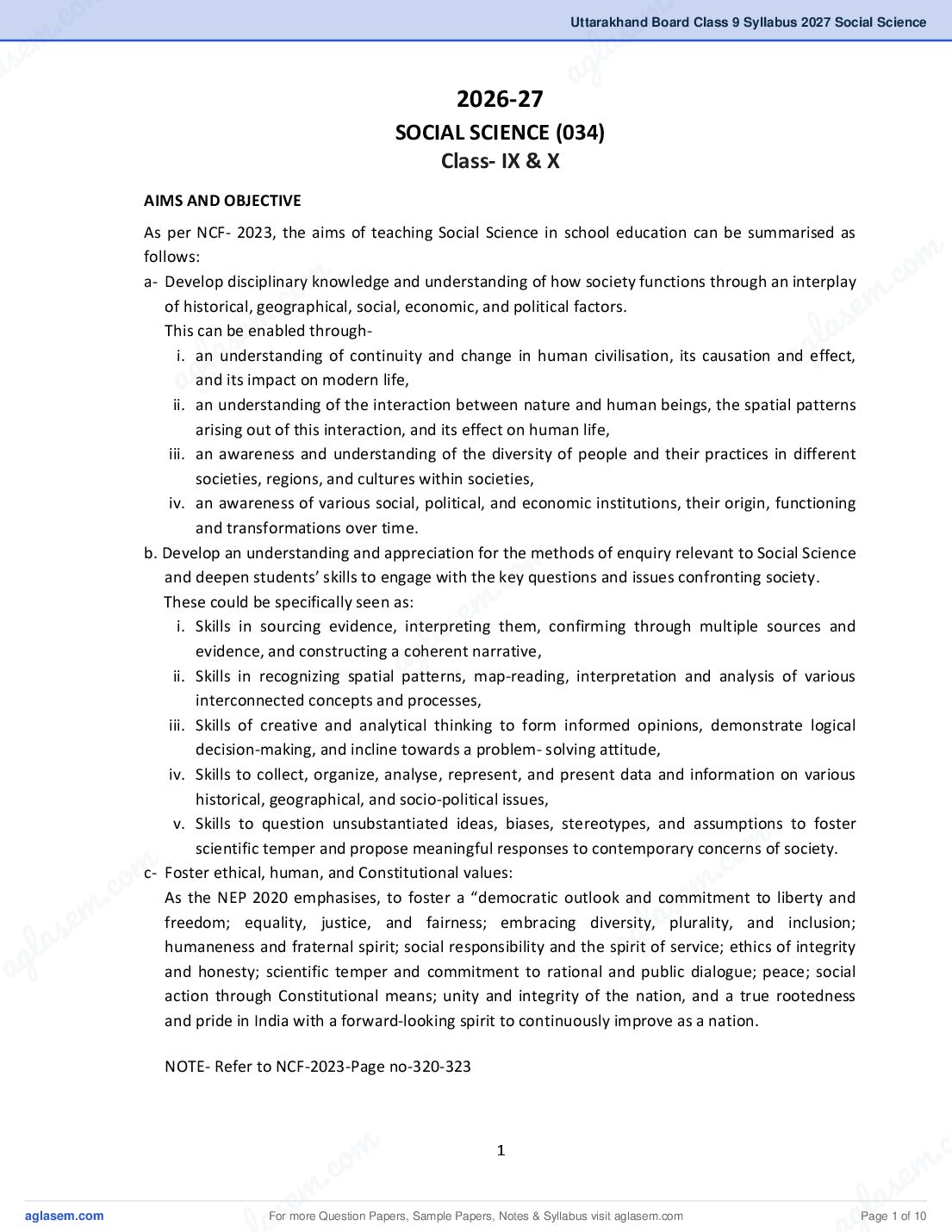
2026-27
SOCIAL SCIENCE (034)
Class- IX & X
AIMS AND OBJECTIVE
As per NCF- 2023, the aims of teaching Social Science in school education can be summarised as
m
co
follows:
. c om
a- Develop disciplinary knowledge and understanding of how society functions through an interplay
e m .
of historical, geographical, social, economic, and political factors.
e m l as
l as
This can be enabled through-
i. an understanding of continuity and change in human civilisation, its causation and effect, ag
ag and its impact on modern life,
ii. an understanding of the interaction between nature and human beings, the spatial patterns
arising out of this interaction, and its effect on human life,
iii. an awareness and understanding of the diversity of people and their practices in different
societies, regions, and cultures within societies,
iv. an awareness of various social, political, and economic institutions, their origin, functioning
and transformations over time.
m
b. Develop an understanding and appreciation for the methods of enquiry relevant to Social Science
These could be specifically seen as:
m .co
and deepen students’ skills to engage with the key questions and issues confronting society.
s e
a
i. Skills in sourcing evidence, interpreting them, confirming through multiple sources and
l
ag
evidence, and constructing a coherent narrative,
ii. Skills in recognizing spatial patterns, map-reading, interpretation and analysis of various
interconnected concepts and processes,
iii. Skills of creative and analytical thinking to form informed opinions, demonstrate logical
decision-making, and incline towards a problem- solving attitude,
iv. Skills to collect, organize, analyse, represent, and present data and information on various
historical, geographical, and socio-political issues,
v. Skills to question unsubstantiated ideas, biases, stereotypes, and assumptions to foster
m
.co
scientific temper and propose meaningful responses to contemporary concerns of society.
m
.co
c- Foster ethical, human, and Constitutional values:
e m
e m las
As the NEP 2020 emphasises, to foster a “democratic outlook and commitment to liberty and
las freedom; equality, justice, and fairness; embracing diversity, plurality, and inclusion;
ag
humaneness and fraternal spirit; social responsibility and the spirit of service; ethics of integrity
ag and honesty; scientific temper and commitment to rational and public dialogue; peace; social
action through Constitutional means; unity and integrity of the nation, and a true rootedness
and pride in India with a forward-looking spirit to continuously improve as a nation.
NOTE- Refer to NCF-2023-Page no-320-323
m . c
c. o
1
e m
em as
s
For more Question Papers, Sample Papers, Notes & Syllabus visit
gl
Page 1 of 10
Page 3
As per NCF 2023– At the Secondary Stage, students will go into details to understand India’s past
and appreciate its complexity, diversity, and unity brought about by cultural integration and the
sharing of knowledge traditions across geographical and linguistic boundaries. P-154
CG -2 Analyse the important phases in world history and draw insight to understand the present-
day world.
CG-3 Understand the idea of a nation and the emergence of the modern Indian Nation.
CG -4 Develops an understanding of the inter-relationship between human beings and their
physical environment and how that influences the livelihoods, cultural diversity, and biodiversity
of the region.
CG -5 Understand the Indian Constitution and explores the essence of Indian democracy and the
characteristics of a democratic government.
CG -6 Understand and analyse social, cultural, and political life in India over time – as well as the
underlying historical Indian ethos and philosophy of unity in diversity – and recognises
challenges faced in these areas in the past and present and the efforts (being) made to address
them.
CG -7 Develop an understanding of the inter-relationship between human beings and their
physical environment and how that influences the livelihoods, cultural diversity, and biodiversity
of the region.
CG -8 Evaluate the economic development of a country in terms of its impact on the lives of its
people and nature.
CG-9 Understand and appreciate the contribution of India through history and present times, to
the overall field of Social Science, and the disciplines that constitute it.
COMPETENCIES
Competencies are specific learning achievements that are observable and can be assessed
systematically. In NCF, Competencies are directly derived from a Curricular Goal and are expected
to be attained by the end of a Stage. The following competencies need to be developed in students
to achieve the curricular goals at secondary stage.
C-2.1 Explain historical events and processes with different types of sources with specific
examples from India and world history.
C-2.3 Trace aspects of continuity and change in different phases of world history (including
cultural trends, social and religious reforms, and economic and political transformations).
C-2.4 Explain the growth of new ideas and practices across the world and how they affected the
course of world history.
C-2.5 Recognise the various practices that arose, such as those in C-2.4, and came to be
condemned later on (such as racism, slavery, colonial invasions, conquests, and plunder,
genocides, exclusion of women from democratic and other institutions), all of which have also
impacted the course of world history and have left unhealed wounds.
C3.2 Identify and analyse important phases of the Indian national freedom struggle against
British colonial rule, with special reference to the movement led by Mahatma Gandhi and other
important figures as well as those that led to independence, and understands the specific Indian
concepts, values, and methods (such as Swaraj, Swadeshi, passive resistance, fight for dharma
self- sacrifice, ahimsa) that played a part in achieving Independence.
2
For more Question Papers, Sample Papers, Notes & Syllabus visit Page 2 of 10
Page 4
.co s e m
s em l a
a ag
C-4.1 Locate physiographic regions of India and the climatic zones of the world on a globe/map.
C-4.2 Explain important geographical concepts, characteristics of key landforms, their origin, and
other physical factors of a region
C-4.3 Draw inter- linkages between various components of the physical environment, such as
climate and relief, climate and vegetation, vegetation, and wildlife.
C-4.4 Analyse and evaluate the inter- relationship between the natural environment and human
beings and their cultures across regions and, in the case of India, the special environmental
ethos that resulted in practices of nature conservation
m
C-4.5 Critically evaluate the impact of human interventions on the environment, including
om . co
climate change, pollution, shortages of natural resources (particularly water), and loss of
. c e m
e m
biodiversity; identifies practices that have led to these environmental crises and the measures
l as
l as
that must be taken to reverse them
ag
ag
C-4.6 Develop sensitivity towards the judicious use of natural resources (by individuals, societies,
and nations) and suggests measures for their conservation.
C-5.1 Understand that the Indian Constitution draws from the great cultural heritage and
common aspirations of the Indian nation, and recalls India’s early experiments with democracy
(assemblies in Mahajanapadas, kingdoms and empires at several levels of the society, guilds
sanghas and ganas, village councils and committees, Uthiramerur inscriptions)
C-5.2 Appreciate fundamental Constitutional values and identify their significance for the
prosperity of the Indian nation.
m
.co
C-5.3 Explain that fundamental rights are the most basic human rights, and they flourish when
people also perform their fundamental duties
e m
l as
C-5.4 Analyse the basic features of a democracy and democratic government – and its history in
India and across the world – and compares this form of government with other forms of
government. ag
C-5.5- Analyse the critical role of non-state and non-market participants in the functioning of a
democratic government and society, such as the media, civil society, socio-religious institutions,
and community institutions
C-6.1 Understands how the Indian ethos and the cultural integration across India did not attempt
uniformity, but respected and promoted a rich diversity in Indian society, and how this
harmonisation and unity in diversity, with a historical respect for all cultures, women have
counted among India’s great strengths by promoting peaceful coexistence
m
m C-6.2 Understand that despite C-6.1, forms of inequality, injustice, and discrimination have
.co
m .co e m
occurred in different sections of society at different times (due to internal as well as outside
s
e la
forces such as colonisation), leading to political, social, and cultural efforts, struggles,
las ag
movements, and mechanisms at various levels towards equity, inclusion, justice, and harmony,
ag with varying outcomes and degrees of success.
C-7.1 Defines key features of the economy, such as, production, distribution, demand, supply,
trade, and commerce, and factors that influence these aspects (including technology).
C-7.2 Evaluates the importance of the three sectors of production (primary, secondary, and
tertiary) in any country’s economy, especially India.
C-7.3 Distinguishes between ‘unorganised’ and ‘organised’ sectors of the economy and their role
in production for the local market in small, medium, and large-scale production centres
m . c
c. o
3
e m
em as
s
For more Question Papers, Sample Papers, Notes & Syllabus visit
gl
Page 3 of 10
Page 5
economy and its connections with the self-organising features of Indian society.
C-7.4 Trace the beginning and importance of large- scale trade and commerce (including e-
commerce) between one country and another - the key items of trade in the beginning, and the
changes from time to time.
C-8.1 Gather, comprehend, and analyse data related to income, capital, poverty, and
employment in one’s locality, region and at the national level. Markets.
C-8.3 Understand these features in the context of ancient India, with its thriving trade, both
internal and external, and its well- established trade practices and networks, business
conventions, and diverse industries, all of which made India one of the world’s leading
economies up to the colonial period.
C-8.4 Describes India’s recent path towards again becoming one of the three largest economies
of the world, and how individuals can contribute to this economic progress.
C-8.5 Appreciates the connections between economic development and the environment, and
the broader indicators of societal wellbeing beyond GDP growth and income.
4
For more Question Papers, Sample Papers, Notes & Syllabus visit Page 4 of 10
Page 6
.co s e m
s em l a
a CLASS- IX
ag
TOTAL MARKS- 100 ¿ 80 (Theory) + 20 (Internal Assessment)À
THEORY: 80 Marks Time: 3:00 Hrs.
Unit No. Unit Marks
I HISTORY- INDIA AND THE CONTEMPORARY WORLD-I 18
II GEOGRAPHY- CONTEMPORARY INDIA 20
III POLITICAL SCIENCE- DEMOCRATIC POLITICS 18
m
IV ECONOMICS
om MANAGEMENT
16
. co
V
c. DISASTER 08
em
em Total 80
l as
l as ag
Unit I:gHISTORY- INDIA AND THE CONTEMPORARY WORLD-I
a
Section 1: Events and Processes: (All the three Hitler’s Rise to Power
themes are compulsory) The Nazi Worldview
I. The French Revolution: Youth in Nazi Germany
French Society During the Late Ordinary People and the Crimes Against
Eighteenth Century Humanity
The Outbreak of the Revolution Section 2: Livelihoods, Economies and
France Abolishes Monarchy and Societies:
Becomes a Republic Note- This section will not be assessed in
m
.co
Did Women have a Revolution? theory examinations but assignment (in
internal assessment) will be given from these
The Abolition of Slavery
e m
The Revolution and Everyday Life
II. Socialism in Europe and the Russian
l as topics.
IV. Forest Society and Colonialism:
Revolution:
The Age of Social Change
ag Why Deforestation?
The Rise of Commercial Forestry
The Russian Revolution Rebellion in the Forest
The February Revolution in Petrograd Forest Transformations in Java
What Changed after October? V. Pastoralists in the Modern World:
The Global Influence of the Russian Pastoral Nomads and their Movements
Revolution and the USSR Colonial Rule and Pastoral life
III. Nazism and the Rise of Hitler: Pastoralism in Africa
Birth of the Weimar Republic
m
m
c. o Learning Outcomes-
Map Work- 02 Marks
m .co
m s e
s e Section 1: Events and Processes:
g la
g la 1- The French Revolution: The students will be able to-
a
a Infer how the French Revolution had an impact on the European countries in the making of
nation states in Europe and elsewhere.
Illustrate that, the quest for imperialism triggered the First World War.
Examine various sources to address imbalances that may lead to revolutions
2- Socialism in Europe and the Russian Revolution: The students will be able to-
Compare the situations that led to the rise of Russian and French Revolutions.
Examine the situations that led to the establishment of Lenin’s communism and Stalin’s
collectivization.
m . c
c. o
5
e m
em as
s
For more Question Papers, Sample Papers, Notes & Syllabus visit
gl
Page 5 of 10
Page 7
3- Nazism and the Rise of Hitler: The students will be able to-
Analyse the role of “Treaty of Versailles” in the rise of Hitler to power.
Analyse the genocidal war waged against the “undesirables” by Hitler.
Compare and contrast the characteristics of Hitler and Gandhi.
Section 2: Livelihoods, Economies and Societies:
4- Forest Society and Colonialism: (for internal assessment only)
5- Pastoralists in the Modern World: (for internal assessment only)
The students will be able to-
Examine the situations that have created nomadic societies highlighting the key factors played by
the climatic conditions and topography.
Analyse varying patterns of developments within pastoral societies in different places in India.
Comprehend the impact of colonialism on Pastoralists in India and Africa.
Analyse Pastoralists in the Modern World.
Unit II: GEOGRAPHY- CONTEMPORARY INDIA
1- India- Size and Location 3- Drainage:
Location Concept
Size Drainage Systems in India
India and the World The Himalayan Rivers- Ganga and
India’s Neighbours Brahmaputra River System
2- Physical Features of India: The Peninsular Rivers- Narmada Basin,
Major Physiographic Divisions– Himalayan Tapti Basin, Godavari Basin, Mahanadi
Mountains, Northern Plains, Peninsular Basin, Krishna Basin, Kaveri Basin
Plateau, Indian Desert, Coastal Plains, Lakes
Islands Role of Rivers in the Economy
River Pollution
4. Climate: Types of Vegetation– Tropical Evergreen
Concept Forests, Tropical Deciduous Forests,
Climatic Controls Thorn Forests and Shrubs, Montane
Factors influencing India’s climate– Forests, Mangrove Forests
Latitude, Altitude, Pressure and Winds Wild Life
The Seasons– Cold Weather Season, Hot 6. Population:
Weather Season, Advancing Monsoon, Population Size and Distribution– India’s
Retreating/ Post Monsoons Population Size and Distribution by
Distribution of Rainfall Numbers, India’s Population Distribution
Monsoon as a unifying bond by Density
5. Natural Vegetation and Wild Life: Population Growth and Processes of
Note- This section will not be assessed in Population Change– Population Growth,
theory examinations but assignment (in Processes of Population Change/Growth.
internal assessment) will be given from these
Map Work- 04 Marks
topics.
Learning Outcomes-
1- India – Size and Location: The students will be able to-
Examine how the location of an area impacts its climate and time with reference to longitude
and latitude.
6
For more Question Papers, Sample Papers, Notes & Syllabus visit Page 6 of 10
Page 8
.co s e m
s em l a
a ag
Explore and analyses the trading and cultural relationships of India with its neighbouring
countries.
Evaluate the situation & reasons that made 82.5E* longitude as Time meridian of India.
Examine how location of India enables its position as a strategic partner in the subcontinent.
Justify the reasons for the differences in climatic conditions, local and standard time.
2- Physical Features of India: The students will be able to-
Justify how the Physical Features of India influences the livelihoods, culture, and the
biodiversity of the region.
Examine the geological process that played a crucial role in the formation of diverse physical
m
om
features in India.
. co
c
Analyse the conditions and relationships of the people living in different physiographic areas.
. e m
m as
ethe information about different lakes and infer on their contribution togIndian
3- Drainage : The students will be able to-
l
l a
Examines a
g
ecology.
aPresent creative solutions to overcome the water pollution and also to increase the
contribution of water bodies to the Indian economy.
Identify the river systems of the country and explain the role of rivers in human society.
4- Climate : The students will be able to-
Analyse and infer the effect of monsoon winds on rainfall of the Indian subcontinent.
Analyse the temperatures between plateau region, Himalayan region, desert region and
coastal region.
m
Enumerate and summarise the reasons for the wide difference between temperatures at
.co
different geographical locations of India.
e m
5- Natural Vegetation and Wild Life: (for internal assessment only)
6- Population : The students will be able a
l s
to-
Analyse and infer the reasons a gbehind the uneven distribution of population in India with
specific reference to UP & Rajasthan and Mizoram and Karnataka
Enlist the factors that affect the population density.
Unit III: POLITICAL SCIENCE- DEMOCRATIC POLITICS
1- What is Democracy? Why Democracy? 4- Working of Institutions:
What is Democracy? How is the major policy decision taken?
Features of Democracy Parliament
m
.co
Why Democracy? Political Executive
m
.co m
Broader Meanings of Democracy The Judiciary
m 2- Constitutional Design: 5- Democratic Rights:
s e
s e Democratic Constitution in South Africa la
Life without Rights
g
g la Why do we need a Constitution? a
Rights in a Democracy
a Making of the Indian Constitution
Guiding Values of the Indian Constitution
Rights in the Indian Constitution
Expanding scope of rights
3- Electoral Politics:
Why Elections?
What is our System of Elections?
What makes elections in Indiademocratic?
m . c
c. o
7
e m
em as
s
For more Question Papers, Sample Papers, Notes & Syllabus visit
gl
Page 7 of 10
Page 9
1- What is Democracy? Why Democracy? : The students will be able to-
Examine the concept of structural components of Democracy and its forms/ features.
Compare and Contrast working of democracies of India and North Korea and infer on their
differences and significance in each country.
Analyse and infer on the different historical processes and forces that have contributed for
the promotion of democracy.
2- Constitutional Design : The students will be able to-
Discuss and describe the situation that led to creation of Indian Constitution.
Enumerate the essential features that need to be kept in mind while drafting a constitution.
Examine the guiding values that created the Indian constitution.
Comprehend the roles and responsibilities as citizens of India.
3- Electoral Politics : The students will be able to-
Analyse the implications of power of vote and power of recall.
Summarise the essential features of the Indian Electoral system.
Examine the rationale for adopting the present Indian
4- Working of Institutions: The students will be able to-
Examine the roles, responsibilities, and interdependency of all the 3 organs of the
Government.
Appreciate the parliamentary system of executive’s accountability to the legislature.
Summarise and evaluate the rule of law in India.
5- Democratic Rights : The students will be able to-
Summarise the importance of fundamental rights and duties in the light of the nation’s glory.
Analyse and recognise the role of a responsible citizen while performing their prescribed
duties versus claiming rights.
Unit IV: ECONOMICS
1- The Story of Village Palampur: 2- People as Resource:
Note- This section will not be assessed in Overview
theory examinations but assignment (in Economic Activities by Men and Women
internal assessment) will be given from Quality of Population
these topics. Unemployment
Overview
Organization of Production
Farming in Palampur
Non-farm activities in Palampur
3- Poverty as a Challenge: 4- Food Security in India:
Overview Overview
Two typical cases of Poverty What is Food Security?
Poverty as seen by Social Scientists Why Food Security?
Poverty Estimates Who are food insecure?
Vulnerable Groups Food Security in India
Interstate Disparities What is Buffer Stock?
Global Poverty Scenario What is the Public Distribution System?
Causes of Poverty Current Status of Public Distribution
Anti-Poverty measures System
The Challenges Ahead Role of Cooperatives in food security
8
For more Question Papers, Sample Papers, Notes & Syllabus visit Page 8 of 10
Page 10
.co s e m
s em l a
a Learning Outcomes-
ag
1- The Story of Village Palampur : (for internal assessment only)
The students will be able to-
Enlist the requirements of production and comprehend the interdependence of these
requirements.
Correlate farming and non-farming activities to economic growth.
Comprehend how the significance of conditions of farming and the factors of production
impact economic development.
Find solutions to foster an equitable society.
m
om
2- People as Resource : The students will be able to-
. co
c
Evaluate the reasons that contribute to the quality of population.
. e m
e m
Observe different government schemes and see their effect on the people there.
l as
as
3- Poverty as a Challenge : The students will be able to-
l ag
ag
Comprehend the reasons for poverty in the rural and urban areas.
Evaluate the efficacy of the government to eradicate poverty.
Correlate the link between education and poverty.
4- Food Security in India : The students will be able to-
Comprehend various aspects of food security that will ensure continuity of supply.
Enumerate the different features of PDS that directly address FSI.
Analyse and infer the impact of the Green Revolution.
Analyse causes and effect of famines in food security during pre and post independent India.
m
Unit V: DISASTER MANAGEMENT
m .co
1- vkink ,oa vkink çca/ku ds ?kVd s e
l a
ag
2- vkink tksf[ke çca/ku o “keu
3- Hkwdai
4- Hkw{kj.k] HkwL[kyu ,oa fgeL[kyu
5- Ckk<+] vfro`f’V o o’kkZ çLQksV % dkj.k ,oa cpko ds mik;
6- lM+d lqj{kk
7- ekuo fufeZr vkink,a] jksdFkke o “keu
8- vkink çcU/ku esa leqnk; ,oa Nk=&Nk=kvksa dh Hkwfedk
9- vkink çca/ku % ifj;kstuk dk;Z
m
mINTERNAL ASSESSMENT :
c. o 1-2- Assignments-
20 Marks
.co
m
05 (02 marks for each) - 10 Marks
s em
e la
Project Work (01 Project)- 05 Marks
las 3- Continuous Assessment (Unit Test)- 05 Marks
g
a(two Unit Tests before half yearly
ag (There will be total 4 Unit Tests to be conducted throughout the year
examination and two after half yearly examination). At the time of half yearly result preparation best of
two Unit Tests (I & II) marks will be taken and converted to the weightage of 05 marks. Likewise, best of
two Unit Tests (III & IV) marks will be taken and converted to the weightage of 05 marks for the annual
result preparation.)
m . c
c. o
9
e m
em as
s
For more Question Papers, Sample Papers, Notes & Syllabus visit
gl
Page 9 of 10
Page 11
Class- 9
Hkkjr vkSj ledkyhu fo”o&1(India and the Contemporary World- I) for class IX- NCERT Publication
ledkyhu Hkkjr&1 (Contemporary India-I) for class IX- NCERT Publication
yksdrkaf=d jktuhfr&1 (Democratic Politics- I) for class IX- NCERT Publication
vFkZ”kkL= (Economics) for class IX- NCERT Publication
vkink izcU/ku (Disaster Management) for class IX.
Class- 10
Hkkjr vkSj ledkyhu fo”o&2(India and the Contemporary World-II) for class X- NCERT Publication
ledkyhu Hkkjr&2 (Contemporary India-II) for class X- NCERT Publication
yksdrkaf=d jktuhfr&2 (Democratic Politics- II) Democratic Politics for class X- NCERT Publication
vkfFkZd fodkl dh le> (Understanding Economic Development) for class X- NCERT Publication
vkink izcU/ku (Disaster Management) for class X.
*****
16
For more Question Papers, Sample Papers, Notes & Syllabus visit Page 10 of 10
Document Details
| Board / Org | Uttarakhand Board |
| Exam | Class 9 |
| Type | Syllabus |
| Pages | 10 |
| Updated | 04 Nov 2026 |