Odisha CPET 2021 Question Paper Microbiology
Finished viewing? Save it for later —
Download Odisha CPET 2021 Question Paper Microbiology (PDF · 8 pages)About Odisha CPET 2021 Question Paper Microbiology
Odisha CPET 2021 Question Paper Microbiology is available here for free download. Published by Odisha Exams for Odisha CPET, this question paper can be viewed online or downloaded as a PDF (8 pages). Candidates preparing for Odisha CPET can use Odisha CPET 2021 Question Paper Microbiology to understand the exam pattern, the type of questions asked, and the overall difficulty level.
Frequently Asked Questions
How can I download Odisha CPET 2021 Question Paper Microbiology?
Open this page and click the Download button to save Odisha CPET 2021 Question Paper Microbiology as a PDF. It is completely free on AglaSem Docs.
Is Odisha CPET 2021 Question Paper Microbiology free to download?
Yes. Odisha CPET 2021 Question Paper Microbiology can be viewed online and downloaded as a PDF free of cost on AglaSem Docs.
How many pages does Odisha CPET 2021 Question Paper Microbiology have?
Odisha CPET 2021 Question Paper Microbiology contains 8 pages, which you can read online or download together as a single PDF.
Where can I find more Odisha CPET study material?
You can find more Odisha CPET question papers, sample papers, syllabus, and answer keys on AglaSem Docs.
Odisha CPET 2021 Question Paper Microbiology – Text
Read the full text of this question paper below — useful to quickly search, copy and reference the content online without downloading the PDF.
📄 View text version (8 pages)
Page 1
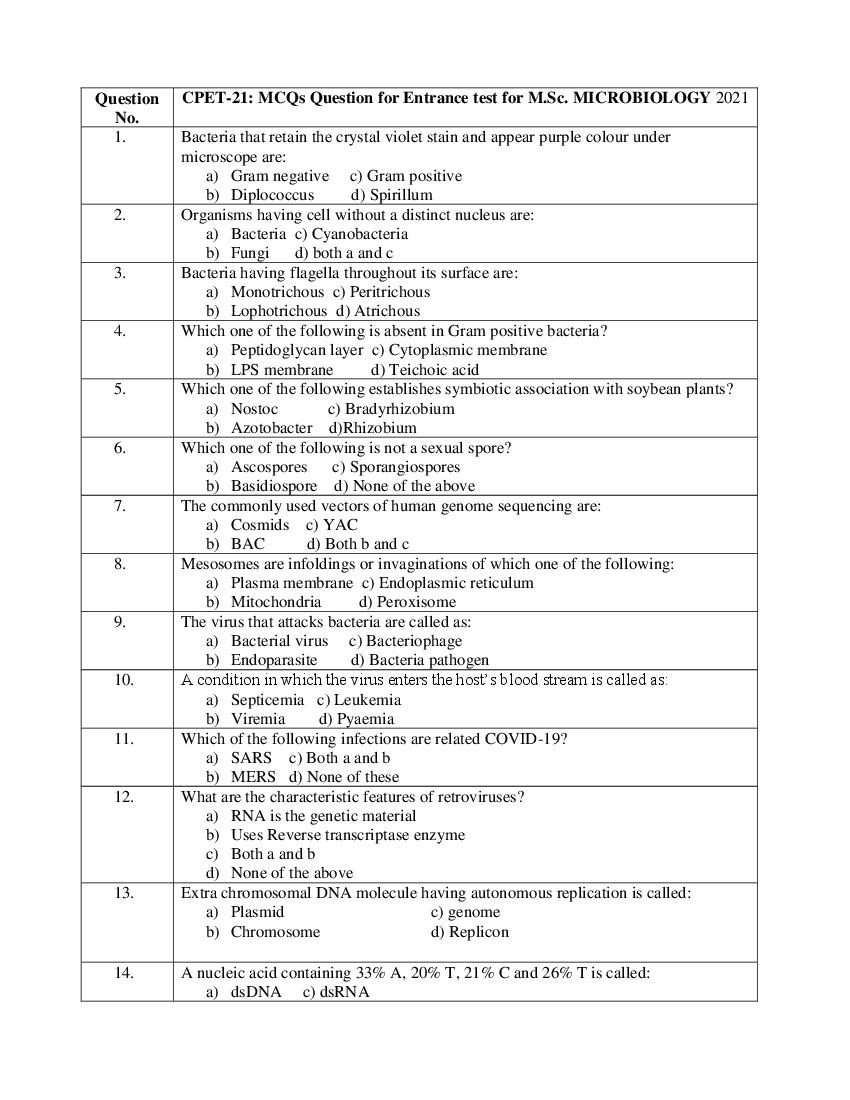
No.
1. Bacteria that retain the crystal violet stain and appear purple colour under
microscope are:
a) Gram negative c) Gram positive
b) Diplococcus d) Spirillum
2. Organisms having cell without a distinct nucleus are:
a) Bacteria c) Cyanobacteria
b) Fungi d) both a and c
3. Bacteria having flagella throughout its surface are:
a) Monotrichous c) Peritrichous
b) Lophotrichous d) Atrichous
4. Which one of the following is absent in Gram positive bacteria?
a) Peptidoglycan layer c) Cytoplasmic membrane
b) LPS membrane d) Teichoic acid
5. Which one of the following establishes symbiotic association with soybean plants?
a) Nostoc c) Bradyrhizobium
b) Azotobacter d)Rhizobium
6. Which one of the following is not a sexual spore?
a) Ascospores c) Sporangiospores
b) Basidiospore d) None of the above
7. The commonly used vectors of human genome sequencing are:
a) Cosmids c) YAC
b) BAC d) Both b and c
8. Mesosomes are infoldings or invaginations of which one of the following:
a) Plasma membrane c) Endoplasmic reticulum
b) Mitochondria d) Peroxisome
9. The virus that attacks bacteria are called as:
a) Bacterial virus c) Bacteriophage
b) Endoparasite d) Bacteria pathogen
10. A condition in which the virus enters the host’s blood stream is called as:
a) Septicemia c) Leukemia
b) Viremia d) Pyaemia
11. Which of the following infections are related COVID-19?
a) SARS c) Both a and b
b) MERS d) None of these
12. What are the characteristic features of retroviruses?
a) RNA is the genetic material
b) Uses Reverse transcriptase enzyme
c) Both a and b
13. Extra chromosomal DNA molecule having autonomous replication is called:
a) Plasmid c) genome
b) Chromosome d) Replicon
14. A nucleic acid containing 33% A, 20% T, 21% C and 26% T is called:
a) dsDNA c) dsRNA
Page 2
15. DNA Pol I has the following functions. Mark the correct one:
a) 5’-3’ Polymerization
b) 5’-3’ Exonuclease
c) 3’- 5’ Exonuclease
d) All of the above
16. The Telomerase enzyme that solves the end replication problem in eukaryotes
contains:
a) RNA and Protein
b) DNA and Protein
c) Protein and Protein
17. Which one of the following conditions arise when the level of glucose and lactose
are high in Lac operon:
a) Glucose will be taken up first by the cells
b) Lactose will be taken up first by the cells
c) Cells can uptake any one of the sugars first
d) None of these
18. Which of the following partial diploids will express β-galactosidase constitutively?
a) F’ lacOclacZ+ / lacO+lacZ+
b) F’ lacI-lacZ+ / lacI+lacZ+
c) F’ lacI+lacZ+ / lacI-lacZ+
d) F’ lacOclacZ- / lacO+lacZ+
19. In protein synthesis, tRNA carrying the initiating amino acid enters in which site of
ribosome?
a) ‘A’ site
b) ‘P’ site
c) anticodon site
d) recognition site
20. In prokaryotes, which subunit of the ribosome has peptidyltransferase activity?
a) 50S subunit
b) 30S subunit
c) A site of ribosome
d) P site of ribosome
21. Mutations which do not cause any functional change in the protein is known as:
a) Nonsense mutation
b) Silent mutation
c) Backward mutation
d) Missense mutation
22. Which one of the following repairs thymine dimers?
a) AP endonuclease
b) Mut S and Mut L
c) DNA photolyase
d) UVr ABC
23. Which of the following is not a post transcriptional modification?
Page 3
b) 3’ polyadenylation
c) Splicing
d) Glycosylation
24. RNA polymerase binds to which site/region of the DNA molecule?
a) Operator
b) Promoter
c) Leader sequence
d) Regulator
25. Which of the following organism is widely used as a biocontrol agent in organic
farming?
a) Rhizobium tropicii
b) Trichodermaviridis
c) Fusariumoxysporum
d) Nostocmuscorum
26. Antibody in the serum of a neonate will be:
a) IgM of maternal origin
b) IgE of maternal origin
c) IgG of maternal origin
d) IgA of maternal origin
27. Lack of Thymus leads to increased infection in humans such a condition is called:
a) Thymectomy
b) Nude mice
c) Di George’s syndrome
28. In a trisomic individual the number of chromosomes is:
a) 2n – 1
b) 2n +2
c) 2n+3
d) 2n+1
29. There are 3 genes A, B and C, if the recombination frequency between AB is 5%and
BC is 10%. Calculate the map distance between AB and BC?
a) AB- 2.5 cM; BC- 5 cM
b) AB- 5 cM; BC- 10 cM
c) Cannot be caculated
d) AB- 10 cM; BC- 20 cM
30. If a disease is Y-linked, which one of the following assumptions are correct?
a) Transferred from male parent to male child
b) All the male progenies will be affected
c) Mitochondrial disease
d) Both a and b
Page 4
a) Unregulated cell cycle progression
b) Inhibition of cell cycle
c) Formation of tumors
d) Both a and c
32. In which phase of the cell cycle there is duplication of the genetic material:
a) G1 phase
b) G2 phase
c) S phase
d) M phase
33. In eukaryotes, which of the following is not a second messenger?
a) 1,2-diacyl glycerol
b) inositol 1,4,5-triphosphate
c) Cyclic AMP
d) cyclins
34. During generation of an action potential, depolarization is due to:
a) K+efllux
b) Na+ efflux
c) Na+ influx
d) K+ influx
35. Transport of water across plasma membrane is regulated by:
a) Diffusion
b) Ion channels
c) Aquaporins
36. The nucleus is not important as the site of:
a) DNA synthesis
b) RNA synthesis
c) Synthesis of ribosomal subunits
d) Protein synthesis
37. The classic experiment on the sequence of organelles that constitute the secretory
pathway carried out by George Palade and his colleagues is:
a) Rough ER/ Golgi/ Secretory vesicles/ Cell exterior
b) Rough ER/ vacuole/ Golgi/ Cell exterior
c) Rough ER/ Cytosol/ Golgi/ Cell exterior
d) Rough ER/ Nucleus/ Secretory vesicles/ Cell exterior
38. Which of the following enzymes do not occur in the lysosomes:
a) Phosphatase
b) Lipase
c) Proteases
d) Polymerase
Page 5
a) Physical removal of solids from polluted water by filtration and sedimentation
b) Removal of chemical remains by precipitation
c) Removal of dissolved organic compounds by activated sludge or tricking filter
d) Removal of microbial pathogens by chlorination or ozonation
40. The fungal disease that affect the internal organs and spread through the body are
called
a) Mycoses
b) Systemic mycoses
c) Mycotoxicosis
d) Superficial mycoses
41. The staining technique used to stain the metachromatic granules of Corynebacterium
a) Giemsa stain
b) Alberts stain
c) Acid fast staining
d) Both a and b
42. Which test is used to identify Influenza virus:
a) Haemagglutinin inhibition test
b) Tissue culture method
c) Embryonated eggs
d) Plaque formation
43. Which strain of fungi is used for the production of streptomycin is:
a) Penicilliumchrysogenum
b) Penicilliumnotatum
c) Streptomyces sp.
d) Saccharomycessp.
44. First genetically engineered and biotechnologically produced vaccine was against
a) AIDS
b) Small pox
c) Herpes simplex
d)Hepatitis B
45. Lyophilization is a technique that involves:
a) Freeze drying
b) Sterilization
c) Moist heat sterilization
d) None of these
46. DNA Polymerase used in PCR techniques is isolated from which one of the
following microorganisms?
a) Pseudomonas aeruginosa
b) Thermusaquaticus
c) Clostridium tetani
d) Bacillus subtilis
Page 6
a) Rhizobium
b) Nitrobacter
c) Azospirillum
d) Clostridium
48. Tricarboxylic acid cycle takes place in which one of the following?
a) Mitochondria
b) Ribosome
c) Golgi apparatus
d) Endoplasmic reticulum
49. Lichens are symbiotic association of fungi and:
a) Mosses
b) Cyanobacteria
c) Algae
d) Both b and c
50. Antibiotics are synthesized in which phase of the microbial growth?
a) Log phase
b) Stationary phase
c) Lag phase
d) All of the above
51. The advantage of mycorrhizal association with plant roots:
a) Improved mineral absorption
b) Protection from pathogens
c) Both a and b
d) Food
52. Which one of the following does not belong to edible group of mushrooms?
a) Agaricusbisporus
b) Cantharelluscibarius
c) Pleurotusostreatus
d) Amanita phalloides
53. The “cold loving” microorganisms are called:
a) Thermophiles
b) Psychrophiles
c) Mesophiles
d) Acidophiles
54. When the virus integrates its genome with the genetic material of host, such a
condition is called:
a) Prophage
b) Ligase
c) Anaphase
55. Which one of the following is not a macronutrient for microorganism?
a) Sulfur
b) Potassium
c) Magnesium
d) Cobalt
Page 7
a) Synchronous growth
b) Diauxic growth
c) Stationary growth
d) Normal growth
57. The other name of Glycolysis pathway is:
a) Embden-Meyerhof pathway
b) Entner-Doudoroff Pathway
c) Hexose Monophosphate Shunt
58. Which one of the following is not an eukaryote:
a) Saccharomyces
b) Trichoderma
c) Salmonella
d) Fusarium
59. Tuberculosis is caused by which group of microorganism?
a) Bacteria
b) Fungi
c) Protozoa
d) Virus
60. Bacterial species involved in the preparation of Ethanol:
a) Zymomonasmobilis
b) Saccharomyces cerevisiae
c) Lactobacillus bulgaris
d) Asperigillusniger
61. The enzyme used in lactic acid fermentation is:
a) Lactate hydrogenase
b) Lactate dehydrogenase
c) Lactate carboxylase
d) All of the above
62. Which one of the following is absent in prokaryotes?
a) Cell membrane
b) Ribosomes
c) Nucleus
d) Mesosomes
63. A specialized cell of fungal pathogens that infects the host is called:
a) Haustorium
b) Appressorium
c) Hyphae
d) Conidia
Page 8
a) Louis Pasteur
b) Escherich
c) Shiga
d) Robert Koch
65. In electron microscope source of electrons is from:
a) Mercury lamp
b) Tungsten metal
c) Both a and b
d) None of these
66. Small pox vaccine was first discovered by:
a) Robert Koch
b) Louis Pasteur
c) Lister
d) Edward Jenner
67. Spirulina belongs to which of the following group?
a) Xanthophyceae
b) Cyanophyceae
c) Rhodophyceae
d) Pheophyceae
68. The dengue fever virus is:
a)Echo virus
b)Entero virus
c) Arbo virus
d)Orthomyxo virus
69. Which one of the following is not true for fungi?
a) Contain no peptidoglycan
b) Are prokaryotic
c) Susceptible to griseofulvin
d) Have nuclear membranes
70. Attenuation of virus means:
a) Killing of the virus
b) Inactivation of virus
c) More activating the virus
d) Both 1 and 2
Document Details
| Board / Org | Odisha Exams |
| Exam | Odisha CPET |
| Type | Question Paper |
| Pages | 8 |
| Updated | 22 Jul 2026 |