Odisha CPET 2021 Question Paper Material Science
Finished viewing? Save it for later —
Download Odisha CPET 2021 Question Paper Material Science (PDF · 8 pages)About Odisha CPET 2021 Question Paper Material Science
Odisha CPET 2021 Question Paper Material Science is available here for free download. Published by Odisha Exams for Odisha CPET, this question paper can be viewed online or downloaded as a PDF (8 pages). Candidates preparing for Odisha CPET can use Odisha CPET 2021 Question Paper Material Science to understand the exam pattern, the type of questions asked, and the overall difficulty level.
Frequently Asked Questions
How can I download Odisha CPET 2021 Question Paper Material Science?
Open this page and click the Download button to save Odisha CPET 2021 Question Paper Material Science as a PDF. It is completely free on AglaSem Docs.
Is Odisha CPET 2021 Question Paper Material Science free to download?
Yes. Odisha CPET 2021 Question Paper Material Science can be viewed online and downloaded as a PDF free of cost on AglaSem Docs.
How many pages does Odisha CPET 2021 Question Paper Material Science have?
Odisha CPET 2021 Question Paper Material Science contains 8 pages, which you can read online or download together as a single PDF.
Where can I find more Odisha CPET study material?
You can find more Odisha CPET question papers, sample papers, syllabus, and answer keys on AglaSem Docs.
Odisha CPET 2021 Question Paper Material Science – Text
Read the full text of this question paper below — useful to quickly search, copy and reference the content online without downloading the PDF.
📄 View text version (7 pages)
Page 1
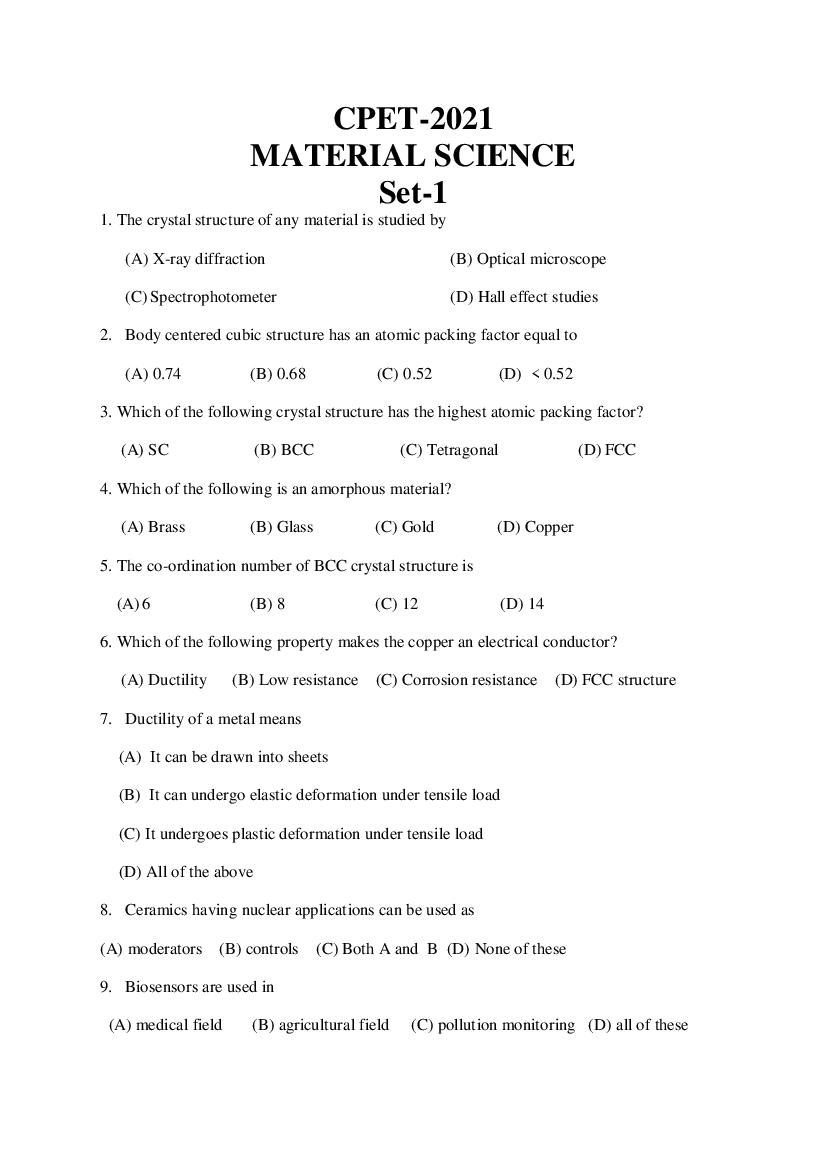
MATERIAL SCIENCE
Set-1
1. The crystal structure of any material is studied by
(A) X-ray diffraction (B) Optical microscope
(C) Spectrophotometer (D) Hall effect studies
2. Body centered cubic structure has an atomic packing factor equal to
(A) 0.74 (B) 0.68 (C) 0.52 (D) < 0.52
3. Which of the following crystal structure has the highest atomic packing factor?
(A) SC (B) BCC (C) Tetragonal (D) FCC
4. Which of the following is an amorphous material?
(A) Brass (B) Glass (C) Gold (D) Copper
5. The co-ordination number of BCC crystal structure is
(A) 6 (B) 8 (C) 12 (D) 14
6. Which of the following property makes the copper an electrical conductor?
(A) Ductility (B) Low resistance (C) Corrosion resistance (D) FCC structure
7. Ductility of a metal means
(A) It can be drawn into sheets
(B) It can undergo elastic deformation under tensile load
(C) It undergoes plastic deformation under tensile load
(D) All of the above
8. Ceramics having nuclear applications can be used as
(A) moderators (B) controls (C) Both A and B (D) None of these
9. Biosensors are used in
(A) medical field (B) agricultural field (C) pollution monitoring (D) all of these
Page 2
(A) low current density (B) high temperature (C) high viscosity (D) All of these
11. In physico-chemical processes, which factors affect reduction method?
(A) Size of particles (B) Shape of materials (C) Reducing agent (D) All of these
12. What is the by-product formed by the condensation of methyl alcohol and acetic acid to
form ester?
(A) Water (B) Hydrogen (C) Oxygen (D) None of these
13. Which type of materials is used as bridges between human tissues and metals?
(A) Polymeric biomaterials (B) Ceramic biomaterials
(C) Metallic biomaterials (D) All of these
14. Which type of microscope is used to determine particle size between (10 to 0.001 μm)?
(A) Optical microscope (B) Electron microscope
(C) Both (A) and (B) (D) None of the above
15. Which one of the following is the best heat and corrosion resistant material?
(A) Metals (B) Polymers (C) Ceramics (D) none of these
16. Which type of materials expand and contract in response to an applied electric field?
(A) Piezoelectric (B) Pyroelectric (C) Biomaterials (D) Nanomaterials
17. The elastic stress strain behaviour of rubber is
(A) linear (B) nonlinear (C) magnetic (D) none of these
18. Which among the following is the characteristics of polymers?
(A) High tensile strength (B) High coefficient of friction
(C) Low density (D) All of these
19. The weight percentage of carbon present in mild steels is
(A) 0.008 to 0.3 (B) 10 to 20 (C) 0.8 to 2.11 (D) None of these
20. Maximum surface hardening is achieved by
Page 3
21. The window of aircraft is made of
(A) PMMA (B) PVC (C) PVDF (D) None of these
22. Which of the following material is used first by the early human?
(A) Iron (B) Bronze (C) Rock (D) Silver
23. Which of the following is not the essential component of Material Science?
(A) Properties (B) Structure (C) Performance (D) Cost
24. Which of the following possesses the strong and ductile properties?
(A) Ceramics (B) Polymers (C) Semiconductors (D) Metals
25. Which of the following is a renewable source of energy?
(A) Solar energy (B) Nuclear energy (C) Fossil fuel energy (D) None of these
26. Which of the following is not a metal?
(A) Sulphur (B) Phosphorous (C) Nitrogen (D) None of these
27. Which of the following is a pure element?
(A)Ceramics (B) Glass (C) Cement (D) Sodium
28. The valence of the element A in the oxide AO2 is
(A) 2 (B) 4 (C) 6 (D) 8
29. Which of the following is not a radioactive substance?
(A) Uranium (B) Francium (C) Tritium (D) Zirconium
30. The pH value of base solution is
(A) > 7 (B) 7 (C) 7 (D) none of these
31. Blue litmus paper turns red when immersed in a solution which is
(A) acidic (B) base (C) salt (D) none of these
32. Which of the following gas has the highest rate of diffusion?
(A) CO2 (B) O2 (C) N2 (D) NH3
Page 4
(A) Water (B) Air (C) Milk (D) None of these
34. Air is a
(A) compound (B) mixture (C) element (D) solution
35. The atoms of elements having same atomic number but different mass number are called
(A) isotopes (B) isobars (C) isotones (D) isomers
36 Ferroelectrics are materials with
(a) irreversible magnetization
(b) reversible magnetization,
(c) irreversible polarization
(d) reversible polarization
37. The structure of ethylene is
(A)Linear (B) Octahedral (C) Tetrahedral (D) Planar Triangular
38. Which of the following is the strongest reducing agent?
(A) Mg (B) Al (C) Na (D) Li
39. Which of the following is a mixture?
(A) Distilled water (B) LPG (C) Gasoline (D) Both (B) and (C)
40. Diamond is
(A) an element (B) a compound (C) a mixture (D) a gaseous matter
41. The most abundant metal in the crust of the earth is
(A) iron (B) gold (C) aluminium (D) silver
42. Which of the following conducts electricity?
(A) Silica (B) Hydrogen chloride (C) Graphite (D) Diamond
43. Which of the following is true for ionic compound?
(A) Conduct electricity when dissolved in water
Page 5
(C) Conduct electricity in gaseous state
(D) None of the above
44. The ionic compound has
(A) High melting and boiling points (B) Low melting and boiling points
(C) Weak inter-atomic forces (D) None of these
45. What is the phase fraction of alloys when it is in one phase?
(A)30% (B) 50% (C) 70% (D) 100%
46. How many components are present in a binary phase system?
(A) 3 (B) 2 (C) 1 (D) 4
47. The material which changes colour due to temperature difference is called
(A) photochromic (B) thermochromic
(C) photovoltaic (D) liquid crystral
48. If a material generates electricity due to deformation, it is called
(A) photochromic (B) photovoltaic
(C) piezoelectric (D) liquid crystal
49. The liquid with orientationally order and anisotropic properties is known as
(A) liquid crystals (B) plasma (C) quasicrystal (D) polymer
50. Which structure metallic glasses exhibit?
(A) FCC (B) BCC (C) tetragonal (D) amorphous
51. The numbers of atoms present in a FCC unit cell is
(A) 4 (B) 1 (C) 6 (D) 2
52. The coordination number of an ion placed at octahedral centre is
(A) 8 (B) 3 (C) 6 (D) 4
53. Which of the followings is a softest phase of steel?
Page 6
54. The expression for Helmholtz free energy is
(A) G=H – TS (B) H = G+TS (C) F= U – TS (D) None of these
55. Entropy of a system depends on the
(A) Bond energy (B) External energy
(C) Randomness of atoms (D) Vander Waals force
56. A semiconductor diode consists of
(A) the junction of n and p-type semiconductor
(B) the junction of two p-type semiconductor
(C) the junction of two n-type semiconductor
(D) none
57. Electron sea exists in
(A) metallicbonded crystal (B) covalent bonded crystal
(C) Van der Waals bonded crystal (D) Ionic bonded crystal
58. Which one of the following is a weak bond?
(A) Ionic bond (B) Van der Waals bond
(C) Covalent bond (D) Metallic bond
59. The material strongly attracted by the magnetic field is known as
(A) paramagnetic (B) diamagnetic
(C) ferromagnetic (D) superconducting
60. The interactions that holds the molecules together in a polar molecular solid is
(A) dipole-dipole interactions (B) metallic bonding
(C) hydrogen bonding (D) none of these
61. An atom located at the body center of a cubic unit cell is shared by
(A) 2 adjacent unit cells (B) 4 adjacent unit cells
Page 7
62. The Miller indices for the crystal plane intersecting at 4, 1, 2 is
(A) (233) (B) (142) (C) (214) (D) (412)
63. The process of incorporation of impurity into the semiconductors to enhance its
conductivity is known as
(A) doping (B) sintering
(C) calcinating (D) none of these
64. The electrical conductivity of semiconductor increases with increasing
(A) mass (B) pressure (C) density (D) temperature
65. Which materials possess remnant magnetization?
(A) Ferroelectric (B) Polymer (C) Ferromagnetic (D) None of these
66. Which among the following is a paramagnetic material?
(A) Iron (B) Cobalt (C) Nickel (D) Aluminum
67. Ferromagnetic substance when heated beyond certain critical temperature change to
(A) diamagnetic (B) paramagnetic (C) antiferromagnetic (D) none of these
68. The property of a substance to offer no resistance to the flow of electricity at a particular
temperature is known as
(A) magnetism (B) doping (C) superconductivity (D) none of these
69. London forces present in
(A) Polar molecular solids (B) non-polar molecular solids
(C) hydrogen bonded molecular solids (D) none of these
70. Which of the following is a network solid?
(A)H2O (B) CS2 (C) KF (D) Diamond
*****
Document Details
| Board / Org | Odisha Exams |
| Exam | Odisha CPET |
| Type | Question Paper |
| Pages | 8 |
| Updated | 22 Jul 2026 |