TIFR GS 2022 Question Paper Chemistry
Finished viewing? Save it for later —
Download TIFR GS 2022 Question Paper Chemistry (PDF · 20 pages)About TIFR GS 2022 Question Paper Chemistry
TIFR GS 2022 Question Paper Chemistry is available here for free download. Published by TIFR for TIFR GS, this question paper can be viewed online or downloaded as a PDF (20 pages). Candidates preparing for TIFR GS can use TIFR GS 2022 Question Paper Chemistry to understand the exam pattern, the type of questions asked, and the overall difficulty level.
Frequently Asked Questions
How can I download TIFR GS 2022 Question Paper Chemistry?
Open this page and click the Download button to save TIFR GS 2022 Question Paper Chemistry as a PDF. It is completely free on AglaSem Docs.
Is TIFR GS 2022 Question Paper Chemistry free to download?
Yes. TIFR GS 2022 Question Paper Chemistry can be viewed online and downloaded as a PDF free of cost on AglaSem Docs.
How many pages does TIFR GS 2022 Question Paper Chemistry have?
TIFR GS 2022 Question Paper Chemistry contains 20 pages, which you can read online or download together as a single PDF.
Where can I find more TIFR GS study material?
You can find more TIFR GS question papers, sample papers, syllabus, and answer keys on AglaSem Docs.
TIFR GS 2022 Question Paper Chemistry – Text
Read the full text of this question paper below — useful to quickly search, copy and reference the content online without downloading the PDF.
📄 View text version (20 pages)
Page 1
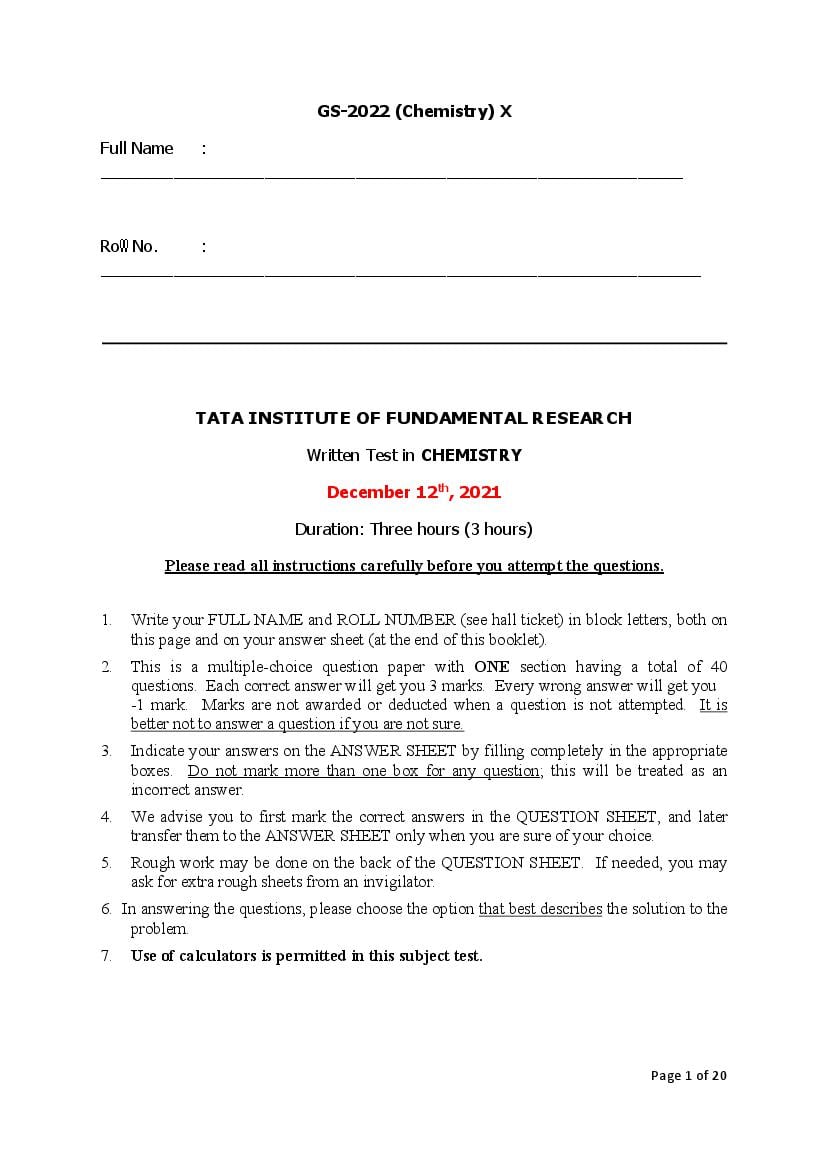
Full Name :
________________________________________________________________
Roll No. :
__________________________________________________________________
TATA INSTITUTE OF FUNDAMENTAL RESEARCH
Written Test in CHEMISTRY
December 12th, 2021
Duration: Three hours (3 hours)
Please read all instructions carefully before you attempt the questions.
1. Write your FULL NAME and ROLL NUMBER (see hall ticket) in block letters, both on
this page and on your answer sheet (at the end of this booklet).
2. This is a multiple-choice question paper with ONE section having a total of 40
questions. Each correct answer will get you 3 marks. Every wrong answer will get you
-1 mark. Marks are not awarded or deducted when a question is not attempted. It is
better not to answer a question if you are not sure.
3. Indicate your answers on the ANSWER SHEET by filling completely in the appropriate
boxes. Do not mark more than one box for any question; this will be treated as an
incorrect answer.
4. We advise you to first mark the correct answers in the QUESTION SHEET, and later
transfer them to the ANSWER SHEET only when you are sure of your choice.
5. Rough work may be done on the back of the QUESTION SHEET. If needed, you may
ask for extra rough sheets from an invigilator.
6. In answering the questions, please choose the option that best describes the solution to the
problem.
7. Use of calculators is permitted in this subject test.
Page 1 of 20
Page 2
Avogadro number = 6.02´1023 mol-1 e = 1.6´10-19 C
RT/F = 0.0257 V at 25°C h = 6.626´10-34 J s
Faraday constant = 96500 C/mol c = 3´108 m s-1
Boltzmann constant kB = 1.38´10-23 J K-1 R = 8.314 J K-1 mol-1
Mass of an electron = 9.109´10-31 kg
1. The 2021 Nobel Prize in Chemistry went to Benjamin List and David W.C.
MacMillan ‘for the development of asymmetric organocatalysis’. Predict the final
product/products of the following reaction for which one of the Laureates won the
prize.
A)
B)
C)
Page 2 of 20
Page 3
Answer: C
2. Which of the following drive the reaction shown below?
Light; Heat; Ring Strain Release; Fluorine substituents
A) Light and Fluorine substituents
B) Heat and Fluorine substituents
C) Ring strain release and fluorine substituents
D) Ring strain release
3. One of the important chemical markers for the rise in oxygen concentration on the
planet earth 3500 billion years ago is the formation of Banded Iron Formation (BIF)
rocks. Can you predict what form of Fe is found in these BIF structures given the
ocean pH to be 8.0?
A) Fe(OH)2
B) Fe(OH)
C) Fe2O3
D) FeO
Page 3 of 20
Page 4
dosage that can treat patients and minor overdosage can cause severe side-effects.
You are a chemist trying to design an antidote for Li(I) overdosage. Which binding
scaffold would be most suitable to remove Li(I) ions from patients without removing
biologically essential metal ions?
A)
B)
C)
D)
Page 4 of 20
Page 5
A) An amphiphillic molecule consists of both a positive charge and a negative
charge.
B) Amphiphillic molecules show spontaneous aggregation behaviour in any solvent
and at all concentrations.
C) Amphiphillic molecules are insoluble in water.
D) Amphiphillic molecules are known to form liquid crystals.
6. Metallic iron crystallizes in a cubic unit cell. The unit cell size is 287 pm. The density
of iron is 7.87 g/cm3. How many iron atoms are there within one unit cell?
A) Not enough information is given to calculate the value.
B) 1
C) 2
D) 3
7. Iron, Cobalt and Nickel are three known elements that display ferromagnetism. Which
of the following statements is true about ferromagnets:
A) In the presence of a magnetic field, the unpaired spins of a ferromagnet all align
with the external field. Then in the absence of the external magnetic field, these
spins then revert back immediately to their original state.
Page 5 of 20
Page 6
spins in a lattice.
C) A ferromagnetic material is weaker (in its attraction to an external magnetic field)
than a paramagnetic material
D) None of the above.
8. An artificial soft drink contains 11.0 gms of tartaric acid C4H6O6, and 20 gms of its
potassium salt C4H5O6K per liter. What is the pH of the drink? (Ka = 1.0 X 10⁻³)
A) 4.24
B) 5.21
C) 3.82
D) 3.16
9. The enthalpy of fusion of ice at 273.15 K and 1 atm is 6010 J/mol. The corresponding
change in molar volume due to fusion of ice is -1.63 cm3/mol. What is the melting
point of ice at 1000 atm?
A) 282.2 K
B) 265.5 K
C) 289.2 K
D) 255.2 K
10. The vapor pressures of solid and liquid ammonia near the triple point are given by:
log(Ps/P0) = 10 – 1630/T
and
log(Pl/ P0) = 8.46 – 1330/T.
Calculate the ratio of the slopes of the solid-gas curve and liquid-gas curve at the
triple point. (P0 = 1 torr)
Page 6 of 20
Page 7
B) 0.23
C) 1.22
D) 2.72
11. The equilibrium constant for the reaction described by
2 SO2(g)+O2(g) → 2SO3(g)
is Kp = 10 at 960 K.
Which direction the reaction will proceed spontaneously for
2 SO2(1.0 X 10⁻³ bar) + O2 (0.20 bar) → 2 SO3 (1.0 X 10⁻⁴ bar)
A) The reaction will be at steady state
B) The reaction will proceed from reactant to product
C) The reaction will proceed from product to reactant
D) The reaction will not take place
12. Given that ΔH0 has an average value of -69.8 kJ/mol over the temperature range of
500 K to 700 K for the reaction described by
PCl3(g)+Cl2 (g) → PCl5(g)
What will be the Kp at 700 K given that Kp = 0.0408 at 500 K?
A) 1.6 X 10⁻²
B) 2.3 X 10⁴
C) 3.6 X 10⁻⁴
D) 6.2 X 10²
13. Mixing the FeSO4 solution with NaNO3, followed by a slow addition of concentrated
H2SO4 through the side of the test tube produces a brown ring.
Among the following, the brown ring is due to the formation of
Page 7 of 20
Page 8
14. In the reaction scheme shown below, Q, R, and S are the major products.
The correct structure of S is
Answer: D
15. The correct combination of L1 and L2 among H−, NO−, MeCH2−, and CO that will
satisfy the 18 electron rule for both metal centres in the following neutral molecule, is
(Given: atomic number of Ru is 44)
Page 8 of 20
Page 9
B) MeCH2−, NO−
C) MeCH2−, CO
D) H−, CO
16. In a new temperature scale ( oH) the melting point of hydrogen is 0 oH and the boiling
point is 100 oH. PV is 28 dm3 atm at 0 oH and 40 dm3 atm at 100 oH. What is the
value of absolute zero in this temperature scale?
A) 0 oH
B) −273.15 oH
C) −233.33 oH
D) 233.33 oH
17. Sodium nitroprusside (SNP), Na2[Fe(CN)5NO], is used for the treatment of severe
hypertension . It works by interacting with oxyhemoglobin which results in release of
cyanide and nitric oxide. Which of the following is not correct about SNP.
A) It is a diamagnetic compound
B) Iron is assigned an oxidation state of +3
C) It is a low spin compound
D) It has NO+ as ligand
18. Jahn Teller effect is not observed in octahedral transition metal complexes with
electron configuration of
A) d4 high spin
B) d5 low spin
Page 9 of 20
Page 10
D) d7 low spin
19. The correct order of molar extinction coefficient for electronic transitions in
[Mn(OH2)6]2+, [Ti(OH2)6]3+, [MnO4]- is
A) [Mn(OH2)6]2+ > [Ti(OH2)6]3+ >[MnO4]-
B) [Ti(OH2)6]3+ > Mn(OH2)6]2+>[MnO4]-
C) [Ti(OH2)6]3+ >[MnO4]- > Mn(OH2)6]2+
D) [MnO4]− > [Ti(OH2)6]3+ > Mn(OH2)6]2+
!
20. The value of the integral ∫"! cos(𝑚𝑥) cos(𝑛𝑥) 𝑑𝑥 for 𝑚 = 𝑛 ≠ 0 and 𝑚 ≠ 𝑛 are
respectively:
A) 0 and 2𝜋
B) 2𝜋 and 0
C) 𝜋 and 0
D) 0 and 𝜋
21. A chemical reaction involves 3 states A, B, and C (see figure below) whose
dependence on a reaction coordinate Q is of the form G# = 0.5 ∗ 𝑘(Q − Q $ )% , where
i=A,B,C and all surfaces have the same curvature 𝑘.
Page 10 of 20
Page 11
between ∆ and 𝛿𝐺') is correct
A) ∆ < 𝛿G*+
B) ∆ > 𝛿G*+
C) ∆ = 𝛿G*+
D) Cannot be determined from the information provided
22. A gas of diatomic molecules is in thermal equilibrium at temperature T. If the
potential energy of the bond b between atoms in each molecule can be described by a
harmonic form: 0.5 ∗ 𝑘(𝑏 − 𝑏, )% , then the root mean square deviation in bond length
is related to the spring constant of the bond and the temperature as:
A) ∝ A1/𝑘𝑇
B) ∝ A𝑇/𝑘
C) ∝ 𝑇/√𝑘
D) ∝ 𝑇/𝑘
23. A particle with energy E is incident on a square barrier with height H > E and width
W. Which of the following statements is correct for the particle after it quantum
mechanically tunnels through the barrier?
A) The particle has energy E after tunneling through the barrier
B) The energy of the particle decreases as W increases but is independent of H
C) The energy of the particle decreases as H increases but is independent of W
D) The energy of the particle decreases as H and/or W increases.
24. (i) Consider a coin with two sides (H = heads; T= tails). The probability of observing
HHHHHTTTTT is equal to the probability of observing HTHTHTHTHT.
(ii) For a system at equilibrium, Gibbs free energy is maximized.
A) Statement (i) is true and Statement (ii) is false
Page 11 of 20
Page 12
C) Both statements are false
D) Both statements are true
25. Given Compound I (FeSO4.(NH4)2SO4.6H2O) and Compound II (K4[Fe(CN)6]), when
dissolved in water the following is correct:
A) Both the compounds give positive tests for Fe2+
B) Only Compound I gives positive test for Fe2+
C) Only Compound II gives positive test for Fe2+
D) Both do not give usual tests of Fe2+
26. (i) Half-life time of a first order reaction is dependent upon the initial concentration of
the reactant.
(ii) Time required for the decomposition of 99.9% of 0.1 mole reactant undergoing a
first order reaction is ____________ to that of its half-life time.
A) (i) True and (ii) Information is insufficient for the calculation
B) (ii) False and (ii) 10 times
C) (i) True and (ii) 10 times
D) (i) False and (ii) approximately 2 times
27. Following are four isomeric square planar complexes formed in a reaction between a
Pt(II) salt and MeNH-CH2-CH2-NHMe. Identify the chiral isomers.
Page 12 of 20
Page 13
B) Pt-1 and Pt-3
C) Pt-1 and Pt-4
D) Pt-1, Pt-3 and Pt-4
28. Predict and compare the thermochemical fuel efficiencies between the two rocket
fuels N2H4 and N2H2(CH3)2.
(A) N2H4 = N2H2(CH3)2
(B) N2H4 > N2H2(CH3)2
(C) N2H4 < N2H2(CH3)2
(D) Cannot be compared
29. Predict the product of the following reaction?
The 1H NMR spectral features: symmetric compound, a singlet at aliphatic region for
three protons, all aromatic protons are up field shifted when compared with tolune.
Page 13 of 20
Page 14
30. Predict the most stable conformation of the following molecule, called Kemp's triacid.
H 3C COOH
HOOC CH3
H3C COOH
A) B) C) D)
R2 R2 R1 R1 R1 R2 R1 R2
R2 R1 R1 R2
R1 R2 R1 R1
R1 R2 R2 R2
R1 R2 R2 R1
R1 = COOH; R2 = CH3
Answer: B
31. Predict the starting material.
1. NH2OH
? CN
2. AcCl
Page 14 of 20
Page 15
O
O
O
Answer: A
32. Predict the aromaticity of the following molecules.
H
N
N
1 2 3
A) 1. aromatic; 2. antiaromatic; 3. aromatic
B) 1. aromatic; 2. nonaromatic; 3. aromatic
C) 1. nonaromatic; 2. antiaromatic; 3. aromatic
D) 1. nonaromatic; 2. antiaromatic; 3. antiaromatic
33. Predict the product.
1. CrO3
HO ?
2. NH2OH
3. H+, heat
A) HO B) HN
N
O
C) D) OH
H 2N H 2N
Answer: B
Page 15 of 20
Page 16
container in the presence of a catalyst:
H2 (g) + D2 (g) 2 HD (g)
Under the high temperature limit, which of the following statements is true about the
value of the equilibrium constant Keq for this above reaction:
A) Keq is approximately equal to 1
B) Keq cannot be estimated unless the catalyst is specified
C) Keq = 2
D) Keq is approximately equal to 4
35. Consider a cylindrical tube of length 100 cm and filled with CO gas at pressure 1 bar
atQ2)
298 K. Electromagnetic
Consider a cylindrical tuberadiation
of lengthwith100 cm frequency
and filledexactly onwith
with filled resonance
CO gas at with the J =
pressure
01tobar1 at 298 K. Electromagnetic
rotational transition (groundradiation with frequency
vibrational state)exactly on resonance
of intensity with theon
I0 is incident J =it.0
to 1 transmitted
The rotational transition
intensity(ground vibrational
is given state)
by Itrans of intensity
. Given that theI0 is incident on
rotational it. The B for CO
constant, -1
transmitted
-1 intensity is given by I trans. Given that the rotational constant, B for CO = 2 cm ,
= 2 cm , which of the following statements is true?
which of the following statement is true?
100 cm
I0 Itrans
I trans
-(a)
!"#$%
approximately equal to 1
A) I0
approximately equal to 1
-&
I trans
-(b)
!"#$% approximately equal to zero
B) -&
approximately
I0 equal to zero
I
-!"#$% trans
C) (c) >1 >1
-& I0
-
I trans cannot be made in this case unless the absorption
!"#$%
D) Approximate estimate
(d) Approximate estimateof
of - can not be made in this case unless the absorption
&
I 0
cross section
cross or or
section coefficient
coefficientis
is known
known
I trans
Correct Answer: (a) Almost the entire radiation will be transmitted and ~1
I0
Explanation: For the v = 0, J = 0 to J = 1 transition will correspond to an energy level gap
of 2B (4 cm-1). At 298 K the average thermal energy is ~ 210 cm-1 (much larger than the 16 of 20
Page
energy level gap under consideration).
Quite clearly, a significant population will be present in J = 1 and hence the population
difference among J = 0 and 1 will be small. Therefore most of the radiation will get
transmitted.
Page 17
Q3) Two students named A and B repeatedly measure the volume of a solution consumed
in a titration experiment 10 times and 4 times, respectively. They report the following
in a titration experiment 10 times and 4 times, respectively. They report the following results:
results:
Student A Student B
Measurement
number Volume (ml) Volume (ml)
1 20.8 19.9
2 20.3 20.9
3 19.4 19.9
4 19.8 20.5
5 21.0 x
6 20.7 x
7 20.3 x
8 20.6 x
9 20.1 x
10 20.0 x
Which option correctly represents the fractional uncertainty in the average (best
estimate) values reported by students A and B?
Which option correctly represents the fractional uncertainty
A) average
in the Fractional uncertainty
(best estimate)for A = 0.8%
values and by
reported B =student
0.5% A and B?
B)
(a)Fractional
Fractional uncertainty
uncertainty for
for A
A = 0.8%
0.49 % andB B= =
and 0.49 %
0.5%
(b)Fractional
C) Fractional uncertainty
uncertainty for
for A
A = 0.49
0.8%%and
and
BB== 0.49 %
1.2%
(c)Fractional
D) Fractional uncertainty
uncertainty for
for A
A== 0.8% andBB==81.2%
5 % and %
(d) Fractional uncertainty for A = 5 % and B = 8 %
37. Consider a particle which is confined to move in one dimension. The following graph
displays the position of this particle as a function of time:
Correct answer: (c)
Explanation: Uncertainty in the estimation of the average value will decrease as the no. of
measurements (N) increases by a factor of Sqrt(N) (assuming random errors following
normal distribution)
Error in the mean = standard deviation/Sqrt(N)
Here both data sets have same average and standard deviation but since A has more
Page 17 of 20
repeated measurements, the uncertainty in estimation of mean is lower
Student A Student B
Average 20.30 20.30
Page 18
A)
B)
C)
D)
38. Suppose you put 100 ml of water in a cup (Cup 1) at +20 °C, and 100 ml of ice in a
similar cup (Cup 2) at -20 °C. Then you put both cups in the microwave and heat
them for 1 min, and then measure the increase of temperature. Which of the following
will most likely be true?
Page 18 of 20
Page 19
B) The temperature of Cup 1 would increase more
C) The temperature of Cup 2 would increase more
D) The answer cannot be determined from the data given
39. You are shown the following spectrum, but the units of wavelength are missing.
Which of the following answers are most likely?
Absorbance
wavelength
A) It is the vibrational spectrum of gaseous dioxygen
B) It is the rotational spectrum of gaseous dioxygen
C) It is the vibrational spectrum of gaseous Carbon monoxide
D) It is the rotational spectrum of gaseous Carbon monoxide
Page 19 of 20
Page 20
optical transitions which ultimately return the molecule to the ground state (note: I
and II consist of two transitions, III consists of 3 transitions). Which of the following
depict the right timescale of these processes?
A) II is the fastest, I is the slowest, III is intermediate
B) I is the fastest, II is the slowest, III is intermediate
C) II is the fastest, III is the slowest, I is intermediate
D) I is the fastest, III is the slowest, II is intermediate
Page 20 of 20
Document Details
| Board / Org | TIFR |
| Exam | TIFR GS |
| Type | Question Paper |
| Pages | 20 |
| Updated | 23 Oct 2026 |