ICSE Class 10 Question Paper 2020 for Economic Applications
Finished viewing? Save it for later —
Download ICSE Class 10 Question Paper 2020 for Economic Applications (PDF · 5 pages)About ICSE Class 10 Question Paper 2020 for Economic Applications
ICSE Class 10 Question Paper 2020 for Economic Applications is available here for free download. Published by CISCE for Class 10, this question paper can be viewed online or downloaded as a PDF (5 pages). Candidates preparing for Class 10 can use ICSE Class 10 Question Paper 2020 for Economic Applications to understand the exam pattern, the type of questions asked, and the overall difficulty level.
Frequently Asked Questions
How can I download ICSE Class 10 Question Paper 2020 for Economic Applications?
Open this page and click the Download button to save ICSE Class 10 Question Paper 2020 for Economic Applications as a PDF. It is completely free on AglaSem Docs.
Is ICSE Class 10 Question Paper 2020 for Economic Applications free to download?
Yes. ICSE Class 10 Question Paper 2020 for Economic Applications can be viewed online and downloaded as a PDF free of cost on AglaSem Docs.
How many pages does ICSE Class 10 Question Paper 2020 for Economic Applications have?
ICSE Class 10 Question Paper 2020 for Economic Applications contains 5 pages, which you can read online or download together as a single PDF.
Where can I find more Class 10 study material?
You can find more Class 10 question papers, sample papers, syllabus, and answer keys on AglaSem Docs.
ICSE Class 10 Question Paper 2020 for Economic Applications – Text
Read the full text of this question paper below — useful to quickly search, copy and reference the content online without downloading the PDF.
📄 View text version (5 pages)
Page 1
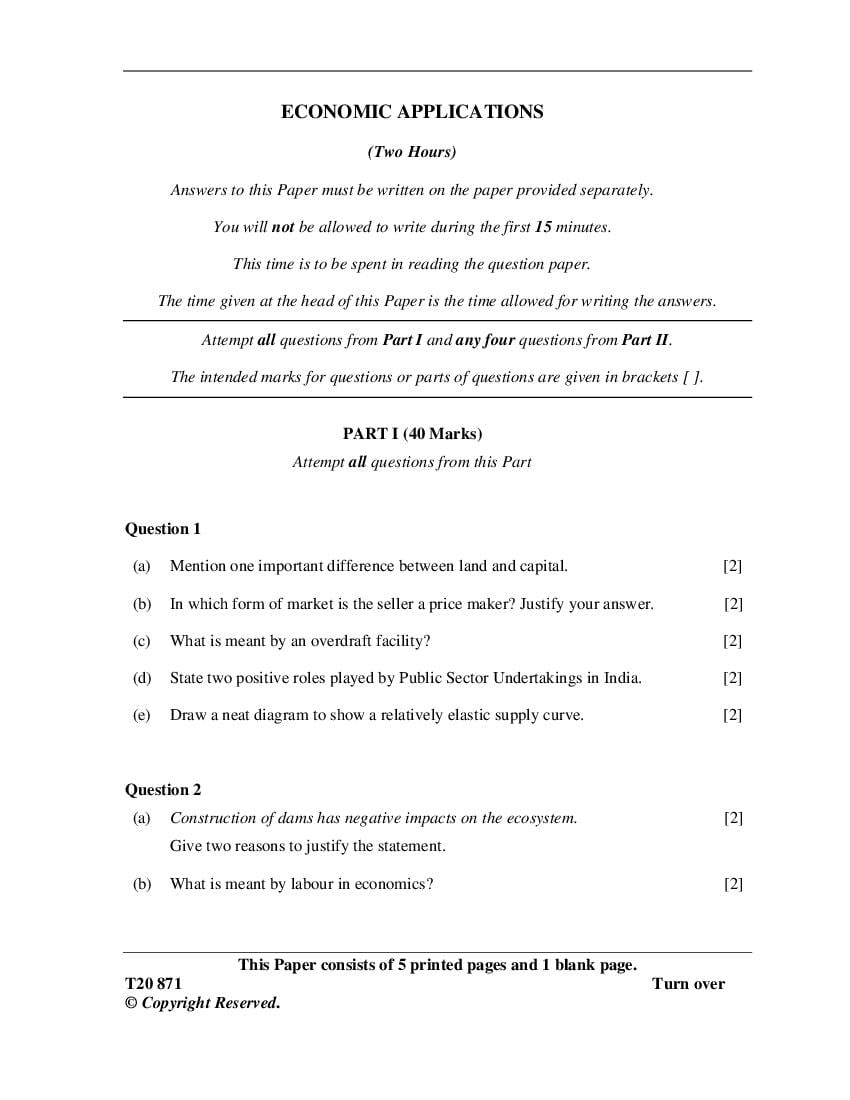
(Two Hours)
Answers to this Paper must be written on the paper provided separately.
You will not be allowed to write during the first 15 minutes.
This time is to be spent in reading the question paper.
The time given at the head of this Paper is the time allowed for writing the answers.
Attempt all questions from Part I and any four questions from Part II.
The intended marks for questions or parts of questions are given in brackets [ ].
PART I (40 Marks)
Attempt all questions from this Part
Question 1
(a) Mention one important difference between land and capital. [2]
(b) In which form of market is the seller a price maker? Justify your answer. [2]
(c) What is meant by an overdraft facility? [2]
(d) State two positive roles played by Public Sector Undertakings in India. [2]
(e) Draw a neat diagram to show a relatively elastic supply curve. [2]
Question 2
(a) Construction of dams has negative impacts on the ecosystem. [2]
Give two reasons to justify the statement.
(b) What is meant by labour in economics? [2]
This Paper consists of 5 printed pages and 1 blank page.
T20 871 Turn over
© Copyright Reserved.
Page 2
to ₹ 12 per unit, demand contracts to 40 units. Calculate the price elasticity of
demand.
(d) Entrepreneurship is not labour even though there are human factors associated [2]
with the same business. Explain.
(e) Complete the following hypothetical individual supply schedule: [2]
Price in ₹ Quantity supplies in kgs.
40 25
35 (i)
30 18
25 (ii)
Question 3
(a) Differentiate between walking inflation and running inflation. [2]
(b) Explain horizontal division of labour with an example. [2]
(c) State two ways in which the Government can play an important role in the rapid [2]
agricultural development of a country.
(d) How is circulating capital different from fixed capital? [2]
(e) What is joint demand? Give an example. [2]
Question 4
Define the following terms:
(a) Regressive Taxation [2]
(b) Monopsony [2]
(c) Migration [2]
(d) Money [2]
(e) Perfectly inelastic demand [2]
T20 871 2
Page 3
Attempt any four questions from this Part
Question 5
(a) Define capital formation. [7]
Explain three important factors affecting the rate of capital formation.
(b) Discuss any four negative impacts of industrialization. [8]
Question 6
(a) What is a Central Bank? Explain the following functions of a Central Bank: [7]
(i) Issuing paper notes
(ii) Acting as a banker to the Government
(iii) Lender of the Last resort
(b) (i) Prepare a hypothetical individual demand schedule. [8]
(ii) Draw the individual demand curve based on the schedule.
(iii) Explain any two determinants of demand other than price.
Question 7
(a) What is privatization? Explain three arguments favouring privatization. [7]
(b) What do you understand by Efficiency of Labour? [8]
Explain three factors affecting efficiency of labour.
T20 871 3 Turn Over
Page 4
(a) What is a monopolistically competitive market? [7]
Explain the following features of this market:
(i) Non-price competition
(ii) Presence of Selling cost
(iii) Price policy which is followed.
(b) Explain any four factors affecting productivity of land. [8]
Question 9
(a) What are direct taxes? [7]
Explain how direct taxes:
(i) are equitable
(ii) increase civic sense
(iii) are economical
(b) What are Commercial Banks? [8]
Name any two Commercial Banks of India.
Explain the difference between Cash Credit and Bank Loans lent by the
Commercial Banks.
Question 10
(a) Read the extract given below and answer the questions that follow:
NDTV Profit, May 01, 2019
State Bank of India, the country’s largest lender, has reduced interest rate
on savings bank accounts with balance of Rs. 1 lakh or more from today.
The State Bank of India customers with Rs. 1 lakh or more in their savings
account will earn an interest of 3.25 percent.
T20 871 4
Page 5
accounts will continue to earn interest at the rate of 3.50 percent.
The move to reduce interest rate on deposits of more than Rs. 1 lakh
comes as the State Bank of India is linking the interest rate to the RBI’s
repo or short-term lending rate. The interest rate on savings bank
account may move up or down depending on what stance the Reserve
Bank of India takes at the bi-monthly monetary policy meeting.
(i) What is monetary policy? [2]
(ii) What is Bank Rate? What is the effect of a reduction in Bank Rate? [4]
(iii) Will a reduction in the interest rate on savings account encourage or [1]
discourage savings?
(b) Several causes have been identified by researchers for the poor performance [8]
of the public sector enterprises in India.
Identify and explain four such causes.
T20 871 5
Document Details
| Board / Org | CISCE |
| Exam | Class 10 |
| Type | Question Paper |
| Pages | 5 |
| Language | english |
| Updated | 30 Apr 2026 |