TIFR GS 2022 Question Paper Wildlife Biology and Conservation
Finished viewing? Save it for later —
Download TIFR GS 2022 Question Paper Wildlife Biology and Conservation (PDF · 40 pages)About TIFR GS 2022 Question Paper Wildlife Biology and Conservation
TIFR GS 2022 Question Paper Wildlife Biology and Conservation is available here for free download. Published by TIFR for TIFR GS, this question paper can be viewed online or downloaded as a PDF (40 pages). Candidates preparing for TIFR GS can use TIFR GS 2022 Question Paper Wildlife Biology and Conservation to understand the exam pattern, the type of questions asked, and the overall difficulty level.
Frequently Asked Questions
How can I download TIFR GS 2022 Question Paper Wildlife Biology and Conservation?
Open this page and click the Download button to save TIFR GS 2022 Question Paper Wildlife Biology and Conservation as a PDF. It is completely free on AglaSem Docs.
Is TIFR GS 2022 Question Paper Wildlife Biology and Conservation free to download?
Yes. TIFR GS 2022 Question Paper Wildlife Biology and Conservation can be viewed online and downloaded as a PDF free of cost on AglaSem Docs.
How many pages does TIFR GS 2022 Question Paper Wildlife Biology and Conservation have?
TIFR GS 2022 Question Paper Wildlife Biology and Conservation contains 40 pages, which you can read online or download together as a single PDF.
Where can I find more TIFR GS study material?
You can find more TIFR GS question papers, sample papers, syllabus, and answer keys on AglaSem Docs.
TIFR GS 2022 Question Paper Wildlife Biology and Conservation – Text
Read the full text of this question paper below — useful to quickly search, copy and reference the content online without downloading the PDF.
📄 View text version (40 pages)
Page 1
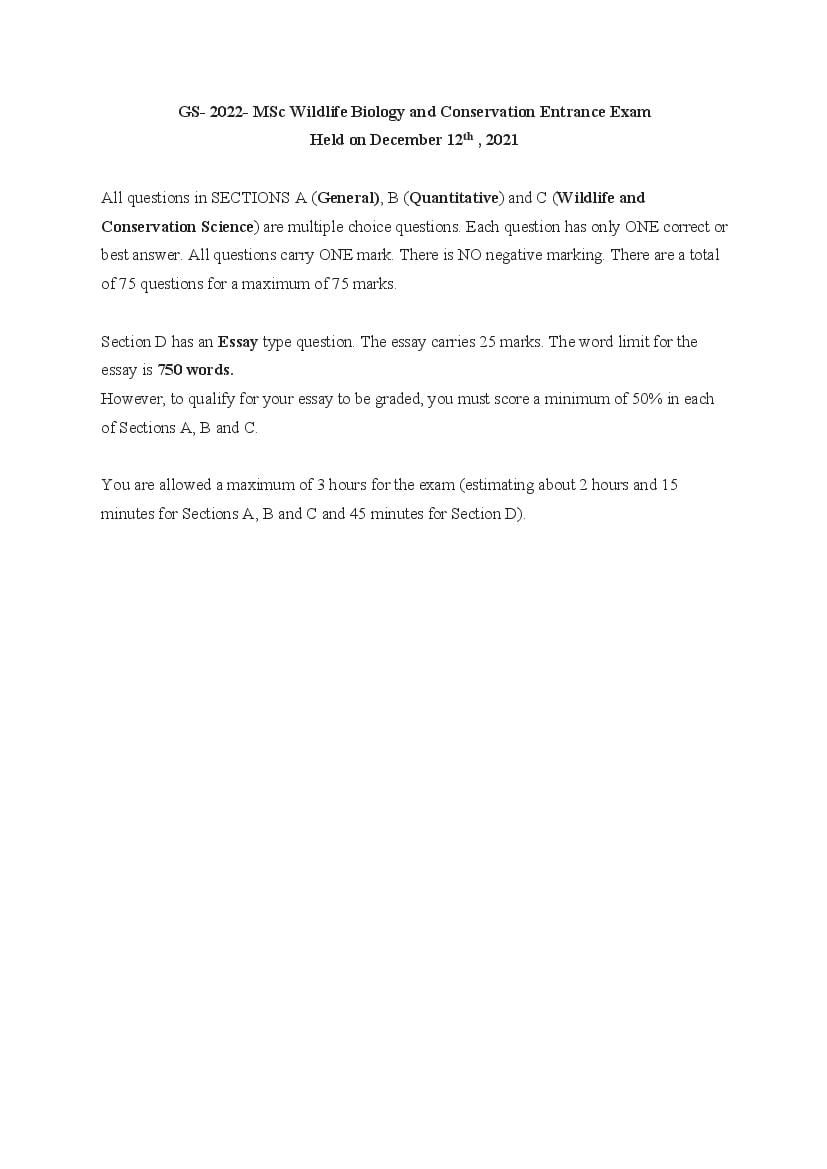
Held on December 12th , 2021
All questions in SECTIONS A (General), B (Quantitative) and C (Wildlife and
Conservation Science) are multiple choice questions. Each question has only ONE correct or
best answer. All questions carry ONE mark. There is NO negative marking. There are a total
of 75 questions for a maximum of 75 marks.
Section D has an Essay type question. The essay carries 25 marks. The word limit for the
essay is 750 words.
However, to qualify for your essay to be graded, you must score a minimum of 50% in each
of Sections A, B and C.
You are allowed a maximum of 3 hours for the exam (estimating about 2 hours and 15
minutes for Sections A, B and C and 45 minutes for Section D).
Page 2
1. Which one of the following sentences has no errors in grammar or choice of words?
a) The tourists saw female leopard having cubs
b) The tourists saw a female leopard having cub
c) The tourists saw a female leopard with cubs
d) The tourists saw female leopard with cubs
2. Read the following paragraph and choose the most logically consistent sentence to fill the
blank:
The genitals of monitor lizards are purported to have magical properties that cure a range of
illnesses. Monitor lizards therefore feature prominently in confiscations of illegally traded
wildlife products. ____________________________________________________. In fact, a
young woman who fell sick in the village of Kanihar eventually succumbed to her illness,
because her family treated her with a concoction made of monitor lizard genitals instead of
seeking medical help. In the interest of both wildlife conservation and human health,
superstitious practices should be eradicated, and replaced by evidence-based medical
treatments.
a) Likewise, fan corals, musk deer glands, caterpillar fungus, and tiger bones are also found
in illegal wildlife trade.
b) A recent study found some evidence for the healing properties of body parts from various
wild species.
c) Several mystics and traditional healers all over India, Myanmar, and Thailand prescribe
medicines made from plant and animal body parts.
d) Recent biomedical research that investigated the chemical composition of these parts
found no evidence in support of their healing properties.
3. Rhea and Jhun were arguing heatedly over the legacies of British colonial rule on wildlife
conservation in India, a topic on which their views were widely divergent. As their exchange
became more heated, Rhea exclaimed, “Jhun! That is below the belt!”
Page 3
a) Jhun had hit her below her waist.
b) Jhun’s argument was unfair
c) Jhun’s argument was inconsistent
d) Jhun’s argument was uninformed.
4. Choose the most appropriate word from the choices below to complete the sentence:
Instead of having a master narrative on why the human population on Easter Island was
extirpated, the book contained many __________ around the same theme.
a) euphemisms
b) vignettes
c) metaphors
d) eulogies
5. In May 2020, Baghjan in Assam was in the news for an accident in an industrial plant that
resulted in human and wildlife deaths, large-scale evacuations, and environmental damage. In
what type of industrial plant did the incident take place?
a) Fertilizer
b) Iron and steel
c) Nuclear power
d) Oil and gas
6. The current (on 13 Nov 2021) Union Minister for Environment, Forest and Climate
Change in India is:
a) Arjun Munda
b) Bhupender Yadav
c) Kiren Rijiju
Page 4
7. Niyamgiri in the state of Odisha is the site of an environmental battle regarding which of
the following developmental projects?
a) Hydro-electric Dam
b) Port construction
c) Open-cast mining
d) Resort construction
8. Which political party won the recent (2021) Legislative Assembly elections in the state of
West Bengal?
a) Bharatiya Janata Party
b) Communist Party of India (Marxist)
c) Bahujan Samaj Party
d) All India Trinamool Congress
9. Which species of woodpecker was declared extinct by the US government in September
2021?
a) Great Slaty
b) Imperial
c) Ivory-billed
d) Magellanic
10. The SARS-COV2 corona virus disease ‘COVID-19’ is the largest pandemic of this
century. Arrange the countries in descending order of total case counts as of October 2021
(note that the order of countries has remained the same since June 2021).
a) USA, India, Brazil, UK
b) China, India, USA, Brazil
c) Brazil, India, Spain, Russia
Page 5
11. Greta Thunberg, Yousafzai Malala and Boyan Slat all have something in common:
a) They are all known for campaigns to call governments to educate girl children
b) They all have spider species named in their honour
c) They are all well-known ornithologists
d) They have all been nominated for the Nobel awards for environmental conservation
12. At the recently concluded COP 26, in Glasgow, India promised to achieve net zero
emissions by ______, missing a key goal of the summit.
a) 2030
b) 2045
c) 2070
d) 2100
13. “If you do not cooperate, you will not be pronounced ‘not guilty’ in court tomorrow”.
What is the inference?
a) If you don’t cooperate, you will be acquitted
b) If you cooperate, you could be acquitted
c) If you cooperate, you will be found guilty
d) If you cooperate, you are guilty
14. Thousands of female Hipposideros bats rear their pups in Elephanta cave. Although
mothers leave the cave at night to forage, on their return, each mother almost always swiftly
returns to her pup among the many in the cave. Since it is known that bat calls are the only
means by which Hipposideros communicate with one another, and a bat pup cannot
distinguish the call of its mother from other adult bats, it can be inferred that each mother bat
Page 6
the above statement is trying to do?
a) Derive a general conclusion about all members of a group from facts known about
representative members of that group.
b) Establish the validity of one explanation for a phenomenon by excluding alternative
explanations
c) Support the idea that a certain phenomenon can occur by describing a mechanism for the
same.
d) Conclude that members of two groups are likely to share a particular ability because of
other characteristics they share.
15. Eleven years ago, Sunita was half as old as Ram will be in 4 years. If Ram is ‘m’ years
old now, how old is Sunita now in terms of ‘m’?
a) 4m – 11
b) ½(m+4)+11
c) ½(m-11)
d) 4m+11/2
16. Assume that at the Vandalur zoo in Madras, 2/5 of all the animals are mammals, and 2/3
of the mammals are allowed to interact directly with the public. If 24 mammals are allowed
to interact directly with the public, how many animals in this zoo are NOT mammals?
a) 36
b) 48
c) 54
d) 60
Page 7
different bird species. The number of birds species found in each habitat are shown below,
where the triangle represents grasslands, the rectangle the scrub forests, and the circle the dry
deciduous forests. Which of the following statements about the birds in this area is NOT
accurate?
a) The number of species unique to grasslands is lower than the number that is shared
between scrub and dry deciduous forests
b) Grasslands share fewer bird species with dry deciduous forests than with scrub forests
c) The number of species unique to grasslands is lower than the number of species
shared between grasslands and at least one other habitat
d) The number of species found in grasslands but not in dry deciduous forests is less than the
number unique to dry deciduous forests
Page 8
rectangles)
a) 15
b) 16
c) 18
d) 20
19. It takes one research assistant a total of 10 hours to complete 10 pages of data entry.
Assuming their computer skills are of the same level, how long will it take for 2 research
assistants to complete 20 pages of data entry each?
a) 20 hours
b) 5 hours
c) 40 hours
d) 10 hours
20. On a bench that sits five persons, Parveen is sitting next to Chaya, and Dilshan is sitting
next to Kiran. Sharan is not sitting next to Dilshan. Sharan and Chaya are sitting at two ends
of the bench. Which two students is Dilshan sitting between?
a) Chaya and Kiran
b) Kiran and Parveen
c) Sharan and Parveen
d) Sharan and Kiran
Page 9
1. The probability of giving birth to a female pup is 0.6 in a mongoose population. What is
the probability that a female gives birth to a litter that has one female and two male pups?
a) 0.096
b) 0.125
c) 0.288
d) 0.66
2. I roll a pair of dice. What is the probability that I get the same number on both dice?
a) 1/8
b) 1/6
c) 1/4
d) 1/2
3. A biologist calculates the mean mass of lizards in a population as 15 g based on a sample
size of 15 individuals. Reviewing her data sheet, she realises that she had mistakenly entered
the measurement for one individual as 10 g less than the actual mass of that individual. The
correct mean mass (in g, rounded to one decimal place) is:
a) 14.7
b) 15.0
c) 15.7
d) 16.0
4. Caracal prey on peafowl in Sariska Tiger Reserve. When a peafowl encounters a caracal,
the probability that the caracal attacks the individual is 1/5 and the probability that the
peafowl escapes the attack is 4/5. What is the probability that a peafowl which encounters a
caracal is NOT killed by the caracal?
a) 0.16
b) 0.2
Page 10
d) 0.96
5. There are 10,000 rats on a small island of 1 km2 area in the Andaman Sea that threaten sea
birds that nest on the shores of the island. A researcher is assessing the rodent population of
this island. He sets up traps across the island and captures 300 animals. He marks and
releases the rats. On the next day, another 300 individuals are captured. Assuming there are
no births, death, immigration or emigration between the sampling days, what is the most
likely number of marked individuals recaptured on the second day?
a) 75
b) 30
c) 110
d) 9
6. The distance between Bangalore and Mysore is 148 km. An express train left Bangalore
towards Mysore at the speed of 80 km/hr. At around the same time, a goods train left Mysore
towards Bangalore at the speed of 36 km/hr. At 12 PM, both the trains were at Mandya
station. The express train had already been there for 10 minutes, while the goods train had
been there for 5 minutes. What is the distance between Mysore and Mandya, and what time
did the goods train leave Mysore?
a) 38, 10:10 AM
b) 52, 10:50 AM
c) 48, 10:35 AM
d) 50, 10:40 AM
7. Swathi takes Mila, Isha and Kai to a sweetshop. Mila wants 1/2 as many sweets as Isha,
and Kai wants 1.5 times as many sweets as Isha. If Swathi bought a total of 36 sweets, how
many did Kai get?
a) 14
b) 16
c) 18
Page 11
Page 12
statements about the first and second derivatives taken at the maximum of this function is
TRUE?
"# "! #
a) "$
= 0 and "$! = 0
"# "! #
b) "$
> 0 and "$! < 0
𝐝𝐘 𝐝𝟐 𝐘
c) 𝐝𝐗
= 𝟎 and 𝐝𝐗 𝟐 < 𝟎
"# "! #
d) "$
= 0 and "$! > 0
Page 13
"(
")
= rNwhere r is the instantaneous rate of increase and N is population size. Which of the
* "(
following statements is correct about per capita growth rate (( × ") ) of this population?
a) Per capita growth rate decreases with an increase in population size.
b) Per capita growth rate increases with an increase in population size.
c) Per capita growth rate increases with an increase in population size, reaches a maximum,
and then decreases with any further increase in population size.
d) Per capita growth rate stays constant with increase in population size.
10. If logb x = y, then which of the following is true?
a) yb = x
b) xy = b
c) by = x
d) yx = b
11. If the mean height of trees in a savanna woodland is 10m and the variance around the
mean is 4, then the coefficient of variation (= [standard deviation/ mean] * 100) is:
a) 40%
b) 20%
c) 80%
d) 10%
Page 14
home town. There are three different routes that lead from her field camp to the only entrance
into the wildlife sanctuary. From the entrance, there are four different routes to a highway,
from which there are two different routes to her home town. How many different ways are
there from her field camp to her home town?
a) 9
b) 14
c) 24
d) 32
13. Conducting multiple t- tests on the same data set will:
a) increase the probability of falsely rejecting a true null hypothesis
b) decrease the probability of falsely rejecting a true null hypothesis
c) increase the probability of failing to reject a true null hypothesis
d) decrease the probability of failing to reject a true null hypothesis
Page 15
morphs are genetically determined. A study found that the two morphs are maintained in the
population through negative frequency dependence. That is, the fitness of any morph is
highest when it is rare and decreases as it becomes more common. Which of the following
figures represents this pattern? In the figures, the dashed line is the fitness of the horned
morph and the solid line is the fitness of the hornless morph. (The X axis represents the
frequency of the horned morph in the population, calculated as abundance of the horned
morph divided by the sum of the abundances of both morphs)
a) P
b) Q
c) R
d) S
Page 16
Ocean. The birds nest only once a year. Researchers have estimated that the adult population
of this bird is about 600. The sex ratio among adults is 2 females to 1 male, but the sex ratio
among juveniles is 1female :1 male. Assuming that males and females in this species form a
strict pair bond for the nesting season and that both males and females are required for
nesting, what is the maximum number of shrewbill nests that we can expect in a given year?
a) 200
b) 300
c) 400
d) 600
16. Which of the following figures contains a prime number of squares and why?
a) X, because its height is much greater than its width
b) Y, because the single square in the bottom row makes the total an odd number
c) Y, because composite (non-prime) numbers of squares can be arranged as rectangles
or squares
d) X, because it is the product of two odd numbers
17. What fraction of the figure below is shaded?
Page 17
b) 3/8
c) 3/4
d) 5/16
18. The figure below shows species accumulation curves for plant communities in a short
grass meadow (P, dashed line) and a tall grass meadow (Q, solid line) in southern peninsular
India, measured in 1992. A researcher wishes to design a study to estimate plant species
richness in these two habitats in 2022. She has only 4 months to sample both forests. She
therefore uses the information shown below and decides to lay twice the number of plots in
short grass than in tall grass meadows. Which option below is the most likely explanation for
this sampling decision?
Page 18
more sampling.
b) The number of species at the asymptote of P is higher than that of Q and therefore P
requires more sampling.
c) P reaches its asymptote more slowly than does Q and therefore P requires more
sampling.
d) The meadow type, of which P is a representative, is of higher endemicity, than the
meadow type that Q belongs to; therefore, P requires more sampling.
Page 19
fragments in a large landscape. He finds the following relationship between species richness
(S) and fragment area (A): S = 9A+.- . Which graph below best represents this relationship?
a) P
b) Q
c) R
d) S
Page 20
sense dragonfly nymph predators. I set up an experiment with four treatments:
i. Visual cues only (V): Artificial pool with a sealed transparent container containing a live
dragonfly nymph
ii. Olfactory cues only (O): Artificial pool with a porous opaque container containing a live
dragonfly nymph
iii. Visual and Olfactory cues (V+O): Artificial pool with a porous transparent container
containing a live dragonfly nymph
iv. No Visual or Olfactory cues (N): Artificial pool with a sealed opaque container containing
a live dragonfly nymph
Mosquito larvae were randomly assigned to any one of the four treatments and their
behaviour was observed for 10 minutes. The average distance of the larva from the container
was estimated as a measure of their predator avoidance behaviour (the greater the distance,
the greater the predator avoidance behaviour). Based on the results shown below, which ONE
of the following statements can be inferred?
a) Visual cues are sufficient for mosquito larvae to sense the predator
b) Olfactory cues are necessary for mosquito larvae to sense the predator
c) The response to both cues is the sum of the responses to individual cues
d) Visual cues are necessary for mosquito larvae to sense the predator
Page 21
growth), how will the rate of growth (the slope of the line, or dN/dt) change over time?
a) Linear increasing line
b) Flat line
c) Unimodal curve
d) Accelerating curve
Page 22
distribution of speed was right skewed (as shown in the figure below). The researcher later
determined that the measurements for some individuals with speeds greater than 40 km/h
were a result of faulty equipment, and reanalyzed the data after removing these aberrant
values. The researcher compared how mean, median and mode changed in the reanalysis.
Which of the following statements is accurate about the absolute changes in mean, median
and mode?
a) change in median > change in mean > change in mode
b) change in mean > change in median > change in mode
c) change in mode > change in median > change in mean
d) change in mode > change in mean > change in median
Page 23
profitability (measured as the energy gained divided by handling time) is greater than that of
F2. Optimal foraging theory posits that when sparrows encounter F1, they should always
choose to feed on it. However, when they encounter F2, they should reject it and continue
./.012134/."
their search unless the time that it takes to find F1 is too long. That is, the 53/"64/1)47. of F2
./.012134/."
should be greater than the 53/"64/1)47.89.30:5)47. of F1.
Given the information in the table below, which option represents the smallest value that the
search time of F1 can take and still make it profitable for the sparrow to eat F2?
Food type Energy (indexed by dry wt. in Handling time (in seconds)
mg)
F1 35 8
F2 5 2
a) 2 seconds
b) 5 seconds
c) 7 seconds
d) 9 seconds
Page 24
between plants changed across elevation. Shown below are results from this study where they
quantified reproduction (flowering or fruiting) in plants that were growing in the presence of
neighbours (Control), and plants that had their neighbours removed (Neighbour removal).
The experiment was conducted at low and high elevations. Based on these results, which of
the following statements is TRUE?
a) Competition dominates interactions with neighbours at low and high elevation
b) Facilitation dominates interactions with neighbours at low and high elevation
c) Facilitation dominates interactions with neighbours at low but not high elevation
d) Facilitation dominates interactions with neighbours at high but not low elevation
Page 25
native plant is debated. One set of researchers proposes that the invasive plant negatively
affects the pollination success of an individual native plant irrespective of the density of the
invasive plant (Idea 1). A second set of researchers proposes that the effect of the invasive on
the native plant is density dependent. When the invasive plant is at low density in the
neighbourhood, they have a negative effect on pollination success of the native plant. In
contrast, when they are at a high density, they have a positive effect: they increase the
pollination success of individual native plants much more than would a similar density of
native conspecifics (Idea 2). A third set of researchers argue that since the invasive plant
rarely occurs at low densities, it is only relevant to consider high density effects of the
invasive plant. They propose that the pollination success of an individual native plant is the
same whether it experiences a high density of the invasive plant or a high density of native
conspecifics (Idea 3).
Which one of the following experiments is most suitable to test Idea 3?
a) Compare the pollination success of a focal native plant grown under (i) low native plant
density and (ii) high native plant density
b) Compare the pollination success of a focal native plant grown under (i) low invasive plant
density and (ii) high invasive plant density
c) Compare the pollination success of a focal native plant grown under (i) low native plant
density and (ii) low invasive plant density
d) Compare the pollination success of a focal native plant grown under (i) high native
plant density and (ii) high invasive plant density
Page 26
1. St. John's Wort (Hypericum fasciculatum) is a terrestrial plant often found growing around
ponds in northern Florida. It has been observed that individuals of this species growing
around ponds containing fishes have greater reproductive success than those growing around
ponds without fish. Tiffany Knight and her colleagues conducted a study to understand this
curious pattern, i.e. fish in the water influencing the fitness of a plant growing on land. Their
study revealed that the fish were connected, in a food chain, to the bee pollinators of St.
John's Wort, through the larval and adult stages of a key species. Based on the information
provided, this key species is most likely to be a:
a) butterfly
b) dragonfly
c) praying mantis
d) ant lion
2. Which of the following processes can increase the genetic diversity of a population?
a) Directional selection
b) Emigration
c) Genetic drift
d) Immigration
3. The evolution of an amniotic egg allowed certain animal taxa to colonise drier terrestrial
habitats. Which of the following taxa have an amniotic egg?
a) Amphibians, reptiles and birds
b) Lancelets, tunicates and reptiles
c) Reptiles, birds and mammals
d) Tunicates, fishes and amphibians
4. In sex-role reversed species, like jacanas, which one of the following patterns is expected?
a) males are the competing sex and females are the choosy sex
b) females are the competing sex and males are the choosy sex
Page 27
d) females are the competing sex and males are the choosy sex in the beginning of the
breeding season and then the roles reverse
5. The Ken-Betwa river linking project threatens to submerge a large part of which Tiger
Reserve?
a) Bandhavghar Tiger Reserve
b) Panna Tiger Reserve
c) Ranthambore Tiger Reserve
d) Satpura Tiger Reserve
6. The Cretaceous–Tertiary extinction (popularly known as the ‘KT’ extinction) was a key
event in evolutionary history. The period witnessed a sudden mass extinction of 3/4th of all
plants and animals on earth. Approximately how long ago (in millions of years) did the KT
extinction take place?
a) 65
b) 3
c) 150
d) 156
7. In 2016, renowned biologist and writer E. O. Wilson authored a famous book, calling for
setting aside a certain proportion of the earth for the purpose of conservation. According to
Prof. Wilson, what percentage of the earth should be designated for nature to thrive?
a) 17%
b) 50%
c) 30%
d) 10%
8. Many wild animals hold cultural and religious significance in India. Which of the
following species is most prominently associated with the Bishnoi community of Rajasthan?
Page 28
b) Sambar deer
c) Striped hyena
d) Blackbuck
9. A commonly known concept in the study of populations is density-dependence, which is
the idea that some demographic rates vary as a function of population density. Study the
graph below. Which combination of lines, from among the options below, correctly
represents density-dependence?
(1)
Growth (a)
(2)
(
(4)
3
)
Density (b)
a) 1 & 4 but not 3
b) 3 & 4 but not 2
c) 1 & 3 but not 4
d) 2 & 4, but not 1
10. During a recent survey in Madagascar, scientists discovered a species that may well be a
contender for the world’s smallest reptile. With a body size around 20 mm, and aptly given
the species specific name of nana, this creature is a:
Page 29
b) skink
c) gecko
d) snake
11. Mass nesting of Olive Ridley turtles known as the arribada happens at:
a) Hutbay, Little Andamans
b) Gahirmata, Odisha
c) Marina beach, Chennai
d) Kovalam, Kerala
12. Mammals and living birds share all of the following characteristics except:
a) endothermy
b) descent from a common amniotic ancestor
c) a dorsal, hollow nerve cord
d) an archosaur common ancestor
13. Arrange the following species in order of increasing number of teeth:
human, cat, pangolin, dog
a) cat < pangolin < dog < human
b) pangolin < cat < human < dog
c) pangolin < dog < cat < human
d) pangolin < human < cat < dog
Page 30
correct grouping of Binturong, Brown mongoose, Field mouse and pika? (Note that species in
a bracket belong to the same order)
a) (Binturong), (Brown mongoose), (Field mouse), (pika)
b) (Binturong, Brown mongoose), (Field mouse), (pika)
c) (Binturong, Brown mongoose), (Field mouse, pika)
d) (Binturong), (Brown mongoose), (Field mouse, pika)
15. Match the following books to their authors:
F) F.W Champion 1) The Unquiet Woods
G) Ramachandra Guha 2) The Song of the Dodo
H) David Quammen 3) With Camera in Tiger-Land
I) Elizabeth Kolbert 4) The Sixth Extinction: An
Unnatural History
a) F-2, G-3, H-1, I-4
b) F-4, G-2, H-3, I-1
c) F-3, G-1, H-2, I-4
d) F-4, G-3, H-1, I-2
16. Niko Tinbergen, a Nobel laureate, observed that ground-nesting gulls meticulously remove
broken eggshells and other debris from their nests, whereas cliff-nesting gulls do not. He made
the following observations about distance of eggs from eggshells and percentage survival of
the chicks in ground-nesting gulls:
Distance between eggs and Percentage survival of the
eggshells (cm) chicks
5 35
15 58
100 68
200 79
No eggshells 78
In contrast, he found no relationship between the presence of eggshells and chick survival in
cliff-nesting gulls. Which of the following best explains the eggshell removal behaviour of
ground-nesting gulls?
Page 31
chicks.
b) The jagged edges of broken shells might endanger newly-hatched chicks.
c) The stark white of the exposed interior and broken shells might nullify camouflage
provided by the mottled brown plumage of chicks.
d) By clearing the surrounding, the birds can lay more eggs; as a result, the survival chances
of the chicks increase.
17. Which of the following are the reasons why rRNA is particularly useful in studies of the
deep-time evolutionary histories of living organisms?
(i) rRNA is evolutionarily ancient and no living organism lacks it.
(ii) rRNA is easier to extract, purify and analyse than tRNA and mRNA.
(iii) rRNA plays the same role in translation in all organisms.
(iv) rRNA has evolved slowly so that sequence similarities between groups of organisms
are easily found.
Choose the correct option.
a. i and ii
b. i, ii and iii
c. ii and iv
d. i, iii and iv
18. The current geological epoch that we live in is widely known as the Anthropocene, and
captures the idea that humans now dominate the earth and earth systems. Based on various
historical indicators of human activities and their footprints on the earth system, the global
scientific community:
a) agrees that this epoch began with the advent of agriculture, about 10000 years ago
b) agrees that this epoch began with the Industrial Revolution, about 170 years ago
c) agrees that this epoch began with the Great Acceleration, marked by sharp rises in various
growth indices of human societies, about 70 years ago
Page 32
19. Match the vectors with the disease that they spread:
i. Aedes aegypti P. Dengue
ii. Anopheles gambiae Q. Kyasanur Forest Disease
iii. Canis familiaris R. Malaria
iv. Haemaphysalis spinigera S. Rabies
a) i. P; ii. Q; iii. S; iv. R
b) i. P; ii. R; iii. S; iv. Q
c) i. Q; ii. P; iii. R; iv. S
d) i. Q; ii. R; iii. S; iv. P
20. The graph below shows the photosynthetic rates of three co-existing tree species,
X,Y and Z across a gradient of light intensity. Assuming that higher photosynthetic rates
translate to better competitive abilities, which of the following statements is true?
Page 33
b) Species Y is outcompeted by X in high light environments
c) Species Z is a superior competitor in all light environments
d) Species Y is out-competed in all light environments
Page 34
number of species found on islands depends on their distance from source populations and
island area. The figure below depicts three islands of the same age, but differing in size and
distance from a mainland.
According to the Macarthur-Wilson model, the relative number of bird species on the main
land and the three islands is predicted to be (assume that species only arrive on islands from
the mainland):
a) Mainland > Island 1 > Island 2 > Island 3
b) Mainland > Island 1 > Island 2 = Island 3
c) Mainland > Island 1 = Island 2 > Island 3
d) Mainland = Island 1 > Island 2 > Island 3
22. Below is a list of 10 species and 8 protected areas
Species: Himalayan thar, Snow leopard, Himalayan brown bear, Lesser florican, Western
tragopan, Cheer pheasant, Hangul, Kashmir musk deer, Asiatic black bear, Himalayan goral
Protected areas: Silent Valley National Park, Eagle-nest Wildlife Sanctuary, Kibber Wildlife
Sanctuary, Dachigam National Park, Dudhwa Tiger Reserve, Great Himalayan National Park,
Corbett Tiger Reserve, Namdapha Tiger Reserve.
Page 35
listed above, which combination of protected areas would you select?
a) Corbett Tiger Reserve, Dudhwa Tiger Reserve, Namdapha Tiger Reserve
b) Corbett Tiger Reserve, Dachigam National Park, Kibber Wildlife Sanctuary
c) Dachigam National Park, Great Himalayan National Park, Dudhwa Tiger Reserve
d) Dachigam National Park, Dudhwa Tiger Reserve, Eagle-nest Wildlife Sanctuary
23. The figure below depicts seed density and percent seed survivorship as a function of
distance from parent tree.
Based on the above figure, recruitment of new individuals into the population should be:
a) Highest directly under the parent tree
b) Highest at an intermediate distance from the parent tree
c) Highest far from the parent tree
d) Independent of the distance from the parent tree.
24. The Bering land bridge allowed for faunal interchange between which regions
a) North America and South America
b) Asia and North America
Page 36
d) South America and Australasia
25. An orchid living on a tree is an example of which of the following types of interactions?
a) Commensalism
b) Mutualism
c) Parasitism
d) Predation
26. Which one of the following may make it difficult to observe genotypes in Hardy-
Weinberg equilibrium in natural populations?
a) Assortative mating between males and females
b) Lack of selection in natural populations
c) Lack of mutations in natural populations
d) Very large size of natural populations
27. The Convention on the Conservation of Migratory Species of wild animals (CMS or
Bonn Convention) aims to conserve terrestrial, aquatic and avian migratory species
throughout their range. Which of the following species would be covered by this convention?
a) Siberian crane, Bar-headed goose, Sperm whale, Olive Ridley turtle
b) Sarus crane, Great Indian hornbill, Humpback whale and Indian Flap-shell turtle
c) Median egret, Pink-headed duck, Gangetic dolphin and Cane turtle
d) Cattle egret, Wreathed hornbill, Irrawaddy dolphin and Soft-shell turtle
Page 37
Which of the following is FALSE?
African
X
Y
European Oriental
a) X has no oriental ancestry
b) Y has ancestry from all lineages
c) Both X and Y have mixed ancestry
d) X has a lower proportion of oriental ancestry than African ancestry
29. Consider two caves X and Y. There are four species of blind fish found in these caves:
S1, S2, S3 and S4. S1 and S2 are only found in Cave X and S3 and S4 are only found in Cave
Y. The species are related to each other as shown in the following phylogeny.
S1
S2
S3
S4
With respect to the above species, which of the following is FALSE?
a) Species richness is equal in X and Y
b) Endemism is equal in X and Y
c) Phylogenetic diversity is equal in X and Y
d) Alpha diversity is equal in X and Y
Page 38
as a consequence of global warming?
a) from lower to higher elevations for terrestrial organisms; from shallower to deeper
depths for marine organisms; from lower to higher latitudes for marine &
terrestrial organisms
b) from lower to higher elevations for terrestrial organisms; from shallower to deeper depths
for marine organisms; from southern to northern latitudes for marine & terrestrial
organisms from lower to higher elevations for terrestrial organisms
c) from deeper to shallower depths for marine organisms; from lower to higher latitudes for
marine & terrestrial organisms
d) from higher to lower elevations for terrestrial organisms; from shallower to deeper depths
for marine organisms; from lower to higher latitudes for marine & terrestrial organisms
Page 39
Choose ONE of the following topics and write an essay on the same (maximum of 750 words):
TOPIC ONE
India aspires to be a leader both in science and conservation. Among the disciplines where India
has sought to build its scientific capabilities is particle physics. Therefore, India started the
Neutrino project, which required the construction of a particle accelerator in a very specific kind
of topography and geology. After a wide search, the best site for such an accelerator was found to
be at the edge of a tiger reserve. The particle accelerator construction involved blasting of rocks,
drilling of a large tunnel, a continuous removal and transport of vast amounts of debris, besides
the presence and movement of people, equipment and material for several years. The physicists
felt that in the interest of science, such environmental costs were reasonable and justified.
Conservationists, on the other hand, felt that such a project should not be permitted on the edge of
a tiger reserve, even if it disadvantaged our science somewhat. If you were the minister jointly
holding the portfolios of environment and science, what decision would you make on this project,
and how would you argue and reason your stance.
OR
TOPIC TWO
The Wild Life (Protection) Act passed in 1972 practically outlawed all hunting of wild animals
in India. Passed at a time when hunting was not regulated, and when most large mammals were
thought to be in decline, this strictness of this law was hailed widely. It has even been credited for
the reported recovery of many mammal species. Today, across many parts of India, cultivators
are complaining more and more stridently about crop depredation by wild pigs that pose a huge
challenge to their farm-based livelihoods. As a result, some farming groups, elected
representatives and state governments have started to ask that legal protections against hunting be
removed for a species like the wild pig. Conservationists, on the other hand, contend that within
protected areas, a species like the wild pig is an important prey species that sustains endangered
large carnivores like the tiger, and any relaxation on its hunting can adversely affect species like
the tiger. So far, no scientific assessments are available from either side to support their claim. Do
Page 40
reason why you believe that your stance is correct, and why the alternative is not.
Document Details
| Board / Org | TIFR |
| Exam | TIFR GS |
| Type | Question Paper |
| Pages | 40 |
| Updated | 23 Oct 2026 |