Odisha CPET 2021 Question Paper Psychology
Finished viewing? Save it for later —
Download Odisha CPET 2021 Question Paper Psychology (PDF · 14 pages)About Odisha CPET 2021 Question Paper Psychology
Odisha CPET 2021 Question Paper Psychology is available here for free download. Published by Odisha Exams for Odisha CPET, this question paper can be viewed online or downloaded as a PDF (14 pages). Candidates preparing for Odisha CPET can use Odisha CPET 2021 Question Paper Psychology to understand the exam pattern, the type of questions asked, and the overall difficulty level.
Frequently Asked Questions
How can I download Odisha CPET 2021 Question Paper Psychology?
Open this page and click the Download button to save Odisha CPET 2021 Question Paper Psychology as a PDF. It is completely free on AglaSem Docs.
Is Odisha CPET 2021 Question Paper Psychology free to download?
Yes. Odisha CPET 2021 Question Paper Psychology can be viewed online and downloaded as a PDF free of cost on AglaSem Docs.
How many pages does Odisha CPET 2021 Question Paper Psychology have?
Odisha CPET 2021 Question Paper Psychology contains 14 pages, which you can read online or download together as a single PDF.
Where can I find more Odisha CPET study material?
You can find more Odisha CPET question papers, sample papers, syllabus, and answer keys on AglaSem Docs.
Odisha CPET 2021 Question Paper Psychology – Text
Read the full text of this question paper below — useful to quickly search, copy and reference the content online without downloading the PDF.
📄 View text version (14 pages)
Page 1
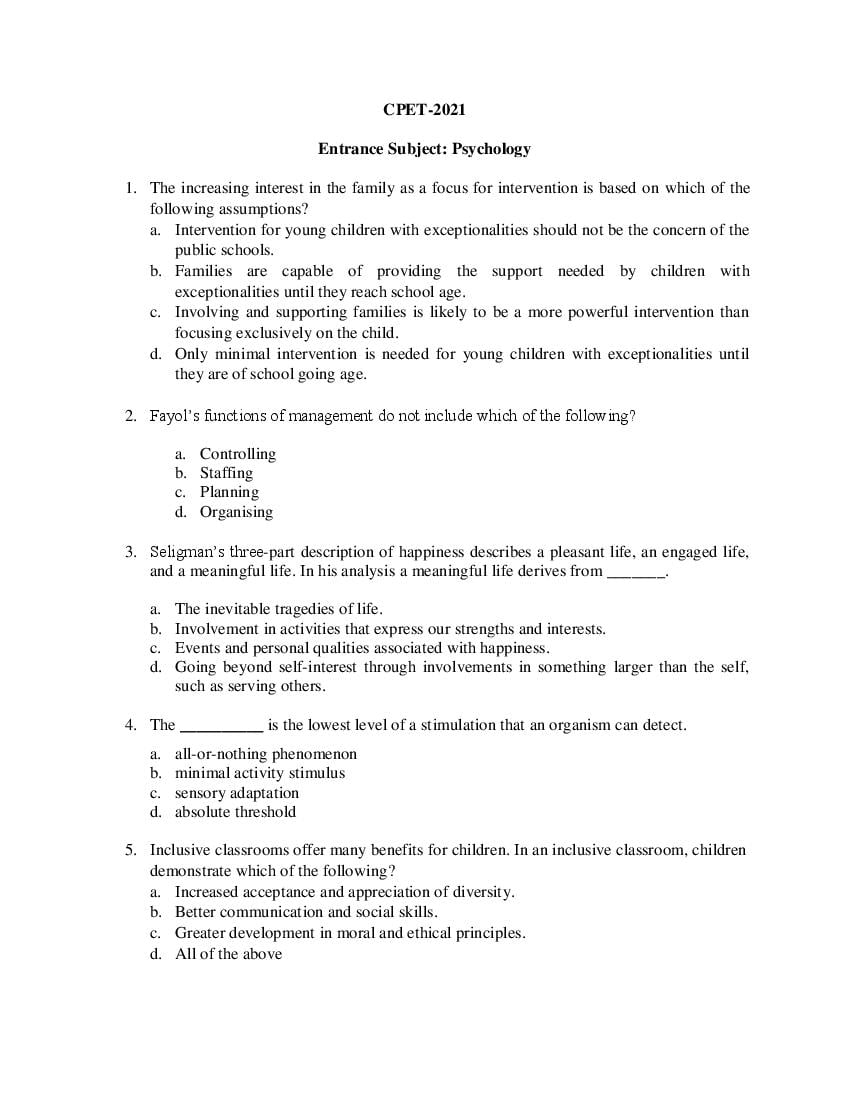
Entrance Subject: Psychology
1. The increasing interest in the family as a focus for intervention is based on which of the
following assumptions?
a. Intervention for young children with exceptionalities should not be the concern of the
public schools.
b. Families are capable of providing the support needed by children with
exceptionalities until they reach school age.
c. Involving and supporting families is likely to be a more powerful intervention than
focusing exclusively on the child.
d. Only minimal intervention is needed for young children with exceptionalities until
they are of school going age.
2. Fayol’s functions of management do not include which of the following?
a. Controlling
b. Staffing
c. Planning
d. Organising
3. Seligman’s three-part description of happiness describes a pleasant life, an engaged life,
and a meaningful life. In his analysis a meaningful life derives from _______.
a. The inevitable tragedies of life.
b. Involvement in activities that express our strengths and interests.
c. Events and personal qualities associated with happiness.
d. Going beyond self-interest through involvements in something larger than the self,
such as serving others.
4. The __________ is the lowest level of a stimulation that an organism can detect.
a. all-or-nothing phenomenon
b. minimal activity stimulus
c. sensory adaptation
d. absolute threshold
5. Inclusive classrooms offer many benefits for children. In an inclusive classroom, children
demonstrate which of the following?
a. Increased acceptance and appreciation of diversity.
b. Better communication and social skills.
c. Greater development in moral and ethical principles.
d. All of the above
Page 2
a. Shifting of Attention
b. Distraction
c. Span of Attention
d. Focus and Margin
7. When progress towards a goal is blocked and underlying tension is unresolved, it is
known as ________.
a. Critical Period
b. Goal
c. Frustration
d. Restriction
8. Which level in the Bronfenbrenner’s ecological model highlights the role of
environmental events and socio-historical circumstances on individuals’ development?
a. Chronosystem
b. Microsystem
c. Exosystem
d. Sociosystem
9. According to Maslow, the self-actualizing tendency is a _______.
a. Instinct
b. Imprinting
c. Growth motivation
d. Deficiency motivation
10. On an average men do better than women on tests requiring _______.
a. spatial ability
b. spelling
c. emotional intelligence
d. pronouncing words
11. Divergent thinking is to ________ as convergent thinking is to ________.
a. one solution, many solutions
b. mathematical ability, verbal ability
Page 3
d. many solutions, one solution
12. If a proposed intelligence test turned out to be a test of patience rather than intelligence, it
would be criticized for having ________.
a. low reliability
b. low construct validity
c. low culture fairness
d. low internal consistency
13. When a motive is aroused and the organism is driven to a goal, a condition is produced
within the organism called ________.
a. Conflict
b. Tension
c. Anxiety
d. Jealousy
14. Which of the following is NOT one of the Sternberg’s triarchic intelligences?
a. creative intelligence
b. practical intelligence
c. fluid intelligence
d. analytical intelligence
15. Which situation describes the use of flashbulb memory?
a. Sasmita recollected that the cold wave was continuing since last few weeks
b. Serena became emotional while she recalled the 9/11 attack
c. Sheetal asked her teacher to name the capital of Telengana
d. Sameer verified his identity over phone by giving his biographical details
16. The theory proposed by R.G.Barker to express the complex combinations of human
behaviour and physical environment is referred to as ________.
a. Planned behaviour theory
b. Behaviour setting theory
c. Physical setting theory
d. Space – behaviour interaction theory
Page 4
a. Health promotion and maintenance
b. Treatment of illness
c. Factors that influence our vulnerability to disease
d. The progression of disease at cellular level
18. Which one of the following is not a principle of organization of perception?
a. Law of Proximity
b. Law of Similarity
c. Law of Pragnaz
d. Law of Contrast
19. Eysenck believed that traits are primarily _______ based.
a. Biologically
b. Socially
c. Culturally
d. Emotionally
20. Which one of the following is not an assumption of biopsychosocial model?
a. There is a single cause for a disease
b. Health and illness have many causes
c. There are connections between mental events and biological changes
d. Interaction of culture, personality and genetics for understanding health and
illness
21. Counterconditioning is an exposure therapy technique which involves __________.
a. sudden appearance of the feared stimulus
b. learning that one negative event may be linked to another
c. learning that an event or situation is no longer threatening
d. helping the client to see that their behaviour is counterproductive
Page 5
Which one of the following is not included in the list?
a. Leaning backward
b. Sitting squarely facing the client
c. Open posture
d. Relaxed position
23. Recognition as a method of measuring memory involves ______.
a. Remembering something in its presence
b. Identifying something in its absence
c. Recognizing something in its absence
d. Learning something in its presence
24. The condition in Schizophrenia where an individual believes that they are being spied
upon or are in danger is referred to as ______.
a. Delusions of grandeur
b. Delusions of control
c. Delusions of persecution
d. Hallucination
25. One of the key functions of Wernicke’s area is ________ .
a. Language comprehension
b. Visualization activity
c. Maintaining body balance
d. Olfactory sensation
26. Children build increasing knowledge of the world by incorporating new information into
the existing schema. Piaget named this process as ___________.
a. Assimilation
b. Conservation
c. Egocentrism
d. Accommodation
Page 6
and algebra?
a. Procedural memory
b. Episodic memory
c. Semantic memory
d. Short term memory
28. When mean of the scores obtained by a group of students on a test is more than the
median, which of the following statements is correct?
a. A large number of students performed worse than the average.
b. A large number of students performed better than the average.
c. Half of the students scored higher than the mean.
d. The scores are normally distributed
29. We are more likely to help someone if it is likely to be repaid in future. This is termed as
__________.
a. Hedonistic altruism
b. Pro-social altruism
c. Mutual altruism
d. Reciprocal altruism
30. Setting a lower alpha level would result in __________.
a. An increase in Type –I error
b. A decrease in Type –I error
c. A decrease in Type – II error
d. An increase in Sampling error
31. Which of the following is not a situational factor but may result in aggression within an
individual?
a. Crowding
Page 7
c. Attribution
d. Culture
32. Which of the following statements is not true about stress management?
a. It enhances our adjustment when we are subjected to pressures of life
b. It helps in understanding the connection between body and mind relationship
c. It teaches us to avoid all kinds of stress and pressures of life
d. It helps to take control of our health by handling the stressors in life
33. A Two-way ANOVA implies that there are ______.
a. Two independent variables
b. Two dependent variables
c. Two covariates
d. Two levels of each variable
34. The beginning of the third week after conception marks the start of ______ stage.
a. Fetal
b. Placental
c. Germinal
d. Embryonic
35. Which of the following is not caused by the activation of the sympathetic nervous
system?
a. Dilation of pupils
b. A decrease in heart rate
c. An increase in blood flow to muscles
d. Vasoconstriction of most blood vessels
36. The profession of counselling aims to _______.
a. solely address the abnormal behaviour
b. provide a successful diagnosis in psychopathology
c. ensure that clients are on correct medication
d. promote personal growth and productivity
Page 8
attachment?
a. John Bowlby
b. Mary Ainsworth
c. Harry Harlow
d. Sigmund Freud
38. Which of the following defense mechanisms plays an important role in the development
of superego?
a. Rationalization
b. Projection
c. Identification
d. Sublimation
39. Sometimes, a person continues to show a behavior for motives that are different from the
one originally giving rise to it. Allport names this phenomenon as ____
a. Proprium
b. Functional autonomy
c. Cardinal trait
d. Developmental epoch
40. Mental age is concerned with
a. Relative position of the individual within a specified group
b. Standard deviation of IQ scores
c. Developmental level attained by the individual
d. Revised norm
41. Feedback on achievement of target is the major focus of which motivation theory?
a. ERG theory
b. McClelland’s theory
Page 9
d. Cognitive evaluation theory
42. Item discrimination is a method of
a. Item conceptualization
b. Item try out
c. Item revision
d. Item analysis
43. The neodissociation theory of hypnosis contends that hypnotism involves __________.
a. Loss of direct contact between the executive and control mechanisms of
consciousness.
b. Role playing in confirmation with the hypnotic subject’s own expectations.
c. Dissociation of personal identity into two separate but coexisting personalities.
d. Conscious effortful faking on the part of the person undergoing hypnosis.
44. A manager is sensitive to similarities and differences among employees in terms of age,
cultural background, gender and so on. This is known as management of ____________.
a. Employment opportunity
b. Workforce diversity
c. Expatriates
d. Collective action
45. Factors in the environment adversely affecting the developing fetus are known as
______.
a. Glucogen
b. Toxicogen
c. Teratogen
d. Histogen
46. Which of the following does not give internal consistency estimate of reliability?
a. Split-half method
b. Kuder-Richardson method
Page 10
d. Cronbach’s alpha method
47. What is negative reinforcement?
a. A technique of punishment
b. Any consequence that encourages behaviour when something unpleasant is taken
away
c. Any consequence that reduces the habit strength
d. Any consequence that discourages behaviour when something pleasant is taken
away
48. One of the following concepts which does not belong to the existential- humanistic
approach is _______.
a. Growth
b. Transference
c. Phenomenological experience
d. Dynamic holism
49. According to the social identity theory, what determines conformity?
a. Internalization of group membership
b. Identification with the out-group
c. Informational influence
d. Normative influence
50. In participant observation, the ___________.
a. participants help develop a coding scheme
b. researcher tries to be unobtrusive
c. researcher uses warm-up exercises
d. volunteers observe the researcher
51. Which of the following can be a part of all three components - input, output and
transformation- in an organization?
a. Customers
b. Technology
c. Personality
d. Raw materials
Page 11
or standard, particularly by hiring or promoting a single member of a previously excluded
group to demonstrate one’s benevolent intentions, refers to ______.
a. Tokenism
b. Glass ceiling
c. Cognitive dissonance
d. Self serving bias
53. Which of the following is not one of the disadvantages of laboratory-based studies of
behaviour?
a. Extraneous variables are difficult to control
b. They lack internal validity
c. The findings may not be generalisable
d. Replication is not easy
54. Within psychology’s recent history, ____________ psychology has been one of the
stronger voices for a more positive approach to the study of human behaviour.
a. Evolutionary
b. Psychoanalytic
c. Humanistic
d. Behavioural
55. The loss of both identity and feelings of responsibility which arises due to group
membership is known as ___________.
a. Zimbardo effect
b. Deindividuation
c. Stanford effect
d. Dehumanisation
56. The newsreader could not control laughing aloud while reading out the report on a funny
incident on National Television Channel. She is expected to exhibit _______.
a. Facial feedback
b. Emotional labour
Page 12
d. Mood swings
57. Which is the correct order of steps in the modelling process?
a. attention, retention, reproduction, motivation
b. motivation, attention, reproduction, retention
c. attention, motivation, retention, reproduction
d. motivation, attention, retention, reproduction
58. When considering the interaction of heredity and environment, it is important for teachers
to understand that
a. changing a child`s environment can have little effect on hereditary influences.
b. present educational viewpoints emphasise the role of heredity.
c. present educational viewpoints adhere to a medical model of exceptionalities.
d. changing the environmental conditions of early childhood can result in behaviour
changes.
59. Which of the following establishes the link between the brain and endocrine system?
a. Hippocampus
b. Hypothalamus
c. Cerebrum
d. Amygdala
60. Which of the following is not a procedure developed from classical conditioning
principles?
a. Flooding
b. Token economy
c. Systematic desensitization
d. Aversion therapy
61. ‘I am shaking, therefore I am scared’ - This perspective of emotional experience belongs
to _______.
a. James-Lange theory
b. Canon-Bard theory
Page 13
d. Cognitive appraisal theory
62. Which of the following statistics would be most affected if there are extreme scores in a
distribution?
a. Mode
b. Median
c. Percentile rank
d. Arithmetic mean
63. Larger and larger doses of amphetamines can lead to a severe mental disturbance called
______.
a. Amphetamine neurosis
b. Amphetamine psychosis
c. Amphetaminism
d. Amphetamine toxicity
64. In Obsessive Compulsive Disorder, compulsions are generally referred to which of the
following?
a. Repetitive or ritualized behaviour patterns that the individual feels driven to
perform in order to prevent some negative outcome happening
b. Repetitive thoughts about harming or distressing others
c. Overwhelming desires to behave in an inappropriate fashion
d. Ritualised worrying about negative outcome of events
65. A study is designed to find out if violent video games cause aggression in children. What
is the dependent variable?
a. Children
b. Aggression
c. Video games
d. Violence
66. Excessive feeling of sleepiness during day time and suddenly slipping into REM sleep
can be due to a disorder known as ____.
a. Sleep apnea
Page 14
c. Night terrors
d. Narcolepsy
67. For constancy to operate in the world of normal objects, the more distant features must be
______.
a. Perceptually expanded
b. Clearly visualised
c. Projected in sufficient light
d. Clearly spaced
68. Which of the following is not true about PET scans?
a. It stands for positron emission tomography
b. It measures the metabolic activity
c. It uses radioactive tracer to show functioning of organs
d. It produces still images of organs and body structures
69. Rakhi announces her views and feelings with great drama. She likes to dress in a manner
that draws attention to her. She becomes uncomfortable in situations where she is not the
center of attention. Which of the following personality disorders is the best diagnosis for
her?
a. Narcissistic
b. Schizotypal
c. Paranoid
d. Histrionic
70. The cocktail party effect focuses on which type of perception?
a. Auditory
b. Gustatory
c. Vestibular
d. Visual
***********
Document Details
| Board / Org | Odisha Exams |
| Exam | Odisha CPET |
| Type | Question Paper |
| Pages | 14 |
| Updated | 22 Jul 2026 |