TN 12th Model Question Paper Political Science
Finished viewing? Save it for later —
Download TN 12th Model Question Paper Political Science (PDF · 12 pages)About TN 12th Model Question Paper Political Science
TN 12th Model Question Paper Political Science is available here for free download. Published by Tamil Nadu Board for Class 12, this sample paper can be viewed online or downloaded as a PDF (12 pages). Candidates preparing for Class 12 can use TN 12th Model Question Paper Political Science to understand the exam pattern, the type of questions asked, and the overall difficulty level.
Frequently Asked Questions
How can I download TN 12th Model Question Paper Political Science?
Open this page and click the Download button to save TN 12th Model Question Paper Political Science as a PDF. It is completely free on AglaSem Docs.
Is TN 12th Model Question Paper Political Science free to download?
Yes. TN 12th Model Question Paper Political Science can be viewed online and downloaded as a PDF free of cost on AglaSem Docs.
How many pages does TN 12th Model Question Paper Political Science have?
TN 12th Model Question Paper Political Science contains 12 pages, which you can read online or download together as a single PDF.
Where can I find more Class 12 study material?
You can find more Class 12 question papers, sample papers, syllabus, and answer keys on AglaSem Docs.
TN 12th Model Question Paper Political Science – Text
Read the full text of this sample paper below — useful to quickly search, copy and reference the content online without downloading the PDF.
📄 View text version (12 pages)
Page 1
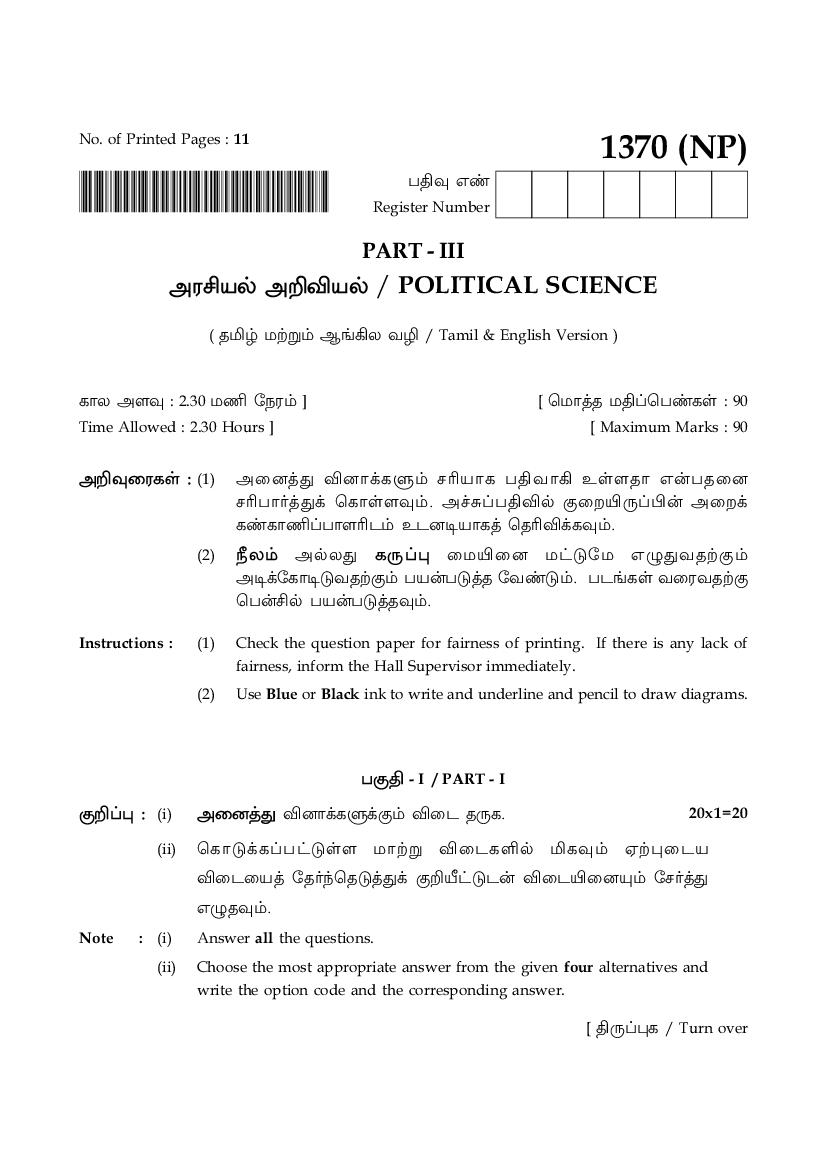
1370 (NP)
!1370NPPoliticalScience! £vÄ Gs
Register Number
PART - III
Aµ]¯À AÔ¯À / POLITICAL SCIENCE
( uªÌ ©ØÖ® B[Q» ÁÈ / Tamil & English Version )
Põ» AÍÄ : 2.30 ©o ÷|µ® ] [ ö©õzu ©v¨ö£sPÒ : 90
Time Allowed : 2.30 Hours ] [ Maximum Marks : 90
AÔÄøµPÒ : (1) AøÚzx ÂÚõUPЮ \›¯õP £vÁõQ EÒÍuõ GߣuøÚ
\›£õºzxU öPõÒÍÄ®. Aa_¨£vÂÀ SøÓ°¸¨¤ß AøÓU
PsPõo¨£õÍ›h® EhÚi¯õPz öu›ÂUPÄ®.
(2) }»® AÀ»x P¸¨¦ ø©°øÚ ©mk÷© GÊxÁuØS®
AiU÷PõikÁuØS® £¯ß£kzu ÷Ásk®. £h[PÒ ÁøµÁuØS
ö£ß]À £¯ß£kzuÄ®.
Instructions : (1) Check the question paper for fairness of printing. If there is any lack of
fairness, inform the Hall Supervisor immediately.
(2) Use Blue or Black ink to write and underline and pencil to draw diagrams.
£Sv - I / PART - I
SÔ¨¦ : (i) AøÚzx ÂÚõUPÐUS® Âøh u¸P. 20x1=20
(ii) öPõkUP¨£mkÒÍ ©õØÖ ÂøhPÎÀ ªPÄ® Hئøh¯
Âøhø¯z ÷uº¢öukzxU SÔ±mkhß Âøh°øÚ²® ÷\ºzx
GÊuÄ®.
Note : (i) Answer all the questions.
(ii) Choose the most appropriate answer from the given four alternatives and
write the option code and the corresponding answer.
[ v¸¨¦P / Turn over
Page 2
1. ©Ûu \•uõ¯zvß ÁõÌÂØS®, Á\vUS® HØ£kzu¨£mh J¸
CßÔ¯ø©¯õu Aø©¨¦ :
(A) Aµ_ (B) öuõÈØ\[P[PÒ
(C) Sk®£® (D) \‰P®
Which one of the following occupies the most important place among all social
institutions ?
(a) State (b) Trade unions
(c) Family (d) Society
2. ©UPÒ |» Aµ_ SÔzu ]¢uøÚ •uß •u¼À G¢u |õmiÀ BÌ¢x
÷Á¹ßÔ¯x :
(A) |õº÷Á (B) öhß©õºU
(C) C[Q»õ¢x (D) ìÃhß
The welfare state ideals took strong root in :
(a) Norway (b) Denmark
(c) England (d) Sweden
3. u¢øu ÁÈ öPõÒøPUS BuµÄ öu›ÂzuÁº :
(A) öíßÔ ö©°ß (B) öáßUì
(C) ©U»Úß (D) ©õºPß
The chief exponent of the Patriarchal theory is :
(a) Henry Maine (b) Jenks
(c) Mclennan (d) Morgan
4. C¯ØøP {ø»ø¯ £h® ¤izx Põmi¯ öPõÒøP :
(A) uõ´ÁÈU öPõÒøP (B) \•uõ¯ J¨£¢uU öPõÒøP
(C) öu´ÃPz ÷uõØÓ öPõÒøP (D) Á¼ø©U öPõÒøP
The theory which pictured the state of nature :
(a) Matriarchal theory (b) Social contract theory
(c) Divine theory (d) Force theory
Page 3
5. |hzøu C¯÷»õk öuõhº¦øh¯ AÔbº :
(A) ¹÷éõ (B) áõß ÷£õuõß
(C) ïßì ³»õ (D) PõµÀ ©õºUì
Who among the following is Behaviouralist ?
(a) Rousseau (b) Jean Bodin
(c) Heinz Eulau (d) Karl Marx
6. C¢v¯ P»õa\õµ® ªPÄ® £»® Áõ´¢ux GÚ TÔ¯Áº :
(A) \õ•÷ÁÀ P. ísi[hß (B) PõµÀ ©õºUì
(C) A©ºzv¯õ ö\ß (D) ¤Íõm÷hõ
In the view of ________"Indian culture is a very strong culture".
(a) Samuel P. Huntington (b) Karl Marx
(c) Amartya Sen (d) Plato
7. Á¸©õÚ Á›ø¯ ö\¾zxuÀ Gߣx GuøÚU SÔUQßÓx ?
(A) £õµ®£›¯ BÐø©
(B) £SzuÔÄ \mh BÐø©
(C) ]Ó¨¤¯À¦PøÍ Eøh¯ uø»ø© BÐø©
(D) ÷©ØTÔ¯ AøÚzx®
Paying Income Tax signifies :
(a) Traditional authority
(b) Rational-legal authority
(c) Charismatic authority
(d) All the above
[ v¸¨¦P / Turn over
Page 4
8. uõµõÍ©¯©õUSuÀ C¢v¯õÂÀ G¢u Bsk öPõsk Áµ¨£mhx ?
(A) 1985 (B) 2002 (C) 1996 (D) 1991
Liberalised economy was introduced in India in the year :
(a) 1985 (b) 2002 (c) 1996 (d) 1991
9. ÷Pªµõ GßÓ C»zwß ö\õÀ¼ß ö£õ¸Ò :
(A) Aø©¨¦ (B) £h® (C) Ãk (D) Pmih®
The Latin word camera means :
(a) Structure (b) Picture (c) House (d) Building
10. SÊ •øÓ Aµ\õ[PzvØS ]Ó¢u Euõµn® :
(A) Aö©›UPõ (B) C¢v¯õ
(C) _Âm麻õ¢x (D) C[Q»õ¢x
The best example for collegiate form of Government is :
(a) U.S.A. (b) India
(c) Switzerland (d) U.K.
11. {v ©÷\õuõUPÒ ©õ{»[PÒ AøÁ°À GzuøÚ |õmPÒ Áøµ
uõ©u¨£kzu»õ® ?
(A) 14 |õmPÒ (B) 7 |õmPÒ (C) 30 |õmPÒ (D) 20 |õmPÒ
Money bills can be delayed in the Rajya Sabha only for :
(a) 14 days (b) 7 days (c) 30 days (d) 20 days
12. AvPõµ ¤›ÂøÚU öPõÒøPø¯ ÂÍUQ¯Áº ¯õº ?
(A) ÷hÂm Dìhß (B) ö£ßuõ®
(C) ©õsöhìQ³ (D) PõºÚº
The Separation of powers is advocated by :
(a) David Easton (b) Bentham
(c) Montesquieu (d) Garner
Page 5
13. C¢v¯ Aµ]¯»ø©¨¦ |øh•øÓUS Á¢u Bsk :
(A) 26 \ÚÁ› 1947 (B) 15 BPìk 1945
(C) 26 \ÚÁ› 1950 (D) 15 BPìk 1947
The Constitution of India came into force on :
(a) 26 th January 1947 (b) 15th August 1945
(c) 26th January 1950 (d) 15th August 1947
14. ©õ{»[PÒ AøÁ°ß uø»Áº ¯õº ?
(A) xøn Si¯µ_zuø»Áº (B) xøn \£õ|õ¯Pº
(C) \£õ|õ¯Pº (D) Si¯µ_zuø»Áº
The Chairperson of Rajya Sabha is :
(a) Vice president (b) Deputy Speaker
(c) Speaker (d) President
15. ©õ{» BÐ|øµ {¯ª¨£Áº ¯õº ?
(A) Si¯µ_zuø»Áº (B) ¤µu©º
(C) •u»ø©a\º (D) E¯º }v©ßÓ }v£v
Who appoints the Governor ?
(a) President of India (b) Prime Minister
(c) Chief Minister (d) High Court Judge
16. Ea\ }v©ßÓzvß J¸ }v£v GzuøÚ Á¯x Áøµ £u ÁQ¨£õº ?
(A) 62 (B) 65 (C) 58 (D) 60
A Judge of Supreme Court shall hold office until the age of :
(a) 62 (b) 65 (c) 58 (d) 60
[ v¸¨¦P / Turn over
Page 6
17. CµõqÁU Th Áõ›¯® G¢u {ºÁõPzvØS Em£mh £Sv :
(A) ©õ{» Aµ\õ[P® (B) ³Û¯ß ¤µ÷u\®
(C) ©zv¯ Aµ\õ[P® (D) ÷©ØTÔ¯ AøÚzx®
The Cantonments are administered by :
(a) State Government (b) Union territory
(c) Central Government (d) All of these
18. GUSÊÂß £›¢xøµPÒ, £g\õ¯zx Cµõä⯠•øÓ°ß "©Põ \õ\Ú®' GßÖ
¦PÇõµ® `mh¨£mhx ?
(A) £ÀÁ¢zµõ´ ÷©zuõ SÊ (B) hõºSß÷h SÊ
(C) A÷\õU ÷©zuõ SÊ (D) ÷PõºÁõ»õ SÊ
Whose report is hailed as the 'Magna Carta' of the Panchayat Raj Systems ?
(a) Balwantrai Mehta Committee (b) Tarkunde Committee
(c) Ashok Mehta Committee (d) Gorwala Committee
19. uªÌ|õmiß uØ÷£õøu¯ BÐ|º :
(A) ÷µõ\´¯õ (B) £õzv©õ ¥Â
(C) £ßÁõ›»õÀ ¦÷µõîz (D) Âz¯õ\õPº µõÆ
The Present Governor of Tamil Nadu is :
(a) Rosaiah (b) Fathima Bevi
(c) Banwarilal Purohit (d) Vidhyasagar Rao
20. Q.¤. 2000 GßÓ ¡ø» GÊv¯Áº :
(A) •øÚÁº •. Áµuµõáß (B) uõ©ì ‰º
(C) •øÚÁº A.P.J. A¨xÀ P»õ® (D) ÷|¸
The book A.D. 2000 is written by :
(a) Dr. Mu. Varadharajan (b) Thomas More
(c) Dr. A.P.J. Abdul Kalam (d) Nehru
Page 7
£Sv & II / PART - II
H÷uÝ® HÊ ÂÚõUPÐUS Âøh¯ÎUPÄ®. ÂÚõ Gs 30 &ØS
Pmhõ¯©õP Âøh¯ÎUPÄ®. 7x2=14
Answer any seven questions, in which question No. 30 is compulsory .
21. ÷\õ\¼é Aµ]øÚ & Áøµ¯Ö.
Define Socialist state.
22. Aµ]ß ÷uõØÓzøu ÂÍUS® öPõÒøPPÒ ¯õøÁ ?
What are the theories which explain the origin of the state ?
23. Aµ]¯À AÔbºPÒ £iUP ¸®¦® \‰P {ÖÁÚ[PÒ ¯õøÁ ?
Name the Social Institutions that the Political Scientists may study .
24. £o\õº SÊ©[PÒ |õßQøÚ GÊxP.
Write four Professional associations.
25. Tmhõm] & Áøµ¯ÖUPÄ®.
Define Federal Government.
26. }v£vPÍõÁuØPõÚ uSvPÒ ¯õøÁ ?
What are the qualifications to become a Judge ?
[ v¸¨¦P / Turn over
Page 8
27. I¢x ÁøP }v¨÷£µõønPøÍ GÊxP.
Write Five Writs.
28. ©UPÒ ö|¸UP® ªS¢u |Pµ[PøÍ GÊxP.
Which are the densely populated Indian cities ?
29. ©õ|Pµõm] £ØÔ SÔ¨¦ GÊxP.
Write short notes on Corporation.
30. C¢v¯õÂÀ DµøÁ \mh©ßÓzøu¨ ö£ØÖÒÍ I¢x ©õ{»[PøÍU TÖP.
Name the five bicameral legislatures states in India.
£Sv & III / PART - III
H÷uÝ® HÊ ÂÚõUPÐUS Âøh¯ÎUPÄ®. AÁØÔÀ ÂÚõ Gs 40 &ØS
Pmhõ¯©õP Âøh¯ÎUPÄ®. 7x3=21
Answer any seven questions, in which question No. 40 is compulsory.
31. Á¼ø©U öPõÒøPø¯ ÂÁ›.
What is meant by force theory ?
32. Aµ]¯À \mhÂv 41 TÖÁøu GÊxP.
Explain about the Article 41.
33. E¯º ÁS¨¦ ÷Põm£õk GßÓõÀ GßÚ ?
What is Elitist theory ?
Page 9
34. ö\´v öuõhº¦ öuõÈÀ ~m£zøu ÂÍUSP.
Define Information Technology.
35. ö£¯µÍ»õÚ ö\¯ØSÊ Gߣøu ÂÍUSP.
Explain nominal executive.
36. }v ©Ö B´Ä GßÓõÀ GßÚ ? Ax |øh•øÓ°À EÒÍ |õkPøÍ GÊxP.
What is Judicial review ? What are the countries which follow the Judicial review ?
37. \mh\ø£ ÷uºu¼À ÷£õmi°k÷Áõ¸US C¸UP ÷Ási¯ uSvPÒ
¯õøÁ ?
Explain the qualifications prescribed for a person seeking election to the Legislative
Assembly.
38. C¢v¯ ÂÁ\õ¯U öPõÒøPø¯ ÂÍUSP.
Describe the Agricultural Policy of India.
39. |Pµ GÀø»¨£Sv SÊUPÒ £ØÔ GÊxP.
Explain Town Area Committee.
40. 1947 •uÀ 1998 Áøµ EÒÍ Põ»zvÀ £u ÁQzu H÷uÝ® BÖ C¢v¯¨
¤µu©ºPÎß ö£¯ºPøÍ GÊxP.
Write the names of any six Prime Ministers of India who were in power between
1947 to 1998.
[ v¸¨¦P / Turn over
Page 10
£Sv & IV / PART - IV
AøÚzx ÂÚõUPÐUS® Âøh¯ÎUPÄ®. 7x5=35
Answer all the questions.
41. (A) {»¨¤µ¦zxÁ Aµ]ß GÊa]ø¯ B´Ä ö\´P.
AÀ»x
(B) ©UPÒ |» Aµ_ GßÓõÀ GßÚ ? ÂÍUP® u¸P.
(a) Explain the rise of Feudal State.
OR
(b) What is Welfare State ? Explain.
42. (A) íõ¨ì, »õU, ¹÷\õÂß \•uõ¯ J¨£¢uU ÷Põm£õmøh J¨¥k ö\´P.
AÀ»x
(B) u¢øu ÁÈU öPõÒøPø¯ ÂÁ›.
(a) Compare the views of Hobbes, Locke, Rousseau regarding Social Contract theory.
OR
(b) Explain patriarchal theory.
43. (A) KµøÁ ©ØÖ® DµøÁ •øÓ°¾ÒÍ ÷ÁÖ£õkPøÍ GÊxP.
AÀ»x
(B) £õµõЩßÓ Aµ_ •øÓ°ß ]Ó¨£®\[PÒ ¯õøÁ ?
(a) Explain the distinction between unicameral and bicameral legislatures.
OR
(b) Describe the essential features of parliamentary form of government.
Page 11
44. (A) BÐø©°ß ußø© ©ØÖ® •UQ¯zxÁzøu ÂÍUSP.
AÀ»x
(B) £ßÚõmk {vUPÇP® ©ØÖ® E»P Á[Q°ß vmh[PÒ ¯õøÁ ?
(a) Explain the Nature and Importance of Authority.
OR
(b) What are the strategic plans of IMF and World Bank ?
45. (A) ©UPÍøÁ, ©õ{»[PÒ AøÁ & ÷ÁÖ£õk u¸P.
AÀ»x
(B) ¤µu©›ß £[QøÚ ÂÁ›UPÄ®.
(a) What are the differences between Lok Sabha and Rajya Sabha ?
OR
(b) Explain the role of Prime Minister of India.
46. (A) uªÌ|õk \mh©ßÓzvß Aø©¨¦, uSvPÒ, £uÂUPõ»® £ØÔ
ÂÍUSP.
AÀ»x
(B) ©õ|Pµõm]°ß £oPøÍ GÊxP.
(a) Explain the Composition, Qualification and Tenure of Tamil Nadu Legislative
Assembly.
OR
(b) What are the functions of Corporation ?
47. (A) C¢v¯õÂß I¢uõsk vmh[PøÍ ÂÁ›UPÄ®.
AÀ»x
(B) CµõqÁU Th Áõ›¯® £ØÔ ÂÁ›UP.
(a) Explain the Five Year Plan in India.
OR
(b) Explain Cantonment Board.
-oOo-
[ v¸¨¦P / Turn over
Page 12
Document Details
| Board / Org | Tamil Nadu Board |
| Exam | Class 12 |
| Type | Sample Paper |
| Pages | 12 |
| Updated | 22 Jul 2026 |