Odisha CPET 2021 Question Paper Public Administration
Finished viewing? Save it for later —
Download Odisha CPET 2021 Question Paper Public Administration (PDF · 16 pages)About Odisha CPET 2021 Question Paper Public Administration
Odisha CPET 2021 Question Paper Public Administration is available here for free download. Published by Odisha Exams for Odisha CPET, this question paper can be viewed online or downloaded as a PDF (16 pages). Candidates preparing for Odisha CPET can use Odisha CPET 2021 Question Paper Public Administration to understand the exam pattern, the type of questions asked, and the overall difficulty level.
Frequently Asked Questions
How can I download Odisha CPET 2021 Question Paper Public Administration?
Open this page and click the Download button to save Odisha CPET 2021 Question Paper Public Administration as a PDF. It is completely free on AglaSem Docs.
Is Odisha CPET 2021 Question Paper Public Administration free to download?
Yes. Odisha CPET 2021 Question Paper Public Administration can be viewed online and downloaded as a PDF free of cost on AglaSem Docs.
How many pages does Odisha CPET 2021 Question Paper Public Administration have?
Odisha CPET 2021 Question Paper Public Administration contains 16 pages, which you can read online or download together as a single PDF.
Where can I find more Odisha CPET study material?
You can find more Odisha CPET question papers, sample papers, syllabus, and answer keys on AglaSem Docs.
Odisha CPET 2021 Question Paper Public Administration – Text
Read the full text of this question paper below — useful to quickly search, copy and reference the content online without downloading the PDF.
📄 View text version (15 pages)
Page 1
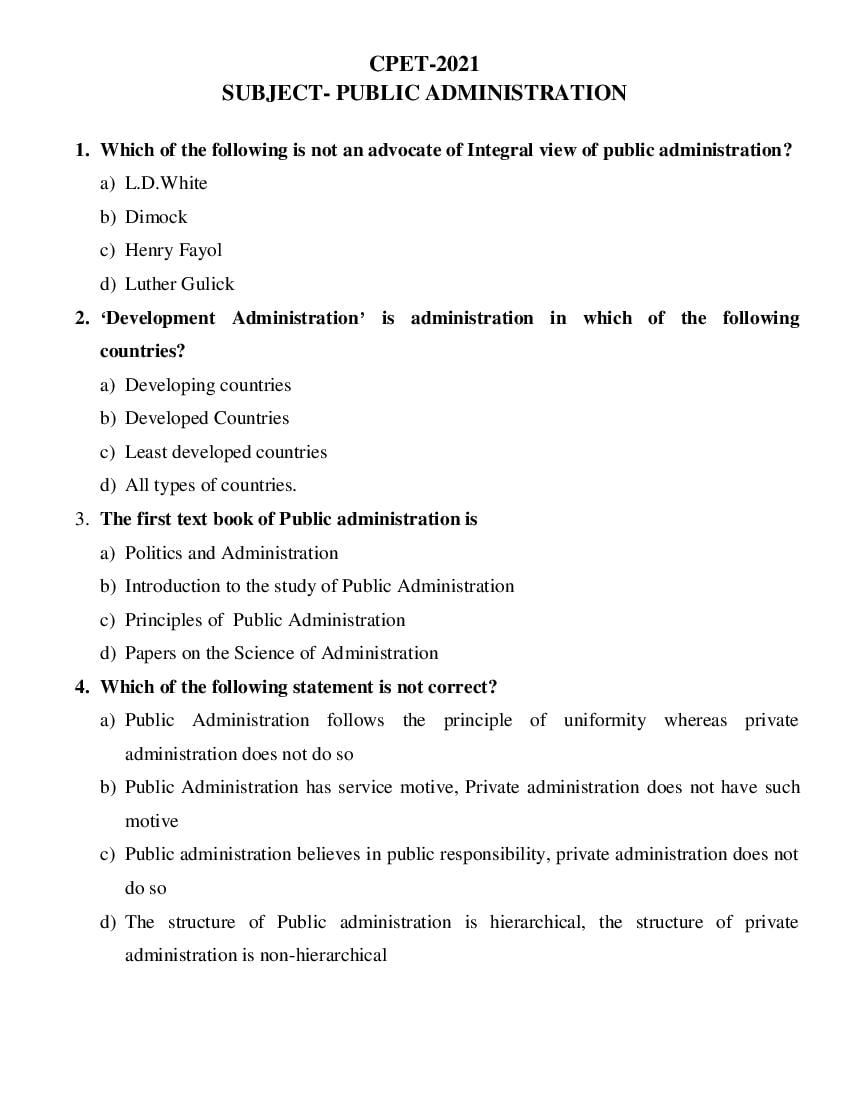
SUBJECT- PUBLIC ADMINISTRATION
1. Which of the following is not an advocate of Integral view of public administration?
a) L.D.White
b) Dimock
c) Henry Fayol
d) Luther Gulick
2. ‘Development Administration’ is administration in which of the following
countries?
a) Developing countries
b) Developed Countries
c) Least developed countries
d) All types of countries.
3. The first text book of Public administration is
a) Politics and Administration
b) Introduction to the study of Public Administration
c) Principles of Public Administration
d) Papers on the Science of Administration
4. Which of the following statement is not correct?
a) Public Administration follows the principle of uniformity whereas private
administration does not do so
b) Public Administration has service motive, Private administration does not have such
motive
c) Public administration believes in public responsibility, private administration does not
do so
d) The structure of Public administration is hierarchical, the structure of private
administration is non-hierarchical
Page 2
a) Henry Fayol
b) Luther Gulick
c) Lyndall Urwick
d) Gullick and Urwick
6. Which of the following approaches strongly believes that administrators can
influence social, political and economic environment in a society?
a) Scientific Management Approach
b) Administrative Management Approach
c) Bureaucratic Approach
d) Ecological approach
7. New Public Management Approach was developed after
a) First Minnowbrook Conference
b) Second Minnowbrook Conference
c) Third Minnowbrook Conference
d) Fourth Minnowbrook Conference
8. The principal disadvantage of the principle of hierarchy is that it develops
a) a superiority or inferiority feeling in organization
b) delay in disposal of cases
c) rigidity in organization
d) decentralization in decision-making
9. The concept of ‘Gang-plank’ stands for
a) A communication channel to connect to the chief executive in the organisation
b) A communication channel to connect to the immediate superior in the organisation
c) A communication channel to connect with an employee of the same level in the
organisation
d) A communication channel to connect to the immediate lower employee in the
organization
Page 3
a) A welfare state
b) A communistic state
c) A neo-liberal state
d) A dictatorial state
11. The principle of unity of command says that
a) An employee should be subjected to the orders of more than one superior
b) A superior should give orders to one subordinate only
c) An employee should receive orders from one superior only
d) All the units of an organization should function under one head only
12. CO in ‘POSDCORB’ stands for
a) Control and Order
b) Coordination
c) Command and Organisation
d) Coordination and Organisation
13. Hawthorne studies belong to
a) F.W. Taylor
b) M. P. Follett
c) Elton Mayo
d) Herbert Simon
14. The functions of the staff agencies do not include
a) Coordination
b) Planning
c) Supervision
d) Housekeeping
Page 4
given by Gulick
a) Planning
b) Place
c) Person
d) Purpose
16. The concept of bureaucracy was theorized by which of the following philosopher
a) John Locke
b) Karl Marx
c) Max Weber
d) V.I.Lenin
17. Which of the following is not a feature of an informal organization?
a) Invisible
b) Roofless
c) Personal Interaction within the organisation
d) Unity of command
18. The Human Relations theory emphasized on
a) Structural factors
b) Psycho-social factors
c) Political factors
d) Economic factors
19. The foremost exponent of behavioural approach to Public Administration is
a) Abraham Maslow
b) F. W Taylor
c) Herbert Simon
d) Max Weber
Page 5
a) Mangers
b) Owners of industries
c) Political representatives
d) Trade Unions
21. The Panchayats in Odisha has gained power during current pandemic by which
legislation?
a) Odisha Gram Panchayat Act ,1964
b) Disaster Management Act,2005
c) India Independence Act, 1947
d) 73rd Constitution Amendment Act, 1992
22. Who wrote the book ‘New Despotism’
a) Robert Dahl
b) Harold Lasswell
c) L.D. White
d) Lord Hewart
23. National Health Mission is a
a) A public policy for rural India
b) A public policy for urban India
c) A Public policy for both rural and urban India
d) A public policy of Government of Odisha
24. ‘Administrative adjudication’ refers to
a) Powers of National Commission for Human Rights in India
b) Powers of District Courts in United Kingdom
c) Powers of First class Magistrate Courts In United States
d) Judicial powers granted by the legislative branch of a State to the federal and
state administrative agencies
Page 6
a) Kautilya
b) Woodrow Wilson
c) Max Weber
d) L.D. White
26. Which of the following is not true about a Neo-liberal state?
a) Market society
b) Capacity-building of people
c) People’s participation in governance
d) Universal Public Distribution policy
27. In which year Ministry of Tribal Affairs was formed?
a) 1996
b) 1997
c) 1998
d) 1999
28. According to Article 239, every Union Territory in India shall be administered by
whom
a) the President of India
b) Administrator
c) Lieutenant Governor
d) Both (b) & (c)
29. Which one of the following is not a feature of 73 rd constitutional amendment act?
a) Reservation of seats for women
b) Indirect election
c) Conduct of elections by State Election Commission
d) Financial viability through a State Finance Commission
Page 7
a) Reformation
b) Rejuvenation
c) Revitalization
d) Renovation
31. The essential principle of modern justice is
a) Judges should be part of executive
b) There should be independence of judiciary
c) The judges should be under the control of the Head of the State
d) The judges should be under the control of the electorate
32. What is meant by Economic justice?
a) The state should follow the theory of free trade policy
b) State should not protect the economically weaker section of society
c) The state should eliminate social discrimination
d) The basic needs regarding food, clothing and shelter of every citizen are met.
33. Budget division is coming under which of the following department of Ministry of
Finance?
a) Department of Economic Affairs
b) Department of Revenue
c) Department of Expenditure
d) Department of Financial Services
34. Who first gave the Concept of ‘Distributive Justice’?
a) Plato
b) Aristotle
c) Machiavelli
d) Locke
Page 8
Constitution?
a) Fifth schedule deals with the administration of Scheduled Areas
b) Tribal Advisory Council are to be constituted in those areas
c) The districts coming under these areas are known as autonomous districts
d) Governor is responsible to submit the report towards the administration of these areas
36. Audit is essentially an instrument of
a) Parliamentary Control
b) Judicial Control
c) Executive Control
d) Popular Control
37. Which one of the following features does not support the federal character of Indian
Constitution?
a) Distribution of powers between Centre and States
b) Authority of Courts
c) Supremacy of the Constitution
d) Single citizenship
38. Who is authorised to specify an area as Industrial Township when municipal
services to it provided through an industrial establishment?
a) President
b) Prime Minister
c) Governor
d) Chief Minister
Page 9
a) population of less than three lacs
b) Population of three lacs only
c) Population of three lacs or more
d) All of the above
40. “Politics has to do with policies or expressions of the state will”, while
administration “has to do with the execution of these policies”. The said statement
was written by whom?
a) Woodrow Wilson
b) Frank J. Goodnow
c) L.D. White
d) Herbert Simon
41. The concept of separation of powers in US constitution was taken from
a) Montesquieu
b) Bentham
c) Machiavelli
d) Rousseau
42. An important non-state actor in any democracy in present times
a) Judiciary
b) Local Government
c) Civil Society Organisation
d) Civil Services
43. The author of “The Function of Executive” is
a) Henry Fayol
b) F.W.Taylor
c) Chester Bernard
d) Mary Parker Follet
Page 10
a) 2014
b) 2015
c) 2016
d) 2017
45. Who is the author of “Principles of Public Administration”?
a) L.D. White
b) W.F. Willoughby
c) Woodrow Wilson
d) Luther Gullick
46. Audit of state government is coming under which list
a) State list
b) Union list
c) Concurrent list
d) Not coming under the above lists
47. Which of the following committees deals with the relations between generalist and
specialist
a) Fulton Committee report
b) Kothari Committee report
c) Haldane Committee report
d) Sarkaria Commission report
48. Which of the following states does not have panchayati raj institution?
a) Assam
b) Kerala
c) Tripura
d) Nagaland
Page 11
a) Madras
b) Calcutta
c) Bombay
d) Delhi
50. Disputes about election of the President and Vice-President are settled by the
a) Supreme Court
b) Election Commission
c) Parliamentary Committee
d) Combined bench of Supreme Court and High Courts
51. The speaker’s vote in the Lok Sabha is called
a) Casting vote
b) Sound vote
c) Direct vote
d) Indirect vote
52. What is ‘Zero Hour?’
a) When the proposals of the opposition are considered.
b) When the matters of utmost importance are raised.
c) When money bill is introduced in the Lok Sabha.
d) Interval between the morning and the evening session.
53. Constituent Assembly which framed India’s Constitution was set up by
a) Indian Independence Act, 1947
b) Government of India Act, 1935
c) Cabinet Mission Plan, 1946
d) Queen’s Proclamation, 1858
Page 12
should it has to be filled?
a) 3 Months
b) 6 Months
c) 9 Months
d) 12 Months
55. Which one of the following languages was not included in the 8 th Schedule by 71st
Amendment?
a) Mizo (Lushai)
b) Konkani
c) Manipuri
d) Nepali
56. In appointing a Governor, the President consults the Chief Minister of the State as
this is
a) Constitutionally imperative
b) A convention
c) As Parliament has legislated to the effect
d) A duty of the President
57. The office of District Collector was created by
a) Robert Clive
b) Lord Cornwallis
c) Lord Warren Hastings
d) Lord Wellesley
58. The Directorate in the State Administration is
a) A Policy-making agency
b) A constitutional agency
c) A statutory agency
d) An executive agency
Page 13
a) In Lok Sabha
b) Joint sitting of the two Houses called for this purpose
c) In either House of Parliament
d) In the Supreme Court
60. Power of judicial review ensures:
a) Supremacy of the Supreme Court
b) That Supreme Court can review its own judgments
c) Constitutionality of laws
d) Justice by subordinate courts
61. Who among the following Indian Prime Ministers resigned before facing a vote of
no-confidence in the Lok Sabha?
a) Chandra Shekhar
b) Morarji Desai
c) Chaudhary Charan Singh
d) V.P. Singh
62. Rajya Sabha enjoys more power than the Lok Sabha in the case of
a) Money bills
b) Non-money bills
c) Setting up of new All India services
d) Amendment of the constitution
63. Which one of the following countries permit the right to strike to civil servants?
a) UK
b) Germany
c) France
d) USA
Page 14
a)Article310
b)Article312
c)Article311
d) Article 315
65. The final work of UPSC in recruitment process is :
a) Selection
b) Appointment
c) Certification
d) Placement
66. The concept of neutrality of civil service was developed most in.
a) UK
b) France
c) Germany
d) USA
67. In the USA, the ‘Spoils System’ was discarded in favour of the ‘Merit Principle’ by
the.
a) Civil Services Reforms Act, 1978
b) Pendleton Act, 1883
c) Hatch Act, 1939
d) Civil Service Act of 1853
68. “Bureaucracy is the price of parliamentary democracy.” This statement is
attributed to:
a) Herman Finer
b) Ramsay Muir
c) F.M. Marx
d) Herbert Morrison
Page 15
India ?
a) Report of 2nd ARC on Local Governance
b) Lord Mayo’s Resolution of 1870
c) 74th Constitutional Amendment Act, 1992
d) Lord Ripon’s Resolution of 1882
70. The first state to create the institution of Lokayukta in India was
a) Andhra Pradesh
b) Uttar Pradesh
c) Odisha
d) Maharashtra
Document Details
| Board / Org | Odisha Exams |
| Exam | Odisha CPET |
| Type | Question Paper |
| Pages | 16 |
| Updated | 22 Jul 2026 |